
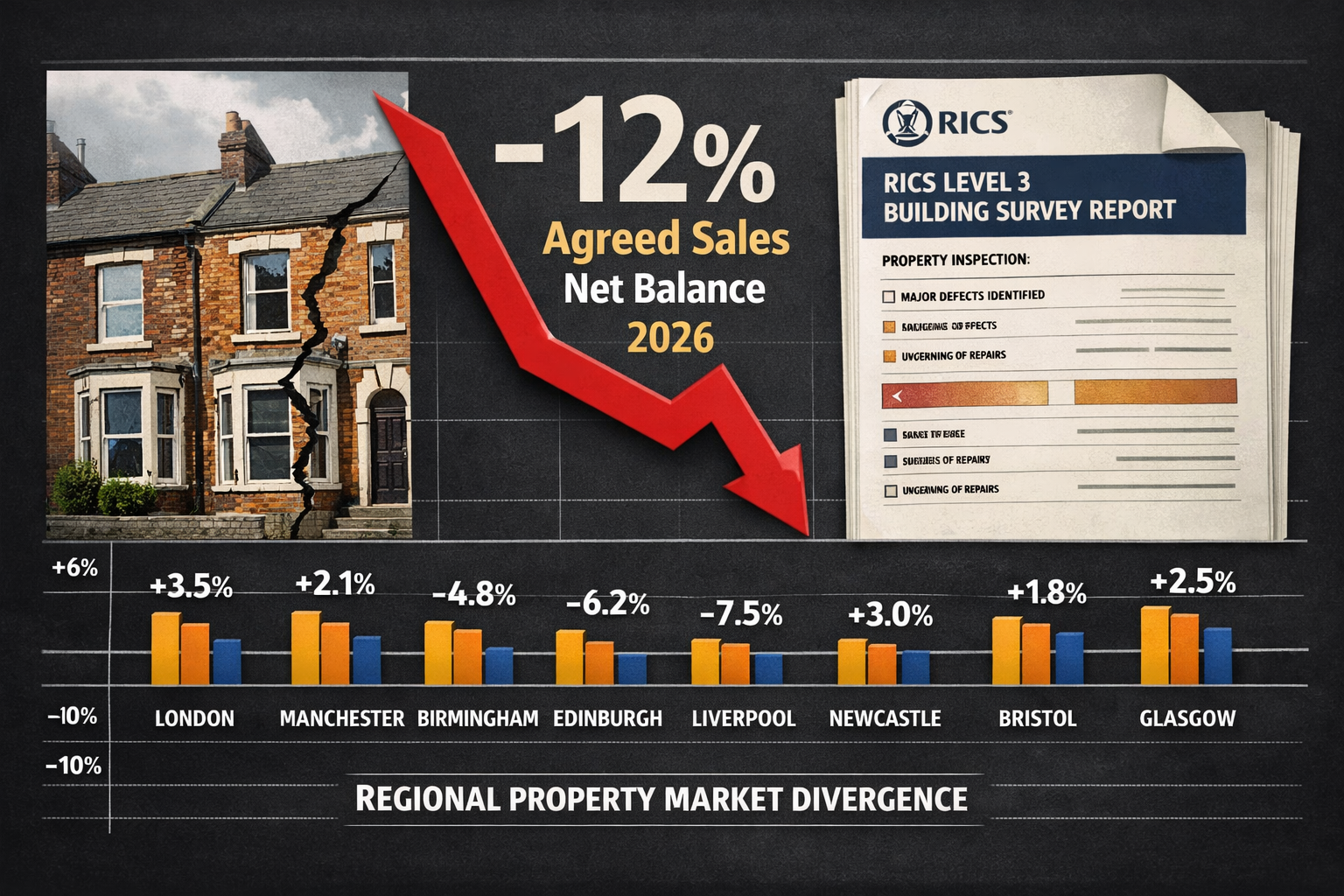
The RICS Residential Market Survey for early 2026 recorded a -12% net balance on agreed sales — meaning significantly more surveyors reported falling transaction volumes than rising ones. That single statistic reframes every property purchase decision made this year. When fewer deals are completing, the ones that do must be built on solid foundations — literally and professionally.
This is precisely where Building Surveys Prioritizing Certainty in 2026's Uncertain Transactions: Level 3 Protocols for -12% Agreed Sales Net Balance becomes not just relevant, but essential. A Level 3 Building Survey is the most thorough inspection available to property buyers in the UK. In a market defined by hesitancy, price renegotiation, and regional divergence, it is the single most powerful tool for front-loading risk identification before exchange.
Key Takeaways 📋
- The -12% net balance on agreed sales signals a buyer's market with elevated transaction risk in 2026.
- A Level 3 Building Survey (formerly the Full Structural Survey) provides the deepest inspection available and is critical for older, complex, or high-value properties.
- Pre-purchase defect identification through Level 3 protocols enables price renegotiation, saving buyers thousands.
- Regional divergence means survey requirements differ significantly across UK markets — one-size-fits-all approaches are no longer adequate.
- First-time buyers leading the recovery benefit most from enhanced survey checklists that protect against hidden structural and damp-related risks.
What the -12% Net Balance Actually Means for Buyers in 2026
A net balance of -12% on agreed sales does not mean the market has collapsed. It means caution is the dominant sentiment. More transactions are falling through, price reductions are more common, and sellers are under greater pressure to accept renegotiated offers — particularly when surveys uncover defects.
This environment creates a paradox: buyers have more negotiating power than at any point in recent years, but only if they have the evidence to use it. Without a professional survey, that power is theoretical.
💬 "In a softening market, a defect uncovered by a Level 3 survey isn't just a problem — it's a negotiating instrument worth potentially tens of thousands of pounds."
The RICS data also highlights sharp regional divergence. London and the South East continue to show resilience in prime postcodes, while certain regional markets face steeper corrections. This makes blanket assumptions about property condition and value increasingly dangerous. A buyer in one region may face entirely different structural risk profiles compared to another — reinforcing the need for property-specific, in-depth assessment.
For those still weighing up whether a survey is necessary at all, our guide on whether you need a survey when buying a house sets out the core arguments clearly.
Understanding Level 3 Protocols: The Gold Standard for Uncertain Markets
What Is a Level 3 Building Survey?
A Level 3 Building Survey — previously known as a Full Structural Survey — is the most comprehensive property inspection available under the RICS Home Survey Standard. It covers the full condition of a property, including:
- 🏗️ Structural integrity (walls, roof, foundations)
- 💧 Damp, moisture ingress, and drainage
- 🪟 Windows, doors, and external joinery
- ⚡ Services (where visible and accessible)
- 🧱 Masonry, pointing, and render
- 🌿 Subsidence indicators and ground movement
- 🔥 Chimney stacks and flues
Unlike a Level 2 HomeBuyer Report, a Level 3 survey does not follow a standardised template. It is a bespoke, narrative report tailored to the specific property, written by a Chartered Surveyor who has physically inspected every accessible element.
For a detailed breakdown of what this entails in practice, see this comprehensive Level 3 building survey guide and example.
Level 3 vs Level 2: Why the Difference Matters in 2026
| Feature | Level 2 Survey | Level 3 Survey |
|---|---|---|
| Depth of inspection | Standard | Exhaustive |
| Report format | Standardised template | Bespoke narrative |
| Structural analysis | Limited | Full |
| Older/complex properties | Not recommended | Ideal |
| Cost guidance included | Sometimes | Yes |
| Defect cause analysis | Rarely | Always |
| Suitable for 2026 uncertainty | Partially | Strongly recommended |
The key distinction is defect cause analysis. A Level 2 report will flag a crack in a wall. A Level 3 report will explain why it is there, how serious it is, what the likely progression will be, and what remediation will cost. In a market where buyers need leverage and lenders need confidence, that depth is invaluable.
For a full comparison, read our article on Level 2 vs Level 3 survey key differences.
Building Surveys Prioritizing Certainty in 2026's Uncertain Transactions: Level 3 Protocols for -12% Agreed Sales Net Balance — The Practical Framework
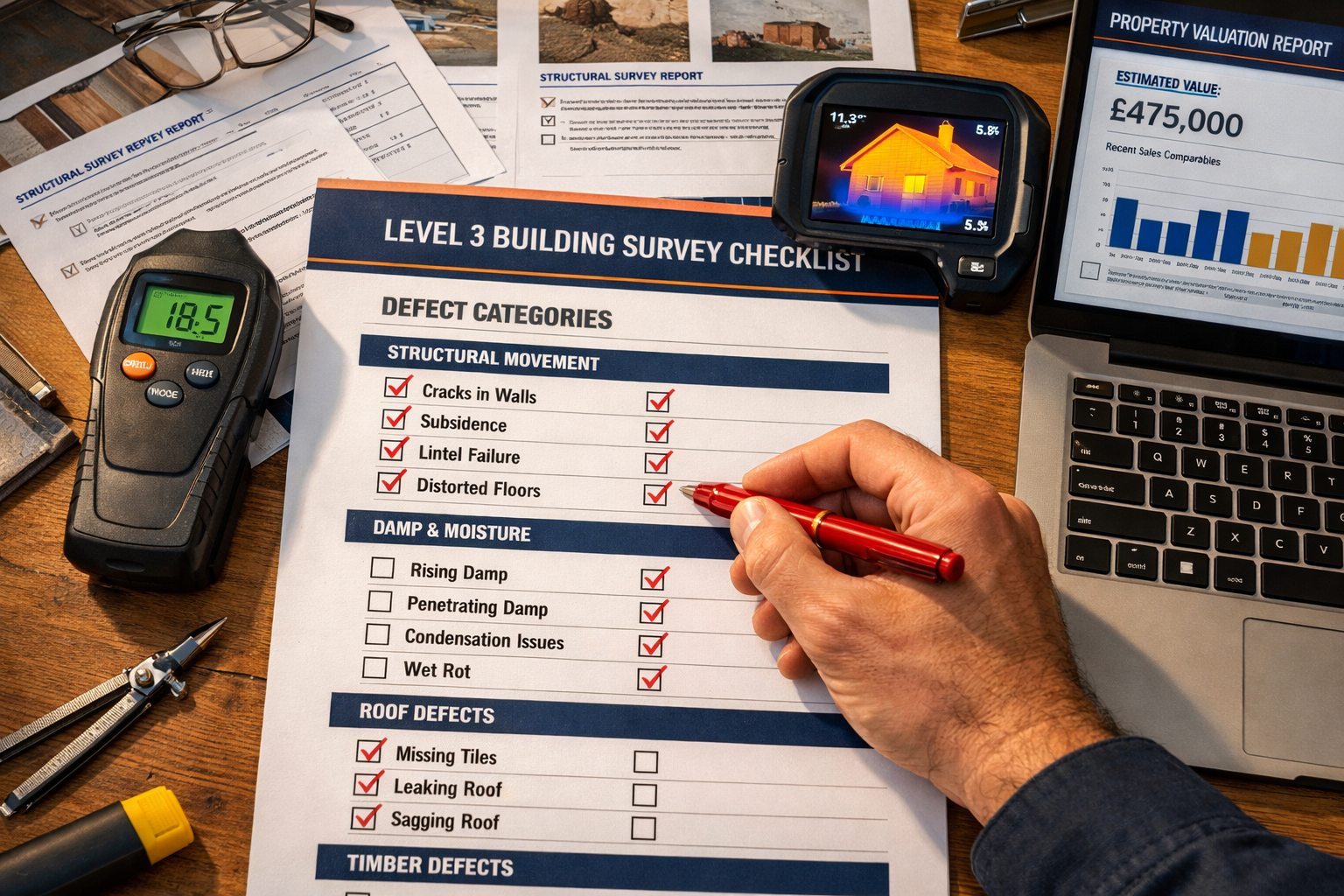
The Pre-Purchase Checklist: Enhanced for 2026
The -12% net balance environment demands an enhanced pre-purchase protocol. Standard checklists are no longer sufficient. The following framework reflects best practice for Level 3 surveys in 2026's conditions:
Stage 1: Pre-Instruction Due Diligence
- Confirm property age, construction type, and known history
- Request any previous survey reports from the seller
- Check planning history and building regulations compliance
- Identify proximity to flood zones, subsidence risk areas, or contaminated land
Stage 2: The Level 3 Inspection
- Full external inspection including roof covering, gutters, and drainage
- Internal inspection of all accessible rooms, loft, and cellar
- Thermal imaging where appropriate to identify hidden damp or insulation failure
- Structural movement assessment using crack pattern analysis
- Damp survey and moisture readings throughout
Stage 3: Post-Survey Action
- Obtain specialist quotes for any Category 3 (urgent) defects
- Use findings to renegotiate the agreed price or request remediation
- Instruct a structural survey specialist if significant movement is identified
- Review the report with your solicitor before exchange
Why First-Time Buyers Are Leading the Recovery — And Why They Need This Most
First-time buyers (FTBs) have emerged as a surprisingly resilient segment in 2026's market. Freed from property chains and benefiting from adjusted stamp duty thresholds, FTBs are completing transactions that others cannot. However, they also carry the highest risk of being underserved by inadequate surveys.
Many first-time buyers default to a Level 2 survey — or worse, no survey at all — to reduce upfront costs. In a -12% net balance market, this is a false economy. Properties that have sat on the market longer are more likely to have deferred maintenance. Sellers under pressure may not disclose known issues. The cost of discovering structural problems after completion can dwarf the cost of a Level 3 survey many times over.
💬 "A Level 3 survey costing £800–£1,500 can uncover defects worth £20,000–£50,000 in remediation. In 2026's market, that survey pays for itself before the ink dries."
Our guide on why hiring a residential surveyor could save you thousands quantifies this in detail.
Specific Property Types Requiring Level 3 Protocols
Not every property carries the same risk profile. The following property types should be considered mandatory candidates for Level 3 surveys in 2026:
- Pre-1919 construction — original materials, no damp proof course, likely settlement
- 1920s–1960s properties — cavity wall issues, asbestos risk, outdated services
- Properties with extensions or conversions — building regulations compliance unknown
- Properties with visible cracks, damp staining, or sagging rooflines
- Properties priced below market rate — often discounted for a reason
- Properties in subsidence-prone areas — clay soils, former mining land, riverside locations
For properties showing signs of ground movement, a dedicated subsidence survey may be required alongside the Level 3 report.
How Level 3 Surveys Address the Core Risks of 2026's Market
Risk 1: Overvaluation in a Falling Market
When agreed sales net balances are negative, valuations lag reality. A Level 3 survey provides independent cost-of-repair evidence that can be used to challenge an agreed price. If a surveyor identifies £15,000 of roof repairs and £8,000 of damp remediation, the buyer has a documented basis for renegotiation — or withdrawal.
Risk 2: Hidden Defects in Distressed Sales
Properties coming to market after extended void periods, probate sales, or repossessions are disproportionately represented in a softening market. These properties frequently have deferred maintenance and hidden defects that a superficial inspection will miss entirely.
Risk 3: Lender Conditions and Mortgage Retention
Lenders are increasingly cautious in 2026. A mortgage offer may include a retention — where a portion of the loan is withheld until specific repairs are completed. A Level 3 survey identifies these issues before the mortgage is offered, allowing buyers to plan accordingly rather than face a last-minute funding shortfall.
Risk 4: Regional Market Divergence
The -12% net balance masks significant regional variation. Some areas are experiencing sharper corrections than others. In markets where prices are falling, a Level 3 survey provides baseline condition evidence that protects buyers from overpaying for a property whose value may decline further if structural issues emerge post-purchase.
Building Surveys Prioritizing Certainty in 2026's Uncertain Transactions: Level 3 Protocols for -12% Agreed Sales Net Balance — Choosing the Right Surveyor
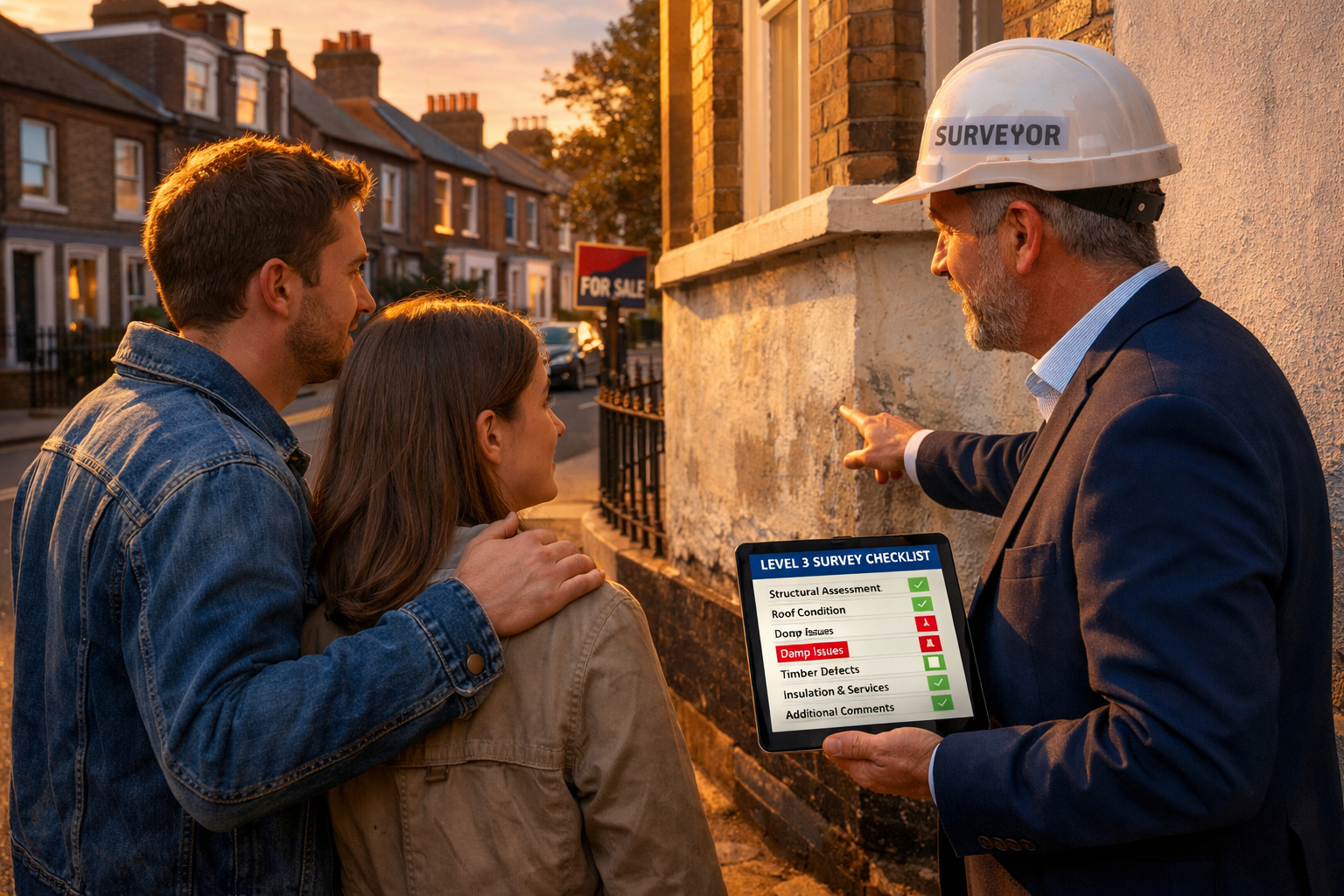
RICS Accreditation: Non-Negotiable in 2026
The quality of a Level 3 survey is only as good as the surveyor conducting it. In 2026, with digital marketing channels proliferating and unregulated inspection services appearing across various platforms [1], the importance of RICS accreditation cannot be overstated.
A Chartered Surveyor (MRICS or FRICS) is bound by professional standards, carries professional indemnity insurance, and is accountable to a regulatory body. An unaccredited "property inspector" is not.
When selecting a surveyor, verify:
- ✅ RICS membership (check the RICS Find a Surveyor register)
- ✅ Specific experience with the property type and age
- ✅ Local market knowledge
- ✅ Clear written terms of engagement
- ✅ Professional indemnity insurance confirmation
For guidance on verifying credentials, see our article on how to confirm your surveyor is qualified.
What a Level 3 Survey Report Should Contain
A properly executed Level 3 report under 2026 RICS standards should include:
- Executive summary with overall condition rating
- Detailed section-by-section condition ratings (1 = satisfactory, 2 = requires monitoring, 3 = urgent action)
- Photographic evidence for all identified defects
- Cause and consequence analysis for significant issues
- Estimated repair costs or recommendation to obtain specialist quotes
- Legal matters flagged for solicitor attention
- Services assessment (where accessible)
- Recommendations for further specialist investigations
For a worked example of what this looks like in practice, the Level 3 building survey essential guide for property buyers provides a thorough walkthrough.
The Cost-Benefit Case: Level 3 Surveys in Numbers
| Property Value | Typical Level 3 Survey Cost | Average Defect Value Uncovered* | ROI |
|---|---|---|---|
| £300,000 | £700–£900 | £8,000–£15,000 | 10x–20x |
| £500,000 | £900–£1,200 | £12,000–£25,000 | 12x–25x |
| £750,000 | £1,200–£1,600 | £20,000–£40,000 | 15x–30x |
| £1,000,000+ | £1,500–£2,500 | £30,000–£60,000+ | 20x–40x |
*Based on industry averages for pre-1970 UK residential properties; individual results vary.
The financial case is compelling at every price point. But the non-financial case — certainty, confidence, and the ability to make an informed decision — is arguably more valuable in a market where one in eight transactions is currently failing to complete.
Conclusion: Certainty Is the Competitive Advantage in 2026
The -12% agreed sales net balance is not just a market statistic — it is a signal. It tells buyers, sellers, and their advisors that the era of transacting on optimism is over. Every party in a 2026 property transaction needs evidence, not assumptions.
Building Surveys Prioritizing Certainty in 2026's Uncertain Transactions: Level 3 Protocols for -12% Agreed Sales Net Balance represent the most direct path to that evidence. By commissioning a Level 3 Building Survey before exchange, buyers gain:
- 🔍 Complete visibility of the property's condition
- 💷 Documented grounds for price renegotiation
- 🏦 Reduced risk of lender retention surprises
- 🛡️ Protection against post-completion cost shocks
- ✅ Confidence to proceed — or the clarity to walk away
Actionable Next Steps
- Identify your property type — if it is pre-1970, has visible defects, or is priced below comparable properties, a Level 3 survey is essential.
- Instruct a RICS-accredited Chartered Surveyor with specific experience in your property type and region.
- Request an enhanced checklist covering damp, structural movement, roof condition, and services.
- Use the report findings to renegotiate, request repairs, or make an informed withdrawal decision.
- Do not skip the survey to save costs — in 2026's market, the survey is the most cost-effective purchase you will make.
The market is uncertain. Your survey does not have to be.
References
[1] Digital Marketing News February 1 10 2026 – https://almcorp.com/blog/digital-marketing-news-february-1-10-2026/
