
The Northern England property market is experiencing a remarkable transformation in 2026. While London and the South East struggle with stagnant valuations, towns across the North West and broader Northern regions are recording price gains exceeding 4%, creating both opportunities and challenges for property professionals. Northern England Valuation Surge 2026: RICS Insights on Price Growth and Surveyor Adjustment Techniques represents a critical shift in the UK property landscape that demands immediate attention from chartered surveyors, valuers, and property investors alike.
Recent RICS data reveals that Northern England and Scotland are leading UK price growth, with surveyors reporting the strongest upward trajectories since early 2025.[1] This geographic divergence requires surveyors to fundamentally recalibrate their valuation methodologies, comparable sales analysis, and risk assessment frameworks. The traditional London-centric approach to UK property valuation no longer reflects market reality.
Key Takeaways
🏘️ Northern towns are outperforming: Burnley, Rochdale, Blackburn, Liverpool, and Wigan recorded price gains exceeding 4% in 2025, with momentum continuing into 2026.[2]
📊 Surveyor confidence surges: 43% of RICS respondents anticipate higher prices over the year ahead—the most positive outlook since February 2025.[1][3]
📈 Regional divergence intensifies: While Northern regions show 3-5% anticipated appreciation, London and the South East remain negative compared to national averages.[4]
🔍 Valuation techniques must adapt: Comparable sales analysis requires geographic recalibration and adjustment factors specific to Northern market dynamics.
💼 Transaction activity improves: Agreed sales net balance reached -9% in January 2026, the least negative reading since June 2025, indicating renewed market momentum.[1]
Understanding the Northern England Valuation Surge 2026: RICS Data and Regional Performance
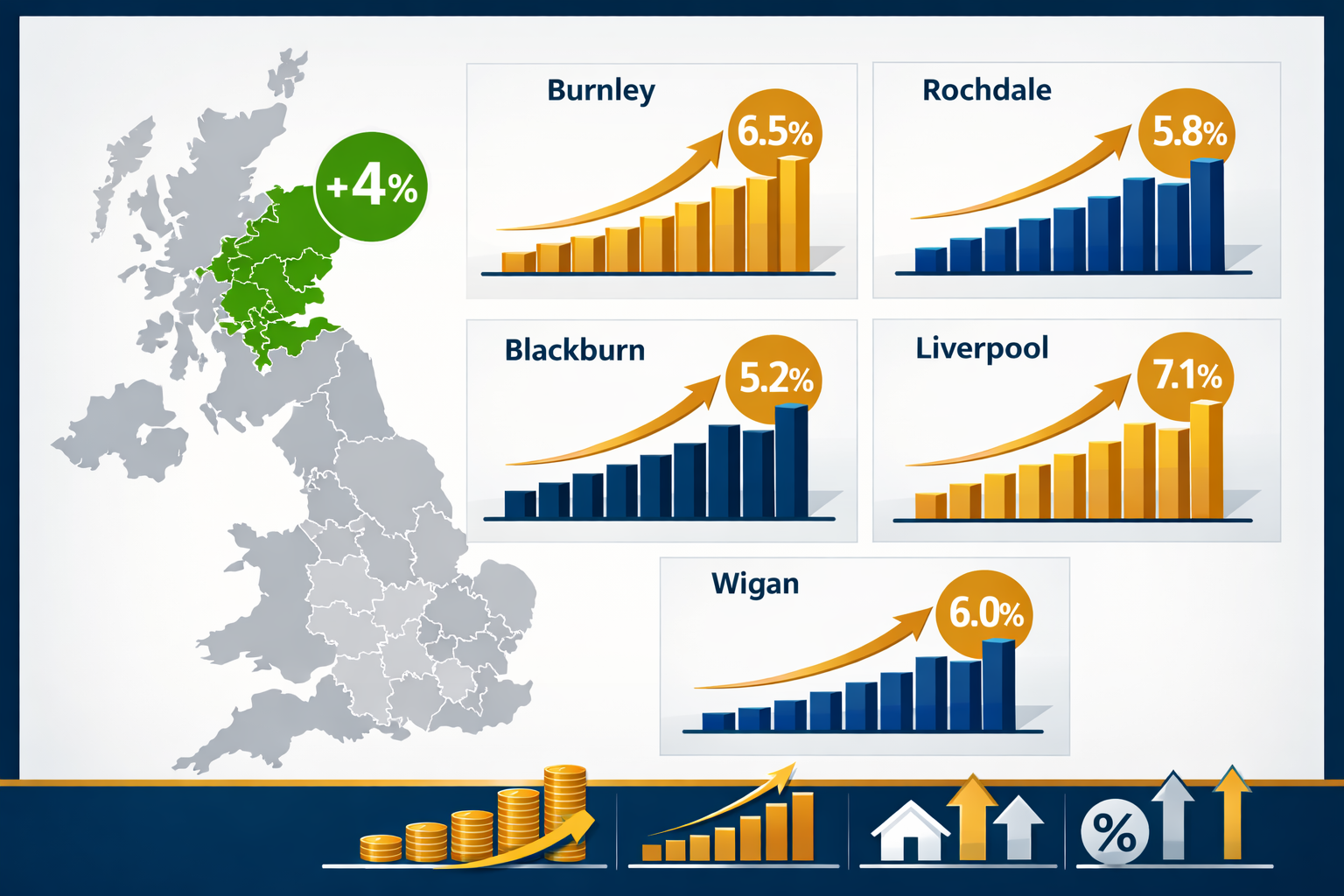
The Northern England Valuation Surge 2026 is not merely a temporary fluctuation—it represents a structural shift in UK property market dynamics. RICS residential market survey data from January and February 2026 provides compelling evidence of this transformation.
National Context and Regional Divergence
The national house price net balance improved dramatically to -10% over the three-month period through January 2026, up from a low of -19% in October 2025.[1][3] This improvement masks significant regional variation, with Northern England, Scotland, and Northern Ireland driving the recovery while southern regions lag considerably.
According to RICS February 2026 economic updates, more affordable regions are experiencing the strongest house price gains, fundamentally challenging the historical premium commanded by London and the South East.[2] This affordability-driven growth pattern creates unique valuation challenges for surveyors accustomed to southern market premiums.
Specific North West Performance Metrics
The North West region deserves particular attention. Towns that historically underperformed are now leading national growth:
| Town | 2025 Price Growth | Market Characteristics |
|---|---|---|
| Burnley | 4%+ | Affordability leader, regeneration projects |
| Rochdale | 4%+ | Transport improvements, commuter demand |
| Blackburn | 4%+ | Value-seeking buyers, rental demand |
| Liverpool | 4%+ | Urban regeneration, cultural investment |
| Wigan | 4%+ | Manchester commuter belt expansion |
These performance metrics require surveyors to reassess traditional comparable selection criteria and adjustment factors.[2]
Twelve-Month Price Outlook
Perhaps most significantly, 43% of RICS survey respondents anticipate higher prices over the year ahead as of January 2026—representing the most positive outlook since February 2025.[1][3] This forward-looking confidence indicator suggests the Northern England valuation surge will continue throughout 2026.
Surveyors should anticipate 3-5% price appreciation in Scotland, Northern Ireland, and Northern England during 2026, representing a moderation from 2025's exceptional performance but still substantially outperforming southern counterparts.[4] Understanding how to incorporate these growth expectations into RICS home survey valuations is critical for accurate property assessment.
Transaction Activity and Market Momentum
Beyond price metrics, transaction activity indicators reveal strengthening market fundamentals. The agreed sales net balance reached -9% in January 2026, the least negative reading since June 2025.[1] New buyer enquiries improved to -15% in January 2026, up from -21% in December and -29% in November, suggesting easing affordability pressures in Northern regions.[1]
Medium-term sales sentiment surged to a net balance of +35% as of January 2026—the strongest reading since December 2024—reflecting surveyor confidence in market recovery momentum.[1] For professionals conducting building surveys, this optimism translates into increased instruction volumes and more complex valuation scenarios.
RICS Insights on Price Growth: Surveyor Adjustment Techniques for Northern Markets
The Northern England Valuation Surge 2026: RICS Insights on Price Growth and Surveyor Adjustment Techniques requires chartered surveyors to adapt their methodologies to reflect rapidly changing market conditions. Traditional comparable sales analysis must incorporate new adjustment factors specific to Northern market dynamics.
Comparable Sales Selection in Rapidly Appreciating Markets
When property values are rising at 4%+ annually, the temporal relevance of comparable sales becomes critical. Time adjustments must be more aggressive than in stable markets:
- Recent comparables (0-3 months): Apply minimal adjustment (0-1%)
- Moderately recent comparables (3-6 months): Apply 1-2% upward adjustment
- Older comparables (6-12 months): Apply 2-4% upward adjustment based on specific location
RICS guidance emphasizes that surveyors must justify time adjustments with reference to local market evidence rather than national trends.[1] In Northern England, this means tracking town-specific price indices rather than relying on regional averages.
Geographic Adjustment Factors
The performance divergence between Northern towns creates new geographic adjustment challenges. A property in Burnley may require different adjustment factors than a comparable property in nearby Preston, despite similar physical characteristics.
Key geographic considerations include:
✅ Proximity to transport infrastructure: Northern Powerhouse Rail and HS2 connectivity expectations
✅ Local regeneration initiatives: Town center investment and cultural development projects
✅ Employment growth patterns: Sector-specific job creation and wage growth
✅ School catchment areas: Educational performance and parental demand
✅ Rental yield differentials: Investor demand and buy-to-let activity levels
Surveyors must develop location-specific adjustment matrices that reflect these nuanced factors. What is a property surveyor working in Northern England must possess deep local market knowledge that extends beyond comparable sales databases.
Property Type and Condition Adjustments
Early signs from January-February 2026 show increased activity particularly in lower-priced flats and mid-market family houses, with stock that remained unsold during 2025's weaker market now attracting renewed interest as asking prices adjust to more realistic levels.[3]
This renewed interest in previously stagnant stock requires surveyors to carefully assess:
- Deferred maintenance impacts: Properties unsold for 6+ months may have accumulated maintenance issues
- Pricing history effects: Multiple price reductions may indicate overvaluation or property defects
- Market positioning: Properties at the lower end of local price distributions are experiencing strongest demand
For professionals conducting Level 3 building surveys, the condition assessment becomes even more critical in rapidly appreciating markets where buyers may overlook defects in competitive bidding situations.
Rental Market Influence on Capital Values
Tenant demand in Northern England and Scotland is edging higher, while landlord supply remains constrained, creating upward pressure on rental prices and supporting overall property valuations.[1] A net balance of +28% of respondents expect rental prices to rise in the near term as of January 2026.[3]
Surveyors must incorporate rental market dynamics into capital value assessments through:
- Yield compression analysis: As rental growth outpaces capital growth, yields compress, supporting higher valuations
- Investor demand indicators: Strong rental markets attract buy-to-let investors, supporting prices
- Tenure mix considerations: Areas with high rental demand may command premiums for properties suitable for letting
Understanding the relationship between rental and capital values is essential for accurate valuation work, particularly for Help to Buy valuations where government equity stakes depend on precise market value assessments.
Risk-Adjusted Valuation Approaches
While Northern England shows strong growth, surveyors must balance optimism with professional skepticism. Risk-adjusted valuation techniques should consider:
🔴 Economic vulnerability: Northern regions historically show greater sensitivity to economic downturns
🔴 Employment concentration: Reliance on specific industries or employers
🔴 Infrastructure delivery risk: Planned transport improvements may face delays or cancellation
🔴 Sustainability of growth: 4%+ annual growth rates typically moderate over time
RICS professional standards require surveyors to provide valuations that reflect market conditions at the valuation date while acknowledging uncertainty. In rapidly appreciating markets, this means clearly documenting assumptions about future growth trajectories and identifying factors that could cause values to deviate from current trends.
Practical Implementation: Surveyor Adjustment Techniques for 2026 Northern England Valuations
Translating Northern England Valuation Surge 2026: RICS Insights on Price Growth and Surveyor Adjustment Techniques into daily practice requires systematic methodology and robust documentation. Here's how chartered surveyors can implement these insights effectively.
Developing Location-Specific Valuation Models
Rather than relying on regional averages, surveyors should develop micro-market valuation models for specific Northern towns and neighborhoods. This approach requires:
Step 1: Data Collection
- Compile transaction data for the past 12-18 months within specific postcodes
- Track asking price trends and time-on-market metrics
- Monitor rental yields and tenant demand indicators
- Document local infrastructure and regeneration projects
Step 2: Trend Analysis
- Calculate monthly price appreciation rates for specific property types
- Identify seasonal variations and market cycles
- Compare local performance to regional and national benchmarks
- Assess correlation between local and broader economic indicators
Step 3: Adjustment Matrix Development
- Create property-type-specific adjustment factors
- Develop time-based adjustment schedules reflecting local appreciation rates
- Establish condition adjustment ranges based on local renovation costs
- Quantify location premiums for specific streets or developments
This systematic approach ensures valuations reflect genuine market conditions rather than outdated assumptions. For surveyors conducting homebuyer surveys, this local expertise adds significant value to client advice.
Comparable Evidence Documentation Standards
RICS standards require comprehensive documentation of comparable evidence and adjustment rationale. In rapidly appreciating Northern markets, this documentation becomes even more critical:
Essential documentation elements include:
📋 Comparable property details: Full address, property type, size, condition, and features
📋 Transaction information: Sale price, date, marketing period, and transaction circumstances
📋 Adjustment calculations: Specific percentage or monetary adjustments with clear justification
📋 Market context: Local market conditions at transaction date versus valuation date
📋 Source verification: Multiple independent sources confirming transaction details
Surveyors should maintain detailed comparable databases that extend beyond Land Registry data to include local estate agent intelligence, auction results, and new build pricing. This comprehensive approach ensures valuations withstand professional scrutiny and challenge.
Communicating Uncertainty and Market Volatility
When markets are changing rapidly, transparent communication about valuation uncertainty becomes essential. RICS guidance encourages surveyors to:
- Quantify confidence intervals: Where appropriate, indicate the range within which the true market value likely falls
- Highlight key assumptions: Clearly state assumptions about future growth, infrastructure delivery, or economic conditions
- Identify sensitivity factors: Explain which factors could cause significant value variation
- Provide market context: Help clients understand how current valuations fit within historical and projected trends
This approach is particularly important for capital gains tax valuations and other statutory purposes where precision is critical but market volatility creates inherent uncertainty.
Technology and Data Analytics Integration
Modern surveying practice increasingly relies on technology-enabled valuation tools:
🖥️ Automated Valuation Models (AVMs): Use as cross-checks rather than primary valuation methods
🖥️ Geographic Information Systems (GIS): Map price trends and identify location-specific premiums
🖥️ Market analytics platforms: Access real-time transaction data and market sentiment indicators
🖥️ Comparable sales databases: Maintain proprietary databases with richer detail than public sources
However, technology should augment rather than replace professional judgment. In Northern England's dynamic market, local knowledge and qualitative assessment remain irreplaceable elements of accurate valuation.
Quality Assurance and Peer Review
Given the significant price movements in Northern markets, internal quality assurance processes become critical:
- Peer review protocols: Have complex or high-value valuations reviewed by senior surveyors
- Consistency checks: Ensure comparable adjustment factors remain consistent across similar instructions
- Market testing: Compare valuations to actual achieved prices and adjust methodologies accordingly
- Continuing professional development: Stay current with RICS guidance and local market developments
For firms providing RICS building surveys across multiple regions, standardized quality assurance processes ensure consistent professional standards while allowing for local market variation.
Client Advisory and Strategic Guidance
Beyond technical valuation work, surveyors provide valuable strategic advice to clients navigating Northern England's changing market:
For buyers:
- Timing considerations: Whether to proceed immediately or wait for market stabilization
- Location selection: Identifying towns and neighborhoods with strongest growth potential
- Property type optimization: Understanding which property types are experiencing strongest demand
For sellers:
- Pricing strategy: Balancing ambitious pricing with realistic market positioning
- Marketing timing: Optimal timing to capitalize on seasonal demand patterns
- Property presentation: Cost-effective improvements that maximize sale price
For investors:
- Yield analysis: Comparing capital appreciation versus rental yield opportunities
- Portfolio diversification: Geographic and property type diversification strategies
- Risk assessment: Understanding economic and market risks specific to Northern regions
This advisory role positions surveyors as trusted advisors rather than mere technicians, adding significant value to the valuation types they provide.
Regional Comparison: Northern England Versus Southern Markets

Understanding the Northern England Valuation Surge 2026 requires context from contrasting southern market performance. This geographic divergence represents one of the most significant structural shifts in UK property markets in recent decades.
London and South East Performance Metrics
While Northern regions show robust growth, London and the South East continue to lag behind national averages.[1] RICS data indicates these regions remain more negative than the headline average, though conditions have improved modestly compared to late 2025.[1][3]
Key southern market characteristics:
❌ Price stagnation or modest declines in many locations
❌ Extended marketing periods and increased price reductions
❌ Affordability constraints limiting buyer demand
❌ Reduced investor activity due to compressed yields
❌ Uncertain outlook for premium and super-prime segments
This performance divergence challenges traditional assumptions about London as the UK's property market bellwether. Surveyors working across multiple regions must develop location-specific expertise rather than extrapolating from London trends.
Affordability-Driven Market Rebalancing
The fundamental driver of Northern outperformance is affordability. February 2026 data indicates that more affordable regions are experiencing the strongest house price gains, with Northern towns significantly outperforming southern counterparts.[2]
Average house prices in Burnley, Rochdale, and Blackburn remain a fraction of London equivalents, creating opportunities for:
- First-time buyers: Accessing homeownership with modest deposits and incomes
- Relocating professionals: Remote work enabling moves from expensive southern cities
- Value-seeking investors: Higher rental yields and capital appreciation potential
- Equity release: Southern homeowners downsizing and relocating north
This affordability advantage appears structural rather than cyclical, suggesting sustained Northern outperformance may continue beyond 2026.
Infrastructure and Economic Development Factors
Northern England benefits from significant infrastructure investment and economic development initiatives:
🚄 Transport improvements: Northern Powerhouse Rail, HS2 connections, and local transit upgrades
🏗️ Regeneration projects: Town center redevelopment and cultural investment
💼 Employment growth: Technology sector expansion and advanced manufacturing
🎓 Educational institutions: University expansion and skills development programs
These factors create fundamental value drivers absent in many southern locations where infrastructure is mature and development opportunities limited.
Implications for Multi-Regional Surveying Practices
Firms operating across both Northern and Southern regions face unique challenges:
Methodology consistency: Maintaining professional standards while adapting to radically different market conditions
Staff expertise: Ensuring surveyors understand local market nuances rather than applying generic approaches
Client communication: Explaining regional divergence to clients with properties in multiple locations
Resource allocation: Directing resources toward growing Northern markets while maintaining southern presence
For practices like those offering services from chartered surveyors in North London to nationwide clients, understanding these regional dynamics is essential for providing accurate advice.
Future Outlook: Sustainability of Northern England Price Growth
While current data supports the Northern England Valuation Surge 2026, surveyors must assess the sustainability of these trends when providing forward-looking advice.
Projected Growth Trajectories
Surveyors should anticipate 3-5% price appreciation in Scotland, Northern Ireland, and Northern England during 2026, representing a moderation from 2025's exceptional performance.[4] This moderation suggests:
- Market maturation as early-stage growth opportunities are captured
- Affordability constraints beginning to limit further rapid appreciation
- Potential for regional divergence within Northern England as some towns outperform others
- Increased sensitivity to national economic conditions and interest rate movements
These projections should inform valuation assumptions and client advice, particularly for probate valuations and other forward-looking assessments.
Risk Factors and Potential Headwinds
Several factors could moderate or reverse Northern England's price growth:
⚠️ Economic downturn: Northern regions historically show greater cyclical sensitivity
⚠️ Interest rate increases: Higher mortgage costs disproportionately affect affordability-driven markets
⚠️ Infrastructure delays: Postponement of planned transport improvements
⚠️ Employment shocks: Closure of major employers or sector-specific downturns
⚠️ Policy changes: Alterations to stamp duty, mortgage regulations, or buy-to-let taxation
Professional surveyors must incorporate these risk factors into valuation advice and clearly communicate uncertainties to clients.
Opportunities for Strategic Positioning
Despite risks, Northern England offers significant opportunities for well-informed market participants:
🌟 Early-stage growth markets: Towns at early stages of regeneration cycles
🌟 Rental market strength: Sustained tenant demand supporting buy-to-let investment
🌟 Lifestyle migration: Remote work enabling permanent relocations from expensive southern cities
🌟 Infrastructure uplift: Properties benefiting from planned transport improvements
Surveyors who develop deep expertise in Northern markets position themselves as valuable advisors for clients seeking to capitalize on these opportunities.
Conclusion
The Northern England Valuation Surge 2026: RICS Insights on Price Growth and Surveyor Adjustment Techniques represents a fundamental shift in UK property market dynamics that demands immediate attention from chartered surveyors and property professionals. With Northern towns recording price gains exceeding 4% while southern markets stagnate, traditional valuation methodologies require significant adaptation.
RICS data demonstrates compelling evidence of this transformation: 43% of surveyors anticipate higher prices over the year ahead, agreed sales activity has improved to the strongest level since June 2025, and rental market dynamics support continued capital value appreciation.[1][3] These metrics indicate the Northern surge is not a temporary aberration but a structural rebalancing driven by affordability, infrastructure investment, and economic development.
Key Implementation Steps for Surveyors
Immediate actions for surveyors working in Northern England markets:
- Develop micro-market expertise: Build location-specific valuation models for individual towns and neighborhoods
- Recalibrate adjustment factors: Update time adjustments, geographic premiums, and condition factors to reflect rapid appreciation
- Enhance comparable databases: Expand beyond Land Registry data to include local estate agent intelligence and auction results
- Strengthen quality assurance: Implement peer review processes for complex valuations in volatile markets
- Communicate uncertainty: Provide clients with transparent explanations of valuation confidence and risk factors
For professionals seeking to understand broader surveying standards, resources like guides on understanding the importance of survey home reports provide valuable context.
Strategic Positioning for 2026 and Beyond
The Northern England valuation surge creates opportunities for surveyors who position themselves as regional specialists. Anticipated 3-5% price appreciation throughout 2026 suggests sustained activity levels and continued demand for professional valuation services.[4]
However, professional skepticism remains essential. Economic vulnerabilities, infrastructure delivery risks, and potential policy changes could moderate growth trajectories. Surveyors must balance optimism about Northern markets with rigorous risk assessment and transparent client communication.
Final Recommendations
For property buyers and investors, engage RICS-qualified surveyors with demonstrated Northern England expertise to ensure valuations reflect genuine local market conditions rather than outdated regional assumptions.
For surveying professionals, invest in continuing professional development focused on rapidly appreciating markets, develop proprietary local market intelligence, and implement robust quality assurance processes to maintain professional standards during periods of market volatility.
For industry stakeholders, recognize that the geographic center of UK property market growth has shifted northward, requiring resource reallocation, expertise development, and strategic repositioning to capitalize on this fundamental market transformation.
The Northern England valuation surge of 2026 is not merely a statistical curiosity—it represents a generational opportunity for surveyors who adapt their methodologies, deepen their local expertise, and provide clients with the sophisticated analysis required to navigate this dynamic market successfully.
References

[1] Uk Resi Survey Jan 2026 Report Shows Early Signs Market Recovery Despite Caution – https://www.rics.org/news-insights/uk-resi-survey-jan-2026-report-shows-early-signs-market-recovery-despite-caution
[2] Uk Economy Property Update February 2026 – https://www.rics.org/content/dam/ricsglobal/documents/market-surveys/uk-economy-property-update-february-2026.pdf
[3] Uk Residential Market Survey January 2026 – https://www.rics.org/content/dam/ricsglobal/documents/market-surveys/uk-residential-market-survey/UK-Residential-Market-Survey_January-2026.pdf
[4] Valuation Strategies For Northern Uk Price Surge Surveyor Tactics In Scotland Northern Ireland And North England 2026 – https://nottinghillsurveyors.com/blog/valuation-strategies-for-northern-uk-price-surge-surveyor-tactics-in-scotland-northern-ireland-and-north-england-2026
[5] The Market View February 2026 – https://www.watsons-property.co.uk/the-market-view-february-2026/
