
The Northern UK property market is experiencing a remarkable transformation that's catching many by surprise. While London and the South East struggle with stagnant or declining values, Scotland, Northern Ireland, and North England are witnessing robust price growth that demands a fundamental shift in how surveyors approach property valuations. This divergence represents one of the most significant regional variations in UK property market history, and understanding the Valuation Strategies for Northern UK Price Surge: Surveyor Tactics in Scotland, Northern Ireland, and North England 2026 has become essential for professionals operating in these dynamic markets.
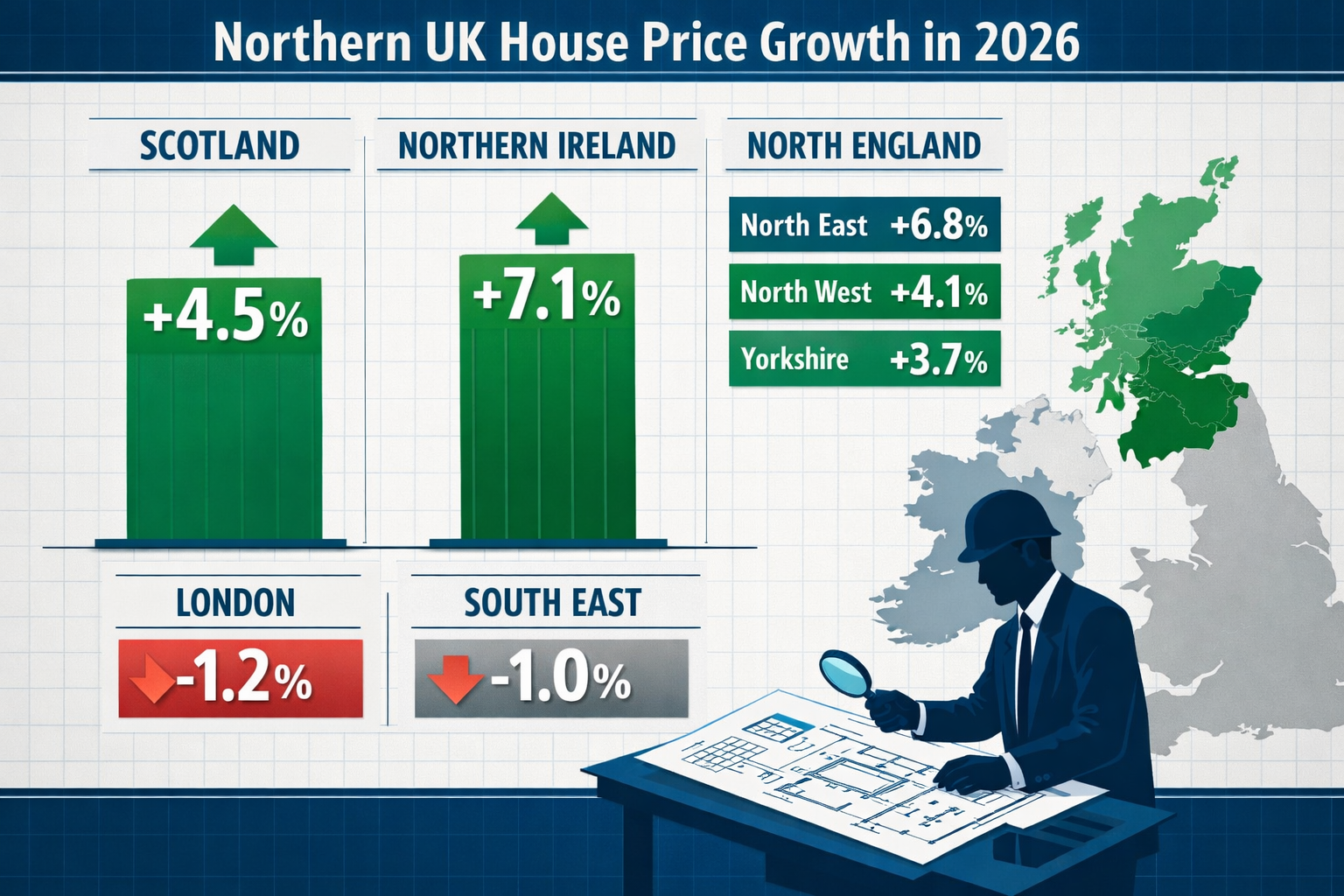
The numbers tell a compelling story: Northern Ireland leads with an impressive 9.7% annual growth[4], Scotland follows with 4.5% year-to-date increases[1], and the North East of England posts 6.8% annual gains[1]. These figures stand in stark contrast to London's -1.2% decline[1], creating valuation challenges that require region-specific expertise and tactical adjustments. For surveyors, this means abandoning one-size-fits-all approaches and embracing sophisticated methodologies that account for local affordability pressures, buyer migration patterns, and regeneration investments.
Key Takeaways
✅ Northern regions outperform southern markets significantly: Scotland, Northern Ireland, and North England are experiencing 3-7% annual price growth while London and the South East remain flat or negative[1][4].
✅ Mortgage rate stabilisation drives northern demand: Expected rates of 3.75%-4.75% in 2026 improve affordability particularly in lower-priced northern markets, attracting first-time buyers and relocating families[2].
✅ Comparable sales analysis requires regional recalibration: Surveyors must adjust valuation methodologies to account for rapid appreciation, regeneration impacts, and supply constraints unique to northern markets[2][3].
✅ RICS sentiment confirms sustained northern momentum: Market optimism reaches highest levels since early 2025, with +43% of respondents anticipating price increases over the coming year[3].
✅ Risk mitigation demands local market intelligence: Accurate valuations require understanding employment hubs, university influence, infrastructure investment, and demographic shifts specific to Scotland, Northern Ireland, and North England[2].
Understanding the Northern UK Price Surge in 2026
The Regional Performance Gap
The Valuation Strategies for Northern UK Price Surge: Surveyor Tactics in Scotland, Northern Ireland, and North England 2026 begin with recognizing the unprecedented performance gap between northern and southern UK property markets. This isn't a temporary blip—it represents a fundamental market rebalancing driven by affordability, employment patterns, and quality of life considerations.
Northern Ireland stands as the undisputed leader, achieving 9.7% growth across 2025[4], a performance that has continued into 2026. Scotland follows with 4.5% annual increases[1], while North England regions demonstrate varied but consistently positive trajectories: the North East at 6.8%, North West at 4.1%, and Yorkshire & Humber at 3.7%[1].
Compare these figures to the struggling southern markets: London posts -1.2% decline and the South East manages only 1.0% growth[1]. This north-south divide creates distinct valuation environments that demand different analytical approaches.
| Region | Annual Price Growth | Market Characteristics |
|---|---|---|
| 🏴 Northern Ireland | +9.7% | Strongest performer, supply-constrained |
| 🏴 Scotland | +4.5% | Consistent growth, diverse buyer base |
| 📍 North East England | +6.8% | Affordability-driven demand |
| 📍 North West England | +4.1% | Regeneration investment support |
| 📍 Yorkshire & Humber | +3.7% | Employment hub attraction |
| 🏙️ London | -1.2% | Affordability constraints |
| 📍 South East | +1.0% | Limited growth potential |
Drivers Behind Northern Market Strength
Several interconnected factors fuel the northern price surge, each requiring careful consideration in valuation work:
Mortgage Rate Stabilisation: Rates are expected to stabilise around 3.75%-4.75% in 2026[2], with further Bank of England interest rate cuts anticipated. This stabilisation disproportionately benefits northern markets where lower absolute prices make monthly payments more manageable even at these rates.
Affordability Advantage: Northern regions like Blackpool and Lancaster maintain significantly lower average prices than the national median, positioning them to attract increased first-time buyer activity as deposit requirements become more achievable[2]. This demographic shift creates sustained demand pressure that supports valuations.
Regeneration Investment: The North West benefits from substantial regeneration investment in Morecambe, Lancaster, and Preston[2], which supports regional price stability even during softer national sentiment periods. Surveyors must account for these infrastructure improvements when assessing comparable properties and future value trajectories.
Employment Hub Resilience: Preston and Lancaster are identified as outperforming areas due to strong employment growth, university influence, ongoing regeneration, and resilient demand from families, commuters, and academics[2]. These employment anchors provide fundamental support for property values that extends beyond speculative demand.
"The January 2026 RICS report shows price growth remains strongest in Scotland and Northern Ireland, with upward trends in the North West and North of England, contrasting sharply with London and the South East which continue to lag."[3]
Understanding these drivers helps surveyors contextualize individual property valuations within broader market dynamics. A comprehensive approach to property assessment becomes essential when markets experience such pronounced regional variations.
Supply Constraints and Market Dynamics
Supply remains constrained in many northern areas, which limits downward price pressure and supports valuations[2]. This supply-demand imbalance creates particular challenges for surveyors attempting to identify truly comparable sales, as limited transaction volumes in specific micro-markets can skew apparent value trends.
The RICS January 2026 report reveals market optimism at its highest levels, with +35% net balance expecting higher prices over the next twelve months—the strongest sentiment since December 2024[3]. Furthermore, +43% anticipate price increases over the year ahead, representing the most positive outlook since February 2025[3].
This optimism isn't unfounded speculation. It's grounded in tangible market fundamentals: improved mortgage affordability due to falling inflation, increased access to 95% and 100% mortgages in lower-value regional markets, and sustained buyer interest from both downsizers and upsizers[2].
Surveyor Tactics for Valuation Strategies in Northern UK Markets
Comparable Sales Analysis in Rapidly Appreciating Markets
Traditional comparable sales analysis assumes relatively stable market conditions, but the Valuation Strategies for Northern UK Price Surge: Surveyor Tactics in Scotland, Northern Ireland, and North England 2026 require adaptations for rapidly appreciating environments.
Time Adjustments: When markets appreciate 5-10% annually, comparable sales from even six months prior require significant upward adjustments. Surveyors must establish clear time-adjustment methodologies based on local market data rather than national averages. A property sold in July 2025 in Northern Ireland, for instance, may need a 4-5% upward adjustment when used as a comparable for a February 2026 valuation.
Location Micro-Premiums: The northern price surge isn't uniform—specific postcodes, streets, and neighborhoods experience varying appreciation rates based on proximity to employment hubs, transport links, schools, and regeneration zones. Surveyors must develop granular location adjustment matrices that reflect these micro-market variations.
Property Condition Differentials: In appreciating markets, buyers become less sensitive to minor condition issues, narrowing the valuation gap between properties in excellent condition and those requiring cosmetic updates. However, structural concerns remain significant differentiators. Understanding the full scope of structural surveys helps surveyors make appropriate condition-based adjustments.
Regeneration Proximity Premiums: Properties near active regeneration projects in Preston, Lancaster, and Morecambe command premiums that evolve as projects progress[2]. Surveyors must track regeneration timelines and adjust valuations accordingly, recognizing that proximity benefits increase as completion approaches.
RICS Compliance and Professional Standards
The Royal Institution of Chartered Surveyors (RICS) provides the professional framework within which all valuations must operate, but applying these standards in divergent market conditions requires careful interpretation.
Red Book Valuation Standards: RICS Valuation – Global Standards (Red Book) mandates specific approaches to market value determination, but allows professional judgment in selecting and weighting comparable evidence. In rapidly appreciating northern markets, surveyors must document their time adjustment methodologies, location premium calculations, and market trend analyses more thoroughly than in stable markets.
Market Value Definition: RICS defines market value as "the estimated amount for which an asset should exchange on the valuation date between a willing buyer and a willing seller in an arm's length transaction, after proper marketing and where the parties had each acted knowledgeably, prudently and without compulsion." In northern markets experiencing strong appreciation, determining what constitutes "proper marketing" and "knowledgeable" parties requires understanding current buyer demographics and motivations.
Uncertainty and Material Valuation Uncertainty: While the northern markets show strong growth trends, surveyors must remain alert to factors that might constitute material valuation uncertainty: potential interest rate volatility, economic policy changes, or local employment disruptions. RICS-registered valuers understand the importance of disclosing such uncertainties appropriately.
Professional Indemnity Considerations: Valuations in rapidly changing markets carry higher professional liability risks. Over-optimistic valuations based on short-term trends can expose surveyors to claims if markets correct, while overly conservative approaches may disadvantage clients in competitive bidding situations. Robust documentation of methodology, assumptions, and market evidence provides essential professional protection.
Regional Differentiation: Scotland, Northern Ireland, and North England
While all northern regions outperform southern markets, each presents unique characteristics requiring tailored valuation approaches.
Scotland-Specific Tactics 🏴
Scotland's 4.5% annual growth[1] occurs within a distinct legal and regulatory framework:
-
Home Report System: Scotland's mandatory Home Report system (comprising a Single Survey, Property Questionnaire, and Energy Report) creates transparency that influences buyer behavior and valuation certainty. Surveyors must understand how existing Home Reports impact comparable evidence and buyer expectations.
-
Legal System Differences: Scottish property law differs significantly from English law, particularly regarding the conveyancing process and the binding nature of offers. These differences affect market dynamics and transaction timelines that inform valuation judgments.
-
Urban-Rural Divide: Edinburgh and Glasgow drive much of Scotland's growth, but rural and island properties show different appreciation patterns. Surveyors must calibrate their comparable selection to reflect these distinct sub-markets.
-
Economic Fundamentals: Scotland's employment patterns, particularly in financial services, technology, renewable energy, and tourism, create location-specific demand drivers that require local market knowledge.
Northern Ireland-Specific Tactics 🏴
Northern Ireland's remarkable 9.7% growth[4] represents the UK's strongest regional performance:
-
Supply-Demand Imbalance: Northern Ireland faces particularly acute housing supply constraints relative to demand, creating upward price pressure that exceeds other regions. Surveyors must account for this structural shortage when projecting value sustainability.
-
Cross-Border Dynamics: Proximity to the Republic of Ireland creates unique market dynamics, particularly in border areas where currency fluctuations, employment opportunities, and regulatory differences influence buyer behavior.
-
Belfast Concentration: Much of Northern Ireland's growth concentrates in Greater Belfast and commuter zones, while rural areas show more moderate appreciation. Comparable selection must reflect these geographic variations.
-
First-Time Buyer Dominance: Northern Ireland's lower absolute prices attract disproportionate first-time buyer activity, supported by government schemes and improving mortgage access[2]. This demographic composition influences market velocity and price sensitivity.
North England Regional Variations 📍
North England encompasses diverse sub-markets requiring distinct approaches:
North East England (+6.8%)[1]: The region benefits from significant affordability advantages and improving employment prospects in Newcastle, Durham, and Middlesbrough. Surveyors must account for ongoing urban regeneration and transport infrastructure improvements.
North West England (+4.1%)[1]: Manchester and Liverpool drive regional growth, but Preston, Lancaster, and Morecambe emerge as particular outperformers due to regeneration investment[2]. University towns show resilient demand from student accommodation investors and academic staff.
Yorkshire & Humber (+3.7%)[1]: Leeds, York, and Sheffield create employment anchors, while coastal areas attract lifestyle buyers and retirees. The region's diversity demands careful comparable selection based on property type and location characteristics.
For surveyors working across these regions, understanding what surveyors do in different contexts helps contextualize the specialized knowledge required for accurate northern market valuations.
Advanced Valuation Methodologies for Northern UK Price Surge

Residual Valuation for Development Opportunities
The northern price surge creates increased development viability, particularly for conversion projects, infill developments, and brownfield regeneration. Residual valuation—calculating land or property value by subtracting development costs from projected end value—becomes particularly relevant in appreciating markets.
Gross Development Value (GDV) Estimation: In markets appreciating 5-10% annually, projecting GDV for projects with 18-24 month timelines requires careful trend analysis. Surveyors must balance optimistic appreciation scenarios against potential market corrections, typically applying conservative growth assumptions (50-75% of recent trends) to avoid over-valuation.
Construction Cost Inflation: Northern regions experience varying construction cost pressures based on labor availability and material logistics. Surveyors must incorporate realistic cost escalation assumptions, particularly for projects in areas with limited contractor availability.
Planning Risk Assessment: Development valuations must account for planning uncertainty, which varies significantly across Scottish, Northern Irish, and English jurisdictions. Local authority capacity, policy priorities, and community sentiment all influence planning probability and timeline.
Profit Margin Requirements: Developer profit requirements typically range from 15-20% of GDV for residential projects, but may increase in less familiar northern markets where developers perceive higher risk. Residual valuations must reflect realistic profit expectations to determine viable land values.
Investment Valuation and Yield Analysis
The northern price surge attracts increased investor interest, particularly from buy-to-let landlords, institutional investors, and property funds seeking higher yields than available in saturated southern markets.
Gross and Net Yields: Northern regions typically offer superior yields compared to London and the South East. A property generating £12,000 annual rent with a £200,000 purchase price delivers a 6% gross yield, compared to 3-4% typical in southern markets. Surveyors must verify rental evidence and account for void periods, management costs, and maintenance to calculate realistic net yields.
Capital Growth Expectations: Investment valuations balance current yield against anticipated capital appreciation. The challenge in northern markets involves determining whether recent 5-10% annual growth rates represent sustainable long-term trends or temporary surges. Conservative investment valuations typically assume reversion to long-term average growth rates (2-3% annually) after initial surge periods.
Tenant Demand Fundamentals: Investment valuations must assess tenant demand sustainability by examining employment trends, demographic projections, and competing supply. Areas with strong university presence, growing employment sectors, or regeneration investment demonstrate more resilient tenant demand.
Regulatory Considerations: Evolving landlord regulations, energy efficiency requirements, and licensing schemes affect investment viability differently across regions. Scottish regulations, for instance, differ from English requirements, impacting net yields and capital expenditure requirements.
Mortgage Valuation Considerations
Mortgage valuations serve lender risk assessment purposes and require particular care in rapidly appreciating markets where over-valuation could expose lenders to negative equity risk if markets correct.
Loan-to-Value (LTV) Implications: The anticipated 3.75%-4.75% mortgage rate environment[2] enables higher LTV lending, particularly through 95% and 100% mortgage products[2] targeting first-time buyers in northern markets. Surveyors must recognize that lenders rely on conservative valuations to mitigate risk at these high LTV levels.
Market Value vs. Mortgage Lending Value: While market value reflects current transaction prices, mortgage lending value may incorporate additional prudence, particularly in markets showing rapid appreciation. Some lenders request valuations that discount recent price surges to ensure sustainable security values.
Comparable Sales Recency: Mortgage lenders typically prefer comparable sales from the most recent 3-6 months, but in rapidly appreciating markets, this timeframe may not capture current value levels. Surveyors must balance lender preferences against market reality, clearly documenting time adjustments applied.
Property Marketability: Mortgage valuations must consider property marketability—how quickly it could be sold if repossession became necessary. Properties in niche markets or unusual configurations may require valuation discounts despite strong local market trends.
Understanding how long surveys take helps manage client expectations regarding valuation timelines, particularly when thorough comparable research is essential.
Risk Mitigation in Northern UK Valuation Strategies
Market Volatility and Correction Risk
While northern markets show strong current performance, prudent surveyors must consider correction risks in their Valuation Strategies for Northern UK Price Surge: Surveyor Tactics in Scotland, Northern Ireland, and North England 2026.
Economic Sensitivity Analysis: Northern regions historically show greater sensitivity to economic downturns due to employment concentration in specific sectors. Surveyors should understand local economic composition—manufacturing, services, public sector employment—and consider how economic scenarios might impact property values.
Interest Rate Sensitivity: Despite anticipated rate stabilisation at 3.75%-4.75%[2], unexpected rate increases could dampen demand, particularly among first-time buyers and mortgaged investors who dominate northern markets. Valuations for long-term investment purposes should consider various interest rate scenarios.
Supply Response Risk: Strong price growth may stimulate increased construction activity, potentially creating future oversupply that moderates appreciation. Surveyors should monitor planning approvals and construction activity in their valuation areas to anticipate supply increases.
Historical Precedent Analysis: Northern regions experienced significant price volatility during previous market cycles, including substantial declines during the 2008-2012 period. While current fundamentals differ, historical patterns provide context for assessing correction risk.
"Despite softer demand nationally, supply remains constrained in many northern areas, which limits downward price pressure and supports valuations."[2]
Quality Assurance and Valuation Accuracy
Maintaining valuation accuracy in dynamic markets requires robust quality assurance processes:
Peer Review Mechanisms: Complex or high-value valuations benefit from peer review by experienced colleagues familiar with local markets. This second-opinion approach identifies potential methodology issues, comparable selection problems, or adjustment errors before valuations are finalized.
Comparable Database Management: Maintaining comprehensive databases of local transactions, including property characteristics, sale prices, dates, and special circumstances, enables more sophisticated comparable analysis. Regular database updates ensure surveyors work with current market evidence.
Client Communication: Clear communication about valuation methodology, assumptions, market conditions, and uncertainty helps manage client expectations and reduces dispute risk. Detailed valuation reports that explain reasoning provide transparency and professional credibility.
Continuing Professional Development: Northern market dynamics evolve rapidly, requiring ongoing professional education about local planning policies, regeneration projects, employment trends, and regulatory changes. RICS building surveys and other professional development opportunities help surveyors maintain current knowledge.
Technology and Data Analytics
Modern valuation practice increasingly incorporates technology and data analytics to improve accuracy and efficiency:
Automated Valuation Models (AVMs): AVMs use statistical modeling to estimate property values based on comparable sales, property characteristics, and location factors. While AVMs provide useful initial estimates, they require professional surveyor judgment to account for property-specific factors, market nuances, and recent trend changes that algorithms may not capture.
Geographic Information Systems (GIS): GIS technology enables sophisticated location analysis, mapping comparable sales, identifying regeneration zones, assessing transport accessibility, and visualizing market trends. This spatial analysis enhances comparable selection and location adjustment accuracy.
Market Data Platforms: Subscription services providing comprehensive transaction data, rental evidence, and market analytics support more informed valuation judgments. However, surveyors must verify data accuracy and understand platform methodologies to use these tools effectively.
Digital Inspection Tools: Laser measurement devices, drone photography, and thermal imaging enhance inspection efficiency and accuracy. These technologies prove particularly valuable for comprehensive condition surveys that inform valuation adjustments for property condition.
Future Outlook and Strategic Recommendations

Expert Forecasts for 2026 and Beyond
Leading property market analysts provide consensus forecasts suggesting continued northern outperformance, though with moderated growth rates compared to recent surges:
- Hamptons: 2.5% national growth forecast[5]
- Savills: 2% national growth projection[5]
- Knight Frank: 3% national growth estimate[5]
- Nationwide: 2-4% national growth range[5]
These national forecasts mask significant regional variation, with northern regions expected to exceed national averages while southern markets remain subdued. Surveyors should anticipate 3-5% appreciation in Scotland, Northern Ireland, and North England during 2026, moderating from 2025's exceptional performance but maintaining positive momentum[1][2][4].
Long-Term Structural Shifts: Beyond 2026, several structural factors support sustained northern market strength:
-
Remote Work Flexibility: Continued remote and hybrid work arrangements enable more buyers to prioritize affordability and quality of life over proximity to southern employment centers.
-
Levelling Up Investment: Government infrastructure and regeneration investment in northern regions improves connectivity and economic prospects, supporting long-term property values.
-
Demographic Trends: Aging populations seeking affordable retirement locations and young families priced out of southern markets drive sustained northern migration.
-
Climate Considerations: Northern regions face lower climate-related risks (flooding, overheating) compared to some southern areas, potentially influencing long-term buyer preferences and insurance costs.
Strategic Recommendations for Surveyors
Surveyors seeking to excel in northern UK markets should consider these strategic approaches:
1. Develop Regional Specialization: Rather than attempting to cover all northern regions, develop deep expertise in specific areas—particular Scottish cities, Northern Irish districts, or North England sub-regions. This specialization enables superior comparable knowledge, market trend understanding, and professional credibility.
2. Build Local Networks: Establish relationships with local estate agents, developers, planning authorities, and other surveyors to access market intelligence before it appears in formal data sources. These networks provide early warning of regeneration projects, planning changes, and market sentiment shifts.
3. Invest in Technology: Adopt valuation technology platforms, GIS tools, and data analytics capabilities that enhance efficiency and accuracy. Technology investment pays dividends through improved service quality and competitive differentiation.
4. Enhance Communication Skills: Develop clear, client-focused communication that explains complex valuation issues in accessible language. Clients increasingly value surveyors who can translate technical analysis into actionable insights.
5. Maintain Professional Standards: Rigorous adherence to RICS valuation standards and professional ethics builds reputation and reduces liability risk. In dynamic markets, professional discipline becomes even more critical.
6. Monitor Economic Indicators: Track local employment data, wage growth, mortgage approval volumes, construction activity, and other leading indicators that signal market direction changes before they appear in price data.
7. Document Thoroughly: Maintain detailed records of comparable selection, adjustment methodologies, market assumptions, and valuation reasoning. This documentation provides professional protection and facilitates quality assurance.
For surveyors expanding their practice into northern markets, understanding different types of surveyors and their specializations helps identify the most appropriate service offerings for local market needs.
Opportunities in Niche Markets
The northern price surge creates opportunities in specialized valuation niches:
Student Accommodation: University towns throughout Scotland and North England experience robust student accommodation demand. Valuing purpose-built student accommodation (PBSA) requires understanding occupancy rates, rental yields, management structures, and university enrollment trends.
Heritage Properties: Northern regions contain significant heritage housing stock requiring specialized valuation approaches that account for listed building constraints, maintenance costs, and niche buyer markets. These properties often appreciate differently than standard housing stock.
Rural and Agricultural: Scotland and North England include substantial rural property markets with unique valuation considerations including agricultural land values, sporting rights, and rural planning constraints.
Commercial Conversion: Regeneration initiatives often involve converting commercial buildings to residential use. Valuing these opportunities requires understanding both commercial and residential markets plus development feasibility analysis.
Build-to-Rent: Institutional investment in build-to-rent developments increases in northern markets seeking higher yields. These valuations require understanding operational models, management costs, and investor return requirements that differ from traditional buy-to-let.
Conclusion
The Valuation Strategies for Northern UK Price Surge: Surveyor Tactics in Scotland, Northern Ireland, and North England 2026 represent a fundamental shift in UK property market dynamics. With northern regions experiencing 3-10% annual growth[1][4] while southern markets stagnate, surveyors must abandon uniform national approaches and embrace sophisticated, region-specific methodologies.
Success in these dynamic markets requires understanding the fundamental drivers: mortgage rate stabilisation at 3.75%-4.75%[2], affordability advantages attracting first-time buyers and relocating families, regeneration investment in key northern cities[2], and supply constraints that limit downward price pressure[2]. These factors create sustained demand that supports continued appreciation, albeit at moderated rates compared to recent exceptional performance.
Effective valuation strategies combine traditional comparable sales analysis with advanced techniques adapted for rapidly appreciating markets: time adjustments reflecting 5-10% annual growth, location micro-premiums capturing regeneration proximity benefits, condition differentials that recognize reduced buyer sensitivity to cosmetic issues, and yield analysis that balances current returns against capital growth expectations.
Regional differentiation remains essential—Scotland's Home Report system, Northern Ireland's supply constraints, and North England's diverse sub-markets each demand tailored approaches. Surveyors must develop deep local knowledge, maintain current market intelligence, and apply professional judgment within the RICS framework to deliver accurate, defensible valuations.
Actionable Next Steps
For surveyors looking to capitalize on northern market opportunities:
✅ Invest in regional market research: Subscribe to local property data services, attend regional property events, and build relationships with northern estate agents and developers.
✅ Enhance technical capabilities: Adopt valuation technology platforms, GIS mapping tools, and data analytics that improve comparable analysis and market trend identification.
✅ Pursue professional development: Engage with RICS training focused on valuation in volatile markets, regional specialization, and emerging valuation methodologies.
✅ Document methodologies rigorously: Develop standardized processes for comparable selection, time adjustments, location premiums, and market assumption documentation that ensure consistency and professional protection.
✅ Monitor leading indicators: Track mortgage approval volumes, employment data, construction activity, and planning approvals in your target northern markets to anticipate trend changes.
✅ Communicate value clearly: Develop client-focused reporting that explains valuation reasoning, market context, and uncertainty in accessible language that builds trust and understanding.
The northern UK price surge represents both opportunity and challenge for property surveyors. Those who develop specialized expertise, embrace sophisticated methodologies, and maintain rigorous professional standards will position themselves as trusted advisors in these dynamic, high-growth markets. As market optimism reaches its highest levels since early 2025[3] and expert forecasts predict continued northern outperformance[5], the surveyors who master these Valuation Strategies for Northern UK Price Surge: Surveyor Tactics in Scotland, Northern Ireland, and North England 2026 will thrive in the evolving UK property landscape.
For property professionals seeking comprehensive surveying services that incorporate these advanced valuation strategies, exploring RICS home survey options and building survey services provides a foundation for informed property decisions in any market environment.
References
[1] House Price Forecast – https://hoa.org.uk/advice/guides-for-homeowners/i-am-buying/house-price-forecast/
[2] Uk Property Market Forecast For 2026 What Buyers Should Expect – https://www.farrellheyworth.co.uk/blog/uk-property-market-forecast-for-2026-what-buyers-should-expect/
[3] Uk Resi Survey Jan 2026 Report Shows Early Signs Market Recovery Despite Caution – https://www.rics.org/news-insights/uk-resi-survey-jan-2026-report-shows-early-signs-market-recovery-despite-caution
[4] House Prices – https://moneyweek.com/investments/house-prices/house-prices
[5] The Property Market In 2026 Britains Top Experts On What You Can Expect And Its Good News All Round – https://www.countrylife.co.uk/property/the-property-market-in-2026-britains-top-experts-on-what-you-can-expect-and-its-good-news-all-round
