
The property surveying profession stands at a pivotal crossroads in 2026. As homebuyers invest hundreds of thousands—often millions—of pounds into properties, the quality and reliability of building surveys have never been more critical. The Royal Institution of Chartered Surveyors (RICS) has responded to this heightened scrutiny by launching comprehensive initiatives to strengthen home survey standards, incorporating consumer insights alongside technological changes that are fundamentally reshaping how surveyors work. Building Survey Standards Evolution: How RICS Quality Strengthening Initiatives Impact Surveyor Practice in 2026 represents not just regulatory updates, but a complete transformation in professional expectations, reporting quality, and client relationships.
The evolution currently underway addresses long-standing concerns about consistency, clarity, and comprehensiveness in property assessments. With the Home Survey Standard 2nd Edition currently in development following extensive member feedback and regulatory guidance, RICS is establishing a new benchmark that balances professional flexibility with consumer protection.[4] This transformation affects every aspect of surveyor practice—from the tools used during inspections to the strategic advice provided to clients navigating increasingly complex property transactions.
Key Takeaways
🔑 RICS is strengthening home survey standards through the Home Survey Standard 2nd Edition, incorporating member feedback and consumer insights to improve clarity, conciseness, and practical application across all survey levels.[4]
🔑 Surveyors now function as strategic advisers rather than simple inspectors, with expanded responsibilities encompassing building safety compliance, sustainability assessments, and comprehensive risk evaluation beyond surface-level observations.[3]
🔑 Level 3 surveys have become the benchmark for thorough property examination in 2026, capable of uncovering hidden defects like building fabric problems and interstitial condensation that less comprehensive inspections might miss.[3]
🔑 Mandatory versus recommended practices are being clearly distinguished, allowing surveyors to remain competitive while ensuring core quality standards are consistently met across the profession.[4]
🔑 Environmental, social, and governance (ESG) standards now integrate with commercial property valuations effective 30 April 2026, reflecting the broader shift toward sustainability and retrofit compliance in building assessments.[6]
The Driving Forces Behind Building Survey Standards Evolution
Consumer Expectations and Market Demands
The property market in 2026 operates in an environment of unprecedented information access and consumer awareness. Homebuyers today arrive at viewings armed with online research, comparable sales data, and heightened expectations for professional services. This informed consumer base demands more than cursory inspections—they expect comprehensive assessments that justify the significant fees charged for professional surveys.
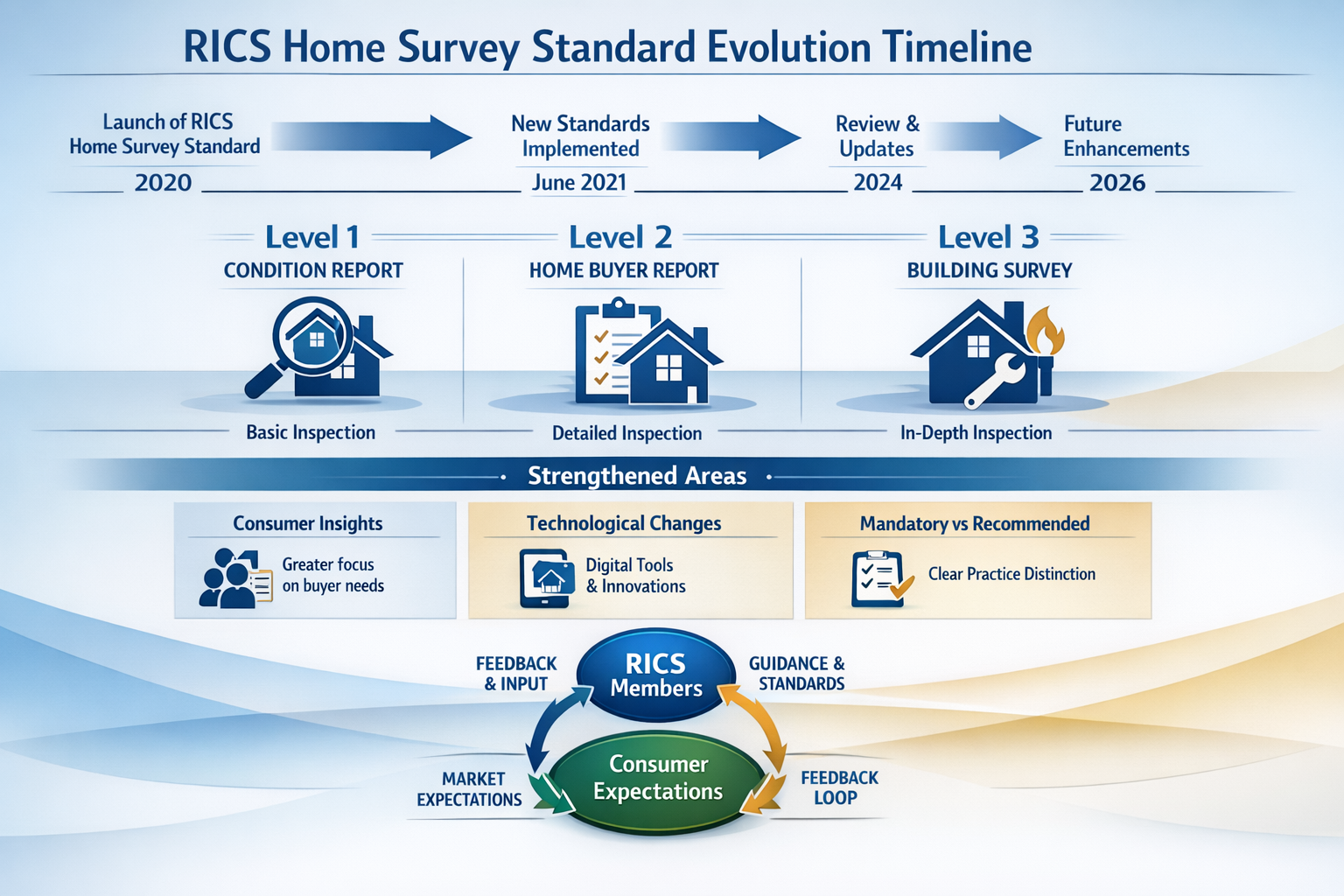
RICS has recognized this shift in consumer expectations as a primary driver for standards evolution. The organization's commitment to operating in the public interest means that the Home Survey Standard establishes best practice designed to ensure excellence in services, meet changing consumer needs, and foster trust in surveyors' work.[4] This consumer-centric positioning represents a fundamental shift from standards that primarily served professional interests to frameworks that balance practitioner needs with client protection.
The feedback gathered from consumers has highlighted several critical gaps in traditional survey approaches:
- Lack of clarity in technical language that obscures rather than illuminates property conditions
- Inconsistent depth of inspection across different surveyors and firms
- Limited actionable advice on remediation costs and prioritization of defects
- Insufficient consideration of modern concerns like energy efficiency and sustainability
These consumer insights have directly informed the strengthened areas of focus within the evolving standards, ensuring that professional practice aligns with what clients actually need from their property assessments.
Technological Advancement and Digital Integration
Technology has revolutionized building surveying over the past decade, and 2026 represents a maturation point where digital tools have become standard rather than exceptional. The RICS quality strengthening initiatives explicitly acknowledge technological changes as a key consideration in standards development.[4]
Modern surveyors now routinely employ:
Advanced diagnostic equipment including thermal imaging cameras that reveal heat loss patterns, moisture meters that detect hidden damp issues, and borescopes that allow visual inspection of concealed spaces without destructive investigation. These tools enable the detection of problems that would have remained invisible using traditional visual inspection methods alone.
Drone technology for roof and chimney inspections, eliminating the need for scaffolding in many cases while providing detailed photographic evidence of conditions at height. This technological advancement has made comprehensive roof surveys safer, more thorough, and more cost-effective.
Digital reporting platforms that allow real-time documentation during site visits, with photographs, annotations, and observations captured systematically and organized automatically into client reports. This technological shift has improved both the speed and consistency of survey delivery.
Building Information Modeling (BIM) integration for complex commercial properties, where survey data feeds into comprehensive digital models that support ongoing building management and future renovation planning.
The challenge for RICS in developing updated standards lies in establishing requirements that embrace these technological capabilities without mandating specific tools that might become obsolete or create competitive disadvantages for smaller practices. The careful consideration of how prescriptive the standard should be reflects this balancing act.[4]
Regulatory Landscape and Building Safety
The regulatory environment surrounding building safety has undergone dramatic transformation following high-profile building failures and the subsequent legislative response. The redefinition of higher-risk buildings and the introduction of mandatory fire safety strategies represent significant changes in how buildings must be managed and maintained.[3]
Building safety and fire safety compliance updates now apply to schools, commercial premises, and multi-occupancy residential buildings, requiring surveyors to navigate complex regulatory requirements that extend far beyond traditional structural assessment.[3] This expanded regulatory scope means that surveyors conducting building surveys must possess current knowledge of:
- Fire safety legislation and how it applies to different building types and occupancy classifications
- Building safety regimes for higher-risk residential buildings, including gateway requirements and ongoing compliance obligations
- Cladding and external wall systems assessment, particularly critical following the increased scrutiny of combustible materials
- Means of escape evaluation and compliance with current Building Regulations
RICS quality strengthening initiatives recognize that surveyors must be equipped to identify not just structural defects but also regulatory compliance issues that could have serious safety implications or affect property value and mortgageability.
Understanding the RICS Home Survey Standard 2nd Edition Progress
Timeline and Development Process
The journey toward the Home Survey Standard 2nd Edition reflects RICS's commitment to inclusive, evidence-based standard development. The progress update published on 10 February 2026 provides transparency about the ongoing refinement process following member feedback and regulatory guidance.[4][5]
The development timeline has included:
| Phase | Period | Key Activities |
|---|---|---|
| Initial Consultation | 2024-2025 | Gathering feedback from RICS members, consumers, and regulatory bodies on existing standards |
| Draft Development | 2025 | Creating initial draft incorporating identified improvements and clarifications |
| Member Review | Late 2025 | Circulating draft to RICS members for detailed technical feedback |
| Refinement | Early 2026 | Addressing feedback themes around clarity, conciseness, and prescriptiveness |
| Regulatory Alignment | Ongoing 2026 | Ensuring standards align with RICS Regulation requirements and consumer protection objectives |
| Final Publication | Expected Late 2026 | Release of final Home Survey Standard 2nd Edition with implementation guidance |
This extended development process demonstrates the complexity of creating standards that must satisfy multiple stakeholder groups while remaining practical for everyday professional application. The consistent theme in member feedback regarding the need for the current draft to be clearer and more concise in its requirements has prompted significant revision work.[4]
Strengthened Areas of Focus
Feedback from RICS members and RICS Regulation has highlighted the need to strengthen certain areas of home surveys and provide further clarification to reflect consumer insight and technological changes.[4] These strengthened areas represent the core improvements that will characterize Building Survey Standards Evolution: How RICS Quality Strengthening Initiatives Impact Surveyor Practice in 2026:
1. Clarity in Reporting Requirements
The updated standards place greater emphasis on clear, accessible language in survey reports. Technical terminology must be explained in plain English, with implications clearly stated rather than implied. This addresses the common consumer complaint that survey reports read like technical documents written for other professionals rather than communications designed to inform client decision-making.
2. Distinction Between Survey Levels
The three-tier system of RICS home surveys (Level 1, Level 2, and Level 3) requires clearer definition to help consumers select the appropriate survey type for their circumstances. The standards now provide more explicit guidance on when each survey level is appropriate, what each includes, and what limitations apply. For those comparing options, understanding the difference between Level 2 and Level 3 surveys has become increasingly important.
3. Mandatory vs. Recommended Practices
One of the most significant refinements involves clarifying the distinction between mandatory requirements ('musts') and recommended practices ('shoulds') to ensure surveyors can remain competitive while following standards.[4] This distinction provides:
- Core quality baseline through mandatory requirements that all RICS surveyors must meet
- Professional flexibility through recommended practices that represent best practice but allow for variation based on property type, client needs, and commercial considerations
- Competitive differentiation enabling firms to exceed minimum standards while maintaining a level playing field
4. Integration of Modern Building Concerns
The updated standards explicitly address contemporary building issues that were peripheral or absent from earlier versions:
- Energy efficiency assessment and identification of opportunities for improvement
- Sustainability considerations including retrofit potential and environmental impact
- Building safety compliance particularly for multi-occupancy residential properties
- Climate resilience including flood risk, overheating risk, and weather exposure
These additions reflect the reality that property assessment in 2026 must consider factors beyond traditional structural integrity and maintenance condition.
Implementation Challenges and Support
The transition to strengthened standards presents practical challenges for surveying practices of all sizes. RICS has committed to providing implementation support including:
Training and continuing professional development (CPD) programs specifically designed to equip surveyors with the knowledge and skills required under the updated standards. This includes technical training on new inspection techniques, regulatory updates, and client communication best practices.
Guidance notes and case studies that illustrate how the standards apply in real-world scenarios, helping surveyors understand expectations through practical examples rather than abstract principles alone.
Template resources for reporting and documentation that help smaller practices implement the standards efficiently without requiring extensive internal development of new systems and processes.
Transition periods that allow practices to update their procedures, train staff, and modify reporting templates before full compliance becomes mandatory.
How Quality Strengthening Initiatives Transform Surveyor Practice
From Inspector to Strategic Adviser
Perhaps the most profound impact of Building Survey Standards Evolution: How RICS Quality Strengthening Initiatives Impact Surveyor Practice in 2026 is the redefinition of the surveyor's role. Following updates to RICS standards, surveyors are now expected to do more than simply inspect properties—they function as trusted advisers who must think strategically and engage deeply with clients' unique needs.[3]
This expanded role manifests in several practical ways:
Comprehensive risk assessment that goes beyond identifying defects to evaluating their implications for the client's intended use of the property, timeline for remediation, and potential impact on value and mortgageability.
Strategic advice on prioritization helping clients understand which issues require immediate attention versus those that can be addressed over time, with realistic cost estimates that support informed decision-making.
Long-term planning support particularly for clients purchasing properties with renovation potential, where the surveyor's assessment informs feasibility evaluation and project scoping.
Regulatory navigation guiding clients through complex compliance requirements, particularly for properties affected by building safety legislation or those requiring planning permission for intended modifications.
This strategic advisory function requires surveyors to develop skills beyond technical inspection competence. Effective client communication, commercial awareness, and the ability to translate technical findings into actionable business advice have become core professional competencies.
Enhanced Technical Competence Requirements
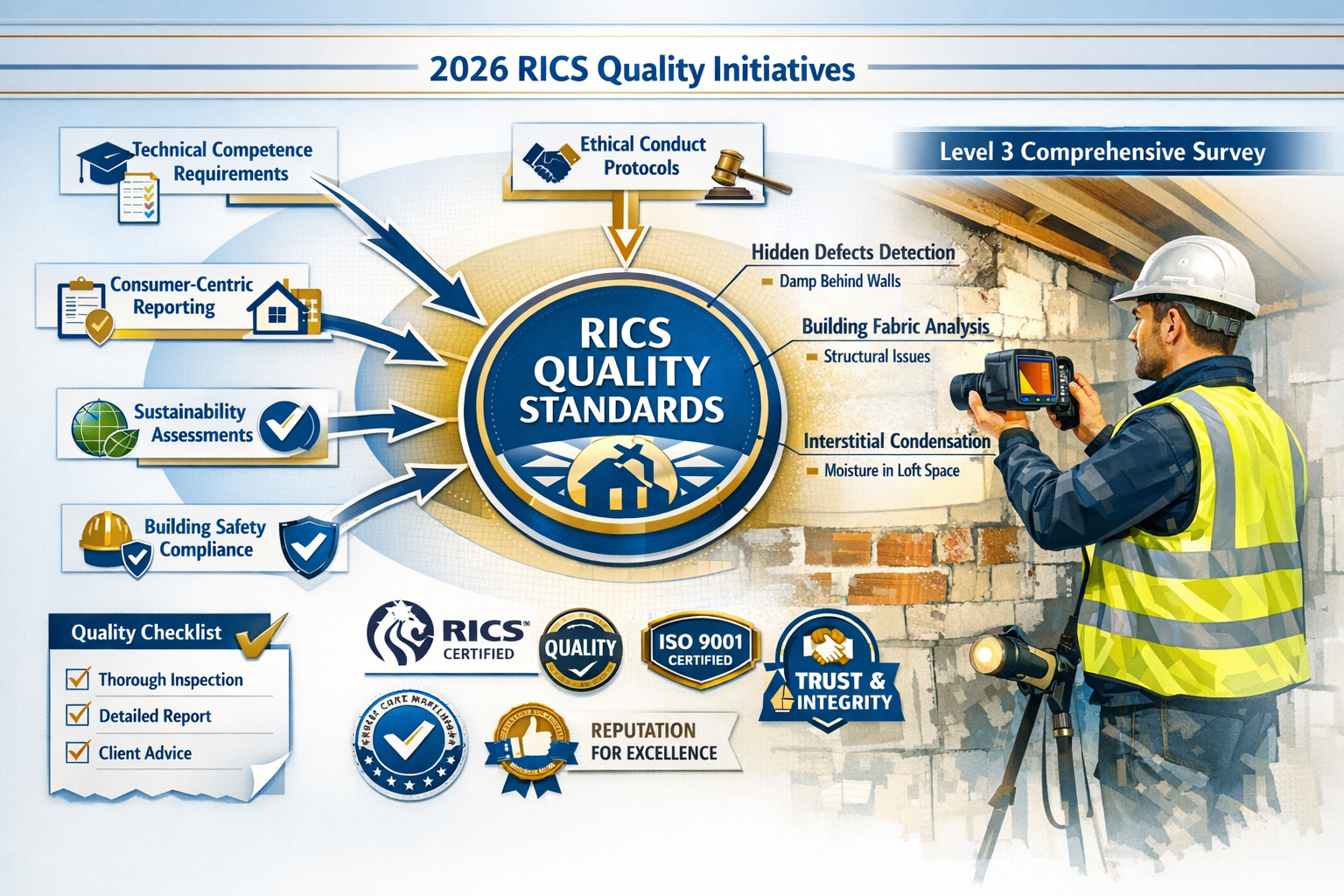
The RICS has reinforced its commitment to professional standards, emphasizing technical competence and ethical conduct to deliver greater confidence in the quality and reliability of surveying services.[3] This emphasis on technical competence translates into specific practice requirements:
Continuous professional development in emerging areas including sustainability assessment, modern methods of construction, building safety legislation, and advanced diagnostic techniques. Surveyors must demonstrate ongoing learning rather than relying on qualifications obtained years or decades earlier.
Specialist knowledge requirements for certain property types, with recognition that a surveyor competent to assess a standard Victorian terrace may not possess the expertise required for a contemporary eco-build or a listed heritage property.
Quality assurance systems within surveying practices that ensure consistent application of standards across all team members, with appropriate supervision and review mechanisms for less experienced surveyors.
Professional indemnity insurance adequate to the scope and complexity of work undertaken, with insurers increasingly requiring evidence of compliance with RICS standards as a condition of coverage.
For clients seeking assurance of surveyor competence, understanding how to verify surveyor qualifications has become an important part of the selection process.
Level 3 Surveys as the Comprehensive Standard
Today's RICS Home Surveys are significantly more comprehensive, with Level 3 surveys providing the most detailed examination of a property, capable of uncovering hidden issues such as building fabric problems and interstitial condensation.[3] The evolution of standards has elevated Level 3 surveys from a specialist service reserved for unusual properties to the benchmark for thorough property assessment.
What distinguishes Level 3 surveys in 2026:
✅ Comprehensive building fabric inspection including roof spaces, sub-floor areas, and concealed spaces accessible without causing damage
✅ Advanced diagnostic testing using thermal imaging, moisture detection, and other specialized equipment to identify hidden defects
✅ Detailed defect analysis with investigation of causes, not just symptoms, enabling targeted remediation strategies
✅ Services assessment including electrical, plumbing, heating, and drainage systems evaluation
✅ Regulatory compliance review identifying potential building control, planning, and building safety issues
✅ Sustainability and energy assessment evaluating current performance and improvement opportunities
✅ Comprehensive photographic documentation providing visual evidence of all significant findings
✅ Detailed cost guidance with realistic estimates for remediation of identified defects
The depth of investigation provided by Level 3 surveys makes them particularly valuable for older properties, buildings with known defects, properties of unusual construction, or situations where the buyer requires maximum information to support investment decisions.
Digital Transformation of Reporting
The evolution of survey standards has been accompanied by a parallel transformation in how survey findings are documented and communicated. Digital reporting platforms have revolutionized the surveyor's ability to deliver clear, comprehensive, and actionable information to clients.
Modern survey reports in 2026 typically include:
📊 Interactive digital formats allowing clients to navigate between sections, expand detail as needed, and access supplementary information through embedded links
📸 Extensive photographic evidence with images annotated to highlight specific defects and concerns, providing visual clarity that supports written descriptions
🗺️ Location-specific mapping showing exactly where defects occur within the property, eliminating confusion about which room or elevation is referenced
📈 Prioritization matrices that categorize defects by urgency and cost, helping clients develop remediation strategies aligned with their budget and timeline
🔗 Reference links to relevant guidance, regulations, and resources that help clients understand context and next steps
💰 Cost estimation tools providing ranges rather than single figures, with explanations of factors that might affect actual costs
This digital transformation improves client comprehension while creating more efficient workflows for surveyors. The ability to capture and organize information during site visits reduces administrative time while improving accuracy and completeness.
Environmental, Social, and Governance (ESG) Integration
Commercial Property Valuation Standards Update
RICS has updated environmental, social, and governance standards for commercial property valuations with an effective date of 30 April 2026, aligning commercial property assessments with retrofit and sustainability compliance.[6] While this update specifically addresses commercial valuations, it reflects broader trends that are influencing residential survey practice as well.
The ESG integration requires valuers and surveyors to consider:
Environmental factors including:
- Energy Performance Certificate (EPC) ratings and implications for value and lettability
- Carbon emissions associated with building operation
- Climate risk exposure including flood risk, overheating potential, and extreme weather vulnerability
- Retrofit potential and costs to achieve improved environmental performance
- Compliance with Minimum Energy Efficiency Standards (MEES) and future regulatory trajectories
Social factors including:
- Health and wellbeing impacts of building design and condition
- Accessibility and inclusive design considerations
- Community impact and social value creation
- Tenant satisfaction and retention in commercial contexts
Governance factors including:
- Building safety compliance and management systems
- Regulatory compliance across planning, building control, and specialist regimes
- Corporate responsibility and ethical considerations in property ownership and management
This ESG integration represents a significant expansion of the surveyor's assessment scope. Properties that might have been considered acceptable under traditional structural and condition-based criteria may now be flagged for environmental performance deficiencies that affect value, lettability, and regulatory compliance.
For properties requiring environmental upgrades, building surveys for retrofit compliance have become an essential service connecting assessment with improvement planning.
Residential Sustainability Assessment
While ESG standards formally apply to commercial properties, the principles and approaches are increasingly relevant to residential surveying. Homebuyers in 2026 demonstrate growing awareness of:
Energy costs and the financial implications of purchasing properties with poor thermal performance, particularly as energy prices remain volatile and carbon taxation increases
Future-proofing against regulatory changes that may impose minimum energy efficiency requirements on residential properties, potentially affecting value and mortgageability
Comfort and health considerations related to indoor air quality, natural light, ventilation, and thermal comfort that affect quality of life beyond simple structural adequacy
Climate adaptation requirements as extreme weather events become more frequent, with properties requiring resilience to flooding, overheating, and storm damage
Surveyors conducting RICS home surveys are increasingly expected to comment on these sustainability factors, even when not formally required by the survey level commissioned. This reflects both consumer expectations and the surveyor's advisory role in supporting informed decision-making.
Practical Implications for Different Property Types

New Build Properties
The question of whether a survey is needed on a new build has evolved significantly as quality concerns and building safety awareness have increased. The strengthened RICS standards explicitly address new build assessment, recognizing that:
Warranty coverage is not equivalent to professional inspection, as warranty providers typically only address defects reported within specific timeframes and may dispute coverage for issues claimed to result from poor maintenance rather than construction defects
Snagging issues can be extensive even in properties built by major developers, with professional snagging surveys identifying dozens or even hundreds of minor defects that should be rectified before completion
Building Regulations compliance cannot be assumed, particularly for complex aspects like fire safety compartmentation, ventilation system performance, and thermal bridging
Modern construction methods including timber frame, insulated concrete formwork, and modular construction require specialist knowledge to assess properly
The updated standards provide clearer guidance on appropriate survey approaches for new build properties, acknowledging that while comprehensive structural investigation may be less critical, detailed quality assessment and compliance verification remain essential.
Period and Heritage Properties
Properties of traditional construction, particularly those predating 1919, present unique assessment challenges that the strengthened standards explicitly address. RICS chartered surveyors now conduct detailed property inspections that go well beyond surface-level observations, reflecting evolving consumer expectations for comprehensive assessments during major property investments.[3]
For period properties, this enhanced approach includes:
Understanding traditional construction and how materials and techniques differ from modern building methods, avoiding misdiagnosis of normal characteristics as defects
Moisture movement assessment recognizing that traditional buildings typically rely on breathability rather than impermeable barriers, with inappropriate modern interventions often creating problems
Historic alteration identification evaluating how modifications over decades or centuries have affected structural performance and regulatory compliance
Conservation considerations for listed buildings or those in conservation areas, where repair approaches must respect historic character and may require specialist consents
Hidden defect investigation in properties where concealed spaces, multiple alterations, and aging materials create elevated risk of undiscovered problems
The depth of investigation required for period properties often necessitates Level 3 surveys, with the enhanced standards providing clearer guidance on when this comprehensive approach is appropriate rather than optional.
Multi-Occupancy Residential Buildings
The building safety regulatory changes have particularly significant implications for flats and apartments in multi-occupancy residential buildings. The expanded scope of regulated buildings requires surveyors to navigate complex regulatory requirements that extend beyond individual unit assessment.[3]
Key considerations for multi-occupancy properties include:
🏢 Building height and classification determining whether the building falls within higher-risk categories requiring enhanced safety management
🔥 Fire safety systems including compartmentation, means of escape, fire detection and alarm systems, and emergency lighting
🚪 Common areas assessment evaluating condition and compliance of shared spaces, access routes, and building services
💼 Building management reviewing whether appropriate safety management systems are in place and whether the building has a registered Building Safety Manager where required
📋 Documentation review examining fire risk assessments, building safety case documents, and maintenance records
🏗️ External wall systems particularly critical following increased scrutiny of cladding materials and construction methods
⚖️ Lease obligations understanding responsibility allocation between leaseholders and freeholders for different building elements
For surveyors, this expanded assessment scope requires knowledge that extends beyond traditional building pathology into regulatory compliance and building management systems. The strengthened standards provide frameworks for this broader evaluation while recognizing that some aspects may require specialist input beyond general surveying competence.
Building Survey Standards Evolution Impact on Client Experience
Enhanced Report Quality and Clarity
The consumer insight integration within Building Survey Standards Evolution: How RICS Quality Strengthening Initiatives Impact Surveyor Practice in 2026 directly translates into improved report quality that better serves client needs. The emphasis on clarity and conciseness in reporting requirements means that survey reports in 2026 are:
More accessible with technical terminology explained in plain language that non-specialist clients can understand without requiring additional research or professional interpretation
Better organized with logical structure that allows clients to quickly locate information relevant to their specific concerns and decision-making priorities
More actionable with clear recommendations, realistic cost guidance, and prioritization that supports practical next steps rather than leaving clients uncertain about how to respond to findings
Visually enhanced with photographs, diagrams, and formatting that improve comprehension and engagement compared to dense text-only documents
Digitally optimized for viewing on various devices, with navigation features that support efficient information access
These quality improvements address long-standing client frustrations with survey reports that were technically thorough but practically difficult to use for decision-making. The result is higher client satisfaction and better-informed property transactions.
Improved Value Proposition
The evolution of standards has strengthened the value proposition of professional RICS surveys by clearly differentiating them from less comprehensive alternatives. Clients increasingly understand that:
Professional surveys identify issues that untrained observers miss, with the cost of the survey often representing a small fraction of the potential cost of undiscovered defects
RICS standards provide assurance of minimum quality and professional accountability that non-regulated providers cannot match
Comprehensive assessment supports negotiation with realistic defect costs enabling price renegotiation that can exceed survey fees many times over
Strategic advice adds value beyond simple defect identification, helping clients make better decisions about whether to proceed, what price to pay, and how to plan for property improvement
Professional indemnity protection provides recourse if negligent survey work results in financial loss, unlike informal inspections by builders or general property consultants
This enhanced value proposition helps justify professional survey fees and supports client understanding of why choosing appropriately qualified surveyors matters for property investment protection.
Setting Realistic Expectations
The clearer distinction between survey levels within the updated standards helps set realistic client expectations about what each survey type will and will not provide. This transparency reduces the common problem of clients commissioning a Level 2 survey but expecting Level 3 comprehensiveness, then feeling disappointed when the report includes limitations and recommendations for further investigation.
The updated standards clarify that:
📋 Level 1 surveys (Condition Reports) provide basic condition assessment suitable for conventional properties in reasonable condition, but include significant limitations and are not appropriate for older properties, those in poor condition, or where comprehensive information is required
📋 Level 2 surveys (HomeBuyer Reports) offer moderate detail suitable for conventional properties in reasonable condition, but do not include detailed investigation of building fabric or services and may recommend further investigation of identified concerns
📋 Level 3 surveys (Building Surveys) provide comprehensive assessment with detailed investigation, extensive reporting, and minimal limitations, appropriate for older properties, those in poor condition, unusual construction, or where maximum information is required
This clarity helps clients select the appropriate survey level for their circumstances, reducing both unnecessary expenditure on overly comprehensive surveys for straightforward properties and false economy from insufficient surveys for complex properties.
Professional Development and Competence Assurance
Continuing Professional Development Requirements
The emphasis on technical competence within the strengthened standards has elevated CPD from a compliance exercise to a genuine professional necessity. RICS members must demonstrate ongoing learning in areas including:
Regulatory updates covering building safety legislation, planning policy changes, energy efficiency requirements, and other evolving compliance frameworks
Technical advances in construction methods, materials, diagnostic equipment, and assessment techniques
Professional skills including client communication, report writing, risk assessment, and strategic advisory capabilities
Specialist knowledge for property types or assessment areas where the surveyor practices, ensuring current competence rather than reliance on outdated knowledge
The CPD requirements support the quality objectives underlying standards evolution by ensuring that surveyors maintain the knowledge and skills necessary to deliver services meeting contemporary expectations.
Quality Assurance Systems
Surveying practices are increasingly implementing formal quality assurance systems that ensure consistent application of RICS standards across all work. These systems typically include:
Standard operating procedures documenting inspection protocols, reporting templates, and quality checks that ensure consistency regardless of which surveyor conducts the work
Peer review mechanisms where senior surveyors review reports prepared by less experienced colleagues before issue, identifying gaps, errors, or areas requiring improvement
Client feedback systems that capture satisfaction data and identify areas where service delivery could be enhanced
Continuing improvement processes that analyze quality metrics, identify trends, and implement systematic improvements to practice procedures
Compliance monitoring ensuring that all work meets RICS standards and regulatory requirements, with corrective action when deficiencies are identified
These quality assurance systems transform RICS standards from external requirements into embedded practice culture, supporting consistent high-quality delivery.
Specialization and Niche Expertise
The increasing complexity of property assessment has driven greater specialization within the surveying profession. Rather than positioning as generalists capable of surveying any property type, many surveyors now develop niche expertise in specific areas:
Property type specialization focusing on particular building types such as period properties, new builds, commercial premises, or multi-occupancy residential buildings
Technical specialization developing deep expertise in areas like building pathology, energy assessment, building safety compliance, or historic building conservation
Geographic specialization concentrating on particular locations where local knowledge of construction types, environmental risks, and regulatory contexts adds value
Service specialization focusing on particular service types such as pre-purchase surveys, defect analysis, expert witness work, or building consultancy
This specialization trend aligns with the strengthened standards' recognition that different property types and assessment contexts require different knowledge and skills. Clients benefit from access to surveyors with relevant specialist expertise rather than generalists attempting to cover all property types and situations.
Challenges and Opportunities in Standards Implementation
Balancing Prescriptiveness and Flexibility
One of the central challenges in developing the Home Survey Standard 2nd Edition involves determining how prescriptive the standard should be.[4] This balance affects:
Consistency vs. adaptability – Highly prescriptive standards ensure consistent service delivery across all RICS surveyors but may not accommodate legitimate variation based on property type, client needs, or local contexts
Quality baseline vs. competitive differentiation – Standards must establish minimum quality requirements while allowing practices to exceed these minimums and differentiate their services
Compliance burden vs. professional judgment – Overly detailed requirements can create administrative burden and reduce surveyor autonomy to apply professional judgment to unique situations
Consumer protection vs. cost efficiency – More comprehensive mandatory requirements improve consumer protection but may increase survey costs, potentially making professional surveys less accessible
The RICS approach of distinguishing between mandatory requirements and recommended practices represents an attempt to navigate this balance, establishing core quality standards while preserving professional flexibility.[4]
Technology Adoption and Investment
The integration of technological changes within updated standards creates both opportunities and challenges for surveying practices:
Opportunities include:
- Enhanced diagnostic capability through thermal imaging, moisture detection, and other specialized equipment
- Improved efficiency through digital reporting platforms and mobile data capture
- Better client communication through interactive reports and visual documentation
- Competitive differentiation through technology-enabled service enhancements
Challenges include:
- Capital investment requirements for equipment, software, and training
- Ongoing costs for software subscriptions, equipment maintenance, and technology updates
- Learning curves as surveyors develop competence with new tools and platforms
- Risk of technology obsolescence requiring repeated investment cycles
Smaller practices may find technology investment particularly challenging, potentially creating competitive disadvantages relative to larger firms with greater resources. RICS support through guidance, training, and reasonable implementation timelines helps mitigate these challenges.
Market Education and Client Understanding
The successful implementation of strengthened standards requires effective market education so that clients understand and value the improvements. Challenges include:
Price sensitivity where clients focus on survey cost rather than value, potentially selecting cheaper non-RICS alternatives that don't meet the enhanced standards
Complexity communication helping clients understand the differences between survey levels and why appropriate survey selection matters
Value demonstration articulating how enhanced standards translate into better outcomes for clients, not just higher costs
Competitive positioning differentiating RICS surveys from alternatives in ways that resonate with client priorities and decision criteria
Surveyors and surveying practices must invest in client education, clear communication of value propositions, and demonstration of how standards compliance benefits clients. This market education function extends the impact of standards evolution from professional practice into client experience and decision-making.
Future Directions and Emerging Trends
Predictive Assessment and Building Analytics
Looking beyond 2026, the evolution of building survey standards is likely to incorporate predictive assessment capabilities enabled by data analytics and artificial intelligence. Rather than simply reporting current condition, future surveys may include:
Deterioration modeling that predicts how identified defects are likely to progress over time based on building type, exposure, and maintenance patterns
Lifecycle cost analysis that evaluates long-term ownership costs considering maintenance, energy, and eventual replacement of building elements
Comparative benchmarking that positions a property's condition and performance against similar buildings, providing context for assessment findings
Maintenance optimization that recommends timing and sequencing of interventions to maximize value and minimize whole-life costs
These predictive capabilities would transform surveys from static snapshots into dynamic decision-support tools that help clients plan for property ownership over extended timeframes.
Climate Resilience and Adaptation
As climate change impacts intensify, building survey standards will increasingly incorporate climate resilience assessment. Future surveys may routinely evaluate:
Flood risk including both current exposure and projected future risk under climate change scenarios
Overheating vulnerability particularly critical for urban properties and those with extensive glazing
Storm resilience assessing roof covering, chimney stacks, and other elements vulnerable to extreme weather
Adaptation potential evaluating opportunities to enhance climate resilience through targeted interventions
This climate-focused assessment would help clients understand not just current property condition but future viability under changing environmental conditions.
Integration with Transaction Processes
The future evolution of survey standards may include greater integration with broader property transaction processes. Possibilities include:
Digital property passports where survey data contributes to comprehensive digital records that follow properties through ownership changes
Automated valuation integration where survey findings feed into valuation models, improving accuracy and consistency
Mortgage process streamlining with survey data automatically shared with lenders to support lending decisions
Remediation planning tools that connect survey findings with contractor networks and cost estimation platforms
This integration would position surveys as central components of efficient, data-driven property transactions rather than isolated professional services.
Conclusion: Embracing Evolution for Professional Excellence
Building Survey Standards Evolution: How RICS Quality Strengthening Initiatives Impact Surveyor Practice in 2026 represents far more than regulatory updates—it reflects a fundamental transformation in how surveyors serve clients, assess properties, and contribute to safe, sustainable, and well-informed property transactions. The initiatives currently underway through the Home Survey Standard 2nd Edition development process, combined with ESG integration and building safety compliance requirements, are reshaping every aspect of professional practice.
For surveyors, this evolution demands commitment to continuous learning, investment in capabilities and technologies, and embrace of the expanded strategic advisory role that clients increasingly expect. The distinction between mandatory requirements and recommended practices provides a framework for maintaining competitive flexibility while ensuring consistent quality across the profession.
For clients, these strengthened standards deliver tangible benefits through clearer, more comprehensive, and more actionable survey reports that better support property investment decisions. The emphasis on consumer insights and plain language communication makes professional surveys more accessible and valuable to the non-specialist buyers who rely on them.
The challenges of implementation—balancing prescriptiveness with flexibility, managing technology investment, and educating the market—are real but manageable through the support frameworks RICS is providing. The opportunities for enhanced service quality, improved client outcomes, and strengthened professional standing make the effort worthwhile.
Actionable Next Steps
For Surveyors:
- Engage with the standards development process by providing feedback on draft standards and participating in consultation opportunities
- Invest in CPD focusing on building safety, sustainability assessment, and digital reporting capabilities
- Review and update practice procedures, reporting templates, and quality assurance systems to align with emerging requirements
- Develop specialist expertise in property types or assessment areas where market demand and professional interest align
- Communicate value to clients through clear explanation of how RICS standards and enhanced survey approaches benefit their property decisions
For Clients:
- Understand survey options by reviewing the differences between Level 1, 2, and 3 surveys and selecting the appropriate level for your property and circumstances
- Verify surveyor credentials by confirming RICS membership and relevant experience with your property type
- Ask questions about what the survey will and won't include, ensuring realistic expectations before commissioning work
- Use survey findings strategically to inform negotiation, remediation planning, and long-term property management decisions
- Recognize value by understanding that professional survey costs represent small investments relative to property values and potential defect costs
The evolution of building survey standards in 2026 positions the surveying profession to meet contemporary challenges while serving the public interest through enhanced quality, transparency, and accountability. By embracing these changes, surveyors can strengthen their professional standing while delivering the comprehensive, insightful, and actionable assessments that property buyers need and deserve.
References
[1] The New Rics Home Survey Standard Explained – https://www.surveymerchant.com/blog/the-new-rics-home-survey-standard-explained
[2] Nsps Land Title – https://www.parkerpoe.com/news/2026/02/key-takeaways-from-the-2026-alta/nsps-land-title
[3] Things About Building Surveying You Need To Know In 2026 – https://mcessex.co.uk/2026/01/23/things-about-building-surveying-you-need-to-know-in-2026/
[4] Home Survey Standard 2nd Edition A Progress Update – https://www.rics.org/news-insights/home-survey-standard-2nd-edition-a-progress-update
[5] Home Survey Standards – https://www.rics.org/profession-standards/rics-standards-and-guidance/sector-standards/building-surveying-standards/home-surveys/home-survey-standards
[6] Building Surveys For Retrofit Compliance Navigating Rics Standards And Consumer Insights In 2026 – https://nottinghillsurveyors.com/blog/building-surveys-for-retrofit-compliance-navigating-rics-standards-and-consumer-insights-in-2026
