
The institutional buy-to-let (BTL) market is experiencing a remarkable resurgence in 2026. After years of market uncertainty, professional landlords and institutional investors are ramping up their property acquisitions, driven by stabilized valuations, improved debt availability, and strong rental fundamentals. Institutional Buy-to-Let Valuation Surveys: Assessing High-Yield Opportunities in the 2026 Recovery have become critical tools for investors seeking to capitalize on this bullish sector while managing compliance risks and maximizing rental yields.
As capital markets reopen and transaction volumes recover, the role of detailed property valuations has never been more important. Professional surveyors must now evaluate not just traditional metrics like location and condition, but also retrofit potential, energy efficiency compliance, and long-term sustainability factors that institutional investors demand.
Key Takeaways
- 📈 Capital deployment is accelerating: 45% of institutional investors plan to increase their private real estate investments over the next 12 months, up from 34% in 2025[8]
- 💰 Debt markets have reopened: Commercial mortgage-backed securities issuance has more than tripled since 2023, with lending standards relaxing and spreads tightening by 183 basis points[1][4]
- 🏢 Rental fundamentals remain strong: Occupancy rates are firm across income-producing assets, with net operating income growth expected at 3-4% and over 12 million severely cost-burdened renter households supporting demand[3][6]
- 🔍 Valuation complexity has increased: Surveyors must now assess EPC ratings, retrofit costs, fire safety compliance, and HMO licensing alongside traditional structural and yield metrics
- ✅ Transaction markets are functional again: Bid-ask spreads have narrowed as buyers and sellers accept the new pricing reality, enabling deal flow after the 2023-2024 stall[6]
Understanding the 2026 Buy-to-Let Market Recovery
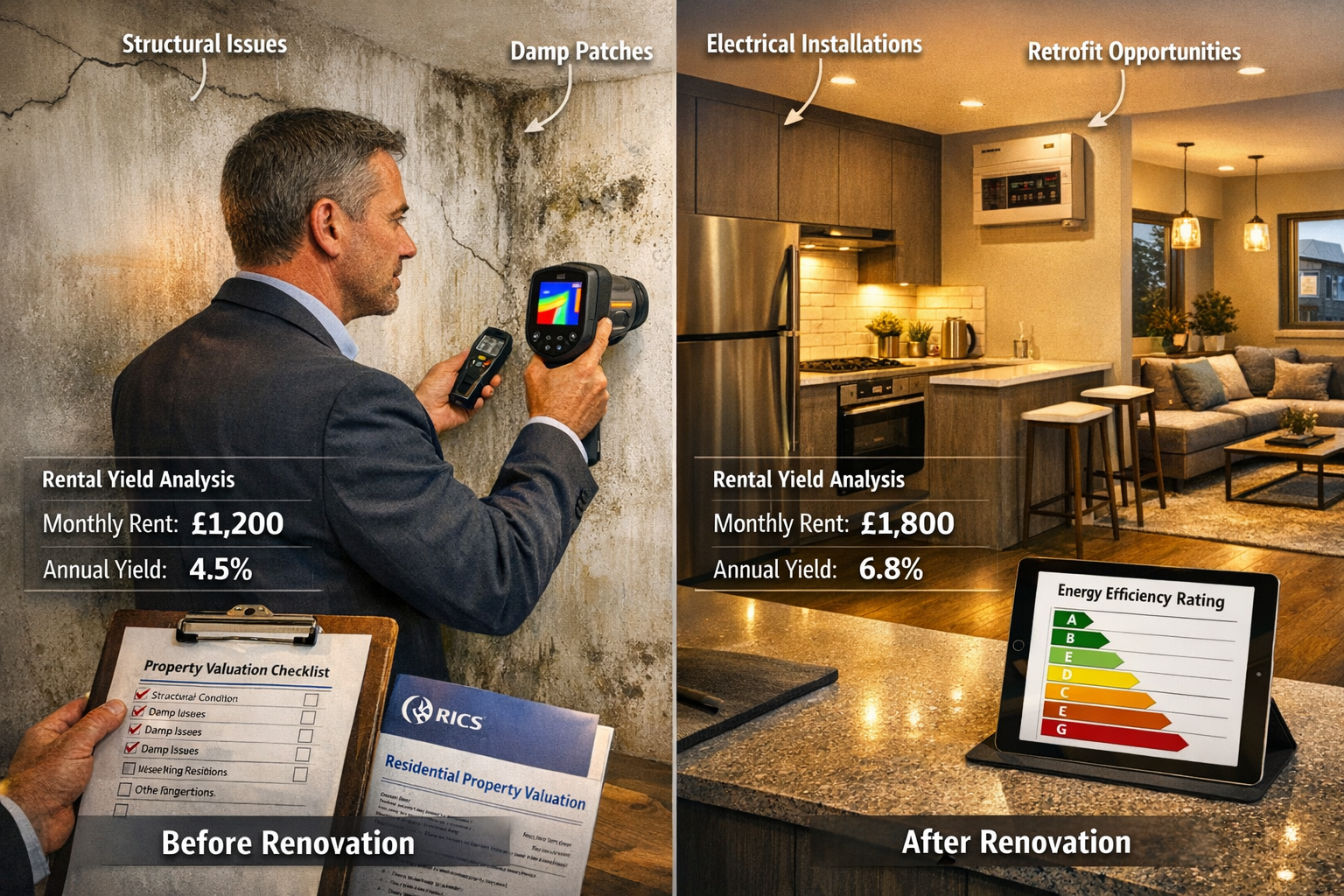
The Valuation Reset is Complete
The commercial and residential investment property markets experienced a significant valuation reset beginning in early 2024. After months of price discovery and market uncertainty, both buyers and sellers have now accepted higher base interest rates as the new normal[1]. This acceptance has created a functional transaction environment where deals can actually close—a stark contrast to the frozen markets of 2023-2024.
For institutional buy-to-let investors, this reset presents a unique opportunity. Properties that were overpriced during the low-interest-rate era have corrected to more realistic valuations, while rental income streams have remained resilient or even grown. The result is improved rental yield opportunities that make BTL investments attractive once again.
Capital Markets Are Reopening
One of the most significant developments for 2026 is the dramatic reopening of capital markets for real estate investment. Commercial mortgage-backed securities (CMBS) issuance has more than tripled since 2023, signaling restored investor appetite for real estate debt[1]. This liquidity is crucial for institutional investors who rely on leverage to maximize returns.
Government-sponsored enterprises (GSEs) received a substantial 20.5% increase to their lending caps in 2026, specifically for multifamily assets[3]. This expansion in debt availability means institutional investors can access the financing they need to execute large-scale buy-to-let acquisitions.
Additionally, commercial mortgage loan spreads have tightened by 183 basis points, and lending standards have relaxed from their 2023 peaks[4]. These conditions enable both early refinancings of existing portfolios and new acquisition activity—creating a favorable environment for professional landlords to expand their holdings.
Institutional Sentiment Has Shifted Positive
Survey data reveals a dramatic shift in institutional investor sentiment. A remarkable 65% of surveyed institutions expect conditions like rental rates, leasing activity, vacancies, and cost of capital to improve through 2026[4]. This optimism is backed by concrete market fundamentals rather than speculation.
Furthermore, 45% of institutional investors expect to increase their capital deployment in private real estate over the next 12 months—a significant jump from 34% in 2025[8]. This redeployment of institutional capital is driving demand for high-quality buy-to-let assets, particularly those with strong rental yields and solid compliance records.
The Critical Role of Institutional Buy-to-Let Valuation Surveys in 2026
Why Detailed Valuations Matter More Than Ever
In the current market environment, Institutional Buy-to-Let Valuation Surveys: Assessing High-Yield Opportunities in the 2026 Recovery serve multiple critical functions beyond simple price determination. Professional surveyors must now provide comprehensive assessments that address:
- Structural integrity and maintenance requirements: Identifying deferred maintenance, structural issues, and potential hidden defects that could impact returns
- Rental yield potential: Calculating realistic rental income projections based on local market conditions, property configuration, and tenant demand
- Compliance and regulatory risks: Assessing energy performance certificate (EPC) ratings, fire safety requirements, HMO licensing needs, and other regulatory obligations
- Retrofit and improvement opportunities: Evaluating the cost-benefit of energy efficiency upgrades, modernization projects, and value-add improvements
- Long-term sustainability: Considering future-proofing measures that will maintain property competitiveness and compliance with evolving standards
These comprehensive valuations help institutional investors make informed decisions and avoid costly surprises after acquisition. A thorough building survey can identify issues that significantly impact the investment case, from subsidence problems to electrical system deficiencies.
Key Valuation Metrics for BTL Properties
When conducting Institutional Buy-to-Let Valuation Surveys: Assessing High-Yield Opportunities in the 2026 Recovery, surveyors must focus on specific metrics that institutional investors prioritize:
| Metric | Target Range | Significance |
|---|---|---|
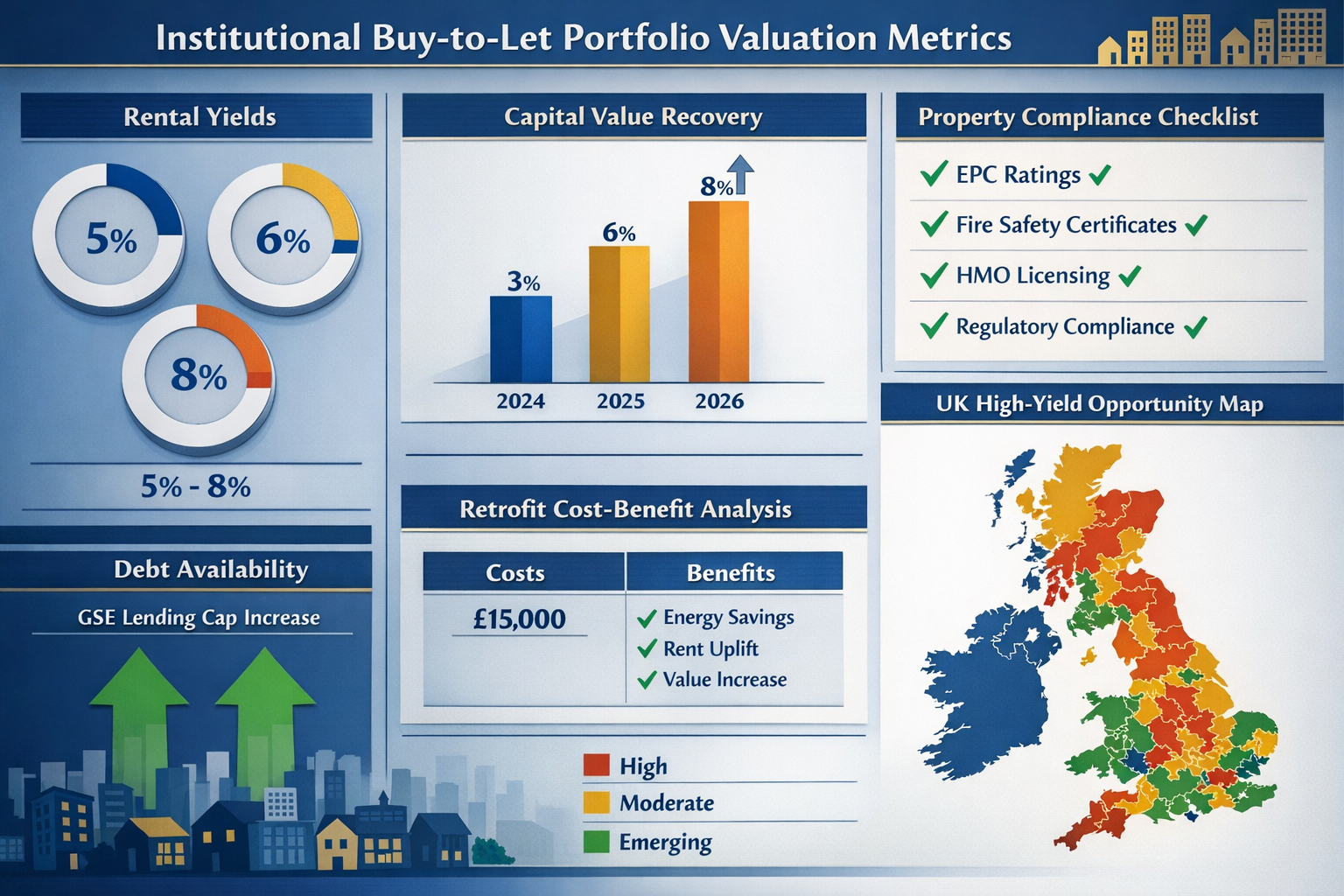
| Gross Rental Yield | 5-8%+ | Annual rental income as percentage of property value |
| Net Rental Yield | 3-6%+ | Rental income after expenses as percentage of value |
| Occupancy Rate | 95%+ | Percentage of time property is tenanted |
| EPC Rating | Minimum C (by 2028) | Legal requirement for rental properties |
| Maintenance Reserve | 1-2% of value annually | Funds needed for ongoing repairs |
| Capital Expenditure | Property-specific | One-time improvements needed |
| Loan-to-Value (LTV) | 65-75% | Typical institutional financing ratio |
Understanding these valuation factors allows surveyors to provide actionable insights that align with institutional investment criteria.
The Compliance Challenge
Regulatory compliance has become a major focus area for institutional buy-to-let investors in 2026. Properties that fail to meet current or upcoming regulatory standards represent significant risk, potentially requiring expensive retrofits or facing rental restrictions.
Key compliance areas that valuations must address include:
✅ Energy Performance Certificates (EPC): Current minimum rating of E, but government proposals suggest a minimum of C by 2028 for all rental properties
✅ Fire Safety: Compliance with fire safety regulations, particularly for multi-unit buildings and HMOs, including smoke alarms, fire doors, and escape routes
✅ Electrical Safety: Valid Electrical Installation Condition Reports (EICR) required every five years
✅ Gas Safety: Annual gas safety certificates for properties with gas appliances
✅ HMO Licensing: Mandatory and additional licensing schemes for houses in multiple occupation
✅ Right to Rent: Verification of tenant immigration status
Surveyors conducting institutional valuations must identify compliance gaps and estimate remediation costs. A property requiring £30,000 in fire safety upgrades significantly impacts the investment case compared to one that's fully compliant.
Assessing High-Yield Opportunities in the 2026 Recovery
Build-to-Rent: A Growing Institutional Opportunity
The build-to-rent (BTR) sector represents one of the most compelling high-yield opportunities for institutional investors in 2026. After a three-year downtrend, BTR occupancies are rising due to slowing supply pipelines, and rent growth is expected to accelerate above traditional apartment trends[5].
BTR properties offer several advantages for institutional investors:
- Professional management at scale: Centralized property management reduces per-unit costs
- Consistent cash flows: Purpose-built rental properties with modern amenities command premium rents
- Lower turnover: Quality BTR developments with amenities retain tenants longer
- Regulatory clarity: New construction meets all current compliance standards
When valuing BTR opportunities, surveyors should assess the quality of amenities, location demographics, competitive positioning, and the developer's track record. These factors directly impact occupancy rates and achievable rents.
Geographic Opportunities and Market Segmentation
Not all buy-to-let markets are created equal in 2026. Institutional investors are focusing on specific geographic markets and property types that offer the best risk-adjusted returns.
High-yield opportunity zones include:
🏙️ Regional cities with strong employment growth: Areas outside London with growing tech sectors, universities, and diverse employment bases
🏘️ Suburban family housing: Three- and four-bedroom properties in good school catchment areas with strong tenant demand
🎓 Student accommodation hubs: Purpose-built student accommodation (PBSA) near major universities with guaranteed rental income
🏢 Urban professionals: One- and two-bedroom apartments in city centers with good transport links
When conducting commercial building surveys for larger BTL assets, surveyors must understand local market dynamics, rental demand drivers, and competitive supply to accurately assess yield potential.
The Retrofit Opportunity
Energy efficiency retrofits represent both a challenge and an opportunity for institutional BTL investors in 2026. Properties with poor EPC ratings require investment to meet regulatory standards, but these improvements can also increase rental values and reduce void periods.
Common retrofit measures include:
- Insulation improvements: Loft, cavity wall, and solid wall insulation
- Heating system upgrades: Replacement of old boilers with modern condensing boilers or heat pumps
- Window replacements: Double or triple glazing to improve thermal performance
- LED lighting: Low-energy lighting throughout
- Solar panels: Renewable energy generation (where suitable)
A comprehensive valuation should include a retrofit cost-benefit analysis that estimates:
- Total investment required to achieve target EPC rating
- Expected increase in rental value
- Reduction in void periods due to improved property quality
- Available grants or incentives
- Payback period for the investment
Properties with straightforward retrofit pathways (e.g., simply needing loft insulation and a new boiler) represent better opportunities than those requiring complex and expensive measures like solid wall insulation.
Understanding Rental Yield in Context
Rental yield is the cornerstone metric for BTL valuations, but it must be understood in proper context. Gross rental yield (annual rent divided by property value) provides a simple comparison, but net rental yield (after all expenses) gives a more accurate picture of investment returns.
Institutional investors typically target net rental yields of 3-6% depending on the property type, location, and risk profile. Higher yields often come with higher risks, such as:
- Properties in less desirable locations with higher void rates
- Older buildings requiring more maintenance
- HMOs with more intensive management requirements
- Properties with compliance issues requiring remediation
Conversely, lower yields may be acceptable for:
- Prime locations with strong capital appreciation potential
- New-build properties with minimal maintenance needs
- Long-term tenancies with professional tenants
- Properties with strong ESG credentials
Surveyors must help institutional investors understand the risk-return trade-off inherent in different yield profiles. A RICS home survey approach adapted for investment properties provides the detailed analysis needed for informed decision-making.
Case Studies: How Detailed Valuations Secure Institutional BTL Deals
Case Study 1: Victorian Terrace Conversion Opportunity
Property: Six-bedroom Victorian terrace in a university city, previously owner-occupied
Initial Asking Price: £650,000
Gross Rental Yield (as marketed): 7.2% (based on £46,800 annual rent as a six-bedroom HMO)
Valuation Survey Findings:
A detailed Level 3 building survey revealed several critical issues:
- Structural concerns: Settlement cracks indicating possible subsidence, requiring investigation and potential underpinning (estimated cost: £25,000-£40,000)
- Electrical system: Outdated wiring not meeting current HMO standards, full rewire required (£12,000)
- Fire safety: No fire doors, inadequate fire detection system, and non-compliant escape routes (£18,000)
- EPC rating: Rating E, requiring insulation and heating improvements to reach minimum C (£15,000)
- Damp issues: Rising damp in ground floor requiring damp-proof course installation (£8,000)
Total remediation costs: £78,000-£93,000
Revised valuation: £570,000 (accounting for remediation costs and risk)
Outcome: The institutional investor negotiated a purchase price of £560,000, invested £85,000 in remediation and upgrades, and achieved full HMO licensing. The property now generates £48,000 annually with a net yield of 5.1% on total investment, with full compliance and minimal ongoing maintenance risk.
Key lesson: Without the detailed valuation survey, the investor would have overpaid by £90,000 and faced unexpected capital expenditure that would have destroyed the investment case.
Case Study 2: New-Build BTR Development
Property: 24-unit purpose-built apartment block in a regional city
Initial Asking Price: £4.8 million
Gross Rental Yield (as marketed): 6.5% (based on £312,000 annual rental income)
Valuation Survey Findings:
A comprehensive commercial building survey identified:
- Construction quality: Generally good, with 10-year NHBC warranty providing security
- EPC ratings: All units rated B, exceeding regulatory requirements
- Rental assumptions: Market research indicated asking rents were 8% above achievable levels in current market
- Service charge: Developer's projected service charge was unrealistically low, likely to increase by 30%
- Parking: Only 18 spaces for 24 units, below local planning standards and tenant expectations
- Build quality issues: Minor snagging items requiring developer remediation before completion
Revised rental projection: £287,000 annually (adjusted for realistic rents and 5% void allowance)
Revised valuation: £4.4 million (reflecting lower rental income and parking constraint)
Outcome: The institutional investor negotiated a purchase price of £4.35 million, secured developer remediation of snagging items, and implemented a professional management strategy. With realistic rent expectations and proper service charge reserves, the investment delivers a sustainable 4.8% net yield with excellent long-term prospects.
Key lesson: Marketing materials often present optimistic rental projections. Independent valuation surveys provide realistic income assessments that protect investors from overpaying based on inflated yield expectations.
Case Study 3: Portfolio Acquisition with Mixed Compliance
Property: 15-property portfolio of two-bedroom terraced houses in a post-industrial city
Initial Asking Price: £1.95 million
Gross Rental Yield (as marketed): 8.1% (based on £157,500 annual rent)
Valuation Survey Findings:
Detailed surveys of all 15 properties revealed:
- Compliance status: Only 6 properties had valid EPC certificates, 4 were rated F or G (below minimum standard)
- Electrical safety: 9 properties lacked current EICR certificates
- Gas safety: All certificates current (positive finding)
- Structural condition: Generally sound, but 3 properties had roof issues requiring immediate attention
- Tenancy status: 2 properties had problematic tenants with rent arrears
- Maintenance backlog: Estimated £45,000 across the portfolio for deferred maintenance
Compliance remediation costs: £38,000 (EPC improvements, electrical testing, and certification)
Immediate repairs: £52,000 (roof repairs, boiler replacements, and urgent maintenance)
Total investment required: £90,000
Revised valuation: £1.75 million (accounting for remediation costs, problematic tenancies, and risk)
Outcome: The institutional investor acquired the portfolio for £1.72 million, invested £95,000 in remediation and improvements, and implemented professional property management. After resolving tenancy issues and completing compliance work, the portfolio generates £162,000 annually with a net yield of 6.2% on total investment, with all properties fully compliant and well-maintained.
Key lesson: Portfolio acquisitions require individual property assessments to identify compliance gaps and maintenance backlogs. Aggregate valuations miss property-specific issues that significantly impact investment returns.
Best Practices for Institutional Buy-to-Let Valuation Surveys in 2026
Comprehensive Inspection Protocols
Professional surveyors conducting institutional BTL valuations should follow comprehensive inspection protocols that go beyond standard residential surveys. These should include:
Structural assessment:
- Foundation condition and evidence of settlement or subsidence
- Load-bearing wall integrity
- Roof structure and covering condition
- Damp and moisture ingress
- Timber condition and evidence of decay or infestation
Building services evaluation:
- Electrical installation age, condition, and compliance with current standards
- Heating system efficiency and condition
- Plumbing and drainage adequacy
- Ventilation systems (particularly important for HMOs)
- Insulation levels and thermal performance
Compliance verification:
- Current EPC rating and improvement pathway to target rating
- Fire safety measures and compliance with regulations
- Gas and electrical safety certification status
- HMO licensing requirements (if applicable)
- Planning use class verification
Rental market analysis:
- Comparable rental evidence from local market
- Tenant demand assessment
- Competitive positioning
- Void rate expectations
- Rental growth prospects
Understanding what surveyors look for in a house survey provides a foundation, but institutional BTL valuations require additional layers of analysis focused on investment performance and compliance.
Technology-Enhanced Surveying
Modern institutional valuations increasingly incorporate technology-enhanced surveying techniques that provide more accurate and comprehensive assessments:
🔧 Thermal imaging: Identifies insulation deficiencies, air leakage, and hidden moisture issues that impact energy performance
📸 Drone surveys: Provides detailed roof condition assessments without expensive scaffolding or access equipment
📱 Digital reporting: Cloud-based reporting systems with photographic evidence, annotated floor plans, and interactive compliance checklists
📊 Data analytics: Comparative market analysis using property databases and rental market intelligence
🎯 Moisture meters: Precise measurement of moisture levels to identify damp issues
These technologies improve accuracy, reduce survey time, and provide better documentation for institutional investors who require detailed evidence to support acquisition decisions.
Risk-Adjusted Valuation Approaches
Institutional investors require risk-adjusted valuations that account for different scenarios and potential outcomes. Professional surveyors should provide:
Base case valuation: Most likely outcome based on current market conditions and property condition
Best case scenario: Optimistic valuation assuming favorable market movements and successful improvement implementation
Worst case scenario: Conservative valuation accounting for adverse market conditions, compliance costs, and potential issues
Sensitivity analysis: How valuation changes with variations in key assumptions (rental rates, void periods, interest rates, remediation costs)
This approach helps institutional investors understand the range of potential outcomes and make informed risk-return decisions. It also supports internal investment committee approvals by demonstrating thorough due diligence.
Regulatory Horizon Scanning
One of the most valuable services surveyors can provide is regulatory horizon scanning—identifying upcoming regulatory changes that will impact property values and compliance costs.
Key regulatory developments to monitor in 2026 include:
- EPC minimum standards: Proposed increase to minimum rating C by 2028
- Decent Homes Standard: Extension to private rental sector
- Building Safety Act: Ongoing implementation affecting multi-unit buildings
- Electrical safety: Five-year EICR requirement for all rental properties
- Selective licensing: Expansion of local authority licensing schemes
Valuations should include forward-looking compliance assessments that estimate costs to meet anticipated future requirements, not just current standards. This protects institutional investors from unexpected capital expenditure and ensures properties remain rentable long-term.
The Future of Institutional Buy-to-Let Investment
Market Outlook Through 2027
The institutional buy-to-let market outlook for 2026-2027 remains fundamentally positive, supported by several structural factors:
Strong rental demand drivers:
- Over 22 million renter households experience housing-cost burdens, with 12 million classified as severely cost-burdened[3]
- Homeownership remains unaffordable for many, sustaining rental demand
- Demographic trends favor rental housing, particularly among younger households
- Immigration and household formation support occupancy rates
Favorable supply-demand dynamics:
- New construction has slowed, reducing competitive supply
- Build-to-rent occupancies are rising as supply pipelines slow[5]
- Same-store net operating income growth expected at 3-4%[6]
- Occupancy rates remain firm across income-producing assets[6]
Improving capital markets:
- Continued debt availability from GSEs and commercial lenders
- Stabilized interest rate environment
- Narrowing bid-ask spreads enabling transaction activity[6]
- Institutional capital redeployment accelerating[8]
These factors create a supportive environment for institutional BTL investment, with professional landlords well-positioned to capture high-yield opportunities identified through comprehensive valuation surveys.
Emerging Investment Themes
Several emerging investment themes are shaping institutional BTL strategies in 2026:
🌱 Sustainability and ESG: Properties with strong environmental credentials command premium rents and attract quality tenants
🏡 Suburban family housing: Post-pandemic preference for space and gardens sustains demand for suburban properties
💻 Connectivity and home working: Properties with dedicated workspace and high-speed internet connectivity are increasingly valued
🏥 Build-to-rent for seniors: Aging demographics create opportunities for purpose-built senior rental housing
🎓 Student accommodation: Universities returning to full in-person teaching supports PBSA demand
🚆 Transport-oriented development: Properties near major transport hubs benefit from connectivity and employment access
Surveyors conducting institutional valuations should understand these themes and how specific properties align with evolving tenant preferences and investor priorities.
Professional Development for Surveyors
As the institutional BTL market grows more sophisticated, surveyors must continuously develop their expertise to provide value-added services. Key professional development areas include:
- Regulatory compliance expertise: Deep knowledge of current and upcoming regulations affecting rental properties
- Energy efficiency assessment: Understanding retrofit technologies, costs, and benefits
- Rental market intelligence: Access to and analysis of local rental market data
- Investment analysis: Ability to prepare detailed financial models showing investment returns
- Technology proficiency: Competence with thermal imaging, drone surveys, and digital reporting tools
- Institutional investor requirements: Understanding the specific needs and decision criteria of institutional capital
Surveyors who develop these competencies position themselves as strategic advisors rather than just technical inspectors, creating long-term relationships with institutional clients.
Conclusion: Securing Success in the 2026 BTL Recovery

The institutional buy-to-let market is experiencing a significant recovery in 2026, driven by stabilized valuations, reopened capital markets, and strong rental fundamentals. Institutional Buy-to-Let Valuation Surveys: Assessing High-Yield Opportunities in the 2026 Recovery have become essential tools for professional landlords seeking to capitalize on this bullish environment while managing compliance risks and maximizing returns.
As demonstrated through the case studies presented, detailed valuation surveys protect institutional investors from overpaying, identify hidden costs and compliance gaps, and provide the evidence-based analysis needed for informed investment decisions. The difference between a superficial valuation and a comprehensive survey can mean the difference between a successful investment and a costly mistake.
Key Success Factors
Institutional investors who succeed in the 2026 BTL market share several common characteristics:
✅ Comprehensive due diligence: They invest in detailed valuation surveys that assess structure, compliance, rental potential, and retrofit opportunities
✅ Realistic yield expectations: They base investment decisions on independently verified rental projections, not optimistic marketing materials
✅ Compliance-first approach: They prioritize properties with current compliance or clear remediation pathways
✅ Long-term perspective: They focus on sustainable income streams rather than short-term gains
✅ Professional management: They implement professional property management to maximize occupancy and tenant satisfaction
Actionable Next Steps
For institutional investors and professional landlords looking to capitalize on high-yield BTL opportunities in 2026, consider these actionable steps:
-
Engage qualified surveyors early: Commission comprehensive building surveys before making offers to identify issues and inform negotiations
-
Prioritize compliance: Focus on properties that meet current regulatory standards or have straightforward compliance pathways
-
Assess retrofit potential: Evaluate energy efficiency improvement opportunities that enhance rental value and meet future regulations
-
Verify rental assumptions: Conduct independent market research to validate rental projections and yield calculations
-
Build professional teams: Assemble experienced surveyors, property managers, and contractors who understand institutional requirements
-
Monitor regulatory developments: Stay informed about upcoming regulatory changes that will impact property values and compliance costs
-
Diversify strategically: Build portfolios across different property types and locations to manage risk while capturing yield opportunities
-
Leverage improving debt markets: Take advantage of relaxed lending standards and tightened spreads to optimize financing structures
The institutional buy-to-let sector offers compelling opportunities for professional landlords in 2026, but success requires thorough due diligence, realistic expectations, and comprehensive valuation surveys. By partnering with experienced surveyors who understand both property assessment and investment analysis, institutional investors can identify and secure high-yield opportunities while avoiding costly pitfalls.
The market recovery is underway, capital is flowing, and rental fundamentals are strong. With proper valuation surveys and professional expertise, institutional investors are well-positioned to build profitable, compliant, and sustainable buy-to-let portfolios that deliver strong returns throughout the recovery and beyond.
For expert assistance with institutional buy-to-let valuations and comprehensive property surveys, contact our team of chartered surveyors who specialize in investment property assessments and understand the unique requirements of institutional landlords.
References
[1] Real Estate – https://www.apollo.com/institutional/insights-news/insights/outlook/2026/real-estate
[2] A New Dawn In Real Estate 2026 U S Commercial Real Estate Outlook – https://www.marketsgroup.org/strategic-insights/a-new-dawn-in-real-estate-2026-u-s-commercial-real-estate-outlook/
[3] Commercial Real Estate Trends – https://www.jpmorgan.com/insights/real-estate/commercial-real-estate/commercial-real-estate-trends
[4] Commercial Real Estate Outlook – https://www.deloitte.com/us/en/insights/industry/financial-services/commercial-real-estate-outlook.html
[5] 2026 Real Estate Outlook United States – https://www.pgim.com/content/dam/pgim/us/en/pgim-real-estate/active/documents/outlooks/2026-Real-Estate-Outlook-United-States.pdf
[6] 2026 Outlook Us Real Estate – https://institutional.easterlyam.com/perspective/2026-outlook-us-real-estate/
[7] Global Real Estate – https://www.jll.com/en-us/insights/market-outlook/global-real-estate
[8] Perspectives 2026 Investors Rekindle Their Ambitions For Private Real Estate – https://www.perenews.com/perspectives-2026-investors-rekindle-their-ambitions-for-private-real-estate/
