
The landscape of high-value property taxation in England is undergoing its most significant transformation in decades. As 2026 marks the critical "Year of Valuation" for the new High-Value Council Tax Surcharge (HVCTS), property owners and surveyors face unprecedented challenges in accurately assessing properties worth £2 million or more. The stakes have never been higher: a valuation discrepancy of just £1,000 around the threshold could mean thousands in additional annual tax liability for the next five years.
For RICS-accredited surveyors and property professionals, navigating new wealth taxes in high-value property valuations: RICS strategies for £2M+ surveys post-2026 budget requires a fundamental shift in methodology, heightened precision, and strategic timing considerations that extend far beyond traditional valuation practices.

Key Takeaways
- 🏛️ April 2026 is the critical valuation baseline that will determine HVCTS liability for properties over £2 million until the first revaluation in 2033
- 💷 Four surcharge bands create significant financial thresholds: £2.5k, £3.5k, £5k, and £7.5k annual charges based on property values
- 📊 Market distortion is already occurring with over 65% of affected properties concentrated in London and the South East, leading to "price bunching" around the £2 million mark
- 🔍 Physical inspections are essential for threshold properties where accuracy can save thousands in long-term tax liability
- ⏰ Strategic timing of renovations during 2026 could inadvertently push properties into higher tax brackets for five years
Understanding the High-Value Council Tax Surcharge Framework
The HVCTS represents a fundamental departure from the historical Council Tax system that has relied on 1991 property valuations for over three decades. Unlike the outdated Band H threshold of £320,000, the new surcharge requires fresh market valuations through a Valuation Office Agency (VOA) targeted exercise using April 2026 as the benchmark date.
The Four-Tier Surcharge Structure
The HVCTS establishes four distinct surcharge bands that will take effect from April 2026:
| Property Value Range | Annual Surcharge | Cumulative Tax Impact |
|---|---|---|
| £2.0m – £2.5m | £2,500 | +35-80% typical increase |
| £2.5m – £3.5m | £3,500 | +50-115% typical increase |
| £3.5m – £5.0m | £5,000 | +65-150% typical increase |
| £5.0m+ | £7,500 | +80-250% typical increase |
Important timing note: While the valuation year is 2026, first payments are not due until April 2028. However, this creates a critical two-year window where property owners must secure accurate valuations that will determine their tax liability for years to come.
Geographic Concentration and Market Impact
The Treasury's own analysis reveals that over 65% of affected properties are concentrated in London and the South East. This geographic clustering is already creating measurable market distortions:
- Price bunching around the £2 million threshold as sellers adjust asking prices to £1.99 million
- Buyer pricing adjustments incorporating the cumulative cost of surcharges over anticipated holding periods
- Average value dampening of 2.5% across the high-end market as buyers factor in long-term tax costs
For surveyors conducting comprehensive condition survey reports on high-value properties, understanding these market dynamics is essential for providing accurate valuations that reflect both intrinsic property value and tax-induced market adjustments.

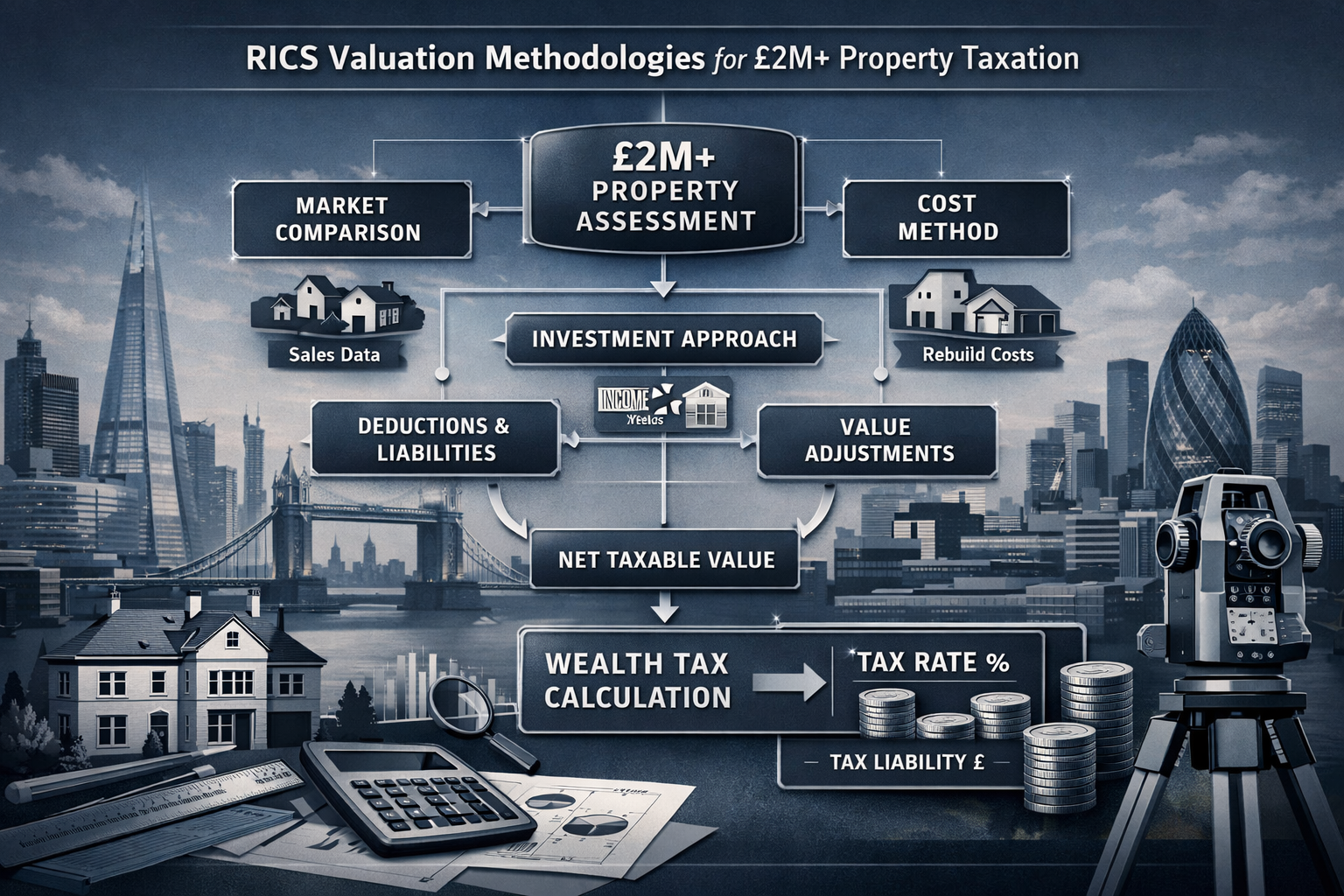
RICS Valuation Methodologies for Navigating New Wealth Taxes in High-Value Property Valuations
Traditional valuation approaches must evolve to address the precision requirements of navigating new wealth taxes in high-value property valuations: RICS strategies for £2M+ surveys post-2026 budget. The five-year revaluation cycle beginning in 2033 means that baseline 2026 valuations carry extraordinary long-term consequences.
Enhanced Comparable Analysis for Threshold Properties
Properties sitting within £100,000 of any surcharge threshold require heightened scrutiny. Standard comparable analysis must be supplemented with:
Micro-market segmentation 🎯
- Analyze sales within 0.25-mile radius rather than broader postcode areas
- Weight recent transactions (Q4 2025 – Q2 2026) more heavily than historical data
- Adjust for seasonal variations in the luxury property market
Specification-level adjustments 📐
- Document every value-adding feature with photographic evidence
- Quantify impact of renovations, extensions, and high-specification finishes
- Create detailed adjustment matrices for comparable properties
Threshold sensitivity analysis ⚖️
- Provide valuation ranges with confidence intervals
- Highlight potential band migration risks
- Document justification for final valuation position relative to thresholds
For properties requiring a Level 3 building survey, the comprehensive nature of these inspections provides ideal opportunities to document condition factors that may justify lower valuations for threshold properties.
Physical Inspection Protocols for High-Stakes Valuations
Desktop valuations are insufficient for properties near surcharge thresholds. RICS best practice for 2026 valuations includes:
Mandatory physical inspections for:
- All properties estimated within £200,000 of any threshold
- Properties with significant recent renovations
- Properties in high-growth areas where historical data may underestimate current values
- Second homes and investment properties where owners may lack detailed property knowledge
Enhanced documentation requirements:
- Minimum 50 photographs covering all rooms and external elevations
- Detailed floor plans with verified measurements
- Condition assessment of all major building elements
- Documentation of any defects that may impact value
Strategic timing considerations:
- Schedule inspections between January-June 2026 for optimal market data availability
- Avoid peak holiday periods when comparable transaction data is limited
- Allow time for appeals process if initial VOA valuation appears inaccurate
The importance of physical inspections cannot be overstated. As highlighted in our guide on how long house surveys take, thorough inspections require adequate time allocation—typically 3-6 hours for high-value properties requiring detailed documentation.
Addressing Renovation Risk During the Valuation Year
One of the most critical strategic considerations for navigating new wealth taxes in high-value property valuations: RICS strategies for £2M+ surveys post-2026 budget involves the timing of property improvements.
The renovation paradox: High-specification improvements completed during 2026 could inadvertently push properties into higher tax brackets for the entire five-year period until 2033.
Strategic guidance for property owners:
✅ Complete before 2026:
- Major extensions or conversions
- High-specification kitchen or bathroom renovations
- Structural improvements that significantly enhance value
⏸️ Defer until after April 2026 valuation:
- Cosmetic upgrades that add £50,000+ in value
- Luxury finishing touches (wine cellars, home cinemas, smart home systems)
- Landscaping projects that enhance overall property appeal
⚠️ Requires careful analysis:
- Essential repairs that maintain but don't enhance value
- Energy efficiency improvements (may be value-neutral or positive)
- Maintenance work that prevents value deterioration
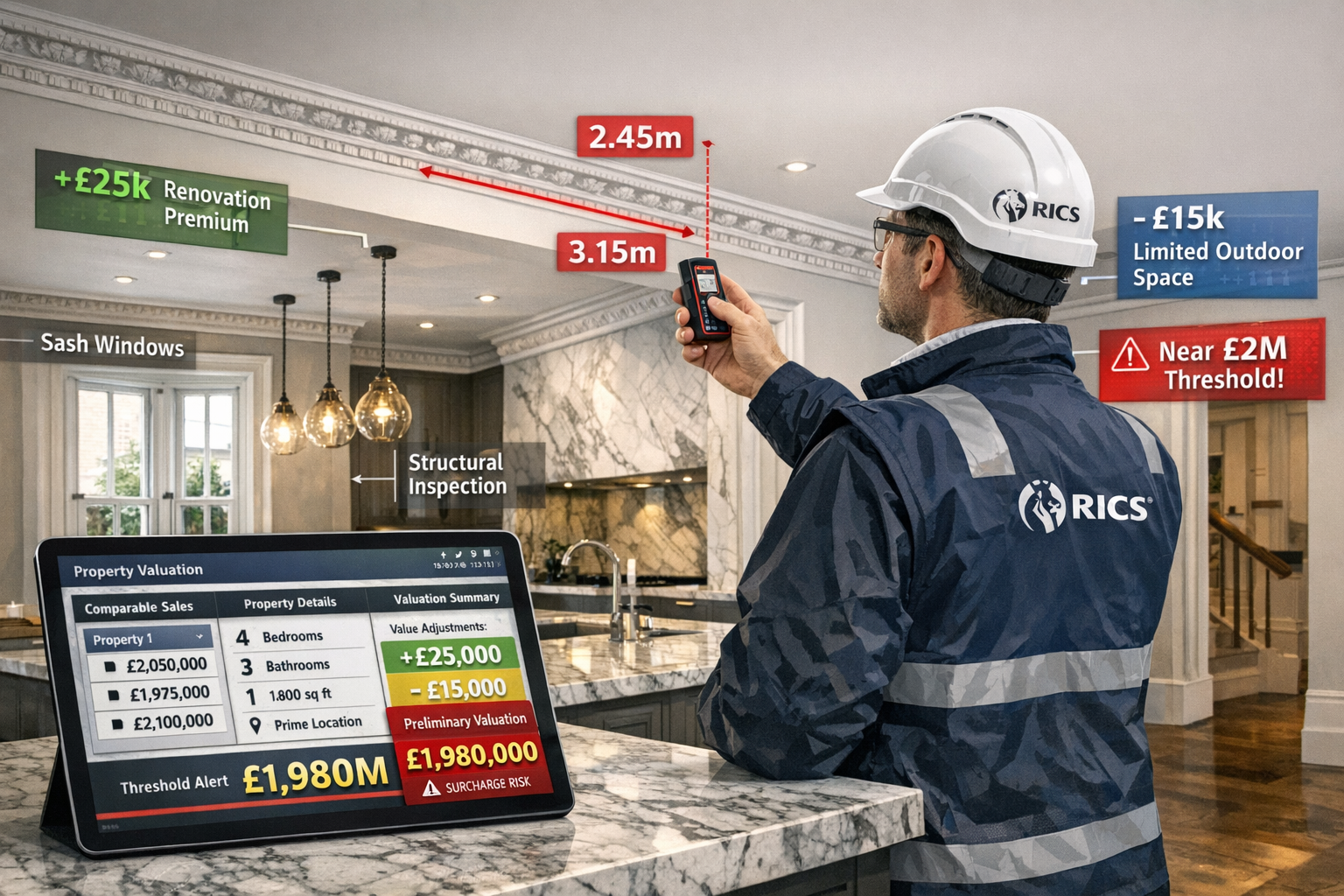
Surveyors providing valuation reports must advise clients on these timing considerations, particularly for properties valued between £1.8 million and £2.2 million where renovation decisions could trigger surcharge liability.
Strategic Approaches for Property Owners and Surveyors
Beyond technical valuation methodologies, navigating new wealth taxes in high-value property valuations: RICS strategies for £2M+ surveys post-2026 budget requires comprehensive strategic planning that addresses both immediate 2026 concerns and long-term tax optimization.
Pre-Valuation Property Positioning
For properties approaching the £2 million threshold, strategic positioning can make the difference between surcharge liability and exemption:
Documentation of defects and deferred maintenance 📝
- Commission detailed condition reports highlighting repair requirements
- Obtain contractor estimates for necessary remedial work
- Document any structural issues, damp problems, or building defects
- Maintain photographic evidence of property condition in early 2026
This approach aligns with the comprehensive analysis provided in specific defect reports, which can substantiate lower valuations based on documented property issues.
Market timing strategies 📅
- Monitor local market conditions throughout 2025-2026
- Understand seasonal variations in the luxury property market
- Consider impact of broader economic conditions on high-value property demand
- Track comparable sales in immediate vicinity
Professional valuation engagement 👔
- Engage RICS-accredited surveyors early in 2026
- Obtain pre-VOA independent valuations for comparison
- Prepare comprehensive property information packs
- Establish clear communication channels with VOA representatives
Appeals and Dispute Resolution Protocols
Given the significant financial implications, property owners should prepare for potential VOA valuation disputes:
Grounds for appeal include:
- Comparable evidence supporting lower valuation
- Property-specific factors not adequately reflected in VOA assessment
- Market condition changes between valuation date and assessment
- Technical errors in VOA methodology or data
Appeal preparation checklist:
- ✅ Obtain independent RICS valuation report
- ✅ Compile comprehensive comparable sales analysis
- ✅ Document all property defects and condition issues
- ✅ Prepare detailed property specification information
- ✅ Gather supporting evidence (photographs, floor plans, surveys)
- ✅ Engage specialist valuation surveyors with appeals experience
For properties with complex ownership structures or party wall considerations, additional documentation may be required to support valuation positions.
Intersection with Inheritance Tax Planning
The 2026 Budget changes extend beyond HVCTS to include significant inheritance tax implications for high-value estates:
Business property relief cap 💼
- Relief now capped at £1 million for trading company holdings
- Excess value above £1 million subject to 20% inheritance tax
- Requires strategic estate planning for business owners with property holdings
Frozen personal allowances 🧊
- Nil rate band remains at £325,000 per individual (unchanged since 2009)
- Residence nil rate band at £175,000 per individual
- Combined married couple allowance of £1 million before IHT applies
- Property price inflation pushing more estates into IHT liability
Integrated planning considerations:
- Coordinate HVCTS valuation strategy with estate planning
- Consider impact of property values on overall estate IHT liability
- Explore legitimate tax planning structures (trusts, lifetime gifts, business structures)
- Engage specialist tax advisors alongside RICS surveyors
For properties requiring probate valuation, the intersection of HVCTS and inheritance tax creates additional complexity that demands coordinated professional advice.
Technology and Data Analytics in High-Value Valuations
Modern RICS surveyors must leverage advanced tools for navigating new wealth taxes in high-value property valuations: RICS strategies for £2M+ surveys post-2026 budget:
Digital valuation platforms 💻
- Automated comparable analysis tools with real-time market data
- Geographic information systems (GIS) for micro-market analysis
- Statistical modeling to identify valuation outliers and anomalies
- Predictive analytics for market trend forecasting
Documentation technology 📱
- 3D scanning and virtual tour creation for comprehensive property records
- Drone photography for external elevation and roof condition assessment
- Digital measurement tools for verified floor area calculations
- Cloud-based collaboration platforms for client communication
Data management systems 📊
- Comprehensive comparable sales databases with detailed filtering
- Historical transaction analysis tools
- Market trend visualization dashboards
- Automated report generation with standardized templates
These technological capabilities enhance the accuracy and defensibility of valuations, particularly important when valuations may be subject to VOA scrutiny or formal appeals processes.
Council Tax Band Misconceptions and HVCTS Reality
A critical aspect of navigating new wealth taxes in high-value property valuations: RICS strategies for £2M+ surveys post-2026 budget involves dispelling common misconceptions about the relationship between existing Council Tax bands and HVCTS liability.
Band H Does Not Equal Surcharge Liability
Many property owners incorrectly assume that Council Tax Band H status automatically triggers HVCTS liability. This dangerous misconception stems from misunderstanding the fundamental difference between 1991 valuations and 2026 market values.
Reality check:
- A Band H property in a low-growth area may be valued well below £2 million in 2026
- Conversely, a Band G property in high-growth London boroughs could exceed £2 million
- 1991 Band H threshold of £320,000 bears no mathematical relationship to 2026 £2 million threshold
- Individual 2026 market valuations are required—historical band assessments are irrelevant
Regional variation examples:
| Location | Band H 1991 Value | Typical 2026 Value | HVCTS Likelihood |
|---|---|---|---|
| Kensington, London | £320,000+ | £2.5m – £8m | Very High ⚠️ |
| Hampstead, London | £320,000+ | £2m – £5m | High ⚠️ |
| Surrey commuter belt | £320,000+ | £1.5m – £2.5m | Moderate ⚡ |
| Northern England | £320,000+ | £800k – £1.5m | Low ✅ |
This geographic variation underscores why chartered surveyors in London face particularly complex HVCTS challenges compared to colleagues in lower-growth regions.
Second Homes and Investment Properties
The HVCTS applies based on asset value regardless of usage status. This creates additional complexity for:
Multiple property owners 🏘️
- Each property assessed individually for HVCTS liability
- No aggregation across portfolio for threshold purposes
- Potential for multiple surcharge liabilities across different properties
Second home considerations 🏖️
- Full HVCTS liability applies to second homes valued over £2 million
- Surcharge applies in addition to any local "second home premiums"
- No usage-based exemptions or reductions available
- Holiday homes in high-value coastal areas particularly affected
Investment property strategies 📈
- Corporate ownership structures may offer planning opportunities
- Requires specialist tax and legal advice
- Must balance HVCTS liability against other tax considerations
- Timing of ownership transfers relative to 2026 valuation date
For landlords dealing with dilapidations surveys, the condition of investment properties at the April 2026 valuation date becomes particularly significant for HVCTS purposes.
Practical Implementation Timeline for 2026
Successful navigating new wealth taxes in high-value property valuations: RICS strategies for £2M+ surveys post-2026 budget requires structured timeline planning:
Q1 2026 (January – March): Preparation Phase
For property owners:
- 📋 Commission preliminary independent RICS valuation
- 🔍 Review property condition and document any defects
- 📸 Create comprehensive photographic record of property state
- 💰 Defer non-essential high-value improvements until after valuation
- 📞 Engage specialist tax advisors for integrated planning
For RICS surveyors:
- 📊 Update comparable sales databases with Q4 2025 transactions
- 🎓 Complete CPD training on HVCTS valuation requirements
- 🤝 Establish VOA liaison protocols and communication channels
- 📝 Develop standardized documentation templates for threshold properties
- 💼 Review professional indemnity insurance coverage for high-stakes valuations
Q2 2026 (April – June): Valuation Window
Critical activities:
- ✅ VOA conducts formal valuations using April 2026 as antecedent date
- ✅ Property owners receive initial valuation assessments
- ✅ Independent RICS surveyors complete verification valuations
- ✅ Identify discrepancies between VOA and independent valuations
- ✅ Prepare preliminary appeal documentation where appropriate
Market monitoring:
- Track comparable sales during valuation period
- Document market conditions and economic factors
- Identify any unusual market distortions affecting valuations
- Compile evidence of "price bunching" around thresholds
Q3-Q4 2026 (July – December): Review and Appeals
For properties near thresholds:
- 📄 Formal review of VOA valuations
- ⚖️ Preparation of detailed appeal submissions where warranted
- 🔬 Commission additional specialist reports (structural, environmental, etc.)
- 👥 Engage in VOA negotiation and dispute resolution processes
- 📋 Finalize documentation for potential tribunal proceedings
Strategic positioning:
- Complete any deferred improvements post-valuation
- Review long-term property strategy in light of confirmed HVCTS liability
- Consider timing of future sales or ownership transfers
- Integrate HVCTS liability into broader estate and tax planning
For properties requiring reinstatement cost valuations for insurance purposes, coordinating these assessments with HVCTS valuations can provide additional supporting documentation.
Risk Mitigation and Professional Standards
RICS surveyors face heightened professional liability when navigating new wealth taxes in high-value property valuations: RICS strategies for £2M+ surveys post-2026 budget. The financial stakes for clients demand exceptional standards of care.
Professional Indemnity Considerations
Enhanced risk factors:
- Valuation errors near thresholds could cost clients £2,500-£7,500 annually for five years
- Total potential liability: £12,500-£37,500 per valuation error over five-year cycle
- Increased likelihood of client claims for negligent valuations
- Potential for VOA challenges to surveyor methodologies
Risk mitigation strategies:
- 🛡️ Maintain adequate professional indemnity insurance coverage
- 📚 Document all valuation assumptions and methodologies comprehensively
- 🔍 Implement peer review processes for threshold valuations
- 📝 Provide clear caveats about valuation uncertainty and market volatility
- 🤝 Engage specialist colleagues for complex or borderline cases
Client Communication and Expectation Management
Transparent communication is essential for managing client expectations:
Key messaging points:
- Explain inherent uncertainty in property valuation (typically ±5-10%)
- Clarify difference between market value and VOA assessment
- Discuss potential for valuation disputes and appeals processes
- Outline timeline and costs for comprehensive valuation services
- Set realistic expectations about outcomes for threshold properties
Documentation requirements:
- Written terms of engagement specifying scope and limitations
- Clear fee structures for valuation and potential appeal work
- Detailed valuation reports with full methodology disclosure
- Regular client updates throughout valuation and appeals processes
- Formal advice letters on strategic timing and property improvement decisions
For surveyors providing expert witness services, the HVCTS creates additional opportunities to support clients in valuation tribunals and dispute resolution proceedings.
Long-Term Market Implications and Future Revaluations
The 2026 HVCTS implementation is just the beginning. The five-year revaluation cycle beginning in 2033 creates ongoing challenges for property owners and surveyors.
2033 Revaluation Horizon
What to expect:
- Fresh market valuations using April 2033 as antecedent date
- Potential for properties to move between surcharge bands
- Market adjustments reflecting five years of price changes
- Possible threshold adjustments for inflation (not yet confirmed)
Strategic implications:
- Properties valued at £1.9 million in 2026 may exceed £2 million by 2033
- Properties near band boundaries in 2026 face highest migration risk
- Long-term property improvement planning must consider revaluation cycles
- Market timing of sales may be influenced by proximity to revaluation dates
Market Stabilization and Price Discovery
The Treasury's predicted 2.5% dampening effect on high-value property prices reflects buyers pricing in cumulative HVCTS costs over anticipated holding periods.
Market adjustment mechanisms:
- Sellers reducing asking prices to maintain post-tax attractiveness
- Buyers demanding discounts to offset ongoing surcharge liability
- Increased price negotiation around threshold boundaries
- Potential for two-tier market above and below £2 million threshold
Long-term equilibrium:
- Initial market disruption likely to stabilize by 2027-2028
- Price bunching around thresholds may diminish as market adjusts
- Geographic concentration in London/South East likely to persist
- Luxury property market may see structural shift in buyer demographics
For those considering whether a homebuyer's survey is worth it, the HVCTS adds another layer of value to professional survey services, particularly for properties approaching valuation thresholds.
Conclusion
Navigating new wealth taxes in high-value property valuations: RICS strategies for £2M+ surveys post-2026 budget represents one of the most significant challenges facing property professionals in a generation. The April 2026 valuation baseline will determine tax liability for thousands of property owners over the next five years, with financial implications running into tens of thousands of pounds for individual properties.
Success requires a multi-faceted approach combining technical valuation excellence, strategic timing considerations, comprehensive documentation, and proactive client communication. RICS surveyors must elevate their standards of care, leverage advanced technology and data analytics, and provide integrated advice that addresses both immediate valuation challenges and long-term tax planning considerations.
Actionable Next Steps
For property owners with properties potentially valued over £1.8 million:
- Commission an independent RICS valuation in Q1 2026 before the formal VOA assessment
- Document property condition comprehensively with photographs and condition reports
- Defer non-essential high-value improvements until after the April 2026 valuation date
- Engage specialist tax advisors to integrate HVCTS planning with broader estate planning
- Prepare for potential appeals by gathering comparable sales evidence and supporting documentation
- Monitor the market for evidence of price adjustments and threshold bunching effects
For RICS surveyors serving the high-value property market:
- Invest in CPD training specifically addressing HVCTS valuation requirements and methodologies
- Upgrade technology platforms for enhanced comparable analysis and documentation
- Review professional indemnity insurance to ensure adequate coverage for high-stakes valuations
- Develop standardized protocols for threshold property inspections and reporting
- Establish VOA liaison relationships to facilitate communication and dispute resolution
- Create client education materials explaining HVCTS implications and strategic options
The 2026 valuation year is rapidly approaching. Those who prepare thoroughly, engage professional expertise early, and implement strategic approaches will be best positioned to navigate this fundamental shift in high-value property taxation. For properties sitting near surcharge thresholds, the difference between a carefully managed valuation strategy and a passive approach could mean thousands of pounds in annual tax liability for years to come.
The time to act is now—before the April 2026 valuation window closes and tax liabilities are locked in for the next five years.
