
{"cover":"Professional landscape format (1536x1024) hero image with bold text overlay: 'Evergreen Party Wall Act Deep Dive: 2026 RICS Updates on Awards, Notices, and Dispute Avoidance' in extra large 70pt white sans-serif font with dark shadow and semi-transparent navy overlay box, centered in upper third. Background shows split composition: left side displays modern UK terraced houses with shared boundary wall, right side shows professional surveyor reviewing technical documents and blueprints. Color scheme: deep navy blue, crisp white, gold accents. High contrast, editorial magazine cover quality, professional architectural photography style with sharp focus and natural lighting.","content":["Detailed landscape format (1536x1024) illustration showing professional party wall award document being drafted, with close-up view of surveyor's hands holding pen over official RICS-branded paperwork. Document displays visible sections including 'Schedule of Condition', 'Rights and Responsibilities', and 'Award Details' with checkboxes and annotations. Background shows desk with measuring tools, architectural plans, and laptop displaying digital award template. Color scheme: professional navy and white with gold RICS accents. Clean, organized composition emphasizing documentation accuracy and completeness. Photorealistic style with shallow depth of field.","Detailed landscape format (1536x1024) infographic-style illustration showing party wall notice timeline and process flow. Visual displays three distinct notice types (Section 1, Section 3, Section 6) as connected flowchart boxes with calendar icons, clock symbols, and checkmark indicators. Center shows example notice letter with highlighted key sections: property address, work description, commencement date, and signature block. Side panels display common pitfalls as red warning icons: insufficient description, wrong timescales, missing details. Color scheme: professional blue gradient with red warning accents and green approval checkmarks. Modern, clean design with clear hierarchy.","Detailed landscape format (1536x1024) professional scene showing two surveyors shaking hands in front of residential property with shared wall. Foreground displays open briefcase containing RICS professional standards documentation, measuring equipment, and tablets showing digital survey forms. Background shows UK terraced houses with visible party wall. Overlay graphics show dispute resolution pathway with icons: initial disagreement, surveyor appointment, negotiation, agreed award. Color scheme: trustworthy navy blue, professional grey, success green accents. Photorealistic business photography style with natural outdoor lighting and professional composition."]
}
When property owners in England and Wales plan building work affecting shared walls, the Party Wall etc. Act 1996 becomes their legal compass. However, navigating this legislation requires more than basic awareness—it demands precision in documentation, timing, and professional conduct. As we progress through 2026, the Royal Institution of Chartered Surveyors (RICS) continues to refine professional standards that govern how surveyors handle party wall matters, making this Evergreen Party Wall Act Deep Dive: 2026 RICS Updates on Awards, Notices, and Dispute Avoidance essential reading for property owners, developers, and construction professionals across all UK regions.
The stakes are high: poorly drafted notices can invalidate entire procedures, incomplete awards leave property owners vulnerable to future disputes, and selecting the wrong surveyor can transform straightforward projects into costly legal battles. This comprehensive guide examines the latest RICS protocols, explores best practices for drafting complete awards, identifies common pitfalls in party wall notices, and provides actionable strategies for selecting agreed surveyors who can facilitate smooth project completion.
Key Takeaways
✅ RICS professional standards established in 2023 continue to govern party wall surveyor conduct in 2026, emphasizing procedural accuracy and ethical practice across all UK regions [2]
✅ Complete party wall awards must include detailed schedules of condition, specific rights granted, clear dispute resolution mechanisms, and comprehensive cost provisions to protect all parties
✅ Notice timing and content remain the most common source of party wall procedure failures, with insufficient work descriptions and incorrect service methods invalidating otherwise valid notices
✅ Agreed surveyor appointments offer significant cost and time advantages but require careful selection criteria including RICS membership, relevant experience, and demonstrated impartiality
✅ Dispute avoidance strategies focus on early communication, transparent documentation, and professional surveyor engagement before conflicts escalate to formal proceedings
Understanding the RICS Framework for Party Wall Procedures in 2026
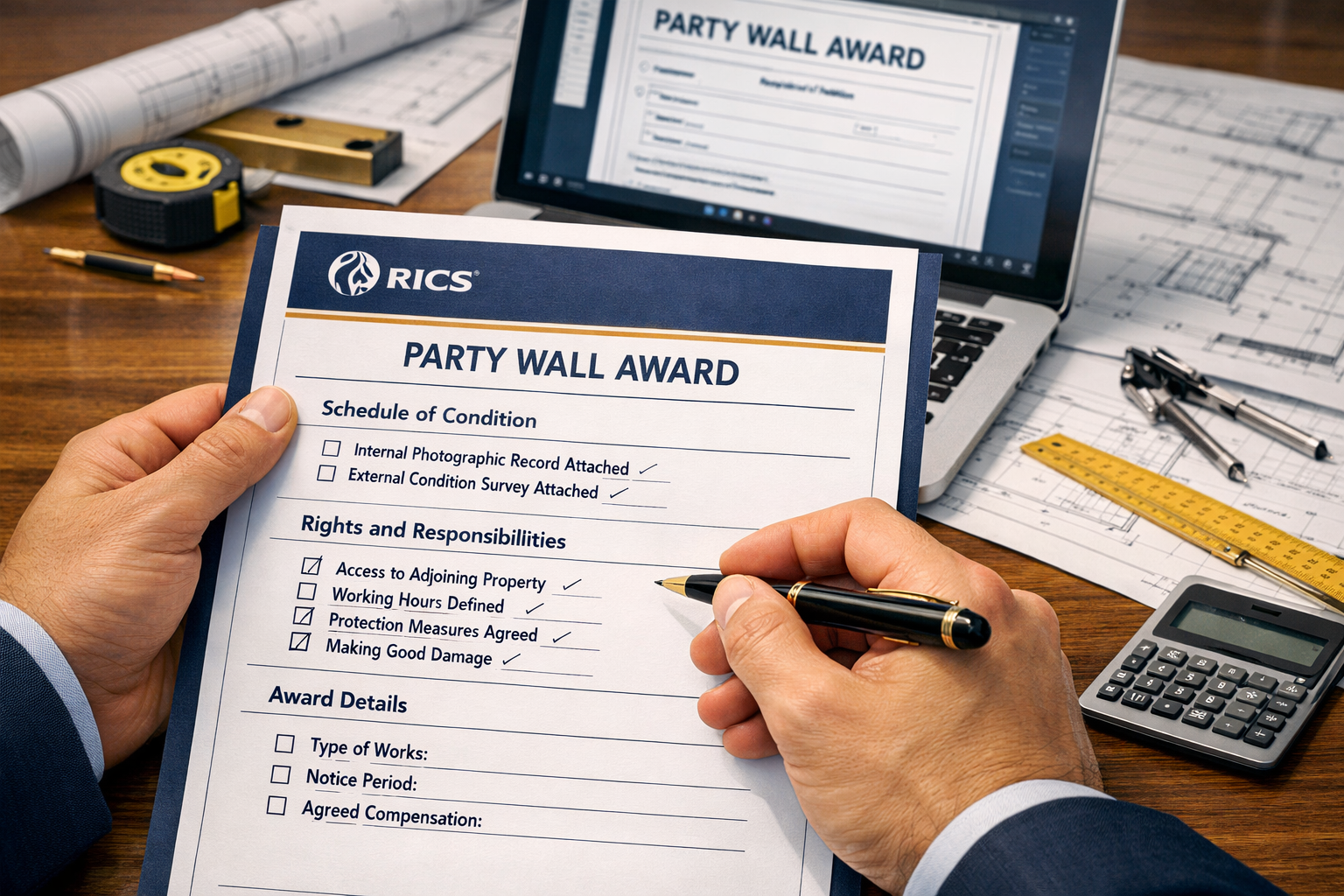
The Royal Institution of Chartered Surveyors plays a pivotal role in maintaining professional standards for party wall surveyors. The RICS Party Wall Legislation and Procedure standard, reissued as a professional standard in May 2023, continues to provide the authoritative framework for surveyor conduct in 2026 [2]. This standard addresses critical aspects of surveyor behavior, procedural requirements, and ethical obligations that directly impact how party wall awards are drafted and disputes are resolved.
Current RICS Policy Priorities Affecting Party Wall Practice
While RICS's January 2026 advocacy update focuses primarily on broader construction and planning reforms—including the planning framework reform, the establishment of a construction regulator, and the warm homes plan [1]—these policy initiatives indirectly influence party wall practice. For instance, increased focus on building safety and construction quality means party wall surveyors must exercise greater diligence when assessing proposed works and their potential impact on neighboring properties.
The professional standards framework ensures that surveyors across London, the Home Counties, and throughout England and Wales apply consistent methodology when:
- Assessing notice validity and compliance with statutory requirements
- Conducting pre-work inspections and preparing schedules of condition
- Drafting awards that balance building owner rights with adjoining owner protections
- Managing disputes through impartial, evidence-based decision-making
- Determining costs and fee apportionment in accordance with the Act
Evolution Through Case Law and Practice
A significant development affecting the Evergreen Party Wall Act Deep Dive: 2026 RICS Updates on Awards, Notices, and Dispute Avoidance comes from evolving case law. Court decisions since the Act's implementation have progressively refined how surveyors interpret statutory provisions, particularly regarding notice sufficiency, award enforceability, and surveyor liability [3]. These judicial interpretations now form part of the practical knowledge base that competent party wall surveyors must possess.
"The Party Wall Act remains an evergreen piece of legislation, but its application must evolve with changing construction practices, building technologies, and judicial interpretation." — RICS Building Surveying Standards
Drafting Complete Party Wall Awards: The 2026 Best Practice Guide
A party wall award represents the formal determination made by surveyors under the Party Wall etc. Act 1996. The quality and completeness of this document directly determines whether building work proceeds smoothly or becomes mired in subsequent disputes. Understanding how to draft—or evaluate—a comprehensive award is central to this Evergreen Party Wall Act Deep Dive: 2026 RICS Updates on Awards, Notices, and Dispute Avoidance.
Essential Components of a Comprehensive Award
Every complete party wall award must include specific elements to satisfy both statutory requirements and practical enforceability. The following table outlines the critical components:
| Award Component | Purpose | Common Deficiencies |
|---|---|---|
| Parties and Properties | Identifies all affected parties and properties with precise addresses | Incomplete owner details, missing leaseholder information |
| Works Description | Details the exact nature, extent, and methodology of proposed works | Vague descriptions, missing technical specifications |
| Schedule of Condition | Documents pre-work condition of adjoining property with photographs | Insufficient photographic evidence, incomplete room coverage |
| Rights Granted | Specifies what the building owner may do, when, and under what conditions | Ambiguous access rights, unclear working hours |
| Safeguards Required | Mandates protective measures during construction | Generic requirements not tailored to specific works |
| Dispute Resolution | Establishes procedures for addressing disagreements during works | Missing or inadequate appeal mechanisms |
| Cost Provisions | Determines who pays surveyor fees and how disputes about costs are resolved | Unclear fee responsibility, missing cost dispute procedures |
The Schedule of Condition: Foundation of Protection
The schedule of condition represents perhaps the most critical element of any party wall award. This detailed record establishes the baseline condition of the adjoining owner's property before work commences, providing the only reliable evidence for assessing whether subsequent damage resulted from the building owner's works.
Best practice in 2026 for schedules of condition includes:
📸 Comprehensive photographic documentation of all rooms, external elevations, and specific vulnerable features (plasterwork, decorative moldings, existing cracks)
📝 Written descriptions accompanying each photograph, noting existing defects, material conditions, and areas of particular concern
📊 Measurement records for existing cracks or settlement, allowing post-work comparison
🗓️ Date-stamped evidence proving the condition assessment occurred before work commenced
Property owners should review their party wall agreement to ensure the schedule of condition meets these standards. Inadequate schedules leave adjoining owners vulnerable to uncompensated damage and building owners exposed to inflated damage claims.
Rights, Restrictions, and Working Parameters
A complete award must precisely define what the building owner may do. Ambiguity in this section creates the conditions for disputes. Effective awards specify:
- Exact access rights: Which areas of the adjoining owner's property may be accessed, for what purposes, and with what notice requirements
- Working hours: Permitted days and times for noisy or intrusive works
- Methodology restrictions: Prohibited techniques or equipment that might cause excessive disturbance or damage
- Progress notification: Requirements for the building owner to inform the adjoining owner of work stages
- Inspection rights: When and how the adjoining owner or their surveyor may inspect ongoing works
For example, rather than stating "the building owner may access the adjoining property as necessary," a complete award specifies: "The building owner's contractors may access the rear garden of [address] on weekdays between 8:00 AM and 6:00 PM, with 48 hours' written notice, for the purpose of erecting and dismantling scaffolding only."
Cost Provisions and Fee Responsibility
The question of who pays for a party wall surveyor often creates tension. The Act establishes that the building owner—the party initiating the works—typically bears all reasonable costs, including:
- The building owner's surveyor fees
- The adjoining owner's surveyor fees
- The agreed surveyor's fees (if appointed)
- Reasonable costs for preparing the schedule of condition
- Costs associated with award preparation and service
However, awards must also address scenarios where costs become disputed or where the adjoining owner's surveyor's fees appear unreasonable. Best practice includes establishing a fee dispute resolution mechanism within the award itself, preventing minor cost disagreements from escalating into formal appeals.
Avoiding Critical Pitfalls in Party Wall Notices
Before any award can be drafted, the building owner must serve valid notice on affected adjoining owners. Notice deficiencies represent the single most common cause of party wall procedure failures. This section of our Evergreen Party Wall Act Deep Dive: 2026 RICS Updates on Awards, Notices, and Dispute Avoidance addresses how to ensure notices meet statutory requirements.
The Three Types of Party Wall Notices
The Party Wall etc. Act 1996 establishes three distinct notice types, each with specific requirements:
1. Section 1 Notice (New Building on the Line of Junction) 🏗️
- Required when building a new wall astride or up to the boundary line
- Must be served at least one month before work begins
- Must specify whether the wall will be built on the boundary line, astride it, or entirely on the building owner's land
2. Section 3 Notice (Excavation Near Neighboring Buildings) ⛏️
- Required when excavating within 3 meters of a neighbor's structure and going deeper than its foundations, or within 6 meters and cutting a line at 45 degrees from the bottom of their foundations
- Must be served at least one month before work begins
- Must include plans and sections showing the proposed excavation depth and proximity
3. Section 6 Notice (Work to Existing Party Structures) 🔨
- Required for work directly to an existing party wall, party fence wall, or party structure
- Must be served at least two months before work begins
- Must describe the proposed work in sufficient detail for the adjoining owner to understand its nature and extent
Understanding party wall act notices and their specific requirements prevents the costly mistake of commencing work with invalid notices.
Common Notice Deficiencies That Invalidate Procedures
Analysis of party wall disputes in 2026 reveals recurring notice failures:
❌ Insufficient work description: Notices stating "loft conversion" or "basement extension" without detailing specific party wall implications
❌ Incorrect timing: Serving Section 6 notices only one month before work (rather than the required two months)
❌ Improper service method: Relying solely on email when the Act requires written notice (though email may supplement physical service)
❌ Missing technical information: Failing to include required plans and sections with Section 3 notices
❌ Wrong recipients: Serving notice on occupiers rather than legal owners, or missing leaseholders who have statutory rights
❌ Ambiguous commencement dates: Stating "work will begin in approximately two months" rather than providing a specific proposed start date
Best Practice Notice Content for 2026
A properly drafted party wall notice should include:
Clear Property Identification
- Full addresses of both the building owner's and adjoining owner's properties
- Title numbers where available
- Identification of the specific party wall or boundary affected
Detailed Work Description
- Specific operations to be performed (e.g., "removing existing chimney breast from party wall," "underpinning party wall foundations to depth of 2.5 meters")
- Methodology where relevant to the adjoining owner's interests
- Expected duration of works affecting the party structure
Supporting Documentation
- Architectural drawings showing the party wall and proposed works
- Structural engineer's details where structural alterations are proposed
- Cross-sections showing excavation depths and proximity (for Section 3 notices)
Statutory Information
- Proposed commencement date (specific date, not approximate timeframe)
- Building owner's contact information
- Statement of the adjoining owner's rights under the Act
Property owners can reference our guide on how to write a party wall letter for template language and legal requirements.
Service Methods and Proof of Delivery
Valid notice service requires verifiable delivery to the correct recipients. In 2026, best practice combines traditional and modern methods:
Recommended Service Methods:
- Hand delivery with signed acknowledgment
- Recorded delivery postal service providing proof of delivery
- Email plus postal service (belt-and-braces approach)
- Service through solicitors for complex or contentious situations
Evidence to Retain:
- Copies of all notices as served
- Postal tracking information and delivery confirmations
- Email delivery receipts and read confirmations
- Photographs of hand-delivered notices
- Signed acknowledgments where obtained
Failure to prove valid service can invalidate the entire procedure, potentially requiring the building owner to restart the notice process and delay project commencement by months.
Selecting and Working with Agreed Surveyors: Strategic Advantages
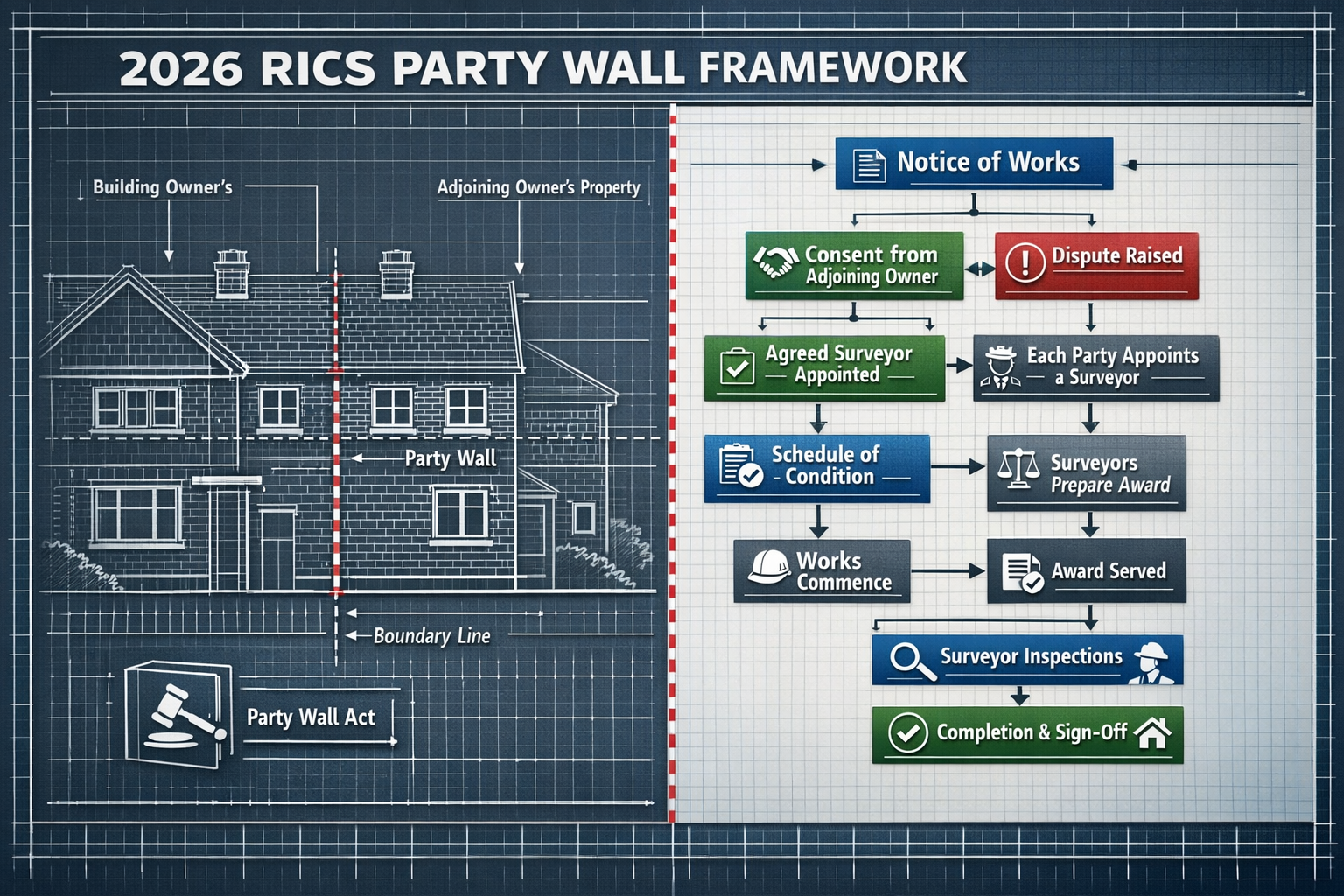
When an adjoining owner dissents from a party wall notice (or fails to respond within 14 days, constituting deemed dissent), the Act requires surveyor appointment. Both parties may appoint their own surveyors, or they may jointly appoint a single agreed surveyor. This section of our Evergreen Party Wall Act Deep Dive: 2026 RICS Updates on Awards, Notices, and Dispute Avoidance explores the strategic considerations around agreed surveyor appointments.
The Agreed Surveyor Advantage: Cost and Efficiency
Appointing an agreed surveyor rather than separate surveyors for each party offers several benefits:
💰 Reduced costs: One surveyor's fee instead of two, plus no third surveyor fees if disputes arise
⏱️ Faster process: Single surveyor can make determinations immediately without requiring consultation with another surveyor
🤝 Simplified communication: One point of contact for both parties reduces coordination complexity
📋 Streamlined documentation: Single award document rather than coordinated awards from two surveyors
However, these advantages only materialize when the agreed surveyor possesses appropriate qualifications, experience, and demonstrates genuine impartiality.
Essential Criteria for Agreed Surveyor Selection
Not all surveyors are equally suited to party wall work. When considering an agreed surveyor appointment, both parties should evaluate:
Professional Qualifications 🎓
- RICS membership (MRICS or FRICS designation)
- Specific party wall expertise (not all chartered surveyors specialize in this area)
- Professional indemnity insurance adequate for the project value
- Continuing professional development in party wall matters
Relevant Experience 📊
- Track record with similar project types (residential extensions, loft conversions, basement excavations, etc.)
- Familiarity with local building practices and construction methods
- Experience with the specific type of party structure involved
- Demonstrated ability to draft comprehensive awards
Impartiality Indicators ⚖️
- No prior relationship with either party
- No financial interest in the project's outcome
- Willingness to act fairly between both parties' interests
- Clear fee structure agreed before appointment
Geographic Knowledge 🗺️
- Understanding of local construction practices
- Familiarity with regional building types and common issues
- Accessibility for site inspections and meetings
Property owners can learn more about what a party wall surveyor does to better evaluate candidate qualifications.
Red Flags: When Not to Appoint an Agreed Surveyor
While agreed surveyor appointments offer advantages, certain circumstances warrant appointing separate surveyors:
🚩 Complex or high-value projects where each party benefits from independent professional advice
🚩 Pre-existing disputes between neighbors that suggest impartiality may be questioned regardless of the surveyor's conduct
🚩 Significant power imbalances (e.g., developer versus residential owner) where the adjoining owner needs independent advocacy
🚩 Unusual or technically complex works where the adjoining owner's interests require specialist assessment
🚩 Surveyor recommended by the building owner without the adjoining owner conducting independent due diligence
In these situations, appointing separate surveyors—even at higher cost—provides better protection for both parties' interests.
The Appointment Process and Documentation
Formal agreed surveyor appointment requires written documentation from both parties. Best practice includes:
Joint Appointment Letter containing:
- Confirmation that both parties agree to the appointment
- Acknowledgment of the surveyor's duty to act impartially
- Agreement on the surveyor's fee basis and payment responsibility
- Specification of the surveyor's scope of work
- Confirmation of the surveyor's RICS membership and insurance
Surveyor's Acceptance confirming:
- Acceptance of the appointment
- Confirmation of impartiality and absence of conflicts
- Fee estimate or hourly rate
- Expected timeline for award preparation
- Contact information and availability
This documentation protects all parties and establishes clear expectations before work commences.
Dispute Avoidance Strategies: Preventing Party Wall Conflicts
The most effective party wall disputes are those that never occur. This final section of our Evergreen Party Wall Act Deep Dive: 2026 RICS Updates on Awards, Notices, and Dispute Avoidance focuses on proactive strategies for preventing conflicts throughout the party wall process.
Early Communication: The Foundation of Cooperation
Many party wall disputes stem from poor communication rather than genuine conflicts of interest. Property owners planning building work should:
Initiate informal discussions before serving formal notices
- Explain the project's nature and benefits
- Address concerns about noise, disruption, and access
- Demonstrate consideration for the neighbor's interests
- Build goodwill that facilitates smoother formal procedures
Provide comprehensive information beyond statutory minimums
- Share architectural drawings and visualizations
- Explain construction methodology and timeline
- Offer site visits to show planned works
- Introduce the building owner's professional team
Maintain ongoing dialogue throughout the process
- Regular updates on project progress
- Advance notice of particularly disruptive work phases
- Responsive communication when concerns arise
- Transparent handling of any damage or issues
This approach transforms the party wall process from adversarial procedure to collaborative problem-solving.
Professional Engagement at the Right Time
Engaging qualified professionals early prevents problems that arise from DIY approaches. Consider:
Pre-notice surveyor consultation
- Review proposed works to identify party wall implications
- Ensure notices will contain sufficient information
- Advise on timing and service methods
- Prepare supporting documentation
Structural engineer involvement
- Design works that minimize party wall impact
- Provide technical specifications for notices and awards
- Offer professional reassurance to concerned adjoining owners
- Ensure works comply with Building Regulations
Legal advice for complex situations
- Review unusual ownership structures (leasehold, shared ownership)
- Address pre-existing boundary disputes
- Navigate situations involving multiple adjoining owners
- Ensure compliance with restrictive covenants alongside party wall requirements
Understanding when you need a party wall agreement helps property owners engage professionals at the optimal time.
Transparent Documentation and Record-Keeping
Comprehensive records prevent disputes about what was agreed, what was found, and what occurred:
📁 Maintain complete files including:
- All correspondence with adjoining owners
- Copies of notices as served with proof of service
- Photographic records before, during, and after works
- Surveyor reports and award documents
- Contractor records of work performed near party structures
- Any damage reports and remediation records
📸 Document everything that might later become disputed:
- Pre-work condition of both properties
- Work methodology and protective measures employed
- Any incidents, damage, or concerns during construction
- Remediation work and final condition
🔄 Share information proactively:
- Provide copies of reports to adjoining owners
- Invite adjoining owners to review schedules of condition
- Offer access for the adjoining owner's surveyor to inspect works
- Maintain transparency about project changes affecting party walls
Addressing Issues Immediately
When problems arise during construction, immediate action prevents escalation:
Damage Response Protocol:
- Stop work in the affected area immediately
- Notify the adjoining owner and their surveyor promptly
- Document the damage with photographs and written description
- Assess whether damage results from party wall works
- Remediate promptly using qualified contractors
- Verify completion with the adjoining owner's surveyor
Dispute De-escalation:
- Acknowledge concerns without admitting liability
- Engage surveyors to assess and mediate
- Propose reasonable solutions proactively
- Consider independent expert assessment for technical disputes
- Maintain professional, courteous communication throughout
For guidance on managing conflicts, review our comprehensive resource on resolving party wall disputes.
Special Considerations for Common Project Types
Different building projects present characteristic party wall challenges:
Loft Conversions 🏠
- Often require party wall work for steel beam installation
- May affect shared roof structures or chimneys
- Require careful assessment of load-bearing party walls
- See our specialized guide on party wall for loft conversions
Basement Excavations ⬇️
- Trigger Section 3 notice requirements for deep excavations
- Require underpinning of party walls in many cases
- Present higher risk of settlement damage
- Demand particularly robust schedules of condition
Chimney Breast Removal 🧱
- Affects party wall structure directly
- May require support for the adjoining owner's retained chimney
- Involves structural calculations and Building Control approval
- Learn more about party wall shared chimneys
Insulation and Damp-Proofing 💧
- May require party wall notice for certain methods
- Consider our guide on party wall insulation
- Requires careful specification to avoid moisture transfer
Regional Considerations Across England and Wales
While the Party Wall etc. Act 1996 applies uniformly across England and Wales, practical implementation varies by region based on local building practices, property types, and construction methods.
London and Dense Urban Areas
Properties in London and other dense urban centers present unique challenges:
- Terraced housing with multiple shared walls
- Conversion flats with complex ownership structures
- High property values increasing dispute stakes
- Professional developer activity requiring experienced surveyors
For London-specific expertise, consider consulting chartered surveyors in Central London or specialists in areas like West London, East London, or specific neighborhoods such as Camden, Fulham, or Clapham.
Home Counties and Suburban Regions
The Home Counties present different characteristics:
- Semi-detached properties with single shared walls
- Larger plots with fewer immediate neighbors
- Mixed property ages requiring varied approaches
- Less frequent party wall work meaning less neighbor familiarity with procedures
Surveyors serving Berkshire, Buckinghamshire, Hampshire, and specific towns like Guildford, Weybridge, Watford, or Harpenden understand these regional nuances.
Wales and Rural Areas
Welsh and rural properties may involve:
- Stone construction requiring specialized knowledge
- Agricultural buildings with party walls
- Listed buildings with additional conservation considerations
- Language considerations in Welsh-speaking areas (bilingual documentation)
Conclusion: Mastering Party Wall Procedures in 2026
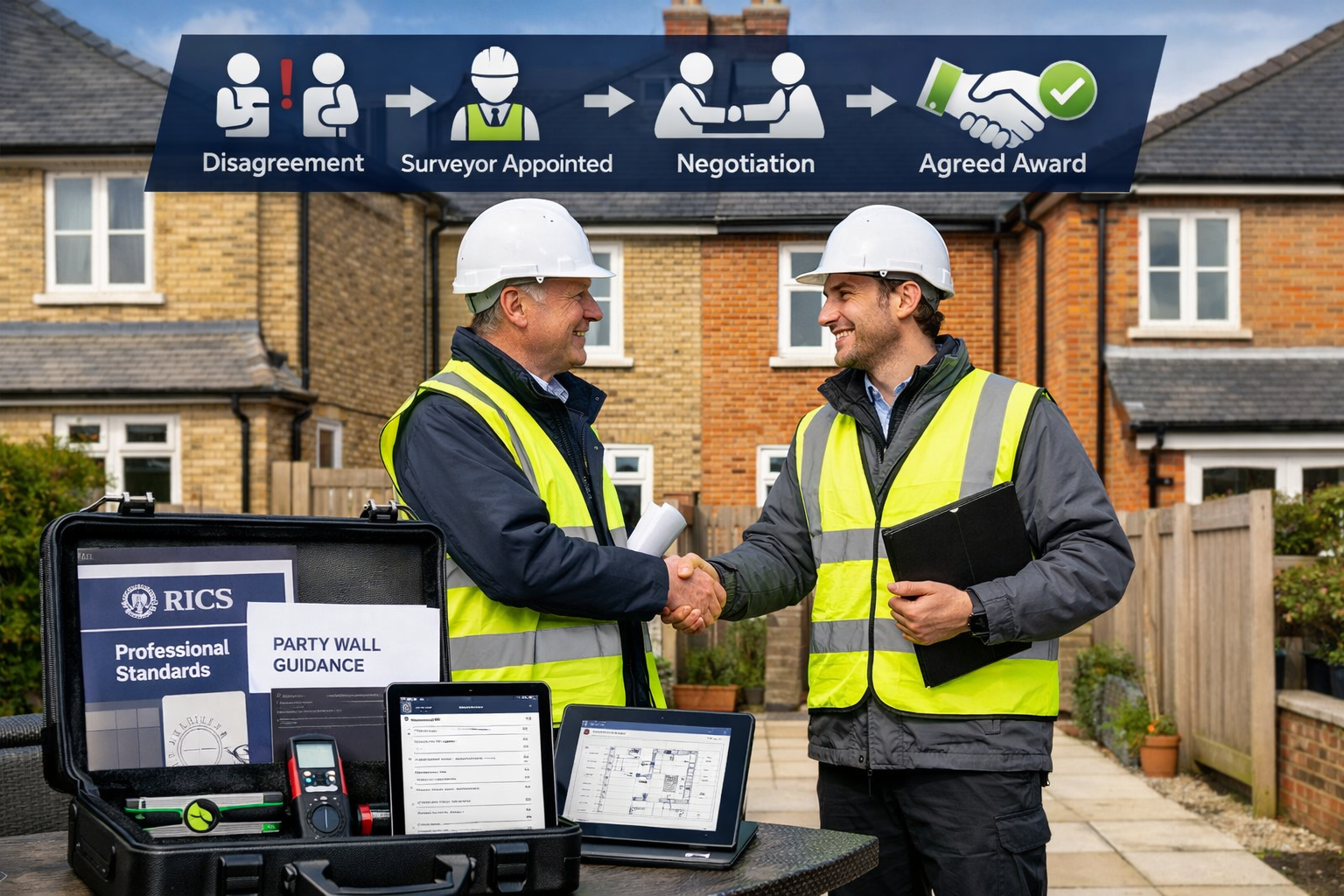
The Evergreen Party Wall Act Deep Dive: 2026 RICS Updates on Awards, Notices, and Dispute Avoidance reveals that successful party wall procedures rest on three pillars: precise documentation, professional expertise, and proactive communication. The Party Wall etc. Act 1996 remains the governing legislation, but its effective application requires understanding current RICS professional standards [2], evolving case law [3], and best practices developed through decades of practical implementation.
Key Success Factors
Property owners and professionals who achieve smooth party wall procedures consistently demonstrate:
✅ Meticulous notice preparation with comprehensive work descriptions, correct timing, and verifiable service methods
✅ Complete award drafting including detailed schedules of condition, precise rights granted, and clear cost provisions
✅ Strategic surveyor selection prioritizing RICS membership, relevant experience, and demonstrated impartiality
✅ Proactive dispute avoidance through early communication, transparent documentation, and immediate issue resolution
✅ Regional awareness of local building practices, property types, and construction methods
Actionable Next Steps
For property owners planning building work affecting party walls:
- Assess your project against the three notice types to determine requirements
- Engage a qualified party wall surveyor early in the planning process
- Initiate informal discussions with neighbors before serving formal notices
- Ensure notices contain comprehensive work descriptions and supporting documentation
- Verify service methods provide proof of delivery to all affected parties
- Review draft awards for completeness before acceptance
- Maintain comprehensive records throughout the construction process
- Address any issues immediately to prevent escalation
For adjoining owners who receive party wall notices:
- Seek professional advice promptly—the 14-day response period is short
- Consider your options: consent, dissent with own surveyor, or agree to an agreed surveyor
- Evaluate surveyor qualifications carefully before agreeing to appointments
- Review schedules of condition thoroughly before works commence
- Maintain communication with your surveyor throughout the project
- Document any concerns immediately and report to your surveyor
The Path Forward
As construction practices evolve, building technologies advance, and case law continues to develop, the practical application of the Party Wall etc. Act 1996 will continue to adapt. However, the fundamental principles remain constant: respect for property rights, fair procedures, and professional conduct.
The RICS professional standards framework [2] ensures that qualified surveyors maintain competence and ethical practice, while broader policy developments [1] in construction regulation and building safety reinforce the importance of rigorous party wall procedures. Property owners who invest in proper procedures, engage qualified professionals, and prioritize neighbor relations will find that party wall requirements facilitate rather than obstruct successful building projects.
For comprehensive party wall support across all regions of England and Wales, professional party wall services provide the expertise necessary to navigate these procedures successfully. Whether undertaking a simple loft conversion or complex basement excavation, proper party wall management protects property values, preserves neighbor relationships, and ensures legal compliance throughout the construction process.
References
[1] Uk Influence And Advocacy Update January 2026 – https://www.rics.org/news-insights/uk-influence-and-advocacy-update-january-2026
[2] Party Wall Legislation And Procedure – https://www.rics.org/profession-standards/rics-standards-and-guidance/sector-standards/building-surveying-standards/party-wall-legislation-and-procedure
[3] Watch – https://www.youtube.com/watch?v=LSTVHcPimTc
[4] rics – https://www.rics.org
