
Nearly one in three basement excavation projects in dense UK urban areas triggers a formal party wall dispute — and the vast majority of those disputes stem from damage that could have been identified before a single shovel broke ground. That gap between what surveyors could know and what they actually knew at the planning stage is closing fast, thanks to digital twin technology.
Digital Twins for Predictive Party Wall Assessments: Anticipating Structural Risks in 2026 Excavation Projects represents one of the most significant shifts in construction risk management this decade. By creating living, data-rich virtual replicas of buildings and their surrounding ground conditions, surveyors can now model the precise impact of deep excavations on neighbouring structures before work commences — replacing reactive dispute management with proactive neighbour protection.
This article explores how digital twin frameworks are transforming the party wall process in 2026, what the technology actually does, and how property owners, developers, and surveyors can leverage it to avoid costly structural surprises.
Key Takeaways 📌
- Digital twins create real-time virtual replicas of buildings and soil conditions, enabling predictive structural risk modelling before excavation begins.
- Machine learning-powered twins can predict structural responses up to 10,000× faster than traditional finite element analysis. [1]
- Physics-Informed Neural Networks (PINNs) enable continuous deformation monitoring with high stress-resolution, ideal for sensitive party wall scenarios. [3]
- Integrating BIM, LiDAR, drone imagery, and sensor data into a single twin model gives surveyors an unprecedented view of risk across adjacent properties. [5][6]
- Digital twins support RICS-aligned documentation, strengthening party wall awards and reducing the likelihood of neighbour disputes escalating to legal proceedings.
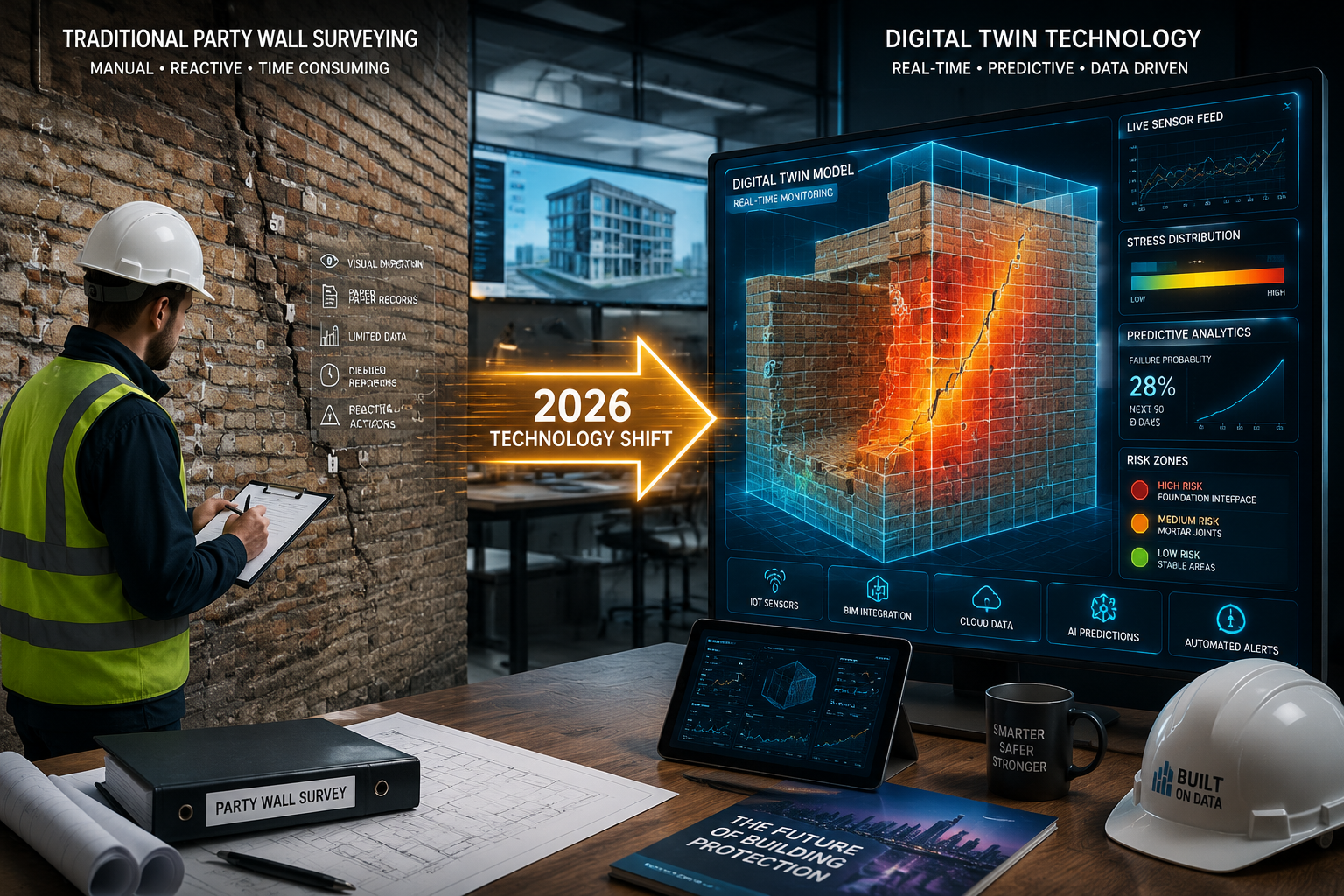
What Are Digital Twins and Why Do They Matter for Party Wall Surveying?
A digital twin is a dynamic, continuously updated virtual model of a physical asset — in this context, a building, a section of ground, or an entire urban block. Unlike a static BIM drawing or a one-time structural survey, a digital twin ingests live data from sensors, drone scans, and environmental feeds to reflect the asset's real-world condition at any given moment. [6]
For party wall surveying, this distinction is transformative. Traditional assessments rely on visual inspections, historic records, and the surveyor's professional judgement. Digital twins add a predictive layer: they can simulate what will happen to a neighbouring wall when excavation reaches a certain depth, when groundwater levels shift, or when vibration from piling equipment exceeds a threshold.
💡 Pull Quote: "A digital twin doesn't just show you what a building looks like — it shows you what it will do under stress conditions you haven't yet created."
The Party Wall Act Context
Under the Party Wall etc. Act 1996, building owners must serve formal notice before undertaking excavations within 3 or 6 metres of a neighbour's structure (depending on depth). Neighbours can consent or dissent, and in the event of dissent, a party wall surveyor must be appointed. Understanding the party wall excavation notice process is the essential starting point for any excavation project.
What the Act does not specify is how the risk to adjoining structures should be assessed — and this is precisely where digital twin technology is filling a critical gap in 2026. For a thorough grounding in the legal framework, the comprehensive UK homeowners' guide to the Party Wall Act remains essential reading.
How Digital Twins for Predictive Party Wall Assessments Work in Practice
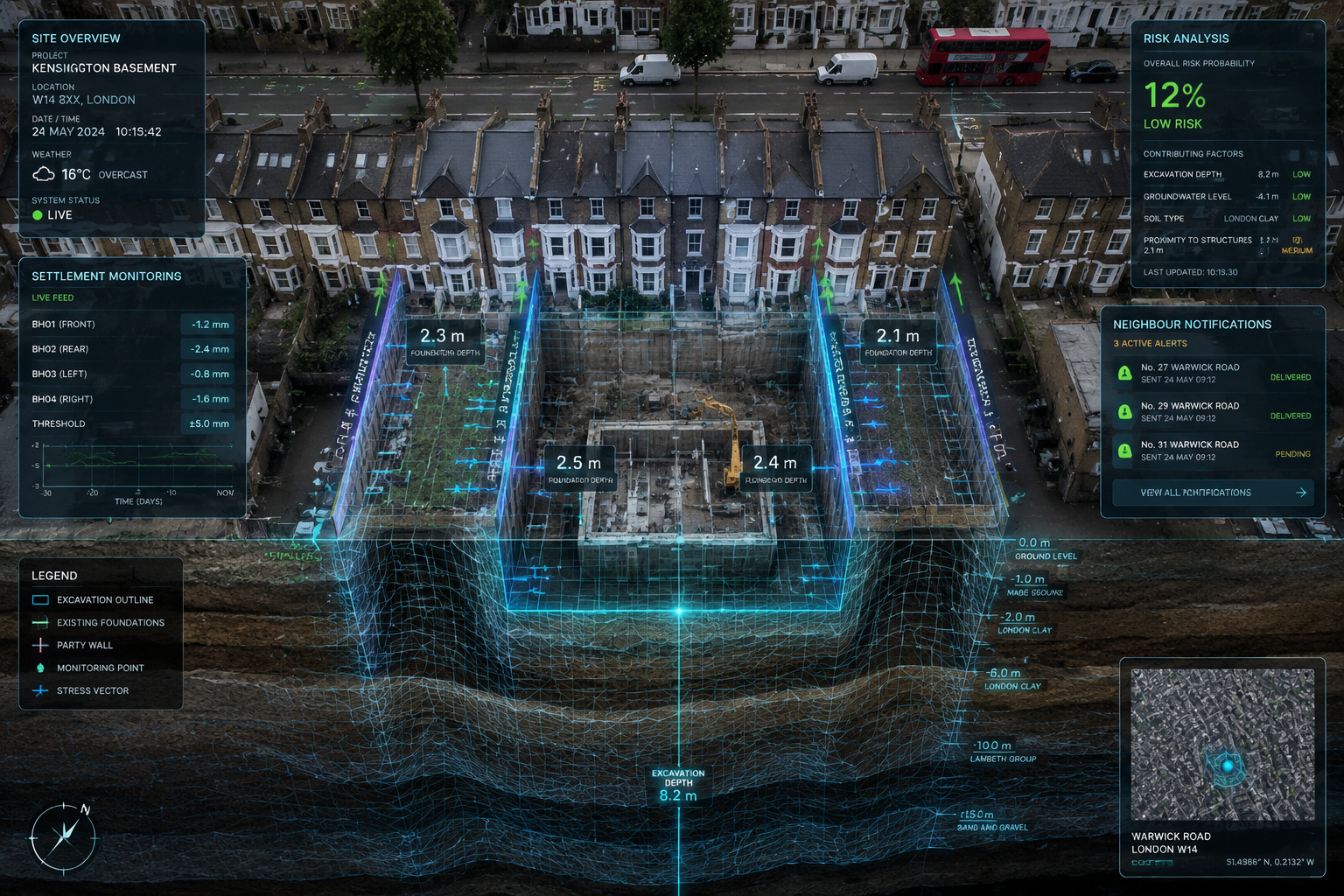
The workflow for deploying Digital Twins for Predictive Party Wall Assessments: Anticipating Structural Risks in 2026 Excavation Projects typically involves four integrated stages:
Stage 1: Data Capture and Model Construction
The process begins with comprehensive data gathering using:
| Data Source | What It Captures | Technology Used |
|---|---|---|
| LiDAR scanning | Precise external geometry of all adjacent buildings | Ground-based or drone-mounted scanners |
| Drone photogrammetry | Surface condition, crack mapping, material identification | High-resolution UAV imagery |
| Ground-penetrating radar | Foundation depth, soil stratification, voids | GPR survey equipment |
| Historic records | Previous structural interventions, subsidence events | RICS archives, council records |
| IoT sensors | Live vibration, tilt, and settlement data | Embedded monitoring hardware |
Research from Ithaca's citywide digital twin project — which modelled all 5,200 buildings in the city using drone imagery, LiDAR, and geospatial data — demonstrates that this kind of multi-source integration is now operationally viable at scale. [5] The same methodology is being adapted for individual party wall assessments in UK urban environments.
Stage 2: Physics-Informed Simulation
Once the model is built, Physics-Informed Neural Networks (PINNs) are applied to simulate structural behaviour. PINNs combine the predictive power of machine learning with the physical laws governing structural mechanics — meaning their predictions are not just statistically probable but physically plausible. [3]
For a party wall scenario, this means the twin can model:
- Settlement curves as excavation depth increases
- Lateral deflection of the party wall under soil pressure changes
- Crack propagation pathways through masonry
- Vibration transmission from piling or breaking equipment
A landmark study published in Nature demonstrated that a digital twin framework using machine learning predicted nonlinear structural responses of reinforced concrete walls in under 2 seconds — compared to hours using conventional finite element analysis. That represents a speed improvement of 3–4 orders of magnitude. [1] Applied to party wall assessments, this means surveyors can run dozens of "what if" excavation scenarios in a single working session.
Stage 3: Risk Quantification and Threshold Setting
The output of the simulation is a risk matrix — a structured view of which structural elements are at risk, at what excavation depths, and with what probability of damage. This can be directly mapped to the 3-metre rule and 6-metre excavation provisions under the Party Wall Act.
Thresholds can be set for:
- ✅ Green zone: Excavation depth/proximity poses negligible risk
- ⚠️ Amber zone: Monitoring required; enhanced protection measures recommended
- 🔴 Red zone: Significant structural risk; design modification or additional underpinning required
Stage 4: Live Monitoring During Construction
Digital twins are not static documents — they update in real time as construction progresses. Sensors embedded in or adjacent to the party wall feed live data back into the model, triggering alerts if actual settlement or vibration exceeds predicted thresholds. This creates a continuous feedback loop between the physical site and the virtual model.
This capability is particularly valuable for schedule of condition reports — the baseline documentation that records a neighbouring property's condition before work begins. When a digital twin is running alongside a condition report, any post-construction damage claim can be assessed against a precise, timestamped record of what changed and when.
Practical Benefits: Dispute Avoidance, RICS Compliance, and Neighbour Protection

The most immediate benefit of Digital Twins for Predictive Party Wall Assessments: Anticipating Structural Risks in 2026 Excavation Projects is not technological sophistication — it is the reduction of conflict between neighbours.
Proactive Dispute Avoidance
Most party wall disputes arise not from malicious intent but from inadequate information at the planning stage. A developer genuinely may not know that their proposed 4-metre basement will cause 12mm of settlement in the Victorian terrace next door. A digital twin makes that consequence visible before it becomes a dispute.
When neighbours can see a credible, data-backed simulation of how their property will be affected — and what protective measures are in place — they are far more likely to consent to the party wall works rather than appointing a dissenting surveyor.
For those cases where disputes do arise, having a digital twin model as part of the evidence base significantly strengthens the party wall award process. It provides an objective, reproducible record that goes far beyond the traditional surveyor's written report.
Strengthening Structural Engineer Reports
Digital twin outputs integrate naturally with structural engineer reports, providing the quantitative foundation that written assessments often lack. Where a structural engineer previously relied on conservative rule-of-thumb calculations, a twin-informed report can cite specific predicted deformation values, soil pressure distributions, and confidence intervals.
This level of precision is increasingly expected by local authorities and RICS-registered surveyors when reviewing excavation proposals in sensitive urban environments.
Multi-Stakeholder Collaboration
Emerging research highlights the value of multi-domain digital twins that incorporate stakeholder input — including neighbours, structural engineers, party wall surveyors, and local planners — into a single collaborative model. [8] This aligns with the RICS push for more transparent, evidence-based assessment processes in 2026.
A property owner who has served a party wall excavation notice can share a digital twin model with their neighbour's surveyor, enabling both parties to interrogate the same data rather than arguing from separate reports. This fundamentally changes the dynamic of the party wall process.
Challenges, Limitations, and Realistic Expectations
Digital twin technology is powerful, but it is not a silver bullet. Several practical constraints deserve honest acknowledgement:
🔧 Technical Challenges
- Data quality dependency: A twin is only as good as its input data. Poor LiDAR scans, incomplete ground investigation, or absent historic records will degrade prediction accuracy.
- Masonry complexity: Most UK party walls are Victorian brick masonry — a highly variable, anisotropic material that is harder to model than reinforced concrete. Research into masonry-specific digital twin frameworks is still maturing. [1]
- Sensor installation access: Embedding monitoring sensors in a neighbour's property requires consent, which may not always be forthcoming.
💰 Cost Considerations
Full digital twin deployment for a single residential excavation project currently adds £3,000–£15,000 to assessment costs, depending on site complexity and sensor requirements. For large basement projects in high-value London properties, this is easily justified. For smaller works, a targeted twin — modelling only the critical structural elements rather than the whole building — offers a more proportionate approach.
As AI-driven property surveying workflows mature, these costs are expected to fall significantly through 2026 and beyond. [2]
⚖️ Legal and Professional Standards
Digital twin outputs are not yet formally recognised in RICS guidance as a standalone assessment method. They are most effective when used to supplement — not replace — the professional judgement of a qualified party wall surveyor. The legal framework of the Party Wall Act still requires human expert sign-off on all awards and notices.
For those navigating the process without professional support, understanding what a party wall agreement involves without a surveyor is important — though for any excavation project where digital twin risk modelling is relevant, professional involvement is strongly recommended.
The 2026 Landscape: Where Digital Twins Are Heading
The "Digital Twins 2.0" paradigm emerging in 2026 emphasises place-based twins — models anchored to specific locations that integrate spatial, environmental, and structural data for real-time assessment. [5] For party wall surveying, this means twins that are not just building-specific but neighbourhood-aware: capable of modelling how a deep excavation at one property affects the entire terrace, not just the immediately adjacent wall.
Key developments shaping the near-term trajectory include:
- RICS data analytics integration — RICS is actively exploring how AI-driven analytics can be embedded in standard surveying workflows, with digital twin outputs increasingly cited in formal guidance consultations.
- BIM-sensor-simulation convergence — The combination of Building Information Modelling, live IoT sensor feeds, and physics-based simulation into unified platforms is accelerating. [6] This convergence is making twin deployment faster and cheaper.
- Automated notice generation — Early-stage tools can now use twin risk outputs to auto-populate party wall notice documentation, reducing administrative burden on surveyors.
- Urban-scale subsidence monitoring — City-level digital twins tracking ground movement across entire boroughs are beginning to provide the macro-context that individual property twins need to make accurate predictions. [5]
Property owners and developers planning excavation projects in 2026 should also be aware of the growing availability of subsidence surveys that incorporate digital monitoring data — an important complement to party wall twin assessments.
Conclusion: Actionable Next Steps for 2026 Excavation Projects
Digital twin technology is reshaping what is possible in party wall risk management — moving the profession from reactive damage assessment to genuine pre-construction risk intelligence. For excavation projects in 2026, the case for integration is compelling: faster risk quantification, stronger legal documentation, fewer neighbour disputes, and better outcomes for everyone involved.
✅ Actionable Next Steps
-
Commission a digital twin feasibility assessment at the pre-planning stage of any excavation project within 3–6 metres of a neighbouring structure. Early investment in modelling avoids far larger dispute costs later.
-
Serve party wall notices early — digital twin preparation takes time, and notices must be served with sufficient lead time under the Act. Use the party wall excavation notice guidance to understand your obligations.
-
Engage a RICS-qualified party wall surveyor who has experience with digital monitoring and AI-assisted assessment tools. Review the complete guide to party wall surveyors' roles and legal requirements to understand what to look for.
-
Combine twin outputs with a formal schedule of condition report — this creates a legally robust baseline that protects both the building owner and the neighbour in the event of any post-construction damage claim.
-
Share twin data transparently with neighbours and their surveyors — transparency is the single most effective tool for dispute avoidance in the party wall process.
The technology is here. The expertise is available. The only remaining question is whether the construction industry will adopt it quickly enough to prevent the disputes that 2026's busy excavation pipeline will otherwise generate.
References
[1] S41598 025 32626 2 – https://www.nature.com/articles/s41598-025-32626-2
[2] Ai Driven Precision In Property Surveying How Artificial Intelligence Is Revolutionizing Workflows In 2026 – https://nottinghillsurveyors.com/blog/ai-driven-precision-in-property-surveying-how-artificial-intelligence-is-revolutionizing-workflows-in-2026
[3] 27525783.2026 – https://www.tandfonline.com/doi/full/10.1080/27525783.2026.2614885
[5] Fall 25 Conference Report – https://mackinstitute.wharton.upenn.edu/2026/fall-25-conference-report/
[6] mdpi – https://www.mdpi.com/2076-3417/15/23/12599
[8] S0378778826000393 – https://www.sciencedirect.com/science/article/pii/S0378778826000393
[10] Real Time 3d Digital Twins Transforming Property Visualization And Decision Making – https://nottinghillsurveyors.com/blog/real-time-3d-digital-twins-transforming-property-visualization-and-decision-making
