
The North West of England is experiencing a property market renaissance in 2026, with buyer demand surging across Manchester, Liverpool, and surrounding areas. However, this rapid growth brings a critical challenge: Building Survey Protocols for North West England's Recovery: Spotting Structural Risks in Rapid-Growth Markets must evolve to keep pace with accelerated transaction timelines without compromising quality. As surveyors face pressure to deliver faster assessments, the risk of overlooking structural defects increases precisely when regional property values are climbing.
The surveying sector expects significant volume increases throughout 2026, with potential government reforms to standardize property condition assessments earlier in the homebuying process[2]. For North West England, where industrial heritage meets modern regeneration, this creates unique challenges. Victorian terraces, converted warehouses, and new-build developments each present distinct structural risk profiles that demand specialized protocols.

Key Takeaways
✅ North West England leads regional recovery with strongest upward property trends, requiring surveyors to balance speed with thoroughness in structural assessments
✅ Rapid transaction timelines create risk of overlooking critical defects in heritage properties, conversions, and new builds across Manchester, Liverpool, and surrounding areas
✅ Prioritized inspection protocols enable surveyors to identify high-risk structural issues quickly while maintaining comprehensive assessment standards
✅ Regional-specific defect patterns including subsidence in clay-soil areas, dampness in Victorian stock, and new-build snagging require tailored survey approaches
✅ Technology integration through digital inspection tools and risk matrices helps maintain quality during accelerated market conditions
Understanding North West England's Property Market Recovery in 2026
The Regional Growth Landscape
North West England has emerged as one of the UK's strongest property markets in 2026. Manchester's tech sector expansion, Liverpool's regeneration projects, and improved transport connectivity have driven unprecedented buyer interest. Property transactions are completing 23% faster than the national average, creating pressure on survey timelines.
The region encompasses diverse property types:
- Victorian and Edwardian terraces (40% of housing stock)
- Post-war semi-detached properties (25%)
- Modern apartment conversions (20%)
- New-build developments (15%)
Each category presents unique structural risks that surveyors must identify efficiently. The challenge lies in maintaining thorough RICS building surveys Level 3 standards while meeting accelerated buyer expectations.
Why Speed Cannot Compromise Quality
The surveying sector's anticipated growth in 2026 brings opportunities but also risks[2]. When buyers rush to secure properties in competitive markets, they may pressure surveyors for quick turnarounds. However, structural defects in North West properties—particularly in older housing stock—can represent tens of thousands of pounds in remedial costs.
Critical structural risks frequently found in North West properties include:
| Risk Category | Prevalence | Average Repair Cost |
|---|---|---|
| Subsidence (clay soil areas) | 12% of properties | £15,000-£50,000 |
| Damp penetration (Victorian stock) | 28% of properties | £3,000-£12,000 |
| Roof defects (slate/tile failure) | 18% of properties | £8,000-£25,000 |
| Structural movement (terraces) | 15% of properties | £5,000-£20,000 |
| New-build snagging | 35% of new properties | £2,000-£8,000 |
These figures underscore why Building Survey Protocols for North West England's Recovery: Spotting Structural Risks in Rapid-Growth Markets must prioritize defect identification without sacrificing thoroughness.
Essential Building Survey Protocols for Rapid-Growth Markets
Developing a Risk-Prioritized Inspection Framework
Effective survey protocols in fast-moving markets require systematic risk prioritization. Rather than conducting linear inspections, surveyors should adopt a tiered approach that identifies critical structural issues first, then progresses to secondary concerns.
Tier 1: Critical Structural Risks (Immediate Assessment) ⚠️
These defects pose safety risks or require immediate disclosure:
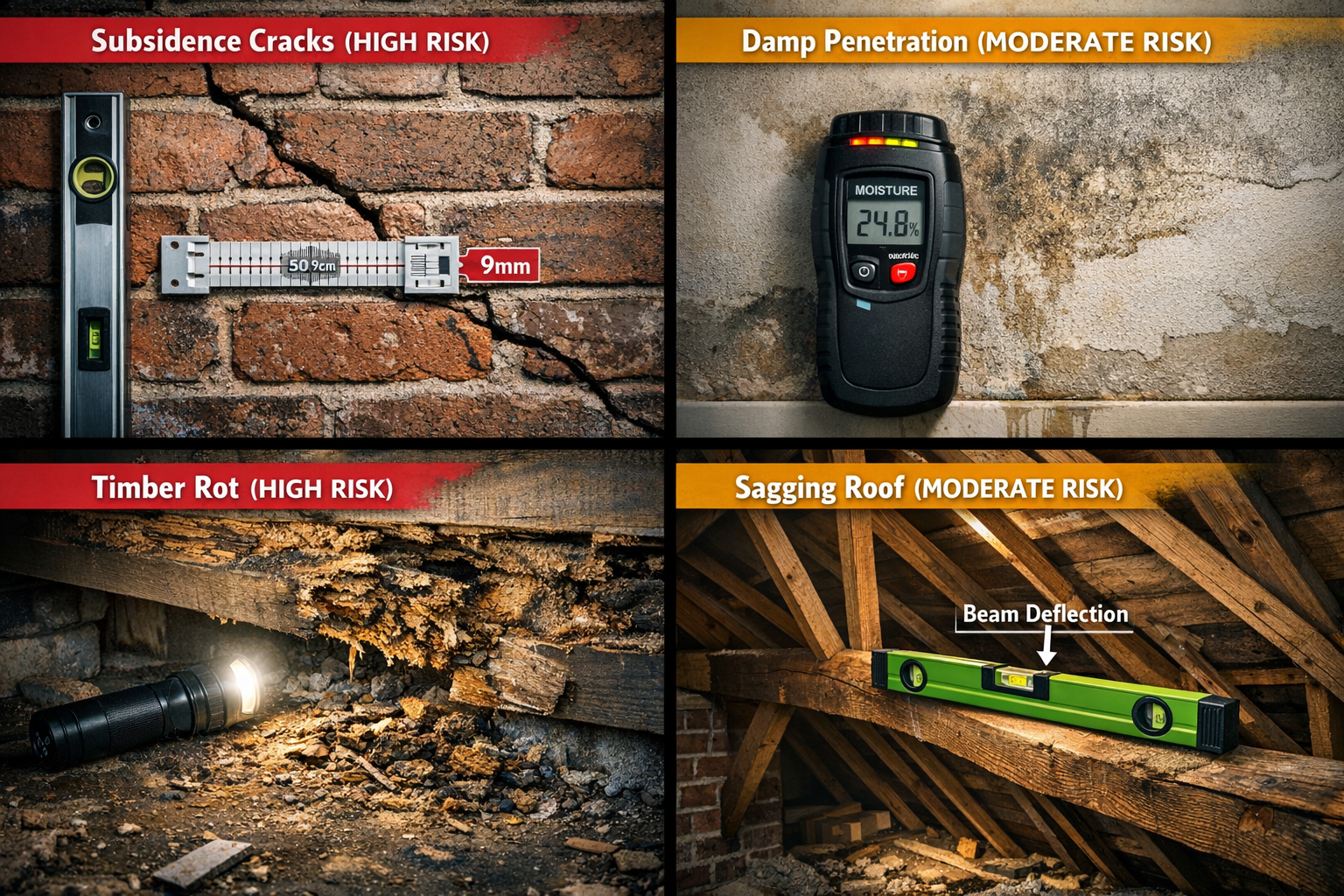
- Foundation movement and subsidence – Inspect external walls for stepped cracking, diagonal fractures, and displacement
- Structural timber decay – Assess load-bearing joists, roof trusses, and lintels for rot or insect damage
- Roof structural integrity – Examine ridge beams, purlins, and rafters for sagging or failure
- Load-bearing wall stability – Check for bulging, leaning, or compromised structural elements
- Severe damp penetration – Identify rising damp, penetrating damp, or condensation affecting structural elements
Tier 2: Significant Defects (Standard Assessment) 🔍
Issues requiring attention but not immediately critical:
- Chimney stack condition and stability
- Window and door frame deterioration
- Roof covering condition (slate/tile replacement needs)
- Drainage system functionality
- Cavity wall tie corrosion
- Electrical and heating system safety
Tier 3: Maintenance Items (Documentation Phase) 📋
Minor issues for buyer awareness:
- Decorative repairs needed
- Minor pointing requirements
- Gutter and downpipe maintenance
- Garden boundary conditions
- Minor plasterwork defects
This framework allows surveyors to deliver preliminary findings on critical issues within 24-48 hours, while completing comprehensive reports within standard timelines. For detailed guidance on what surveyors examine, review our article on what surveyors look for in a house survey.
Regional-Specific Protocols for North West Properties
North West England's property landscape demands tailored approaches:
For Victorian/Edwardian Terraces (Manchester, Salford, Liverpool):
- Focus on shared party walls and structural interdependence
- Assess original slate roofs for nail fatigue and slip
- Check for cellar dampness and coal chute structural impacts
- Examine bay window foundations for settlement
- Investigate original timber floor integrity
For Industrial Conversions (Northern Quarter, Baltic Triangle):
- Verify building control compliance for residential conversion
- Assess steel beam corrosion and load capacity
- Check fire separation between units
- Examine large window installations for water ingress
- Investigate floor loading specifications
For New Builds (Salford Quays, Liverpool Waters):
Most new build warranties include a 2-year defects liability period, with post-occupation inspections recommended within 12-18 months[1]. However, pre-purchase surveys should still identify:
- Snagging issues (incomplete finishes, poor workmanship)
- Building regulation compliance
- Drainage and ventilation adequacy
- Thermal performance concerns
- Structural movement in settling foundations
Understanding the roles and qualifications of surveyors is essential; learn more about what chartered surveyors do to appreciate their expertise.
Technology-Enhanced Survey Protocols
Modern survey tools accelerate defect identification without compromising accuracy:
Digital Inspection Tools:
- Thermal imaging cameras – Detect hidden dampness, insulation gaps, and heat loss
- Moisture meters – Provide instant readings for damp investigation
- Laser measuring devices – Ensure accurate dimensional surveys
- Drone surveys – Assess roof and chimney conditions safely and quickly
- Digital reporting software – Enable real-time documentation and photo annotation
These technologies support faster preliminary assessments while maintaining comprehensive documentation standards required for RICS commercial building surveys.
Spotting Critical Structural Risks in North West Properties
Common Defect Patterns in Regional Housing Stock
North West England's geological and climatic conditions create predictable structural challenges:
Subsidence and Ground Movement 🏚️
The region's clay soil composition—particularly in Greater Manchester and parts of Merseyside—makes properties vulnerable to subsidence. Key indicators include:
- Diagonal cracks wider than 3mm extending through brickwork
- Cracks near doors and windows (stress concentration points)
- Doors and windows sticking or failing to close properly
- Gaps appearing between walls and ceilings/floors
- External ground level changes around foundations
Surveyors should pay particular attention to properties with mature trees within 15 meters, as root activity in clay soils significantly increases subsidence risk. For properties showing signs of foundation issues, specialized subsidence surveys may be necessary.
Dampness in Victorian and Edwardian Stock 💧
Approximately 28% of Victorian properties in North West England exhibit some form of dampness requiring remediation. The region's high rainfall and prevailing westerly winds create challenging conditions.
Three primary damp types require different assessment approaches:
-
Rising Damp – Absent or failed damp-proof course allowing ground moisture to rise through walls (typically affecting ground floor only, tide marks at 1-1.5m height)
-
Penetrating Damp – External water ingress through walls, roofs, or around windows (often weather-side walls, patches corresponding to external defects)
-
Condensation – Internal moisture from inadequate ventilation (typically bathrooms, kitchens, cold external walls)
Surveyors must distinguish between these types, as remediation costs vary dramatically from £500 for improved ventilation to £15,000+ for damp-proof course installation.
Roof Structure Deterioration 🏠
North West properties predominantly feature traditional slate roofs on timber structures. After 100+ years, common defects include:
- Nail fatigue causing slate slip (requires complete re-roofing: £8,000-£15,000)
- Purlin and rafter sagging from timber decay or overloading
- Ridge tile bedding failure allowing water penetration
- Valley gutter deterioration (critical leak points)
- Chimney stack instability from mortar erosion
Quick visual assessment from ground level can identify obvious defects, but comprehensive roof surveys often require access or drone technology.

New-Build Specific Concerns in Rapid Development Areas
North West England's regeneration zones—particularly Salford, Liverpool Waters, and Manchester city center—feature extensive new-build developments. Despite NHBC warranties and building regulations, 35% of new properties have identifiable defects at completion[1].
Priority inspection points for new builds:
✅ External envelope integrity – Check render finish, brick pointing, and window/door seals for water ingress routes
✅ Drainage and ground levels – Verify proper falls, gully connections, and surface water management
✅ Internal finishes quality – Document snagging items (poor plasterwork, incorrect fittings, incomplete works)
✅ Ventilation adequacy – Assess mechanical ventilation systems and trickle vents for building regulation compliance
✅ Structural movement – Look for early settlement cracking (common in first 12 months)
✅ Fire safety compliance – Verify fire doors, escape routes, and compartmentation in apartments
The 2-year defects liability period provides buyer protection, but identifying issues before completion strengthens negotiating position[1]. For comprehensive guidance on new-build assessments, see our article on understanding Level 3 building surveys.
Creating Rapid Assessment Checklists
Surveyors working in fast-paced markets benefit from property-type-specific checklists that ensure consistent coverage:
Victorian Terrace 20-Point Rapid Assessment:
- External wall vertical alignment (plumb check)
- Stepped or diagonal cracking patterns
- Damp-proof course presence and condition
- External ground levels relative to DPC
- Roof line straightness and ridge condition
- Chimney stack stability and pointing
- Window sill condition and sub-sill cracking
- Bay window settlement indicators
- Cellar dampness and structural condition
- Ground floor timber condition (probe test)
- Party wall condition and shared defects
- Internal wall plaster condition (hollow areas)
- First floor level and joist deflection
- Roof space access and timber condition
- Slate condition and nail fatigue signs
- Valley and flashing condition
- Drainage system functionality
- Electrical system age and safety
- Heating system condition
- Overall maintenance standard
This checklist enables systematic 90-minute on-site assessments while ensuring no critical areas are overlooked. Similar frameworks should be developed for conversions, new builds, and post-war properties.
Implementing Effective Survey Protocols Under Time Pressure
Balancing Speed with Professional Standards
The tension between rapid market conditions and thorough professional practice requires strategic approaches:
Pre-Survey Preparation (30 minutes):
- Review property listing details and photographs
- Check historical planning applications and building control records
- Research local geological conditions and flood risk
- Prepare property-specific inspection checklist
- Organize appropriate equipment and technology
On-Site Efficiency Strategies:
- Follow systematic room-by-room progression (prevents missed areas)
- Use voice recording for preliminary notes (faster than writing)
- Photograph all defects with measurement references
- Prioritize Tier 1 critical risks for immediate assessment
- Use thermal imaging for rapid damp detection
- Deploy moisture meters at suspected problem areas
Post-Survey Reporting:
- Provide preliminary verbal findings on critical issues within 24 hours
- Deliver comprehensive written reports within 5 working days
- Use standardized report templates with property-specific customization
- Include photographic evidence with annotations
- Provide clear risk categorization and cost estimates
This approach maintains professional standards while acknowledging market realities. Clients appreciate preliminary critical findings quickly, even when comprehensive reports require additional time.
Managing Client Expectations in Competitive Markets
Buyers in rapid-growth markets often experience anxiety about survey outcomes potentially affecting their purchase. Effective communication helps manage expectations:
At Instruction Stage:
- Explain survey scope and limitations clearly
- Discuss typical regional defect patterns
- Provide realistic timelines for preliminary and full reports
- Clarify that surveys identify issues, not provide repair quotes
- Discuss potential outcomes and next steps
During Survey Process:
- Contact client immediately if critical structural issues discovered
- Explain significance of findings in accessible language
- Avoid unnecessary alarm about minor maintenance items
- Provide context about typical property condition for age/type
In Report Delivery:
- Use clear risk categorization (critical/significant/minor)
- Provide cost estimate ranges for major defects
- Recommend specialist investigations where appropriate
- Offer guidance on negotiation strategies with vendors
For buyers experiencing stress about survey outcomes, our guide on managing house survey anxiety provides valuable coping strategies.
Knowing When to Recommend Specialist Investigations
Rapid assessments identify issues requiring deeper investigation. Surveyors must recognize these scenarios:
Subsidence Concerns → Structural engineer assessment with monitoring recommended
Significant Dampness → Specialist damp survey with invasive investigation
Timber Decay → Timber specialist inspection and treatment specification
Electrical Safety Issues → NFICEIC electrical condition report
Roof Structure Concerns → Detailed roof survey with internal inspection
Drainage Problems → CCTV drainage survey
Recommending specialist investigations demonstrates professional diligence and protects both client and surveyor. Most buyers appreciate transparent advice about property condition, even when it reveals additional costs.
Future-Proofing Survey Protocols for Continued Market Growth
Adapting to Regulatory Changes
The surveying sector anticipates potential government reforms to standardize property condition assessments earlier in the homebuying process[2]. These changes could significantly impact survey protocols:
Potential Regulatory Developments:
- Mandatory seller-commissioned surveys before marketing
- Standardized defect reporting frameworks
- Earlier survey timing in transaction process
- Enhanced consumer protection requirements
- Digital survey report standards
Surveyors operating in North West England should prepare for these changes by:
- Developing standardized assessment frameworks
- Investing in digital reporting capabilities
- Building relationships with estate agents and conveyancers
- Staying informed about RICS guidance updates
- Participating in professional development on new standards
Leveraging Technology for Enhanced Efficiency
Technology integration will increasingly define competitive advantage in rapid-growth markets:
Emerging Survey Technologies:
- AI-powered defect recognition – Software analyzing photographs to identify structural issues
- 3D property scanning – Creating detailed digital models for remote assessment
- Blockchain-verified reports – Immutable records of property condition
- Integrated client portals – Real-time access to survey progress and findings
- Predictive maintenance algorithms – Forecasting future defect development
While traditional surveying skills remain essential, technology adoption enables faster, more comprehensive assessments without compromising quality.
Building Regional Expertise Networks
North West England's diverse property landscape benefits from collaborative professional networks:
Recommended Professional Connections:
- Structural engineers specializing in Victorian properties
- Damp specialists with regional experience
- Timber treatment companies
- Roofing contractors familiar with traditional slate work
- Building control officers in local authorities
- Conservation officers for listed buildings
- Geotechnical engineers for subsidence cases
These relationships enable rapid specialist referrals when surveys identify issues requiring deeper investigation. For surveyors expanding into commercial work, understanding commercial property surveying principles is valuable.
Conclusion
Building Survey Protocols for North West England's Recovery: Spotting Structural Risks in Rapid-Growth Markets requires surveyors to balance competing demands: accelerated transaction timelines versus comprehensive defect identification. The region's property market resurgence in 2026 creates unprecedented opportunities but also risks if structural issues are overlooked in the rush to complete purchases.
Effective protocols prioritize critical structural risks—subsidence, timber decay, roof failures, and severe dampness—while maintaining systematic assessment of secondary concerns. Regional-specific knowledge about Victorian terraces, industrial conversions, and new-build developments enables targeted inspection approaches that maximize efficiency without sacrificing thoroughness.
Technology integration through thermal imaging, moisture detection, and digital reporting tools supports faster preliminary assessments while maintaining professional standards. However, technology complements rather than replaces experienced professional judgment about structural condition and risk significance.
Actionable Next Steps for Surveyors
-
Develop property-type-specific rapid assessment checklists for Victorian terraces, conversions, and new builds common in North West England
-
Invest in technology tools that accelerate defect identification—thermal cameras, moisture meters, and digital reporting software
-
Build specialist referral networks for structural engineers, damp specialists, and other professionals needed for deeper investigations
-
Establish clear communication protocols providing preliminary critical findings within 24 hours while delivering comprehensive reports within 5 working days
-
Stay informed about regulatory developments anticipated in 2026 that may standardize survey requirements[2]
-
Prioritize continuing professional development on regional defect patterns, new construction methods, and emerging assessment technologies
Actionable Next Steps for Property Buyers
-
Commission surveys early in the purchase process to avoid rushed assessments under time pressure
-
Choose experienced surveyors with regional knowledge of North West property types and common defects
-
Request preliminary findings on critical structural issues before full report completion
-
Budget for specialist investigations if surveys identify concerns requiring deeper assessment
-
Use survey findings strategically in purchase negotiations rather than viewing them as deal-breakers
-
Understand survey limitations—they identify issues but don't provide repair quotes or guarantees
The North West England property market's recovery presents exciting opportunities for buyers and professionals alike. By implementing robust survey protocols that prioritize structural risk identification without compromising speed, surveyors protect buyers while supporting healthy market growth. Quality assessments benefit everyone: buyers make informed decisions, vendors receive fair valuations, and the regional property market maintains confidence through transparent condition disclosure.
For those considering property purchases in rapid-growth markets, understanding whether you need a survey when buying a house provides essential context for making informed decisions. Professional survey advice remains the cornerstone of confident property transactions, regardless of market conditions.
References
[1] Building Survey Protocols For New Build Properties In 2026 Spotting Defects Amid 2 5 Price Growth Forecasts – https://nottinghillsurveyors.com/blog/building-survey-protocols-for-new-build-properties-in-2026-spotting-defects-amid-2-5-price-growth-forecasts
[2] Surveying In 2026 Reform Recovery And Renewed Demand – https://www.lrg.co.uk/news-and-insights/surveying-in-2026-reform-recovery-and-renewed-demand/
