
The tragic Grenfell Tower fire fundamentally changed how the United Kingdom approaches building safety. In 2026, the Building Safety Act's enforcement mechanisms have intensified, creating a complex regulatory landscape that demands rigorous compliance from property developers, building owners, and surveyors alike. Building Safety Act Compliance in 2026 Building Surveys: Gateway Processes and Surveyor Checklists for Higher-Risk Properties has become essential knowledge for professionals navigating the assessment of high-rise and complex residential structures.
With the Building Safety Regulator (BSR) now operating as an independent executive non-departmental public body since January 27, 2026[4], enforcement powers have strengthened considerably. Surveyors conducting assessments on higher-risk buildings must understand mandatory gateway approvals, duty-holder responsibilities, and comprehensive compliance frameworks to protect both their clients and the public.
Key Takeaways
✅ Three mandatory gateways control the lifecycle of higher-risk buildings from planning through completion, with the BSR exercising significant oversight powers at each stage[2]
✅ Building Safety Regulator independence since January 2026 has consolidated enforcement authority and increased regulatory assertiveness for occupied and new higher-risk buildings[4]
✅ Approved Persons must maintain Safety Cases documenting all building safety risks and mitigation measures, with formal Safety Case Reports submitted to the BSR[1]
✅ Surveyor registration requirements now mandate that building control restricted functions can only be performed by registered building inspectors[1]
✅ October 2026 Building Safety Levy will impose additional costs on new dwelling construction to fund the £3.4 billion remediation programme[3]
Understanding Higher-Risk Buildings Under the Building Safety Act 2026
Defining Higher-Risk Buildings (HRBs)
Higher-Risk Buildings represent a specific category of residential structures subject to enhanced regulatory oversight. The Building Safety Act defines these as buildings containing at least two residential units and standing 18 meters or more in height (approximately seven stories), or buildings containing at least two residential units and having at least seven stories[1].
This classification captures approximately 12,500 occupied buildings across England, housing hundreds of thousands of residents. The BSR commenced calling in occupied HRBs for compliance assessment in Spring 2024, with ambitious targets to assess approximately 20% of buildings representing 37% of residential dwellings in the first year[1].
By April 2026, the BSR aimed to have assessed approximately 40% of occupied HRBs representing 65% of residential dwellings[1], with priority given to buildings with un-remediated aluminium composite material (ACM) cladding—the material implicated in the Grenfell Tower tragedy.
The Building Safety Regulator's Enhanced Powers
The BSR's transition to an independent executive non-departmental public body on January 27, 2026 represents a watershed moment in building safety regulation[4]. This structural change implements key recommendations from the Grenfell Tower Inquiry and consolidates all building safety functions under dedicated statutory powers designed to enable more assertive enforcement.
Key regulatory powers include:
- 🏛️ Building control oversight for all new higher-risk building applications
- 📋 Occupancy registration requiring Accountable Persons to register occupied HRBs
- ⚖️ Enforcement authority including compliance notices, stop orders, and prosecution powers
- 🔍 Investigation capabilities for building control approver non-compliance
- 📊 Strategic planning with mandatory annual reporting requirements
The HSE will continue supporting the BSR until December 2026 to ensure a managed handover of responsibilities[4], creating a transitional period where coordination between agencies remains critical.
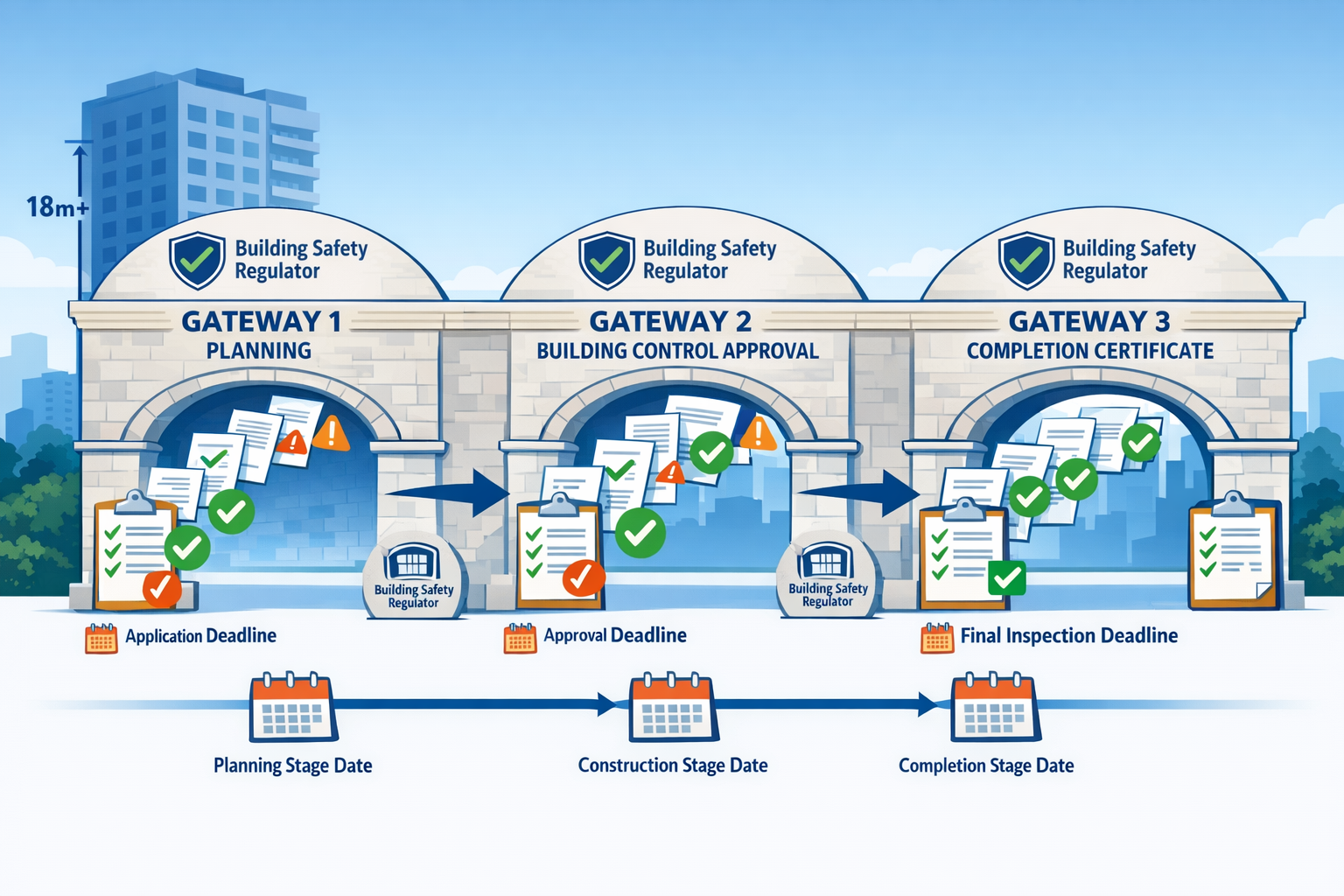
The Three Gateway Process for Building Safety Act Compliance in 2026 Building Surveys
The gateway system represents the structural backbone of Building Safety Act compliance for new higher-risk building projects. Understanding these mandatory checkpoints is essential for surveyors conducting assessments and providing advice on development feasibility.
Gateway 1: Planning Permission Stage
Gateway 1 integrates building safety considerations into the planning permission process. Before submitting a planning application for a higher-risk building, applicants must notify the BSR and provide specific information about fire and structural safety considerations[2].
Surveyor responsibilities at Gateway 1:
- Review site conditions and constraints affecting building safety
- Assess proposed building height and residential unit configuration
- Identify potential fire safety risks in the design concept
- Evaluate structural stability considerations for the proposed development
- Document baseline conditions for future gateway submissions
The BSR reviews the notification and may provide comments to the local planning authority, though Gateway 1 does not constitute formal approval. This early-stage engagement allows the BSR to flag potential concerns before significant design investment occurs.
Gateway 2: Building Control Approval
Gateway 2 represents the most substantive regulatory checkpoint in the building lifecycle. Before construction commences, the Principal Designer and Principal Contractor must submit detailed plans demonstrating compliance with building regulations, particularly concerning fire and structural safety[2].
Critical elements for Gateway 2 compliance:
| Requirement | Description | Surveyor Assessment Role |
|---|---|---|
| Fire Safety Strategy | Comprehensive fire engineering analysis | Review adequacy of fire safety measures and compartmentation |
| Structural Design | Detailed structural calculations and specifications | Verify structural integrity provisions meet regulatory standards |
| Change Control Procedures | Systems for managing design changes | Assess robustness of change management protocols |
| Competency Declarations | Evidence of duty holder qualifications | Verify appropriate professional credentials |
| Golden Thread Documentation | Digital record-keeping systems | Evaluate information management capabilities |
The BSR must approve Gateway 2 submissions before construction can legally commence. This approval process can take several weeks to months depending on submission quality and complexity, making early surveyor involvement crucial for project timeline management.
Staged applications are now permitted for complex multi-block developments, allowing groundworks and basement works to commence before full design details are submitted for the entire development[2]. This flexibility helps maintain construction momentum while ensuring safety compliance.
Gateway 3: Completion Certificate
Gateway 3 occurs upon building completion, requiring demonstration that the building has been constructed in accordance with approved plans and meets all building regulation requirements[2].
Gateway 3 submission requirements:
- ✅ Completion certificate application to the BSR
- ✅ Evidence of construction compliance with approved designs
- ✅ Updated "golden thread" information reflecting as-built conditions
- ✅ Resident engagement materials and safety information
- ✅ Fire and emergency file documentation
Surveyors conducting Level 3 building surveys on newly completed higher-risk buildings should verify Gateway 3 approval status, as occupation without proper certification constitutes a serious regulatory breach.
The BSR will not issue a completion certificate until satisfied that all requirements have been met, potentially delaying occupancy and creating significant financial implications for developers.
Duty Holder Responsibilities and the Safety Case Framework
Key Duty Holders Under the Building Safety Act
The Act establishes a clear hierarchy of responsibility for building safety throughout the building lifecycle:
During Design and Construction:
- 🏗️ Principal Designer – Coordinates design work and ensures safety integration
- 👷 Principal Contractor – Manages construction activities and safety compliance
- 📐 Building Control Approver – Reviews and approves building control applications
During Occupation:
- 🏢 Accountable Person – Responsible for building safety in occupied HRBs (typically the building owner or landlord)
- 🔧 Building Safety Manager – Day-to-day management of building safety risks
- 👥 Residents' Engagement Strategy – Mandatory consultation and communication framework
Understanding these roles is critical for surveyors, as different duty holders control different aspects of building information and compliance documentation.
The Safety Case: Central Compliance Document
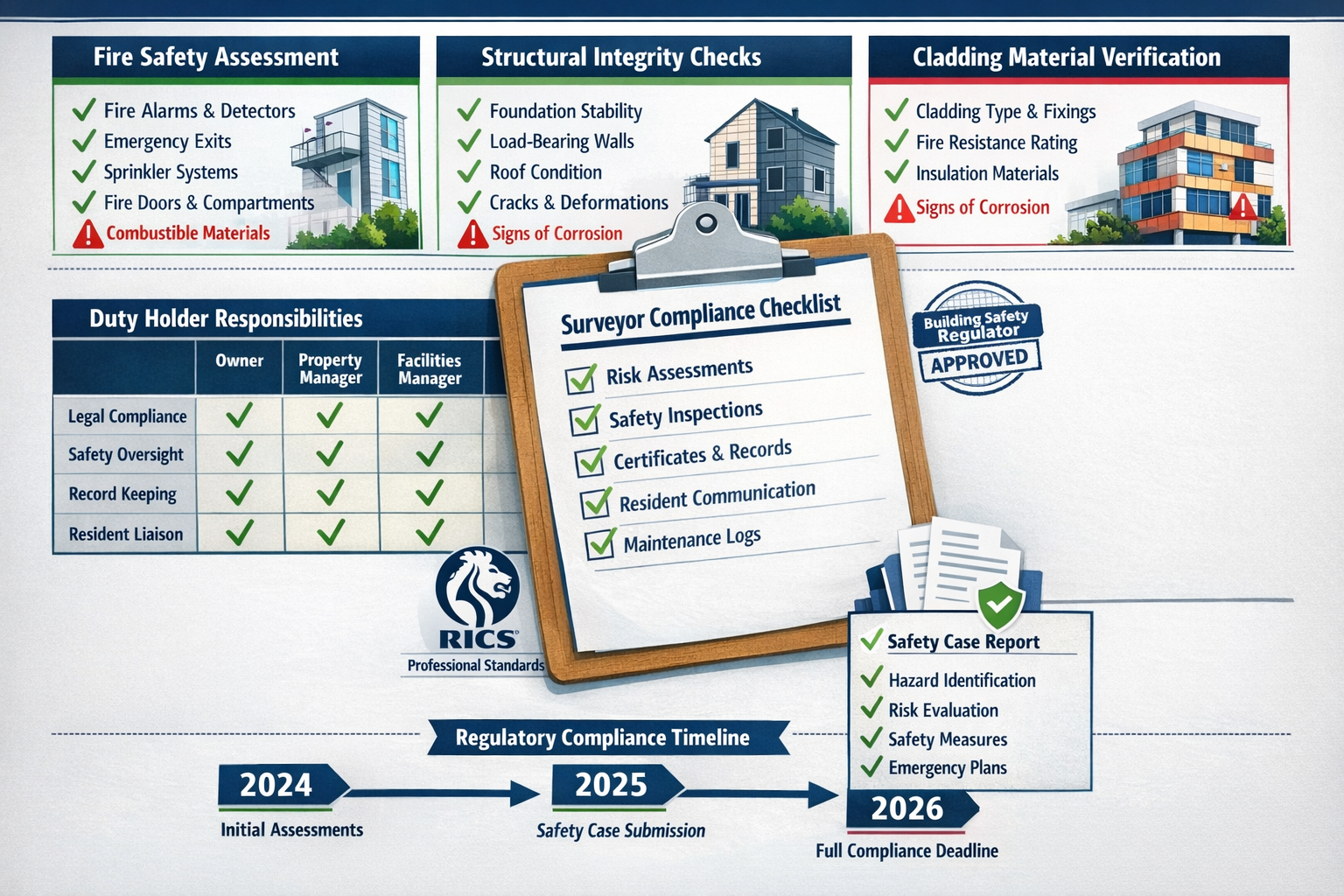
The Safety Case represents the cornerstone of Building Safety Act compliance for occupied higher-risk buildings. Approved Persons (APs) must create and maintain this living document, which comprehensively identifies building safety risks and demonstrates adequate mitigation measures[1].
Safety Case components:
- Building description – Detailed physical characteristics and occupancy information
- Risk assessment – Identification of fire and structural failure risks
- Safety measures – Description of systems preventing or mitigating identified risks
- Management systems – Procedures for maintaining safety throughout building lifecycle
- Competency framework – Evidence of appropriate expertise managing building safety
- Resident engagement – Communication strategies and complaint handling procedures
The formal Safety Case Report summarizes this information for submission to the BSR[1]. Surveyors may be engaged to provide technical input to Safety Case development, particularly regarding structural condition assessments and fire safety evaluations.
When conducting RICS building surveys on higher-risk properties, professionals should request access to the Safety Case Report to understand identified risks and verify that appropriate mitigation measures are in place.
Building Safety Act Compliance in 2026 Building Surveys: Essential Surveyor Checklists
Pre-Survey Compliance Verification
Before commencing any building survey on a higher-risk property, surveyors should complete comprehensive compliance verification:
📋 Regulatory Status Checklist:
- Confirm building height and residential unit count meet HRB criteria
- Verify BSR registration status for occupied buildings
- Obtain Gateway approval documentation for new/recently completed buildings
- Request current Safety Case Report (occupied buildings)
- Identify Accountable Person and Building Safety Manager
- Review building control approver registration status
- Check for outstanding BSR compliance notices or enforcement actions
- Verify ACM cladding remediation status (if applicable)
This preliminary work establishes the regulatory context and identifies potential compliance gaps requiring detailed investigation during the physical survey.
Structural and Fire Safety Assessment
The physical inspection should systematically evaluate compliance with Building Safety Act requirements:
🔍 External Envelope Assessment:
- Cladding systems – Material composition, fire performance ratings, attachment methodology
- Compartmentation – External wall fire barriers, cavity barriers, fire stopping
- Balconies – Structural integrity, fire spread prevention, drainage systems
- Windows and doors – Fire resistance ratings, emergency escape provisions
- Roof construction – Fire resistance, structural stability, access provisions
🔍 Internal Common Areas Assessment:
- Escape routes – Width, signage, emergency lighting, travel distances
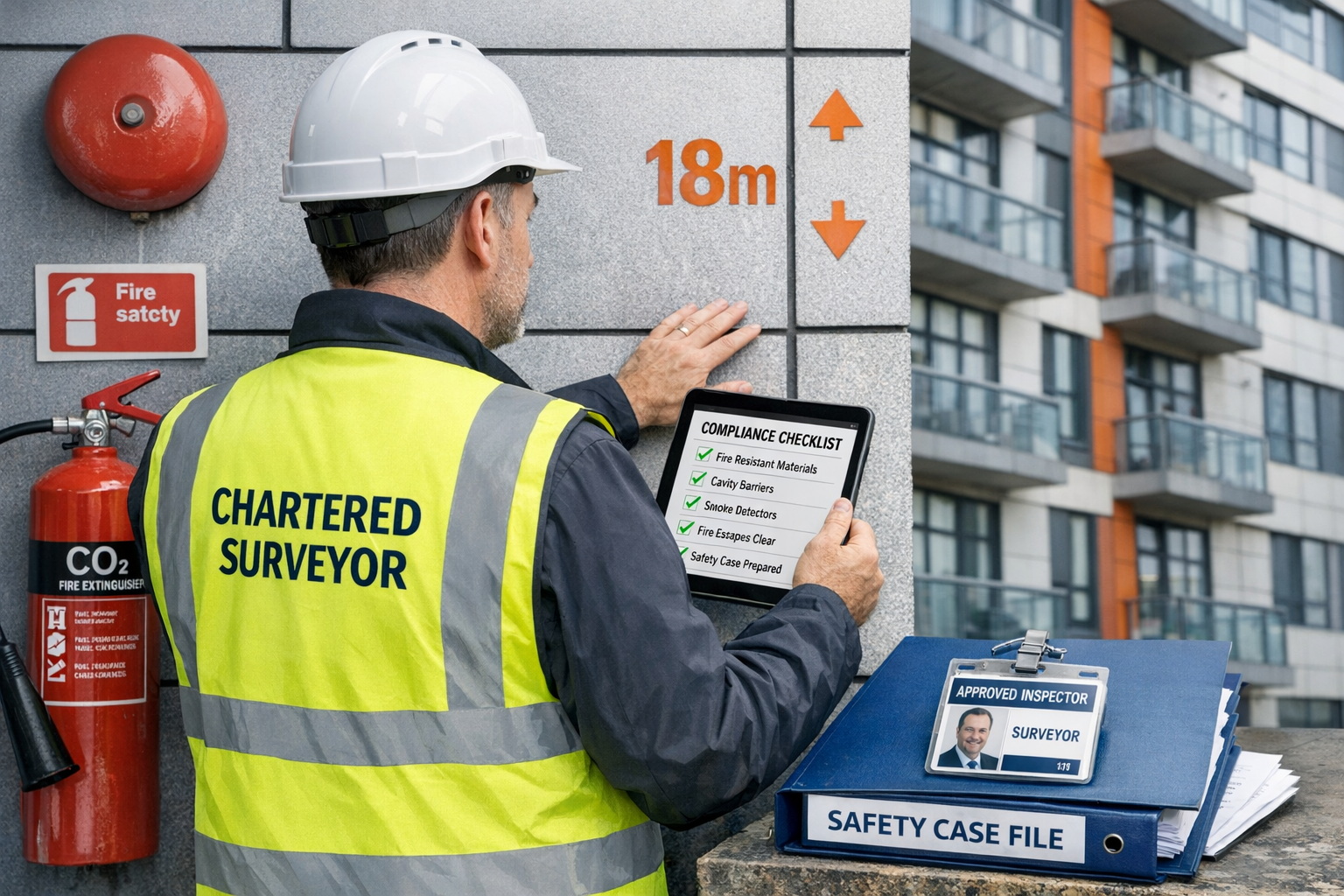
- Staircase provisions – Number of staircases (new regulations require multiple staircases for buildings 18+ meters)[2]
- Fire doors – Condition, self-closing mechanisms, intumescent strips, smoke seals
- Fire detection systems – Alarm coverage, monitoring provisions, maintenance records
- Sprinkler systems – Coverage, water supply, maintenance compliance
- Smoke control systems – Ventilation provisions, pressurization systems
🔍 Building Services Assessment:
- Electrical installations – Fire safety compliance, emergency power provisions
- Gas installations – Safety shut-off systems, ventilation requirements
- Lifts – Evacuation provisions, firefighting lift requirements
- Ventilation systems – Fire damper provisions, smoke extraction capabilities
Surveyors should document findings with reference to specific Building Regulations Approved Documents, particularly Approved Document B (Fire Safety) and Approved Document A (Structure).
Documentation and Information Management
The "golden thread" concept requires comprehensive, accessible building information throughout the building lifecycle. Surveyors should assess information management compliance:
📄 Documentation Review Checklist:
- As-built drawings accuracy and accessibility
- Building manual completeness and currency
- Fire and emergency file availability
- Maintenance records for safety-critical systems
- Change control documentation for building alterations
- Resident safety information materials
- Competency records for contractors and service providers
- Building Safety Manager appointment documentation
Poor information management represents a common compliance failure. Surveyors identifying documentation gaps should recommend immediate remediation, as the BSR has enforcement powers to address information management deficiencies.
Wales-Specific Considerations for Building Safety Act Compliance
New regulations governing Higher-Risk Buildings came into force on July 1, 2026 in Wales[2], establishing a procedural framework broadly aligned with the English regime but with some distinct characteristics.
Key differences for Welsh properties:
- 🏴 Separate Welsh Building Safety Regulator oversight
- 📋 Welsh language documentation requirements for resident engagement
- ⚖️ Distinct enforcement procedures and appeal mechanisms
- 🏛️ Coordination with Welsh planning authorities
Surveyors working on higher-risk buildings in Wales should familiarize themselves with the Welsh-specific regulatory framework and ensure compliance assessments reference the appropriate Welsh regulations.
The Building Safety Levy: Financial Implications for 2026
The Building Safety Levy will come into force on October 1, 2026 following a one-year postponement[3]. This levy is designed to raise £3.4 billion over ten years to fund remediation of unsafe buildings.
Levy structure:
- Applied to all new dwellings with certain exceptions and thresholds
- Calculated based on dwelling size and type
- Not exclusively limited to higher-risk buildings
- Collected by building control bodies at completion certificate stage
Surveyors providing comprehensive building surveys for property purchasers should inform clients about potential levy implications for new-build purchases, as developers may pass these costs to buyers.
The levy represents an additional financial consideration in development feasibility assessments and may influence construction timelines as developers seek to complete projects before the October 1, 2026 implementation date.
Registration Requirements for Building Inspectors and Surveyors
Building inspectors and building control approvers must now be registered with the BSR[1]. Building control restricted functions can only be performed by registered inspectors, with the BSR investigating allegations of non-compliance.
Registration requirements include:
- ✅ Demonstrated competency through qualifications and experience
- ✅ Continuing professional development commitments
- ✅ Professional indemnity insurance
- ✅ Adherence to BSR code of conduct
- ✅ Regular competency reassessment
Surveyors providing building control services or conducting inspections related to gateway approvals must ensure their registration status is current. Property owners engaging surveyors for higher-risk building assessments should verify surveyor credentials to ensure regulatory compliance.
The BSR maintains a public register of approved inspectors, providing transparency and accountability in the building control profession.
Enforcement Actions and Remediation Deadlines
The BSR has demonstrated increasing willingness to use enforcement powers against non-compliant buildings and duty holders.
Key enforcement mechanisms:
- ⚠️ Compliance notices – Requiring specific actions within defined timeframes
- 🛑 Stop notices – Halting construction or occupation of non-compliant buildings
- 💰 Financial penalties – Significant fines for regulatory breaches
- ⚖️ Prosecution – Criminal proceedings for serious violations
- 🏗️ Special measures – BSR-appointed managers for persistently non-compliant buildings
Critical 2026 remediation deadlines:
Remediation of unsafe ACM cladding must be completed or underway by March 2026, with enforcement action against non-compliant buildings[1]. This deadline has passed, meaning surveyors encountering un-remediated ACM cladding should immediately flag this as a critical compliance failure requiring urgent attention.
Fire Safety Regulations amendments effective September 30, 2026 require blocks of flats 18 meters or more in height to have more than one common staircase[2]. This requirement applies to new buildings and may trigger retrofit requirements for certain existing buildings, creating significant cost implications.
Practical Recommendations for Surveyors
Client Communication and Risk Management
Surveyors must clearly communicate Building Safety Act implications to clients:
🗣️ Essential client communications:
- Regulatory status – Clearly identify whether the property constitutes a higher-risk building
- Compliance gaps – Document any identified non-compliance with specific regulatory references
- Financial implications – Estimate remediation costs for compliance failures
- Timeline considerations – Explain gateway approval timescales for development projects
- Ongoing obligations – Clarify duty holder responsibilities for building owners
- Insurance implications – Highlight how compliance status affects building insurance
When conducting Level 2 or Level 3 surveys, surveyors should include a dedicated Building Safety Act compliance section in their reports, providing clients with clear, actionable information.
Continuing Professional Development
The Building Safety Act's complexity demands ongoing professional education. Surveyors should:
- 📚 Complete BSR-approved training on higher-risk building assessment
- 🎓 Maintain current knowledge of regulatory updates and guidance
- 🤝 Engage with professional bodies (RICS, CIOB) for best practice guidance
- 💻 Utilize BSR resources and technical guidance documents
- 👥 Participate in peer review and knowledge-sharing networks
The regulatory landscape continues evolving, with the BSR publishing regular updates and guidance. Surveyors must commit to continuous learning to maintain competency in this specialized area.
Technology and Documentation Tools
Effective Building Safety Act compliance requires robust documentation systems:
Recommended technological approaches:
- 📱 Digital survey tools with compliance checklist integration
- ☁️ Cloud-based information management for golden thread documentation
- 📸 Photographic evidence systems with metadata tagging
- 🗺️ Building information modeling (BIM) for complex developments
- 📊 Compliance tracking dashboards for duty holders
Investing in appropriate technology enhances survey quality, improves documentation accessibility, and demonstrates professional competency to clients and regulators.
Conclusion
Building Safety Act Compliance in 2026 Building Surveys: Gateway Processes and Surveyor Checklists for Higher-Risk Properties represents a fundamental shift in how the United Kingdom approaches residential building safety. The BSR's transition to independent status in January 2026, combined with strengthening enforcement mechanisms and approaching levy implementation, creates a demanding regulatory environment requiring rigorous professional competency.
Surveyors play a critical role in this safety framework, providing independent assessment of compliance status, identifying risks, and advising clients on remediation requirements. The three-gateway process, Safety Case framework, and duty holder responsibilities create multiple touchpoints where surveyor expertise adds value and protects public safety.
Actionable Next Steps
For surveyors and property professionals navigating Building Safety Act compliance:
- Verify registration status – Ensure all building control functions are performed by registered inspectors
- Update survey templates – Incorporate comprehensive Building Safety Act compliance checklists
- Request gateway documentation – Systematically obtain approval records for all higher-risk buildings
- Review Safety Cases – Access and evaluate Safety Case Reports for occupied HRBs
- Monitor regulatory updates – Subscribe to BSR communications and guidance publications
- Invest in training – Complete specialized Building Safety Act education programmes
- Enhance documentation systems – Implement robust information management supporting golden thread requirements
The Building Safety Act represents more than regulatory compliance—it embodies a moral imperative to prevent future tragedies like Grenfell Tower. Surveyors embracing this responsibility with diligence and professionalism contribute meaningfully to protecting residents and enhancing building safety standards across the United Kingdom.
For property owners and developers, engaging qualified surveyors with demonstrated Building Safety Act expertise is essential. The complexity of gateway processes, Safety Case requirements, and ongoing compliance obligations demands professional guidance from the earliest planning stages through building occupation and beyond.
As enforcement intensifies and deadlines approach, proactive compliance assessment through professional building surveys provides the foundation for safe, legally compliant higher-risk buildings that protect residents and preserve property value.
References
[1] Building Safety Regulator Strategic Plan 2023 To 2026 – https://www.gov.uk/government/publications/building-safety-regulator-strategic-plan-2023-to-2026/building-safety-regulator-strategic-plan-2023-to-2026
[2] Building Safety Act 2026 Key Developments And What To Expect – https://www.rwkgoodman.com/info-hub/building-safety-act-2026-key-developments-and-what-to-expect/
[3] Building Safety Act 2022 What To Expect In 2026 – https://gowlingwlg.com/en/insights-resources/articles/2025/building-safety-act-2022-what-to-expect-in-2026
[4] Building Safety Regulator Key Changes From January 2026 – https://connections.nortonrosefulbright.com/post/102m2l3/building-safety-regulator-key-changes-from-january-2026
