
The tragic death of two-year-old Awaab Ishak in 2020 from prolonged mould exposure in his family's social housing flat shocked the nation and exposed critical failures in how landlords respond to damp and mould complaints. Fast forward to 2026, and the landscape of housing condition surveys has fundamentally transformed. Awaab's Law, enacted as part of the Social Housing (Regulation) Act 2023, has been active for five months and is revolutionizing how surveyors detect, report, and address hazardous living conditions in rental properties across England.[1][8]
This legislation isn't just about faster response times—it's reshaping inspection protocols, survey methodologies, and professional standards for housing condition assessments. For property surveyors, landlords, and tenants alike, understanding Awaab's Law Impact on Housing Condition Surveys: Detecting Damp, Mould, and Hazards in 2026 Rental Properties has become essential for compliance, safety, and professional practice.
Key Takeaways
- ⏰ Strict Timeframes: Social landlords must investigate emergency hazards within 24 hours and damp/mould issues within 10 working days, fundamentally changing survey response protocols
- 📊 Expanded Scope: Phase 2 implementation in October 2026 will extend requirements to cover excess cold/heat, falls, structural collapse, fire, electrical hazards, and hygiene risks
- 🏘️ Massive Coverage: The law currently affects 4.5 million social homes, with plans to extend to 4.6 million private rental properties in the coming years
- 🔍 Enhanced Detection Methods: Surveyors now employ advanced thermal imaging, moisture detection, and comprehensive hazard assessment techniques to meet regulatory standards
- ⚖️ Enforceable Rights: Requirements form part of tenancy agreements, giving tenants legal recourse through courts or the Housing Ombudsman for non-compliance
Understanding Awaab's Law: Legislative Framework and Current Implementation Status
What Is Awaab's Law?
Awaab's Law represents a watershed moment in housing regulation. Named after Awaab Ishak, whose death from respiratory complications caused by prolonged exposure to black mould in his Rochdale home highlighted systemic failures in social housing maintenance, this legislation establishes mandatory response timeframes for landlords addressing hazardous living conditions.[1][8]
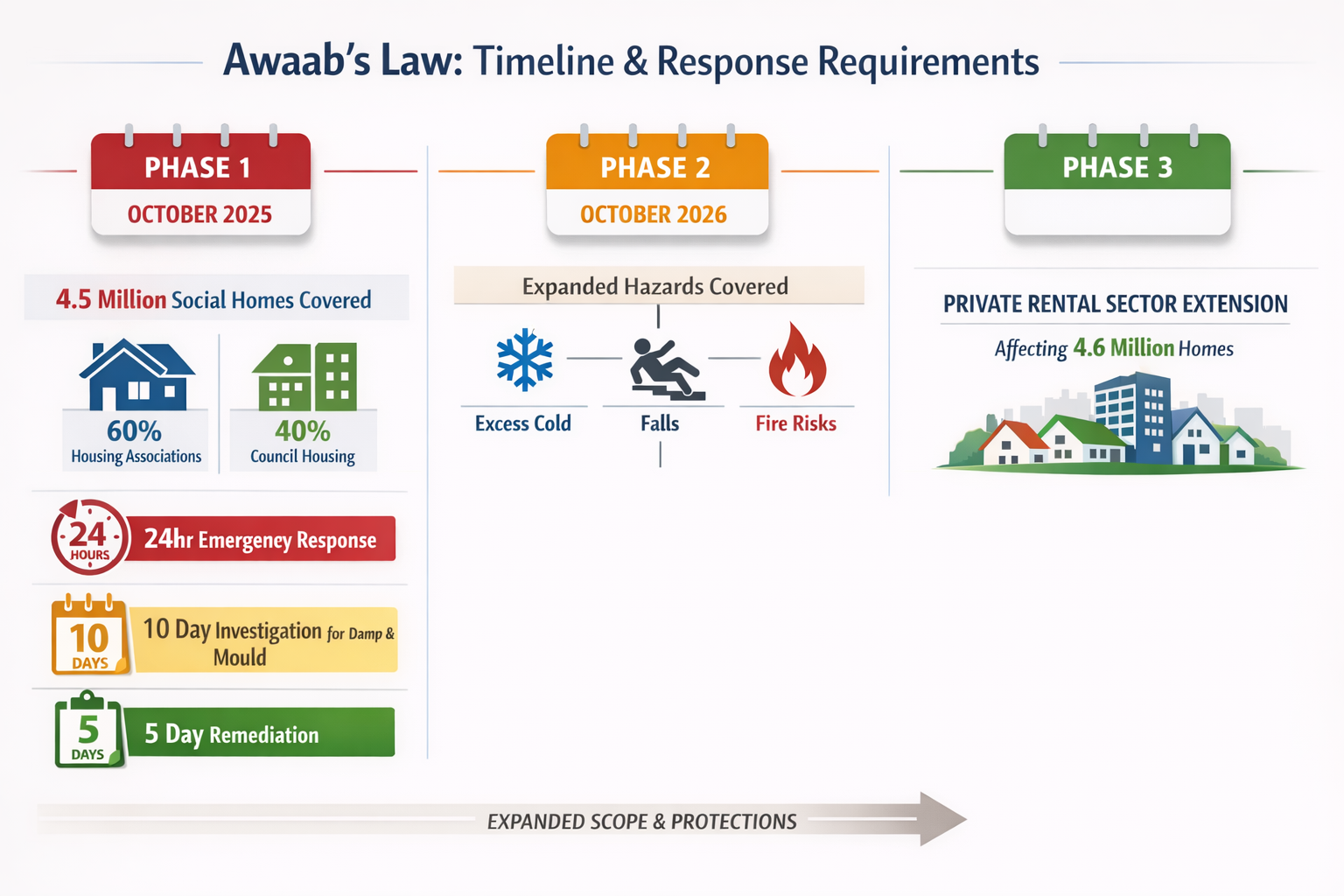
The law came into force on 27 October 2025 for social housing providers in England, creating enforceable contractual duties within all social housing tenancy agreements.[1][4] This means approximately 4.5 million social homes—comprising 2.9 million housing association dwellings and 1.6 million local council-managed properties—now operate under strict compliance requirements.[7]
Three-Phase Implementation Timeline
Phase 1 (Active Since October 2025)
The current phase focuses on two critical categories:
-
Emergency Hazards: Dangerous electrical faults, damaged external doors/windows, major leaks, and other immediate safety threats requiring investigation and property safety measures within 24 hours of notification[1][8]
-
Damp and Mould: Significant damp and mould issues must be investigated within 10 working days, with properties made safe within a further 5 working days[1][8]
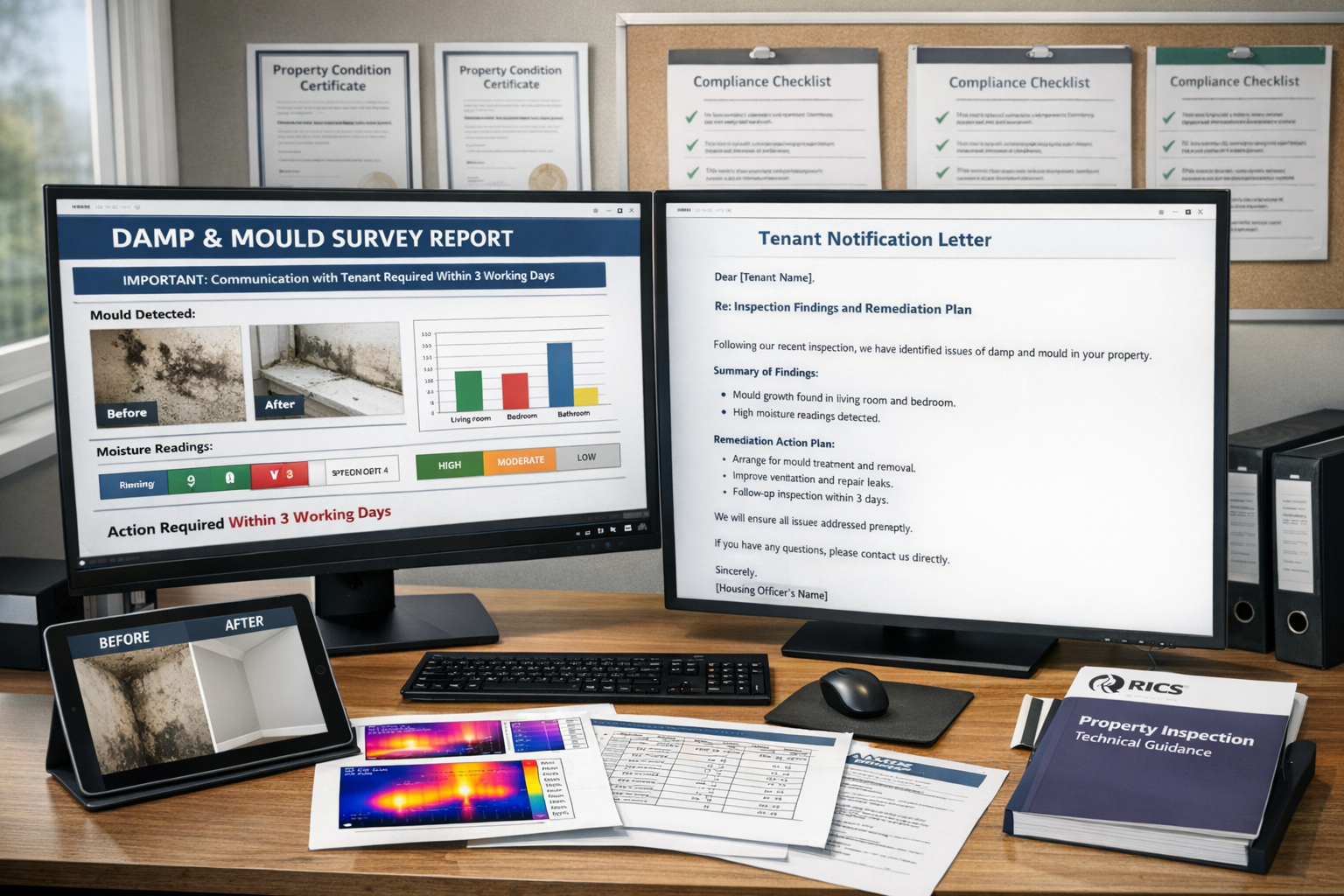
Additionally, landlords must communicate inspection findings to tenants in writing within 3 working days of completing investigations.[1]
Phase 2 (October 2026)
Just months away, Phase 2 will dramatically expand the scope to include:
- Excess cold and heat
- Falls on level surfaces and stairs
- Structural collapse and falling elements
- Fire and electrical hazards
- Domestic hygiene, pests, and food safety risks[1][3][5]
Phase 3 (Timeline Uncertain)
The government intends to extend Awaab's Law to private landlords, potentially affecting approximately 4.6 million privately rented homes. However, implementation dates remain uncertain, with suggestions ranging from 2026 to as late as 2035-2037.[2][6]
Vulnerable Tenant Protections
A crucial aspect of the legislation requires landlords to consider tenant circumstances that increase risk, including:
- Young children 👶
- Elderly residents 👵
- People with disabilities ♿
- Those with existing health conditions 🏥
When homes cannot be made safe within required timeframes, landlords must provide alternative accommodation at their own expense.[1]
Awaab's Law Impact on Housing Condition Surveys: New Detection Standards and Inspection Protocols
The implementation of Awaab's Law has fundamentally altered how housing condition surveys are conducted. Surveyors now operate under enhanced scrutiny and tighter deadlines, requiring updated methodologies and more sophisticated detection equipment.
Enhanced Damp and Mould Detection Techniques
Traditional visual inspections are no longer sufficient. Modern damp surveys now incorporate multiple detection methods:
Thermal Imaging Technology 🌡️
Thermal imaging cameras detect temperature variations that indicate moisture penetration, condensation issues, and insulation defects invisible to the naked eye. These non-invasive tools allow surveyors to:
- Identify cold spots indicating thermal bridging
- Detect moisture behind wall surfaces
- Map condensation risk areas
- Document evidence for compliance reporting
Moisture Meter Readings 💧
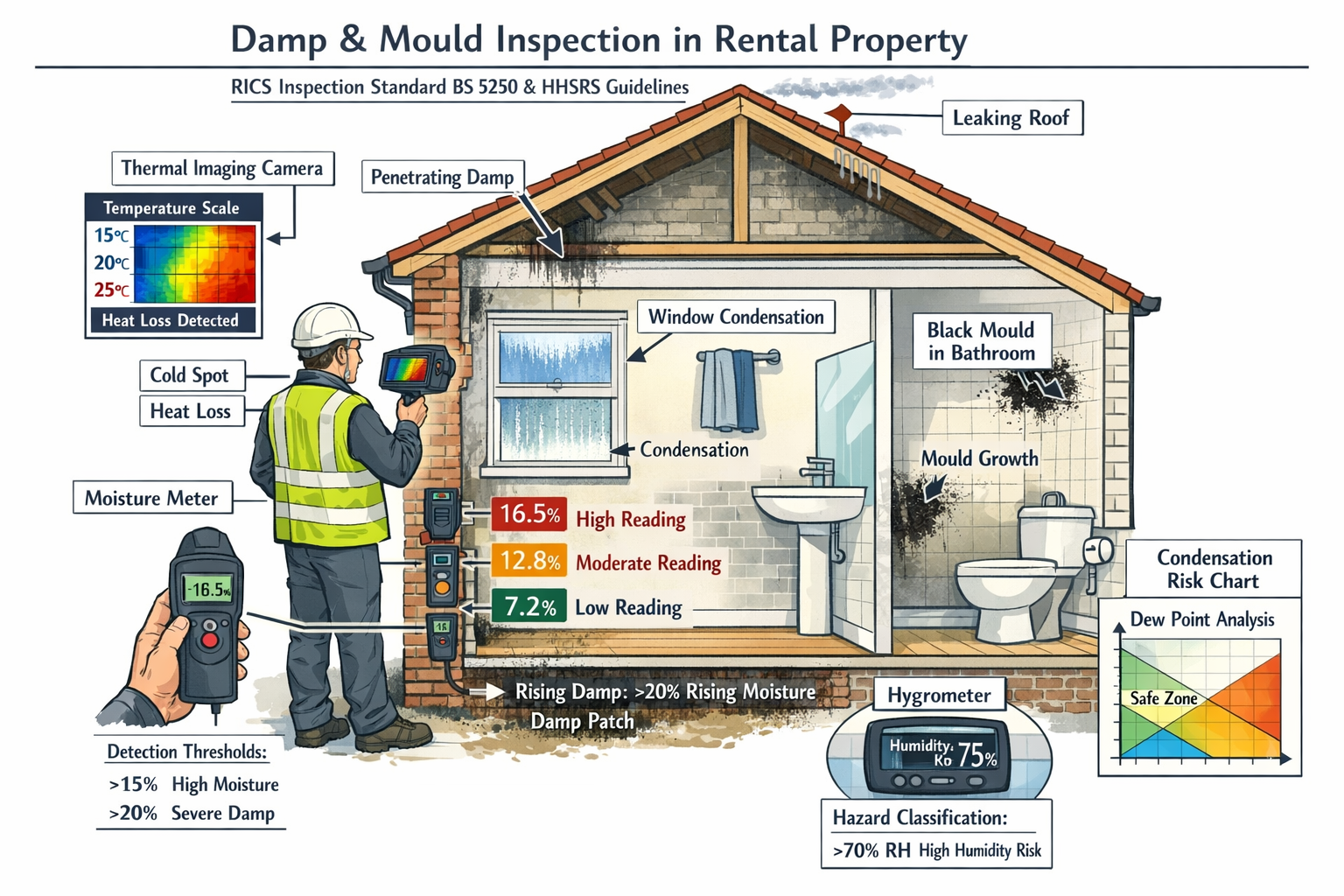
Calibrated moisture meters provide quantifiable data on dampness levels:
| Moisture Reading | Classification | Action Required |
|---|---|---|
| Below 15% | Normal | Routine monitoring |
| 15-20% | Elevated | Investigation needed |
| 20-25% | High | Immediate action |
| Above 25% | Critical | Emergency response |
Air Quality and Humidity Assessment
Hygrometers measure relative humidity levels, helping identify environments conducive to mould growth. Surveyors now routinely assess:
- Ventilation adequacy
- Condensation risk factors
- Indoor air quality parameters
- Mould spore concentrations (in severe cases)
Comprehensive Hazard Assessment Framework
Beyond damp and mould, surveyors must now evaluate properties against the expanded hazard categories coming into effect in October 2026. This requires familiarity with the Housing Health and Safety Rating System (HHSRS) and ability to identify:
Structural Hazards
- Ceiling and wall stability
- Floor integrity
- Staircase safety
- Balcony and balustrade security
Environmental Hazards
- Excess cold (inadequate heating/insulation)
- Excess heat (poor ventilation/cooling)
- Lighting deficiencies
- Noise exposure
Fire and Electrical Safety
- Smoke alarm functionality
- Electrical installation condition
- Fire escape accessibility
- Combustible material risks
Understanding what surveyors look for in a house survey has evolved significantly to accommodate these expanded requirements.
Updated Survey Reporting Standards
Documentation requirements have intensified under Awaab's Law. Survey reports must now include:
✅ Photographic Evidence: Time-stamped images of all identified hazards
✅ Quantifiable Data: Moisture readings, temperature measurements, humidity levels
✅ Hazard Classification: Severity ratings aligned with HHSRS categories
✅ Timeline Compliance: Clear indication of when issues were identified and reported
✅ Remediation Recommendations: Specific, actionable solutions with priority rankings
✅ Tenant Communication Records: Documentation of findings shared within 3-working-day requirement
For properties requiring more comprehensive assessment, a Level 3 building survey provides the detailed analysis necessary to identify all potential hazards and structural concerns.
Practical Implementation: How Surveyors Are Adapting to Awaab's Law Requirements in 2026
Accelerated Response Protocols
The 24-hour emergency response requirement has necessitated significant operational changes for surveying practices:
On-Call Systems 📱
Many firms now maintain 24/7 on-call rotas to ensure emergency hazard notifications receive immediate attention. This includes:
- Dedicated emergency contact numbers
- Rapid deployment protocols
- Pre-positioned emergency equipment
- Streamlined reporting templates
Prioritization Matrices
Surveyors use risk-based prioritization to triage incoming requests:
| Priority Level | Response Time | Examples |
|---|---|---|
| Emergency | 24 hours | Electrical faults, major leaks, structural collapse risk |
| Urgent | 10 working days | Significant damp/mould, heating failure in winter |
| Standard | 20 working days | Minor repairs, routine maintenance |
| Planned | Scheduled | Cyclical decorations, upgrades |
Technology Integration
Digital tools have become indispensable for meeting Awaab's Law compliance requirements:
Mobile Survey Applications
Cloud-based survey apps enable real-time documentation:
- Instant photo uploads with GPS tagging
- Voice-to-text note-taking
- Automatic timestamp recording
- Direct tenant communication features
Thermal Imaging and Drone Technology
Advanced equipment accelerates comprehensive property assessment. Drone surveys and roof surveys allow surveyors to inspect difficult-to-access areas without scaffolding delays, particularly important when 24-hour emergency response is required.
Database Management Systems
Centralized databases track:
- Historical survey data
- Previous hazard reports
- Remediation completion status
- Compliance deadline monitoring
- Tenant communication logs
Training and Professional Development
The expanded scope of Awaab's Law has driven increased demand for specialized training:
Core Competencies for 2026
Surveyors now require expertise in:
- Advanced damp and mould pathology 🔬
- Thermal imaging interpretation
- HHSRS hazard assessment methodology
- Regulatory compliance frameworks
- Tenant communication protocols
- Emergency response procedures
Continuing Professional Development (CPD)
Professional bodies including RICS (Royal Institution of Chartered Surveyors) have developed specialized CPD modules covering Awaab's Law compliance, ensuring surveyors maintain current knowledge of evolving requirements.
Collaborative Working Relationships
Effective implementation requires coordination between multiple stakeholders:
Landlord-Surveyor Partnerships
Social housing providers increasingly employ in-house surveying teams or establish framework agreements with specialist firms to ensure rapid response capability. Understanding what a property surveyor does helps landlords select appropriately qualified professionals.
Multi-Disciplinary Teams
Complex cases often require collaboration with:
- Structural engineers for stability concerns
- Electrical contractors for safety hazards
- Ventilation specialists for mould remediation
- Environmental health officers for severe cases
Tenant Engagement
Surveyors now play a more direct role in tenant communication, explaining:
- Investigation findings in accessible language
- Remediation timelines and processes
- Alternative accommodation arrangements
- Rights and recourse mechanisms
Challenges and Considerations for Housing Condition Surveys Under Awaab's Law
Capacity and Resource Constraints
The strict timeframes imposed by Awaab's Law have created significant capacity challenges:
Surveyor Availability 👷
The demand for qualified surveyors has increased substantially, particularly specialists in damp and mould investigation. Some regions face shortages, making 24-hour emergency response difficult to achieve consistently.[5]
Equipment Investment 💰
Thermal imaging cameras, moisture detection equipment, and digital reporting systems represent substantial capital investment. Smaller surveying practices may struggle to acquire necessary technology.
Administrative Burden 📋
The documentation and communication requirements add considerable administrative work, requiring additional support staff and robust systems.
Diagnostic Complexity
Not all damp and mould issues present straightforward solutions:
Identifying Root Causes
Surveyors must distinguish between:
- Condensation: Caused by inadequate ventilation or heating
- Rising damp: Groundwater penetration through walls
- Penetrating damp: Water ingress from external sources
- Leaks: Plumbing or roofing failures
Each requires different remediation approaches, and misdiagnosis can lead to ineffective solutions and continued tenant exposure.
Building Pathology Expertise
Understanding how different construction types behave requires specialized knowledge. Non-standard construction properties present unique challenges requiring tailored assessment approaches.
Enforcement and Accountability
While Awaab's Law creates enforceable rights, implementation faces practical challenges:
Monitoring Compliance ⚖️
Tracking whether landlords meet response timeframes requires robust systems. The Housing Ombudsman and courts provide recourse mechanisms, but tenants must be aware of their rights and willing to pursue complaints.[8]
Remediation Quality
Meeting deadlines is important, but effective, lasting solutions are crucial. Quick fixes that fail to address underlying causes may achieve technical compliance while leaving tenants in hazardous conditions.
Alternative Accommodation Standards
When properties cannot be made safe within required timeframes, landlords must provide suitable alternative accommodation. Defining "suitable" and ensuring adequate supply presents ongoing challenges.
Preparing for Phase 2 Expansion
With Phase 2 implementation approaching in October 2026, surveyors face additional preparation requirements:
Expanded Hazard Knowledge
Familiarity with additional hazard categories requires:
- Understanding thermal efficiency standards
- Fall risk assessment protocols
- Fire safety evaluation methodologies
- Electrical installation inspection techniques
Updated Survey Templates
Reporting frameworks must accommodate expanded hazard categories while maintaining clarity and usability.
Client Education
Landlords require guidance on Phase 2 implications, including:
- Anticipated compliance costs
- Preventive maintenance strategies
- Upgrade investment priorities
- Tenant communication approaches
Private Rental Sector Implications: Preparing for Awaab's Law Extension
While Awaab's Law currently applies only to social housing, the government's stated intention to extend requirements to private landlords makes preparation essential for the broader rental sector.
Anticipated Timeline and Scope
Although specific implementation dates remain uncertain, with estimates ranging from 2026 to 2035-2037, private landlords should begin preparation now.[2][6] The extension will potentially affect approximately 4.6 million privately rented homes, creating massive demand for compliant housing condition surveys.
Proactive Compliance Strategies
Preventive Surveys 🔍
Forward-thinking private landlords are commissioning comprehensive homebuyer surveys and condition assessments to identify potential hazards before regulatory requirements take effect. Early identification allows planned remediation rather than emergency response.
Property Upgrade Investment
Addressing common issues proactively includes:
- Improving ventilation systems
- Upgrading heating and insulation
- Resolving drainage problems through drainage surveys
- Modernizing electrical installations
- Installing damp-proof courses
Documentation Systems
Establishing robust record-keeping now facilitates future compliance:
- Maintenance logs
- Survey reports
- Tenant communication records
- Remediation completion certificates
- Photographic documentation
Market Differentiation Opportunities
Landlords who voluntarily adopt Awaab's Law standards before mandatory implementation gain competitive advantages:
✅ Tenant Attraction: Properties meeting enhanced safety standards appeal to quality-conscious tenants
✅ Reduced Void Periods: Well-maintained properties experience less tenant turnover
✅ Risk Mitigation: Proactive hazard management reduces liability exposure
✅ Property Value: Compliance-ready properties command premium valuations
Surveyor Preparation for Private Sector Extension
Surveying practices should position themselves for the anticipated expansion:
Service Development
Creating specialized Awaab's Law compliance packages for private landlords, including:
- Baseline hazard assessments
- Remediation planning
- Compliance monitoring
- Tenant communication support
Market Education
Proactive outreach to private landlord clients explaining:
- Anticipated regulatory requirements
- Preparation timelines
- Cost implications
- Competitive advantages of early compliance
Capacity Planning
Scaling operations to handle increased demand when private sector requirements take effect, including:
- Recruitment and training
- Equipment acquisition
- Systems development
- Partnership establishment
Best Practices for Conducting Awaab's Law-Compliant Housing Condition Surveys
Pre-Survey Preparation
Information Gathering 📝
Before site visits, surveyors should obtain:
- Property construction details and age
- Previous survey reports
- Maintenance history
- Tenant complaint records
- Building plans and specifications
Equipment Checklist
Essential tools for comprehensive assessment:
- Thermal imaging camera
- Moisture meters (surface and penetrating)
- Hygrometer
- Torch and inspection mirror
- Camera for photographic documentation
- Measuring tape and laser measure
- Protective equipment (mask, gloves, coveralls)
- Digital tablet with survey software
On-Site Inspection Methodology
Systematic Approach 🏠
Conduct room-by-room assessment following consistent methodology:
- External Envelope: Inspect walls, windows, doors, roof, gutters, and drainage
- Internal Spaces: Examine walls, ceilings, floors, and fixtures in each room
- Services: Assess heating, ventilation, plumbing, and electrical systems
- High-Risk Areas: Pay particular attention to bathrooms, kitchens, basements, and poorly ventilated spaces
Documentation Standards
For each identified hazard:
- Take multiple photographs from different angles
- Record precise location
- Measure extent (affected area dimensions)
- Note moisture readings or other quantifiable data
- Assess severity using HHSRS criteria
- Document environmental conditions (temperature, humidity)
Tenant Interaction Protocols
Professional Communication 💬
Effective tenant engagement includes:
- Explaining the survey purpose and process
- Asking about specific concerns or symptoms
- Listening to occupant observations about property behavior
- Providing realistic timelines for investigation completion
- Explaining next steps and communication procedures
Sensitivity and Respect
Remember that tenants may be:
- Living in distressing conditions
- Anxious about survey outcomes
- Concerned about potential displacement
- Unfamiliar with technical terminology
Use clear, jargon-free language and demonstrate empathy throughout interactions.
Report Writing and Communication
Clarity and Accessibility 📄
Reports must be understandable to non-technical readers:
- Use plain English
- Define technical terms
- Include annotated photographs
- Provide clear hazard severity ratings
- Offer specific, actionable recommendations
Compliance Documentation
Ensure reports include:
- Survey date and time
- Surveyor credentials
- Comprehensive photographic evidence
- Quantifiable measurements
- Hazard classifications
- Remediation priorities and timelines
- Estimated costs (where appropriate)
- Tenant communication confirmation
Timely Delivery
Meet the 3-working-day communication requirement by:
- Using digital reporting systems for rapid turnaround
- Establishing streamlined approval processes
- Maintaining template libraries for common scenarios
- Implementing automated delivery systems
Quality Assurance
Peer Review 👥
For complex cases, implement peer review processes where senior surveyors verify findings and recommendations before report finalization.
Continuous Improvement
Regularly review:
- Survey accuracy (comparing initial findings with remediation outcomes)
- Compliance with timeframe requirements
- Tenant feedback
- Landlord satisfaction
- Professional standards adherence
The Future of Housing Condition Surveys: Trends and Developments Beyond 2026
Technological Advancement
Artificial Intelligence Integration 🤖
Emerging AI technologies promise to enhance survey capabilities:
- Automated image analysis for hazard detection
- Predictive modeling for maintenance needs
- Pattern recognition across property portfolios
- Risk scoring algorithms
Internet of Things (IoT) Monitoring
Smart sensors enable continuous monitoring:
- Real-time humidity and temperature tracking
- Leak detection systems
- Ventilation performance monitoring
- Automated alerts for threshold breaches
Regulatory Evolution
Expanded Scope
Beyond Phase 2 and private sector extension, potential future developments include:
- Energy efficiency integration with hazard assessment
- Climate adaptation requirements (flooding, overheating)
- Accessibility standards incorporation
- Sustainability criteria
Standardization
Industry-wide standardization efforts may produce:
- Unified hazard classification systems
- Consistent reporting templates
- Accredited training programs
- Quality assurance frameworks
Professional Practice Development
Specialization 🎓
Increasing complexity drives surveyor specialization:
- Damp and mould specialists
- Thermal efficiency experts
- Fire safety assessors
- Accessibility consultants
Interdisciplinary Collaboration
Greater integration with related professions:
- Environmental health officers
- Building control inspectors
- Social workers (for vulnerable tenant cases)
- Legal advisors (for enforcement matters)
Tenant Empowerment
Digital Platforms 📱
Technology enables tenant self-service:
- Online hazard reporting portals
- Survey request systems
- Progress tracking dashboards
- Digital communication channels
Education and Awareness
Increased tenant knowledge of:
- Housing rights under Awaab's Law
- Hazard recognition
- Reporting procedures
- Recourse mechanisms
Conclusion
The Awaab's Law Impact on Housing Condition Surveys: Detecting Damp, Mould, and Hazards in 2026 Rental Properties represents a fundamental transformation in how the housing sector approaches tenant safety and property maintenance. Five months into Phase 1 implementation, the legislation has already reshaped surveying practices, introducing strict timeframes, enhanced detection methodologies, and comprehensive reporting standards that prioritize tenant health and safety.
For surveyors, the law demands professional excellence: rapid response capability, advanced technical skills, sophisticated equipment, and meticulous documentation. The 24-hour emergency response requirement and 10-day damp and mould investigation timeline leave no room for complacency. As Phase 2 approaches in October 2026, expanding coverage to additional hazard categories, surveyors must continue developing expertise and refining processes.
For landlords—both social housing providers currently covered and private landlords anticipating future extension—Awaab's Law represents both challenge and opportunity. Proactive compliance through regular damp surveys and comprehensive property assessments reduces emergency response demands, protects tenants, and demonstrates responsible property management.
For tenants, the legislation provides enforceable rights and clear timelines, transforming the power dynamic in reporting and resolving hazardous living conditions.
Actionable Next Steps
For Surveyors:
- Invest in thermal imaging and moisture detection equipment
- Complete Awaab's Law-specific CPD training
- Implement digital reporting systems for rapid turnaround
- Establish emergency response protocols
- Develop Phase 2 expertise in expanded hazard categories
For Landlords:
- Commission baseline property condition assessments
- Establish preventive maintenance programs
- Implement tenant communication systems
- Budget for compliance-related upgrades
- Develop relationships with qualified surveying professionals
For Tenants:
- Understand your rights under Awaab's Law
- Document hazardous conditions with photographs
- Report issues promptly in writing
- Track landlord response times
- Know recourse mechanisms (Housing Ombudsman, courts)
The legacy of Awaab Ishak is a safer, more accountable rental housing sector. By embracing enhanced survey standards, leveraging advanced detection technologies, and prioritizing tenant wellbeing, the property industry can ensure no family endures similar tragedy. The transformation is underway—and housing condition surveys stand at the forefront of this vital change.
References
[1] Awaabs Law – https://www.apizee.com/awaabs-law.php
[2] Awaabs Law What Private Landlords Need To Know Before 2026 – https://objectivehealth.co.uk/news/awaabs-law-what-private-landlords-need-to-know-before-2026
[3] Social Housing – https://theindependentlandlord.com/resources/property-investors-glossary/social-housing/
[4] Awaab%e2%80%99s Law Comes Into Force – https://www.ciob.org/blog/awaab%E2%80%99s-law-comes-into-force
[5] Awaabs Law Legislation Requires Extra Clarity Capacity And Capability – https://www.ube.ac.uk/whats-happening/articles/awaabs-law-legislation-requires-extra-clarity-capacity-and-capability/
[6] How Awaabs Law Will Be Stress Tested In 2026 – https://theintermediary.co.uk/2026/02/how-awaabs-law-will-be-stress-tested-in-2026/
[7] Awaabs Law Comes Into Force What Does It Mean For Construction – https://www.trowers.com/insights/2025/november/awaabs-law-comes-into-force-what-does-it-mean-for-construction
[8] New Law – https://housinghub.campaign.gov.uk/make-things-right/new-law/
