
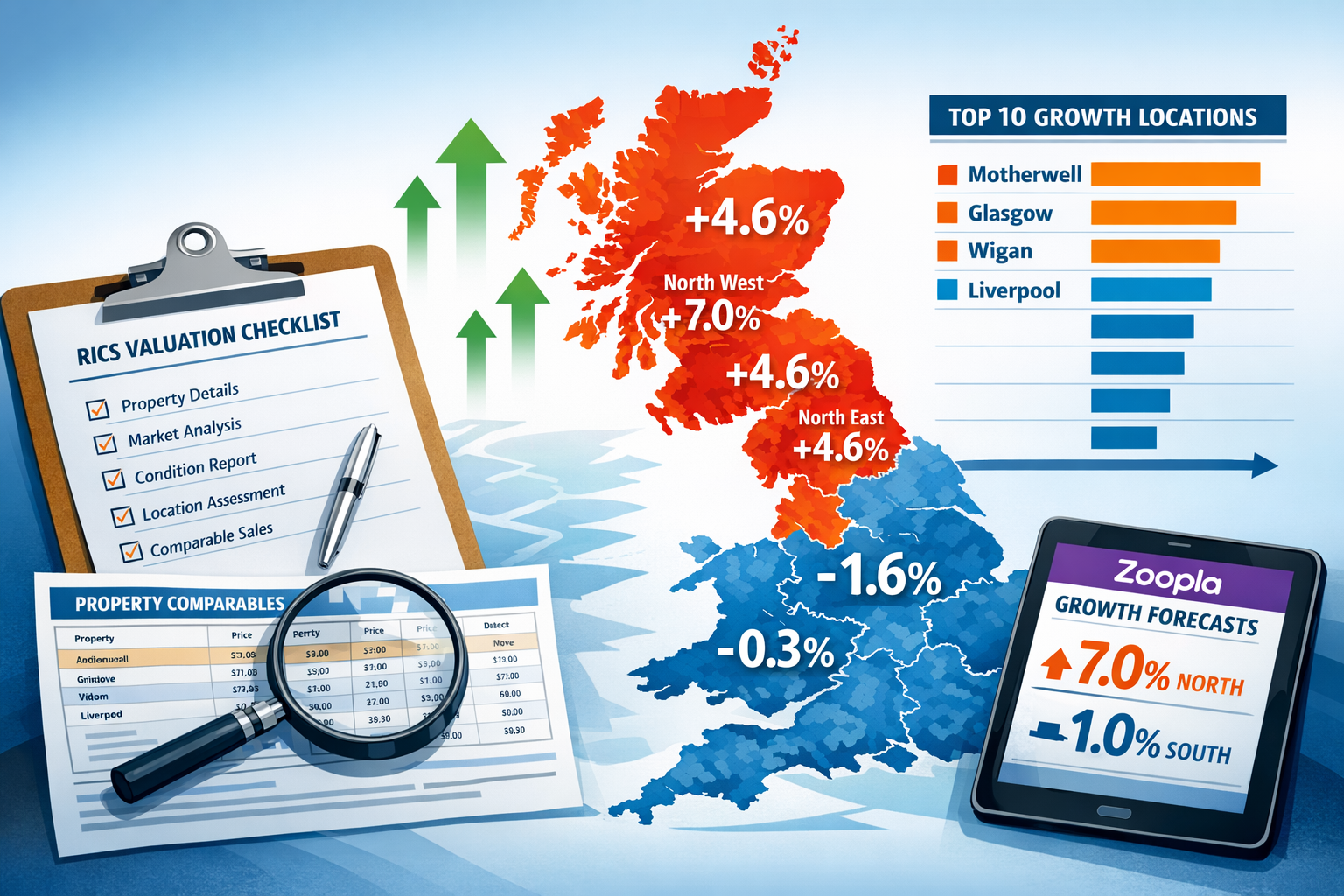
The UK property market has entered a new era of regional divergence in 2026, with Northern England experiencing unprecedented price growth while Southern markets face persistent affordability challenges. The North East recorded a remarkable 7.0% monthly price increase in January 2026, while the South East contracted with a -1.6% annual decline—a stark contrast that demands sophisticated valuation approaches.[1] Understanding Valuation Strategies for Northern England's 2026 Price Surge: Outpacing Southern Affordability Challenges has become essential for surveyors, investors, and property professionals navigating these divergent market conditions.
This comprehensive guide explores the regional valuation tactics, comparable analysis methodologies, and adjustment factors that RICS-qualified surveyors must employ when operating across these dramatically different market landscapes. With six North West locations featured in Zoopla's top 20 growth prospects for 2026 and Scotland hosting nine of the top 10 forecast locations, the traditional North-South property dynamic has fundamentally shifted.[2]
Key Takeaways
- Regional price divergence has reached historic levels: The North East leads with 4.6% annual growth and 7.0% monthly increases, while the South East faces -1.6% annual decline[1][3]
- Northern stock abundance drives sustained growth: Greater housing supply in Northern markets reduces asking price reductions and maintains buyer interest, contrasting with Southern price sensitivity[2]
- Valuation adjustments must reflect local dynamics: Comparable analysis requires region-specific adjustment factors accounting for rental inflation (+8.0% in North East), stock levels, and buyer demand patterns[3]
- North West dominates 2026 forecasts: Wigan, Liverpool, Manchester, and Warrington feature prominently in growth predictions, with all recording at least 2.8% price rises in 2025[2]
- First-time buyer markets show Southern weakness: Average first-time buyer prices declined -0.7% year-on-year in January 2026, indicating reduced affordability in traditionally Southern-dominated entry markets[1]
Understanding the 2026 Regional Price Divergence
The North East's Remarkable Performance
The North East has emerged as England's strongest regional performer in the 2026 property market cycle. Recording 4.6% annual house price inflation in the 12 months to December 2025, the region demonstrated sustained momentum that accelerated into the new year.[3] The extraordinary 7.0% monthly price increase in January 2026 represents one of the most significant single-month gains recorded in recent UK property history.[1]
This growth trajectory reflects several fundamental market factors:
📊 Supply-Demand Balance: Unlike Southern markets experiencing oversupply relative to weakened demand, the North East maintains a healthier equilibrium between available stock and buyer interest.
💼 Economic Strengthening: The region's 8.0% annual rental inflation—the highest among all English regions—signals broader economic vitality and employment growth supporting both rental and purchase markets.[3]
🏘️ Affordability Advantage: With property prices significantly below the national average of £368,031, the North East offers accessible entry points for first-time buyers and investors seeking yield.[1]
For surveyors conducting RICS valuations in the North East, these conditions necessitate careful consideration of momentum factors when applying comparable evidence. Properties sold even three to six months prior may require substantial upward adjustments to reflect current market conditions.
North West's Sustained Dominance
The North West region has established itself as the UK's most consistent growth market heading into 2026. Zoopla's analysis places six North West locations within the top 20 growth prospects, including Wigan (10th), Liverpool (11th), Carlisle (15th), Oldham (19th), Manchester (20th), and Warrington (21st).[2]
Key North West locations recorded impressive 2025 performance:
| Location | 2025 Price Rise | 2026 Growth Ranking |
|---|---|---|
| Wigan | 2.8%+ | 10th |
| Liverpool | 2.8%+ | 11th |
| Stoke-on-Trent | 2.8%+ | Outside top 20 |
| Wolverhampton | 2.8%+ | Outside top 20 |
The region's abundant housing stock serves as a counterintuitive growth driver. Rather than suppressing prices, greater supply availability reduces the frequency of asking price reductions and maintains sustained buyer interest across multiple property segments.[2] This dynamic contrasts sharply with Southern markets where increased supply meets price-sensitive demand, resulting in downward pressure.
Professional surveyors must recognize that traditional supply-demand relationships operate differently across regional markets. When conducting valuation assessments, the presence of healthy stock levels in Northern markets should be interpreted as a positive indicator rather than a constraint on value.
Southern England's Affordability Crisis Deepens
While Northern markets surge, Southern England faces compounding affordability challenges that have translated into negative price movements. The South East's -1.6% annual decline represents one of the joint largest annual falls among English regions, despite recording a modest +1.7% monthly increase in January 2026.[1]
The East of England demonstrates similar vulnerability, remaining in negative territory with -0.3% annual price decline despite a +3.0% monthly increase in January 2026.[1] These volatile monthly fluctuations against negative annual trends indicate market uncertainty rather than genuine recovery momentum.
⚠️ London's weak growth trajectory further exemplifies Southern market challenges. The capital achieved only +0.9% annual growth despite a strong +2.8% monthly jump in January 2026, placing it firmly among the UK's lowest growth regions.[1] This performance reflects minimal upside potential for 2026 as buyer affordability constraints persist.
Zoopla explicitly forecasts subdued house price growth across southern England in 2026, with buyers remaining price-sensitive despite increased property supply.[2] For surveyors operating in these markets, this environment demands conservative valuation approaches that acknowledge downward pressure and avoid over-reliance on historical comparable evidence from stronger market periods.
Valuation Strategies for Northern England's 2026 Price Surge: Comparable Analysis Methodologies
Selecting Appropriate Comparables in High-Growth Markets
When property values increase 7.0% in a single month, as occurred in the North East in January 2026, traditional comparable analysis methodologies require significant adaptation.[1] Time adjustments become the most critical factor in maintaining valuation accuracy.
Best practices for comparable selection in Northern growth markets include:
✅ Prioritize recent transactions: Comparables from the previous 3-6 months provide more reliable evidence than older sales, even if they represent fewer data points.
✅ Apply systematic time adjustments: Use monthly growth rates derived from regional indices (HM Land Registry, Rightmove, Zoopla) to adjust older comparables forward to the valuation date.
✅ Weight evidence appropriately: Recent sales should receive greater weighting in valuation reconciliation, even if they show higher values than older comparables.
✅ Consider pending transactions: In rapidly rising markets, properties currently under offer may provide forward-looking value indicators, though these require careful verification.
For example, when valuing a three-bedroom terrace in Newcastle in March 2026, a comparable sale from September 2025 at £180,000 would require approximately 4-5% upward adjustment to reflect the intervening six months of growth, suggesting a current value range of £187,200-189,000 before applying property-specific adjustments.
Professional surveyors conducting Help to Buy valuations in Northern markets must be particularly diligent in applying time adjustments, as government equity loan calculations depend on accurate current market valuations.
Regional Adjustment Factors for Cross-Market Comparisons
The unprecedented divergence between Northern and Southern markets in 2026 complicates valuations for properties with characteristics spanning regional boundaries. Surveyors must develop robust adjustment frameworks that account for regional market dynamics beyond simple location coefficients.
Key adjustment categories include:
🔹 Market momentum adjustments: Properties in high-growth regions (North East +4.6% annual, +7.0% monthly) warrant premium adjustments compared to declining regions (South East -1.6% annual).[1][3]
🔹 Stock availability factors: Northern markets with abundant housing stock demonstrate different price dynamics than constrained Southern markets, affecting the rate of value appreciation for comparable property types.[2]
🔹 Rental yield differentials: The North East's 8.0% annual rental inflation creates investment value premiums that may not apply to similar properties in lower-yield Southern markets.[3]
🔹 Buyer demographic shifts: First-time buyer average prices declined -0.7% year-on-year in January 2026, predominantly affecting Southern entry-level markets and requiring downward adjustments for properties in this segment.[1]
"The traditional approach of applying simple location adjustments no longer captures the complexity of 2026's regional divergence. Surveyors must incorporate market momentum, rental dynamics, and buyer sentiment into their adjustment frameworks." — RICS Valuation Standards
When conducting commercial valuations across regions, these adjustment factors become even more critical, as commercial property values respond more directly to economic fundamentals that vary substantially between Northern and Southern England.
Dealing with Limited Comparable Evidence
Northern markets experiencing rapid growth often present limited recent comparable evidence, particularly for unique or high-value properties. The surge in buyer enquiries—up 57% in the two weeks after Christmas 2025 compared with pre-Christmas weeks—has accelerated transaction volumes but may not yet provide sufficient comparable sales data.[1]
Strategies for addressing limited comparables:
📋 Expand geographic search parameters: Consider comparables from adjacent postcodes or similar Northern towns with comparable demographic and economic profiles.
📋 Utilize asking price evidence: While requiring careful interpretation, current asking prices in high-growth markets may indicate value trends, particularly when adjusted for typical negotiation margins.
📋 Apply cross-property-type analysis: In the absence of direct comparables, analyze value movements across different property types in the same location to establish market direction.
📋 Leverage rental evidence: The North East's 8.0% rental inflation provides supporting evidence for capital value growth, as rental and capital markets typically demonstrate correlation.[3]
📋 Consider new build premiums: In growth markets, new construction pricing often leads the market and can provide forward-looking value indicators.
For surveyors conducting matrimonial valuations or capital gains tax assessments, limited comparable evidence requires particularly robust documentation of the methodology employed and the reasoning behind any adjustments applied.
Professional Valuation Approaches for Divergent Regional Markets
RICS Red Book Compliance in Volatile Markets
The RICS Valuation – Global Standards (Red Book) provides the professional framework for all property valuations, but application in 2026's divergent regional markets requires careful consideration of specific guidance provisions.
Critical Red Book requirements for regional valuation work include:
🎯 Market Value definition: Valuers must determine "the estimated amount for which an asset should exchange on the valuation date between a willing buyer and a willing seller in an arm's length transaction, after proper marketing and where the parties had each acted knowledgeably, prudently and without compulsion."
🎯 Valuation uncertainty disclosure: In rapidly changing markets like the North East (+7.0% monthly growth), valuers should consider including material uncertainty clauses or commentary on market volatility.[1]
🎯 Assumptions and special assumptions: Regional market divergence may require explicit assumptions about continued growth trajectories or market stabilization.
🎯 Comparable evidence documentation: Red Book compliance demands comprehensive documentation of comparable selection, adjustment rationale, and weighting decisions—particularly critical when applying time adjustments in high-growth markets.
For properties requiring RICS reinstatement cost valuations, the regional divergence has less direct impact, as rebuild costs relate more closely to construction costs than market values. However, surveyors should note that regional labor and material cost variations may still apply.
Adjustment Factors for Northern Growth Markets
Developing systematic adjustment frameworks for Northern England's 2026 price surge requires quantifying the impact of various property and market characteristics on value. The following adjustment matrix provides guidance for common scenarios:
Time Adjustments:
- 0-3 months old comparable: 0-2% upward adjustment
- 3-6 months old comparable: 2-4% upward adjustment
- 6-12 months old comparable: 4-7% upward adjustment
- 12+ months old comparable: Consider excluding or apply 7%+ adjustment with caution
Location Micro-Adjustments (within Northern regions):
- Prime North West locations (Manchester, Liverpool city centers): +5-10% premium
- Secondary North West towns (Wigan, Oldham): Baseline
- North East coastal locations: -5% to +5% depending on specific amenities
- Scotland growth hotspots (Motherwell, Glasgow, Paisley): +3-8% premium[2]
Property Condition Adjustments:
- Recently renovated/modernized: +10-15% in growth markets (buyers pay premiums for move-in ready properties)
- Original condition requiring updating: -15-25% (buyers discount renovation costs more heavily in rising markets)
- New build premium: +5-10% in supply-constrained submarkets
Stock Availability Adjustments:
- Areas with abundant stock (characteristic of North West): Baseline valuation
- Areas with limited stock relative to demand: +3-5% scarcity premium
- Oversupplied segments: -5-10% discount
These adjustments should be applied cumulatively and transparently documented in valuation reports. For instance, a six-month-old comparable in original condition in a prime Manchester location might receive +4% (time) +8% (location) -20% (condition) = -8% net adjustment.
Addressing Southern Market Decline in Valuations
Valuing properties in declining Southern markets presents distinct challenges requiring conservative, well-supported approaches. The South East's -1.6% annual decline and East of England's -0.3% annual decline create downward pressure that must be reflected in current valuations.[1]
Key considerations for Southern market valuations:
⚠️ Recognize negative time adjustments: Comparables from stronger market periods (6-12 months ago) may require downward adjustment to reflect current market realities.
⚠️ Account for buyer price sensitivity: Zoopla's forecast of continued buyer price sensitivity in Southern England suggests limited near-term recovery potential, supporting conservative valuation approaches.[2]
⚠️ Consider days-on-market trends: Extended marketing periods indicate weakened demand and may justify valuations at the lower end of comparable evidence ranges.
⚠️ Evaluate first-time buyer segment weakness: Properties targeting first-time buyers face particular pressure given the -0.7% year-on-year decline in this segment.[1]
⚠️ Document market context: Southern market valuations should include comprehensive market commentary explaining regional underperformance and its impact on value conclusions.
For shared ownership valuations in Southern markets, the combination of declining values and affordability constraints may affect staircasing assumptions and should be clearly addressed in valuation reports.
Investment and Portfolio Implications

Yield Analysis Across Regional Markets
The rental inflation differential between Northern and Southern markets creates significant yield implications for property investors. The North East's 8.0% annual rental inflation substantially outpaces capital value growth in Southern regions, fundamentally altering investment return profiles.[3]
Comparative yield analysis for 2026:
Northern Markets (North East example):
- Average property value: £150,000-200,000
- Typical gross rental yield: 6-8%
- Annual rental inflation: +8.0%[3]
- Capital appreciation: +4.6% annual, +7.0% recent monthly[1][3]
- Total return potential: 10-15% annually
Southern Markets (South East example):
- Average property value: £400,000-500,000
- Typical gross rental yield: 3-4%
- Annual rental inflation: 2-4% (estimated, lower than North)
- Capital appreciation: -1.6% annual[1]
- Total return potential: 1-3% annually (potentially negative after costs)
This yield divergence creates compelling investment cases for Northern properties, particularly for portfolio investors seeking income generation alongside capital growth. However, surveyors must ensure that valuations reflect sustainable rental levels rather than temporary yield compression.
Portfolio Rebalancing Strategies for 2026
Investment portfolios weighted toward Southern properties face strategic rebalancing decisions in light of 2026's regional divergence. Professional valuation advice becomes critical for portfolio managers considering geographic reallocation.
Rebalancing considerations:
🔄 Gradual Northern allocation increase: Rather than wholesale portfolio restructuring, consider incremental increases in Northern exposure through new acquisitions.
🔄 Retain prime Southern assets: Despite regional underperformance, prime London and South East locations may offer long-term value retention not captured in short-term metrics.
🔄 Leverage refinancing opportunities: Northern properties experiencing capital appreciation may support refinancing to extract equity for further investment.
🔄 Consider development opportunities: Northern markets with abundant stock and strong demand may present development or renovation opportunities with attractive returns.
For portfolios requiring regular RICS valuations for reporting or financing purposes, the regional divergence necessitates more frequent revaluation cycles to capture rapid value changes in Northern holdings while monitoring potential further declines in Southern assets.
Risk Assessment and Market Timing
While Northern England's 2026 price surge presents attractive opportunities, prudent risk assessment remains essential. The 7.0% monthly increase in the North East, while impressive, raises questions about market sustainability and potential correction risks.[1]
Risk factors to monitor:
⚡ Economic fundamentals: Ensure regional employment, wage growth, and economic diversification support sustained property demand.
⚡ Mortgage affordability: Monitor whether Northern price growth begins to erode the affordability advantage that drives demand.
⚡ Interest rate sensitivity: Rising mortgage rates could disproportionately impact Northern markets if buyers are operating at maximum affordability thresholds.
⚡ Supply pipeline: Track planning permissions and new construction that could increase supply and moderate price growth.
⚡ Southern recovery potential: Consider whether Southern markets represent contrarian value opportunities if affordability improves or economic conditions shift.
"The current regional divergence represents the most pronounced North-South split in UK property market performance in over a decade. While Northern growth appears fundamentally supported, surveyors must remain vigilant for signs of momentum exhaustion or correction risks."
Professional surveyors providing investment advice should incorporate these risk factors into valuation reports and market commentary, ensuring clients understand both opportunities and potential vulnerabilities.
Future Outlook and Strategic Positioning
2026 Growth Forecasts and Market Predictions
Looking beyond the immediate data, Zoopla's comprehensive 2026 forecasts provide valuable context for medium-term valuation strategies. The prediction that six North West locations and nine Scottish locations will feature in the top 20 growth areas suggests sustained regional outperformance throughout 2026.[2]
Top forecast locations for 2026 growth:
🏆 Scotland dominates: Motherwell, Glasgow, Paisley, and Falkirk lead UK rankings with Scotland hosting nine of the top 10 forecast growth locations.[2]
🏆 North West maintains momentum: Wigan (10th), Liverpool (11th), Carlisle (15th), Oldham (19th), Manchester (20th), and Warrington (21st) demonstrate broad-based regional strength.[2]
🏆 Southern England subdued: Explicit forecasts of subdued growth across southern England indicate continued divergence throughout 2026.[2]
These forecasts suggest that valuation strategies for Northern England's 2026 price surge should incorporate sustained growth assumptions rather than treating current performance as a temporary anomaly. Surveyors developing long-term valuation advice for clients should factor in continued Northern outperformance when providing strategic guidance.
Preparing for Market Evolution
The property market rarely maintains linear trajectories, and prudent valuation strategies must anticipate potential market evolution scenarios. Several factors could alter the current regional divergence pattern:
Potential market evolution scenarios:
📈 Continued divergence: Northern growth and Southern stagnation persist through 2026-2027, widening the regional gap further.
📈 Southern recovery: Improved affordability (through price correction or wage growth) reignites Southern demand, narrowing the regional gap.
📈 National correction: Economic headwinds or interest rate increases dampen both Northern and Southern markets, though potentially at different rates.
📈 Regional rotation: Northern growth moderates as affordability erodes while Southern markets stabilize and begin recovery.
Surveyors should develop scenario-based valuation frameworks that can adapt to changing market conditions. This approach provides clients with robust advice that acknowledges uncertainty while maintaining professional rigor.
Long-Term Investment Positioning
For property investors and portfolio managers, the 2026 regional divergence presents strategic positioning opportunities that extend beyond immediate market conditions. Understanding how to leverage professional valuation advice becomes critical for long-term success.
Strategic positioning recommendations:
✨ Diversified geographic exposure: Maintain presence in both Northern growth markets and Southern markets with long-term value retention potential.
✨ Segment specialization: Focus on property types and price points that align with regional demand drivers (e.g., first-time buyer properties in affordable Northern markets, premium properties in established Southern locations).
✨ Value-add strategies: Northern markets may offer renovation and improvement opportunities where capital investment generates returns through both improved rental income and capital appreciation.
✨ Regular professional valuations: Engage qualified surveyors for periodic portfolio valuations to track performance, identify underperforming assets, and inform strategic decisions.
For investors requiring specialized valuation services such as Right to Buy valuations or non-domicile tax valuations, the regional divergence may create specific opportunities or challenges that warrant expert professional advice.
Conclusion
The Valuation Strategies for Northern England's 2026 Price Surge: Outpacing Southern Affordability Challenges represent a fundamental shift in UK property market dynamics that demands sophisticated, regionally-adapted approaches from professional surveyors. With the North East recording 7.0% monthly price increases while the South East faces -1.6% annual decline, traditional valuation methodologies require significant enhancement to maintain accuracy and professional standards.[1]
Key strategic imperatives for surveyors and property professionals include:
✅ Implement robust time adjustment frameworks that reflect rapid Northern market appreciation and Southern market stagnation
✅ Develop region-specific adjustment matrices accounting for stock availability, rental inflation differentials, and buyer demographic shifts
✅ Maintain RICS Red Book compliance while adapting methodologies to volatile market conditions
✅ Provide comprehensive market commentary that contextualizes valuations within broader regional trends
✅ Monitor evolving market dynamics through regular review of regional indices, rental data, and economic fundamentals
The investment implications of this regional divergence are profound. Northern markets offer compelling total return potential combining 4.6%+ capital appreciation with 8.0% rental inflation, while Southern markets face continued affordability challenges that may persist throughout 2026.[2][3] Portfolio managers should consider strategic rebalancing toward Northern exposure while maintaining selective positions in prime Southern locations with long-term value retention characteristics.
Actionable Next Steps
For property professionals navigating these divergent markets:
-
Engage qualified RICS surveyors with specific regional expertise when valuing Northern or Southern properties—local market knowledge has never been more critical
-
Review existing valuation assumptions to ensure they reflect current regional market dynamics rather than historical national trends
-
Develop scenario-based valuation frameworks that can adapt to potential market evolution throughout 2026
-
Monitor key indicators including regional price indices, rental inflation rates, stock levels, and buyer demand metrics
-
Document methodologies comprehensively to ensure transparency and professional defensibility of valuation conclusions
The 2026 regional divergence represents both challenge and opportunity. Surveyors who adapt their methodologies to reflect these new market realities will provide superior client service while maintaining professional standards. Those who rely on outdated assumptions risk producing inaccurate valuations that fail to capture the fundamental shifts reshaping UK property markets.
As Northern England's price surge continues to outpace Southern affordability challenges, the demand for sophisticated, regionally-adapted valuation strategies will only intensify. Professional surveyors equipped with robust methodologies, comprehensive market knowledge, and adaptive frameworks will be best positioned to serve clients navigating this transformed property landscape.
References

[1] Record January House Price Jump Jan26 – https://www.rightmove.co.uk/news/articles/record-january-house-price-jump-jan26/
[2] Revealed The 10 Uk Locations Which Could See The Biggest House Price Growth In 2026 – https://moneyweek.com/investments/house-prices/revealed-the-10-uk-locations-which-could-see-the-biggest-house-price-growth-in-2026
[3] February2026 – https://www.ons.gov.uk/economy/inflationandpriceindices/bulletins/privaterentandhousepricesuk/february2026
