
The Building Safety Act 2022 has fundamentally transformed the landscape of high-rise construction litigation in the UK. As enforcement intensifies in 2026, expert witnesses face unprecedented scrutiny in safety compliance cases. With the Royal Institution of Chartered Surveyors (RICS) launching its first major update to expert witness standards since 2014, surveyors must navigate complex new protocols that govern everything from evidence preparation to courtroom testimony. Understanding these Expert Witness Protocols Under Building Safety Act Disputes: RICS Guidance for 2026 High-Rise Litigation is no longer optional—it's essential for professional survival and legal compliance.
Key Takeaways
✅ The RICS 5th Edition expert witness standard introduces global application and enhanced conflict of interest requirements specifically designed for high-volume Building Safety Act cases
✅ Expert witnesses owe their primary duty to the tribunal, not the client, requiring complete independence and unbiased reporting in all high-rise safety disputes
✅ New provisions address AI use, digital evidence, and emerging legal procedures including Awaab's Law, which became effective in October 2025
✅ Fee arrangements must protect professional independence with clear guidance on conditional fees, deferred payments, and risk mitigation for template-based work
✅ Enhanced disclosure protocols require explicit identification of conflicts of interest with detailed explanation of legal consequences for non-compliance
Understanding the RICS 5th Edition: A Global Framework for Expert Witness Protocols Under Building Safety Act Disputes
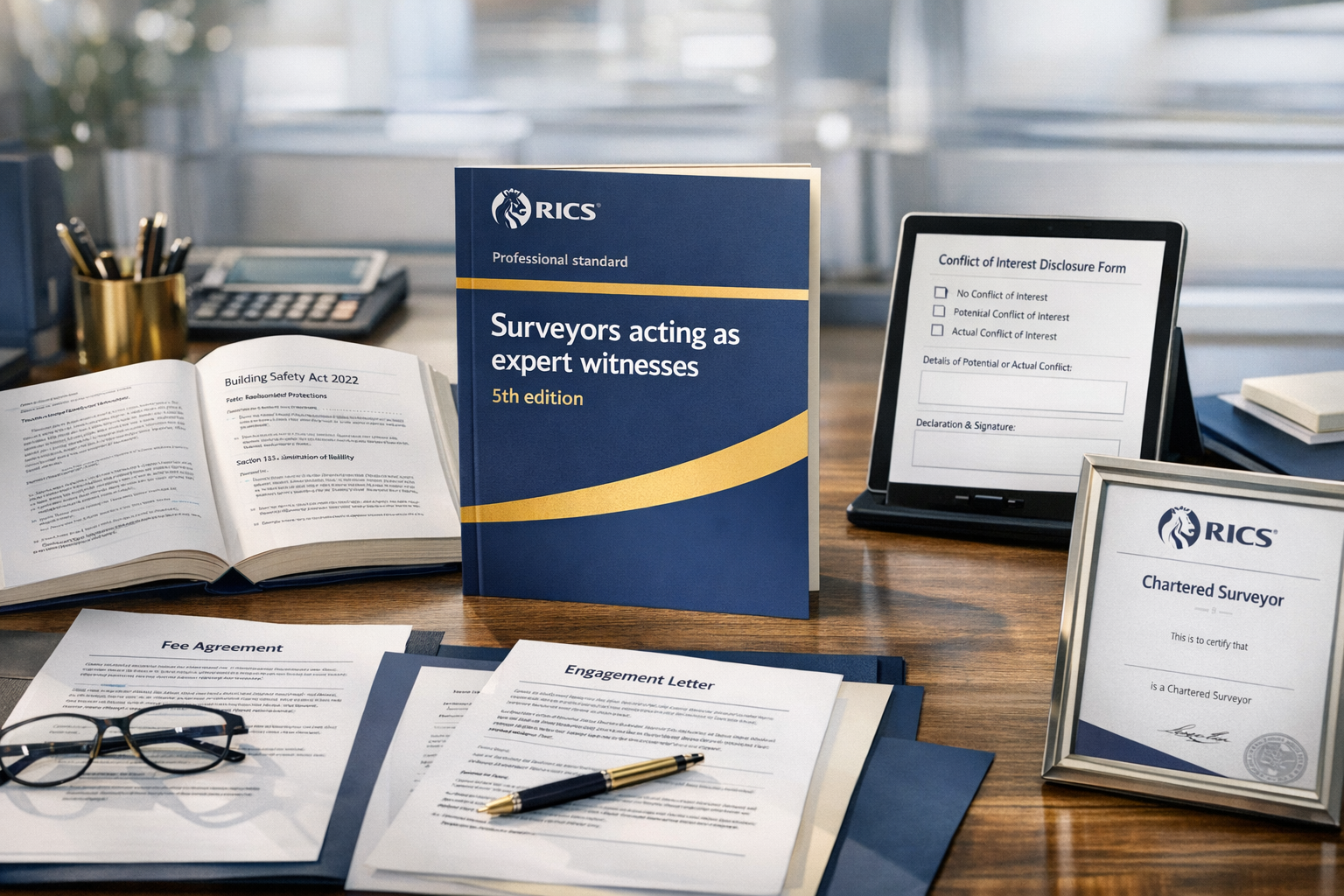
The RICS 5th Edition professional standard represents a watershed moment for surveyors acting as expert witnesses in building safety litigation. Released following extensive consultation that concluded in October 2025, this updated framework addresses the specific challenges posed by the Building Safety Act 2022 and the surge in high-rise defect claims.[3]
What Makes the 5th Edition Different?
Unlike the 4th Edition, which applied exclusively to UK practitioners, the new standard has global application while recognizing local legal differences across jurisdictions.[3] This international scope reflects the increasingly complex nature of construction disputes, where building materials, design standards, and expert testimony often cross borders.
The standard underwent rigorous development through collaborative work with technical experts over several years, followed by a six-week public consultation period from August 26, 2025, through October 7, 2025.[3] This thorough vetting process ensures the protocols remain both practical and achievable in real-world scenarios while addressing current and emerging challenges.
Core Principles Reinforced
At the heart of the updated standard lies a fundamental principle: the expert witness's primary duty is to the tribunal, not the client.[3][5] This requirement demands that all reports and evidence remain independent, unbiased, and firmly within the surveyor's genuine area of expertise.
For surveyors working on Building Safety Act disputes, this means resisting pressure from clients—whether building owners, developers, or residents—to slant findings in their favor. The tribunal needs objective, scientifically sound analysis of whether fire safety measures, structural integrity, or cladding systems meet required standards.
"The standard clarifies the distinction between the expert witness role and other roles a surveyor may undertake during proceedings."[1]
This distinction proves particularly important in high-rise cases where a surveyor might initially serve as a consultant before being asked to provide expert testimony. Understanding when these roles must remain separate protects both professional integrity and legal validity.
Key Protocol Requirements: Expert Witness Protocols Under Building Safety Act Disputes in Practice
Terms of Engagement and Conflict Management
The 5th Edition provides comprehensive guidance on terms of engagement, managing conflicts of interest, fee arrangements, and preparation of written reports.[1] For Building Safety Act disputes specifically, these protocols take on heightened importance given the high stakes and potential for multiple overlapping interests.
Enhanced Conflict of Interest Requirements
The updated standard introduces clearer identification and disclosure protocols with explicit explanation of legal consequences for non-compliance.[3] Expert witnesses must now:
- 🔍 Conduct thorough conflict checks before accepting any engagement
- 📋 Disclose any previous relationships with parties, buildings, or related entities
- ⚖️ Understand the legal ramifications of undisclosed conflicts
- 🔄 Maintain ongoing vigilance as cases develop and new parties emerge
In high-rise litigation, conflicts can arise from previous work on the same building, relationships with contractors or developers, or even financial interests in competing properties. The enhanced protocols require surveyors to document these checks comprehensively and update disclosures as circumstances change.
Fee Arrangements That Protect Independence
One of the most significant updates addresses fee guidance with clear provisions on conditional and deferred fees while protecting professional independence.[3] The standard also includes risk mitigation strategies for high-volume cases and template usage—particularly relevant given the surge in Building Safety Act claims.
Acceptable Fee Structures:
| Fee Type | Permitted? | Conditions |
|---|---|---|
| Fixed Fee | ✅ Yes | Must be agreed upfront and documented |
| Hourly Rate | ✅ Yes | Standard practice with detailed time records |
| Conditional Fee | ⚠️ Limited | Only if independence remains protected |
| Success-Based | ❌ No | Compromises objectivity and tribunal duty |
| Deferred Payment | ⚠️ Limited | Requires careful documentation of independence |
The RICS Practice Alert issued in April 2025 specifically warned members about risks in housing disrepair and high-volume work, emphasizing the importance of maintaining professional standards even under commercial pressure.[4]
For surveyors handling multiple Building Safety Act cases, the temptation to use standardized templates can be strong. However, the 5th Edition makes clear that each case requires individualized analysis. Templates may provide structure, but findings must reflect the specific conditions of each building and dispute.
Report Preparation and Evidence Standards
The updated protocols emphasize quality and relevance of expert evidence while incorporating provisions for AI use and digital evidence.[3] This forward-looking approach acknowledges that Building Safety Act disputes in 2026 increasingly involve:
- 🤖 AI-assisted analysis of building defects
- 📱 Digital documentation and photographic evidence
- 💻 Computer modeling of fire spread or structural failure
- 🌐 Remote inspection technologies
Expert witnesses must understand both the capabilities and limitations of these tools. An AI system might identify potential cladding defects, but the surveyor remains responsible for verifying findings, understanding context, and drawing professional conclusions.
The standard also addresses new legal procedures that have emerged since 2014, including case management protocols specific to Building Safety Act litigation.[3] Surveyors must familiarize themselves with these procedural requirements to ensure their evidence meets admissibility standards.
Building Safety Act Specific Considerations: Expert Witness Protocols Under Building Safety Act Disputes for High-Rise Cases
Awaab's Law and Evolving Legislation
Awaab's Law became effective in October 2025, representing a significant evolution in housing safety legislation that directly impacts expert witness reports in housing disrepair claims.[3] Named after two-year-old Awaab Ishak who died from prolonged exposure to mold, this law imposes strict timeframes on landlords to address health hazards.
For expert witnesses, Awaab's Law creates new responsibilities:
- Timely Assessment: Reports must be completed within timeframes that allow landlords to meet legal deadlines
- Health Impact Analysis: Surveyors must understand and document health implications of defects
- Causation Evidence: Clear linkage between building conditions and health outcomes
- Remediation Guidance: Expert opinions on appropriate fixes and timeframes
These requirements intersect with Building Safety Act protocols, particularly in high-rise residential buildings where multiple dwellings may face similar hazards. Expert witnesses must coordinate their findings across units while maintaining independence for each specific claim.
High-Rise Specific Technical Challenges
Building Safety Act disputes involving high-rise structures present unique technical challenges that demand specialized expertise:
Fire Safety Systems: Expert witnesses must evaluate compartmentation, fire doors, alarm systems, and evacuation routes against current standards—not just those in effect when the building was constructed.
Cladding and External Wall Systems: Perhaps the most contentious area of high-rise litigation, cladding analysis requires understanding of combustibility testing, installation standards, and remediation options. Expert witnesses must stay current with evolving guidance from the Building Safety Regulator.
Structural Integrity: High-rise buildings experience different load patterns and environmental stresses than low-rise structures. Expert analysis must account for wind loading, settlement patterns, and long-term material degradation.
Building Control and Compliance: The Building Safety Act introduced new regulatory frameworks for high-rise residential buildings. Expert witnesses must understand both historical and current compliance regimes to assess whether defects constitute breaches of duty.
For comprehensive guidance on building defect assessment, surveyors should consult resources on specific defect surveys that align with RICS standards.
Case Study Applications
Consider a typical 2026 Building Safety Act dispute: A 15-story residential tower built in 2018 has been identified as having non-compliant cladding and fire stopping defects. Multiple leaseholders have joined litigation against the developer, main contractor, and building control authority.
Expert Witness Challenges:
- Multiple Parties: Conflicts must be checked against all defendants and potential third parties
- Overlapping Expertise: Fire safety, structural, and building control experts must coordinate without compromising independence
- Evolving Standards: The building met 2018 standards but fails current requirements—expert must explain both contexts
- Remediation Costs: Opinions on appropriate fixes affect millions in potential damages
An expert witness following the RICS 5th Edition protocols would:
- Conduct thorough conflict checks before accepting the engagement
- Clearly define the scope of expertise (e.g., cladding systems but not structural engineering)
- Inspect the building independently, documenting findings with digital evidence
- Prepare a report that serves the tribunal's need for objective analysis
- Resist pressure to modify findings based on client preferences
- Coordinate with other experts while maintaining independence
- Disclose any limitations in available evidence or analysis
This approach mirrors best practices outlined in commercial building surveys, adapted for the litigation context.
Practical Implementation: Preparing for Expert Witness Roles in 2026 Building Safety Litigation
Pre-Engagement Checklist
Before accepting any expert witness role in a Building Safety Act dispute, surveyors should complete this comprehensive checklist:
✅ Competence Verification
- Confirm expertise covers the specific technical issues in dispute
- Identify any knowledge gaps requiring additional research or co-experts
- Review recent case law and regulatory updates relevant to the case
✅ Conflict Assessment
- Check previous work on the building or related properties
- Identify relationships with any parties or their representatives
- Disclose financial interests that could affect independence
- Document the conflict check process thoroughly
✅ Engagement Terms
- Negotiate fee arrangements that protect independence
- Clarify scope of work and reporting requirements
- Establish timelines compatible with court procedures
- Define communication protocols with instructing solicitors
✅ Insurance and Professional Standards
- Verify professional indemnity insurance covers expert witness work
- Review RICS 5th Edition requirements specific to the case type
- Understand tribunal expectations and procedural rules
- Confirm compliance with any Practice Alerts or regulatory guidance
This systematic approach reduces the risk of conflicts emerging mid-case and ensures the expert witness role begins on solid professional footing.
Evidence Gathering and Documentation
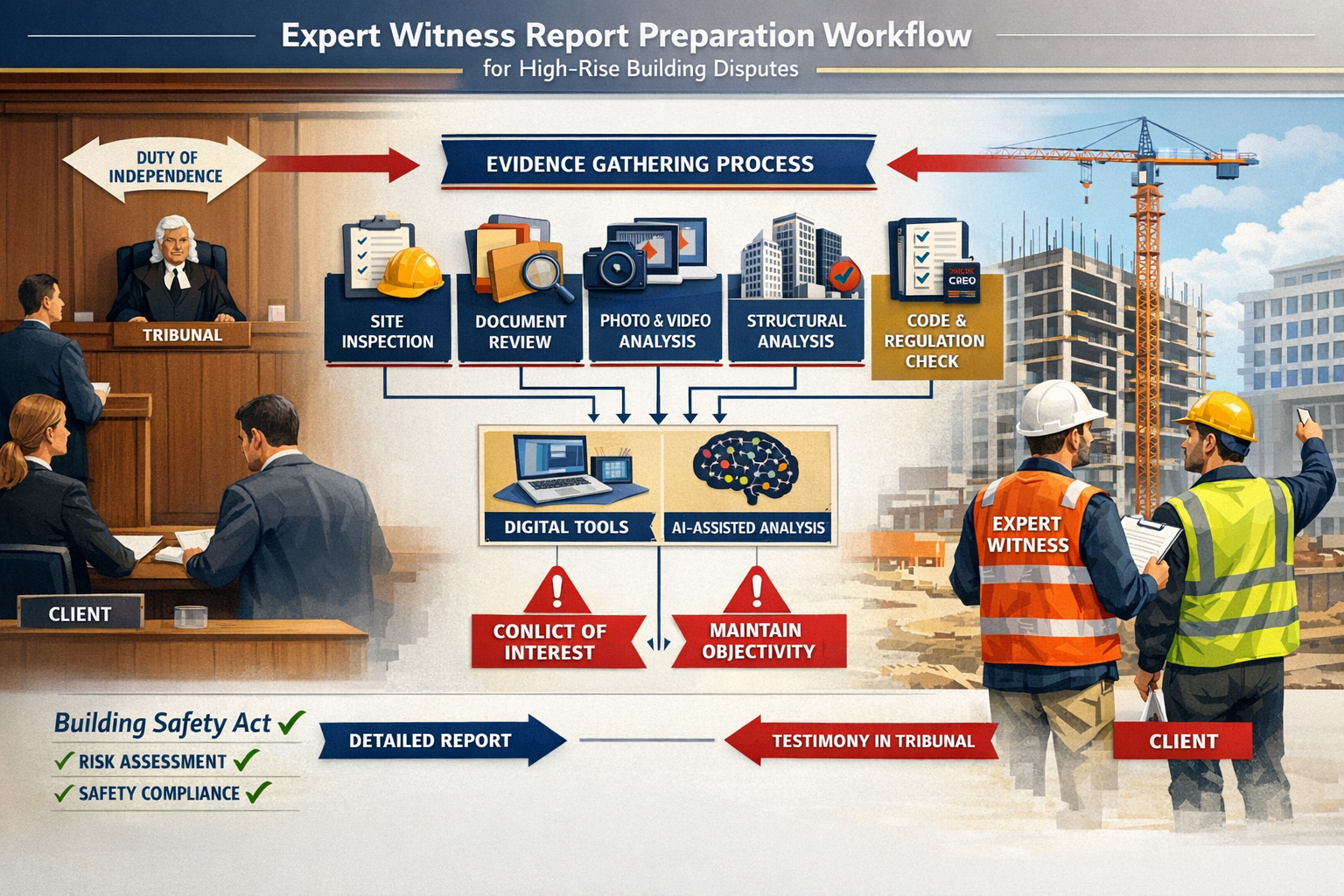
The quality of expert evidence depends entirely on the thoroughness of investigation and documentation. For Building Safety Act disputes, this means:
Site Inspection Protocols:
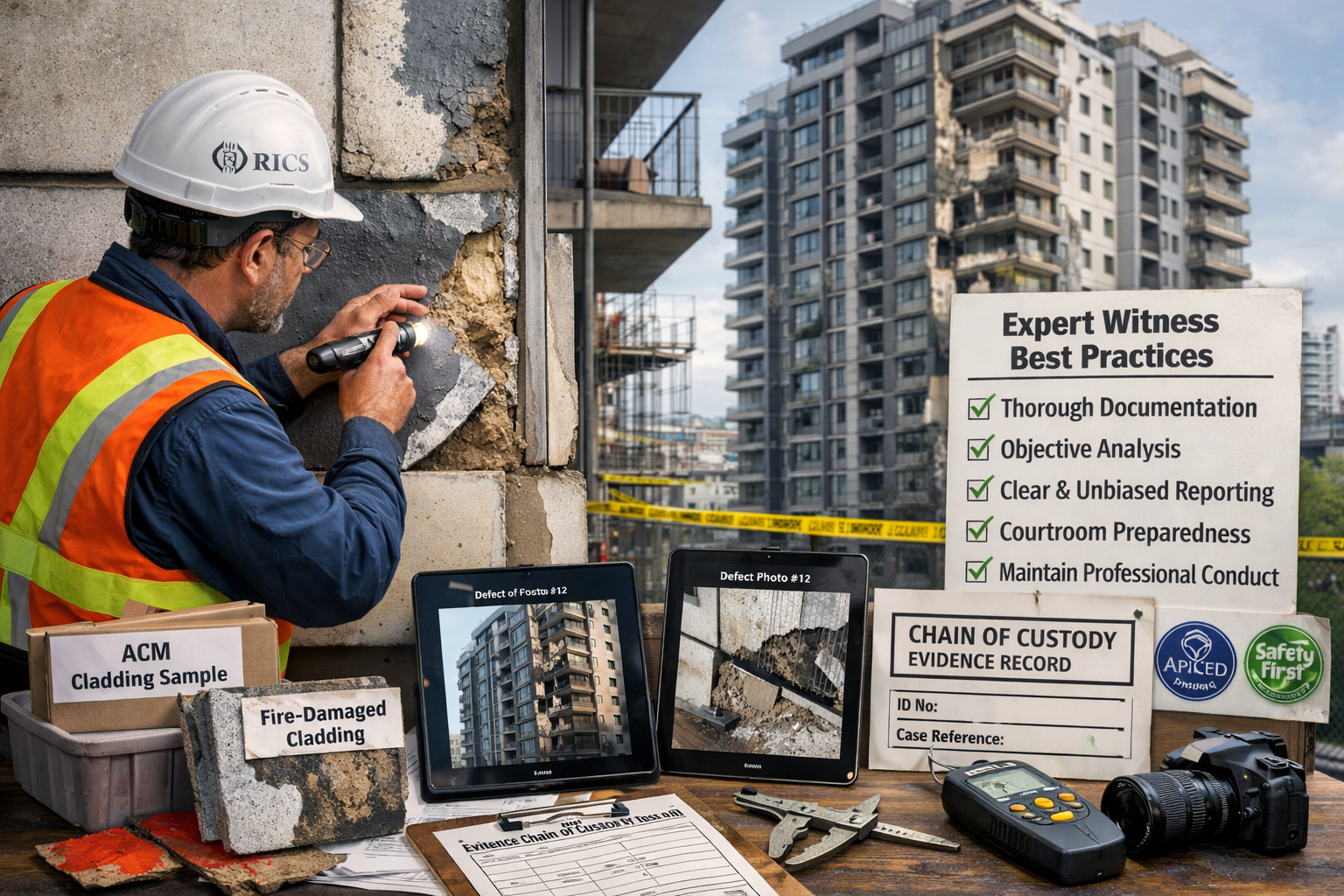
- 📸 Comprehensive photographic documentation with metadata
- 📏 Precise measurements and technical specifications
- 🔬 Material sampling where appropriate (with proper permissions)
- 👥 Witness interviews documented contemporaneously
- 🗂️ Chain of custody for all physical evidence
Document Review:
- Original building plans and specifications
- Building control approvals and inspection records
- Contractor correspondence and site records
- Previous survey reports or safety assessments
- Regulatory guidance applicable at time of construction
Technical Analysis:
- Laboratory testing of materials (fire resistance, structural capacity)
- Computer modeling of fire spread or structural performance
- Comparison against current and historical standards
- Peer review of complex technical conclusions
Modern technology enables more sophisticated evidence gathering, but expert witnesses must ensure all methods meet admissibility standards. The RICS 5th Edition's provisions for digital evidence and AI use provide helpful guidance, but ultimate responsibility for evidence quality remains with the surveyor.[3]
For structural concerns, collaboration with structural engineering specialists may be necessary to ensure comprehensive analysis.
Report Writing Best Practices
An expert witness report in a Building Safety Act dispute must serve the tribunal while remaining accessible to non-technical readers. The RICS 5th Edition emphasizes several key requirements:
Essential Report Elements:
- Declaration of Independence: Clear statement of duty to tribunal
- Qualifications and Expertise: Detailed CV demonstrating relevant experience
- Instructions Received: Scope of work and questions to be answered
- Methodology: Explanation of inspection, testing, and analysis methods
- Factual Findings: Objective observations separated from opinions
- Expert Opinions: Professional conclusions based on findings
- Alternative Scenarios: Consideration of competing explanations
- Limitations: Honest disclosure of evidence gaps or uncertainties
- Supporting Materials: Photographs, test results, calculations
- Statement of Truth: Formal declaration of accuracy and honesty
Writing Style Considerations:
- Use clear, jargon-free language where possible
- Define technical terms when they must be used
- Organize content logically with clear headings
- Include visual aids (diagrams, photographs, charts)
- Maintain objectivity in tone and word choice
- Avoid advocacy or argumentative language
- Acknowledge reasonable alternative viewpoints
The report should enable a judge or tribunal member without construction expertise to understand the technical issues and the basis for the expert's conclusions. This accessibility requirement doesn't mean "dumbing down" the analysis—it means explaining complex concepts clearly.
Courtroom Testimony Preparation
Even the most thorough written report may require oral testimony. Expert witnesses should prepare for cross-examination by:
Understanding Legal Context:
- Review relevant case law and statutory provisions
- Understand burden of proof and standard of proof applicable
- Familiarize yourself with opposing expert's reports
- Anticipate challenges to methodology or conclusions
Communication Skills:
- Practice explaining technical concepts to non-experts
- Prepare for hostile questioning without becoming defensive
- Maintain professional demeanor under pressure
- Acknowledge limitations honestly
Practical Logistics:
- Coordinate availability with court schedules
- Bring supporting materials and references
- Dress professionally and arrive early
- Follow tribunal protocols for addressing judges and counsel
The RICS guidance emphasizes that expert witnesses serve the tribunal's search for truth, not the client's desire to win. This principle becomes most tested during cross-examination, when opposing counsel attempts to undermine credibility or findings.
Risk Mitigation and Professional Protection
Common Pitfalls in Building Safety Act Expert Witness Work
The April 2025 RICS Practice Alert specifically warned members about risks in housing disrepair and high-volume work.[4] These warnings apply with particular force to Building Safety Act litigation, where common pitfalls include:
⚠️ Template Over-Reliance: Using standardized reports without adequate case-specific analysis
⚠️ Scope Creep: Opining on matters outside genuine expertise to please clients
⚠️ Independence Compromise: Allowing fee arrangements or client pressure to influence findings
⚠️ Inadequate Investigation: Rushing inspections or skipping necessary testing to meet deadlines
⚠️ Disclosure Failures: Neglecting to update conflict disclosures as cases evolve
⚠️ Advocacy Creep: Crossing the line from objective analysis to arguing the client's case
Each of these pitfalls can result in professional sanctions, exclusion of evidence, or even personal liability. The RICS regulatory framework takes expert witness misconduct seriously, with potential consequences ranging from fines to removal from the professional register.
Professional Indemnity Insurance Considerations
Standard professional indemnity insurance may not adequately cover expert witness work. Surveyors should:
- Review policy terms specific to litigation support and expert testimony
- Ensure coverage limits reflect potential exposure in high-value Building Safety Act cases
- Understand exclusions that might apply to expert witness activities
- Consider supplemental coverage for high-risk engagements
- Notify insurers promptly of any claims or potential claims
The financial stakes in high-rise Building Safety Act disputes can reach tens of millions of pounds. An expert witness whose negligent report contributes to an incorrect judgment could face substantial liability claims.
Continuing Professional Development
The rapidly evolving landscape of building safety regulation demands ongoing education. Expert witnesses should:
📚 Stay Current on Legislation: Track Building Safety Act implementation, secondary legislation, and regulatory guidance
📚 Monitor Case Law: Follow court decisions interpreting Building Safety Act provisions and expert witness duties
📚 Technical Updates: Maintain knowledge of evolving construction standards, testing methods, and remediation techniques
📚 Professional Standards: Review RICS updates, Practice Alerts, and guidance notes regularly
📚 Cross-Disciplinary Learning: Understand fire safety, structural engineering, and building control perspectives
Many surveyors find value in specialized training programs focused on expert witness skills, including report writing, courtroom testimony, and ethical decision-making under pressure.
Integration with Broader Surveying Practice
Balancing Expert Witness and Other Professional Roles
The RICS 5th Edition explicitly addresses the distinction between expert witness roles and other professional activities.[1] For surveyors working in building safety, this distinction creates practical challenges:
Scenario: A surveyor conducts a building survey for a prospective purchaser and identifies potential Building Safety Act compliance issues. The purchaser later enters litigation with the seller, and wants the surveyor to serve as expert witness.
Conflict Analysis: The surveyor has already formed opinions in an advisory capacity. Can they now serve the tribunal objectively? The RICS guidance suggests careful consideration of whether the prior role compromises independence.
Best Practice: Clearly define roles at the outset. If litigation is anticipated, consider whether a separate expert should be engaged from the beginning.
This principle extends to party wall disputes, dilapidations surveys, and other surveying activities where litigation might emerge. Understanding when to transition from advisor to expert witness—or when to decline the expert role entirely—protects both professional integrity and client interests.
Collaborative Working with Other Experts
Building Safety Act disputes frequently require multiple expert disciplines:
- Fire Safety Engineers: Assess compartmentation, means of escape, fire suppression systems
- Structural Engineers: Evaluate load-bearing capacity, settlement, structural defects
- Building Control Surveyors: Analyze compliance with Building Regulations
- Quantity Surveyors: Assess remediation costs and value diminution
- Environmental Consultants: Evaluate health hazards like mold or air quality
Expert witnesses must coordinate findings while maintaining independence. The RICS protocols support this through:
- Joint expert meetings to narrow areas of disagreement
- Agreed statements of common ground
- Clear identification of remaining disputes
- Professional courtesy and mutual respect
This collaborative approach serves the tribunal's interest in efficient case resolution while preserving each expert's duty to provide independent analysis within their specific expertise.
Understanding what surveyors check across different specializations helps expert witnesses identify when co-experts are needed and how to coordinate effectively.
Future Trends and Emerging Issues
Technology Integration in Expert Evidence
The RICS 5th Edition's provisions for AI use and digital evidence reflect the growing role of technology in expert witness work.[3] Looking ahead to the remainder of 2026 and beyond, several trends are reshaping Building Safety Act litigation:
🤖 Artificial Intelligence Applications:
- Automated defect detection from building imagery
- Pattern recognition across multiple similar buildings
- Predictive modeling of building performance
- Natural language processing of building records
📱 Digital Documentation:
- 3D scanning and photogrammetry
- Drone inspections of high-rise exteriors
- Thermal imaging for insulation and moisture issues
- Real-time data from building monitoring systems
💻 Advanced Modeling:
- Computational fluid dynamics for fire spread analysis
- Finite element analysis for structural assessment
- Building Information Modeling (BIM) integration
- Virtual reality for tribunal visualization
Expert witnesses must understand both the power and limitations of these tools. A thermal imaging scan might reveal anomalies, but professional judgment remains essential for interpreting whether those anomalies represent actionable defects.
Regulatory Evolution
The Building Safety Act 2022 continues to evolve through secondary legislation and regulatory guidance. Expert witnesses must track:
- Building Safety Regulator guidance notes
- Updates to Approved Documents
- Case law interpreting Building Safety Act provisions
- Industry best practice developments
The integration of Awaab's Law in October 2025 demonstrates how quickly the regulatory landscape can shift.[3] Expert witnesses who fail to maintain current knowledge risk providing outdated opinions that don't serve the tribunal's needs.
Professional Standards Development
The RICS commitment to regular review of professional standards suggests the 5th Edition won't remain static. Surveyors should anticipate:
- Further refinement based on practical experience
- Additional guidance on emerging technologies
- Enhanced protocols for specific dispute types
- International harmonization efforts
Engaging with RICS consultations and providing feedback helps shape standards that remain practical and achievable while maintaining professional rigor.
Conclusion
The Expert Witness Protocols Under Building Safety Act Disputes: RICS Guidance for 2026 High-Rise Litigation represent a critical evolution in professional standards for surveyors. As enforcement of the Building Safety Act intensifies and the volume of high-rise litigation continues to grow, expert witnesses face unprecedented demands for technical competence, professional independence, and ethical integrity.
The RICS 5th Edition provides a comprehensive framework that addresses these challenges through enhanced conflict of interest requirements, clear fee guidance, provisions for emerging technologies, and reinforcement of the fundamental duty to the tribunal. For surveyors working in this space, mastering these protocols isn't merely about regulatory compliance—it's about delivering the objective, high-quality evidence that enables tribunals to reach just decisions in complex building safety disputes.
Actionable Next Steps
For surveyors preparing to serve as expert witnesses in Building Safety Act disputes:
-
Review the RICS 5th Edition thoroughly and identify how it applies to your specific practice areas
-
Audit your current procedures against the enhanced protocols, particularly for conflict identification and fee arrangements
-
Invest in continuing professional development focused on Building Safety Act requirements, Awaab's Law implications, and expert witness skills
-
Establish robust systems for evidence gathering, documentation, and report preparation that meet the new standards
-
Review professional indemnity insurance to ensure adequate coverage for expert witness activities
-
Build relationships with complementary experts in fire safety, structural engineering, and other disciplines for collaborative working
-
Stay informed about regulatory developments, case law, and RICS guidance updates through professional networks and publications
The intersection of building safety regulation and expert witness practice will only grow more complex as the Building Safety Act's full implications unfold. Surveyors who embrace the RICS protocols and commit to the highest standards of professional practice will find themselves well-positioned to serve both the tribunals that depend on their expertise and the clients who seek justice in these critical disputes.
For surveyors seeking to deepen their expertise in building defect assessment and litigation support, exploring resources on commercial property surveys and structural engineering reports provides valuable context for the multidisciplinary nature of Building Safety Act disputes.
The path forward requires technical excellence, unwavering independence, and commitment to the expert witness's primary duty: serving the tribunal's search for truth in an increasingly complex built environment.
References
[1] Rics Consultation On Professional Standard For Surveyors Acting As Expert Witnesses 5th Edition 2025 – https://www.ewi.org.uk/News/rics-consultation-on-professional-standard-for-surveyors-acting-as-expert-witnesses-5th-edition-2025
[2] Building Safety Act Information Centre – https://www.rics.org/news-insights/building-safety-act-information-centre
[3] Rics Launches Global Consultation On Updated Expert Witness Standard – https://www.rics.org/news-insights/rics-launches-global-consultation-on-updated-expert-witness-standard
[4] Regulation Practice Alerts – https://www.rics.org/regulation/how-we-regulate/regulation-practice-alerts
[5] Rics Launches Consultation On Updated Global Expert Witness Professional Standard – https://www.lexisnexis.co.uk/legal/news/rics-launches-consultation-on-updated-global-expert-witness-professional-standard
