
The UK property market stands on the brink of its most significant transformation in decades. Home Buying Reforms 2026: How Mandatory Upfront Surveys Will Transform Building and Valuation Practices represents a seismic shift that will fundamentally change how properties are bought, sold, and evaluated across the nation. With government proposals demanding upfront property condition reports, the surveying profession faces unprecedented demand while buyers and sellers navigate a completely reimagined transaction process.
For residential property professionals, estate agents, and homeowners, understanding these reforms isn't optional—it's essential. The changes promise to reduce failed transactions by half, potentially saving the industry £1.5 billion annually in abandoned sales costs.[5] But this transformation requires careful preparation, updated standards, and strategic adaptation from every stakeholder in the property ecosystem.
Key Takeaways
✅ Mandatory upfront surveys will be required within 2 weeks of offer acceptance, shifting responsibility and timing dramatically from current practices
✅ Survey costs will increase significantly from an average of £38 to £380 per property as comprehensive condition assessments become standard[2]
✅ Surveyor capacity must expand rapidly to meet demand, requiring investment in training, technology, and resources across the profession
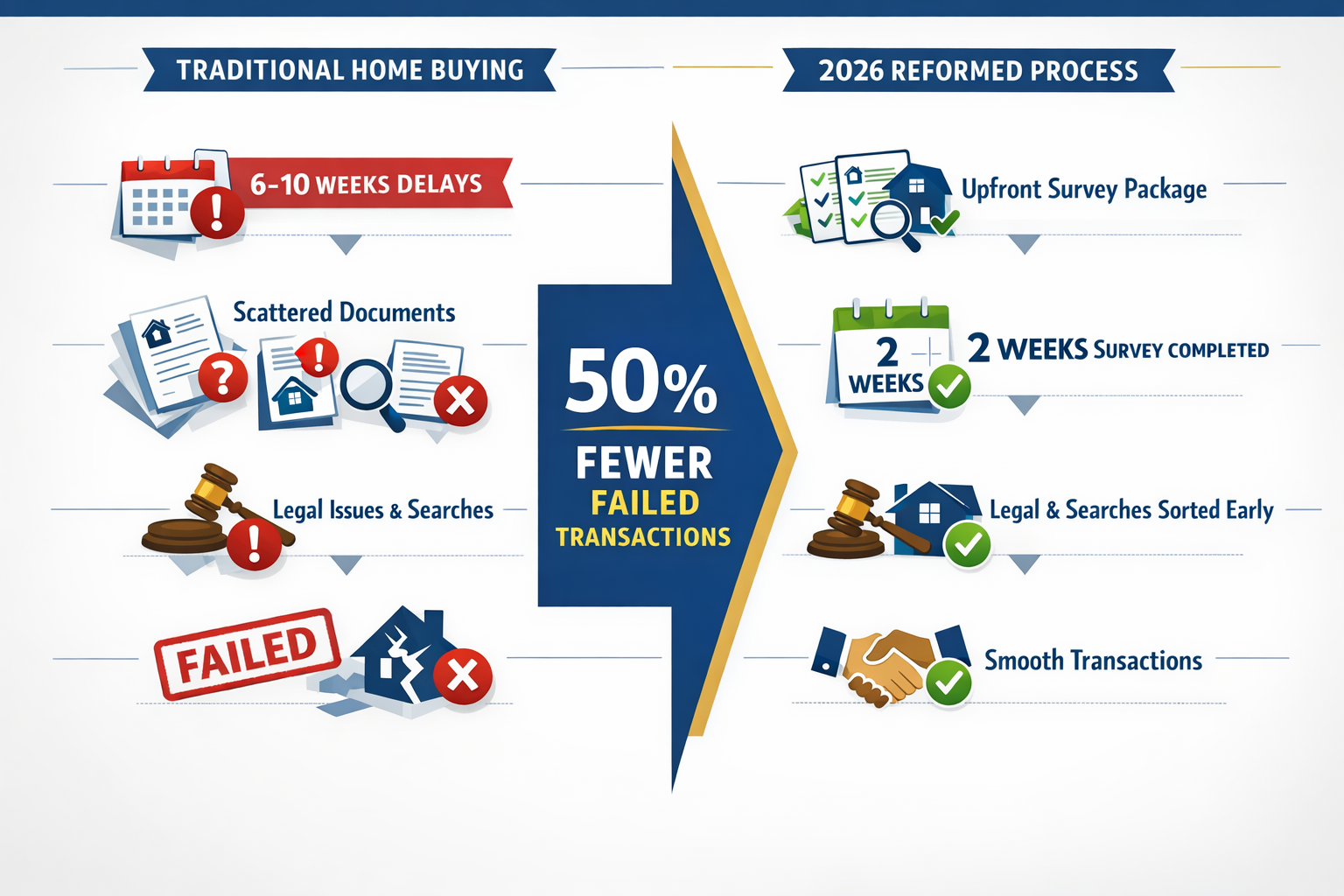
✅ Transaction timelines will accelerate with regulated search turnaround times dropping from 6-10 weeks to a maximum of 3 weeks[1]
✅ Professional standards will be enforced through mandatory qualifications, public registers, and a new Code of Practice for estate agents and conveyancers
Understanding the 2026 Home Buying Reforms Framework
What Are the Mandatory Upfront Information Packages?
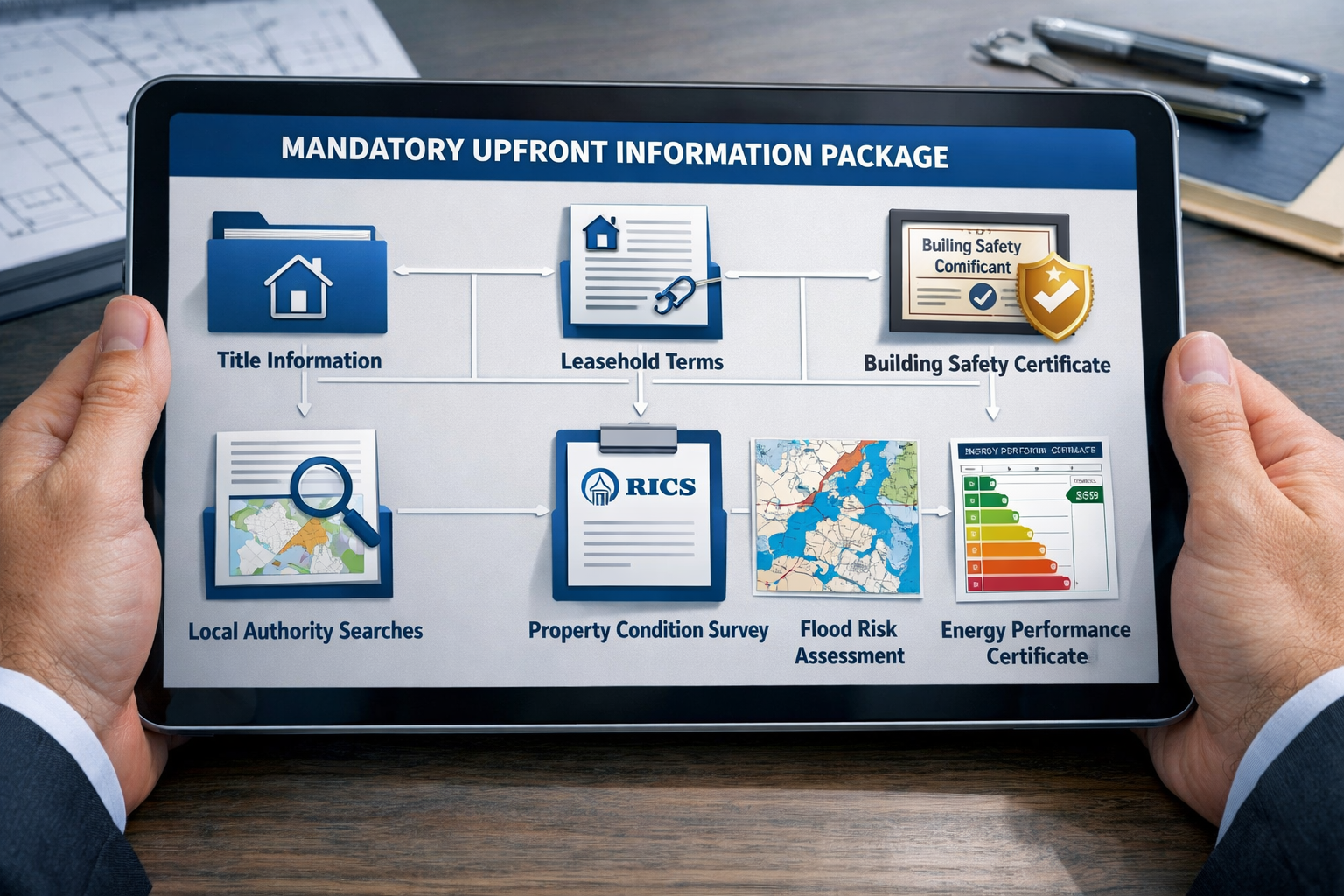
The cornerstone of Home Buying Reforms 2026: How Mandatory Upfront Surveys Will Transform Building and Valuation Practices lies in comprehensive upfront information packages that sellers and estate agents must provide before listing properties. This represents a fundamental departure from the current reactive approach where information emerges piecemeal throughout transactions.
These packages must include:
📋 Title information – Complete legal ownership details and restrictions
📋 Leasehold terms – Full lease documentation, ground rent, service charges, and management company details
📋 Building safety data – Fire safety certificates, cladding reports, and compliance documentation
📋 Local authority searches – Planning, building control, environmental, and highways information
📋 Property condition assessments – Professional survey reports detailing structural integrity and defects
📋 Flood risk information – Environmental hazard assessments and insurance implications[1][2]
This shift transforms property marketing from advertising-first to disclosure-first, ensuring buyers make informed decisions from the outset rather than discovering problems weeks into the process.
Timeline and Implementation Strategy
Draft legislation is expected to begin phased implementation from early 2026, with a full roadmap following the consultation period.[5] The government has coordinated with the Competition and Markets Authority to ensure new powers under the Digital Markets Consumers and Competition Act (2024) support high standards in the property sector.[2]
Critical implementation milestones include:
| Phase | Timeframe | Key Deliverables |
|---|---|---|
| Consultation Response | Q1 2026 | Final policy framework published |
| Pilot Programs | Q2-Q3 2026 | Testing in select regions |
| Professional Standards | Q3-Q4 2026 | RICS updates, agent qualifications |
| Full Rollout | 2027 | Nationwide mandatory compliance |
The Conveyancing Association has emphasized that reforms must be "fair, enforceable and grounded in how transactions actually operate" to avoid the pitfalls of previous failed initiatives.[4]
How Mandatory Upfront Surveys Will Impact Building Practices
The Transformation of Survey Timing and Responsibility
Currently, homebuyer surveys typically occur after an offer is accepted, often weeks into the transaction process. Under the 2026 reforms, surveys must be ordered within 2 weeks of offer acceptance, representing a dramatic acceleration of the inspection timeline.[1]
This timing shift creates several critical implications:
🏠 Earlier defect discovery – Problems are identified before significant time and money are invested
🏠 Reduced transaction failures – Buyers enter agreements with full knowledge of property conditions
🏠 Increased seller accountability – Properties must be assessed before serious negotiations begin
🏠 Compressed decision-making – Buyers and surveyors must work within tighter timeframes
For those wondering whether a Level 3 survey is worth it, the answer becomes increasingly clear under the new framework—comprehensive assessments will be essential rather than optional for most transactions.
Survey Cost Implications and Value Proposition
The financial impact of these reforms is substantial. Survey costs are projected to increase from an average of £38 to £380 per property—a tenfold increase that reflects the enhanced scope and mandatory nature of assessments.[2]
When combined with other upfront requirements, including the £500 reservation fee, fixed seller costs will rise to approximately £710 per transaction.[2] However, this investment must be weighed against the current £1.5 billion annual cost of failed transactions, which could be halved under the new system.[5]
"While many firms have expressed willingness to invest and scale resources, this requires government certainty on reform scope, design, and timing to avoid repeating mistakes from past reforms." – RICS Response[3]
Understanding the differences between survey types becomes crucial for homeowners navigating these changes. Resources like Level 2 vs Level 3 survey comparisons help property buyers select appropriate assessment levels for their circumstances.
Building Standards and Compliance Requirements
The mandatory nature of upfront surveys will inevitably raise building standards across the property market. Sellers will face pressure to address defects before listing, knowing that comprehensive assessments will reveal problems early in the process.
Key compliance areas that will receive heightened scrutiny include:
- Structural integrity – Foundation issues, subsidence, wall cracks, and load-bearing concerns
- Damp and moisture – Rising damp, penetrating damp, condensation, and water ingress
- Roofing condition – Tile condition, flashing, guttering, and weatherproofing
- Building safety – Fire safety measures, cladding compliance, and escape routes
- Energy efficiency – Insulation, heating systems, and EPC ratings
- Electrical and plumbing – System age, safety, and compliance with current regulations
For new build properties, the question "do you need a survey on a new build" will be definitively answered—yes, comprehensive assessments will be mandatory regardless of property age.
Valuation Practices Under the New Reform Framework
How Upfront Surveys Affect Property Valuations
The integration of mandatory upfront surveys with valuation practices creates a more transparent and accurate pricing environment. RICS home surveys will provide standardized condition assessments that inform both asking prices and mortgage valuations.
This transparency benefits multiple stakeholders:
For Sellers:
- More accurate initial pricing based on actual condition
- Reduced risk of renegotiation after defects are discovered
- Faster sales with fewer collapsed transactions
- Enhanced credibility through professional disclosure
For Buyers:
- Confident decision-making with full condition knowledge
- Reduced survey anxiety and uncertainty
- Better mortgage approval rates with complete documentation
- Fair pricing reflecting true property condition
For Lenders:
- More accurate risk assessment for mortgage lending
- Reduced exposure to overvalued properties
- Standardized condition data for underwriting decisions
- Lower default rates from better-informed borrowers
The Role of Professional Surveyors in Valuation
Professional surveyors will become central figures in the reformed transaction process, with their assessments forming the foundation of pricing and negotiation. Comparing different types of surveys helps stakeholders understand which assessment level provides appropriate detail for various property types and transaction values.
The reforms will likely standardize survey reporting formats to ensure consistency across the industry. Understanding survey home reports becomes essential for interpreting these standardized assessments and making informed decisions.
Search Process Integration and Timing
Local authorities will be required to supply searches within a maximum timeframe of 3 weeks—a dramatic improvement from current 6-10 week delays—and searches will remain valid for 12 months.[1]
This regulated timeline creates predictability and reduces one of the most common causes of transaction delays. The integration of search results with survey findings provides a comprehensive property profile that supports accurate valuations and informed purchasing decisions.
Preparing for Increased Surveyor Demand
Capacity Challenges and Industry Response
Surveyor capacity has been identified as critical to successful implementation of Home Buying Reforms 2026: How Mandatory Upfront Surveys Will Transform Building and Valuation Practices. RICS notes that while many firms have expressed willingness to invest and scale resources, this requires government certainty on reform scope, design, and timing.[3]
The profession faces several capacity challenges:
⚠️ Workforce expansion – Training and qualifying sufficient surveyors to meet demand
⚠️ Geographic distribution – Ensuring coverage across all regions, not just major cities
⚠️ Technology investment – Adopting digital tools for efficient reporting and data management
⚠️ Quality maintenance – Scaling without compromising professional standards
⚠️ Specialization development – Building expertise in emerging areas like building safety and environmental assessments
Technology and Innovation in Survey Practices
Modern surveying increasingly incorporates advanced technology to improve accuracy, efficiency, and comprehensiveness. Drone surveys enable detailed roof and chimney inspections without scaffolding, while thermal imaging reveals hidden insulation and moisture issues.
Technological innovations supporting the 2026 reforms include:
- Digital reporting platforms – Standardized, accessible survey reports with multimedia integration
- Mobile inspection apps – Real-time data capture and cloud synchronization
- 3D modeling and photogrammetry – Comprehensive visual documentation of property conditions
- AI-assisted defect detection – Machine learning tools that identify common issues from photographs
- Blockchain verification – Secure, tamper-proof documentation of survey findings and property history
These tools not only increase surveyor productivity but also enhance the quality and accessibility of survey information for buyers, sellers, and lenders.
Training and Professional Development
The shift to mandatory upfront surveys requires updated training programs that reflect new responsibilities and expectations. RICS has already developed a Code of Practice with the Property Ombudsman and offered to incorporate it into government plans.[1][3]
Key training priorities include:
📚 Building safety expertise – Understanding fire safety, cladding issues, and compliance requirements
📚 Environmental assessment – Flood risk, contamination, and climate resilience evaluation
📚 Digital competency – Proficiency with modern survey technology and reporting platforms
📚 Customer communication – Explaining complex technical findings to non-specialist audiences
📚 Regulatory compliance – Understanding legal obligations under the reformed framework
For those exploring what Level 3 house surveys entail, the enhanced training standards will ensure more consistent, comprehensive assessments across the profession.
Professional Standards and Regulatory Framework
Mandatory Qualifications for Estate Agents
A significant component of the reforms introduces mandatory qualifications for estate agents as part of broader regulatory reform, with legislation proposed when a suitable legislative vehicle becomes available.[2][3]
This professionalization addresses longstanding concerns about inconsistent standards in property marketing and transaction management. Estate agents will need to demonstrate competency in:
- Property law and conveyancing processes
- Material information disclosure requirements
- Consumer protection regulations
- Professional ethics and conduct standards
- Digital marketing and data protection compliance
The New Code of Practice
A comprehensive Code of Practice will be established to ensure professional standards across the property transaction ecosystem. RICS has indicated it has already developed such a code with the Property Ombudsman, positioning the organization to support government implementation.[1][3]
The Code will likely address:
✓ Information disclosure – What must be revealed, when, and in what format
✓ Professional conduct – Ethical standards for surveyors, agents, and conveyancers
✓ Quality assurance – Minimum standards for survey reports and property assessments
✓ Dispute resolution – Processes for addressing disagreements and complaints
✓ Continuing professional development – Ongoing education requirements for practitioners
Public Register and Transparency Measures
A public register of conveyancers and estate agents will be created, displaying professional specialisms, performance benchmarks, and digital service provision to enable consumer comparison and fair pricing verification.[1]
This transparency empowers consumers to make informed choices about which professionals to engage, creating competitive pressure for quality service and fair pricing. The register will likely include:
- Professional qualifications and certifications
- Areas of specialization and expertise
- Customer satisfaction ratings and reviews
- Average transaction times and success rates
- Fee structures and pricing transparency
- Disciplinary history and compliance records
Transaction Timeline Transformation
From Weeks to Days: The New Buying Journey
The combination of upfront information packages, accelerated survey timelines, and regulated search processes will fundamentally compress property transaction timelines. What currently takes months could potentially be completed in weeks.
Traditional Timeline vs. 2026 Reformed Timeline:
| Stage | Current Duration | 2026 Reformed Duration |
|---|---|---|
| Property listing to offer | 4-8 weeks | 2-4 weeks (with full information) |
| Survey arrangement | 1-2 weeks post-offer | Within 2 weeks mandatory[1] |
| Local authority searches | 6-10 weeks | Maximum 3 weeks[1] |
| Legal work and exchange | 8-12 weeks | 4-6 weeks (with upfront data) |
| Total transaction time | 19-32 weeks | 9-15 weeks |
This acceleration benefits buyers and sellers through reduced uncertainty, lower holding costs, and faster access to capital or new properties.
Managing Reservation Fees and Commitment
The introduction of a £500 reservation fee creates a formal commitment mechanism that reduces speculative offers and time-wasting.[2] This fee demonstrates serious intent while compensating sellers for removing properties from the market during the transaction process.
However, the fee structure must balance commitment with fairness—buyers who proceed in good faith but withdraw due to legitimate survey findings should have clear recourse for fee recovery.
Reducing Failed Transactions
Perhaps the most compelling benefit of Home Buying Reforms 2026: How Mandatory Upfront Surveys Will Transform Building and Valuation Practices is the potential to halve failed transactions, reducing the current £1.5 billion annual cost of abandoned sales.[5]
Common reasons for transaction failure that the reforms address:
- Undisclosed defects – Mandatory surveys reveal issues before significant investment
- Delayed searches – Regulated timelines prevent prolonged uncertainty
- Financing problems – Upfront valuations support accurate mortgage applications
- Chain complications – Faster transactions reduce chain length and complexity
- Unrealistic pricing – Professional assessments support accurate market valuations
For buyers experiencing house survey anxiety, the reforms actually provide reassurance—comprehensive information upfront reduces the fear of discovering deal-breaking problems late in the process.
Strategic Preparation for Property Professionals

For Surveyors: Scaling Operations and Expertise
Surveying firms must prepare strategically for the demand surge that mandatory upfront surveys will create. This preparation involves:
Operational Scaling:
- Recruiting and training additional qualified surveyors
- Investing in technology for efficient inspection and reporting
- Developing standardized processes for consistent quality
- Creating capacity buffers to handle demand spikes
- Establishing partnerships to cover geographic gaps
Expertise Development:
- Specializing in high-demand assessment areas (building safety, environmental risks)
- Obtaining advanced certifications and credentials
- Developing expertise in specific property types (period properties, new builds, conversions)
- Building relationships with estate agents and conveyancers
- Creating educational content to support informed client decisions
Understanding what chartered surveyors do helps firms position their services appropriately in the reformed market.
For Estate Agents: Adapting to New Responsibilities
Estate agents face significant changes in their role and responsibilities under the reforms. Successful adaptation requires:
Process Transformation:
- Implementing systems for gathering upfront information packages
- Coordinating survey arrangements within required timeframes
- Managing reservation fees and commitment processes
- Providing transparent pricing and service comparisons
- Maintaining compliance with new qualification requirements
Client Education:
- Explaining the reformed process to sellers and buyers
- Setting realistic expectations about timelines and costs
- Communicating the value of upfront transparency
- Addressing concerns about increased upfront costs
- Supporting informed decision-making throughout transactions
For Buyers and Sellers: Navigating the New Landscape
Property buyers and sellers must understand how the reforms affect their experience and prepare accordingly:
For Sellers:
💡 Budget for upfront costs – Approximately £710 in fixed costs including surveys and fees[2]
💡 Address defects proactively – Consider pre-listing repairs to avoid price negotiations
💡 Gather documentation early – Assemble title, leasehold, and building safety information
💡 Price realistically – Professional assessments will reveal accurate market values
💡 Choose qualified professionals – Use the public register to select experienced agents
For Buyers:
💡 Review upfront packages thoroughly – Use comprehensive information to make informed offers
💡 Act decisively – Compressed timelines require quicker decision-making
💡 Budget appropriately – Understand survey costs and reservation fee requirements
💡 Engage professionals early – Secure surveyor and conveyancer appointments promptly
💡 Leverage transparency – Use disclosed information to negotiate fairly
Resources like understanding the importance of survey home reports help buyers interpret professional assessments and make confident decisions.
Challenges and Considerations
Implementation Complexity and Coordination
The Conveyancing Association has emphasized that successful implementation requires clarity and coordination across conveyancers, surveyors, and estate agents.[4] Several challenges must be addressed:
Coordination Challenges:
- Synchronizing processes across multiple professional disciplines
- Ensuring consistent standards and quality across regions
- Managing technology integration and data sharing
- Balancing speed with thoroughness in compressed timelines
- Addressing capacity constraints without compromising quality
Regulatory Challenges:
- Defining clear, enforceable standards and requirements
- Creating effective oversight and compliance mechanisms
- Establishing fair dispute resolution processes
- Protecting consumer interests while supporting market efficiency
- Adapting regulations as implementation reveals practical issues
Cost-Benefit Analysis for Stakeholders
While the reforms promise significant benefits, stakeholders must carefully evaluate costs against advantages:
Industry Costs:
- Initial investment in technology, training, and process redesign
- Ongoing compliance and regulatory costs
- Potential liability increases from enhanced disclosure requirements
- Marketing and client education expenses
- Competitive pressure on fees and service quality
Consumer Costs:
- Higher upfront transaction costs (£710+ for sellers)[2]
- Increased survey fees (£380 average vs. £38 currently)[2]
- Potential for information overload requiring professional interpretation
- Reservation fees that create financial commitment earlier in the process
Offsetting Benefits:
- Reduced failed transaction costs (potentially £750 million annually saved)[5]
- Faster transaction times reducing holding costs and uncertainty
- Better-informed decisions reducing post-purchase regret and disputes
- More accurate pricing supporting fair market values
- Enhanced consumer protection and professional accountability
Regional Variations and Market Dynamics
The reforms will impact different property markets and regions variably:
High-demand markets (London, Southeast) may see:
- Greater surveyor capacity and competition
- Faster adoption of digital tools and processes
- More sophisticated buyers leveraging comprehensive information
- Continued strong prices supported by transparency
Lower-demand markets (rural areas, declining regions) may face:
- Surveyor capacity challenges and limited competition
- Slower technology adoption and process modernization
- Concerns about upfront costs deterring transactions
- Need for targeted support and incentives
Policymakers must monitor regional impacts and provide support where market dynamics create implementation challenges.
Conclusion
Home Buying Reforms 2026: How Mandatory Upfront Surveys Will Transform Building and Valuation Practices represents the most significant transformation of the UK property market in generations. By requiring comprehensive upfront information packages, accelerating survey timelines, and professionalizing estate agency, these reforms promise to reduce failed transactions, save billions in wasted costs, and create a more transparent, efficient property market.
For surveyors, the reforms create unprecedented demand that requires strategic preparation through workforce expansion, technology investment, and expertise development. Estate agents must adapt to new responsibilities and qualification requirements while supporting clients through the transformed process. Buyers and sellers will navigate a faster, more transparent transaction journey with higher upfront costs offset by reduced failure rates and better-informed decisions.
Next Steps for Property Professionals
Immediate Actions (2026):
✅ Monitor consultation responses and final policy framework
✅ Assess organizational capacity and identify scaling requirements
✅ Invest in technology and training to support new processes
✅ Develop client education materials explaining the reforms
✅ Build partnerships across surveying, agency, and conveyancing disciplines
Medium-term Preparation (2026-2027):
✅ Participate in pilot programs and provide implementation feedback
✅ Obtain required qualifications and certifications
✅ Refine processes based on early implementation experience
✅ Establish presence on public registers with strong performance metrics
✅ Develop specialized expertise in high-demand assessment areas
Long-term Strategy (2027+):
✅ Continuously improve service quality and efficiency
✅ Leverage data and technology for competitive advantage
✅ Build reputation through transparent performance and client satisfaction
✅ Adapt to evolving standards and regulatory requirements
✅ Support industry-wide improvement and professional development
The transformation ahead is substantial, but the potential benefits—halved transaction failures, compressed timelines, enhanced transparency, and improved consumer protection—make it a worthwhile endeavor. Property professionals who prepare strategically will not only survive the transition but thrive in the reformed market, while buyers and sellers will benefit from a fundamentally improved home buying experience.
For comprehensive support navigating these changes, consider consulting with experienced chartered surveyors who understand both current best practices and emerging requirements under the 2026 reforms.
References
[1] Government Announces Biggest Shake Home Buying Process Countrys History – https://todaysconveyancer.co.uk/government-announces-biggest-shake-home-buying-process-countrys-history/
[2] Home Buying And Selling Reform – https://www.gov.uk/government/consultations/home-buying-and-selling-reform/home-buying-and-selling-reform
[3] Rics Response To The Home Buying And Selling Reform Consultation – https://www.rics.org/news-insights/rics-response-to-the-home-buying-and-selling-reform-consultation
[4] The Conveyancing Association Outlines Its Full Response To Home Buying Reform And Material Information Government Consultations – https://www.conveyancingassociation.org.uk/the-conveyancing-association-outlines-its-full-response-to-home-buying-reform-and-material-information-government-consultations/
[5] Uk Government Announces Plans To Reform The Homebuying Process – https://www.petermans.co.uk/news-and-updates/uk-government-announces-plans-to-reform-the-homebuying-process.html
[6] Home Buying Selling Reforms – https://www.lawsociety.org.uk/topics/property/home-buying-selling-reforms
