
{"cover":"Professional landscape format (1536×1024) hero image featuring bold text overlay 'Building Survey Protocols for UK Office-to-Residential Conversions: RICS Standards Amid 2026 Urban Recovery' in extra large 70pt white sans-serif font with dark shadow effect, positioned in upper third. Background shows dramatic split-screen composition: left side displays vintage office building facade with large windows being renovated, right side shows modern residential conversion with balconies and updated cladding. Urban UK cityscape visible in background with construction cranes symbolizing recovery. Color scheme: deep navy blue, white, orange construction accents. High contrast, magazine cover quality, editorial architectural photography style with professional lighting.","content":["Detailed landscape format (1536×1024) architectural survey scene showing RICS chartered surveyor in high-visibility vest and hard hat conducting detailed structural inspection inside partially converted office building. Visible elements include exposed concrete columns, measurement tools, digital tablet displaying floor plans, structural beams with visible reinforcement work, and annotation overlays showing load-bearing capacity calculations. Background shows transition from commercial open-plan layout to residential partition framework. Professional lighting highlights structural defects including concrete spalling and cladding issues. Technical blueprints and RICS documentation visible on clipboard. Urban UK setting with natural daylight streaming through large office windows.","Detailed landscape format (1536×1024) fire safety compliance visualization showing cross-section cutaway view of converted residential building with technical annotations. Visual elements include new fire compartmentation walls highlighted in red, upgraded stairwell with emergency lighting, smoke control systems with directional airflow arrows, fire doors with ratings labeled, sprinkler system infrastructure, and evacuation route signage. Split comparison showing 'before' office layout with single staircase and open atrium versus 'after' residential configuration with compliant fire safety measures. Technical diagrams overlay showing British Standards compliance checkpoints. Professional architectural rendering style with color-coded safety zones and measurement specifications.","Detailed landscape format (1536×1024) energy performance and mechanical systems diagram showing comprehensive M&E infrastructure redesign for office-to-residential conversion. Visual elements include EPC rating comparison chart showing progression from rating D to B, individual residential HVAC units replacing central commercial systems, new drainage configuration with highlighted pipework, ventilation ducting for individual apartments, upgraded insulation layers in cross-section wall detail, and smart heating controls. Background shows building facade with thermal imaging overlay indicating heat loss areas. Technical specifications and 2026 compliance standards displayed in professional infographic style with color-coded efficiency ratings, measurement annotations, and retrofit improvement indicators."]"}
As the UK property market experiences a remarkable shift in 2026, vacant office buildings are emerging as undervalued assets ripe for transformation. The surge in remote working has left city centers dotted with empty commercial spaces, creating unprecedented opportunities for residential conversion. However, Building Survey Protocols for UK Office-to-Residential Conversions: RICS Standards Amid 2026 Urban Recovery require meticulous attention to structural integrity, fire safety compliance, and energy performance standards. This comprehensive guide explores the critical survey methodologies, regulatory frameworks, and technical challenges that define successful conversions in today's recovering urban landscape.
Key Takeaways
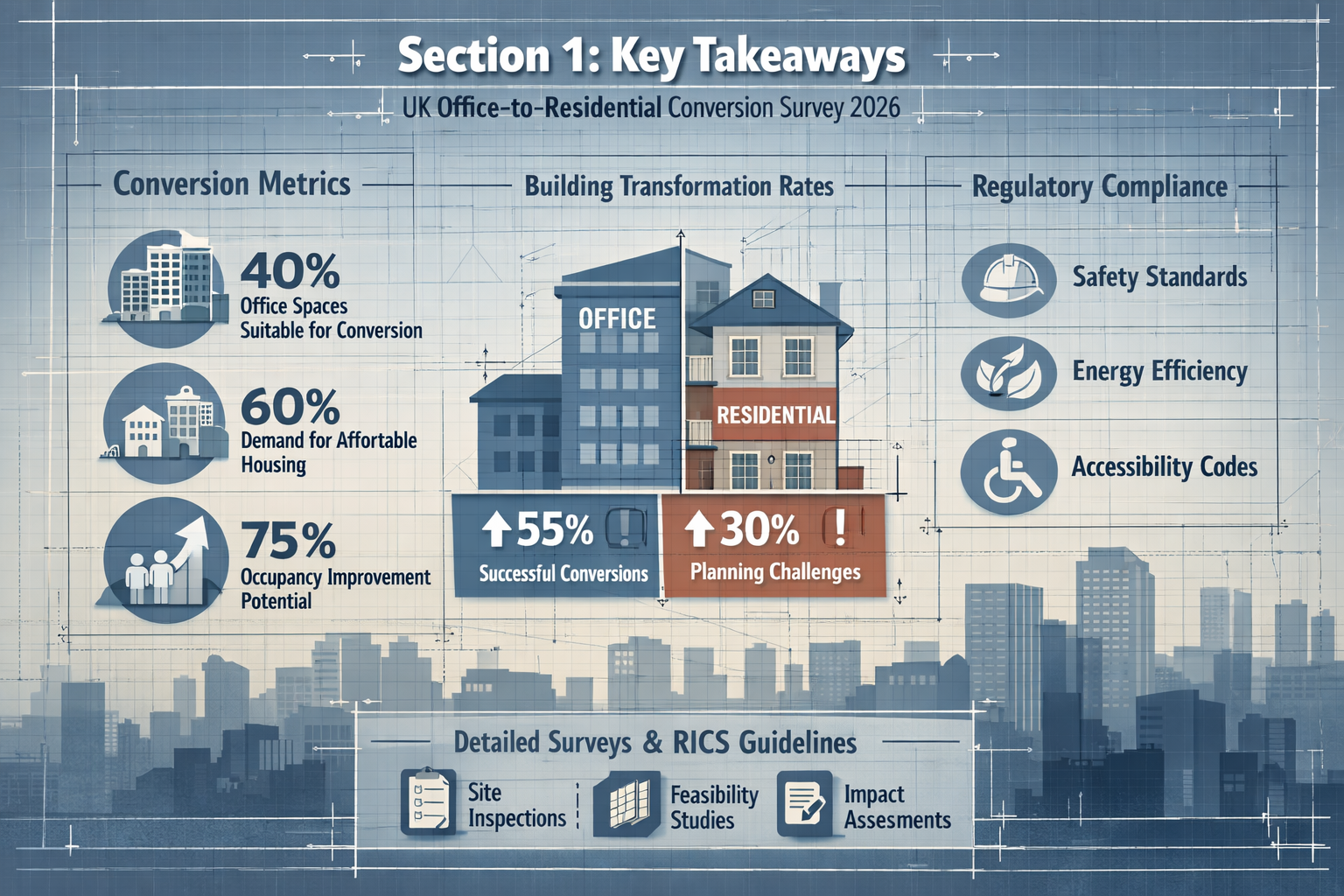
- 🏢 Structural assessments are paramount: Office buildings require comprehensive evaluation of load-bearing capacity to safely transition from open-plan commercial layouts to residential configurations with multiple partition walls
- 🔥 Fire safety compliance represents the greatest technical hurdle: Most office buildings feature single staircases and open atriums unsuitable for residential use, demanding extensive compartmentation and evacuation route upgrades
- ⚡ Energy performance standards are tightening: EPC reforms taking effect in late 2026 will impose stricter assessment methodologies, with domestic properties targeting rating "C" by 2030
- 📋 RICS standards are evolving: The anticipated 7th edition of the Code of Measuring Practice and updated service charge standards establish new benchmarks for conversion projects
- 💰 Early engagement prevents costly delays: Proactive coordination between surveyors, warranty providers, and developers identifies hidden defects and compliance issues before they derail project timelines
Understanding the 2026 Context for Office-to-Residential Conversions
The landscape of UK property development has transformed dramatically. With an estimated 25 million homes requiring energy improvement[3], and office vacancy rates reaching historic highs in major urban centers, conversion projects represent a critical solution to housing shortages while addressing sustainability challenges.
The Urban Recovery Phenomenon
London and other major UK cities are experiencing a conversion boom following relaxed planning restrictions. The shift to hybrid and remote work models has fundamentally altered commercial property demand, leaving developers and investors seeking viable alternatives for underutilized office stock[1].
However, this opportunity comes with significant technical complexity. Quality concerns persist regarding some converted units, with cramped layouts and inadequate natural light plaguing poorly executed schemes[1]. These challenges underscore the importance of rigorous building survey protocols aligned with RICS standards.
Regulatory Evolution in 2026
Several regulatory changes are reshaping the conversion landscape:
EPC Reforms: Energy Performance Certificate requirements are undergoing substantial revision, with changes expected in the second half of 2026. These reforms will affect when EPCs are required, assessment methodology, and data sharing requirements, with increased enforcement anticipated[2].
RICS Professional Standards: The updated RICS Professional Standard for Service Charges in Commercial Property (2nd edition) became mandatory on December 31, 2025, establishing new transparency and fairness requirements for all RICS-accredited professionals[4].
Code of Measuring Practice: The 7th edition is scheduled for release in 2026, with public consultation expected in Q1 2026, providing updated measurement methodologies applicable to conversion projects[5].
Essential Building Survey Protocols for UK Office-to-Residential Conversions: RICS Standards Amid 2026 Urban Recovery
Conducting thorough building surveys for office-to-residential conversions demands specialized expertise beyond standard commercial building surveys. The protocols must address unique structural, regulatory, and functional challenges inherent to repurposing commercial spaces for residential occupancy.
Structural Assessment Requirements
Load Distribution Analysis forms the foundation of any conversion survey. Office buildings typically feature:
- Open-plan layouts with minimal internal walls
- Concentrated load points designed for desks and equipment
- Floor slabs engineered for commercial rather than residential loading
Conversion to residential use introduces fundamentally different load patterns. Multiple partition walls, kitchen fixtures, bathroom installations, and distributed furniture create new stress points throughout the structure[1].
A comprehensive Level 3 building survey must evaluate:
| Assessment Component | Key Considerations |
|---|---|
| Floor Slab Capacity | Can existing slabs support additional partition walls and residential fixtures? |
| Column Spacing | Does the structural grid accommodate residential room layouts without excessive span modifications? |
| Reinforcement Works | What strengthening is required to alter load distribution patterns? |
| Foundation Adequacy | Can foundations support increased residential density and altered load paths? |
Hidden Defects Identification requires proactive inspection beyond standard building control certificates. Conversion warranty providers frequently request additional assessments to identify[1]:
- Defective concrete (carbonation, alkali-silica reaction)
- Non-compliant cladding systems
- Inadequate insulation in older office buildings
- Concealed structural modifications from previous refurbishments
Fire Safety Compliance Protocols
Fire safety represents the most significant technical challenge in office-to-residential conversions[1]. The fundamental differences between commercial and residential fire safety requirements demand comprehensive survey protocols addressing:
Compartmentation Assessment:
- Evaluation of existing fire barriers and their residential suitability
- Identification of required new fire-resistant walls and floors
- Assessment of service penetrations requiring fire-stopping
Means of Escape Evaluation:
- Analysis of stairwell capacity and configuration
- Assessment of travel distances from habitable rooms
- Evaluation of alternative escape routes
- Smoke control system adequacy
Most office buildings feature single staircases and open atriums fundamentally unsuitable for residential use without substantial modification[1]. Survey protocols must identify these deficiencies early to inform cost estimates and feasibility assessments.
Protected Route Requirements:
Office corridors rarely meet residential protected route standards. Surveyors must assess:
- Corridor widths and fire resistance
- Door specifications and self-closing mechanisms
- Emergency lighting provision
- Smoke detection and alarm systems
For detailed guidance on structural evaluation methodologies, refer to our structural surveys resource.
RICS Standards and Measurement Protocols for 2026 Conversions
The Royal Institution of Chartered Surveyors establishes the professional framework governing building surveys for conversion projects. Understanding current and forthcoming RICS standards is essential for compliance and professional practice.
RICS Code of Measuring Practice (7th Edition)
The anticipated 7th edition of the RICS Code of Measuring Practice, scheduled for release in 2026 with Q1 consultation[5], will provide updated measurement methodologies directly applicable to conversion projects. While the 6th edition remains current during the interim period, surveyors should prepare for:
Gross Internal Area (GIA) Considerations:
- Measurement protocols for mixed-use buildings during conversion phases
- Treatment of common areas transitioning from commercial to residential use
- Standardized approaches to measuring unconventional residential layouts
Net Internal Area (NIA) Applications:
- Residential unit measurement standards
- Exclusion protocols for service areas and circulation spaces
- Consistency in reporting convertible versus non-convertible spaces
Service Charge Standards for Conversion Projects
The updated RICS Professional Standard for Service Charges in Commercial Property (2nd edition), effective December 31, 2025[4], establishes mandatory requirements emphasizing:
- Transparency: Clear communication of service charge calculations during conversion phases
- Fairness: Equitable allocation of costs between remaining commercial tenants and new residential occupants
- Timely Budget Delivery: Advance notification of anticipated service charge changes resulting from conversion works
These standards particularly impact phased conversion projects where commercial and residential uses coexist during development.
Energy Performance and Retrofit Standards
With domestic minimum energy efficiency standards expected to rise to rating "C" by 2030[2][4], and longer-term targets indicating a minimum EPC rating of 'B' for non-domestic properties between 2030 and 2035, conversion surveys must thoroughly assess:
Current Energy Performance:
- Baseline EPC rating of existing office building
- Thermal performance of existing envelope
- Efficiency of current mechanical systems
Improvement Pathways:
- Cost-effective interventions to achieve target ratings
- Feasibility of renewable energy integration
- Whole-building energy modeling for conversion scenarios
RICS retrofit guidance[3] emphasizes the critical role of professional advice in achieving energy improvements across the UK's building stock, with conversion projects offering unique opportunities to implement comprehensive sustainability upgrades.
Mechanical and Electrical Systems: Critical Survey Components

M&E systems require fundamental redesign for office-to-residential conversions, as most office buildings rely on centralized HVAC systems incompatible with individual residential units[1]. Survey protocols must comprehensively evaluate existing infrastructure and conversion requirements.
Heating, Ventilation, and Air Conditioning (HVAC)
Existing System Assessment:
- Central plant capacity and condition
- Distribution network configuration
- Suitability for individual metering and control
Residential Requirements:
- Individual apartment heating and cooling needs
- Ventilation standards for habitable rooms
- Hot water provision for multiple residential units
The transition from commercial to residential HVAC typically necessitates:
✅ Installation of individual boilers or heat pumps per unit
✅ Reconfiguration of ductwork for apartment-specific distribution
✅ Provision for individual temperature control
✅ Compliance with Part F (Ventilation) Building Regulations
Drainage and Plumbing Infrastructure
Office buildings feature minimal drainage infrastructure compared to residential requirements. Survey protocols must assess:
Capacity Analysis:
- Existing soil stack capacity for multiple bathrooms and kitchens
- Horizontal drainage runs and fall adequacy
- Connection points to public sewers
New Installation Requirements:
- Kitchen waste disposal systems
- Bathroom drainage for each residential unit
- Washing machine and dishwasher connections
- Rainwater and surface water management
Water Supply Provisions:
- Incoming main capacity for increased residential demand
- Pressure and flow rates at upper floors
- Hot water generation and distribution
- Individual metering infrastructure
Electrical Systems Evaluation
Commercial electrical systems require substantial modification to meet residential standards:
| System Component | Commercial Configuration | Residential Requirements |
|---|---|---|
| Distribution | Centralized panels for floor plates | Individual consumer units per apartment |
| Capacity | Designed for office equipment loads | Higher diversity factor for residential appliances |
| Emergency Systems | Fire alarm and emergency lighting | Residential fire detection and emergency escape lighting |
| Data Infrastructure | Structured cabling for business use | Individual broadband and TV connections |
For comprehensive survey methodologies, explore our guide on building surveys.
Conversion Warranty Requirements and Survey Implications
Conversion warranties provide essential protection for lenders and purchasers, but obtaining coverage requires detailed structural assessments and proactive defect management[1].
Warranty Provider Expectations
Conversion warranty specialists emphasize early engagement and proactive management of structural and compliance challenges. Survey protocols must address warranty provider requirements including:
Structural Certification:
- Confirmation that existing structures can safely accommodate residential load distribution
- Documentation of reinforcement works needed to alter load patterns
- Professional engineer certification of structural adequacy
Defect Disclosure:
- Comprehensive identification of existing defects
- Remediation plans for identified issues
- Exclusions for pre-existing conditions not addressed during conversion
Compliance Documentation:
- Building Regulations approval for conversion works
- Fire safety certification
- Energy performance compliance evidence
Case Study: Belmont Place, Maidenhead
The Belmont Place development exemplifies successful navigation of conversion complexities through coordinated insurer and developer collaboration[1]. This 31-apartment scheme demonstrated the importance of:
- Early structural assessment identifying load-bearing modifications
- Proactive fire safety design addressing single-staircase limitations
- Comprehensive M&E redesign for individual apartment services
- Transparent communication with warranty providers throughout the process
The project's success underscores the value of rigorous survey protocols aligned with warranty requirements from project inception.
Valuation Impacts and Market Considerations in 2026
Building survey findings directly influence conversion project valuations and investment decisions. Understanding the relationship between technical assessments and market value is essential for developers, lenders, and investors.
Structural Defect Impact on Valuation
Significant structural defects identified during surveys can dramatically affect project viability:
Concrete Defects: Carbonation, alkali-silica reaction, or chloride contamination may require extensive remediation, potentially rendering conversions economically unviable.
Cladding Non-Compliance: Post-Grenfell scrutiny of cladding systems means non-compliant materials necessitate complete replacement, adding substantial costs and timeline extensions.
Foundation Inadequacy: Insufficient foundation capacity to support altered loads may require underpinning or structural reinforcement exceeding initial budget projections.
Fire Safety Compliance Costs
Fire safety modifications represent the largest single cost category in many conversions[1]. Survey identification of:
- Single-staircase configurations requiring second stairwell installation
- Inadequate compartmentation demanding extensive fire barrier construction
- Non-compliant escape routes necessitating layout redesign
These findings can shift projects from profitable to marginal, emphasizing the importance of thorough early-stage assessment.
Energy Performance Value Premium
With EPC reforms taking effect in 2026[2] and minimum standards rising to rating "C" by 2030[2][4], energy-efficient conversions command premium valuations. Survey protocols identifying cost-effective pathways to superior energy performance create competitive advantages in the residential market.
Properties achieving EPC rating "B" or "A" through conversion works position themselves favorably for:
- Higher sale prices reflecting lower occupancy costs
- Faster sales velocity as buyers prioritize energy efficiency
- Future-proofing against regulatory tightening
- Potential eligibility for green financing products
Implementing Building Survey Protocols for UK Office-to-Residential Conversions: RICS Standards Amid 2026 Urban Recovery
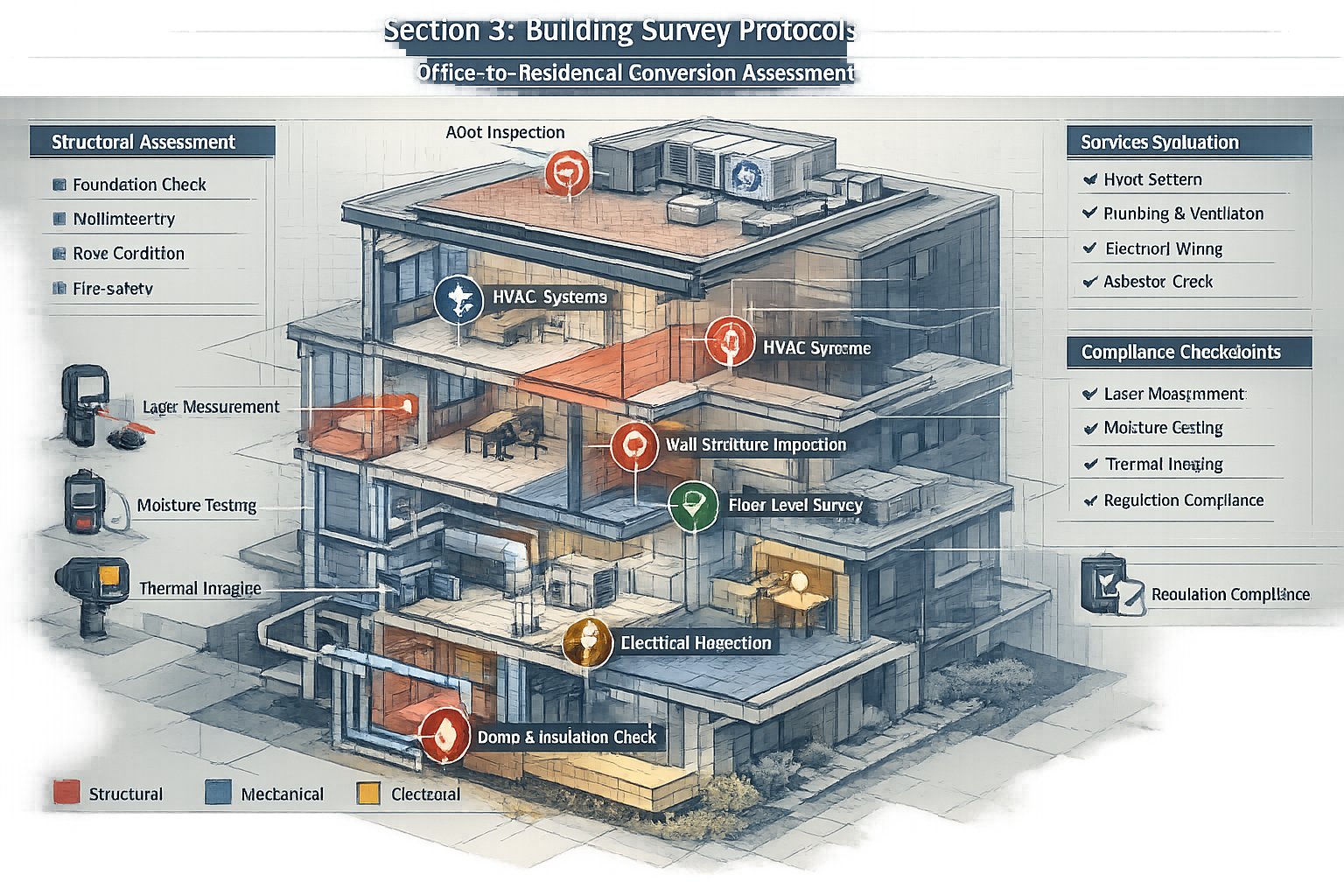
Successful implementation of comprehensive survey protocols requires structured methodology, qualified professionals, and coordinated stakeholder engagement.
Survey Team Composition
Complex conversion projects demand multidisciplinary expertise:
RICS Chartered Building Surveyor: Overall survey coordination, building pathology assessment, and regulatory compliance evaluation. Engage chartered surveyors with conversion experience.
Structural Engineer: Load analysis, reinforcement design, and structural certification for warranty purposes.
M&E Consultant: Mechanical and electrical systems assessment, residential infrastructure design, and energy performance modeling.
Fire Safety Specialist: Fire risk assessment, means of escape evaluation, and compliance strategy development.
Quantity Surveyor: Cost estimation for identified remediation works and conversion requirements.
Survey Methodology and Sequencing
Phase 1: Desktop Review
- Historical building records analysis
- Previous survey and inspection reports
- Planning permission and building control history
- Asbestos registers and hazardous materials documentation
Phase 2: Non-Invasive Inspection
- Visual assessment of structural elements
- Building services infrastructure mapping
- Fire safety provision evaluation
- Energy performance preliminary assessment
Phase 3: Invasive Investigation
- Concrete core sampling and testing
- Opening-up works to expose concealed elements
- Drainage testing and CCTV surveys
- Electrical testing and certification
Phase 4: Specialist Assessments
- Structural calculations and load analysis
- Fire engineering studies
- Acoustic performance testing
- Environmental and contamination surveys
For timeline expectations, review our guide on how long building surveys take.
Reporting Standards and Documentation
Survey reports for conversion projects should follow RICS guidance while addressing conversion-specific requirements:
Executive Summary:
- Project viability assessment
- Critical defects and compliance issues
- Cost implications of identified works
- Recommended next steps
Detailed Findings:
- Structured assessment by building element
- Photographic evidence of conditions
- Technical drawings and diagrams
- Compliance gap analysis
Recommendations:
- Prioritized remediation works
- Alternative design strategies
- Further investigation requirements
- Warranty provider engagement strategy
Future-Proofing Conversions: 2026 and Beyond
As regulatory frameworks continue evolving, forward-thinking survey protocols must anticipate future requirements to protect investment value and ensure long-term viability.
Anticipated Regulatory Developments
Building Safety Act Implementation: Ongoing implementation of the Building Safety Act will impose additional requirements on converted residential buildings, particularly those exceeding 18 meters in height.
EPC Methodology Changes: The second half of 2026 will see EPC assessment methodology revisions, potentially affecting how converted properties are rated[2].
Accessibility Standards: Emerging guidance on accessibility in converted buildings may impose retrofit requirements for inclusive design.
Technology Integration
Modern survey protocols increasingly incorporate advanced technologies:
3D Laser Scanning: Precise dimensional capture facilitating accurate residential layout design within existing structural constraints.
Thermal Imaging: Non-invasive identification of insulation deficiencies, thermal bridging, and moisture ingress.
Building Information Modeling (BIM): Digital twin creation enabling coordinated design development and clash detection before construction.
Drone Surveys: Safe, cost-effective external envelope inspection, particularly valuable for tall buildings.
Sustainability and Circular Economy Considerations
RICS advocacy emphasizes sustainable growth and retrofit excellence[8]. Survey protocols should evaluate:
- Embodied carbon benefits of conversion versus new construction
- Material reuse opportunities from existing building fabric
- Whole-life carbon assessment of conversion schemes
- Biodiversity enhancement potential in urban regeneration
Conclusion
Building Survey Protocols for UK Office-to-Residential Conversions: RICS Standards Amid 2026 Urban Recovery represent a specialized discipline requiring comprehensive technical knowledge, regulatory awareness, and strategic foresight. As vacant office buildings emerge as valuable residential development opportunities in the recovering urban market, rigorous survey methodologies aligned with RICS standards are essential for project success.
The convergence of structural complexity, fire safety challenges, M&E system redesign requirements, and evolving energy performance standards demands multidisciplinary expertise and proactive risk management. Early engagement with qualified professionals, thorough investigation of existing conditions, and transparent communication with warranty providers and stakeholders create the foundation for viable, compliant, and valuable conversion projects.
Actionable Next Steps
For developers, investors, and property professionals embarking on office-to-residential conversions in 2026:
- Engage RICS-qualified surveyors early in the feasibility stage to identify critical constraints before financial commitment
- Commission comprehensive structural assessments including invasive investigation to reveal hidden defects
- Prioritize fire safety compliance as the primary technical and cost driver in conversion projects
- Develop energy performance strategies targeting EPC rating "C" or better to future-proof against regulatory tightening
- Coordinate with conversion warranty providers from project inception to ensure insurability
- Monitor RICS standard updates including the forthcoming Code of Measuring Practice 7th edition
- Invest in specialist M&E design recognizing that residential infrastructure requirements differ fundamentally from commercial systems
The office-to-residential conversion opportunity in 2026 offers substantial potential for addressing housing shortages while repurposing underutilized urban assets. Success depends on rigorous application of professional survey protocols, adherence to RICS standards, and proactive management of the unique technical challenges these transformative projects present.
References
[1] Office To Resi Conversions – https://j3advisory.co.uk/office-to-resi-conversions/
[2] What Does 2026 Hold Real Estate Sector England – https://www.osborneclarke.com/insights/what-does-2026-hold-real-estate-sector-england
[3] Retrofit – https://www.rics.org/profession-standards/rics-standards-and-guidance/sector-standards/real-estate-standards/retrofit
[4] Uk Real Estate Sector 2026 And Beyond – https://www.charlesrussellspeechlys.com/en/insights/expert-insights/real-estate/2026/uk-real-estate-sector-2026-and-beyond/
[5] Code Of Measuring Practice – https://www.rics.org/profession-standards/rics-standards-and-guidance/sector-standards/real-estate-standards/code-of-measuring-practice
[6] Uk Influence And Advocacy Update January 2026 – https://www.rics.org/news-insights/uk-influence-and-advocacy-update-january-2026
[7] Building Survey Quality Standards 2026 Navigating Rics Updates And Enhanced Home Inspection Requirements – https://nottinghillsurveyors.com/blog/building-survey-quality-standards-2026-navigating-rics-updates-and-enhanced-home-inspection-requirements
[8] Rics Calls For Bold Reform By Chancellor To Unlock Sustainable Growth – https://www.rics.org/news-insights/rics-calls-for-bold-reform-by-chancellor-to-unlock-sustainable-growth
