
{"cover":"Professional landscape format (1536×1024) hero image featuring bold text overlay 'Valuing Properties in Scotland and Northern Ireland's 2026 Growth Leaders' in extra large 72pt white sans-serif font with dark gradient shadow, positioned in upper third. Background shows split composition: left side displays Edinburgh castle and Scottish highlands, right side shows Belfast cityscape and Northern Ireland coastal properties. Overlay of transparent property price growth charts showing upward trends. Color scheme: deep navy blue, emerald green, gold accents representing regional growth. High contrast, magazine cover quality, editorial financial publication style with subtle map outlines of Scotland and Northern Ireland regions.","content":["Detailed landscape format (1536×1024) infographic showing comparative regional house price performance across UK in 2026. Split-screen composition with Scotland and Northern Ireland highlighted in vibrant green showing +8% and +4.5% growth arrows, while South East England appears in muted grey with declining -0.2% indicators. Central data visualization displays bar charts comparing average property values: Scotland £193,114, Northern Ireland £196,000, England £293,131. Include surveyor with clipboard examining property details, price comparison tables, RICS survey sentiment indicators with percentage metrics, professional real estate analytics aesthetic with clean typography and data-driven visual hierarchy.","Detailed landscape format (1536×1024) illustration depicting surveyor conducting comprehensive property valuation in Scottish stone cottage. Scene shows professional chartered surveyor using tablet and laser measuring device, examining structural elements including traditional stonework, timber beams, and roof condition. Overlay displays transparent checklist items: comparable sales analysis, local market conditions, property-specific factors, regional growth adjustments. Background features Highland landscape through window. Include visual callouts highlighting Level 3 survey inspection points, damp meter readings, structural assessment notes. Professional documentary photography style with warm natural lighting and technical precision.","Detailed landscape format (1536×1024) strategic planning visualization showing forecasting tools and regional benchmark analysis for 2026-2027 property market. Central digital dashboard displays interactive map of Scotland and Northern Ireland with heat-map showing growth hotspots in Edinburgh, Glasgow, Belfast, and surrounding areas. Surrounding elements include: 3% national growth projection graphs, affordability index comparisons, buyer demand trend lines with 21% net balance indicators, sales volume forecasts showing 34% anticipated increases. Include professional surveyor analyzing data on multiple screens, comparative market analysis spreadsheets, and forward-looking price expectation charts. Modern fintech aesthetic with blue and green data visualization, clean interface design."]

While London's property market treads water and the South East continues its downward trajectory, a remarkable transformation is unfolding across Scotland and Northern Ireland. These once-overlooked regions now lead the UK's housing market recovery, with Northern Ireland posting an impressive 8% annual growth and Scotland demonstrating the strongest price sentiment in nearly a year.[1][5] For property surveyors and valuation professionals, Valuing Properties in Scotland and Northern Ireland's 2026 Growth Leaders: Surveyor Tactics Beyond the South-East Slump requires a fundamental shift in methodology—one that accounts for affordability-driven migration, regional economic resilience, and fundamentally different market dynamics than those governing traditional southern hotspots.
The stark regional divergence defining 2026's property landscape presents both challenges and opportunities for chartered surveyors. As traditional valuation approaches calibrated for South East markets prove inadequate for Scotland and Northern Ireland's unique growth trajectories, professionals must adapt their comparable selection, adjustment factors, and forecasting models to capture the nuances of these outperforming regions.
Key Takeaways
- 🏴 Scotland leads sentiment recovery with 42% net balance of surveyors reporting rising prices and 55% expecting further increases over the coming year[1]
- 📈 Northern Ireland tops annual growth at 8% year-on-year, while Scotland posts 2.8% gains compared to London's -0.2% decline[5]
- 💷 Affordability advantage drives demand with average prices of £193,114 (Scotland) and £196,000 (Northern Ireland) versus England's £293,131[3][4]
- 🔍 Surveyor tactics must evolve beyond South East methodologies to account for regional supply constraints, buyer migration patterns, and local economic factors
- 📊 Forward indicators signal sustained growth with Scottish buyer enquiries up 21% and new seller instructions rising 27% net balance[1]
Understanding the Regional Divergence in 2026's UK Property Market
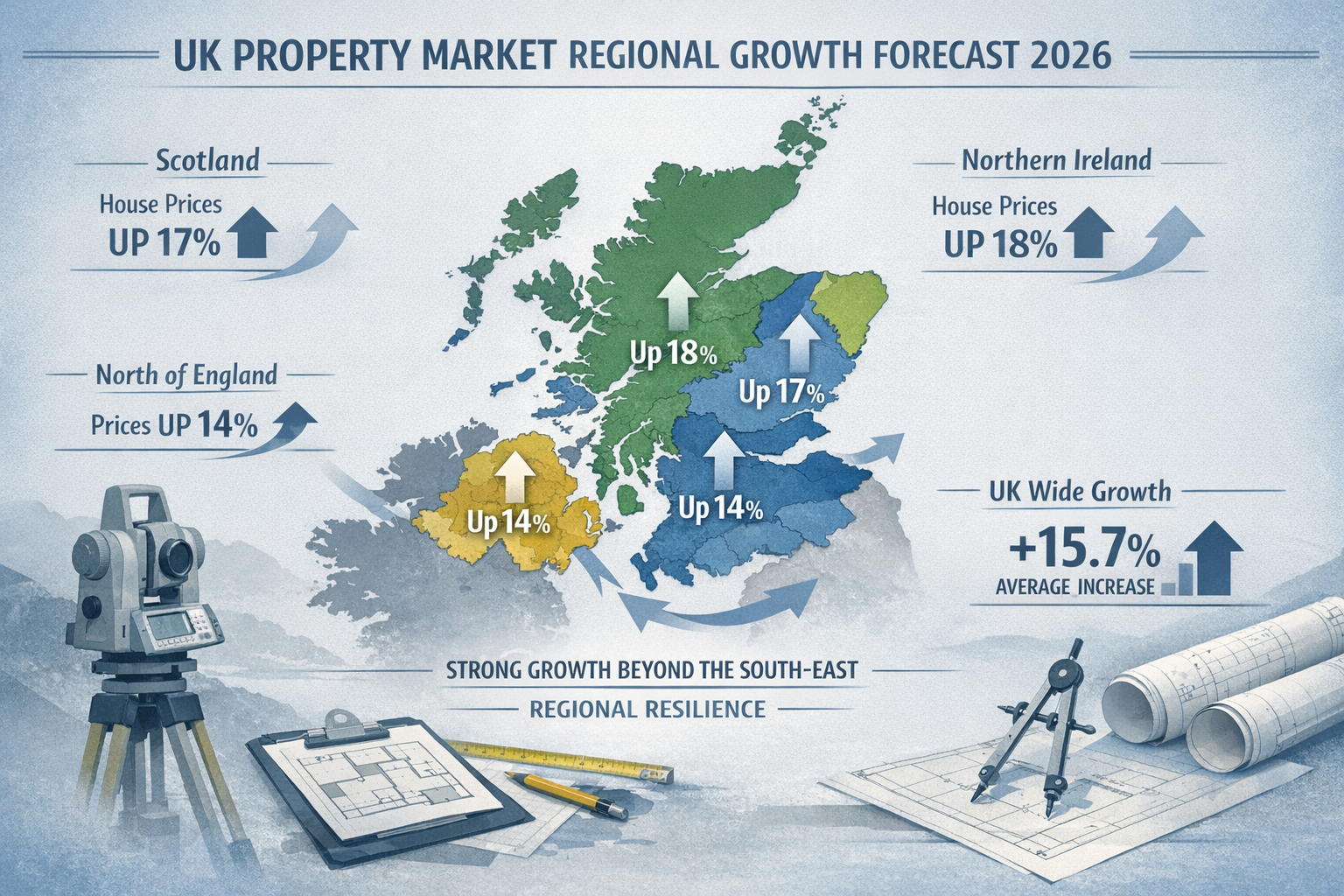
The UK housing market in 2026 tells a tale of two nations. While overall annual house price growth moderated to just 1.3% in the twelve months to January 2026—down from 1.8% the previous year—this headline figure masks dramatic regional variations that fundamentally reshape valuation practice.[5]
The North-South Divide Intensifies
Regional performance data reveals an unprecedented divergence. Northern Ireland leads with 8% annual growth, followed by the North West at 3.3% and Scotland at 2.8%.[5] Meanwhile, London experienced a 0.2% year-on-year decline, with the South East, South West, and East Anglia all underperforming the national average.[2]
This shift represents more than cyclical fluctuation—it reflects structural changes in buyer preferences, workplace flexibility, and affordability constraints that are reshaping where people choose to live and invest.
| Region | Annual Growth (Jan 2026) | Average Price | Year-on-Year Change |
|---|---|---|---|
| Northern Ireland | 8.0% | £196,000 | +7.5% (Q4 2025)[3] |
| North West | 3.3% | — | Strong growth |
| Scotland | 2.8% | £193,114 | +4.5% (2025)[4] |
| UK Average | 1.3% | — | Down from 1.8% |
| London | -0.2% | — | Declining |
| South East | Negative | — | Below average |
Why Scotland and Northern Ireland Are Outperforming
Several interconnected factors drive the exceptional performance of these regions:
Affordability advantage: With average house prices substantially below England's £293,131, both Scotland (£193,114) and Northern Ireland (£193,247) offer compelling value propositions for first-time buyers and relocating families.[4]
Remote work flexibility: The normalization of hybrid working arrangements has liberated buyers from geographical constraints, enabling them to prioritize quality of life and property value over proximity to traditional employment centers.
Supply constraints: Both regions face limited housing stock relative to surging demand. In Scotland, the 27% net balance increase in new seller instructions still struggles to meet the 21% rise in buyer enquiries.[1]
Economic resilience: Scotland's 4.5% year-to-date inflation in 2025 compared to England's 2.2% reflects stronger underlying economic activity and wage growth supporting housing demand.[4]
For surveyors accustomed to conducting comprehensive property assessments, these regional dynamics necessitate recalibrating valuation assumptions and comparable selection criteria.
Valuing Properties in Scotland and Northern Ireland's 2026 Growth Leaders: Core Surveyor Methodologies
Effective property valuation in Scotland and Northern Ireland's growth markets requires surveyors to adapt traditional methodologies while maintaining professional standards and RICS compliance. The following tactical approaches enable accurate assessments in these dynamic regional markets.
Comparable Selection in Low-Volume Markets
The challenge: Scotland and Northern Ireland often feature thinner transaction volumes than South East markets, making traditional comparable selection more complex. A three-bedroom semi-detached property in a Scottish market town may have only a handful of relevant sales within the past six months.
Surveyor tactics:
-
Expand geographical search parameters while maintaining market homogeneity. Consider properties within a 5-10 mile radius in rural areas, versus the 0.5-1 mile standard in dense urban markets.
-
Extend temporal range selectively. In stable or appreciating markets, comparables from 9-12 months prior remain relevant with appropriate time adjustments reflecting the 2.8-8% annual growth rates.[5]
-
Weight recent transactions heavily. Given rapid appreciation, prioritize sales from the past three months, applying 55% of surveyors' forward price expectations to adjust older comparables.[1]
-
Cross-reference rental yields. In investment-heavy areas, rental comparables provide additional validation points for capital value assessments.
Adjusting for Regional Growth Trajectories
Standard valuation models calibrated for modest 1-2% annual appreciation underestimate value in Scotland and Northern Ireland's accelerating markets. Surveyors must incorporate forward-looking adjustments based on regional sentiment and supply-demand fundamentals.
Key adjustment factors:
- Time adjustments: Apply monthly appreciation rates derived from regional indices (approximately 0.23% monthly for Scotland, 0.67% for Northern Ireland based on annual figures)
- Sentiment weighting: Factor in the 55% of Scottish surveyors expecting higher prices and 23% anticipating near-term rises[1]
- Supply constraints: Adjust upward for properties in areas with limited new instruction volumes relative to buyer enquiry strength
"Scotland reported the strongest price sentiment in nearly a year, with 42% net balance of surveyors reporting house prices rising over the past three months, compared to the UK headline balance of -10%."[1]
Property-Specific Factors in Scottish and Northern Irish Markets
Beyond regional trends, individual property characteristics carry different weight in these markets compared to South East valuations.
Premium features in growth regions:
✅ Energy efficiency: With higher heating costs in northern climates, properties with modern insulation, efficient boilers, and renewable energy installations command significant premiums
✅ Period character: Traditional Scottish stone cottages and Northern Irish terraced properties with original features attract premium pricing from relocating buyers seeking authentic regional character
✅ Outdoor space: Gardens and land parcels carry enhanced value given lower density and lifestyle-focused buyer priorities
✅ Connectivity infrastructure: Fiber broadband and mobile coverage critically impact valuations for remote workers
When conducting a Level 3 building survey, surveyors should document these features comprehensively, as they directly influence marketability and value in these regions.
Addressing Structural and Regional Building Characteristics
Scottish and Northern Irish properties frequently present construction types uncommon in southern England, requiring specialized assessment expertise:
Traditional Scottish construction:
- Stone-built properties with solid walls requiring different damp assessment protocols
- Slate roofing with extended lifespan but higher replacement costs
- Timber sash windows with preservation requirements in conservation areas
Northern Irish building stock:
- Cavity wall construction with potential historical insulation issues
- Render finishes requiring ongoing maintenance assessment
- Mixed-tenure developments with service charge implications
Surveyors unfamiliar with these regional building types should consult local specialists or undertake continuing professional development to ensure competent assessment. The chartered surveyor's role extends beyond simple valuation to comprehensive property analysis.
Advanced Tactics for Valuing Properties in Scotland and Northern Ireland's 2026 Growth Leaders
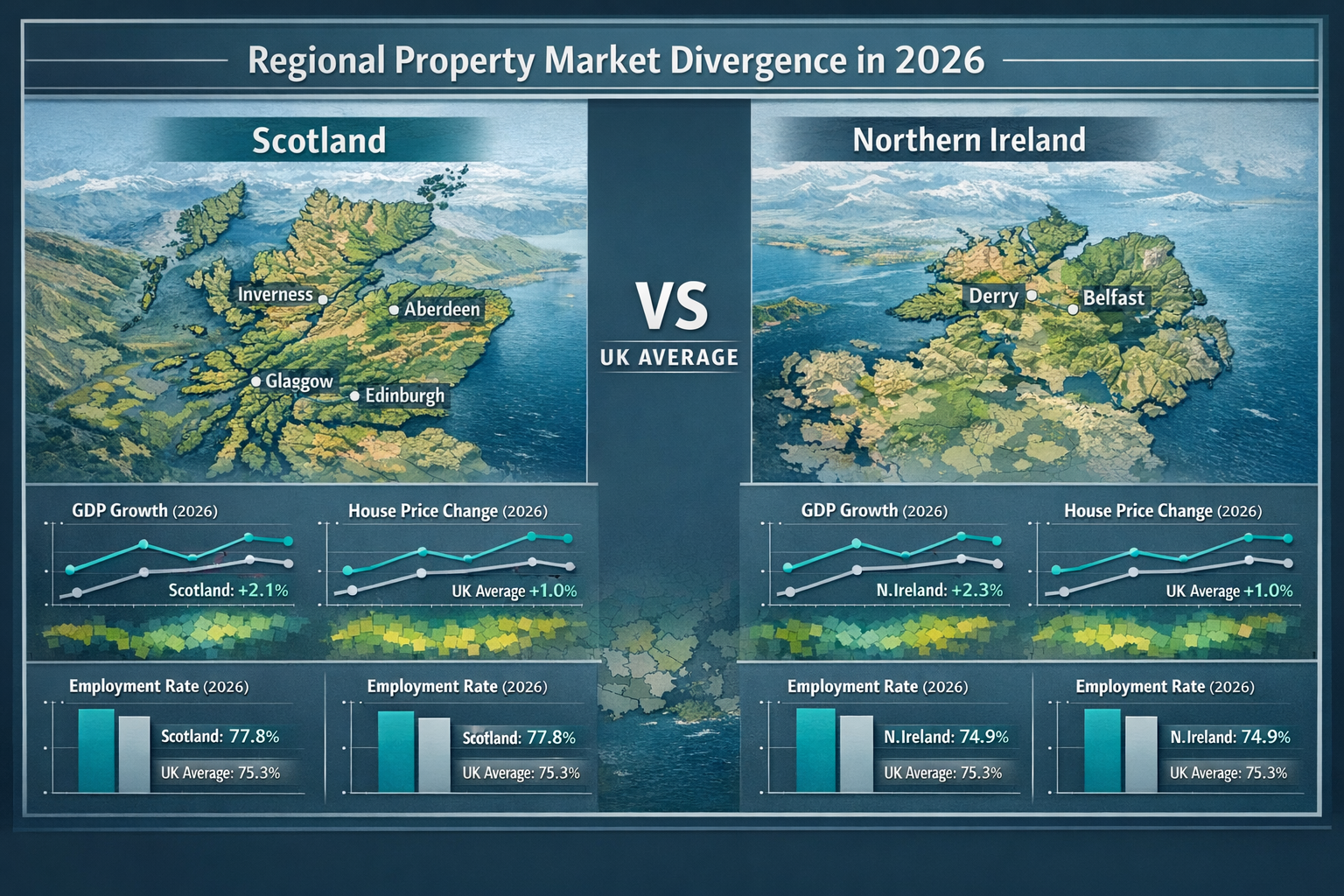
As regional markets mature and appreciation continues, sophisticated valuation techniques become essential for accuracy and defensibility.
Incorporating Market Sentiment Indicators
RICS survey data provides invaluable forward-looking indicators that enhance valuation precision. For Scotland and Northern Ireland, current sentiment metrics signal sustained growth:[1]
Scottish market indicators:
- Price sentiment: 42% net balance reporting rising prices (strongest in nearly a year)
- Forward expectations: 55% anticipating higher prices over 12 months
- Near-term outlook: 23% expecting rises within three months
- Sales volume: 34% anticipating higher transaction volumes in coming quarter
Practical application: When valuing properties for mortgage purposes or investment analysis, surveyors can reference these sentiment indicators to justify valuations at the upper end of comparable ranges or to support positive growth assumptions in discounted cash flow models.
Supply-Demand Analysis at Micro-Market Level
Regional headline figures mask significant variation at the local authority and neighborhood levels. Effective valuation requires granular supply-demand analysis:
Buyer demand assessment:
- Track local estate agent instruction volumes and time-on-market trends
- Monitor planning application approvals for new residential development
- Analyze demographic shifts and employment growth in specific localities
- Assess infrastructure investment (transport links, schools, amenities)
Seller supply constraints:
- Evaluate new instruction trends (Scotland's 27% net balance increase indicates improving but still constrained supply)[1]
- Consider planning restrictions and conservation area limitations
- Assess land availability for new construction
- Review local authority housing strategies and delivery targets
For properties in high-demand, low-supply micro-markets, valuations may justifiably exceed regional averages by 10-15% based on localized scarcity premiums.
Forecasting Models for 3% National Growth Environment
With national house price growth projected around 3% for 2026-2027, but Scotland and Northern Ireland likely to outperform, surveyors require robust forecasting frameworks for development appraisals, investment valuations, and strategic advice.
Multi-scenario modeling approach:
Conservative scenario (probability-weighted 30%):
- Scotland: 2.5% annual growth
- Northern Ireland: 5% annual growth
- Driven by: Economic slowdown, interest rate persistence
Base case scenario (probability-weighted 50%):
- Scotland: 4% annual growth
- Northern Ireland: 7% annual growth
- Driven by: Continued affordability advantage, sustained demand
Optimistic scenario (probability-weighted 20%):
- Scotland: 6% annual growth
- Northern Ireland: 10% annual growth
- Driven by: Accelerated migration, supply crisis deepening
This probabilistic approach provides clients with realistic value ranges rather than single-point estimates, enhancing decision-making quality.
Leveraging Technology and Data Analytics
Modern surveying practice increasingly incorporates technological tools that enhance accuracy and efficiency:
📱 Digital measurement tools: Laser distance meters and photogrammetry applications ensure precise floor area calculations critical for per-square-foot comparisons
📊 Automated valuation models (AVMs): While not replacing professional judgment, AVMs provide useful sanity checks and identify outlier comparables
🗺️ Geographic information systems (GIS): Mapping tools visualize comparable locations, transport links, and amenity proximity
📈 Market analytics platforms: Subscription services provide real-time transaction data, rental yields, and demographic trends at postcode level
When conducting homebuyer surveys or RICS valuations, integrating these technologies with traditional surveying expertise delivers superior outcomes.
Addressing Unique Scottish Legal and Regulatory Frameworks
Scotland's distinct legal system creates valuation considerations absent in England, Wales, and Northern Ireland:
Home Report requirements: Since 2008, Scottish sellers must commission a Home Report including a Single Survey and property valuation before marketing. Surveyors must understand how these mandated valuations influence market pricing and buyer expectations.
Offers over pricing strategy: The Scottish convention of marketing properties "offers over" a guide price rather than at a fixed asking price affects comparable analysis, as actual sale prices typically exceed advertised figures by 5-10% in competitive markets.
Missives and conclusion of contract: The binding nature of missives in Scottish conveyancing means fewer fall-throughs than in English markets, providing greater transaction certainty that supports valuation confidence.
Leasehold rarity: With most Scottish properties held as freehold (or feudal equivalent), surveyors avoid the complex leasehold valuation adjustments common in English markets.
Understanding these legal distinctions ensures valuations align with local market realities and client expectations.
Strategic Considerations for Surveyors Operating in Growth Markets
Beyond technical valuation methodology, professional surveyors must navigate strategic and ethical considerations when operating in rapidly appreciating markets.
Managing Client Expectations in Appreciating Markets
The optimism challenge: Sellers in Scotland and Northern Ireland may harbor unrealistic price expectations based on media coverage of regional outperformance. Surveyors must balance acknowledging genuine growth with tempering unfounded optimism.
Communication tactics:
- Present comparable evidence transparently, showing both supporting and contradicting data points
- Explain regional trends while emphasizing property-specific factors that may limit individual appreciation
- Provide realistic marketing price guidance that maximizes achievable sale price without extended time-on-market
- Document assumptions and limitations clearly in written reports
Ethical Considerations in Valuation Inflation Pressures
Rapidly appreciating markets create pressures that challenge professional ethics:
⚠️ Mortgage valuation pressure: Lenders or borrowers may pressure surveyors to "hit" specific figures to facilitate transactions. RICS standards require valuations reflect genuine market value regardless of desired outcomes.
⚠️ Development appraisal optimism: Developers may seek aggressive residual valuations to justify land acquisitions. Surveyors must apply realistic growth assumptions and construction cost estimates.
⚠️ Investment yield compression: Investors purchasing in growth markets may accept lower initial yields anticipating capital appreciation. Valuations must clearly distinguish between investment value and market value.
Maintaining professional independence and adhering to RICS valuation standards protects both surveyor reputation and client interests over the long term.
Building Regional Expertise and Networks
Surveyors seeking to capitalize on Scotland and Northern Ireland's growth markets must invest in developing genuine regional expertise:
Knowledge development:
- Attend regional property conferences and RICS local association events
- Subscribe to Scottish and Northern Irish property market publications
- Complete CPD courses on regional building types, legal frameworks, and market dynamics
- Conduct site visits to build firsthand familiarity with local areas
Professional networks:
- Establish relationships with local estate agents, solicitors, and developers
- Join regional property professional associations
- Participate in local authority planning consultations
- Collaborate with regional specialists on complex assignments
This investment in regional knowledge creates competitive advantage and enhances service quality for clients navigating these growth markets.
Diversifying Service Offerings for Regional Clients
Scotland and Northern Ireland's property boom creates demand for specialized surveying services beyond standard valuations:
🏘️ Development feasibility studies: Assessing residential development opportunities in growth areas
🏡 Portfolio reviews: Advising investors on acquisition and disposal strategies across regional markets
🔧 Retrofit and renovation advice: Guiding property improvements that maximize value in regional markets
📋 Expert witness services: Providing valuation evidence for disputes, matrimonial settlements, and tax matters
By expanding service offerings while maintaining core valuation competence, surveyors build sustainable practices aligned with regional market opportunities.
Conclusion

Valuing Properties in Scotland and Northern Ireland's 2026 Growth Leaders: Surveyor Tactics Beyond the South-East Slump represents both a professional imperative and a commercial opportunity for chartered surveyors. As these regions continue outperforming traditional southern markets—with Northern Ireland posting 8% annual growth and Scotland demonstrating the strongest price sentiment in nearly a year—valuation professionals must fundamentally adapt their methodologies, comparable selection criteria, and forecasting approaches.[1][5]
The tactics outlined in this guide—from expanding geographical search parameters and incorporating regional sentiment indicators to understanding Scottish legal frameworks and leveraging technology—equip surveyors to deliver accurate, defensible valuations in these dynamic markets. As affordability-driven migration continues, remote work flexibility normalizes, and supply constraints persist, Scotland and Northern Ireland's structural advantages position these regions for sustained outperformance.
Actionable Next Steps
For surveyors seeking to capitalize on these growth markets:
-
Conduct a knowledge audit: Assess current understanding of Scottish and Northern Irish property markets, legal frameworks, and building types; identify gaps requiring CPD investment
-
Build regional networks: Establish relationships with local professionals, attend regional events, and develop on-the-ground market intelligence
-
Review and update methodologies: Ensure valuation approaches account for regional growth trajectories, supply-demand dynamics, and property-specific factors unique to these markets
-
Invest in technology: Implement digital tools that enhance measurement accuracy, comparable analysis, and market data access
-
Diversify service offerings: Explore specialized services aligned with regional market opportunities beyond standard valuations
-
Monitor market indicators: Track RICS survey data, transaction volumes, and sentiment metrics to anticipate market shifts and adjust valuation assumptions accordingly
The regional divergence defining 2026's UK property market is not a temporary aberration but a structural realignment reflecting fundamental shifts in buyer preferences, economic geography, and housing affordability. Surveyors who recognize this transformation and adapt their practices accordingly will position themselves at the forefront of the profession's evolution—delivering superior client outcomes while building sustainable, growth-oriented practices beyond the South-East slump.
For comprehensive guidance on surveying best practices, explore our resources on what surveyors check during property inspections and choosing between Level 2 and Level 3 surveys to ensure thorough property assessments regardless of regional location.
References
[1] Scottish Housing Market 2026 Rics Survey – https://www.simpsonmarwick.com/journal/scottish-housing-market-2026-rics-survey
[2] Uk Resi Survey Jan 2026 Report Shows Early Signs Market Recovery Despite Caution – https://www.rics.org/news-insights/uk-resi-survey-jan-2026-report-shows-early-signs-market-recovery-despite-caution
[3] February2026 – https://www.ons.gov.uk/economy/inflationandpriceindices/bulletins/privaterentandhousepricesuk/february2026
[4] House Price Forecast – https://hoa.org.uk/advice/guides-for-homeowners/i-am-buying/house-price-forecast/
[5] House Price Growth Remains In Check – https://propertyindustryeye.com/house-price-growth-remains-in-check/
