
The UK's artificial intelligence revolution has triggered an unprecedented surge in data centre construction—and with it, a complex web of party wall challenges that surveyors must navigate with precision. As the nation races to build the digital infrastructure powering tomorrow's AI applications, Party Wall Surveys for Data Centre Expansions in the UK AI Boom: RICS Guidance and Case Studies from 2026 Projects have become critical to ensuring these high-stakes developments proceed smoothly, legally, and cost-effectively.
In 2026, data centres represent one of the fastest-growing investment sectors in UK construction[4]. These massive facilities, often built in tight urban locations or expanded into neighbouring industrial estates, regularly trigger party wall requirements under the Party Wall etc. Act 1996. The stakes are higher than ever: delays can cost developers millions, whilst improper party wall procedures can result in costly disputes, injunctions, and reputational damage.
This comprehensive guide explores the essential surveyor checklists, RICS compliance frameworks, and real-world lessons from 2026 data centre projects that reveal both common pitfalls and proven cost-saving strategies.
Key Takeaways
- Data centre expansions frequently trigger party wall requirements due to excavations, structural modifications, and shared boundaries in industrial locations
- RICS professional standards provide the framework for conducting thorough party wall surveys that protect all parties' interests
- Proper notice procedures and documentation can prevent costly disputes and project delays in high-value AI infrastructure builds
- 2026 case studies reveal common mistakes including inadequate condition surveys, rushed timelines, and poor neighbour communication
- Proactive surveyor engagement early in planning delivers significant cost savings and smoother project delivery
Understanding Party Wall Requirements for Data Centre Developments
What Triggers Party Wall Procedures in Data Centre Projects
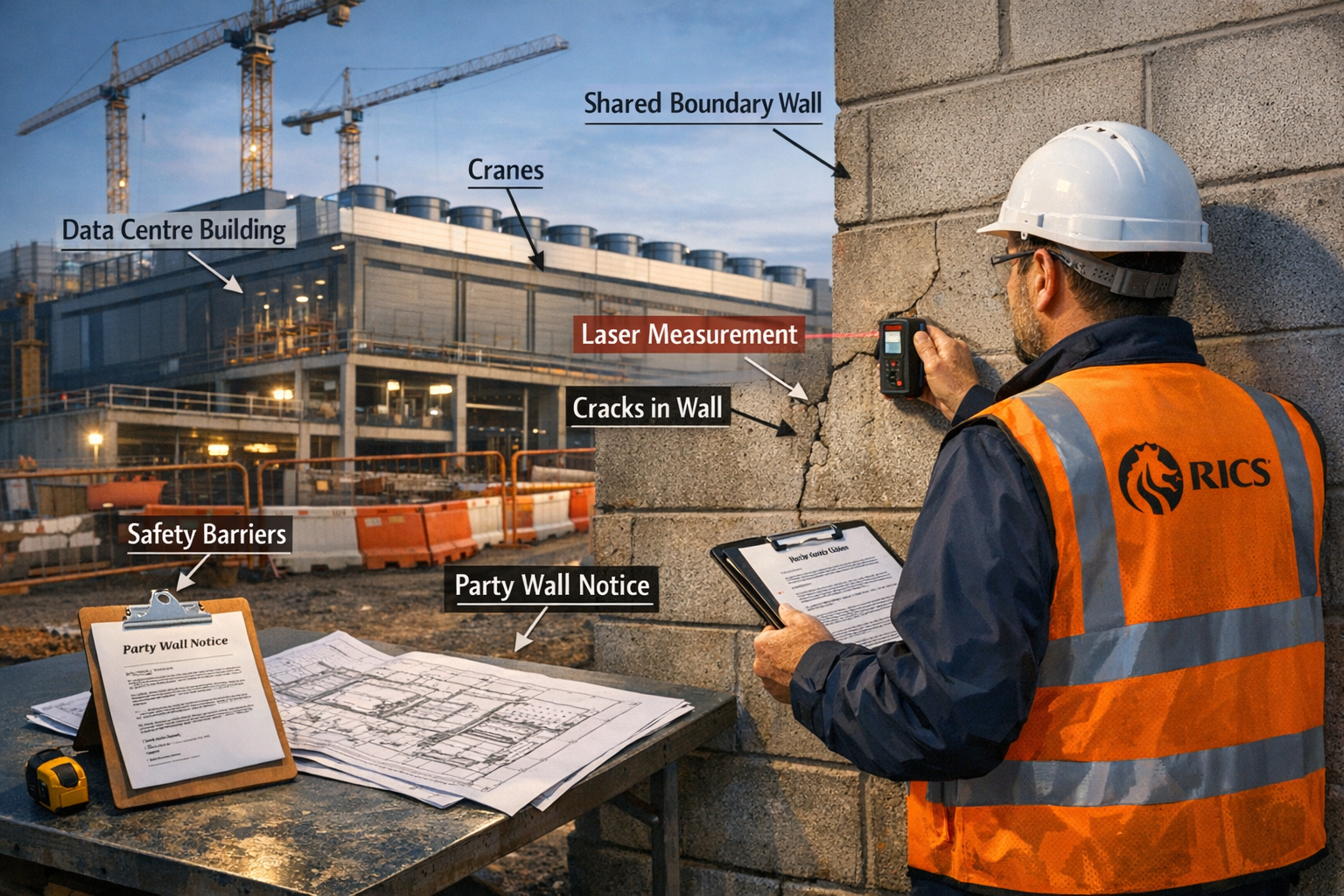
Data centre expansions create unique party wall scenarios that differ significantly from residential developments. These facilities require substantial excavations for cooling systems, backup power infrastructure, and underground cable routes—often extending beyond the depth of neighbouring foundations[2].
The Party Wall etc. Act 1996 applies when developers plan to:
- Excavate within three or six metres of adjacent structures (depending on depth)
- Build on or astride the boundary line between properties
- Modify existing party walls or structures shared with neighbours
- Undertake works to party fence walls or boundary structures
For data centres specifically, common triggers include:
🔧 Foundation work for heavy server equipment and cooling towers
🔧 Basement excavations for backup generators and battery storage
🔧 Structural modifications to existing industrial buildings with shared walls
🔧 Vibration-generating installations that may affect adjacent properties
"The complexity of modern data centre infrastructure means party wall considerations must be integrated into the earliest planning stages, not treated as an afterthought." — Industry surveyor observation from 2026 projects
Geographic Expansion Beyond London
While London has historically dominated UK data centre development, 2026 marks a significant shift toward regional diversification[2]. This geographic expansion means party wall surveys are now required across a broader range of locations, from Manchester's industrial corridors to Scotland's emerging tech hubs.
This diversification creates additional challenges:
- Different local planning contexts and building regulations
- Varied property ownership structures in industrial estates
- Regional differences in construction practices and neighbour expectations
- Less established networks of qualified party wall surveyors in some areas
Understanding these regional nuances is essential for developers planning multi-site data centre portfolios across the UK.
RICS Standards and Professional Guidance Framework
Core RICS Principles for Party Wall Surveyors
The Royal Institution of Chartered Surveyors (RICS) develops and enforces leading international standards to protect consumers and businesses across the built environment[3]. While RICS does not publish a specific technical standard exclusively for data centre party wall surveys, several core frameworks apply:
Professional Standards Framework:
| Standard Area | Application to Data Centres |
|---|---|
| Competency Requirements | Surveyors must demonstrate understanding of complex industrial structures |
| Impartiality | Equal duty to building owner and adjoining owner regardless of project value |
| Documentation | Comprehensive condition surveys before high-impact construction begins |
| Communication | Clear explanation of technical impacts to non-specialist property owners |
RICS party wall surveyors must maintain professional indemnity insurance and adhere to ethical standards even when commercial pressures mount in fast-moving AI infrastructure projects.
The Party Wall Award Process
The party wall award represents the legal document that governs how works proceed. For data centre developments, awards typically include:
✅ Detailed scope of works affecting party structures
✅ Condition schedules documenting pre-construction state
✅ Access arrangements for ongoing monitoring
✅ Security provisions (critical for data centre operations)
✅ Working hours and noise limitations
✅ Dispute resolution procedures
Understanding what is a party wall award helps all parties recognize their rights and obligations throughout the construction process.
Surveyor Selection and Appointment
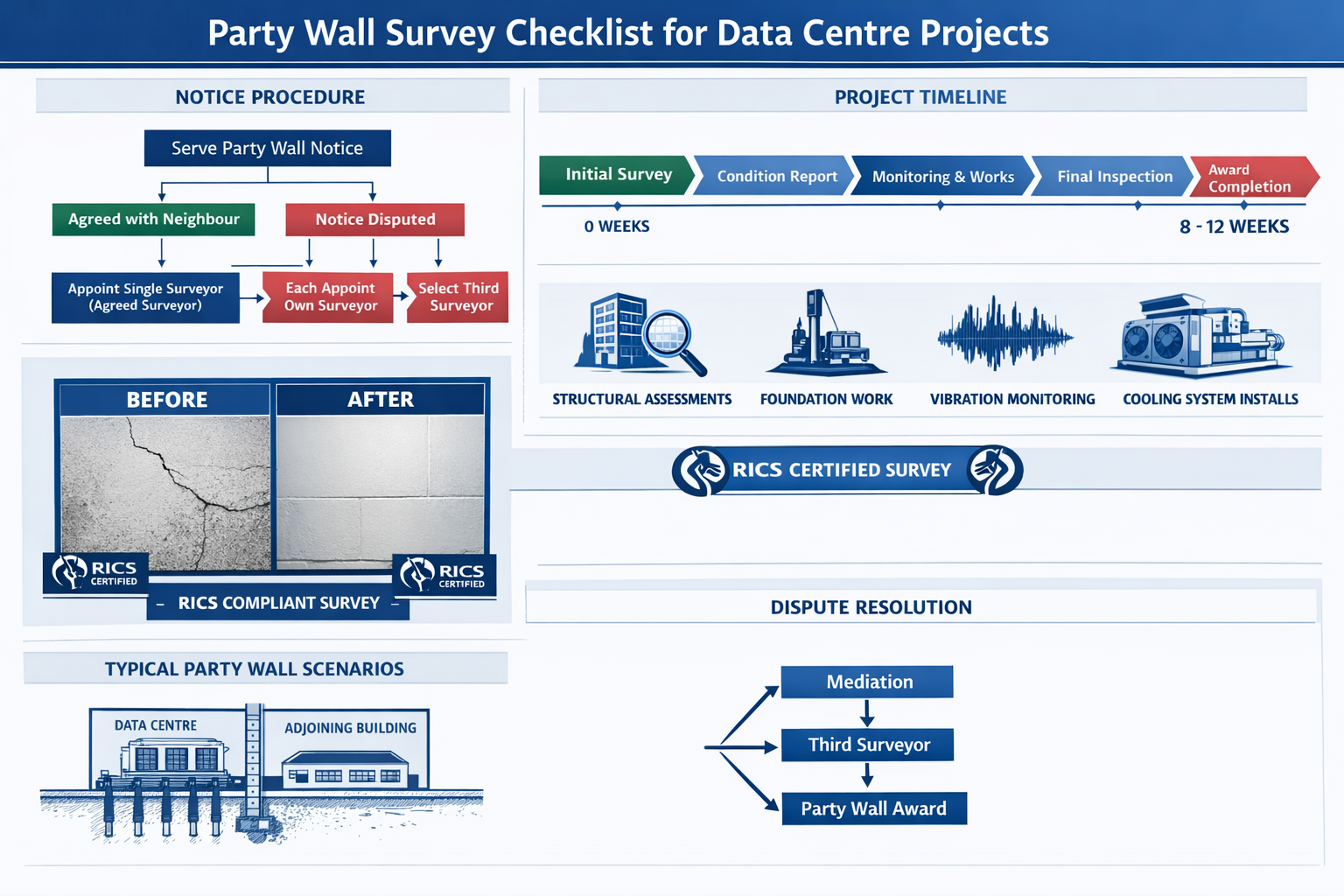
Data centre developers face a critical choice: appoint a single "agreed surveyor" or proceed with separate surveyors for each party. In 2026 projects, the trend favours separate surveyors due to:
- Complexity of technical assessments required
- High financial stakes justifying independent representation
- Potential for significant disruption to neighbouring operations
- Insurance and liability considerations
The complete guide to party wall surveys provides essential background for property owners unfamiliar with the process.
Party Wall Surveys for Data Centre Expansions: Essential Surveyor Checklists
Pre-Construction Condition Survey Requirements
Comprehensive condition surveys form the foundation of successful party wall management in data centre projects. Unlike residential developments, these surveys must account for:
Structural Elements:
- Load-bearing capacity of existing walls
- Foundation depths and construction methods
- Previous modifications or repairs
- Existing cracks, settlement, or structural movement
- Damp or water ingress issues
Mechanical and Electrical Systems:
- Vibration-sensitive equipment in neighbouring facilities
- Shared utilities and service corridors
- Emergency power systems
- Cooling and ventilation infrastructure
Photographic Documentation:
- High-resolution images of all potentially affected areas
- Video walkthroughs for complex industrial spaces
- Drone surveys for roof structures and upper levels
- Timestamped and georeferenced records
"We discovered during a 2026 London data centre expansion that the neighbouring warehouse contained precision manufacturing equipment worth £2 million. Our condition survey identified this early, allowing us to implement enhanced vibration monitoring that prevented potential damage claims." — Case study from surveyor records
Notice Procedures and Timeline Management
Proper notice procedures are non-negotiable under the Party Wall etc. Act 1996. For data centre projects, the timeline typically follows this pattern:
Recommended Timeline:
- Initial assessment (8-12 weeks before planned start): Identify all party wall matters
- Notice service (minimum 2 months before works): Formal written notices to all affected owners
- Response period (14 days): Adjoining owners consent or dissent
- Surveyor appointment (10 days if dissent): Parties appoint surveyors
- Award preparation (4-8 weeks): Surveys, negotiations, documentation
- Works commence: Only after award is agreed or determined
⚠️ Common mistake: Developers often underestimate this timeline, leading to project delays when notices are served too late.
For insight into typical costs associated with this process, review the party wall agreement cost breakdown.
Technical Assessment Checklist for Data Centres
Surveyors conducting party wall assessments for data centre expansions should use this specialized checklist:
Foundation and Excavation Considerations:
- Depth of proposed excavations relative to neighbouring foundations
- Soil conditions and groundwater levels
- Temporary works requirements (shoring, underpinning)
- Vibration impacts from piling or excavation equipment
- Settlement risk assessment
Structural Modifications:
- Load increases on party walls from heavy equipment
- New openings or alterations to existing party structures
- Roof modifications affecting shared structures
- Fire separation requirements between properties
Operational Impacts:
- Noise from cooling systems and generators
- Electromagnetic interference potential
- Access requirements during construction
- Security implications for neighbouring businesses
- Emergency egress considerations
Monitoring and Protection:
- Vibration monitoring equipment locations
- Crack monitoring schedule
- Settlement monitoring points
- Photographic monitoring frequency
- Reporting procedures and thresholds
This comprehensive approach ensures nothing is overlooked in these high-stakes developments.
Dispute Resolution and Compliance Strategies
Common Sources of Party Wall Disputes in Data Centre Projects
Analysis of 2026 data centre projects reveals recurring dispute patterns that proactive surveyors can anticipate and mitigate:
Top Dispute Triggers:
- Inadequate condition surveys failing to capture pre-existing defects
- Noise and vibration exceeding anticipated levels during construction
- Extended working hours disrupting neighbouring operations
- Access disputes when security requirements conflict
- Damage claims arising from construction activities
- Cost disagreements over surveyor fees and monitoring expenses
The guide to resolving party wall disputes provides frameworks for addressing these issues when they arise.
Proactive Dispute Prevention Strategies
Best practices from successful 2026 projects include:
💡 Early engagement: Meet with neighbouring property owners before formal notices
💡 Clear communication: Explain technical aspects in accessible language
💡 Realistic timelines: Build buffer time into construction schedules
💡 Robust monitoring: Implement comprehensive monitoring programs
💡 Responsive management: Address concerns promptly as they arise
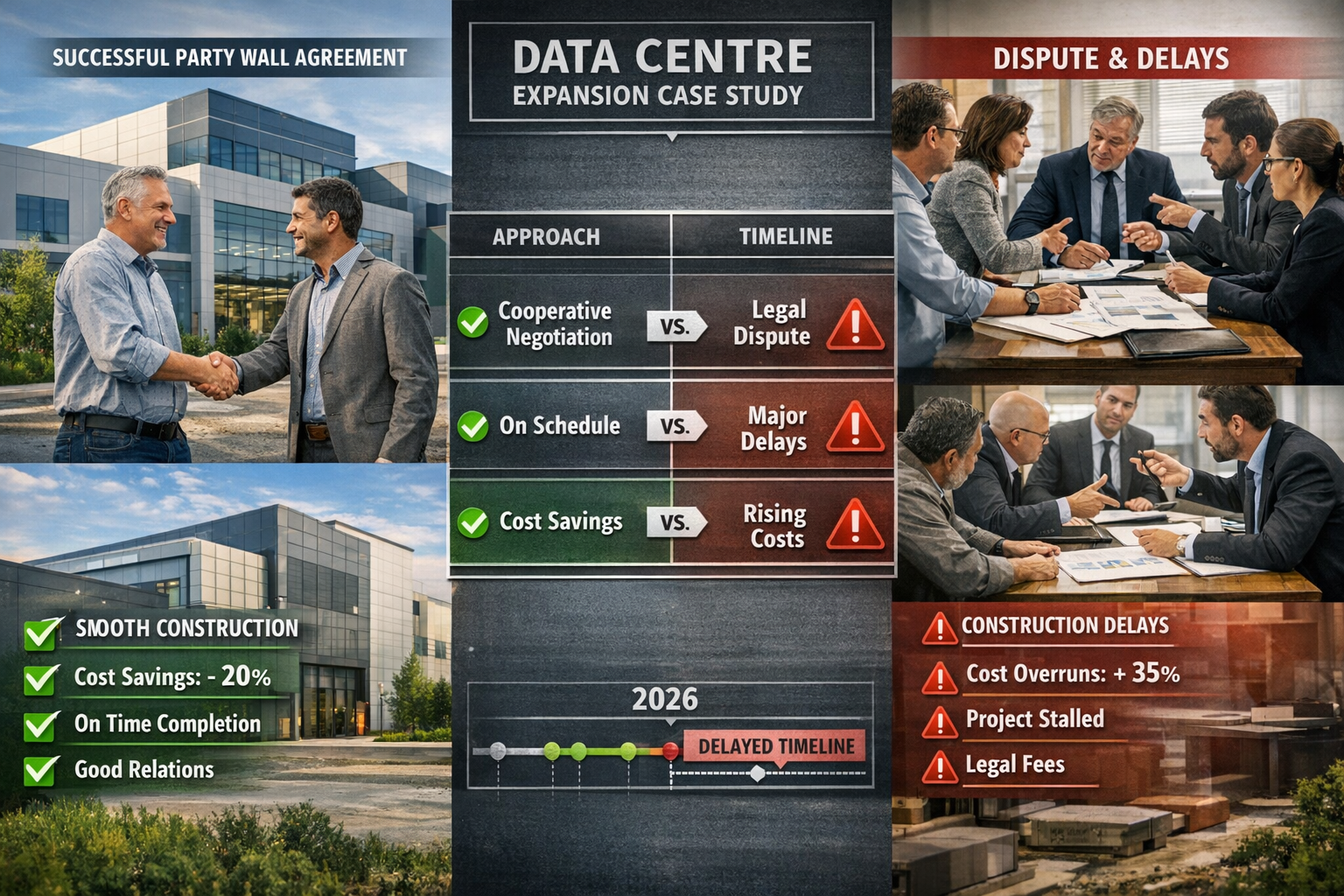
Case Study – Manchester Data Centre Expansion (2026):
A developer planning a 15MW data centre expansion adjacent to an active logistics facility implemented a proactive engagement strategy:
- Held pre-notice meetings with warehouse operators
- Commissioned independent vibration assessments
- Agreed enhanced monitoring protocols
- Established direct communication channels
- Provided regular construction updates
Result: Zero formal disputes, project completed on schedule, and positive ongoing neighbour relations.
Third Surveyor Appointments and Appeals
When disputes cannot be resolved between appointed surveyors, the Party Wall etc. Act 1996 provides for third surveyor appointment. In data centre projects, this mechanism becomes particularly important due to:
- Technical complexity requiring specialist expertise
- High financial stakes justifying independent determination
- Time pressures from construction schedules
- Insurance and liability considerations
Third surveyors in 2026 data centre disputes have typically been appointed to resolve:
- Disagreements over scope of necessary works
- Cost allocation disputes
- Monitoring methodology conflicts
- Damage assessment disagreements
Understanding when to invoke this mechanism—and selecting appropriately qualified third surveyors—can prevent lengthy delays and escalating costs.
Real-World Case Studies from 2026 Data Centre Projects
Case Study 1: London Docklands AI Hub Expansion
Project Overview:
- 25MW hyperscale data centre expansion
- Shared boundary with active commercial property
- Deep excavation for cooling infrastructure
- £45 million construction value
Party Wall Challenges:
- Excavation extending 8 metres below neighbouring foundations
- Vibration-sensitive laboratory equipment in adjacent building
- 24/7 construction schedule requirements
- Complex ownership structure with multiple leaseholders
Surveyor Approach:
✓ Comprehensive condition survey including specialist equipment assessment
✓ Enhanced vibration monitoring with real-time alerts
✓ Phased construction schedule minimizing peak impacts
✓ Regular stakeholder meetings throughout construction
Outcomes:
- Award agreed within 6 weeks
- Zero damage claims filed
- Project completed 2 weeks ahead of schedule
- Cost savings: £180,000 avoided in potential dispute resolution and delays
Key Lesson: Investment in thorough upfront assessment and monitoring delivered significant ROI through dispute avoidance.
Case Study 2: Regional Data Centre with Inadequate Preparation
Project Overview:
- 8MW regional data centre in Midlands industrial estate
- Multiple adjoining owners
- Rushed development timeline
- £18 million construction value
Party Wall Failures:
✗ Notices served only 4 weeks before planned construction start
✗ Minimal condition survey conducted
✗ Poor communication with neighbouring businesses
✗ Inadequate vibration assessment
Consequences:
- 12-week project delay while party wall procedures completed properly
- Formal dispute requiring third surveyor appointment
- Damage claim from neighbouring property (cracking attributed to vibration)
- Strained community relations affecting future expansion plans
Costs:
- Direct costs: £95,000 in additional surveyor fees and dispute resolution
- Delay costs: Estimated £340,000 in lost revenue and extended financing
- Damage settlement: £28,000 repair costs
Key Lesson: Cutting corners on party wall procedures proved far more expensive than proper compliance would have been.
Case Study 3: Scottish AI Research Facility Success Story
Project Overview:
- Purpose-built AI research data centre
- Brownfield site with existing industrial neighbours
- Innovative cooling system requiring significant excavation
- £32 million construction value
Innovative Approaches:
✓ Appointed RICS-accredited surveyors with data centre experience
✓ Created detailed 3D models shared with all parties
✓ Established community liaison committee
✓ Implemented predictive monitoring using AI analytics
Standout Features:
- Used building information modeling (BIM) to visualize party wall impacts
- Provided virtual reality walkthroughs for non-technical stakeholders
- Established automated alert systems for monitoring thresholds
- Created transparent online dashboard for all parties
Outcomes:
- Unanimous consent from all adjoining owners
- Agreed surveyor appointment (cost savings)
- Exemplary construction phase with zero complaints
- Model referenced in RICS regional guidance
Key Lesson: Technology-enhanced communication and monitoring can transform party wall processes from adversarial to collaborative.
Cost-Saving Strategies and Best Practices
Financial Planning for Party Wall Compliance
Understanding the true cost of party wall compliance helps developers budget appropriately and avoid unwelcome surprises. For data centre projects in 2026, typical costs include:
Cost Components:
| Item | Typical Range (per project) |
|---|---|
| Building owner's surveyor fees | £8,000 – £25,000 |
| Adjoining owner's surveyor fees | £6,000 – £20,000 (per neighbour) |
| Condition survey costs | £3,000 – £12,000 |
| Monitoring equipment and services | £5,000 – £18,000 |
| Third surveyor (if required) | £4,000 – £15,000 |
| Legal fees (disputes) | £10,000 – £50,000+ |
For more detailed cost information, see the cost of party wall guidance.
Cost-Saving Strategies:
- Early surveyor engagement reduces rushed fees and allows competitive selection
- Agreed surveyor appointments (when appropriate) halve surveyor costs
- Comprehensive initial surveys prevent costly supplementary assessments
- Proactive communication minimizes dispute-related expenses
- Efficient documentation reduces administrative time and costs
Timeline Optimization Techniques
Time is money in data centre development, where delays directly impact revenue generation. Successful 2026 projects have employed these timeline optimization strategies:
Parallel Processing:
- Begin party wall procedures during detailed design phase
- Conduct preliminary neighbour engagement during planning applications
- Prepare draft awards while awaiting formal responses
- Mobilize monitoring equipment during award finalization
Critical Path Integration:
- Identify party wall milestones as critical path items
- Build appropriate contingency into project schedules
- Establish clear escalation procedures for delays
- Maintain regular communication between surveyors and project managers
Realistic Scheduling:
- Allow minimum 16 weeks from initial assessment to construction start
- Add 4-week buffer for complex multi-party scenarios
- Factor in holiday periods and surveyor availability
- Plan for potential disputes without derailing entire schedule
Technology Integration in Party Wall Management
The 2026 construction boom has accelerated technology adoption in party wall surveying[4]. Leading practices include:
Digital Documentation:
- Cloud-based document management systems
- Automated notice generation and tracking
- Digital signature platforms for awards
- Blockchain-verified condition records (emerging)
Monitoring Technology:
- IoT-enabled vibration sensors with real-time alerts
- Automated crack monitoring using photogrammetry
- Settlement monitoring via precision GPS
- Integrated dashboards for all stakeholders
Communication Platforms:
- Dedicated project portals for document sharing
- Automated progress notifications
- Virtual meeting capabilities
- Mobile apps for site inspections
These technologies not only improve efficiency but also create transparent audit trails that protect all parties' interests.
Regulatory Compliance and Future Outlook
Integration with Planning and Building Control
Party wall compliance does not exist in isolation. Successful data centre projects in 2026 demonstrate integrated regulatory management:
Coordinated Compliance:
- Align party wall timelines with planning conditions
- Coordinate with Building Control inspections
- Integrate with CDM (Construction Design and Management) requirements
- Ensure consistency with environmental permits
The UK construction industry's significant turnaround in 2026[4] has brought renewed focus to regulatory compliance across all sectors, with data centres receiving particular scrutiny due to their infrastructure importance.
Emerging Trends and Future Considerations
Looking ahead, several trends will shape Party Wall Surveys for Data Centre Expansions in the UK AI Boom: RICS Guidance and Case Studies from 2026 Projects:
Anticipated Developments:
🔮 Increased standardization of data centre party wall procedures
🔮 Enhanced RICS guidance specific to AI infrastructure projects
🔮 Greater use of predictive analytics in risk assessment
🔮 Sustainability considerations in party wall awards
🔮 Climate resilience factors in condition assessments
Regulatory Evolution:
RICS continues to develop and enforce leading standards[3], with industry observers anticipating more specific technical guidance for complex infrastructure projects including data centres. The organization's January 2026 influence and advocacy update[1] demonstrates ongoing engagement with policy developments affecting the built environment.
Professional Development and Expertise
The specialized nature of data centre party wall surveys demands ongoing professional development. Surveyors working in this sector should pursue:
- Technical understanding of data centre infrastructure
- Knowledge of cooling systems and their structural implications
- Familiarity with vibration-sensitive equipment
- Understanding of security and operational requirements
- Awareness of AI industry growth patterns and planning policy
For property owners seeking expertise, the party wall FAQ provides helpful starting points for understanding the process.
Conclusion
Party Wall Surveys for Data Centre Expansions in the UK AI Boom: RICS Guidance and Case Studies from 2026 Projects represent a critical intersection of traditional property law and cutting-edge technology infrastructure. As the UK races to build the digital backbone for tomorrow's AI applications, proper party wall compliance ensures these essential developments proceed legally, ethically, and efficiently.
The case studies from 2026 demonstrate clear patterns: proactive engagement, comprehensive surveying, and professional expertise deliver significant cost savings whilst avoiding disputes that can derail high-stakes projects. Conversely, rushed procedures and inadequate preparation consistently result in expensive delays and strained relationships.
Actionable Next Steps
For developers planning data centre expansions:
- Engage qualified party wall surveyors at the earliest planning stages
- Allow realistic timelines (minimum 16 weeks) for party wall procedures
- Budget appropriately for comprehensive compliance
- Invest in thorough condition surveys and monitoring
- Prioritize transparent communication with all stakeholders
For property owners adjacent to proposed developments:
- Understand your rights under the Party Wall etc. Act 1996
- Respond promptly to formal notices
- Consider appointing your own surveyor for independent representation
- Document existing property conditions thoroughly
- Maintain open communication channels with developers
For surveyors serving this sector:
- Develop specialized knowledge of data centre infrastructure
- Invest in modern monitoring and documentation technology
- Build networks with other specialists in the field
- Stay current with RICS guidance and industry developments
- Share lessons learned to elevate professional standards
The UK's AI boom shows no signs of slowing, and data centre construction will remain a dominant force in the built environment for years to come. By applying the lessons from 2026 projects and adhering to RICS professional standards, the industry can ensure this critical infrastructure expands smoothly whilst protecting the interests of all parties involved.
The future of AI depends on the physical infrastructure being built today—and proper party wall compliance ensures that foundation is built on solid legal and professional ground.
References
[1] Uk Influence And Advocacy Update January 2026 – https://www.rics.org/news-insights/uk-influence-and-advocacy-update-january-2026
[2] Party Wall Surveys For Data Centre Expansions Navigating Agreements In The 2026 Investment Surge – https://nottinghillsurveyors.com/blog/party-wall-surveys-for-data-centre-expansions-navigating-agreements-in-the-2026-investment-surge
[3] Home Survey Standards – https://www.rics.org/profession-standards/rics-standards-and-guidance/sector-standards/building-surveying-standards/home-surveys/home-survey-standards
[4] Party Wall Surveys Amid 2026 Construction Boom Handling Disputes In High Demand Uk Housing Markets – https://nottinghillsurveyors.com/blog/party-wall-surveys-amid-2026-construction-boom-handling-disputes-in-high-demand-uk-housing-markets
