
Landlords who fail to register on the new Private Rented Sector (PRS) Database risk losing the legal right to serve a valid Section 8 notice — a consequence that could leave them unable to recover possession of their own property. That single enforcement mechanism makes Building Survey Checklists for Private Rented Sector Database Compliance: Pre-Registration Hazard Assessments Under 2026 Reforms one of the most practically urgent topics in UK property management right now.
The Renters' Rights Act 2026 reforms have reshaped the compliance landscape for every landlord operating in England. Central to the new framework is a mandatory PRS Database, against which landlords must register before they can exercise key legal remedies. Registration is not a box-ticking exercise — it demands verified evidence that a property meets the Decent Homes Standard, complies with Awaab's Law on hazardous damp and mould, and holds valid safety certificates [1]. A structured pre-registration building survey checklist is the most reliable tool for assembling that evidence efficiently.
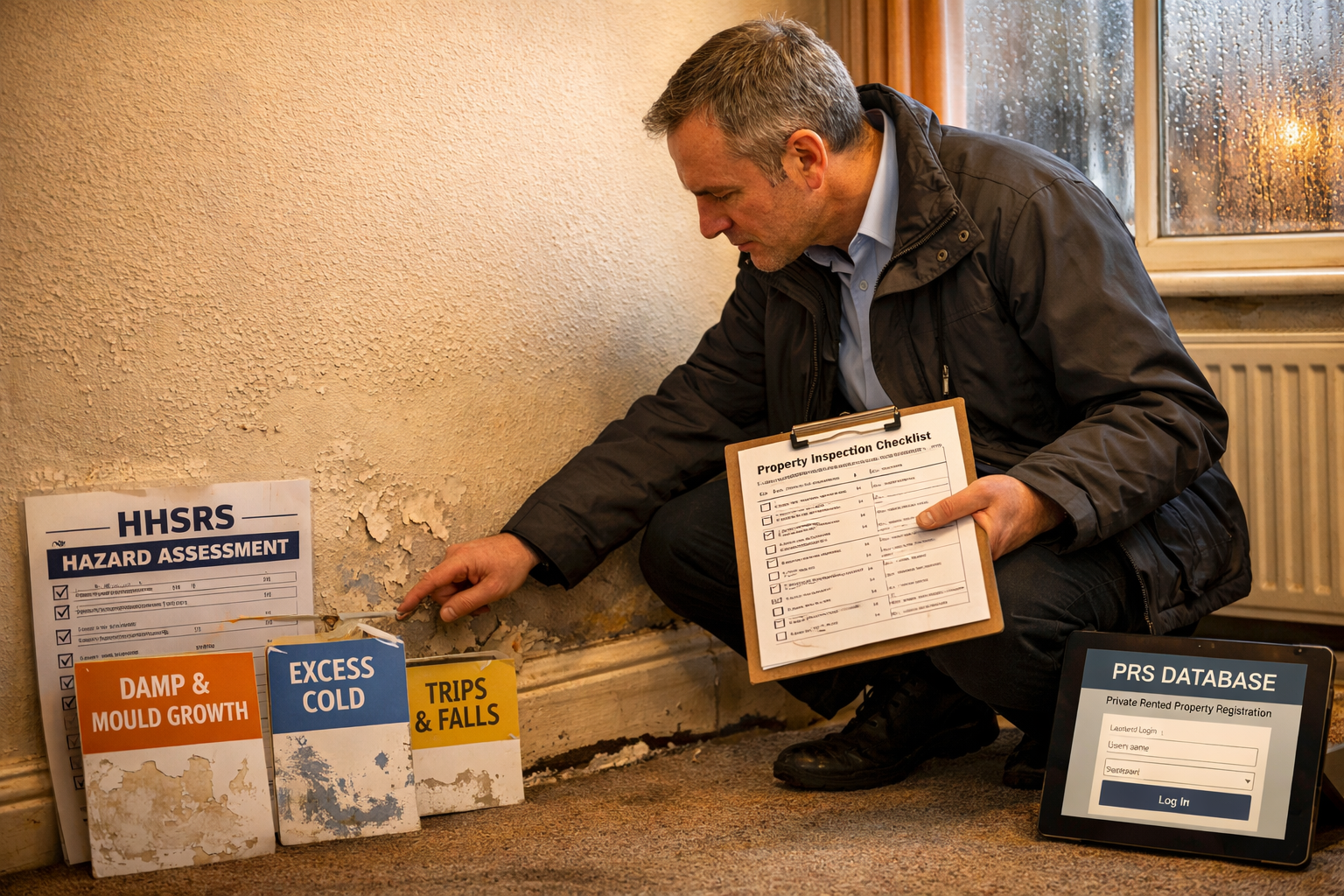
Key Takeaways 📋
- PRS Database registration is now a legal prerequisite for serving Section 8 notices; non-registration undermines landlord enforcement rights.
- Pre-registration hazard assessments must address Decent Homes Standard criteria, Awaab's Law damp/mould obligations, and HHSRS Category 1 hazards.
- Valid safety certificates — gas, electrical, fire — plus a current EPC are mandatory compliance documents for database submission [1].
- A structured building survey checklist reduces the risk of registration rejection and protects landlords during investor due diligence.
- RICS-accredited surveyors using updated 2026 quality standards provide the most defensible pre-registration hazard assessment reports [3].
Why the PRS Database Changes Everything for Landlords in 2026
The PRS Database is not simply a digital register of addresses. It is an active compliance gateway. Under the 2026 reforms, landlords must demonstrate — before registration is confirmed — that their properties meet a defined set of health, safety, and habitability standards [1]. Failure to achieve registered status has cascading consequences:
- ❌ Section 8 possession notices become legally unenforceable
- ❌ Rent repayment orders become easier for tenants to pursue
- ❌ Local authority enforcement powers are amplified
- ❌ Investor due diligence flags the property as a liability
💬 "Registration is the new licence to operate. Without it, a landlord's legal toolkit is effectively empty."
This environment makes pre-registration hazard assessments a commercial necessity, not just a regulatory formality. Landlords, portfolio investors, and letting agents all need a reliable, repeatable survey process that maps directly onto the database's compliance criteria [2].
The Awaab's Law Dimension
Awaab's Law — named after Awaab Ishak, the two-year-old who died from exposure to mould in a social housing property — has been extended to the private rented sector under the 2026 reforms. It requires landlords to investigate reported damp and mould hazards within 14 days and begin remediation within a further 7 days in urgent cases.
A pre-registration survey that identifies and documents existing damp or mould issues gives landlords the opportunity to remediate before a tenancy begins, avoiding the legal clock entirely. Surveyors conducting assessments for PRS database compliance should treat Awaab's Law triggers as a priority inspection category.
Building Survey Checklists for Private Rented Sector Database Compliance: Core Hazard Assessment Categories
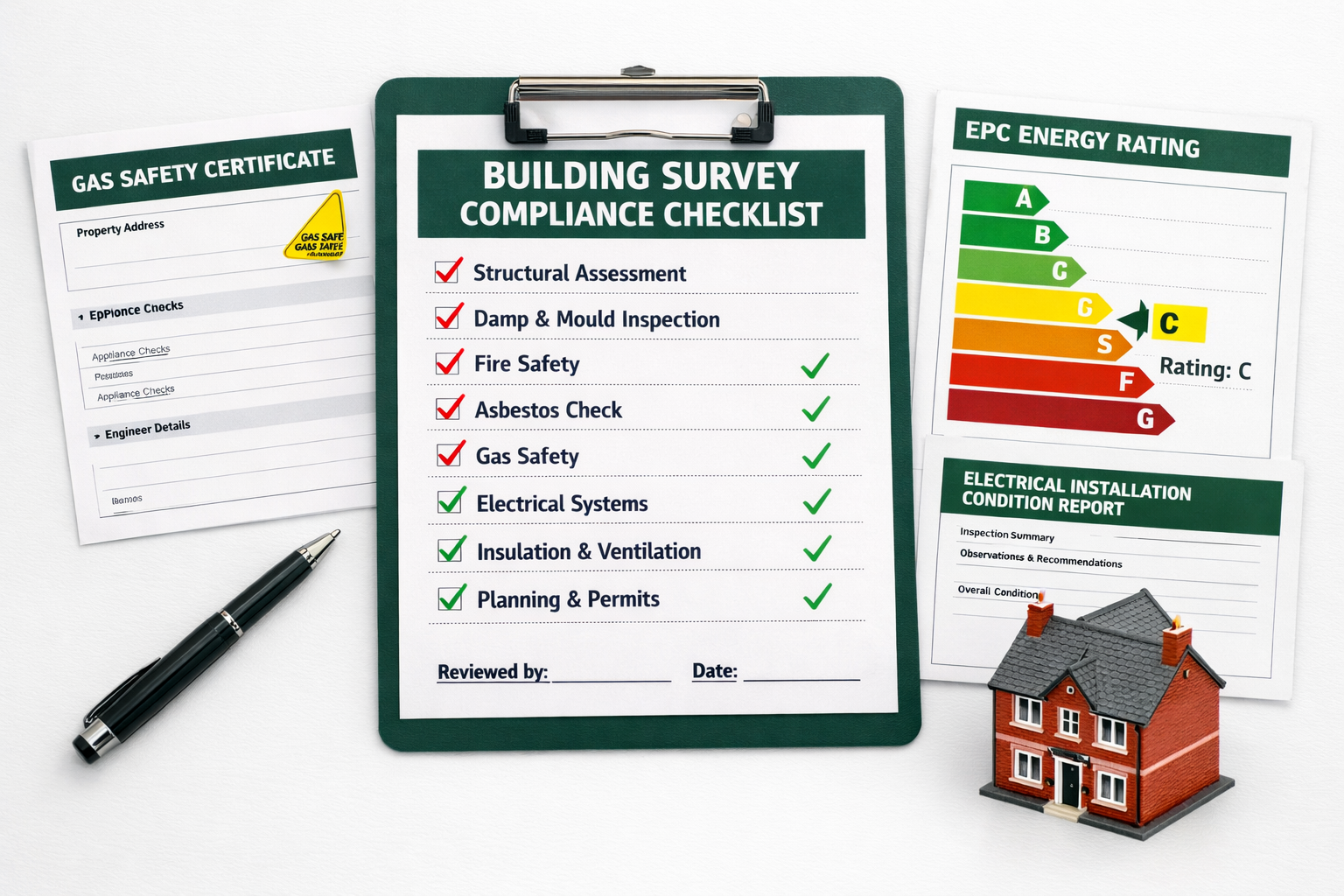
A well-structured checklist for pre-registration hazard assessments should be organised around the Housing Health and Safety Rating System (HHSRS), which underpins both the Decent Homes Standard and the PRS Database's compliance criteria. The HHSRS identifies 29 hazard categories — but for PRS database purposes, certain categories carry the highest regulatory weight.
🏠 Structural Integrity and Fabric
| Element | Inspection Points | Risk Level |
|---|---|---|
| Roof structure | Missing tiles, sagging, water ingress | High |
| External walls | Cracks, spalling, failed pointing | High |
| Windows and doors | Draught sealing, security, glazing safety | Medium |
| Floors and ceilings | Deflection, rot, structural movement | High |
| Chimney stacks | Stability, flashing, pointing | Medium |
For older stock, a Level 3 building survey provides the most thorough structural assessment and is strongly recommended for pre-registration inspections of properties built before 1980.
🔥 Fire Safety
Fire safety documentation is a mandatory component of PRS Database registration [1]. The checklist must confirm:
- ✅ Working smoke alarms on every storey
- ✅ Carbon monoxide detectors in rooms with solid fuel appliances
- ✅ Fire doors (where applicable, e.g., HMOs)
- ✅ Escape routes unobstructed
- ✅ Electrical Installation Condition Report (EICR) — valid within 5 years
💧 Damp, Condensation, and Mould (Awaab's Law Priority)
This is the highest-profile category under 2026 reforms. Surveyors should record:
- Type of damp: rising, penetrating, or condensation
- Location and extent of mould growth (percentage of wall/ceiling area)
- Moisture meter readings at all affected surfaces
- Ventilation adequacy in kitchens, bathrooms, and bedrooms
- Evidence of previous remediation attempts
Any Category 1 HHSRS damp hazard identified during a pre-registration survey must be remediated before database submission. Documenting this process creates a defensible audit trail.
⚡ Gas and Electrical Safety
Both gas and electrical safety certificates are required for registration [1]:
- Gas Safety Certificate (CP12): Must be current (renewed annually). Issued by a Gas Safe registered engineer.
- Electrical Installation Condition Report (EICR): Valid for up to 5 years. Must confirm no Category 1 or 2 defects remain unresolved.
The survey checklist should verify certificate validity dates and flag any installations that are approaching expiry, since lapsed certificates will block registration.
🌡️ Energy Performance and Thermal Comfort
Properties must meet current minimum EPC standards as part of the registration process [1]. The checklist should assess:
- Current EPC rating and expiry date
- Loft insulation depth and condition
- Cavity wall insulation status
- Boiler age and efficiency rating
- Double glazing coverage
For a full understanding of how survey scope affects property compliance reporting, the understanding the importance of a survey home report resource provides useful context on what surveyors are expected to document.
Pre-Registration Checklist Template: A Practical Framework for Surveyors
The following template is designed for RICS-accredited surveyors conducting pre-registration hazard assessments under the 2026 PRS reforms. It maps each inspection element to its corresponding compliance obligation.
Section A: Documentation Audit (Pre-Survey)
Before attending the property, the surveyor should confirm the following documents are available for review:
| Document | Required? | Valid Period |
|---|---|---|
| Gas Safety Certificate | ✅ Mandatory | 12 months |
| EICR | ✅ Mandatory | 5 years |
| EPC | ✅ Mandatory | 10 years (min. Band E, rising) |
| Legionella Risk Assessment | ✅ Mandatory | Reviewed regularly |
| Deposit Protection Evidence | ✅ Mandatory | Per tenancy |
| HMO Licence (if applicable) | ✅ Mandatory | 5 years |
Section B: Physical Inspection Checklist
Exterior
- Roof covering: condition and completeness
- Gutters and downpipes: blockage, leaks, fixings
- External walls: cracking, damp staining, pointing
- Boundaries and paths: trip hazards, security
Interior — Room by Room
- Damp and mould: type, extent, moisture readings
- Ventilation: trickle vents, extractor fans, openable windows
- Heating: system type, controls, radiator coverage
- Electrical: visible wiring condition, consumer unit type
- Smoke/CO alarms: location, test result
- Stairs and balustrades: stability, baluster spacing
- Kitchen: ventilation, appliance safety, worktop condition
- Bathroom: ventilation, slip hazards, water pressure
Services
- Stopcock location and operation
- Gas meter and pipework visible condition
- Electrical consumer unit: RCDs present, no signs of overloading
Section C: HHSRS Hazard Rating Summary
The surveyor should complete a formal HHSRS assessment for any identified hazard, recording:
- Hazard category (from the 29 HHSRS categories)
- Likelihood of harm occurring
- Spread of outcomes (severity)
- Hazard score and band (Category 1 or 2)
- Recommended remediation action and timeline
For complex properties or those with suspected structural issues, a stock condition survey provides a portfolio-level view that is particularly useful for landlords with multiple units to register simultaneously.
Building Survey Checklists for Private Rented Sector Database Compliance: Investor Due Diligence Applications
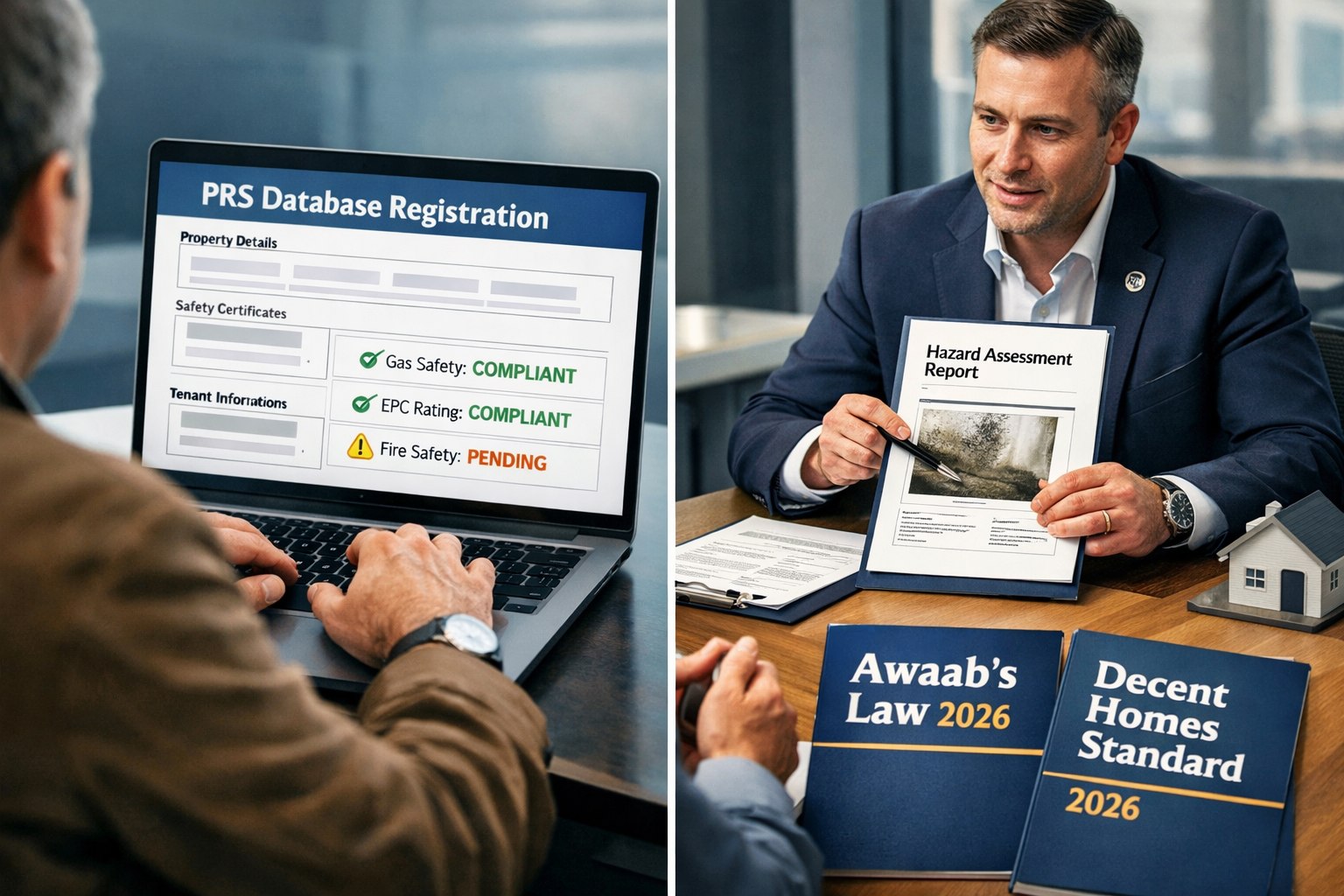
The PRS Database compliance framework has created a new layer of due diligence for property investors. When acquiring rental stock, buyers now need to assess not just the physical condition of a property but its registrability — the likelihood that it can be successfully enrolled on the database without significant remediation expenditure [2].
What Investors Should Request Before Exchange
A pre-acquisition building survey for PRS compliance purposes should include:
- Registrability Assessment: A surveyor's opinion on whether the property currently meets PRS Database requirements or what work is needed to achieve compliance.
- Remediation Cost Schedule: Estimated costs for addressing any Category 1 HHSRS hazards, lapsed certificates, or EPC deficiencies.
- Awaab's Law Risk Profile: Specific assessment of damp and mould risk, given the 14-day investigation obligation post-tenancy commencement.
- Certificate Validity Timeline: A forward-looking schedule of when each mandatory certificate will require renewal, factoring into holding costs.
💬 "A property that cannot be registered on the PRS Database is, in practical terms, an unlettable asset under 2026 rules."
For investors acquiring properties with existing tenants, a dilapidations survey can help establish a clear baseline condition record that supports both compliance documentation and future end-of-tenancy negotiations.
The Section 8 Notice Risk
Under the 2026 framework, an unregistered landlord cannot serve a valid Section 8 notice. This means that if a tenant falls into arrears or breaches their tenancy agreement, the landlord has no legal route to possession until registration is achieved. For investors, this risk must be priced into any acquisition where the property is not already registered and compliant.
Surveyors providing pre-registration assessments should explicitly address this risk in their reports, noting the estimated time to achieve registrable status and any barriers to compliance.
Working with RICS-Accredited Surveyors Under 2026 Quality Standards
The RICS Building Survey Quality Standards 2026 have updated the framework within which chartered surveyors conduct and report on building inspections [3]. For PRS database compliance purposes, these updates are significant because they:
- Strengthen requirements for reporting on HHSRS hazards within survey outputs
- Clarify the surveyor's duty to identify Awaab's Law trigger conditions
- Require explicit commentary on energy performance and EPC-related deficiencies
- Introduce enhanced standards for photographic evidence within survey reports
Landlords and investors commissioning pre-registration surveys should confirm that their chosen surveyor is RICS-accredited and is working to the 2026 quality standards. A Level 3 building survey conducted under these standards provides the most comprehensive hazard assessment output and is the most defensible document for PRS database submission.
Choosing the Right Survey Level
| Property Type | Recommended Survey | Rationale |
|---|---|---|
| Pre-1919 terraced/semi | Level 3 Building Survey | Complex construction, high defect risk |
| 1919–1980 standard stock | Level 2 or Level 3 | Age-related systems risk |
| Post-1980 standard construction | Level 2 RICS Homebuyer | Lower structural risk, focus on services |
| HMO or multi-let | Level 3 + HHSRS Assessment | Enhanced fire/safety obligations |
| New build (converted use) | Level 2 + Snagging | Conversion quality verification |
For landlords uncertain about which survey level is appropriate, the Level 2 vs Level 3 survey comparison guide provides a clear breakdown of scope differences and cost implications.
Common Compliance Gaps That Delay PRS Database Registration
Based on the compliance documentation requirements under the 2026 framework [1][2], the following issues most frequently cause registration delays:
- Lapsed EICR — Electrical reports that expired during the COVID backlog period and were never renewed
- EPC below minimum band — Properties still rated F or G, requiring insulation or heating upgrades before registration
- Unresolved Category 1 damp hazards — Particularly in older terraced stock with solid walls and no mechanical ventilation
- Missing legionella risk assessment — Often overlooked in smaller landlord portfolios
- Incomplete deposit protection records — Especially where tenancies predate digital protection schemes
- No carbon monoxide detector — Required in all rooms with a fixed combustion appliance from 2022, but still absent in many properties
A pre-registration building survey checklist that systematically addresses each of these categories will significantly reduce the risk of a delayed or rejected registration application.
Conclusion: Actionable Next Steps for Landlords and Investors
The 2026 PRS Database reforms have made Building Survey Checklists for Private Rented Sector Database Compliance: Pre-Registration Hazard Assessments Under 2026 Reforms an essential operational tool — not an optional extra. The connection between registration status and Section 8 enforceability means that compliance gaps are no longer just regulatory inconveniences; they are direct threats to a landlord's ability to manage their investment.
Immediate Actions to Take
- Commission a pre-registration hazard assessment from a RICS-accredited surveyor working to 2026 quality standards before submitting to the PRS Database
- Audit all safety certificates — gas, electrical, fire — and schedule renewals for any expiring within 12 months
- Obtain or update the EPC and identify any cost-effective improvements needed to meet minimum band requirements
- Document all damp and mould identified during the survey and complete remediation before tenancy commencement to avoid Awaab's Law obligations
- Use the checklist template in this article as a starting framework and adapt it to your specific property portfolio
- Engage a specialist surveyor for portfolio-level assessments if managing multiple properties — a stock condition survey approach can streamline compliance across multiple units simultaneously
The landlords who act early — commissioning thorough pre-registration surveys and resolving compliance gaps proactively — will be best positioned to maintain uninterrupted lettings income and retain full legal enforcement rights under the 2026 framework.
References
[1] The New PRS Database: A Landlord's Guide to Early Compliance and Registration – https://www.whitegates.co.uk/guides/landlord/the-new-prs-database-a-landlords-guide-to-early-compliance-and-registration/
[2] 2026 Property Management Compliance Guide – https://thelibertygroup.com/2026-property-management-compliance-guide/
[3] Building Survey Quality Standards 2026: Navigating RICS Updates and Enhanced Home Inspection Requirements – https://nottinghillsurveyors.com/blog/building-survey-quality-standards-2026-navigating-rics-updates-and-enhanced-home-inspection-requirements
