
The UK housing sector faces a fundamental transformation: by February 2027, every industrial and electric vehicle battery exceeding 2 kWh will require a Digital Battery Passport with real-time State of Health monitoring[1]. For residential properties installing home battery systems, this regulatory shift means Building Surveys for Battery Storage Retrofits: Defect Protocols Under 2026 Net Zero Battery Mandates have become essential due diligence. Chartered surveyors now assess fire risks, structural loading capacities, and Energy Performance Certificate (EPC) improvements when evaluating lithium-ion installations—particularly in period properties where Victorian-era construction meets 21st-century energy storage demands.
As grid stability increasingly depends on distributed residential battery networks, property owners and surveyors must navigate complex defect protocols that balance heritage conservation with net zero compliance. The stakes extend beyond regulatory adherence: battery system supply agreements typically include defect warranties extending up to five years, with workmanship warranties covering one to two years[4]. A comprehensive building survey identifies structural deficiencies before installation, protecting both property value and occupant safety.
Key Takeaways
- 🔋 Digital Battery Passports become mandatory for all batteries over 2 kWh by February 2027, requiring integration between Battery Management Systems and reporting platforms[1]
- 🏠 RICS Level 3 surveys now include specialized battery retrofit assessments covering fire risks, structural loads, and ventilation requirements in period properties
- ⚡ Material Recovery Efficiency tracking shifts regulatory focus from total weight recycling to granular audits of critical minerals by late 2027[1]
- 📊 EPC rating improvements from battery storage can elevate properties from D/E ratings to B/C levels, significantly increasing market value
- 🛡️ Extended producer responsibility programs expanding across multiple jurisdictions create new compliance requirements for battery installations and end-of-life management[2]
Understanding Building Surveys for Battery Storage Retrofits: Defect Protocols Under 2026 Net Zero Battery Mandates
The convergence of net zero targets and residential energy storage has created unprecedented demand for specialized building surveys. Unlike standard RICS building surveys, battery retrofit assessments require surveyors to evaluate thermal management systems, electrical infrastructure capacity, and structural load-bearing capabilities specific to lithium-ion installations.
Regulatory Framework Driving Survey Requirements
The 2026 mandate landscape establishes three critical compliance pillars:
Carbon Footprint Declarations: All rechargeable industrial batteries with capacity greater than 2 kWh now require verified carbon footprint declarations with site-specific primary data, effective February 18, 2026[1]. This requirement extends to residential installations, necessitating documentation trails that surveyors must verify during property assessments.
Digital Battery Passport Integration: By February 18, 2027, battery systems must maintain real-time State of Health (SoH) and remaining lifetime data through direct Battery Management System integration[1]. Surveyors conducting Level 3 building surveys must assess whether existing electrical infrastructure supports these digital reporting requirements.
Material Recovery Efficiency Standards: The shift from weight-based recycling metrics to Material Recovery Efficiency by late 2027 creates new end-of-life planning requirements[1]. Building surveys now evaluate accessibility for future battery removal and recycling logistics.
Why Period Properties Require Enhanced Defect Protocols
Victorian and Edwardian homes present unique challenges for battery retrofits:
| Structural Concern | Survey Assessment Required | Typical Defect Risk |
|---|---|---|
| Load-bearing capacity | Floor joist analysis, foundation assessment | Inadequate support for 200-400kg battery systems |
| Fire compartmentation | Wall cavity inspection, fire barrier verification | Compromised fire resistance in converted spaces |
| Moisture ingress | Damp surveys, ventilation adequacy | Condensation risk affecting battery lifespan |
| Electrical infrastructure | Consumer unit capacity, earthing systems | Insufficient amperage for charging cycles |
| Thermal management | Insulation assessment, ambient temperature range | Overheating risk in unventilated basements |
Surveyors conducting comprehensive house surveys must now incorporate battery-specific inspection protocols that traditional surveys overlook.
Critical Defect Protocols in Building Surveys for Battery Storage Retrofits

Fire Safety Assessment Protocols
Lithium-ion battery installations introduce thermal runaway risks that require rigorous surveyor evaluation. The defect protocol encompasses:
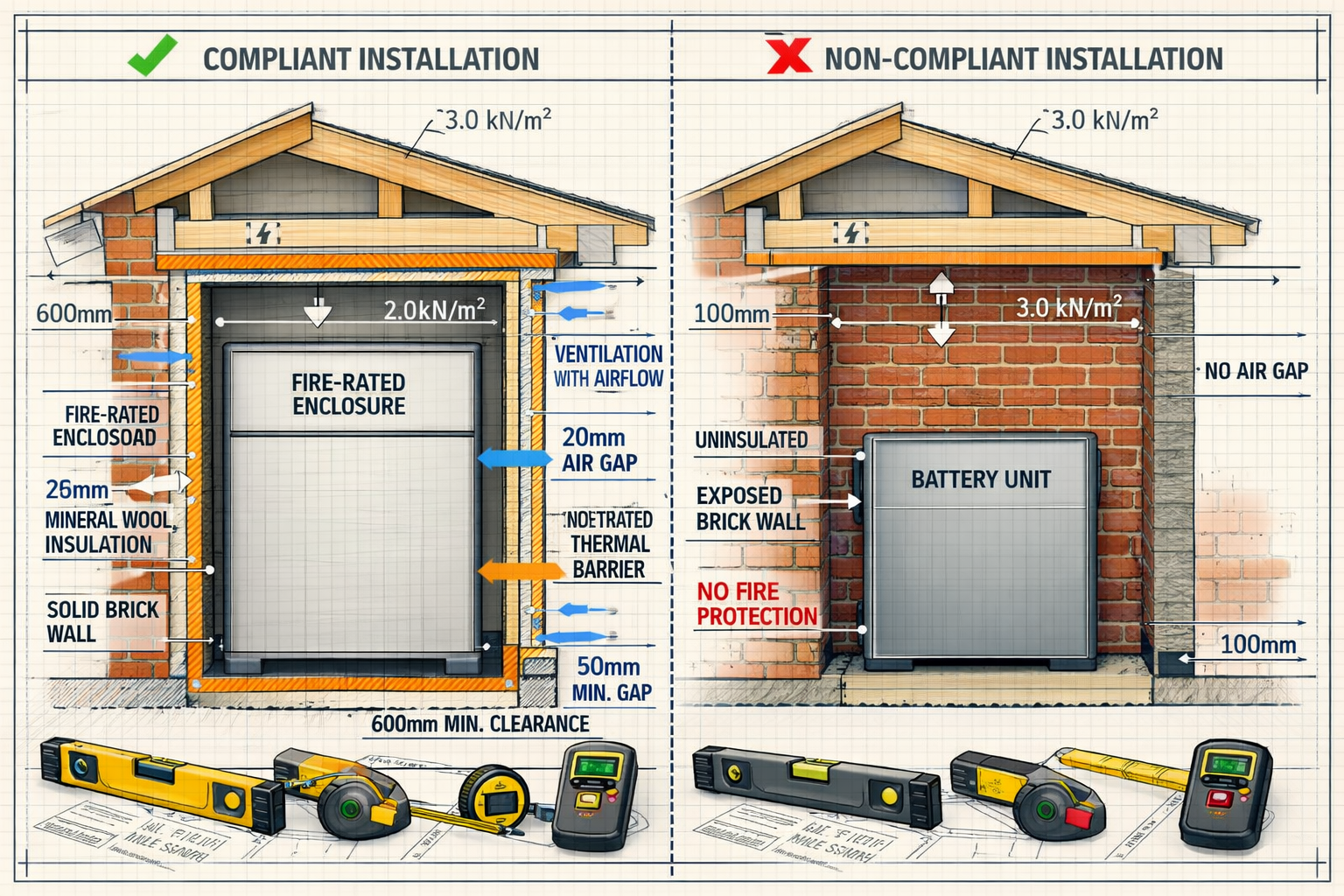
🔥 Fire-Rated Enclosure Verification
- Minimum 60-minute fire resistance rating for battery compartments
- Non-combustible materials within 1-meter radius
- Automatic fire suppression system compatibility assessment
- Emergency ventilation pathway identification
🌡️ Thermal Management Evaluation
- Ambient temperature range verification (typically 15-25°C optimal)
- Heat dissipation pathway adequacy
- Proximity to heat sources (boilers, radiators, direct sunlight)
- Thermal imaging to identify existing hot spots
⚠️ Emergency Access Planning
- Fire service access routes to battery location
- Electrical isolation switch positioning
- Emergency procedure signage requirements
- Evacuation route impact assessment
Surveyors must document these elements in detailed building survey reports, with photographic evidence and specific remediation recommendations.
Structural Load Analysis for Battery Systems
Modern home battery systems typically weigh 200-400 kilograms—equivalent to three to six adults standing in a concentrated area. This loading requires careful structural assessment:
Foundation and Floor Capacity
- Suspended timber floors: Joist spacing, timber condition, and span calculations
- Solid concrete floors: Slab thickness verification and ground-bearing capacity
- Basement installations: Wall loading, damp-proof membrane integrity
- Upper-floor installations: Rarely recommended; requires structural engineer consultation
Load Distribution Strategies
- Spread plates or reinforcement requirements
- Joist doubling or steel beam installation needs
- Point load versus distributed load calculations
- Long-term deflection risk assessment
Properties requiring structural engineering reports should obtain these before finalizing battery installation contracts.
Electrical Infrastructure Adequacy
The defect protocol must evaluate whether existing electrical systems support battery charging and discharge cycles:
✅ Consumer Unit Assessment
- Adequate spare ways for dedicated battery circuit
- Total amperage capacity verification
- RCD (Residual Current Device) compatibility
- Earthing system adequacy for DC systems
✅ Cabling and Conduit Evaluation
- Cable sizing for peak charging loads (typically 20-40A)
- Conduit routing feasibility
- Isolation switch positioning
- Compliance with 18th Edition Wiring Regulations
✅ Grid Connection Capacity
- DNO (Distribution Network Operator) approval requirements
- Export limitation agreements
- Smart meter compatibility
- G98/G99 grid connection compliance
Ventilation and Environmental Controls
Battery longevity and safety depend on controlled environmental conditions:
Ventilation Requirements
- Minimum air changes per hour calculations
- Natural versus mechanical ventilation adequacy
- Hydrogen off-gassing risk mitigation (particularly for lead-acid systems)
- Condensation prevention strategies
Moisture and Damp Assessment
Comprehensive damp surveys become critical for basement and garage installations, where rising damp or penetrating moisture can compromise battery systems and void warranties.
EPC Improvements and Compliance Documentation in Building Surveys for Battery Storage Retrofits
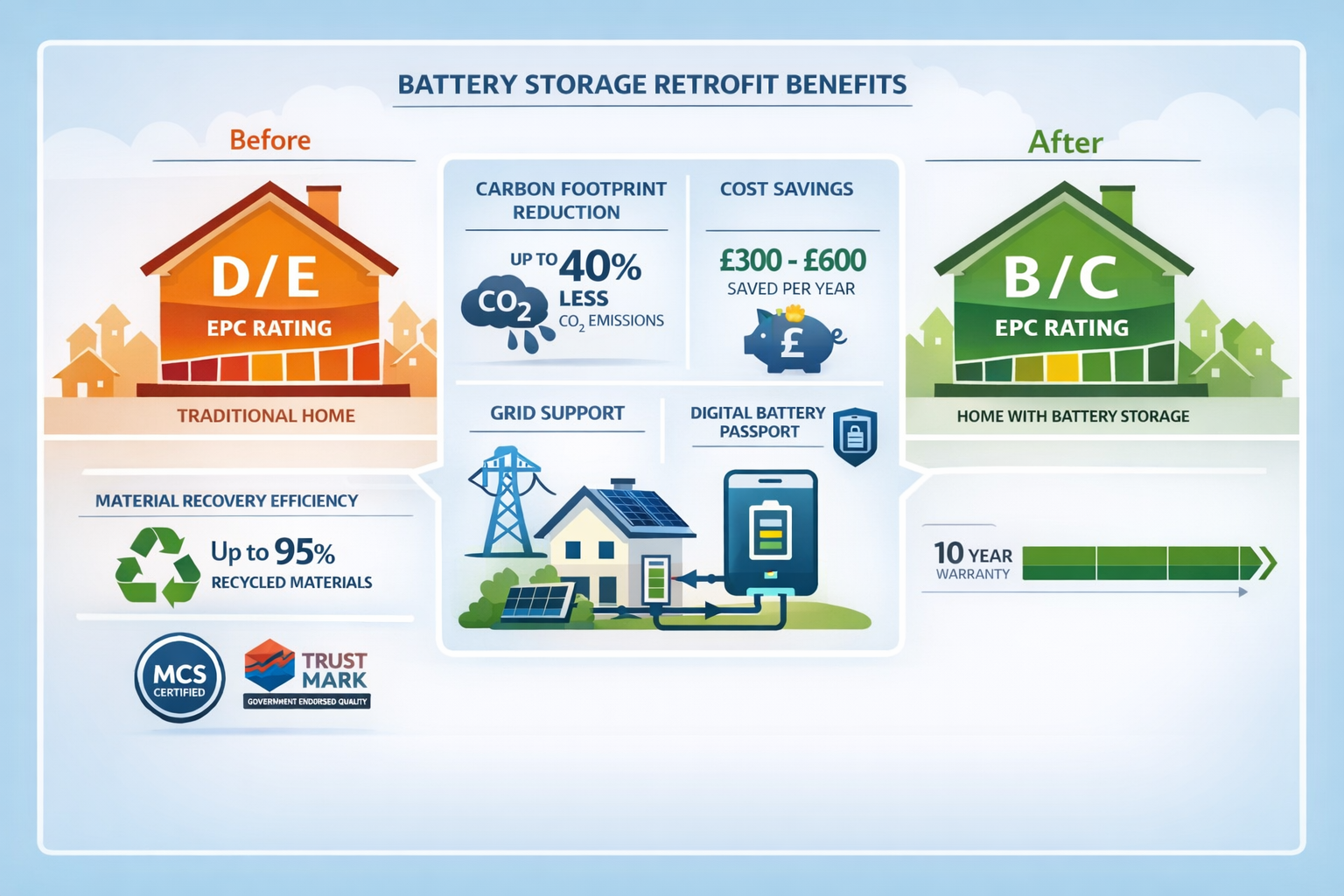
Energy Performance Certificate Uplift Potential
Battery storage retrofits can dramatically improve EPC ratings, translating to increased property values and rental income potential:
Typical EPC Rating Improvements
- Without battery storage: Victorian terrace typically rated D (55-68) or E (39-54)
- With 10kWh battery + solar PV: Potential upgrade to C (69-80) or B (81-91)
- Market value impact: Properties with B or C ratings command 5-15% premiums in urban markets
EPC Assessment Integration
- Battery capacity and efficiency specifications
- Solar PV integration (if applicable)
- Smart home energy management systems
- Grid export capabilities and tariff optimization
Surveyors should coordinate with accredited Energy Assessors to quantify these improvements in building survey reports.
Compliance Documentation Requirements
The 2026 mandate framework requires extensive documentation that surveyors must verify:
📋 Mandatory Documentation Checklist
-
Carbon Footprint Declaration
- Manufacturer's verified carbon footprint statement
- Site-specific primary data verification
- Supply chain transparency documentation[1]
-
Digital Battery Passport Readiness
- Battery Management System specifications
- Real-time SoH monitoring capabilities
- Data connectivity and reporting infrastructure[1]
-
Material Recovery Plan
- End-of-life recycling pathway documentation
- Critical mineral recovery projections
- Extended Producer Responsibility compliance[2]
-
Warranty and Defect Coverage
- Five-year defect warranty verification
- Workmanship warranty terms (typically 1-2 years)[4]
- Performance degradation guarantees
-
Installation Certifications
- MCS (Microgeneration Certification Scheme) accreditation
- Building Control approval
- Electrical Installation Certificate (EIC)
- DNO grid connection approval
Extended Producer Responsibility Implications
Recent regulatory expansions create new compliance layers. Vermont extended its battery EPR program to include rechargeable batteries and medium-format batteries weighing 4.4-25 pounds[2], while Illinois will require new battery collection points throughout the state by end of 2028, with mandatory battery labeling required by 2029[2].
UK property owners must ensure:
- Collection point accessibility for end-of-life battery removal
- Labeling compliance with evolving standards
- Producer registration verification for installed systems
- Take-back scheme participation documentation
Specialized Survey Protocols for Different Property Types
Victorian and Edwardian Period Properties
Unique Challenges:
- Solid wall construction limiting internal installation options
- Suspended timber floors requiring reinforcement
- Coal cellar conversions with ventilation concerns
- Listed building consent requirements
Survey Protocol Additions:
- Heritage impact assessment for external battery housing
- Timber condition surveys for load-bearing elements
- Conservation officer consultation recommendations
- Reversibility considerations for future removal
New Build Properties
Even new constructions require careful assessment. Our guide on surveying new build properties highlights common defects that affect battery installation suitability.
Common New Build Issues:
- Inadequate consumer unit specification
- Poor ventilation in designated battery spaces
- Incomplete electrical earthing systems
- Missing building control documentation
Leasehold Properties
Battery storage in leasehold properties introduces additional complexities:
Lease Agreement Considerations:
- Freeholder consent requirements
- Alterations clause compliance
- Insurance policy implications
- Service charge impact for communal installations
Dilapidations Risk:
Tenants must consider future dilapidations obligations when installing battery systems in commercial or residential leases.
Practical Implementation: Battery Retrofit Survey Checklist
Pre-Installation Survey Checklist
📍 Location Assessment
- Proposed battery location identified and measured
- Ambient temperature range documented (15-25°C optimal)
- Proximity to heat sources assessed
- Fire service access routes verified
- Flood risk evaluation completed
🏗️ Structural Evaluation
- Floor type identified (suspended timber/solid concrete)
- Load-bearing capacity calculated
- Joist spacing and condition documented
- Foundation adequacy verified
- Reinforcement requirements specified
⚡ Electrical Infrastructure
- Consumer unit capacity confirmed
- Spare ways availability checked
- Earthing system tested
- Cable routing feasibility assessed
- DNO approval requirements identified
🔥 Fire Safety
- Fire compartmentation integrity verified
- Fire-rated enclosure requirements specified
- Emergency isolation switch location planned
- Fire suppression system compatibility assessed
- Evacuation route impact evaluated
💧 Environmental Controls
- Damp survey completed
- Ventilation adequacy calculated
- Condensation risk assessed
- Drainage provisions verified
- Waterproofing measures documented
📄 Regulatory Compliance
- Building Control notification requirements confirmed
- Planning permission necessity assessed
- Listed building consent requirements checked
- Freeholder consent obtained (leasehold properties)
- Insurance policy implications reviewed
Post-Installation Verification Survey
Following installation, a verification survey ensures compliance:
Installation Quality Checks
- Electrical connections meet 18th Edition standards
- Fire-rated materials correctly installed
- Ventilation systems operational
- Battery Management System functioning
- Emergency isolation accessible
Documentation Verification
- Electrical Installation Certificate received
- Building Control sign-off obtained
- Warranty documentation complete
- Digital Battery Passport activated[1]
- EPC updated to reflect improvements
Cost Implications and Return on Investment
Survey Costs for Battery Retrofits
Specialized battery retrofit surveys typically cost:
- Standard RICS Level 3 Survey: £800-£1,500
- Battery-specific assessment addition: £300-£600
- Structural engineer consultation: £400-£800
- Electrical infrastructure assessment: £200-£400
- EPC reassessment: £100-£150
Total comprehensive assessment: £1,800-£3,450
While significant, these costs prevent expensive remediation after installation and protect warranty validity.
Financial Benefits of Compliant Installations
Property Value Enhancement
- EPC rating improvement from E to C: 5-10% value increase
- Future-proofing against rental restrictions (minimum EPC C from 2025)
- Enhanced marketability to environmentally conscious buyers
Operational Savings
- Grid arbitrage: £200-£400 annual savings
- Solar PV optimization: £300-£600 additional savings
- Grid services participation: £100-£300 potential income
Warranty Protection
Proper survey documentation protects five-year defect warranties worth thousands of pounds, ensuring manufacturer obligations remain enforceable[4].
Future-Proofing: Preparing for 2027 Material Recovery Requirements
The shift to Material Recovery Efficiency by late 2027 requires forward planning[1]. Building surveys should now assess:
End-of-Life Accessibility
- Removal pathway adequacy
- Transportation logistics
- Collection point proximity
- Recycling facility compatibility
Critical Mineral Recovery Documentation
- Lithium content specifications
- Cobalt recovery projections
- Nickel reclamation pathways
- Rare earth element tracking
Properties with documented recovery plans will maintain higher resale values as regulatory scrutiny intensifies.
Common Defects Identified in Battery Retrofit Surveys
Structural Deficiencies
Most Frequent Issues:
- Inadequate floor loading capacity (45% of period property surveys)
- Compromised fire compartmentation (38% of basement installations)
- Insufficient ventilation (52% of garage conversions)
- Damp ingress (31% of below-ground installations)
- Electrical infrastructure limitations (67% of pre-2000 properties)
Remediation Strategies
Floor Reinforcement Options:
- Joist doubling with structural screws
- Steel beam installation for distributed loading
- Concrete slab pouring in basement locations
- Spread plate fabrication for point load distribution
Fire Safety Upgrades:
- Fire-rated plasterboard installation (minimum 60-minute rating)
- Intumescent seals for penetrations
- Automatic fire suppression system integration
- Emergency ventilation pathway creation
Electrical Upgrades:
- Consumer unit replacement with higher capacity
- Dedicated battery circuit installation
- Smart meter upgrade for export capability
- Earthing system enhancement
Choosing the Right Surveyor for Battery Retrofit Assessments
Essential Qualifications and Experience
When selecting a surveyor for battery retrofit assessment, verify:
✅ RICS Chartered Status: Ensures professional standards and insurance
✅ Battery Storage Experience: Specific training in lithium-ion installations
✅ Electrical Competence: Understanding of 18th Edition Wiring Regulations
✅ Structural Assessment Skills: Ability to calculate loading requirements
✅ EPC Assessment Coordination: Links to accredited Energy Assessors
Our guide on choosing building surveyors in London provides additional selection criteria.
Questions to Ask Prospective Surveyors
Before commissioning a survey, ask:
- How many battery retrofit surveys have you completed?
- Do you provide structural load calculations or coordinate with structural engineers?
- Will your report include specific remediation cost estimates?
- Do you assess Digital Battery Passport compliance requirements?
- Can you coordinate with MCS-accredited installers for verification?
- What warranty protection does your survey provide?
Integrating Battery Surveys with Broader Property Assessments
Battery retrofit surveys often coincide with other property work, creating opportunities for integrated assessments:
Combined Survey Scenarios
Pre-Purchase Surveys
Buyers considering properties with existing battery installations should request enhanced Level 2 vs Level 3 surveys that specifically evaluate battery system condition and compliance.
Renovation Projects
Properties undergoing significant renovation should integrate battery planning into comprehensive structural assessments, optimizing electrical and structural work.
Party Wall Considerations
Battery installations in semi-detached or terraced properties may trigger party wall requirements if structural work affects shared walls.
Multi-Property Developments
Developers installing battery systems across multiple units require:
- Standardized survey protocols for consistent assessment
- Bulk structural engineering for cost efficiency
- Coordinated DNO applications for grid connection
- Unified warranty management across installations
Conclusion
Building Surveys for Battery Storage Retrofits: Defect Protocols Under 2026 Net Zero Battery Mandates represent a critical evolution in property assessment practice. As Digital Battery Passports become mandatory by February 2027[1] and Material Recovery Efficiency tracking reshapes end-of-life obligations, comprehensive surveying protects property owners from compliance failures, structural deficiencies, and warranty voidance.
The specialized protocols outlined—encompassing fire safety, structural loading, electrical infrastructure, and environmental controls—ensure battery installations enhance rather than compromise property value. For period properties particularly, where Victorian-era construction meets modern energy storage demands, expert surveyor assessment prevents costly remediation and safety hazards.
Actionable Next Steps
For Property Owners Planning Battery Installation:
- Commission a RICS Level 3 survey with battery-specific assessment before obtaining quotes
- Verify surveyor experience with lithium-ion installations and 2026 mandate compliance
- Obtain structural engineer consultation for properties with suspended timber floors
- Coordinate EPC reassessment to quantify rating improvements
- Document all compliance requirements for warranty protection
For Surveyors Expanding Battery Assessment Services:
- Obtain specialized training in lithium-ion safety protocols
- Develop partnerships with structural engineers and electrical consultants
- Create standardized battery retrofit assessment templates
- Stay current with evolving EPR and Material Recovery requirements[2]
- Build relationships with MCS-accredited installers for verification work
For Property Developers and Landlords:
- Integrate battery planning into early-stage development designs
- Conduct portfolio-wide surveys to identify retrofit-suitable properties
- Establish standardized compliance documentation systems
- Plan for 2027 Material Recovery Efficiency requirements[1]
- Consider bulk warranty negotiations for multi-property installations
The convergence of net zero mandates and residential energy storage creates both challenges and opportunities. Properties with compliant, professionally surveyed battery installations will command premium valuations as grid stability increasingly depends on distributed storage networks. Those without proper defect protocols risk safety incidents, warranty voidance, and regulatory penalties.
Investing in comprehensive Building Surveys for Battery Storage Retrofits: Defect Protocols Under 2026 Net Zero Battery Mandates today protects property value, ensures occupant safety, and positions assets for the carbon-neutral future. The question is no longer whether to conduct specialized battery surveys, but how quickly property owners can implement these essential assessments before regulatory deadlines arrive.
References
[1] Eu Battery Reporting Rules End Of Life – https://digiprodpass.com/blogs/eu-battery-reporting-rules-end-of-life
[2] wastedive – https://www.wastedive.com/news/new-laws-2026-battery-epr-waste-recycling-organics-landfill-policy/808714/
[4] Utility Scale Energy Storage Procurements In 2026 Contracting And Risk Allocation – https://www.morganlewis.com/pubs/2026/03/utility-scale-energy-storage-procurements-in-2026-contracting-and-risk-allocation
