
Two-year-old Awaab Ishak died in 2020 from prolonged exposure to mould in his family's social housing flat—a tragedy that sparked legislative reform across England's rental sector. While the initial framework addressed damp and mould, the 2026 expansion of Awaab's Law introduces a critical shift: surveyors must now assess electrical hazards, excess temperatures, and structural collapse risks in addition to moisture-related dangers[7]. This evolution transforms building survey protocols from optional due diligence into mandatory compliance tools for private rented sector (PRS) properties, creating an urgent knowledge gap for practitioners who must adapt their inspection methodologies to meet stringent new regulatory standards.
The Awaab's Law 2026 Expansion: Building Survey Protocols for New Hazard Categories in Private Rented Sector Properties represents a fundamental change in how rental property safety is assessed, documented, and remediated across England's housing market.
Key Takeaways
- ⚡ Expanded Hazard Categories: The 2026 regulations extend beyond damp and mould to include electrical hazards, excess heat/cold, and structural collapse risks in private rental properties
- ⏱️ Strict Investigation Timelines: Emergency hazards require response within 24 hours, while standard investigations must commence within 10 working days of tenant notification[2][3]
- 📋 Four Investigation Types: Surveyors must conduct Standard, Renewed, Emergency, and Further investigations depending on hazard severity and tenant requests[3]
- 🔍 Professional Survey Requirement: Building surveys have become "critical compliance tools rather than optional extras" for demonstrating reasonable landlord conduct[1]
- ⚖️ Severe Penalties: Non-compliance exposes landlords to enforcement action, unlimited fines, and potential legal proceedings under the Social Housing (Regulation) Act 2023[3]
Understanding the Awaab's Law 2026 Expansion Framework
Legislative Timeline and Implementation Path
Awaab's Law came into force for social housing on October 27, 2025, under the Social Housing (Regulation) Act 2023[7]. The legislation established mandatory timeframes for investigating and repairing hazardous conditions, initially focusing on emergency hazards and damp/mould issues in social housing properties.
The extension to private rented sector properties follows a deliberate implementation pathway. The Renters' Rights Act 2025 (RRA) provides the legal framework for this expansion, though secondary legislation is still required to fully implement the extension[5]. The government confirmed its intention to extend Awaab's Law to private rentals through forthcoming regulations, with consultations also exploring coverage for temporary accommodation[3].
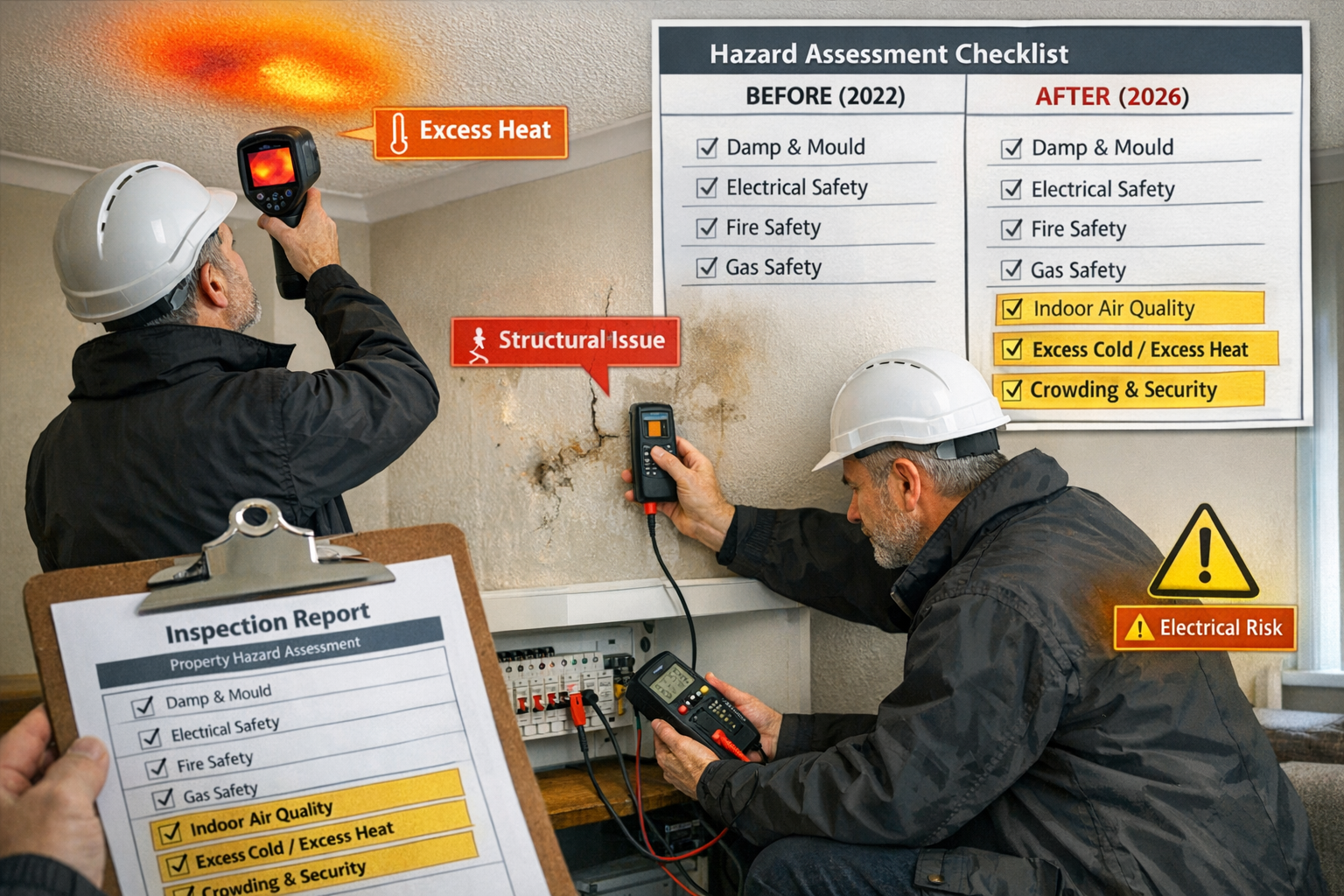
The 2026 expansion introduces additional hazard categories beyond the original scope, requiring surveyors to develop new assessment protocols for:
- Electrical hazards: Faulty wiring, overloaded circuits, inadequate earthing
- Excess heat or cold: Inadequate heating systems, poor insulation, thermal comfort failures
- Structural collapse risks: Foundation defects, load-bearing element deterioration, subsidence indicators
- Fire safety concerns: Inadequate fire detection, blocked escape routes, combustible materials
Mandatory Compliance Standards for Private Landlords
From 2026, private landlords face mandatory investigation requirements for hazard complaints with defined timescales for action and stronger enforcement by local authorities[1]. This represents a significant shift from the previous reactive approach to property maintenance.
Professional RICS building surveys now serve as the primary mechanism for demonstrating compliance with these standards. Landlords must provide evidence-based documentation showing:
✅ Timely investigation of reported hazards
✅ Professional assessment using appropriate methodologies
✅ Clear identification of hazard sources and severity
✅ Evidence-based remediation plans with defined timescales
✅ Written tenant notification within required timeframes
The consequences of non-compliance are substantial. Failure to meet Awaab's Law requirements constitutes a breach of both the tenancy agreement and statutory law, exposing landlords to enforcement action, unlimited fines, and potential legal proceedings[3].
Building Survey Protocols for New Hazard Categories in Private Rented Sector Properties
The Four Investigation Types Under Awaab's Law
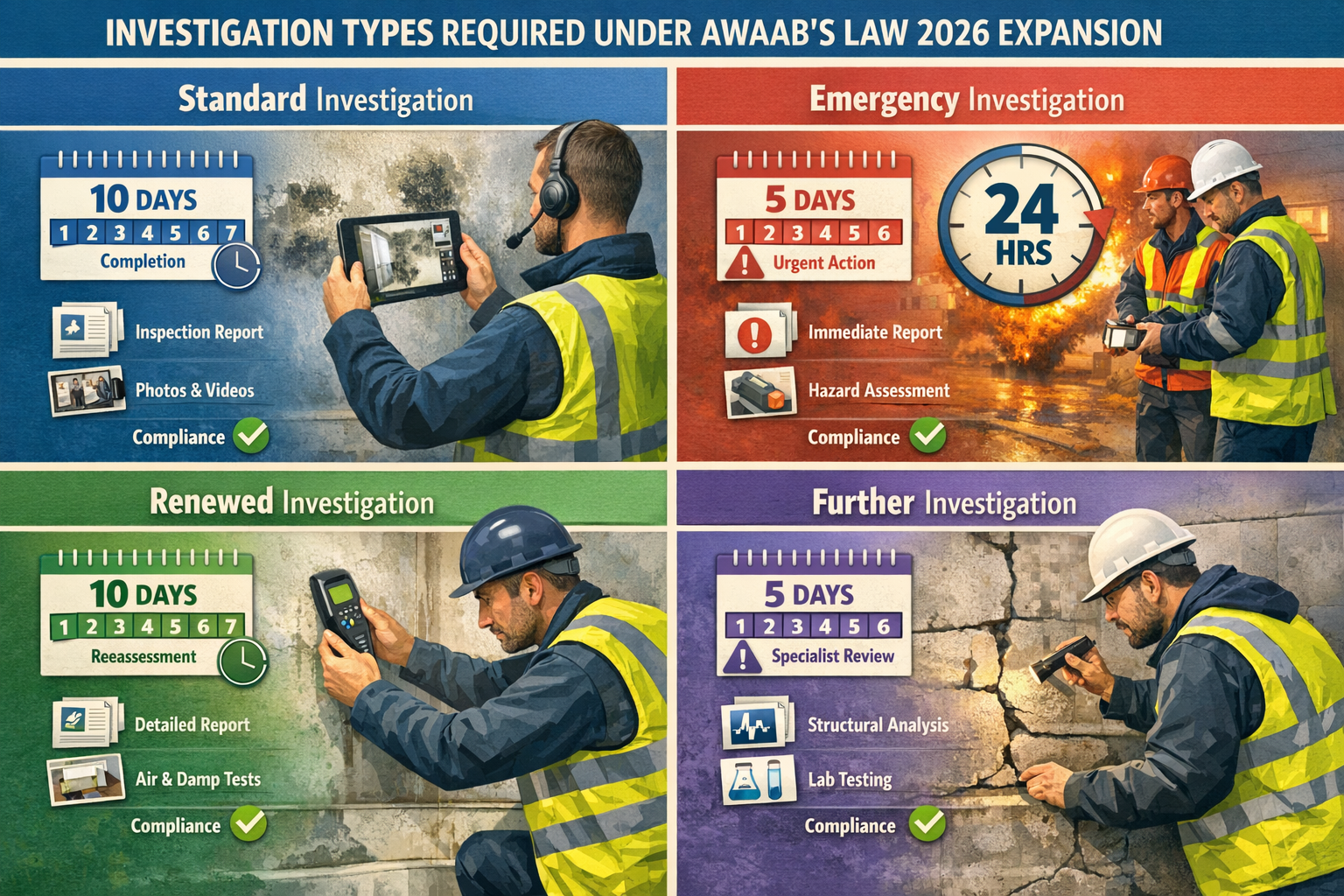
The 2026 expansion requires surveyors to conduct four distinct investigation types, each with specific protocols and timelines[3]:
| Investigation Type | Timeline | Methodology | Documentation Requirements |
|---|---|---|---|
| Standard Investigation | Within 10 working days | Can be conducted remotely using video, photos, or tenant-provided evidence | Written summary to tenant within 3 working days of completion |
| Renewed Investigation | Upon tenant request | In-person inspection if tenant requests following remote assessment | Comprehensive site visit report with photographic evidence |
| Emergency Investigation | Within 24 hours | Immediate on-site assessment for severe hazards | Urgent action plan with interim safety measures |
| Further Investigation | As required | Specialist assessments (structural surveys, electrical testing, thermal imaging) | Technical reports from qualified professionals |
Understanding when to deploy each investigation type is critical for compliance. A Level 3 building survey may be necessary for Further Investigations involving complex structural or building envelope issues.
Standard Investigation Protocols for Expanded Hazard Categories
Electrical Hazard Assessment
Surveyors must now incorporate electrical safety assessments into standard investigation protocols. This requires:
🔌 Visual Inspection: Consumer unit condition, evidence of overheating, DIY modifications, inadequate circuit protection
🔌 Testing Requirements: Electrical Installation Condition Reports (EICR) for properties where visual inspection reveals concerns
🔌 Risk Indicators: Scorching around sockets, flickering lights, frequent circuit breaker trips, aluminum wiring in older properties
🔌 Documentation Standards: Photographic evidence of defects, thermal imaging where available, clear risk categorization
Excess Temperature Hazard Protocols
The 2026 expansion recognizes thermal comfort failures as significant health hazards. Assessment protocols include:
🌡️ Heating System Evaluation: Boiler capacity, radiator coverage, thermostat functionality, heat distribution adequacy
🌡️ Insulation Assessment: Loft insulation depth, cavity wall treatment, window glazing performance, thermal bridging identification
🌡️ Ventilation Analysis: Adequate air circulation, condensation risk factors, mechanical ventilation system operation
🌡️ Temperature Monitoring: Evidence of inadequate heating during cold periods, overheating risks in summer months
Structural Collapse Risk Assessment
Structural integrity concerns require specialized investigation approaches:
🏗️ Visual Structural Survey: Foundation movement indicators, wall cracking patterns, ceiling deflection, beam deterioration
🏗️ Load-Bearing Element Inspection: Timber decay in structural members, steel corrosion, masonry bond failure
🏗️ Specialist Referral Triggers: Significant cracking (>5mm), progressive movement, structural alterations without building control approval
🏗️ Monitoring Requirements: Crack monitoring where progressive movement suspected, repeat inspections at defined intervals
For properties exhibiting serious structural concerns, surveyors should recommend structural engineer reports as part of Further Investigation protocols.
Emergency Investigation Response Protocols
Emergency hazards demand immediate response within 24 hours of identification[2]. The expanded hazard categories introduce new emergency scenarios:
Electrical Emergency Indicators:
- Exposed live wiring
- Burning smell from electrical installations
- Electrical arcing or sparking
- Complete loss of electrical safety devices
Structural Emergency Indicators:
- Sudden appearance of major cracking
- Visible structural movement
- Partial collapse of building elements
- Imminent collapse risk identified
Thermal Emergency Indicators:
- Complete heating system failure during winter
- Temperatures below 18°C in occupied living spaces
- Dangerous overheating creating health risks
Emergency investigations require immediate site attendance, interim safety measures, and urgent remediation planning. Surveyors must provide clear written guidance to landlords on temporary safety measures while permanent repairs are arranged.
Implementing Awaab's Law 2026 Expansion: Practical Surveyor Protocols
Evidence-Based Investigation Standards
Adequate investigations under the 2026 expansion must meet stringent evidence standards[1]:
Professional Assessment Requirements:
- Qualified surveyor or specialist inspection
- Appropriate diagnostic equipment (moisture meters, thermal cameras, electrical testing equipment)
- Systematic documentation of findings
- Risk categorization using Housing Health and Safety Rating System (HHSRS) methodology
Moisture Source Identification:
- Differentiation between condensation, penetrating damp, and rising damp
- Building envelope defect identification
- Ventilation adequacy assessment
- Occupant behavior factors
Clear Reporting Standards:
- Plain language explanations accessible to tenants
- Photographic evidence with annotations
- Prioritized recommendations based on hazard severity
- Defined timescales for remediation actions
Evidence-Based Remediation Plans:
- Root cause analysis rather than symptom treatment
- Specification of appropriate materials and methods
- Quality assurance measures
- Post-remediation verification protocols
Surveyors conducting comprehensive building surveys should integrate these evidence standards throughout their inspection methodology.
Tenant Notification and Communication Requirements
Landlords must provide written summaries to tenants within 3 working days after investigation concludes, unless all remediation works are completed within that period[3]. This notification must include:
📄 Investigation Findings: Clear description of hazards identified, severity assessment, causation analysis
📄 Remediation Plan: Specific actions to be taken, responsible parties, defined completion timescales
📄 Interim Measures: Temporary safety precautions while permanent repairs are arranged
📄 Tenant Obligations: Any actions required from tenants (ventilation practices, access arrangements)
📄 Escalation Process: How tenants can request renewed or further investigations if concerns persist
The communication must be accessible and understandable, avoiding technical jargon where possible. Surveyors should provide landlords with template notification letters that meet regulatory requirements while maintaining clarity.
Remediation Timescales and Work Commencement
The 2026 expansion establishes strict timescales for commencing remediation work:
For Damp and Mould Hazards:
- Investigation must begin within 10 working days of notification
- Repair work must commence within 5 working days of investigation conclusion[3]
For Emergency Hazards (All Categories):
- Investigation within 24 hours
- Immediate interim safety measures
- Permanent remediation as soon as practically possible
For Non-Emergency Hazards:
- Investigation within 10 working days
- Remediation timescales proportionate to hazard severity
- Regular progress updates to tenants
Surveyors play a crucial role in defining realistic yet compliant remediation timescales. Recommendations must balance urgency with practical considerations of contractor availability, material procurement, and work complexity.
Documentation and Record-Keeping Requirements
Comprehensive documentation is essential for demonstrating compliance with Awaab's Law 2026 expansion requirements. Surveyors should maintain:
📁 Investigation Records: Date of tenant notification, investigation commencement date, methodology employed, findings summary
📁 Photographic Evidence: Time-stamped images showing hazard conditions, diagnostic equipment readings, remediation progress
📁 Communication Logs: Copies of tenant notifications, correspondence regarding access arrangements, progress updates
📁 Remediation Documentation: Work specifications, contractor qualifications, completion certificates, post-remediation verification
📁 Monitoring Records: Follow-up inspection reports, tenant feedback, evidence of hazard resolution
This documentation provides crucial evidence in the event of regulatory enforcement action or tenant legal proceedings. Condition survey reports should incorporate these documentation standards as baseline practice.
Advanced Survey Methodologies for Expanded Hazard Categories
Thermal Imaging and Electrical Testing Integration
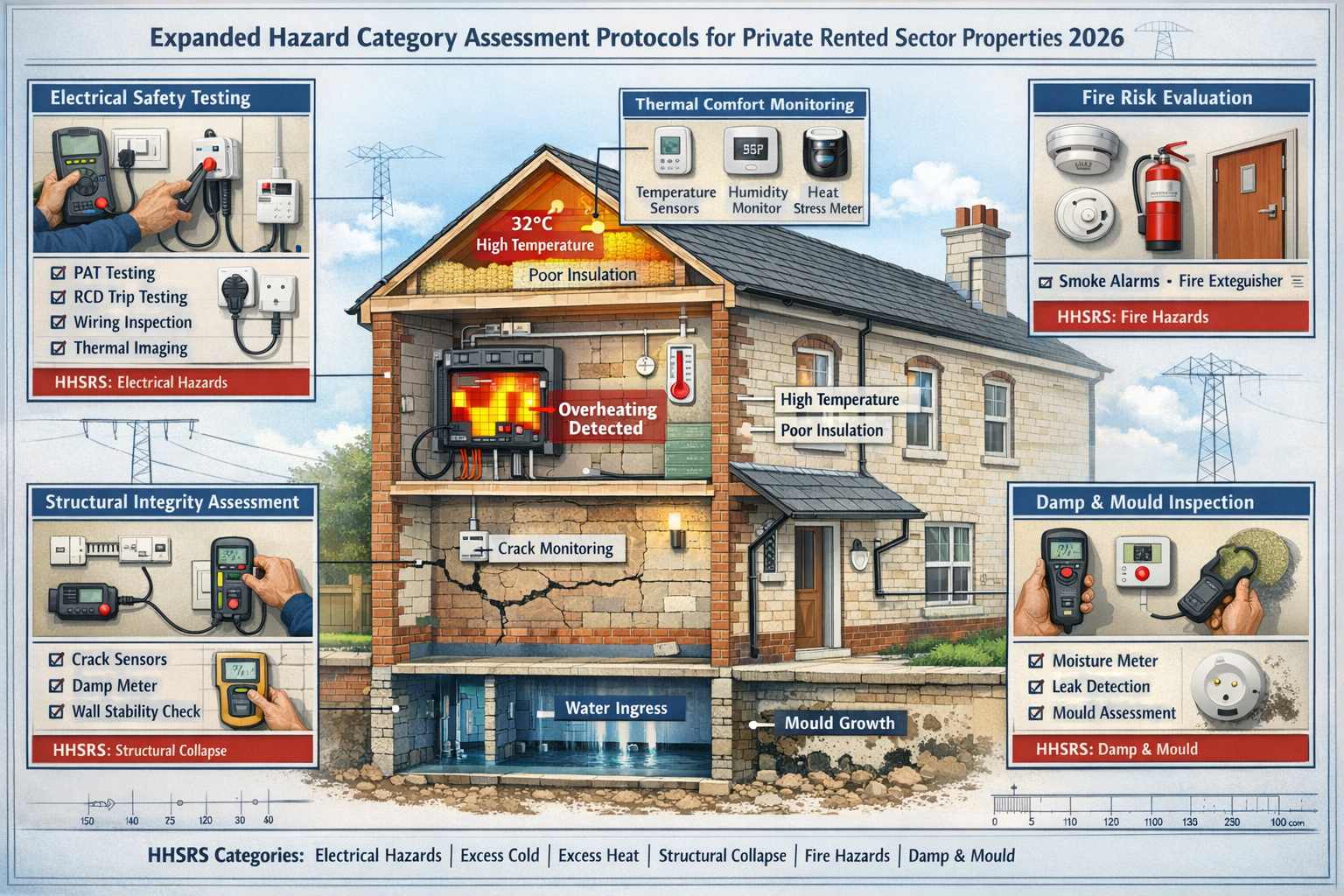
The 2026 expansion necessitates integration of advanced diagnostic technologies into standard survey protocols:
Thermal Imaging Applications:
- Identification of thermal bridging and insulation defects
- Detection of electrical hotspots indicating overloaded circuits
- Moisture ingress pathway identification
- Heating system performance verification
Electrical Testing Requirements:
- Visual inspection of consumer units and visible wiring
- EICR commissioning where defects identified
- RCD (Residual Current Device) functionality testing
- Earthing and bonding verification
Moisture Measurement Protocols:
- Multi-point moisture meter readings
- Differentiation between surface and deep-seated moisture
- Relative humidity monitoring in problematic areas
- Hygrometer readings for condensation risk assessment
Surveyors should consider drone surveys for comprehensive roof and external envelope assessment, particularly for multi-story properties where access is challenging.
Structural Assessment Protocols for Collapse Risk
Identifying structural collapse risks requires systematic assessment of load-bearing elements:
Foundation Assessment:
- External ground level inspection for settlement indicators
- Internal floor level variations
- Crack patterns indicating foundation movement
- Proximity to trees, watercourses, or mining activity
Structural Element Inspection:
- Timber frame members for rot, insect attack, or overloading
- Steel beams for corrosion or inadequate support
- Masonry walls for bulging, leaning, or bond failure
- Lintels and beams for deflection or cracking
Load Path Analysis:
- Verification of adequate load transfer from roof to foundations
- Identification of removed or altered structural elements
- Assessment of structural alterations against building regulations
- Evaluation of additional loading from extensions or conversions
For properties exhibiting significant structural concerns, surveyors should recommend subsidence surveys or specialist structural engineering assessment as part of Further Investigation protocols.
Multi-Hazard Risk Assessment Frameworks
The 2026 expansion requires surveyors to adopt holistic assessment approaches that recognize hazard interactions:
Interconnected Hazard Scenarios:
- Inadequate ventilation contributing to both condensation and excess cold
- Electrical defects creating fire risks and excess heat hazards
- Structural defects allowing water ingress leading to damp and mould
- Poor insulation causing both thermal comfort issues and condensation risks
HHSRS Integration:
- Systematic evaluation against all 29 hazard categories
- Prioritization based on likelihood and harm potential
- Category 1 hazard identification triggering mandatory enforcement
- Category 2 hazard documentation for landlord action
Risk Scoring Methodologies:
- Likelihood assessment (rare, occasional, frequent, continuous)
- Harm potential evaluation (extreme, severe, serious, moderate, negligible)
- Combined risk rating determining remediation urgency
- Documentation supporting enforcement authority decisions
Surveyors conducting what surveyors look for in house surveys should expand their standard inspection protocols to incorporate these multi-hazard assessment frameworks.
Compliance Strategies for Private Landlords and Property Managers
Proactive Survey Scheduling and Maintenance Planning
Forward-thinking landlords are implementing proactive survey schedules to ensure compliance before tenant complaints arise:
Annual Inspection Programs:
- Comprehensive property surveys at tenancy commencement
- Annual maintenance inspections covering expanded hazard categories
- Pre-emptive identification and remediation of emerging hazards
- Documentation demonstrating reasonable landlord conduct
Preventative Maintenance Protocols:
- Regular electrical installation testing (every 5 years minimum)
- Annual boiler servicing and heating system checks
- Periodic structural inspections for older properties
- Ventilation system maintenance and filter replacement
Tenant Education Initiatives:
- Clear guidance on adequate ventilation practices
- Heating usage recommendations to prevent condensation
- Prompt reporting procedures for emerging defects
- Responsibilities for minor maintenance tasks
Professional Survey Commissioning Best Practices
Selecting appropriate survey levels and qualified professionals is crucial for compliance:
Survey Level Selection:
- Level 2 surveys for standard properties without significant defects
- Level 3 surveys for older properties or those with known issues
- Specialist surveys for specific hazard concerns (electrical, structural, damp)
- Regular monitoring surveys for properties with ongoing issues
Surveyor Qualification Verification:
- RICS (Royal Institution of Chartered Surveyors) membership
- Relevant professional indemnity insurance
- Experience with private rented sector compliance
- Understanding of Awaab's Law requirements and timescales
Report Quality Standards:
- Clear hazard identification and categorization
- Evidence-based recommendations with defined priorities
- Realistic remediation timescales
- Plain language accessible to tenants and enforcement authorities
Enforcement and Penalty Mitigation
Understanding enforcement mechanisms helps landlords avoid penalties:
Local Authority Powers:
- Hazard awareness notices for Category 1 and 2 hazards
- Improvement notices specifying required remediation
- Prohibition orders preventing property occupation
- Unlimited fines for serious or persistent breaches
Mitigating Factors:
- Evidence of timely investigation following tenant notification
- Professional survey commissioning demonstrating due diligence
- Prompt remediation commencement within required timescales
- Clear communication and cooperation with tenants
Defense Strategies:
- Comprehensive documentation of all investigation and remediation activities
- Evidence of reasonable landlord conduct throughout process
- Professional survey reports supporting decision-making
- Demonstration of compliance with notification and timeline requirements
Future Developments and Emerging Compliance Considerations
Anticipated Regulatory Expansions Beyond 2026
The government has indicated ongoing development of hazard coverage under Awaab's Law framework:
Potential Additional Hazard Categories:
- Radon exposure in high-risk geographic areas
- Carbon monoxide risks from combustion appliances
- Lead paint hazards in pre-1970s properties
- Asbestos exposure in older buildings
Temporary Accommodation Extension:
- Consultation exploring coverage for temporary housing
- Particular focus on family accommodation standards
- Enhanced protection for vulnerable households
- Alignment with social housing standards
Enforcement Enhancement:
- Increased local authority funding for compliance monitoring
- Database systems tracking landlord compliance records
- Potential licensing scheme integration
- Tenant empowerment through accessible complaint mechanisms
Technology Integration in Survey Protocols
Emerging technologies are transforming survey methodologies:
Digital Inspection Tools:
- Mobile applications for systematic hazard documentation
- Cloud-based reporting systems enabling rapid tenant notification
- Photographic evidence management with automatic time-stamping
- Integration with property management systems
Advanced Diagnostic Equipment:
- Thermal imaging cameras becoming standard survey equipment
- Moisture mapping systems for comprehensive damp assessment
- Electrical testing devices for non-invasive circuit analysis
- Structural monitoring sensors for progressive defect tracking
Artificial Intelligence Applications:
- Automated hazard identification from photographic evidence
- Risk scoring algorithms based on HHSRS methodology
- Predictive maintenance scheduling based on property characteristics
- Natural language report generation for accessibility
Professional Development Requirements for Surveyors
The 2026 expansion creates urgent professional development needs:
Essential Training Areas:
- Awaab's Law compliance requirements and timescales
- Expanded hazard category identification methodologies
- Evidence standards for investigation adequacy
- Tenant communication and notification protocols
Specialist Qualifications:
- Advanced damp and mould assessment certifications
- Electrical safety awareness for surveyors
- Thermal performance evaluation training
- Structural defect identification courses
Continuing Professional Development:
- Regular updates on regulatory developments
- Case study analysis of enforcement actions
- Technology integration in survey practice
- Multi-disciplinary collaboration with specialist consultants
Conclusion
The Awaab's Law 2026 Expansion: Building Survey Protocols for New Hazard Categories in Private Rented Sector Properties represents a watershed moment in rental property safety regulation. The extension beyond damp and mould to encompass electrical hazards, excess temperatures, and structural collapse risks fundamentally transforms the surveyor's role from advisory consultant to compliance gatekeeper.
Critical takeaways for immediate action:
✅ Update survey protocols to incorporate systematic assessment of all expanded hazard categories
✅ Implement strict timeline compliance for investigations (24 hours for emergencies, 10 working days for standard assessments)
✅ Adopt evidence-based methodologies using appropriate diagnostic equipment and professional standards
✅ Establish robust documentation systems to demonstrate compliance with investigation and notification requirements
✅ Commission professional surveys proactively rather than waiting for tenant complaints
Private landlords who view these requirements as bureaucratic burdens miss the fundamental purpose: preventing tragedies like Awaab Ishak's death. Professional building surveys are no longer optional extras but essential compliance tools that protect both tenant welfare and landlord interests.
The knowledge gap facing practitioners is real and urgent. Surveyors must rapidly adapt their methodologies, invest in appropriate diagnostic equipment, and develop expertise across expanded hazard categories. Those who embrace this evolution will find themselves indispensable to a private rented sector increasingly defined by professional standards and regulatory accountability.
Next steps for property professionals:
- Audit current survey protocols against 2026 expansion requirements
- Invest in training and equipment for expanded hazard assessment
- Develop template documentation meeting notification and reporting standards
- Establish relationships with specialist consultants for Further Investigation requirements
- Implement proactive inspection schedules for rental property portfolios
The 2026 expansion is not the endpoint but the beginning of an ongoing evolution toward comprehensive hazard management in England's rental sector. Forward-thinking professionals who position themselves at the forefront of this change will define best practices for the next generation of property safety standards.
References
[1] Awaabs Law Private Landlords 2026 – https://www.idealresponse.co.uk/blog/awaabs-law-private-landlords-2026/
[2] Awaabs Law Private Rented Sector Extension – https://awaabs-law.com/awaabs-law-private-rented-sector-extension
[3] Awaabs Law Is Here The Surveyors Guide For Compliance – https://www.surventrix.com/blog/awaabs-law-is-here-the-surveyors-guide-for-compliance
[5] Awaabs Law Comes Into Force What Does It Mean For Construction – https://www.trowers.com/insights/2025/november/awaabs-law-comes-into-force-what-does-it-mean-for-construction
[7] Awaabs Law Guidance For Social Landlords Timeframes For Repairs In The Social Rented Sector – https://www.gov.uk/government/publications/awaabs-law-guidance-for-social-landlords/awaabs-law-guidance-for-social-landlords-timeframes-for-repairs-in-the-social-rented-sector
