
Landlords across England now face a critical compliance bottleneck: without registration on the new Private Rented Sector (PRS) database, they cannot serve Section 8 eviction notices—even when major property works become urgent. This regulatory shift has triggered an unprecedented wave of party wall surveys as landlords rush to complete compliance upgrades, particularly damp remediation mandated under Awaab's Law, before they can legally regain possession rights. Understanding Party Wall Notice Requirements for PRS Database Compliance Works: Surveyor Tactics Post-Renters' Rights Act Registration in 2026 has become essential for property owners navigating this complex intersection of housing legislation.
The Renters' Rights Act 2026 fundamentally restructured landlord obligations, creating a direct link between property standards, database registration, and legal recourse. For properties sharing party walls—common in terraced housing and converted flats—this means coordinating statutory notices under the Party Wall etc. Act 1996 while simultaneously meeting new PRS database requirements. The strategic implications extend beyond simple compliance; they affect construction timelines, tenant relations, and ultimately, property portfolio viability.
Key Takeaways
- 🏠 PRS database registration is now mandatory before landlords can serve Section 8 notices, forcing compliance works to be completed with sitting tenants
- 📋 Party wall notices must be served 2 months before works commence, creating extended timelines for urgent damp remediation and structural repairs
- ⚖️ Surveyor tactics have evolved to address access arrangements, working hour restrictions, and tenant protection provisions under the new Act
- 💰 Award specifications must now account for Awaab's Law timelines and PRS database compliance deadlines to avoid regulatory penalties
- 🔍 Documentation standards have intensified with surveyors required to evidence both structural necessity and regulatory compliance justification
Understanding the PRS Database Registration Requirement
The 2026 Renters' Rights Act introduced a centralized PRS database that fundamentally altered landlord operations. Before serving any Section 8 notice—including grounds for substantial works or property sale—landlords must demonstrate active registration and compliance status [4]. This requirement creates a critical pressure point: properties requiring major works to meet Awaab's Law standards cannot be emptied for renovations through traditional possession proceedings until those very works are completed.
The Awaab's Law Connection
Awaab's Law provisions within the Act mandate specific timelines for addressing serious hazards, particularly damp and mould conditions. Landlords must:
- Investigate reported hazards within 14 days
- Commence remedial works within specified timeframes based on hazard severity
- Complete works within maximum periods or face substantial penalties
When these remediation works affect party walls—as damp-proofing, cavity wall treatments, and structural repairs frequently do—landlords must navigate both the Party Wall etc. Act 1996 requirements and new PRS database compliance obligations simultaneously [3].
Registration Prerequisites
To achieve PRS database registration status, landlords must demonstrate:
✅ Current electrical safety certificates
✅ Valid gas safety records
✅ Energy Performance Certificate (EPC) rating of E or above
✅ Compliance with prescribed hazard standards
✅ No outstanding enforcement notices
✅ Proof of deposit protection scheme membership
Properties failing to meet these standards cannot register, creating a catch-22 where necessary compliance works require party wall procedures but cannot proceed to vacant possession.
Party Wall Notice Requirements for PRS Database Compliance Works: Surveyor Tactics Post-Renters' Rights Act Registration in 2026
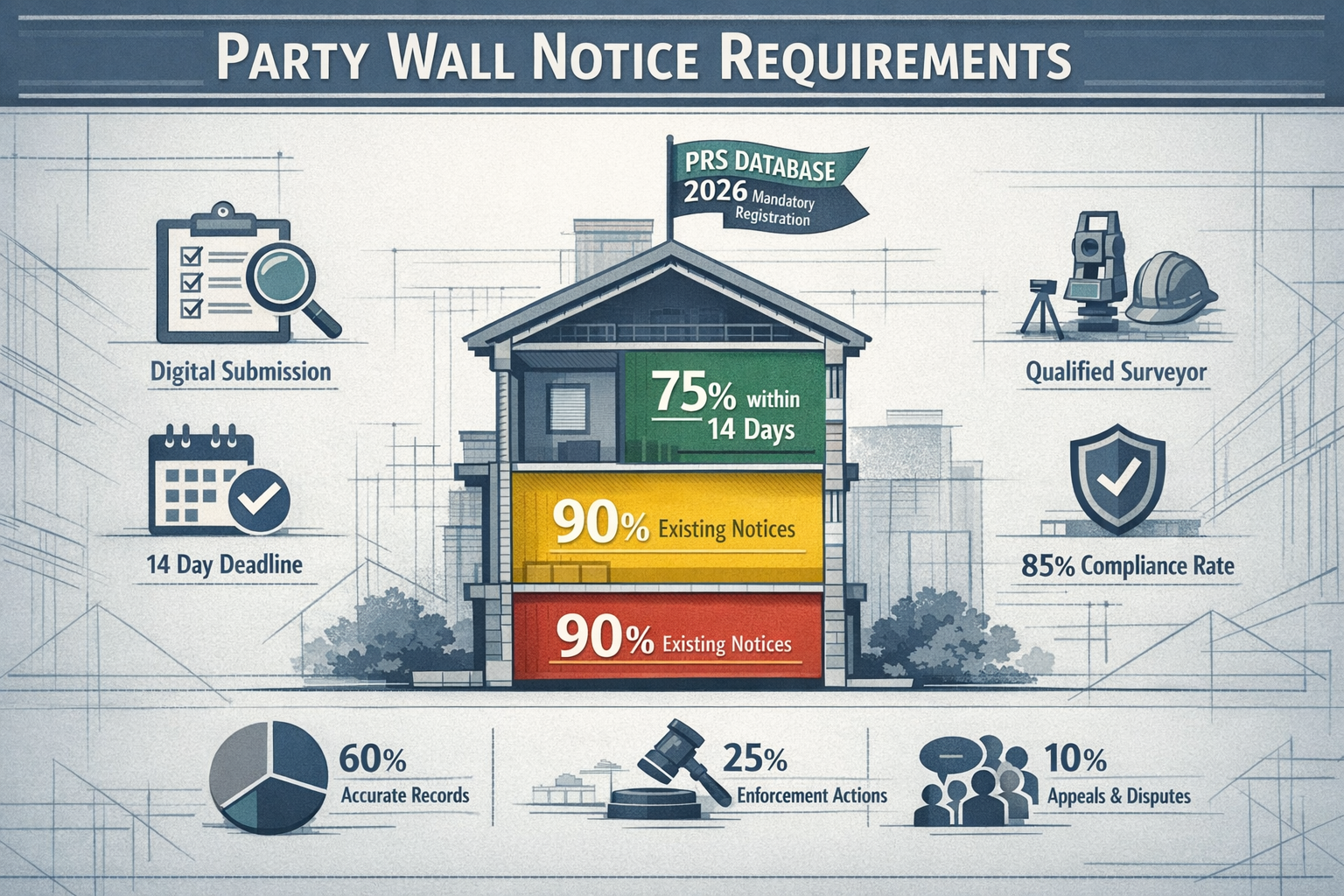
The intersection of party wall legislation and PRS database requirements has created new procedural complexities. Understanding when and how to serve notices has become more nuanced, particularly for works categorized as compliance-driven rather than discretionary improvements.
Statutory Notice Periods Under Current Legislation
The Party Wall etc. Act 1996 remains the governing framework, requiring specific notice periods [1]:
| Work Type | Notice Period | Notice Form |
|---|---|---|
| New building on boundary line | 1 month | Line of Junction Notice |
| Work to existing party wall | 2 months | Party Structure Notice |
| Excavation within 3-6 metres | 1 month | Adjacent Excavation Notice |
For PRS database compliance works—predominantly involving existing party structures for damp remediation, structural repairs, or building envelope improvements—the 2-month Party Structure Notice applies in most cases [1].
Critical Timing Considerations
The extended notice period creates planning challenges when Awaab's Law timelines are simultaneously running. Consider this scenario:
- Day 1: Tenant reports severe damp affecting party wall
- Day 14: Investigation reveals structural damp-proofing required
- Day 14: Party Structure Notice served to adjoining owner
- Day 74: Earliest works can commence (assuming no dispute)
- Day 74+: Remediation works completed
- Day 90+: PRS database registration achieved
- Day 120+: Section 8 notice can be served (if required)
This timeline demonstrates why early identification of party wall implications is crucial for compliance planning. Our guide on party wall surveys under the Renters' Rights Act provides detailed planning frameworks.
Notice Content Requirements
Party Structure Notices for PRS compliance works must specify:
Essential Elements:
- Precise description of proposed works
- Construction methodology and materials
- Expected duration and working hours
- Access requirements to adjoining property
- Temporary works or support needed
Enhanced 2026 Requirements:
- Reference to PRS database compliance objective
- Awaab's Law hazard category and timeline
- Tenant occupation status and protection measures
- Alternative methodology considerations (if applicable)
The notice must be sufficiently detailed to allow the adjoining owner to understand the scope and implications. Vague descriptions citing "general repairs" or "compliance works" are insufficient and may be challenged [3].
Serving Notices to Multiple Parties
Terraced properties and converted buildings often involve multiple adjoining owners. Each must receive individual notice, and the 2-month period runs independently for each party. Strategic surveyor tactics include:
🎯 Simultaneous Service: Serving all notices on the same day to align timelines
🎯 Preliminary Discussions: Informal neighbour consultation before formal notice
🎯 Comprehensive Documentation: Detailed plans and specifications reducing dispute likelihood
🎯 Professional Presentation: Formal letterhead and proper legal formatting
For guidance on proper notice formatting, see our resource on how to write a party wall letter.
Surveyor Appointment Strategies in the Post-Act Environment
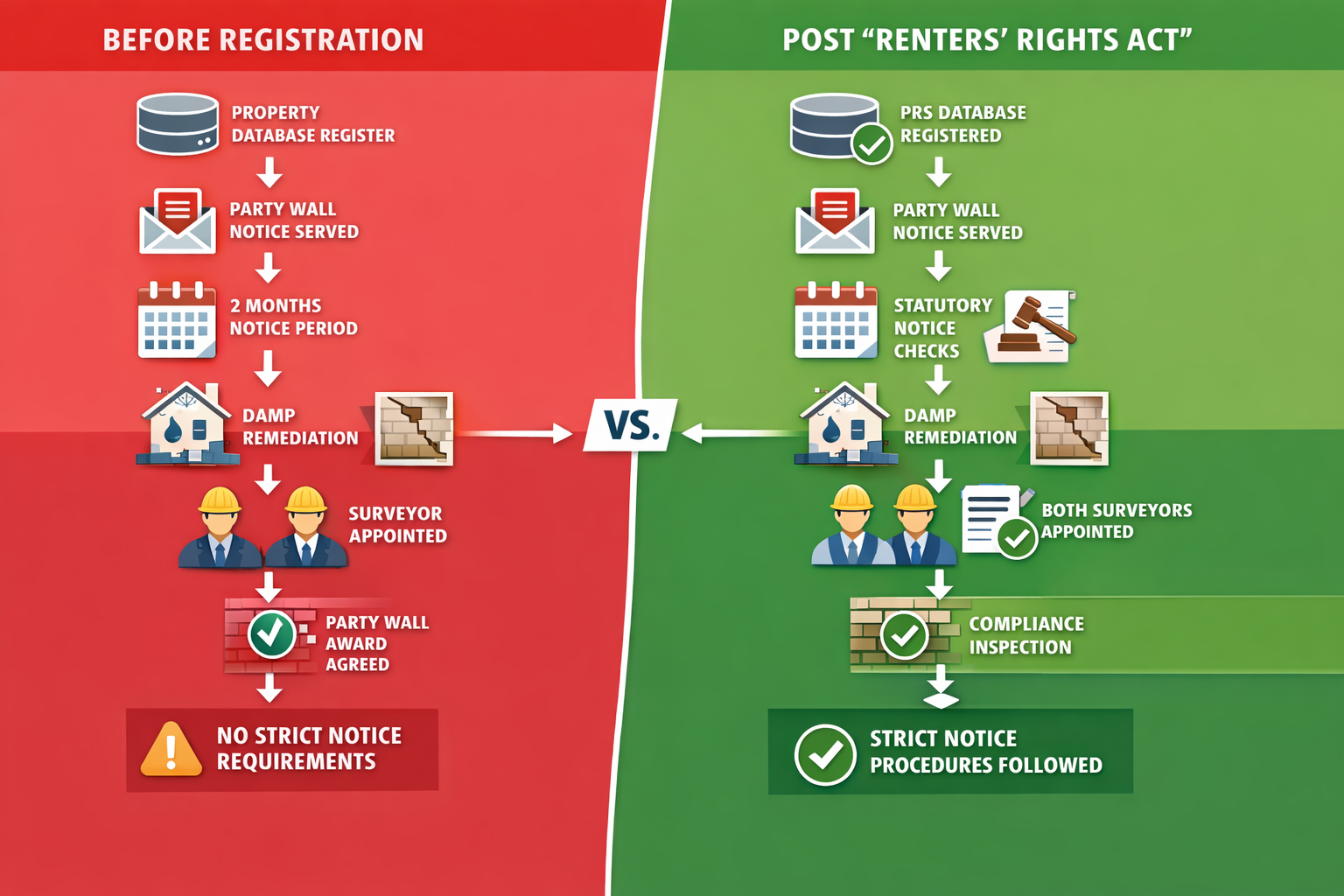
The 2026 regulatory environment has prompted surveyors to develop specialized tactics addressing the unique pressures of PRS database compliance works. Traditional party wall procedures remain valid, but practical application has evolved significantly [4].
Agreed Surveyor vs. Two Surveyor Approach
When the adjoining owner receives a Party Structure Notice, they have three options:
- Consent in writing (no surveyor required)
- Appoint their own surveyor (two surveyor approach)
- Take no action within 14 days (deemed dissent, triggering surveyor appointment)
For PRS compliance works with tight Awaab's Law deadlines, the Agreed Surveyor approach offers significant advantages:
Benefits:
- Single point of coordination
- Reduced costs (shared fee structure)
- Faster award preparation
- Simplified communication
Considerations:
- Both parties must consent to the appointment
- Surveyor must demonstrate impartiality
- May not suit complex or contentious situations
Experienced RICS party wall surveyors increasingly recommend the Agreed Surveyor route for straightforward compliance works where good neighbour relations exist.
Award Provisions for Occupied Properties
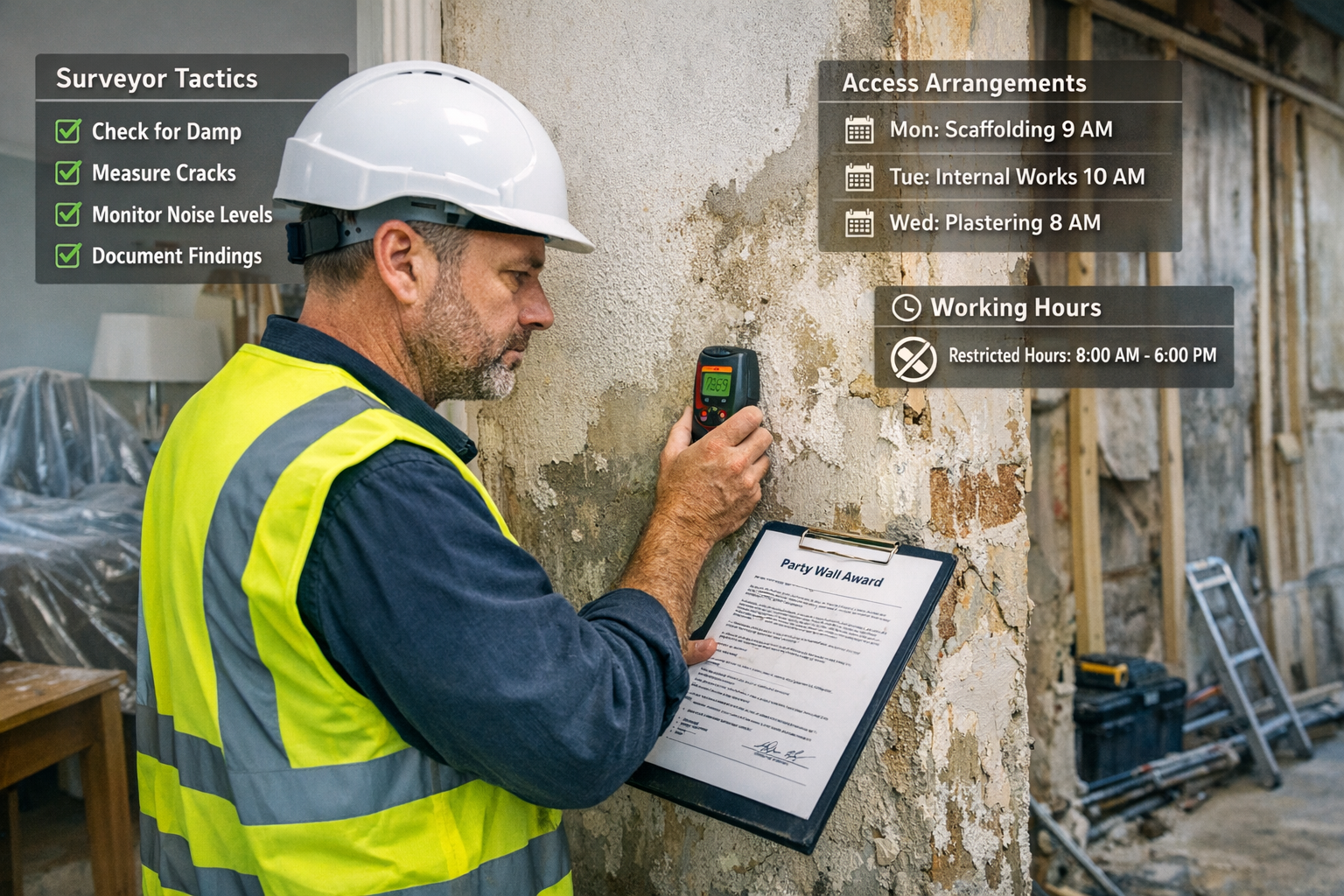
Party wall awards for PRS compliance works must address tenant occupation realities. Standard provisions now commonly include:
Access Arrangements:
- Minimum 7 days' written notice before each site visit
- Restricted access hours (typically 8am-6pm weekdays)
- Tenant right to be present during access
- Alternative arrangements during tenant absence
Noise and Disruption Management:
- Prohibited hours for noisy works
- Weekend and bank holiday restrictions
- Dust and debris containment measures
- Temporary accommodation provisions (if required)
Tenant Protection Clauses:
- No rent increase during works period
- Compensation for significant disruption
- Utilities maintenance guarantees
- Emergency contact procedures
These provisions recognize that, unlike traditional scenarios where works might proceed in vacant properties, PRS database requirements often necessitate completion with sitting tenants [2].
Condition Surveys and Documentation
Pre-commencement condition surveys have become more comprehensive in 2026, serving dual purposes:
- Traditional Party Wall Protection: Documenting existing condition to resolve damage disputes
- PRS Database Evidence: Demonstrating hazard severity and remediation necessity
Professional surveyors now photograph and document:
- Damp meter readings with calibrated equipment
- Thermal imaging showing heat loss and moisture patterns
- Structural crack measurements and monitoring
- Mould growth extent and classification
- Building envelope defects
This enhanced documentation supports both the party wall award and subsequent PRS database registration applications. Understanding what party wall surveyors do in this context helps landlords appreciate the expanded scope.
Dispute Resolution Tactics
When adjoining owners dispute proposed works, surveyors employ specific tactics to maintain compliance timelines:
Early Intervention:
- Immediate appointment upon deemed dissent
- First meeting within 7 days of appointment
- Draft award circulation within 21 days
Negotiation Strategies:
- Demonstrating regulatory necessity (not discretionary works)
- Offering enhanced protections beyond statutory minimums
- Providing detailed methodology to address concerns
- Scheduling works to minimize neighbour impact
Award Enforcement:
- Clear specification of permitted works scope
- Defined construction timelines with milestones
- Penalty provisions for non-compliance
- Third surveyor escalation procedures
The goal is producing an enforceable award that allows works to proceed while protecting all parties' interests. For complex situations, our party wall dispute resolution guide provides detailed frameworks.
Cost Implications and Fee Structures
The financial dimension of Party Wall Notice Requirements for PRS Database Compliance Works: Surveyor Tactics Post-Renters' Rights Act Registration in 2026 extends beyond surveyor fees to encompass broader compliance costs.
Surveyor Fee Expectations
Party wall surveyor costs in 2026 typically range:
- Agreed Surveyor: £700-£1,500 for straightforward compliance works
- Building Owner's Surveyor: £800-£1,800
- Adjoining Owner's Surveyor: £600-£1,200 (paid by building owner)
- Award Preparation: £300-£600 additional
Complex cases involving multiple adjoining owners, structural concerns, or disputes can exceed these ranges significantly. Our detailed party wall surveyor cost guide provides current market rates.
Hidden Compliance Costs
Beyond surveyor fees, landlords face:
💷 Extended Financing Costs: Interest on loans during extended notice periods
💷 Tenant Compensation: Rent reductions or disruption payments
💷 Accelerated Works Premiums: Premium rates for restricted working hours
💷 Documentation Expenses: Enhanced photography, testing, and reporting
💷 Legal Review: Solicitor input on complex awards
Cost Recovery Considerations
The Party Wall etc. Act 1996 places surveyor fee responsibility on the building owner (landlord initiating works). These costs cannot typically be recovered through:
- Rent increases during works
- Service charge pass-through (unless specifically permitted)
- Deductions from tenant deposits
However, successful PRS database registration and compliance achievement may justify:
- Market rent adjustments post-works
- Enhanced property valuations
- Reduced void periods through improved condition
- Avoided enforcement penalties
Understanding the complete party wall survey process helps landlords budget accurately for these requirements.
Practical Compliance Workflow
Implementing Party Wall Notice Requirements for PRS Database Compliance Works: Surveyor Tactics Post-Renters' Rights Act Registration in 2026 requires systematic planning.
Step-by-Step Implementation
Phase 1: Assessment (Days 1-14)
- Identify compliance deficiency requiring works
- Determine party wall implications
- Obtain contractor quotations and specifications
- Assess Awaab's Law timeline requirements
Phase 2: Notice Service (Day 14)
5. Prepare detailed Party Structure Notice
6. Serve notice to all adjoining owners
7. Notify tenants of proposed works
8. Begin 2-month statutory period
Phase 3: Surveyor Engagement (Days 15-28)
9. Propose Agreed Surveyor or appoint own surveyor
10. Respond to adjoining owner surveyor appointments
11. Coordinate condition surveys
12. Prepare award specifications
Phase 4: Award Finalization (Days 29-60)
13. Review draft award provisions
14. Negotiate any disputed terms
15. Obtain award signatures
16. Distribute copies to all parties
Phase 5: Works Execution (Days 61+)
17. Mobilize contractors per award terms
18. Maintain access notice protocols
19. Document works progress
20. Complete final inspections
Phase 6: Registration (Post-Completion)
21. Obtain completion certificates
22. Submit PRS database application
23. Achieve registration status
24. Resume normal tenancy management
This workflow integrates party wall requirements with PRS database objectives, ensuring neither aspect causes compliance failure.
Common Pitfalls to Avoid
❌ Serving inadequate notices lacking sufficient detail
❌ Commencing works before award finalization
❌ Failing to document tenant notification
❌ Ignoring access protocol requirements
❌ Underestimating timeline requirements
❌ Neglecting condition survey evidence
Professional guidance from experienced party wall surveyors helps avoid these costly mistakes.
Regional Variations and Local Authority Considerations
While the Party Wall etc. Act 1996 applies throughout England and Wales, local authority enforcement of PRS database requirements varies. Some councils have implemented:
- Enhanced inspection regimes for registered properties
- Accelerated processing for compliant landlords
- Additional local licensing requirements
- Specific technical standards beyond national minimums
Landlords operating across multiple local authorities must ensure their party wall procedures satisfy the most stringent applicable requirements. London boroughs, in particular, have adopted rigorous enforcement approaches following the Act's implementation [2].
Technology and Documentation Tools
Modern surveyor practice increasingly relies on digital tools:
Documentation Platforms:
- Cloud-based photo and measurement storage
- Automated award generation software
- Digital signature and distribution systems
- Tenant communication portals
Inspection Technology:
- Calibrated moisture meters with data logging
- Thermal imaging cameras with report integration
- Drone surveys for roof and chimney works
- 3D scanning for complex structural assessment
Compliance Tracking:
- Integrated timeline management
- Automated notice period calculations
- Regulatory deadline alerts
- PRS database application preparation
These tools enhance accuracy, reduce timelines, and provide robust evidence for both party wall awards and database registration applications.
Future Outlook and Emerging Practices
The intersection of party wall law and PRS regulation continues evolving. Emerging trends include:
📈 Standardized Award Templates: Industry bodies developing PRS-specific award provisions
📈 Fast-Track Procedures: Expedited processes for urgent Awaab's Law compliance
📈 Integrated Inspections: Combined party wall and property condition assessments
📈 Digital Notice Service: Electronic service becoming accepted practice
📈 Tenant Engagement Protocols: Enhanced communication reducing disputes
Surveyors and landlords staying ahead of these developments gain competitive advantages in compliance efficiency and cost management.
Conclusion
Party Wall Notice Requirements for PRS Database Compliance Works: Surveyor Tactics Post-Renters' Rights Act Registration in 2026 represents a complex but manageable regulatory intersection. The key to successful navigation lies in early planning, professional surveyor engagement, and systematic workflow implementation.
Landlords must recognize that PRS database registration is no longer optional—it's a prerequisite for basic tenancy management rights. When compliance works affect party walls, the statutory 2-month notice period becomes non-negotiable, requiring integration with Awaab's Law timelines and tenant protection obligations.
Professional surveyors have adapted their practices to address these new realities, developing specialized tactics for occupied property works, enhanced documentation standards, and streamlined award provisions. By engaging experienced practitioners early in the compliance planning process, landlords can avoid costly delays, minimize dispute risks, and achieve registration objectives efficiently.
Actionable Next Steps
For landlords facing PRS database compliance requirements:
- Conduct immediate property audits identifying potential party wall implications
- Engage qualified party wall surveyors before serving any notices
- Develop integrated compliance timelines accounting for all regulatory deadlines
- Document tenant communications thoroughly throughout the process
- Budget comprehensively for surveyor fees, works costs, and potential delays
For adjoining owners receiving party wall notices:
- Respond promptly within the 14-day statutory period
- Appoint experienced surveyors familiar with PRS compliance contexts
- Request detailed specifications ensuring full understanding of proposed works
- Negotiate appropriate protections addressing your specific concerns
- Maintain constructive dialogue facilitating timely award finalization
The regulatory landscape will continue evolving as the Renters' Rights Act 2026 matures. Staying informed, maintaining professional relationships, and prioritizing compliance will separate successful landlords from those facing enforcement action and operational restrictions.
For expert guidance on your specific situation, consider consulting with qualified party wall surveyors who understand both the technical requirements and regulatory context of 2026 compliance works.
References
[1] Party Wall Agreement – https://hoa.org.uk/advice/guides-for-homeowners/i-am-improving/party-wall-agreement/
[2] Valuation Adjustments For Renters Rights Act 2026 How Building Surveyors Must Assess Landlord Tenant Compliance – https://nottinghillsurveyors.com/blog/valuation-adjustments-for-renters-rights-act-2026-how-building-surveyors-must-assess-landlord-tenant-compliance
[3] Party Wall Surveys Under Renters Rights Act 2026 Managing Landlord Modifications And Pet Friendly Extensions – https://nottinghillsurveyors.com/blog/party-wall-surveys-under-renters-rights-act-2026-managing-landlord-modifications-and-pet-friendly-extensions
[4] Party Wall Surveys For Renters Rights Act Compliance Managing Notices When Landlord Initiated Works Face New Section 8 Ground Requirements – https://nottinghillsurveyors.com/blog/party-wall-surveys-for-renters-rights-act-compliance-managing-notices-when-landlord-initiated-works-face-new-section-8-ground-requirements
