
The Renters' Rights Act 2025 received Royal Assent on October 27, 2025, fundamentally transforming how landlords approach property modifications in rental properties [4]. With major provisions taking effect May 1, 2026—including the abolition of Section 21 "no fault" evictions and the introduction of assured periodic tenancies—the intersection between tenant rights and party wall procedures has created entirely new compliance requirements. Party Wall Surveys Under Renters' Rights Act 2026: Managing Landlord Modifications and Pet-Friendly Extensions represents the most significant shift in rental property management protocols in decades, requiring landlords to navigate complex surveying requirements while accommodating tenant pet requests and maintaining structural integrity.
This comprehensive guide examines how the May 2026 Act's pet accommodation provisions and periodic tenancy framework impact party wall notice procedures for rental property alterations, providing surveyor strategies for compliance and dispute avoidance.

Key Takeaways
- Party wall survey protocols now require tenant-centered approaches under the Renters' Rights Act 2026, with landlords unable to use Section 21 evictions to bypass tenant objections to building works
- Pet-friendly extensions trigger dual compliance requirements: both Party Wall Act 1996 procedures and new habitability standards for animal accommodation must be satisfied
- Two-month notice periods for party wall works now intersect with periodic tenancy rights, requiring careful coordination between surveyor assessments and tenant consultation
- Independent party wall surveyors play critical roles in documenting baseline conditions and preventing disputes when landlords modify rental properties
- Schedule of condition documentation has become essential for protecting both landlord investments and tenant rights during structural modifications
Understanding Party Wall Surveys Under Renters' Rights Act 2026: The New Regulatory Landscape
The convergence of the Party Wall etc. Act 1996 and the Renters' Rights Act 2026 creates a fundamentally different environment for landlords planning property modifications. Party wall survey protocols are undergoing "complete recalibration" under the new framework, with tenant rights now placed at the center of every notice [2].
The Abolition of Section 21 and Its Impact on Building Works
Previously, landlords could serve Section 21 notices to regain possession before undertaking major building works that might disrupt tenants. This option no longer exists after May 1, 2026. Landlords must now complete party wall procedures while tenants remain in situ, fundamentally changing project planning and surveyor coordination.
The Party Wall Act 1996 applies exclusively to England and Wales, governing processes for serving Party Wall Notices and creating Party Wall Awards to prevent building work that compromises shared wall structural integrity [1]. Under the new regulatory environment, these procedures must accommodate:
- ✅ Tenant consultation requirements throughout the building work process
- ✅ Assured periodic tenancy protections that prevent forced relocations
- ✅ Pet accommodation considerations when modifications affect animal-friendly spaces
- ✅ Enhanced habitability standards during and after construction
Timeline Requirements for Party Wall Notices in Rental Properties
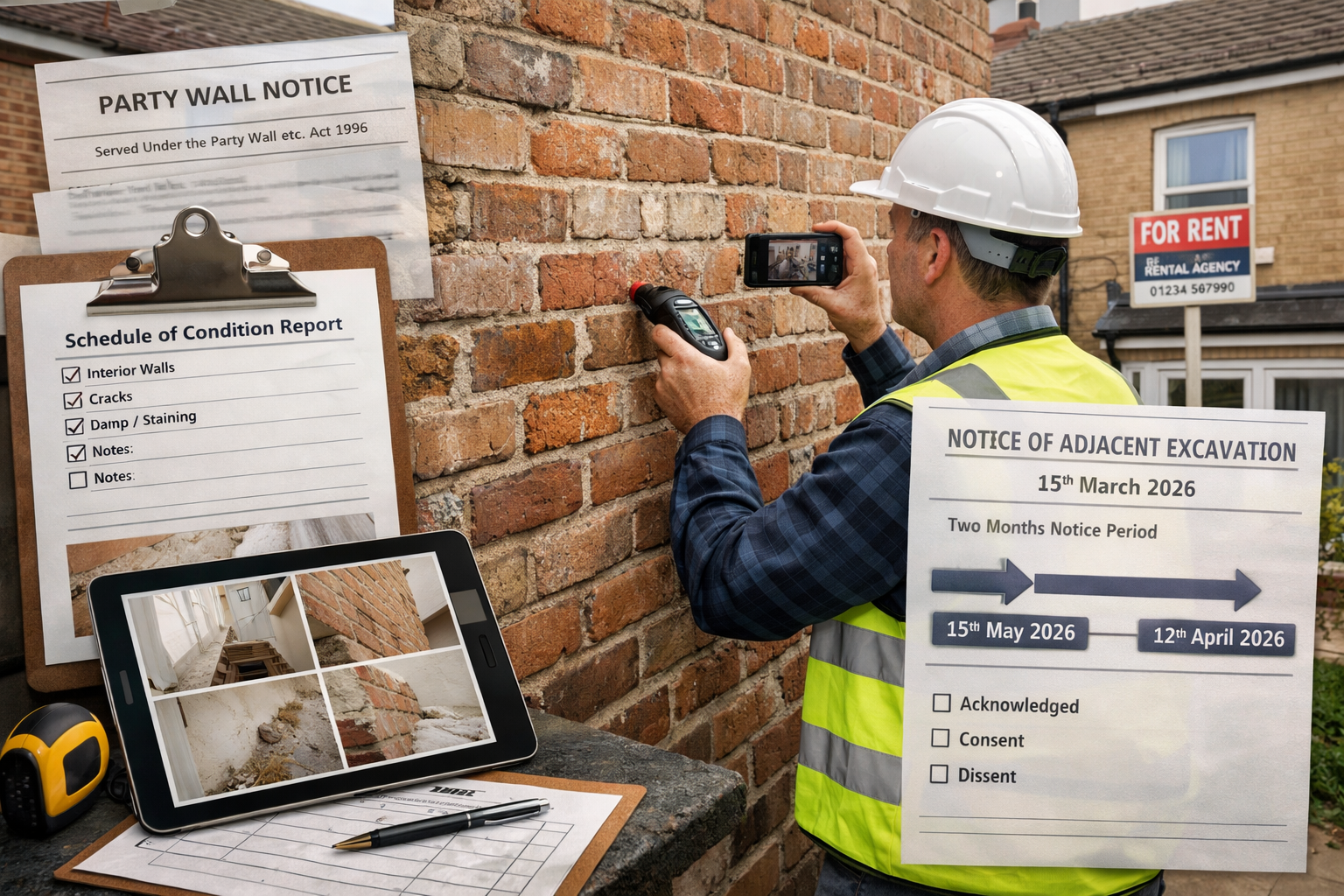
The Party Wall Act 1996 establishes specific notice periods that landlords must observe [3]:
| Type of Work | Notice Period | Neighbor Response Time |
|---|---|---|
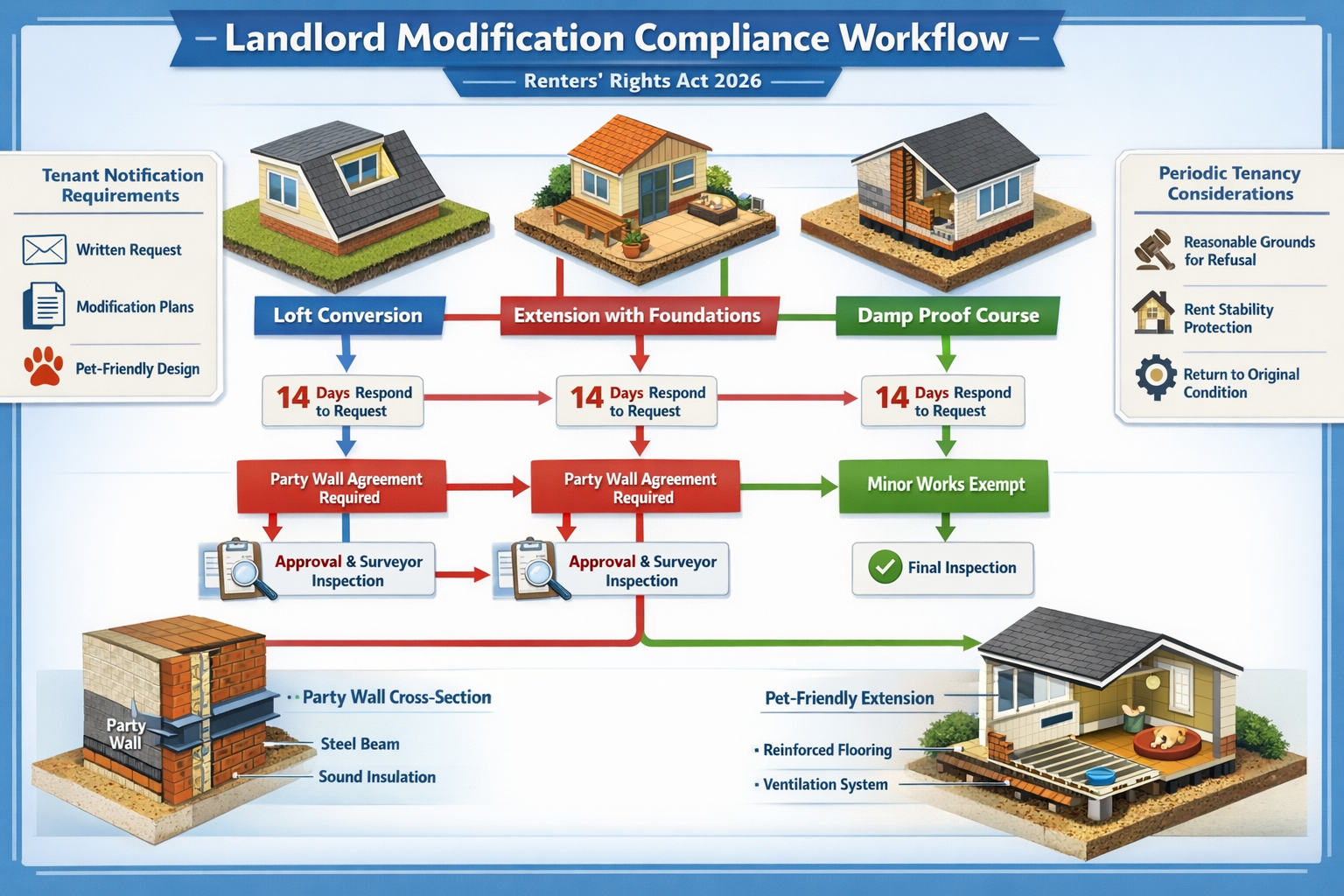
| Building works affecting party walls or boundaries | Two months | 14 days |
| Excavation work or new boundary walls | One month | 14 days |
| Minor internal works (plastering, electrical) | No notice required | N/A |
These timelines now intersect with tenant rights under periodic tenancies. Landlords cannot accelerate building schedules by removing tenants, making proper party wall agreement procedures more critical than ever.
Most Common Party Wall Works in Rental Properties
Understanding which modifications require party wall agreements helps landlords plan compliant projects. The most common party wall agreement needs include [3]:
🏗️ Loft conversions (affecting shared roof structures)
🏗️ Damp proof course insertion (penetrating party walls)
🏗️ New foundation digging (required for extensions)
🏗️ Structural alterations to shared walls
🏗️ Chimney breast removal affecting party walls
Conversely, minor works like plastering, electrical installations, or drilling internal walls do not require party wall agreements [3]. This distinction becomes crucial when landlords plan pet-friendly modifications that may or may not trigger formal surveyor involvement.
Managing Landlord Modifications and Pet-Friendly Extensions: Surveyor Strategies for Compliance
The Renters' Rights Act 2026 introduces a presumptive right for tenants to keep pets, with landlords required to provide reasonable justification for refusals. This provision creates new challenges when landlords plan extensions or modifications to accommodate pet-friendly rentals while complying with party wall requirements.
Pet-Friendly Extensions and Party Wall Considerations
Property surveyors now play a pivotal role helping landlords evaluate habitability standards and assess pet-friendly rental requirements under the framework taking effect May 1, 2026 [6]. When planning extensions that accommodate pets, landlords must address:
Structural Modifications:
- Reinforced flooring to handle increased wear from animals
- Enhanced ventilation systems to manage pet odors
- Soundproofing measures to prevent noise transmission through party walls
- Accessible outdoor spaces requiring foundation work near boundaries
Each of these modifications may trigger party wall notice requirements, necessitating coordination between structural surveyors and party wall specialists.
The Critical Role of Independent Party Wall Surveyors
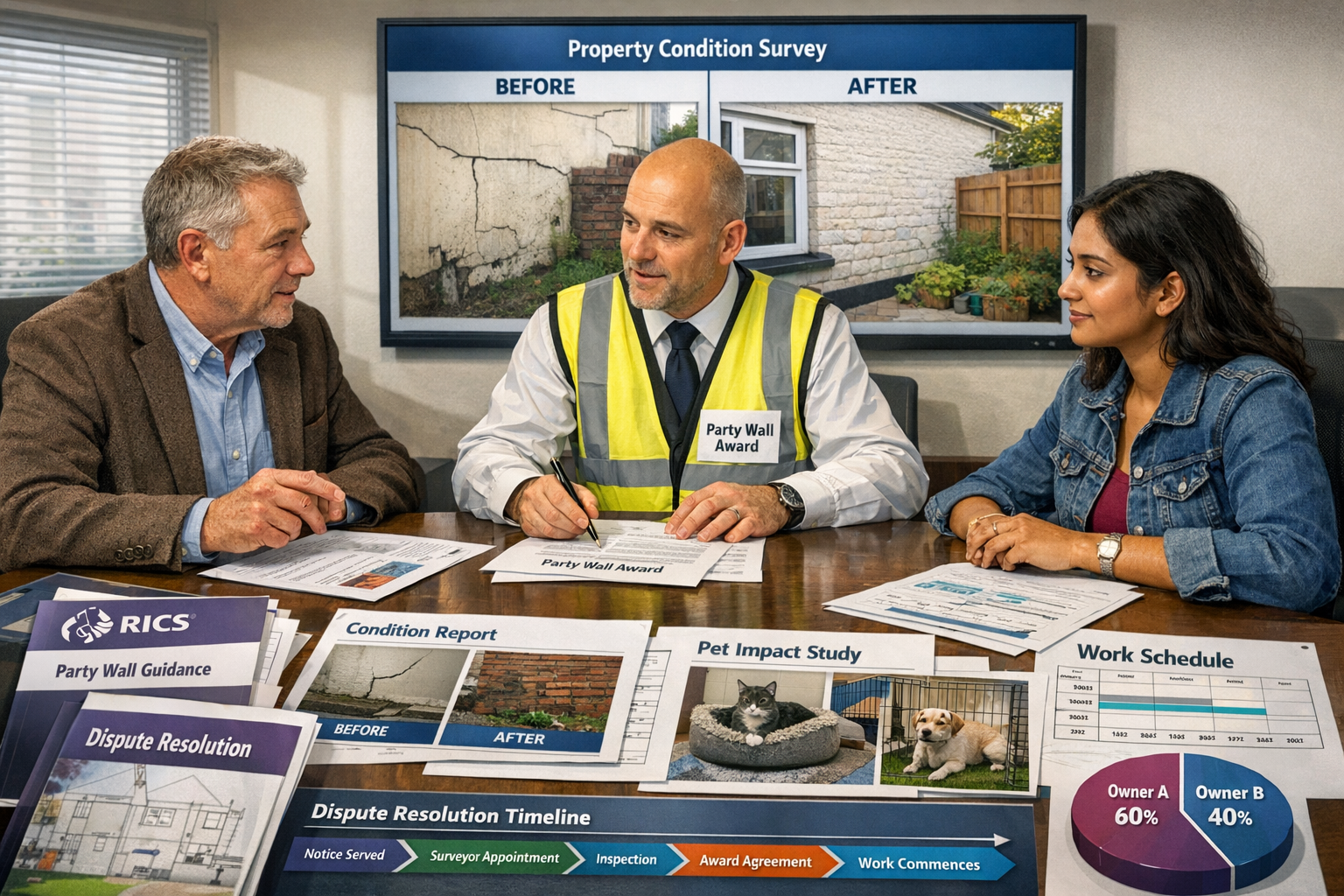
Agreed party wall surveyors must be independent and not the same surveyor used by the homeowner, ensuring neutrality in the assessment process [3]. This independence becomes especially important in rental property contexts where multiple stakeholder interests intersect:
- Landlord interests: Protecting property value and investment returns
- Tenant interests: Maintaining habitability and pet accommodation during works
- Neighboring property interests: Preventing structural damage and excessive disruption
Professional party wall surveyors coordinate these competing interests by:
- Conducting pre-work condition surveys to establish baseline documentation
- Preparing detailed party wall awards that specify work parameters and protections
- Monitoring construction progress to ensure compliance with agreed terms
- Resolving disputes through expert technical assessment rather than litigation
Schedule of Condition: The Foundation of Dispute Prevention
A schedule of condition (baseline documentation) is required before works begin, including pictures and noted conditions, to create a record preventing disputes about how building work affected neighboring properties [3]. This documentation has become exponentially more important under the Renters' Rights Act 2026 for several reasons:
📋 Tenant Protection: Tenants cannot be evicted to avoid documenting pre-existing conditions
📋 Liability Clarity: Clear records distinguish construction damage from wear-and-tear
📋 Pet Accommodation: Baseline conditions help assess whether pet-related modifications caused structural issues
📋 Dispute Resolution: Photographic evidence prevents costly disagreements about damage causation
Understanding dilapidations surveys provides valuable context for landlords managing rental properties through construction periods.
Cost Responsibilities Under the New Framework
One of the most frequently asked questions concerns who pays for party wall surveyors. The building owner (landlord) typically bears the cost of:
- Their own surveyor's fees
- The adjoining owner's surveyor's fees (if a separate surveyor is appointed)
- The agreed surveyor's fees (if both parties use the same surveyor)
- Any remedial work required due to construction damage
These costs cannot be passed to tenants through rent increases during the works, as periodic tenancies under the Renters' Rights Act 2026 include protections against retaliatory rent adjustments.
Party Wall Awards and Dispute Resolution in the 2026 Regulatory Environment
Understanding party wall awards becomes essential when landlords navigate the intersection of tenant rights and structural modifications. A party wall award is a legal document that sets out the details of proposed works, the rights and responsibilities of all parties, and the procedures for resolving disputes [1].
Components of a Comprehensive Party Wall Award
A properly drafted party wall award for rental property modifications should include:
1. Work Specifications
- Detailed description of all proposed modifications
- Construction methods and timelines
- Access arrangements for surveyors and contractors
- Tenant accommodation provisions during works
2. Condition Documentation
- Comprehensive schedule of condition for all affected properties
- Photographic evidence of pre-work status
- Specific notation of existing defects or damage
- Pet-related wear documentation (if applicable)
3. Protection Measures
- Structural support requirements during construction
- Noise and dust control protocols
- Working hours restrictions
- Emergency contact procedures
4. Dispute Resolution Procedures
- Surveyor inspection schedules
- Complaint escalation processes
- Remediation timelines for identified issues
- Cost allocation frameworks
Common Disputes and Prevention Strategies
The RICS (Royal Institution of Chartered Surveyors) launched a consultation on updated party wall guidance to help professionals work effectively under the Party Wall etc. Act 1996 in the evolving regulatory environment [5]. This guidance addresses common dispute scenarios:
Dispute Type 1: Construction Damage Claims
Prevention Strategy: Comprehensive baseline documentation with time-stamped photographs and detailed condition descriptions. Understanding the party wall process helps establish clear protocols before works begin.
Dispute Type 2: Excessive Disruption to Tenants
Prevention Strategy: Party wall awards that specify working hours, noise limits, and tenant notification requirements. Include provisions for temporary accommodation if disruption exceeds agreed thresholds.
Dispute Type 3: Pet Accommodation Conflicts
Prevention Strategy: Explicit provisions in party wall awards addressing how pet-friendly modifications will be managed, including temporary animal housing during high-noise construction phases.
Dispute Type 4: Boundary and Access Issues
Prevention Strategy: Clear documentation of access rights for surveyors and contractors, with specific provisions for rental properties where tenant consent is required for property entry.
When Party Wall Agreements Can Be Reached Without Surveyors
While professional surveyor involvement is recommended for most party wall matters, some situations allow for party wall agreements without surveyors. This typically occurs when:
- Works are minor and well-defined
- All parties have good relationships and clear communication
- No structural concerns exist
- Written agreements adequately document all terms
However, in rental property contexts under the Renters' Rights Act 2026, professional surveyor involvement provides valuable protection for all stakeholders and is strongly recommended.
Consequences of Proceeding Without Party Wall Agreements
Operating without a party wall agreement creates significant risks:
⚠️ Legal liability for any damage to neighboring properties
⚠️ Injunction risk that can halt construction mid-project
⚠️ Tenant complaints that may trigger local authority investigations
⚠️ Insurance complications if damage claims arise
⚠️ Reduced property value due to unresolved disputes
These risks are amplified in rental properties where tenants have enhanced protections under periodic tenancies and cannot be removed to facilitate construction.
Practical Implementation: Step-by-Step Guide for Landlords
Successfully managing Party Wall Surveys Under Renters' Rights Act 2026: Managing Landlord Modifications and Pet-Friendly Extensions requires systematic planning and execution.
Phase 1: Pre-Planning (3-6 Months Before Works)
Step 1: Determine Party Wall Requirements
Assess whether proposed modifications trigger party wall procedures by consulting when you need a party wall agreement. Consider:
- Will works affect shared walls, floors, or ceilings?
- Do excavations occur within three meters of neighboring foundations?
- Are new walls being built on boundary lines?
- Will structural alterations impact party structures?
Step 2: Engage Professional Surveyors
Retain qualified party wall surveyors early in the planning process. Verify surveyor credentials and ensure they understand both Party Wall Act requirements and Renters' Rights Act 2026 implications.
Step 3: Tenant Consultation
Unlike pre-2026 practices, landlords must now consult tenants about planned works, explaining:
- Nature and duration of modifications
- Expected disruption levels
- Pet accommodation provisions (if applicable)
- Tenant rights during construction
- Complaint and feedback mechanisms
Phase 2: Formal Notice Period (2-3 Months Before Works)
Step 4: Serve Party Wall Notices
Issue formal notices to adjoining owners according to statutory timelines:
- Two months for works affecting party walls or boundaries
- One month for excavation or new boundary walls
Notices must include detailed work descriptions, proposed timelines, and surveyor contact information.
Step 5: Facilitate Surveyor Appointments
Adjoining owners have 14 days to respond to party wall notices [3]. They may:
- Consent to the works (no surveyor needed)
- Dissent and appoint their own surveyor
- Agree to use the same surveyor as the building owner
Step 6: Commission Schedule of Condition
Independent surveyors prepare comprehensive baseline documentation for all affected properties, including:
- Detailed photographic records
- Structural condition assessments
- Existing defect documentation
- Pet-related wear notation (if relevant)
Phase 3: Party Wall Award Preparation (1-2 Months Before Works)
Step 7: Award Drafting
Surveyors prepare party wall awards specifying:
- Permitted work scope and methods
- Construction timelines and working hours
- Access arrangements and notice requirements
- Protection measures for neighboring properties
- Dispute resolution procedures
- Cost allocation frameworks
Step 8: Award Agreement and Distribution
All parties review and sign the party wall award. Copies are distributed to:
- Building owner (landlord)
- Adjoining owners
- Appointed surveyors
- Tenants (for information and reference)
- Contractors (for compliance guidance)
Phase 4: Construction and Monitoring
Step 9: Ongoing Surveyor Oversight
Surveyors conduct periodic inspections during construction to:
- Verify compliance with party wall award terms
- Address emerging concerns promptly
- Document any damage or deviations
- Facilitate communication between parties
Step 10: Post-Completion Assessment
After works conclude, surveyors conduct final inspections comparing post-construction conditions to baseline documentation. Any damage attributable to construction must be remediated at the building owner's expense.
Special Considerations for Pet-Friendly Extensions
When landlord modifications specifically aim to accommodate pet-friendly rentals, additional considerations arise:
Structural Requirements for Animal Accommodation
Pet-friendly extensions often require enhanced specifications:
- Flooring: Scratch-resistant and easy-to-clean surfaces
- Ventilation: Increased air circulation to manage odors
- Soundproofing: Enhanced acoustic insulation to contain pet noise
- Access: Pet-friendly doorways and outdoor connections
Each of these features may impact party wall considerations. For example, enhanced ventilation systems might require penetrations through party walls, triggering formal notice requirements.
Balancing Tenant Pet Rights with Neighbor Concerns
The Renters' Rights Act 2026 creates a presumptive right for tenants to keep pets, but this doesn't override party wall protections for neighboring properties. Landlords must:
- Assess noise transmission: Will pet-related sounds travel through party walls?
- Evaluate structural impacts: Could pet wear affect shared structures?
- Consider odor management: Are ventilation systems adequate?
- Plan outdoor spaces: Do pet access areas require boundary modifications?
Party wall awards should explicitly address how pet-friendly modifications will be managed to protect all stakeholders.
Insurance Considerations
Landlord insurance policies may require specific provisions for properties undergoing structural modifications. Ensure coverage addresses:
- Construction-related damage to party walls
- Pet-related wear and damage
- Tenant displacement costs if works exceed planned disruption
- Professional indemnity for surveyors and contractors
Regional Variations and Local Authority Requirements
While the Party Wall Act 1996 applies uniformly across England and Wales [1], local authority requirements may impose additional obligations on landlords undertaking modifications.
Planning Permission and Building Control
Many party wall works also require:
- Planning permission for extensions or significant alterations
- Building control approval for structural modifications
- Conservation area consent in designated historic districts
Coordinate party wall procedures with these parallel regulatory requirements to avoid delays.
London-Specific Considerations
Landlords operating in London face additional complexities due to:
- Higher property densities increasing party wall interactions
- More stringent noise and disruption regulations
- Greater prevalence of leasehold properties with additional restrictions
- Enhanced tenant protections in some boroughs
Party wall surveyors in London bring specialized knowledge of these local factors.
Cost Analysis and Budgeting
Understanding the full cost implications of Party Wall Surveys Under Renters' Rights Act 2026: Managing Landlord Modifications and Pet-Friendly Extensions helps landlords plan financially viable projects.
Typical Cost Components
| Cost Category | Estimated Range | Notes |
|---|---|---|
| Party wall surveyor fees | £700-£2,000+ | Varies by project complexity |
| Schedule of condition | £300-£800 | Per affected property |
| Party wall award preparation | £500-£1,500 | Included in some surveyor fees |
| Dispute resolution | £1,000-£5,000+ | If conflicts arise |
| Remedial works | Variable | Depends on damage extent |
These costs are in addition to construction expenses and cannot be recovered through tenant rent increases during works.
Return on Investment for Pet-Friendly Modifications
Despite upfront costs, pet-friendly extensions can deliver strong returns:
- Higher rental demand: 50%+ of UK households include pets
- Premium rents: Pet-friendly properties command 10-20% rent premiums
- Longer tenancies: Pet owners stay longer, reducing turnover costs
- Property value: Enhanced facilities increase resale value
Proper party wall compliance protects these investments by preventing disputes that could delay or derail projects.
Conclusion
Party Wall Surveys Under Renters' Rights Act 2026: Managing Landlord Modifications and Pet-Friendly Extensions represents a fundamental shift in how rental property improvements are planned and executed. The abolition of Section 21 evictions, combined with enhanced tenant rights and pet accommodation provisions, requires landlords to adopt more collaborative, tenant-centered approaches to structural modifications.
Key success factors include:
✅ Early engagement with qualified, independent party wall surveyors
✅ Comprehensive baseline documentation through detailed schedules of condition
✅ Transparent tenant communication throughout the planning and construction process
✅ Explicit party wall awards that address pet-friendly modification requirements
✅ Proactive dispute prevention through clear protocols and regular surveyor oversight
The intersection of party wall procedures and the Renters' Rights Act 2026 creates complexity, but also opportunity. Landlords who navigate these requirements effectively can deliver pet-friendly, high-quality rental properties that command premium rents while maintaining positive relationships with tenants and neighbors.
Actionable Next Steps
- Assess current portfolio: Identify properties where modifications could enhance pet-friendliness and rental value
- Consult qualified surveyors: Engage professionals who understand both party wall requirements and Renters' Rights Act implications
- Review insurance coverage: Ensure policies adequately cover construction and pet-related risks
- Develop tenant communication protocols: Establish clear processes for consulting tenants about planned works
- Create compliance checklists: Systematize party wall procedures to ensure consistent regulatory compliance
The regulatory landscape for rental property modifications has fundamentally changed as of May 1, 2026. Landlords who adapt their practices to this new reality—embracing professional surveyor guidance, comprehensive documentation, and tenant-centered planning—will be best positioned to deliver successful projects that enhance property value while maintaining full regulatory compliance.
For expert guidance on navigating party wall requirements in the Renters' Rights Act 2026 environment, consult with qualified chartered surveyors who specialize in rental property modifications and pet-friendly extensions.
References
[1] Buying Property Party Wall Award – https://osborneslaw.com/blog/buying-property-party-wall-award/
[2] Party Wall Surveys Under Renters Rights Act 2026 Protocols For Landlord Improvements Without Section 21 Evictions – https://nottinghillsurveyors.com/blog/party-wall-surveys-under-renters-rights-act-2026-protocols-for-landlord-improvements-without-section-21-evictions
[3] Party Wall Agreement – https://hoa.org.uk/advice/guides-for-homeowners/i-am-improving/party-wall-agreement/
[4] Changes For Property Lawyers To Expect In 2026 – https://broadfield-law.com/thought-leadership/changes-for-property-lawyers-to-expect-in-2026/
[5] Rics Launches Consultation On Party Wall Guidance – https://thenegotiator.co.uk/news/regulation-law-news/rics-launches-consultation-on-party-wall-guidance/
[6] Renters Rights Act 2026 Building Survey Implications For Pet Friendly Rentals And New Decent Homes Standards – https://nottinghillsurveyors.com/blog/renters-rights-act-2026-building-survey-implications-for-pet-friendly-rentals-and-new-decent-homes-standards
