
Institutional investors now control approximately 574,000 single-family rental homes across the UK, yet 68% of surveyed property managers admit confusion about party wall notice requirements under the 2026 Renters' Rights Act. This legislative shift has fundamentally transformed how large-scale landlords approach property modifications, placing tenant rights at the forefront of every structural decision. For surveyors navigating Party Wall Surveys for Institutional Buy-to-Let Expansions: Managing Notices Under 2026 Renters' Rights Act Compliance, understanding these new protocols isn't optional—it's essential for avoiding costly disputes and regulatory penalties.
The 2026 Renters' Rights Act has recalibrated party wall survey protocols to center tenant rights in all notices and procedures [2]. This means institutional landlords expanding their portfolios through conversions, extensions, or renovations must now navigate a more complex regulatory landscape. The Act's provisions on periodic tenancies, pet accommodations, and enhanced tenant challenge rights directly impact how party wall notices are served, documented, and executed.
Key Takeaways
- 🏢 Institutional landlords must integrate tenant notification protocols with traditional party wall procedures when planning expansions or modifications
- 📋 PRS Database registration requirements now intersect with party wall notice timelines, creating new compliance checkpoints for surveyors
- ⚖️ Enhanced tenant rights under the 2026 Act give occupants greater ability to challenge party wall works that affect their tenancy conditions
- 📅 Notice periods have been extended to accommodate tenant consultation requirements, adding 14-28 days to traditional party wall timelines
- 🔍 Survey documentation standards must now include tenant impact assessments and accommodation provisions during works
Understanding Party Wall Surveys for Institutional Buy-to-Let Expansions Under 2026 Compliance
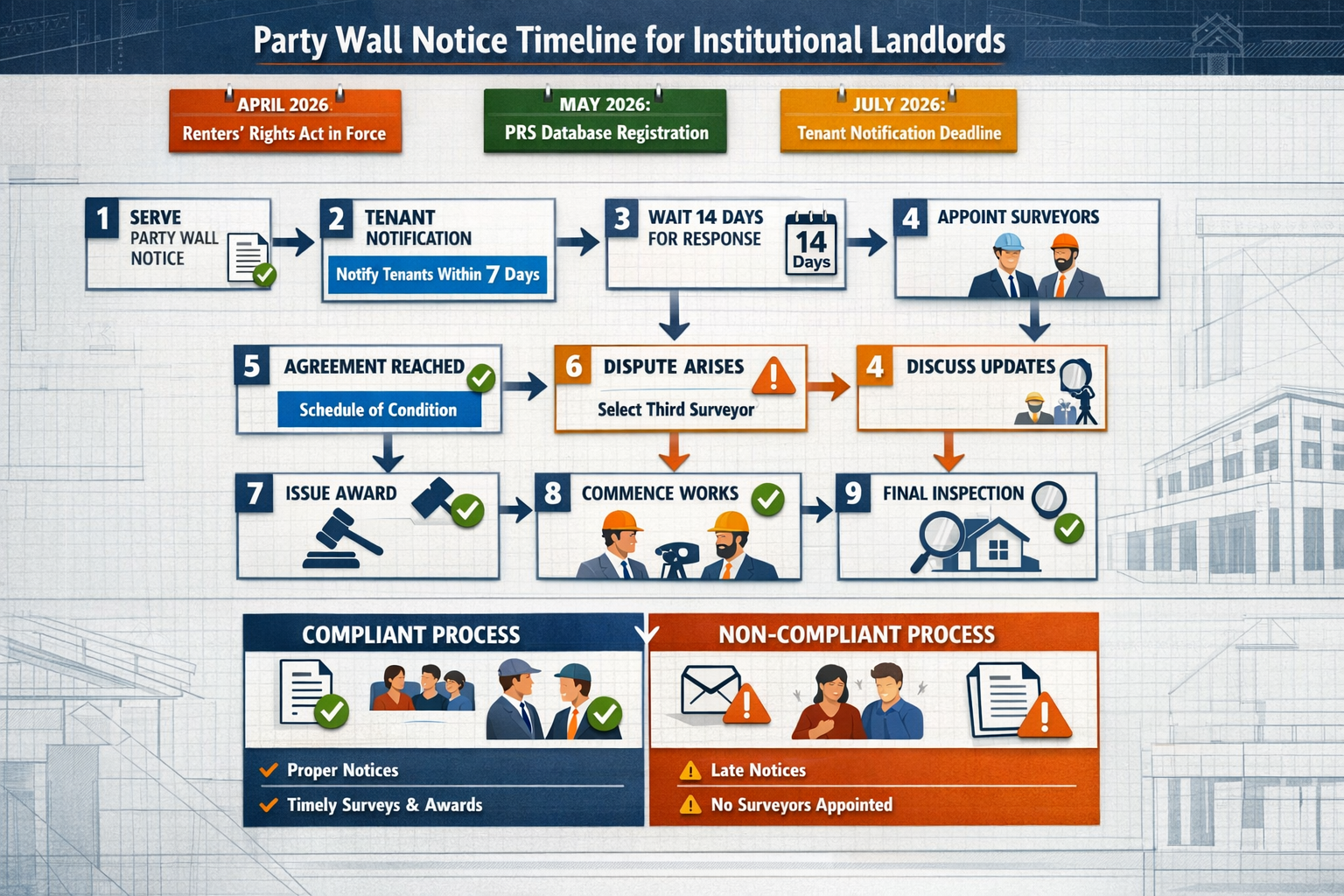
The intersection of party wall legislation and the Renters' Rights Act 2026 creates a dual compliance framework that institutional landlords must navigate. Traditional party wall procedures remain grounded in the Party Wall etc. Act 1996, but the 2026 legislation adds layers of tenant protection that fundamentally alter notice protocols.
The Dual Compliance Framework
Institutional buy-to-let operators face two parallel regulatory streams:
Traditional Party Wall Requirements:
- Notice to adjoining owners for excavations, new walls, or structural alterations
- Standard notice periods (1-2 months depending on work type)
- Surveyor appointment procedures
- Award documentation
2026 Renters' Rights Act Additions:
- Mandatory tenant notification regardless of ownership status
- Extended consultation periods for occupied units
- Pet accommodation considerations during works
- Periodic tenancy protection measures
- PRS Database compliance documentation [1]
The abolition of Section 21 "no-fault" evictions means landlords cannot simply remove tenants to facilitate party wall works [2]. This creates operational challenges for portfolio expansions that require vacant possession or significant disruption.
Key Changes for Institutional Landlords
| Compliance Area | Pre-2026 Practice | 2026 Requirements |
|---|---|---|
| Notice Period | 1-2 months to adjoining owners | Additional 14-28 days for tenant consultation |
| Tenant Rights | Limited input on landlord modifications | Right to challenge works affecting occupancy |
| Documentation | Party wall award only | Award + tenant impact assessment + PRS registration |
| Access Rights | Negotiated with owner | Must accommodate tenant schedules and pet provisions [4] |
| Dispute Resolution | Surveyor-led process | Dual track: surveyor + tenant tribunal rights |
PRS Database Integration Requirements
The Private Rented Sector Database now requires landlords to register party wall works that affect tenant units [1]. This creates a compliance checkpoint that surveyors must incorporate into their notice procedures:
✅ Registration triggers include:
- Extensions affecting tenant access or amenity
- Structural modifications impacting tenant safety
- Works requiring temporary relocation
- Alterations to shared facilities or utilities
Failure to properly register party wall works can result in penalties ranging from £5,000 to £30,000 per property, making surveyor awareness of these requirements critical.
Managing Party Wall Notices for Institutional Buy-to-Let Expansions: Practical Protocols
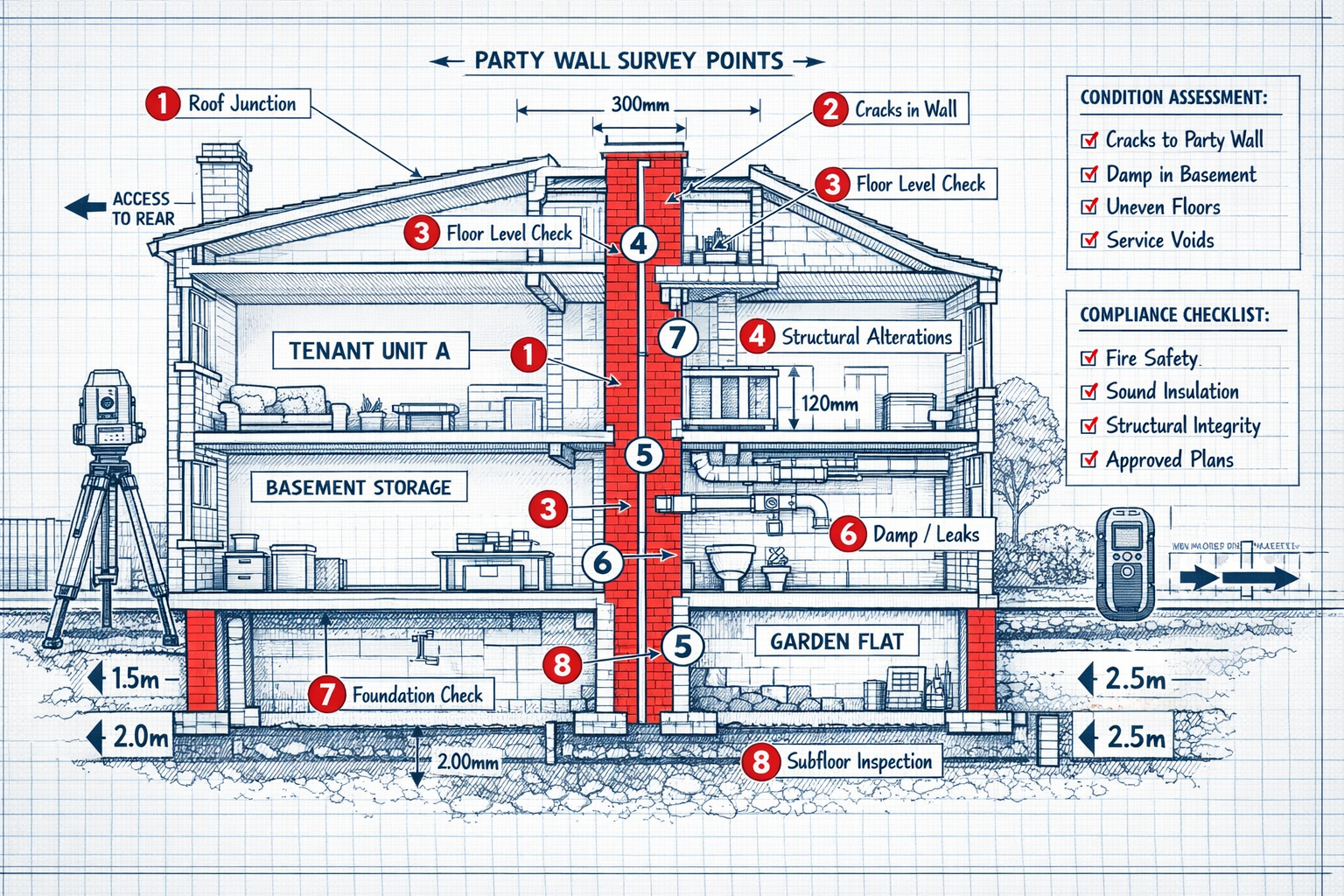
For surveyors advising institutional clients on portfolio expansions, the notice management process now requires a structured approach that integrates both party wall survey protocols and tenant rights compliance.
The Enhanced Notice Timeline
Phase 1: Pre-Notice Preparation (Weeks 1-2)
- Conduct preliminary building assessment
- Identify all affected parties (owners + tenants)
- Review tenancy agreements for pet provisions and access clauses
- Prepare tenant impact assessment documentation
- Verify PRS Database registration status
Phase 2: Formal Notice Service (Weeks 3-4)
- Serve traditional party wall notices to adjoining owners
- Simultaneously serve tenant notification documents
- Include plain-language explanations of works
- Provide accommodation provisions during construction
- Offer consultation meeting opportunities
Phase 3: Consultation Period (Weeks 5-8)
- Extended 28-day tenant consultation window [2]
- Address tenant concerns about pets, noise, access
- Negotiate temporary accommodation if required
- Document all tenant communications for PRS compliance
- Finalize surveyor appointments
Phase 4: Award and Execution (Weeks 9+)
- Prepare comprehensive party wall award
- Include tenant protection clauses
- Register works with PRS Database
- Commence construction with tenant liaison protocols
- Maintain ongoing compliance documentation
Tenant Notification Best Practices
The 2026 Act requires that tenants receive clear, accessible information about party wall works [4]. Surveyors should ensure institutional clients provide:
📝 Essential Notification Elements:
- Plain-language description of proposed works
- Expected duration and daily working hours
- Noise and disruption mitigation measures
- Pet safety protocols during construction
- Temporary accommodation provisions if applicable
- Contact information for concerns or complaints
- Rights to challenge works through proper channels
Handling Tenant Challenges and Disputes
Enhanced tenant rights mean that occupants can now challenge party wall works that they believe will adversely affect their tenancy conditions [1]. Surveyors must be prepared to address:
Common Tenant Objections:
- 🔊 Excessive noise affecting work-from-home arrangements
- 🐕 Pet safety concerns during construction
- 🚪 Access disruption to shared facilities
- 🏠 Structural safety during excavation or foundation work
- ⏰ Extended timelines affecting lease renewal decisions
When tenants raise legitimate concerns, surveyors should work with institutional landlords to implement reasonable accommodations. This might include adjusted working hours, enhanced dust control measures, or temporary relocation assistance.
Pet Accommodation Provisions
The 2026 Act's pet-friendly provisions create unique considerations for party wall works [4]. Institutional landlords must now:
- Ensure construction sites are securely fenced to prevent pet access
- Provide advance notice of loud or disruptive activities
- Offer temporary pet accommodation during high-risk phases
- Include pet safety clauses in party wall awards
- Document pet-related accommodations for PRS compliance
These requirements add complexity to traditional party wall procedures but are essential for maintaining compliance and avoiding tenant disputes.
Party Wall Surveys for Institutional Buy-to-Let Expansions: Documentation and Compliance Standards
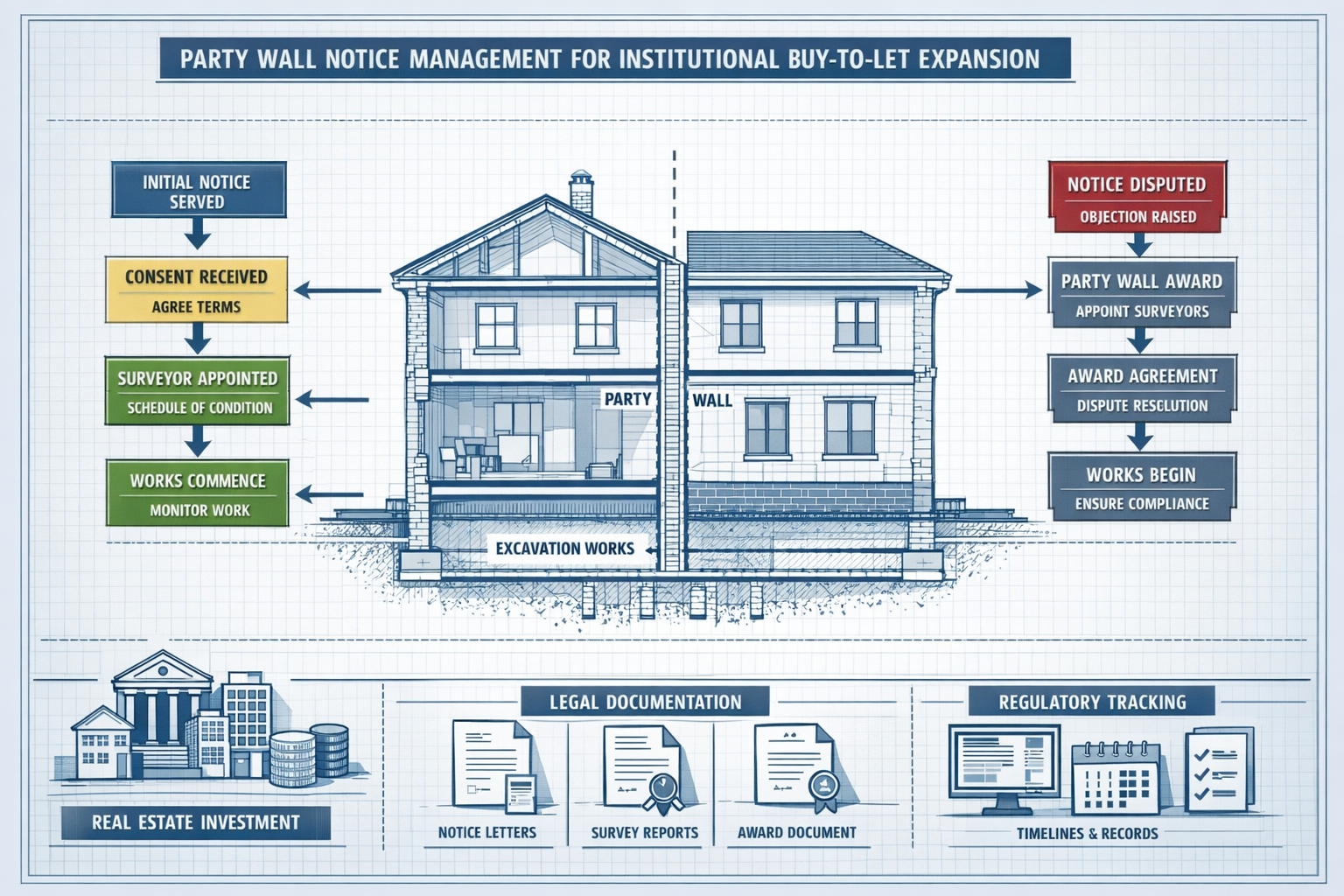
Proper documentation has always been central to party wall surveying, but the 2026 Renters' Rights Act introduces new standards that institutional landlords must meet to avoid regulatory penalties.
Comprehensive Party Wall Award Requirements
Modern party wall awards for institutional buy-to-let expansions must now include:
Traditional Award Components:
- Description of proposed works
- Rights of access and working hours
- Condition schedules for adjoining properties
- Dispute resolution procedures
- Surveyor fee arrangements
2026 Compliance Additions:
- Tenant impact assessment summary
- Pet accommodation provisions
- Temporary relocation protocols
- PRS Database registration confirmation
- Tenant consultation documentation
- Periodic tenancy protection clauses
PRS Database Compliance Documentation
Institutional landlords must maintain comprehensive records linking party wall works to their PRS Database entries [1]. Surveyors should ensure clients document:
📊 Required Records:
- Initial party wall notice dates and recipients
- Tenant notification evidence (emails, letters, meeting notes)
- Surveyor appointment confirmations
- Award execution dates and terms
- Construction commencement and completion dates
- Tenant accommodation provisions implemented
- Final condition assessments
This documentation serves dual purposes: demonstrating party wall compliance and satisfying PRS Database reporting requirements.
Section 8 Notice Considerations
While Section 21 evictions are abolished, landlords can still use Section 8 notices for legitimate grounds [1]. However, party wall works cannot be used as a pretext for Section 8 evictions based on property modification needs. Surveyors should advise clients that:
⚠️ Party wall works are NOT valid grounds for:
- Mandatory possession under Section 8
- Claiming property is required for landlord occupation
- Arguing tenant presence prevents necessary repairs
Instead, institutional landlords must work around existing tenancies, incorporating tenant rights into their expansion planning from the outset.
Record Retention and Audit Preparedness
Institutional portfolios face greater regulatory scrutiny than individual landlords. Surveyors should recommend clients maintain party wall documentation for:
- Minimum 6 years for general compliance purposes
- 12+ years for properties with structural modifications
- Indefinite retention for works involving foundation alterations or major structural changes
Digital documentation systems with searchable metadata help institutional landlords quickly retrieve party wall records during regulatory audits or tenant disputes.
Risk Mitigation Strategies for Institutional Landlords
The complexity of Party Wall Surveys for Institutional Buy-to-Let Expansions: Managing Notices Under 2026 Renters' Rights Act Compliance creates multiple risk vectors that institutional investors must address proactively.
Common Compliance Pitfalls
🚨 High-Risk Scenarios:
-
Inadequate Tenant Notification
- Risk: PRS Database penalties + tenant tribunal claims
- Mitigation: Implement dual-track notice systems with documented delivery confirmation
-
Insufficient Pet Provisions
- Risk: Tenant challenges under 2026 Act pet accommodation rights
- Mitigation: Include specific pet safety protocols in party wall awards [4]
-
Compressed Timelines
- Risk: Failing to allow proper consultation periods
- Mitigation: Add 4-6 weeks to traditional party wall schedules for tenant engagement
-
Poor Documentation
- Risk: Inability to demonstrate compliance during audits
- Mitigation: Implement centralized digital record systems with automated compliance tracking
-
Ignoring Periodic Tenancy Rights
- Risk: Tenant challenges based on occupancy disruption
- Mitigation: Negotiate temporary accommodation or work schedules that minimize tenant impact
Surveyor Selection for Institutional Portfolios
Institutional landlords should engage party wall surveyors with specific expertise in:
✅ Essential Qualifications:
- RICS accreditation with party wall specialism
- Experience with multi-unit residential properties
- Knowledge of 2026 Renters' Rights Act provisions
- Familiarity with PRS Database requirements
- Track record with institutional clients
- Understanding of tenant rights and accommodation protocols
Cost Implications and Budgeting
The enhanced compliance requirements add costs to party wall procedures:
| Cost Category | Traditional Range | 2026 Enhanced Range |
|---|---|---|
| Surveyor Fees | £700-£1,200 per property | £1,000-£1,800 per property |
| Notice Preparation | £200-£400 | £400-£700 (includes tenant documentation) |
| Consultation Process | Minimal | £500-£1,000 (meetings, accommodations) |
| Documentation Systems | £100-£300 | £500-£1,200 (PRS integration) |
| Contingency Reserve | 10% of works | 15-20% of works (tenant accommodations) |
Institutional landlords should budget an additional 25-40% above traditional party wall costs to ensure full compliance with 2026 requirements.
Strategic Considerations for Portfolio Expansion
Beyond immediate compliance, institutional investors must integrate party wall considerations into their broader portfolio strategy.
Acquisition Due Diligence
When acquiring properties for buy-to-let expansion, institutional investors should:
🔍 Pre-Acquisition Assessments:
- Review existing party wall agreements and awards
- Identify potential expansion opportunities requiring party wall works
- Assess tenant mix and lease terms for modification flexibility
- Evaluate neighboring property relationships and dispute history
- Calculate compliance costs into acquisition models
Properties with complex party wall situations or difficult tenant relationships may require adjusted valuations to account for expansion constraints.
Phased Development Approaches
Rather than attempting large-scale simultaneous modifications, institutional landlords should consider:
Sequential Development Strategy:
- Phase works by building or unit cluster
- Allow tenant consultation and accommodation between phases
- Build compliance track record with PRS Database
- Refine procedures based on early-phase learnings
- Maintain operational rental income during expansion
This approach reduces risk concentration and demonstrates good-faith compliance efforts to regulators and tenants.
Tenant Communication Programs
Proactive tenant engagement reduces disputes and facilitates smoother party wall procedures. Institutional landlords should establish:
📢 Ongoing Communication Channels:
- Quarterly portfolio newsletters explaining planned improvements
- Dedicated tenant liaison officers for construction concerns
- Digital portals for accessing party wall documentation
- Regular community meetings for multi-unit properties
- Feedback mechanisms for tenant suggestions and concerns
Tenants who feel informed and respected are less likely to challenge legitimate party wall works through formal dispute channels.
International Context: US Institutional Investment Restrictions
While this article focuses on UK compliance, it's worth noting parallel developments affecting institutional buy-to-let investors globally. The US Senate passed the 21st Century ROAD to Housing Act on March 12, 2026, which prohibits large institutional investors from purchasing single-family homes [6]. The legislation passed with an 89-10 vote and includes specific exceptions for newly constructed homes in build-to-rent or renovate-to-rent programs [3].
These restrictions reflect growing policy concerns about institutional capital's impact on housing affordability and availability. UK institutional investors should monitor whether similar restrictions might emerge domestically, potentially affecting portfolio expansion strategies and making existing holdings more valuable.
The US legislation defines "large institutional investors" as entities owning 75+ single-family rental homes [8]. UK policymakers have not proposed similar thresholds, but the 2026 Renters' Rights Act's enhanced compliance requirements effectively create operational barriers for institutional expansion.
Technology Solutions for Compliance Management
Modern institutional landlords increasingly rely on technology platforms to manage complex compliance requirements across large portfolios.
Digital Compliance Platforms
Specialized software solutions now offer:
💻 Key Features:
- Automated party wall notice generation and tracking
- Tenant notification workflows with delivery confirmation
- PRS Database integration and automated reporting
- Document repository with searchable metadata
- Compliance deadline alerts and escalation protocols
- Surveyor coordination and communication tools
- Cost tracking and budget management
Leading platforms include PropertyWise Compliance Suite, LandlordTech Pro, and RentalShield Portfolio Manager, with pricing typically ranging from £50-£200 per unit annually.
Data Analytics for Risk Assessment
Institutional investors can leverage data analytics to identify high-risk properties requiring enhanced party wall management:
📊 Predictive Indicators:
- Properties with previous party wall disputes
- Units with long-term tenants (higher challenge likelihood)
- Buildings with complex structural relationships
- Neighborhoods with active tenant advocacy groups
- Properties requiring extensive modification for portfolio standardization
By identifying high-risk properties early, institutional landlords can allocate additional resources and engage specialist surveyors proactively.
Working with Professional Advisors
The complexity of Party Wall Surveys for Institutional Buy-to-Let Expansions: Managing Notices Under 2026 Renters' Rights Act Compliance necessitates a multi-disciplinary advisory team.
Essential Professional Relationships
Institutional landlords should maintain relationships with:
Core Advisory Team:
- 🏗️ Party Wall Surveyors: RICS-accredited specialists with institutional experience
- ⚖️ Property Solicitors: Experts in landlord-tenant law and 2026 Act compliance
- 📋 Compliance Consultants: PRS Database specialists and regulatory advisors
- 🏢 Property Managers: On-ground tenant liaison and communication professionals
- 🔨 Contractors: Builders experienced with occupied property modifications
Regular coordination meetings between these advisors ensure consistent approaches across portfolio properties and reduce compliance gaps.
Surveyor Engagement Models
Institutional landlords typically use one of three engagement approaches:
- Retained Surveyor Model: Annual retainer for portfolio-wide party wall services
- Project-Based Engagement: Individual appointments for specific expansion projects
- Hybrid Approach: Retained advisory services with project-specific execution fees
The retained model offers cost predictability and relationship continuity, while project-based engagement provides flexibility for variable expansion timelines.
Future Outlook: Evolving Compliance Landscape
The regulatory environment for institutional buy-to-let continues to evolve. Surveyors and landlords should anticipate:
Potential Regulatory Developments
🔮 Likely Changes (2027-2030):
- Enhanced PRS Database reporting requirements
- Standardized party wall notice templates for tenanted properties
- Mandatory tenant liaison officer requirements for institutional portfolios
- Expanded grounds for tenant challenges to party wall works
- Integration with building safety and energy efficiency regulations
Institutional investors should build compliance systems with flexibility to adapt to these evolving requirements.
Industry Best Practices Evolution
Professional bodies including RICS are developing updated guidance for party wall surveyors working with institutional clients. Expected guidance areas include:
- Standardized tenant impact assessment frameworks
- Model party wall award clauses for 2026 Act compliance
- Continuing professional development on tenant rights
- Ethical guidelines for balancing owner and tenant interests
Surveyors should engage with these professional development opportunities to maintain expertise in this rapidly evolving area.
Conclusion
Party Wall Surveys for Institutional Buy-to-Let Expansions: Managing Notices Under 2026 Renters' Rights Act Compliance represents a significant evolution in property management practice. The 2026 Renters' Rights Act has fundamentally shifted the balance toward tenant protection, requiring institutional landlords and their surveyors to adopt more comprehensive, tenant-centered approaches to party wall procedures.
Success in this new regulatory environment requires:
✅ Proactive planning with extended timelines accommodating tenant consultation
✅ Comprehensive documentation integrating party wall awards with PRS Database requirements
✅ Professional expertise from surveyors experienced in both traditional procedures and tenant rights
✅ Technology adoption for compliance tracking across large portfolios
✅ Tenant engagement through transparent communication and reasonable accommodations
Institutional investors who view these requirements as burdensome obstacles will struggle with compliance costs and tenant disputes. Those who embrace tenant-centered approaches as portfolio management best practices will build stronger tenant relationships, reduce turnover, and create more sustainable long-term returns.
Actionable Next Steps
For institutional landlords planning buy-to-let expansions:
- Audit current party wall procedures against 2026 Act requirements
- Engage specialist surveyors with institutional and tenant rights expertise
- Implement digital compliance systems for portfolio-wide tracking
- Review tenant communication protocols and enhance engagement programs
- Build extended timelines into expansion project planning (add 4-6 weeks)
- Establish professional advisory teams coordinating legal, surveying, and property management expertise
- Monitor regulatory developments and participate in industry consultation processes
For surveyors advising institutional clients:
- Develop 2026 Act expertise through professional development programs
- Create standardized templates for tenant impact assessments and enhanced awards
- Build relationships with property solicitors and compliance specialists
- Invest in technology for efficient notice management and documentation
- Establish clear fee structures reflecting enhanced compliance requirements
- Join professional networks focused on institutional property management
The intersection of party wall law and tenant rights creates complexity, but also opportunity for professionals who develop specialized expertise. As institutional investment in buy-to-let continues to grow, demand for surveyors who can navigate this compliance landscape will increase correspondingly.
By prioritizing tenant rights alongside traditional party wall procedures, the industry can deliver portfolio expansions that protect all stakeholders—building owners, adjoining owners, and the tenants whose homes are affected by construction works. This balanced approach represents the future of professional party wall surveying in the institutional buy-to-let sector.
References
[1] Party Wall Implications Of Renters Rights Act 2026 Survey Protocols For Prs Database And Section 8 Notice Compliance – https://nottinghillsurveyors.com/blog/party-wall-implications-of-renters-rights-act-2026-survey-protocols-for-prs-database-and-section-8-notice-compliance
[2] Party Wall Surveys Under Renters Rights Act 2026 Protocols For Landlord Improvements Without Section 21 Evictions – https://nottinghillsurveyors.com/blog/party-wall-surveys-under-renters-rights-act-2026-protocols-for-landlord-improvements-without-section-21-evictions
[3] The 21st Century Road To Housing Act Considerations For Large Institutional Investors – https://www.gtlaw.com/en/insights/2026/3/the-21st-century-road-to-housing-act-considerations-for-large-institutional-investors
[4] Party Wall Surveys Under Renters Rights Act 2026 Managing Landlord Modifications And Pet Friendly Extensions – https://nottinghillsurveyors.com/blog/party-wall-surveys-under-renters-rights-act-2026-managing-landlord-modifications-and-pet-friendly-extensions
[6] Us Senate Advances Housing Legislation That Includes A Ban On Institutional Investors Purchasing Single Family Homes – https://www.mayerbrown.com/en/insights/publications/2026/03/us-senate-advances-housing-legislation-that-includes-a-ban-on-institutional-investors-purchasing-single-family-homes
[8] Senate Pushes Forward Bill Impacting Large Institutional Investors In The Single Family Housing Market – https://www.mondaq.com/unitedstates/landlord-tenant-leases/1771018/senate-pushes-forward-bill-impacting-large-institutional-investors-in-the-single-family-housing-market
