
Starting 1 May 2026, landlords conducting party wall works on rental properties face a fundamentally altered legal landscape where traditional eviction routes vanish and tenant protections intersect with structural survey obligations in unprecedented ways. The Party Wall Implications of Renters' Rights Act 2026: Survey Protocols for PRS Database and Section 8 Notice Compliance create a complex regulatory framework that demands surveyors and property owners rethink how they draft awards, schedule inspections, and document building works affecting tenanted properties.[1]
The convergence of the Renters' Rights Act 2026 with established Party Wall Act 1996 procedures introduces critical compliance challenges for surveyors navigating shared-wall construction projects in the private rental sector. With Section 21 "no-fault evictions" abolished and all tenancies converting to periodic arrangements, party wall surveyors must now integrate tenant notification protocols, database registration requirements, and stricter Section 8 grounds into their standard survey procedures.
Key Takeaways
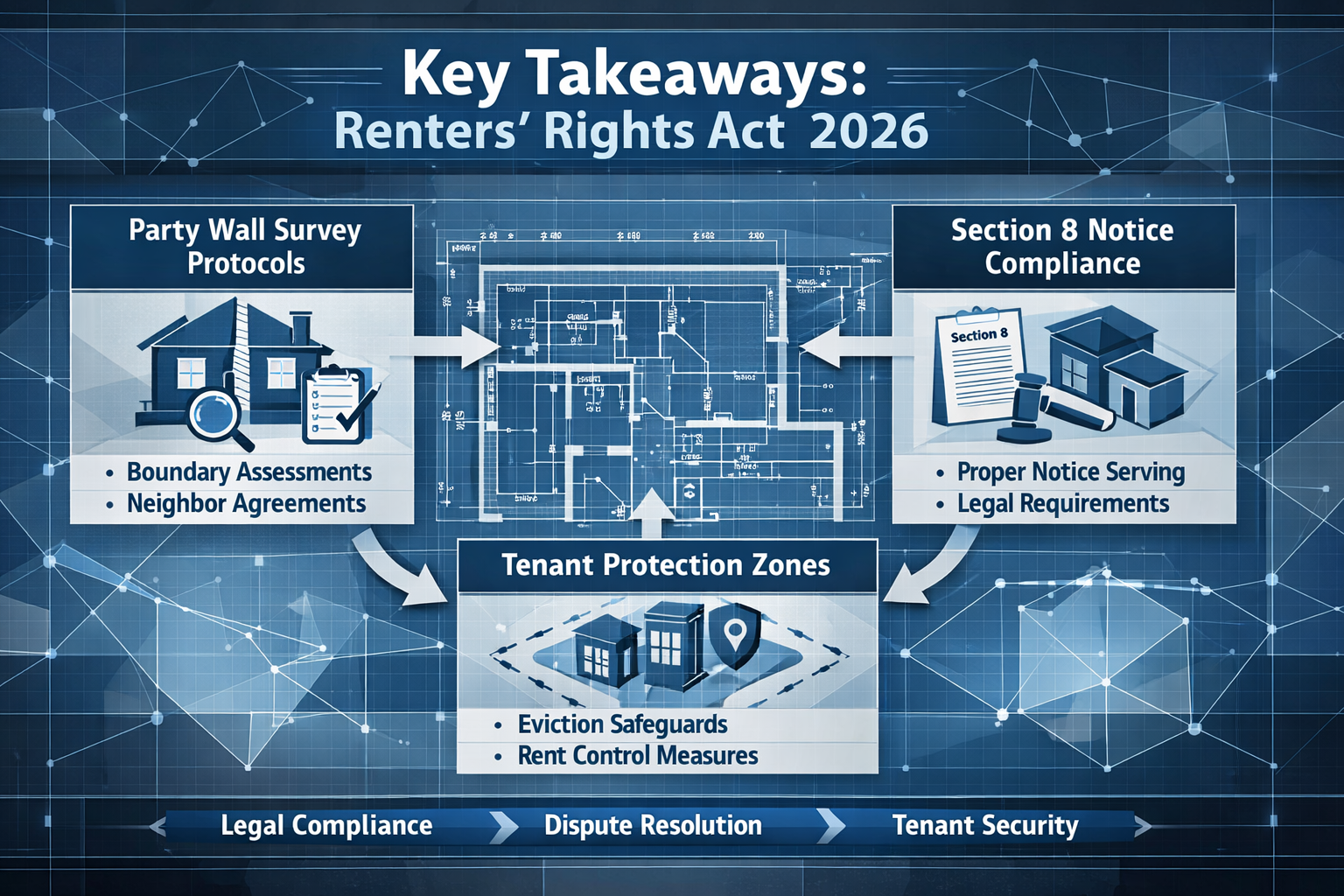
- Section 21 abolition from 1 May 2026 eliminates no-fault evictions, requiring landlords to use Section 8 grounds exclusively, which affects timing and feasibility of party wall works in rental properties[1]
- All fixed-term tenancies convert to periodic monthly arrangements, creating indefinite occupancy that complicates access arrangements for party wall surveys and construction schedules[4]
- Party wall awards remain non-transferable between owners, meaning new landlords purchasing rental properties cannot rely on previous awards and must restart the party wall process[3]
- Mandatory PRS database registration (in later implementation phases) will require surveyors to verify landlord compliance before commencing party wall procedures[1]
- Penalties up to £40,000 apply for using invalid possession grounds, making accurate documentation of party wall work necessity critical for Section 8 Ground 6 (property sale) claims[1]
Understanding the Renters' Rights Act 2026 Framework and Party Wall Intersections
The Renters' Rights Act 2026 fundamentally reshapes the landlord-tenant relationship in England and Wales, with substantive provisions taking effect on 1 May 2026.[1] This legislation abolishes the controversial Section 21 "no-fault eviction" mechanism that previously allowed landlords to end assured shorthold tenancies without providing reasons. Under the new framework, landlords must rely exclusively on Section 8 grounds to regain possession—each requiring specific justification and evidence.
For party wall surveyors, this transformation creates immediate practical implications. When landlords need to conduct structural works affecting party walls—such as loft conversions, basement excavations, or party wall insulation installations—they can no longer simply issue Section 21 notices to clear properties before construction begins.
The Section 8 Ground 6 Complication
The most relevant Section 8 ground for party wall works is Ground 6: intention to sell the property. However, this ground now requires landlords to provide substantial evidence of genuine sale intent, not merely construction plans.[2] Surveyors must understand that claiming party wall works necessitate property sale requires:
- Documentary proof of marketing arrangements or estate agent instructions
- Credible timeline showing sale process initiation
- Legitimate connection between structural works and sale necessity
The government has introduced penalties ranging from £7,000 for minor breaches to £40,000 for serious offences such as knowingly using invalid possession grounds.[1] This creates significant liability risks for landlords who misrepresent party wall construction as sale-related when actually planning to continue renting.
Periodic Tenancy Conversion and Access Arrangements
From May 2026, all existing fixed-term tenancies automatically convert to periodic monthly tenancies that continue indefinitely until formally ended.[4] This eliminates the natural break point that landlords previously used to schedule disruptive construction works.
For party wall surveyors, this means:
✅ Survey scheduling must accommodate ongoing tenant occupation throughout construction phases
✅ Access protocols require more detailed negotiation and documentation in party wall awards
✅ Schedule of condition surveys must account for furnished, occupied properties rather than vacant units
✅ Noise and disruption clauses need enhanced specificity regarding tenant rights during works
The Act also increases tenant notice periods from one month to two months (unless parties agree otherwise), creating longer timelines between tenancy end and construction commencement.[4]
Party Wall Survey Protocols Under the PRS Database Registration System
While the Private Rental Sector (PRS) database implementation will occur in later phases beyond the initial May 2026 rollout, surveyors must prepare for how this registration system will intersect with party wall procedures.[1] The database aims to consolidate key information about rental properties, landlord compliance status, and property conditions—creating a centralized verification system for local authorities, tenants, and service providers.
Pre-Survey Database Verification Requirements
When the PRS database becomes operational, party wall surveyors will likely need to verify:
- Landlord registration status before accepting instructions
- Property compliance history including previous enforcement actions
- Outstanding tenant complaints related to property condition
- Existing party wall awards recorded against the property
This verification step protects surveyors from inadvertently facilitating works by non-compliant landlords who face potential prohibition from letting activities. According to our complete guide to party wall surveys, due diligence on property ownership and legal status forms a critical preliminary step—a requirement that intensifies under the new regulatory framework.
Integrating Database Reporting into Award Procedures
Party wall awards will need enhanced documentation protocols to align with PRS database reporting requirements. Surveyors should anticipate including:
Property Identification Details:
- PRS database registration number
- Landlord verification code
- Tenancy status confirmation
- Local authority jurisdiction
Tenant Notification Records:
- Evidence of tenant consultation regarding proposed works
- Tenant acknowledgment of party wall notice service
- Documented arrangements for access during construction
- Alternative accommodation provisions (if applicable)
Compliance Documentation:
- Building control approval references
- Planning permission details (where required)
- Insurance certificate numbers
- Contractor licensing verification
Schedule of Condition Enhanced Standards
The Party Wall Act 1996 requires a schedule of condition documenting the pre-work state of adjoining properties.[5] Under the Renters' Rights Act 2026 framework, these schedules gain additional importance as evidence in potential disputes about whether building works caused damage justifying Section 8 possession claims.
Enhanced schedule of condition protocols should include:
📋 Timestamped digital photography with metadata preservation for evidential weight
📋 Tenant-witnessed inspections with signed acknowledgment of property condition
📋 Detailed defect cataloging distinguishing pre-existing issues from potential work impacts
📋 Utility and service documentation recording water pressure, drainage function, and structural soundness
📋 Database submission confirmation once PRS portal integration becomes mandatory
These enhanced standards protect both landlords and tenants while providing surveyors with defensible documentation if disputes arise about work impacts on rental properties.
Drafting Party Wall Awards for Section 8 Notice Compliance and Tenant Protections
The abolition of Section 21 and strengthened tenant protections fundamentally alter how party wall surveyors should draft awards for rental properties. Traditional award language focused primarily on building owner rights and adjoining owner protections—but now must incorporate tenant interests and Section 8 compliance considerations.
Award Clauses Addressing Tenant Occupation
Modern party wall awards for rental properties should include specific provisions addressing:
Access and Notice Requirements:
- Minimum 72-hour advance notice for inspection visits
- Reasonable hours restrictions (typically 9am-5pm weekdays)
- Tenant consent protocols for internal access to rental units
- Emergency access procedures with tenant notification obligations
Disruption Mitigation Measures:
- Maximum noise levels during works (measured in decibels)
- Prohibited hours for high-impact activities
- Dust and debris control standards protecting tenant health
- Temporary facility provisions if utilities require disconnection
Compensation and Remedy Frameworks:
- Rent abatement formulas for significant disruption periods
- Damage repair timelines with tenant inspection rights
- Alternative accommodation standards if works render property uninhabitable
- Dispute resolution procedures involving tenant representation
These provisions protect surveyors from liability when landlords face Section 8 defense claims based on inadequate construction management affecting tenant quiet enjoyment.
Documenting Work Necessity for Ground 6 Claims
When landlords intend to use Section 8 Ground 6 (property sale) to regain possession before party wall works, surveyors play a crucial evidential role. The party wall award itself can provide supporting documentation demonstrating why works necessitate vacant possession, but must avoid language suggesting fabricated justifications.
Appropriate evidential language includes:
"The proposed basement excavation works extending 3 meters below ground level will require continuous access to the building owner's property for a period of approximately 14 weeks, with internal shoring installations affecting all habitable rooms. The scale and duration of works make continued residential occupation impractical and potentially unsafe."
Inappropriate language that creates liability risk:
❌ "The building owner requires vacant possession to facilitate property sale following completion of works."
The distinction matters because the first statement documents objective construction realities, while the second creates evidence of premeditated possession grounds that may prove invalid if sale plans change. For guidance on party wall surveyor responsibilities, maintaining professional neutrality while documenting factual necessity remains paramount.
Non-Transferability Considerations for Rental Property Transactions
The principle that party wall awards are non-transferable between owners creates particular complications in the rental sector.[3] When landlords sell rental properties with sitting tenants, new owners cannot rely on previous party wall awards and must restart the entire notice process if they wish to conduct structural works.
This creates a due diligence imperative for prospective landlord-purchasers:
🏠 Pre-purchase party wall searches identifying existing awards and ongoing works
🏠 Tenancy agreement review for clauses addressing construction disruption
🏠 Schedule of condition verification confirming current property state
🏠 Surveyor consultation regarding re-notification requirements and timelines
Surveyors advising landlord-purchasers should clearly explain that acquiring a property with an existing party wall award provides no legal rights to continue or rely upon that award. New notices under the Party Wall Act 1996 must be served, creating potential delays of 2-3 months before works can commence—a timeline that now extends further when coordinating with Section 8 notice requirements.
Practical Workflow Integration: Party Wall Procedures and Renters' Rights Compliance
For practicing surveyors, integrating Party Wall Implications of Renters' Rights Act 2026: Survey Protocols for PRS Database and Section 8 Notice Compliance requires systematic workflow adjustments. The following framework provides a practical implementation roadmap.
Phase 1: Initial Instruction and Verification (Weeks 1-2)
When accepting instructions for party wall works on rental properties:
Step 1: Landlord Status Verification
- Confirm landlord registration in PRS database (once operational)
- Review compliance history and enforcement actions
- Verify ownership documentation and legal capacity
- Check for outstanding tenant disputes or complaints
Step 2: Tenancy Status Assessment
- Obtain current tenancy agreements and terms
- Identify fixed-term conversion dates (post-May 2026)
- Review existing access and works clauses
- Assess tenant notification requirements
Step 3: Work Scope Documentation
- Detailed construction plans and specifications
- Building control and planning approvals
- Contractor credentials and insurance
- Timeline projections including disruption periods
This preliminary phase establishes the factual foundation for both party wall procedures and potential Section 8 compliance issues. Understanding who pays for a party wall surveyor becomes more complex when tenant interests require separate representation.
Phase 2: Notice Service and Tenant Consultation (Weeks 3-6)
The notice period under the Party Wall Act 1996 requires two months for excavation works and one month for other party wall works.[5] This timeline now overlaps with tenant notification obligations under the Renters' Rights Act 2026.
Parallel Notice Procedures:
| Party Wall Act Notice | Renters' Rights Consideration |
|---|---|
| Service on adjoining owner | Verify tenant occupancy in adjoining property |
| 14-day response period | Allow tenant consultation time with landlord |
| Surveyor appointment process | Consider tenant-appointed surveyor option |
| Award drafting commencement | Integrate tenant protection clauses |
Tenant Consultation Best Practices:
- Provide plain-language explanations of proposed works and impacts
- Offer in-person consultation meetings to address concerns
- Document all communications with timestamped records
- Establish ongoing communication channels for construction phase
Phase 3: Award Drafting with Enhanced Protections (Weeks 7-10)
Modern party wall awards for rental properties should follow this enhanced structure:
Section A: Standard Party Wall Provisions
- Property descriptions and ownership details
- Work scope and specifications
- Statutory rights and obligations
- Insurance and indemnity requirements
Section B: Tenant Protection Provisions ⭐
- Access protocols and notice requirements
- Disruption mitigation measures
- Compensation and remedy frameworks
- Dispute resolution procedures
Section C: Section 8 Compliance Documentation
- Work necessity statements
- Timeline and vacant possession requirements (if applicable)
- Alternative accommodation provisions
- Database reporting obligations
Section D: Schedule of Condition
- Pre-work property state documentation
- Tenant-witnessed inspection records
- Photographic evidence with metadata
- Baseline measurements and defect cataloging
This comprehensive structure provides legal protection for all parties while creating an evidential record supporting potential Section 8 proceedings if works genuinely necessitate possession.
Phase 4: Construction Monitoring and Compliance (Ongoing)
Once works commence, surveyors must maintain enhanced oversight ensuring both Party Wall Act compliance and tenant protection:
✔️ Regular inspection visits documenting work progress and impacts
✔️ Tenant liaison maintenance addressing concerns promptly
✔️ Disruption logging recording noise levels, access instances, and incidents
✔️ Photographic documentation tracking condition changes
✔️ Database updates (once PRS portal integration operational)
For complex projects involving party wall excavation, this monitoring phase becomes critical to preventing disputes that could trigger Section 8 defenses based on landlord breach of quiet enjoyment obligations.

Dispute Resolution and Section 8 Defense Considerations
The intersection of party wall procedures and strengthened tenant rights creates new dispute scenarios requiring careful navigation. Surveyors must understand how party wall disputes may affect or be affected by Section 8 possession proceedings.
Party Wall Disputes Triggered by Tenant Complaints
Under the Renters' Rights Act 2026, tenants gain enhanced ability to challenge landlord actions affecting their occupancy rights. When party wall works cause significant disruption, tenants may:
- File complaints with local authority enforcement alleging breach of tenancy obligations
- Withhold rent claiming constructive eviction or habitability issues
- Defend Section 8 possession claims by citing landlord breach of covenant
- Pursue damages claims for excessive disruption or property damage
These tenant actions can trigger party wall dispute resolution under the Party Wall Act 1996, which provides for:
- Third surveyor appointment when building owner and adjoining owner surveyors disagree
- Award challenges within 14 days of service
- County Court appeals on points of law
- Injunctive relief for unauthorized or dangerous works
For comprehensive guidance on resolving party wall disputes, understanding the interaction between statutory dispute mechanisms and tenancy law becomes essential.
Evidential Standards for Section 8 Proceedings
When landlords use Section 8 grounds to regain possession before party wall works, courts will scrutinize whether:
Ground 6 (Property Sale) Requirements:
- Evidence demonstrates genuine sale intention rather than pretext
- Timeline shows reasonable connection between works and sale necessity
- Party wall award documentation supports vacant possession requirement
- Landlord has no history of similar claims that proved unfounded
Ground 1 (Landlord Occupation) Requirements:
- Landlord requires property for personal residence or family member
- Works make dual occupation impractical during construction
- Notice given before tenancy commencement (for new tenancies)
- No evidence of pattern of similar claims on other properties
Party wall surveyors should avoid language in awards that appears to manufacture possession grounds. Instead, focus on objective documentation of work scope, duration, and access requirements that naturally demonstrate whether continued occupation remains feasible.
Cost Implications and Fee Structures
The enhanced complexity of Party Wall Implications of Renters' Rights Act 2026: Survey Protocols for PRS Database and Section 8 Notice Compliance affects surveyor fee structures. Traditional party wall surveyor costs must now account for:
- Extended consultation time with tenants and landlords
- Enhanced documentation requirements for database compliance
- Ongoing monitoring obligations during construction phases
- Dispute resolution involvement in tenancy-related proceedings
Standard fee arrangements typically place costs on the building owner (landlord), but tenant-protection provisions may require separate tenant representation with independent fee arrangements. This creates potential for three-surveyor scenarios even in straightforward party wall matters when tenant interests diverge from adjoining owner interests.
Regional Variations and Jurisdictional Considerations
While the Renters' Rights Act 2026 applies throughout England and Wales, the Party Wall Act 1996 similarly covers only these jurisdictions—not Scotland or Northern Ireland.[5] However, regional variations in enforcement approaches and local authority resources create practical differences in how these frameworks interact.
London and Urban High-Density Areas
In densely populated urban areas like London, party wall works in rental properties face particular scrutiny due to:
- Higher tenant density increasing notification and consultation requirements
- More active enforcement by well-resourced local authorities
- Greater tenant awareness of rights and complaint mechanisms
- Complex ownership structures with multiple freeholders and leaseholders
Surveyors practicing in Camden, Islington, or Fulham should anticipate more rigorous documentation standards and longer consultation timelines compared to less dense areas.
Regional Rental Market Variations
Different rental market characteristics affect party wall work feasibility:
High-Demand Markets:
- Landlords face greater pressure to maintain rental income during works
- Tenants have less negotiating power for disruption compensation
- Shorter vacancy periods if Section 8 possession obtained
- Higher property values justifying more extensive structural works
Lower-Demand Markets:
- Extended vacancy periods make timing less critical
- Tenants may have stronger negotiating position for work scheduling
- Lower renovation returns may discourage extensive party wall projects
- Simpler ownership structures with fewer stakeholders
Understanding these regional dynamics helps surveyors provide realistic advice about project feasibility and timeline expectations under the new regulatory framework.
Future Developments and Ongoing Compliance Obligations
The Renters' Rights Act 2026 implementation occurs in phases, with the 1 May 2026 date marking only the initial rollout.[1] Surveyors must prepare for additional requirements in subsequent phases, particularly regarding the PRS database system.
Anticipated Phase 2 Requirements (2027-2028)
Government guidance indicates future implementation phases will likely include:
PRS Database Full Rollout:
- Mandatory registration of all rental properties with detailed specifications
- Digital integration with party wall notice systems
- Automated compliance checking before works authorization
- Public access portal for tenant verification of landlord status
Enhanced Enforcement Mechanisms:
- Rent repayment orders for non-compliant landlords conducting works
- Selective licensing expansion in areas with high party wall activity
- Increased penalties for database non-compliance
- Criminal sanctions for serious or repeated violations
Tenant Rights Expansion:
- Mandatory compensation schemes for construction disruption
- Enhanced consultation requirements before works authorization
- Third-party dispute resolution services for party wall conflicts
- Legal aid expansion for tenant representation in possession proceedings
Professional Development Requirements
Surveyors must invest in ongoing professional development to maintain competence in this evolving regulatory landscape. Recommended areas for continuing education include:
📚 Landlord-tenant law fundamentals and recent case law
📚 Section 8 possession grounds and evidential requirements
📚 Database systems and digital compliance procedures
📚 Tenant consultation techniques and conflict resolution
📚 Enhanced documentation standards for regulatory compliance
Professional bodies like RICS (Royal Institution of Chartered Surveyors) will likely develop specialized guidance and certification programs addressing these intersecting regulatory frameworks.
Technology Integration Opportunities
The digital transformation of rental sector regulation creates opportunities for technology-enhanced party wall procedures:
Digital Notice Service:
- Electronic delivery with proof of receipt and timestamp verification
- Automated reminders for response deadlines
- Digital signature integration for award acceptance
- Cloud-based document repositories for multi-party access
Condition Survey Technology:
- 360-degree photography with immersive virtual tours
- Drone surveys for external wall and roof condition assessment
- Thermal imaging documenting pre-work building performance
- Laser measurement systems for precise dimensional records
Project Management Platforms:
- Integrated timelines coordinating party wall and tenancy notice periods
- Stakeholder communication portals for landlords, tenants, and contractors
- Automated compliance checking against regulatory requirements
- Real-time progress tracking with photographic documentation
These technological solutions can streamline compliance while improving documentation quality and stakeholder communication.
Conclusion
The Party Wall Implications of Renters' Rights Act 2026: Survey Protocols for PRS Database and Section 8 Notice Compliance represent a fundamental shift in how structural works proceed on rental properties in England and Wales. The abolition of Section 21 no-fault evictions, conversion of all tenancies to periodic arrangements, and introduction of the PRS database system create a complex regulatory environment where traditional party wall procedures must integrate with enhanced tenant protections.
For surveyors, these changes demand enhanced due diligence, more comprehensive award drafting, and ongoing monitoring obligations that extend beyond conventional party wall practice. The non-transferability of party wall awards gains particular significance in rental property transactions, while Section 8 compliance considerations affect how surveyors document work necessity and vacant possession requirements.
Actionable Next Steps for Surveyors and Landlords
Immediate Actions (Before May 2026):
- Review existing party wall procedures and identify gaps in tenant protection provisions
- Develop enhanced award templates incorporating Section 8 compliance documentation
- Establish database verification protocols for landlord status checking
- Update fee structures reflecting increased complexity and time requirements
- Invest in professional development covering landlord-tenant law fundamentals
Post-Implementation Actions (May 2026 Onwards):
- Verify landlord PRS database registration before accepting instructions
- Implement enhanced tenant consultation procedures for all rental property works
- Document work necessity with objective evidence supporting any possession claims
- Maintain detailed construction monitoring records protecting all stakeholder interests
- Stay informed about Phase 2 implementation and evolving regulatory requirements
Long-Term Strategic Considerations:
- Develop technology solutions streamlining compliance and documentation
- Build relationships with tenant advocacy organizations and legal advisors
- Participate in professional body initiatives shaping best practice guidance
- Consider specialization in rental sector party wall work as a niche practice area
- Monitor case law development as courts interpret the new regulatory framework
The intersection of party wall law and rental sector regulation creates both challenges and opportunities for surveyors willing to develop expertise in this complex area. By understanding the Party Wall Implications of Renters' Rights Act 2026: Survey Protocols for PRS Database and Section 8 Notice Compliance, professionals can provide enhanced value to clients while ensuring full regulatory compliance in an evolving legal landscape.
For specialized assistance navigating these complex requirements, consult with experienced chartered surveyors who understand both party wall procedures and rental sector regulations. The integration of these frameworks requires careful attention to detail, comprehensive documentation, and ongoing vigilance as implementation phases unfold throughout 2026 and beyond.
References
[1] Alerts Realestate Impacts Of The Renters Rights Act – https://www.goodwinlaw.com/en/insights/publications/2026/01/alerts-realestate-impacts-of-the-renters-rights-act
[2] Selling A Rental Property In 2026 How The New Renters Rights Bill Affects You – https://www.gorvinsresidential.com/selling-a-rental-property-in-2026-how-the-new-renters-rights-bill-affects-you/
[3] Buying Property Party Wall Award – https://osborneslaw.com/blog/buying-property-party-wall-award/
[4] Watch – https://www.youtube.com/watch?v=i0o26ggvr00
[5] Party Wall Agreement – https://hoa.org.uk/advice/guides-for-homeowners/i-am-improving/party-wall-agreement/
[6] Renters Rights Act 2026 Building Survey Implications For Pet Friendly Rentals And New Decent Homes Standards – https://nottinghillsurveyors.com/blog/renters-rights-act-2026-building-survey-implications-for-pet-friendly-rentals-and-new-decent-homes-standards
