
Only 14% of small claims litigants in England and Wales recover any expert witness costs — yet poorly scoped surveying evidence remains one of the most common reasons property disputes stall or escalate unnecessarily. For surveyors and property owners alike, understanding how to calibrate expert witness work to the size and nature of a dispute is not just good practice — it is increasingly a court requirement.
This guide explains how expert witness surveying in small claims and fast‑track property disputes: keeping evidence proportionate and cost‑effective works in practice — from scoping the right report to structuring fees that courts will actually allow.
Key Takeaways 📌
- Proportionality is a legal obligation, not just a courtesy — courts actively scrutinise expert costs against the value of the claim under CPR rules.
- Single Joint Experts (SJEs) are strongly preferred in lower-value tracks, cutting duplication and cost.
- Expert reports for sub-£10,000 claims should typically cost between £1,500 and £3,000 to remain recoverable [2].
- Plain language and focused scope make reports more persuasive and court-ready, not less authoritative.
- Alternative Dispute Resolution (ADR) — including expert determination — can resolve technical property disputes faster and cheaper than full litigation [4].
Understanding the Court Tracks: Where Expert Witness Surveying Fits
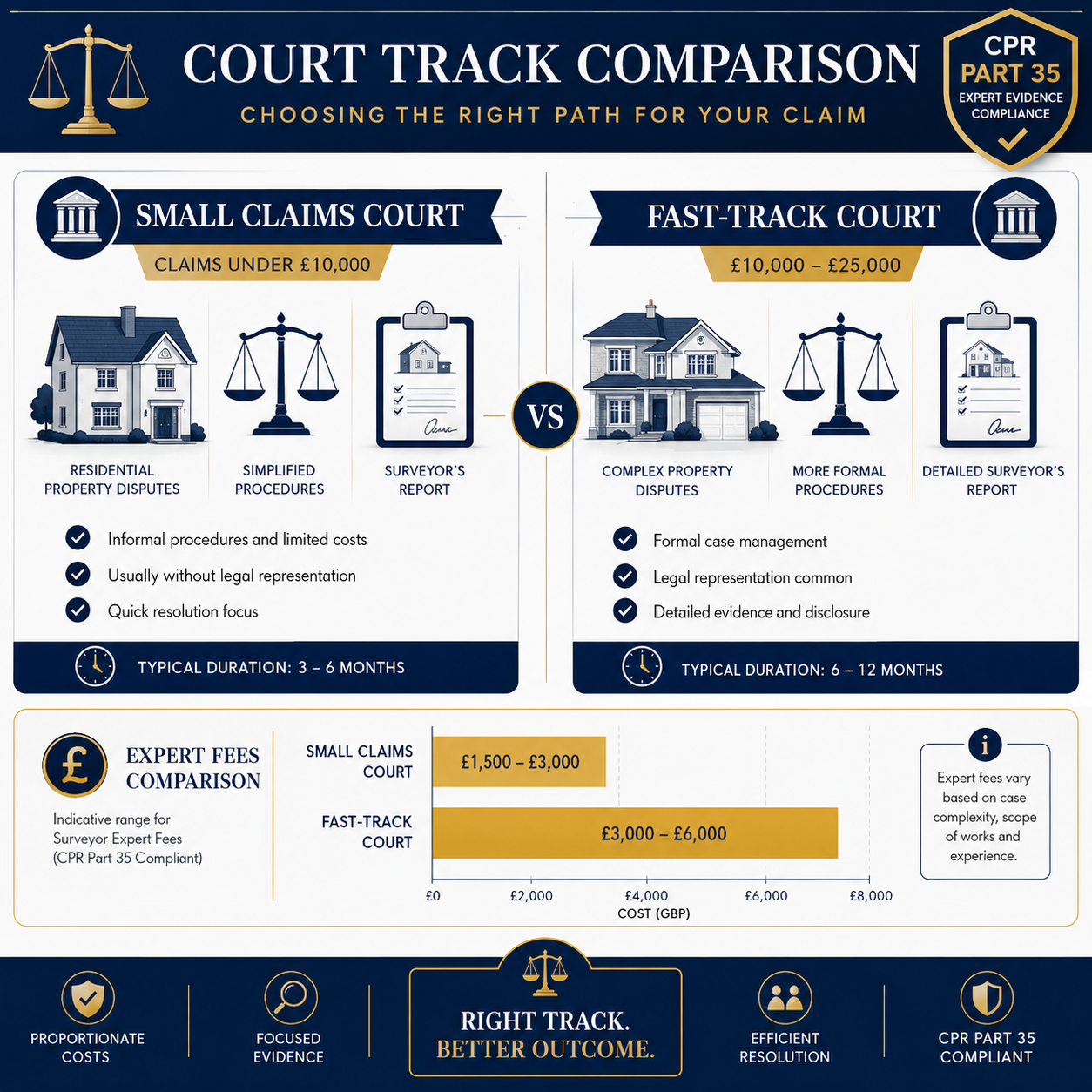
Before a surveyor accepts an instruction, it is essential to understand which litigation track governs the dispute. The three civil tracks in England and Wales each carry different expectations for expert evidence.
The Three Tracks at a Glance
| Track | Claim Value | Expert Evidence Approach |
|---|---|---|
| Small Claims | Up to £10,000 | Strictly limited; SJE strongly preferred |
| Fast-Track | £10,001–£25,000 | One expert per discipline; proportionate scope |
| Multi-Track | Over £25,000 | Full expert evidence permitted |
In small claims cases, cost recovery is limited to court fees, reasonable witness expenses, and necessary expert report costs [7]. This means a surveyor who produces a £6,000 report for a £8,000 boundary dispute is almost certainly producing irrecoverable costs — and may actively damage their client's position.
Fast-track cases allow slightly more latitude, but the Civil Procedure Rules (CPR) Part 35 still require that expert evidence is "reasonably required to resolve the proceedings" and that costs are proportionate to the sums at stake.
What Types of Property Disputes Land in These Tracks?
Common small claims and fast-track property matters include:
- 🏠 Boundary and encroachment disputes — garden fences, walls, and access paths
- 🔨 Neighbour damage claims — water ingress, subsidence, party wall damage
- 📋 Dilapidations disputes — end-of-tenancy condition disagreements
- 🏗️ Minor construction defects — snagging, incomplete works, defective materials
- 💧 Damp and drainage issues — cause and responsibility disputes
For expert witness surveyors, the challenge is delivering authoritative, court-compliant evidence within the tight cost envelope these tracks demand. For guidance on resolving neighbour-related property disputes more broadly, see this comprehensive guide to resolving party wall disputes.
The Core Principles of Proportionate Expert Witness Surveying in Small Claims and Fast‑Track Property Disputes
1. Scope the Report to the Question, Not the Property
The single biggest driver of disproportionate expert costs is over-scoping. A surveyor instructed to comment on a disputed boundary should not produce a full structural survey. The report must answer the specific question the court needs resolved — nothing more.
💬 "The duty of an expert is to help the court on matters within their expertise. That duty overrides any obligation to the person instructing them." — CPR Part 35.3
Practical scoping steps include:
- Agree a single, clearly worded instruction letter with the solicitor or litigant in person
- Define the specific issue (e.g., "Did the defendant's drainage works cause the claimant's subsidence?")
- Limit site inspection time to what is genuinely necessary
- Avoid commentary on issues outside the instruction
The RICS updated its Expert Witness Professional Statement in late 2025 to address exactly these risks, emphasising that impartiality and focused expertise — not volume of evidence — define a high-quality expert report [1].
2. Adopt Plain, Accessible Language
Courts in the small claims and fast-track tiers frequently involve litigants in person — people without legal representation. A report dense with technical jargon may be authoritative in a multi-track trial but actively unhelpful before a District Judge handling 12 cases in a morning.
Effective plain-language techniques include:
- Define every technical term on first use (e.g., "spalling — the flaking of brick or concrete surfaces")
- Use numbered paragraphs for easy cross-referencing
- Include a one-page executive summary at the front
- Attach annotated photographs with clear captions
- Avoid Latin legal phrases unless essential
Plain language does not weaken expert evidence. It strengthens it by making the surveyor's conclusions impossible to misread.
3. Comply Fully With CPR Part 35
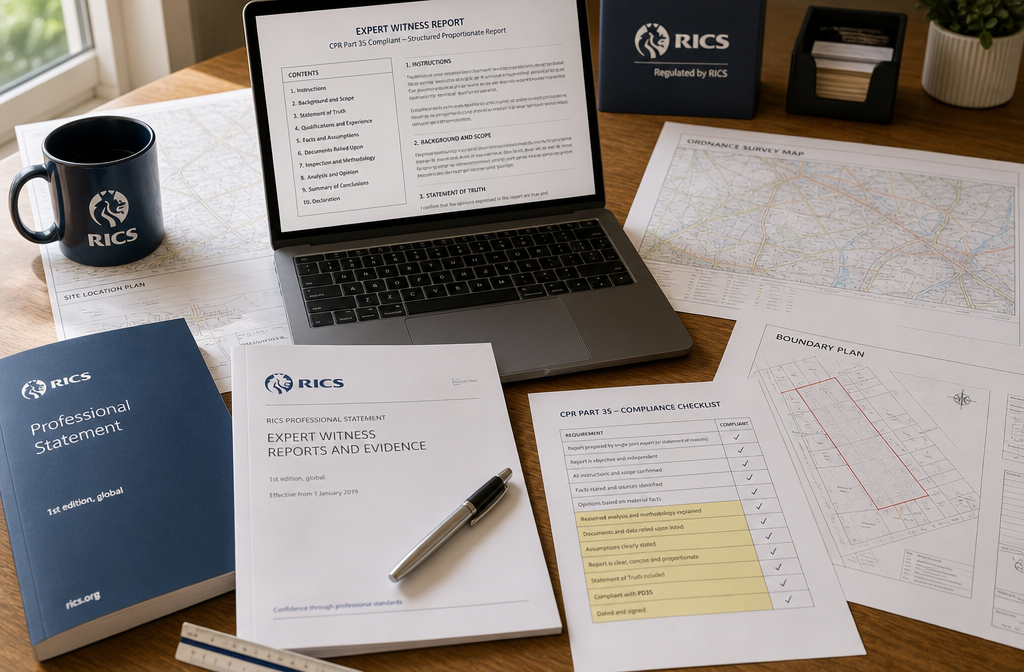
CPR Part 35 compliance is non-negotiable regardless of track. Every expert report must include:
- ✅ A statement that the expert understands their duty to the court
- ✅ A declaration that the report is the expert's own work
- ✅ Details of the expert's qualifications and experience
- ✅ A statement of facts and assumptions relied upon
- ✅ A summary of conclusions
- ✅ A statement of any limitations on the expert's opinion
For a detailed breakdown of what compliant expert witness reporting looks like in practice, the expert witness report service provides a useful reference point.
Failure to comply with CPR Part 35 — even in a small claims matter — can result in the report being excluded entirely, wasting both time and money [8].
4. Structure Fees Transparently
Courts and opposing parties scrutinise expert fees closely in lower-value disputes. For disputes under £10,000, reasonable expert costs typically range from £1,500 to £3,000 [2]. For fast-track matters up to £25,000, fees between £2,500 and £5,000 are generally considered proportionate, depending on complexity.
Fee structuring best practice:
| Service Element | Typical Cost Range |
|---|---|
| Document review and instruction | £200–£400 |
| Single site inspection (half-day) | £400–£700 |
| Report drafting and CPR compliance check | £600–£1,200 |
| Expert discussions / joint statement | £200–£500 |
| Attendance at hearing (if required) | £500–£1,500/day |
Surveyors should provide a written fee estimate before instruction and flag immediately if the scope expands. Surprise invoices are a frequent source of complaints and can undermine the expert's credibility.
Single Joint Experts, ADR, and Smarter Dispute Resolution
The Case for Single Joint Experts (SJEs)
The appointment of a Single Joint Expert — one surveyor instructed by both parties — is actively encouraged by courts in small claims and fast-track cases [3]. The advantages are significant:
- Halves expert costs for both parties combined
- Removes adversarial bias from technical evidence
- Speeds up proceedings by eliminating expert-versus-expert disputes
- Increases settlement prospects when both parties receive the same neutral opinion
The SJE model works best in relatively straightforward technical disputes: a single boundary point, a specific defect, or a discrete valuation question. Where the dispute involves multiple competing technical issues, separate experts may still be justified — but this requires court permission.
When acting as an SJE, the surveyor must be especially careful to communicate with both parties equally, keep records of all correspondence, and avoid giving one party an advantage in how the instruction is framed. The expert witness services page outlines how this role is managed in practice.
Expert Discussions: Keeping Them Proportionate
Where separate experts are appointed, CPR Part 35 and the Protocol for the Instruction of Experts require them to hold a without-prejudice discussion to identify agreed and disputed points [10]. In small claims and fast-track cases, these discussions should be:
- Conducted by telephone or written correspondence rather than in-person meetings
- Focused on a narrow agenda agreed in advance
- Documented in a joint statement that is concise and specific
This approach keeps the process efficient without sacrificing the rigour that courts expect.
Alternative Dispute Resolution: A Faster Route
For many lower-value property disputes, Alternative Dispute Resolution (ADR) — particularly expert determination — offers a faster and cheaper resolution than litigation [4]. In expert determination:
- The parties appoint an independent expert (often a chartered surveyor)
- The expert's decision is binding on both parties
- The process typically completes in weeks rather than months
- Costs are shared and usually significantly lower than court proceedings
ADR is particularly effective for boundary disputes, dilapidations, and service charge disagreements. Courts in 2026 are increasingly directing parties to consider ADR before proceeding to trial, and a failure to engage with ADR can result in adverse costs orders even for winning parties.
For disputes involving party wall matters specifically, understanding what a party wall dispute involves can help determine whether ADR or formal expert witness evidence is the more appropriate route.

Boundary Disputes: A Specialist Area
Boundary disputes represent one of the most common categories of small claims and fast-track property litigation. Expert witnesses in this area must be able to interpret:
- Historical title deeds and conveyancing plans
- Ordnance Survey mapping and its limitations
- Land Registry filed plans (which are indicative, not definitive)
- Physical features on the ground and their historical context [6]
A proportionate boundary dispute report for a small claims matter might run to 8–12 pages, with annotated plans, rather than the 40-page documents sometimes produced for multi-track litigation. The key is to answer the question precisely — not to demonstrate the full breadth of the surveyor's knowledge.
Practical Checklist: Delivering Proportionate Expert Witness Evidence
Before accepting an instruction in a small claims or fast-track matter, surveyors should work through the following:
📋 Pre-Instruction Checks
- Confirm which track the claim is allocated or likely to be allocated to
- Identify the specific question(s) the court needs answered
- Check for conflicts of interest with either party
- Agree a written fee estimate proportionate to the claim value
- Confirm whether a Single Joint Expert appointment is appropriate
📋 During the Instruction
- Limit the site inspection to issues within the instruction
- Photograph and document only what is relevant
- Note any limitations on access or information
- Maintain equal communication if acting as SJE
📋 Report Drafting
- Include all mandatory CPR Part 35 declarations
- Write a plain-language executive summary
- Use numbered paragraphs and annotated photographs
- Ensure conclusions are clearly stated and directly address the instruction
- Keep the report concise — aim for quality over quantity
📋 Post-Report
- Be available for expert discussions within a reasonable timeframe
- Produce a joint statement that is focused and proportionate
- Attend hearings only if the court specifically requires oral evidence
For a broader understanding of how different survey types and their costs compare, the guide to comparing different types of survey provides useful context. And for those navigating the cost implications of expert evidence in neighbour disputes, the full structural survey cost guide helps set realistic expectations.
Common Mistakes That Undermine Proportionate Expert Evidence
Even experienced surveyors can fall into traps that make their evidence less effective — or outright inadmissible — in lower-value disputes.
❌ Mistake 1: Producing a multi-track report for a small claims case
A 50-page report with extensive appendices signals to the court that the expert has not understood the proportionality requirement. It also generates costs that cannot be recovered.
❌ Mistake 2: Expressing opinions outside the area of instruction
If instructed on drainage, do not comment on structural defects. Courts treat scope creep as a sign of bias or poor professional judgment.
❌ Mistake 3: Using partisan language
Phrases like "the defendant clearly caused" or "it is obvious that" undermine the expert's appearance of impartiality. Use measured language: "the evidence suggests," "in my opinion," "on the balance of probabilities."
❌ Mistake 4: Failing to disclose limitations
If the expert could not access a particular area, or if key documents were unavailable, this must be stated clearly. Omitting limitations creates vulnerability under cross-examination.
❌ Mistake 5: Ignoring the RICS Professional Statement
The RICS Expert Witness Professional Statement — currently under revision as of late 2025 [1] — sets minimum standards for all RICS members acting in this capacity. Non-compliance exposes the surveyor to disciplinary risk as well as legal challenge.
Conclusion: Proportionate Evidence Is Powerful Evidence
The goal of expert witness surveying in small claims and fast‑track property disputes: keeping evidence proportionate and cost‑effective is not to produce less rigorous work — it is to produce precisely targeted work that serves the court efficiently and keeps costs within bounds that parties can actually afford.
A well-scoped, plainly written, CPR-compliant report from a qualified chartered surveyor can resolve a £15,000 fast-track dispute just as decisively as a £50,000 multi-track exercise — and it will do so without generating satellite costs litigation or judicial criticism.
Actionable Next Steps
- Review your instruction template — ensure it captures the specific question(s) to be addressed, not just the general subject matter.
- Set a fee estimate in writing before starting any small claims or fast-track instruction, benchmarked against the claim value.
- Consider SJE appointment proactively — raise it with the instructing party early, as courts increasingly expect it.
- Audit your report format — does it include all CPR Part 35 declarations? Is there a plain-language summary? Are photographs annotated?
- Stay current with RICS standards — the updated Expert Witness Professional Statement will bring new obligations when finalised [1].
- Explore ADR options — for the right dispute, expert determination can save all parties significant time and money [4].
For those looking to understand the full scope of professional surveying services available for dispute contexts, the complete guide to home surveying provides a strong foundation.
References
[1] Surveyors Acting As Expert Witnesses – https://www.rics.org/profession-standards/rics-standards-and-guidance/sector-standards/dispute-resolution-standards/surveyors-acting-as-expert-witnesses
[2] Expert Witness Valuations In Neighbour Dispute Settlements Mediation Evidence And CPR Part 35 Compliance – https://nottinghillsurveyors.com/blog/expert-witness-valuations-in-neighbour-dispute-settlements-mediation-evidence-and-cpr-part-35-compliance
[3] Expert Witnesses Single Joint Experts And Independent Experts – https://www.rics.org/dispute-resolution-service/drs-information-hub/expert-witnesses-single-joint-experts-and-independent-experts
[4] Expert Determination Services – https://www.expertservices.international/expert-determination-services
[5] Forensic Investigations Expert Testimony – https://bestinspections.org/forensic-investigations-expert-testimony/
[6] Expert Witness Surveyor Specializations In 2026 Building Your Practice Across Land Property And Construction Disputes – https://wimbledonsurveyors.com/expert-witness-surveyor-specializations-in-2026-building-your-practice-across-land-property-and-construction-disputes/
[7] Litigation Tracks An Overview – https://brightlegal.co.uk/wp-content/uploads/2024/12/Litigation-Tracks-An-Overview.pdf
[8] Expert Witness Services – https://www.clystcore.co.uk/expert-witness-services
[9] XpertsPortal – https://xpertsportal.com/
[10] Protocol Instruction Of Experts To Give Evidence In Civil Claims 2005 – https://www.judiciary.uk/wp-content/uploads/2011/06/protocol-instruction-of-experts-to-give-evidence-in-civil-claims-2005.pdf
