
Over 178,000 private rented homes in England contain excess cold as a Category 1 hazard — yet the same regulatory framework that flags these dangers is routinely misapplied, creating panic where proportionality is needed [3]. The challenge of addressing damp, mould and excess cold in private housing: how building surveyors can evidence Category 1 hazards without over‑alarmism sits at the intersection of tenant safety, landlord compliance, and professional credibility. With Awaab's Law now extended to the private rented sector (PRS) in 2026 and the Decent Homes Standard applying to private landlords for the first time, surveyors face sharper scrutiny than ever before [1][2].
Getting this balance right is not optional. A surveyor who under-reports a genuine hazard exposes a tenant to serious health risk. One who over-reports turns a manageable condensation problem into a legal crisis. This guide sets out how residential building surveyors should inspect, record, and communicate damp, mould, and excess cold risks in private stock — proportionately, evidentially, and in line with current law.
Key Takeaways 📋
- Category 1 hazards under the Housing Health and Safety Rating System (HHSRS) require evidence-based scoring, not subjective alarm — surveyors must distinguish between serious risk and minor defect.
- Awaab's Law (2026) and the expanded Decent Homes Standard now apply to private landlords, raising the stakes for accurate hazard identification and reporting.
- Three root causes — condensation, penetrating damp, and rising damp — require different inspection techniques and carry different hazard scores.
- Thermal imaging, moisture meters, and structured HHSRS scoring are the gold standard for defensible, proportionate reports.
- Clear, plain-language communication with landlords and tenants prevents unnecessary alarm while ensuring compliance obligations are understood.
Understanding the Regulatory Landscape in 2026
The HHSRS Framework: What Surveyors Are Actually Scoring
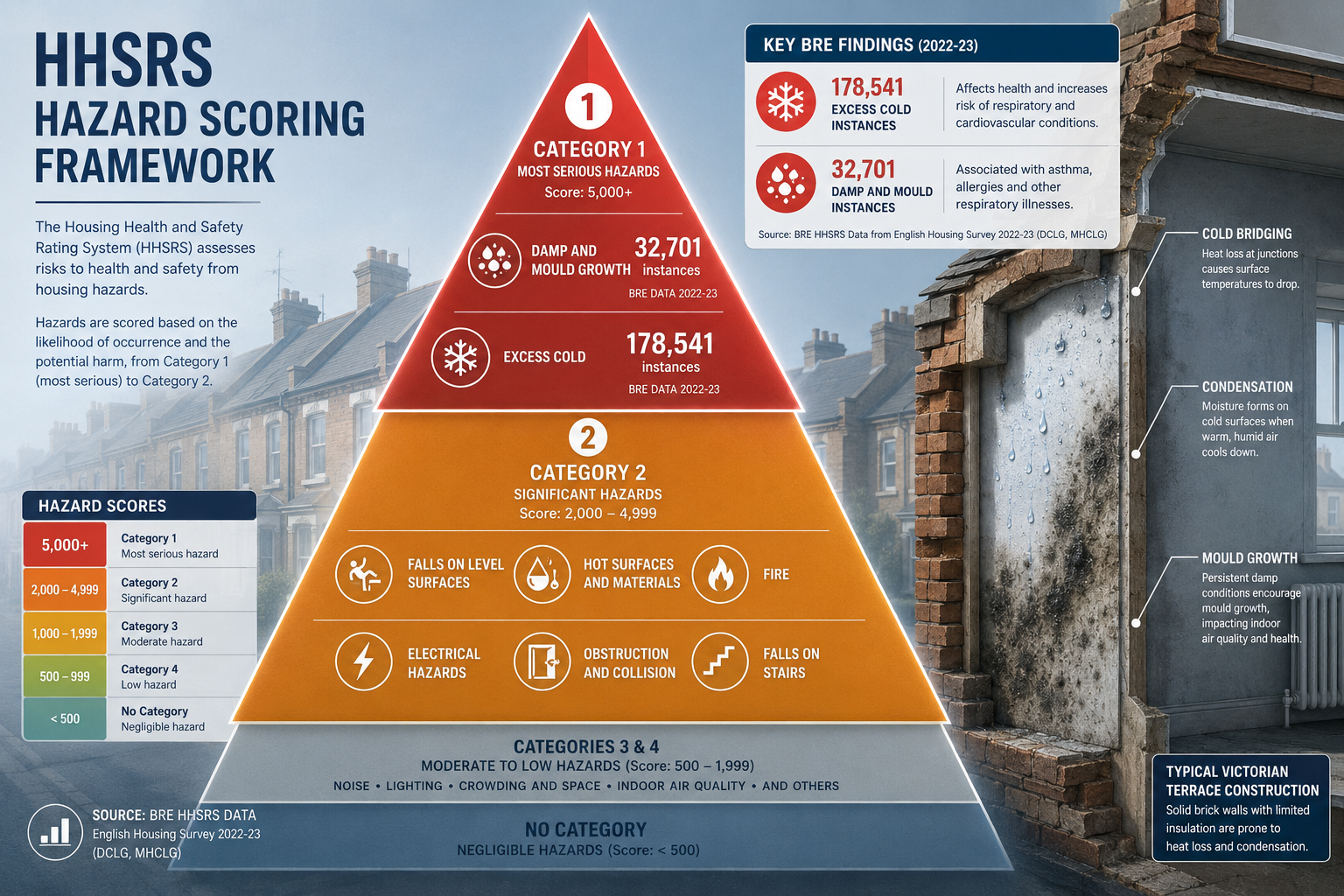
The Housing Health and Safety Rating System (HHSRS) assesses 29 hazard categories across residential properties. For damp, mould and excess cold in private housing, the two most relevant hazards are Damp and Mould Growth (Hazard 1) and Excess Cold (Hazard 3). Each is scored using a likelihood-versus-harm calculation that produces a numerical hazard score [6].
A Category 1 hazard is defined as a score of 1,000 or above — indicating a serious and immediate risk to health or safety. A Category 2 hazard scores below 1,000 and represents a less urgent but still reportable concern [6]. The distinction matters enormously. Local authorities have a legal duty to act on Category 1 hazards and a discretionary power to act on Category 2 hazards. Surveyors who conflate the two — or who score subjectively rather than evidentially — undermine the entire system.
According to the Building Research Establishment's 2023 briefing, excess cold accounts for 178,541 Category 1 instances in the PRS, while damp and mould growth accounts for 32,701 [3]. These are significant numbers, but they represent a fraction of the total PRS stock — meaning the majority of properties with some damp or cold do not automatically qualify as Category 1.
Awaab's Law and the Decent Homes Standard: What Changed in 2026
The death of two-year-old Awaab Ishak from prolonged mould exposure prompted a fundamental shift in housing law. Awaab's Law, originally applied to social housing, was extended to the private rented sector in early 2026 [1]. It mandates that landlords investigate damp and mould complaints within 14 days, begin remediation within a further 7 days for urgent hazards, and complete all repairs within a reasonable timeframe.
Simultaneously, the Decent Homes Standard was extended to the PRS [2]. This standard requires that all private rented properties be free from Category 1 HHSRS hazards — including damp and mould growth and excess cold. For surveyors, this creates a dual obligation: produce reports that are accurate enough to trigger landlord action where genuinely needed, but calibrated enough to avoid generating false Category 1 findings that waste resources and erode trust.
💬 "The surveyor's role is not to be an advocate for alarm — it is to be an advocate for evidence. A defensible report protects tenants, landlords, and the profession itself."
For a broader overview of what a professional inspection covers, see this complete guide to what a surveyor checks during an inspection.
Identifying the Root Causes: Condensation, Penetrating Damp, and Rising Damp
Accurate hazard classification begins with correct diagnosis. The three primary causes of damp in private housing each present differently, carry different HHSRS implications, and require different remediation responses [7].
Condensation
Condensation is the most common cause of mould growth in UK homes [7]. It occurs when warm, moisture-laden air meets a cold surface — typically external walls, window reveals, and north-facing corners. It is strongly associated with inadequate heating, poor ventilation, and thermal bridging.
Key indicators:
- Black mould (Aspergillus/Cladosporium) concentrated at cold corners and window frames
- Moisture readings elevated on surface but not in the wall substrate
- Symptoms worst in winter and in rooms with high humidity (kitchens, bathrooms)
- Absence of structural water ingress pathways
Condensation-related mould does not automatically score as Category 1. The HHSRS assessment must consider the spread of mould, the vulnerability of occupants, and the adequacy of heating and ventilation before a score is calculated [4].
Penetrating Damp
Penetrating damp results from water ingress through the building fabric — failed pointing, cracked render, defective gutters, or poorly sealed windows. It presents as localised damp patches, often with tide marks, on walls or ceilings.
Key indicators:
- Damp patches that correlate with external defects
- Elevated moisture readings within the wall substrate
- Staining patterns consistent with water tracking
- Symptoms that worsen during or after rainfall
Penetrating damp is a structural defect first and a health hazard second. Surveyors should identify the ingress pathway before scoring the hazard — remediation of the source eliminates the hazard more effectively than treating the symptom.
Rising Damp
Rising damp — the upward movement of ground moisture through porous masonry — is frequently over-diagnosed. Genuine rising damp is characterised by a tide mark typically no higher than 1 metre above floor level, salt crystallisation (efflorescence), and a failed or absent damp-proof course (DPC).
Key indicators:
- Tide marks at consistent height on ground-floor walls
- Salt deposits and plaster deterioration
- Elevated moisture readings decreasing with height
- Evidence of DPC failure or absence
Surveyors should be cautious: many cases diagnosed as rising damp are in fact condensation or penetrating damp. Over-diagnosis leads to unnecessary (and expensive) DPC treatment and inflated hazard scores [4].
Surveyor Protocols: Evidencing Hazards Proportionately
The Inspection Toolkit
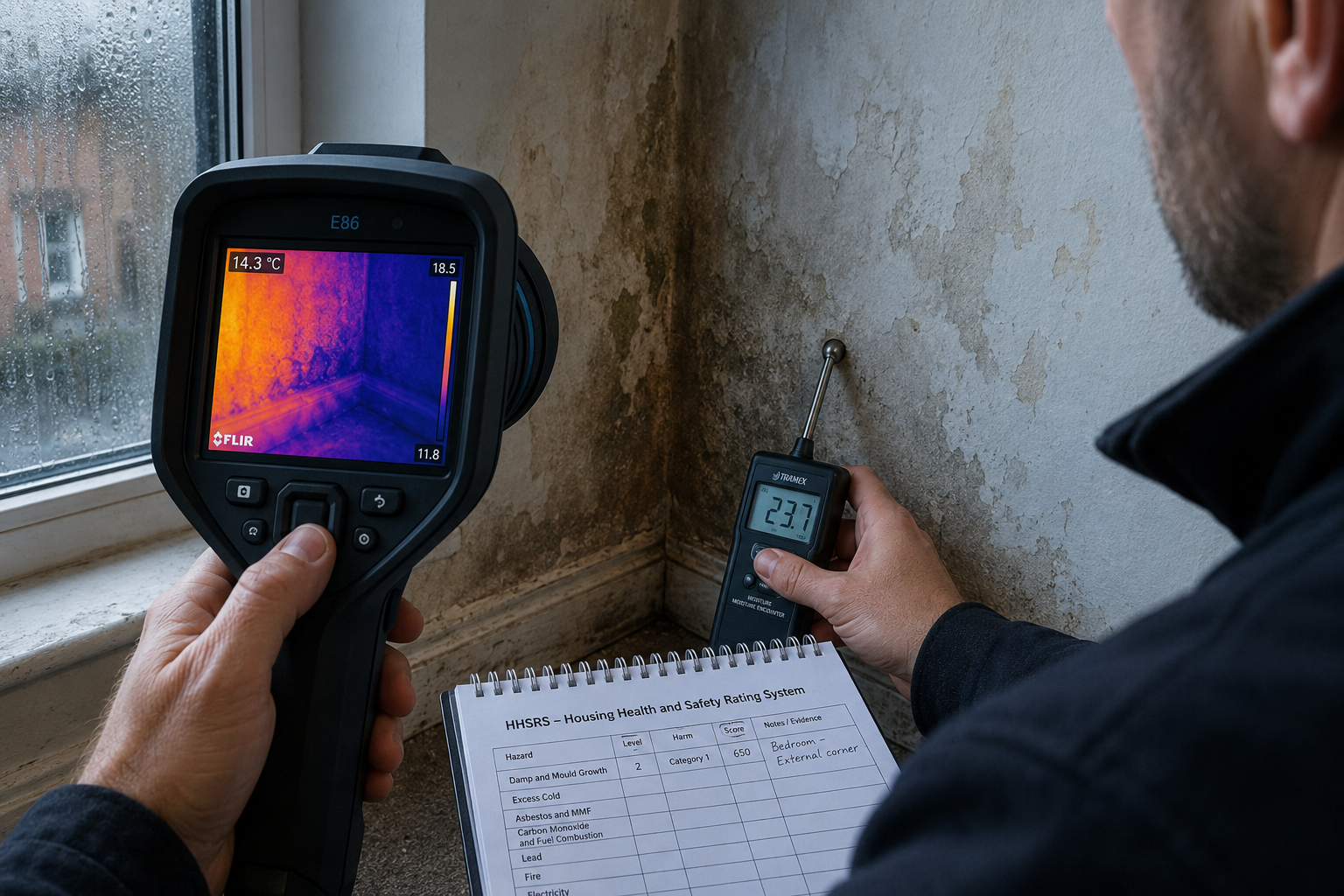
A robust inspection for damp, mould and excess cold in private housing requires more than a visual walkthrough. The following tools form the professional standard for evidencing Category 1 hazards [8]:
| Tool | Purpose | Limitation |
|---|---|---|
| Moisture meter (pin-type) | Measures moisture content in timber and plaster | Surface readings only; can be skewed by salts |
| Moisture meter (capacitance) | Non-invasive wall scanning | Less accurate; useful for screening |
| Thermal imaging camera | Identifies cold spots, thermal bridging, and hidden moisture | Requires temperature differential of ≥5°C |
| Hygrometer / data logger | Records relative humidity and temperature over time | Requires extended deployment |
| Borescope | Inspects cavities and voids | Invasive; requires access points |
For excess cold assessments, the HHSRS guidance uses the Fuel Poverty Standard — a property where the main room cannot be heated to 21°C and other rooms to 18°C at reasonable cost. Surveyors should record actual heating system type, boiler age, insulation levels (loft, walls, floors), and window specification [10].
Structured HHSRS Scoring: Avoiding Subjectivity
The HHSRS scoring process requires surveyors to estimate:
- The likelihood of an occurrence that could cause harm (expressed as a ratio, e.g., 1 in 100)
- The spread of harm — the range of outcomes from slight discomfort to death
- The weighting of each outcome by its probability
This is not a subjective exercise. Surveyors should reference the HHSRS Operating Guidance (2006) and the updated 2024 HHSRS Review recommendations when assigning scores. Crucially, the vulnerability of the most likely occupant group — not the current occupant — is used in the calculation [6].
A property with surface mould in a single bathroom corner, adequate heating, and no vulnerable occupant profile will score very differently from the same mould in a bedroom occupied by an infant or immunocompromised adult. Documenting the basis for each scoring decision is essential for defensibility.
Photographic and Written Evidence Standards
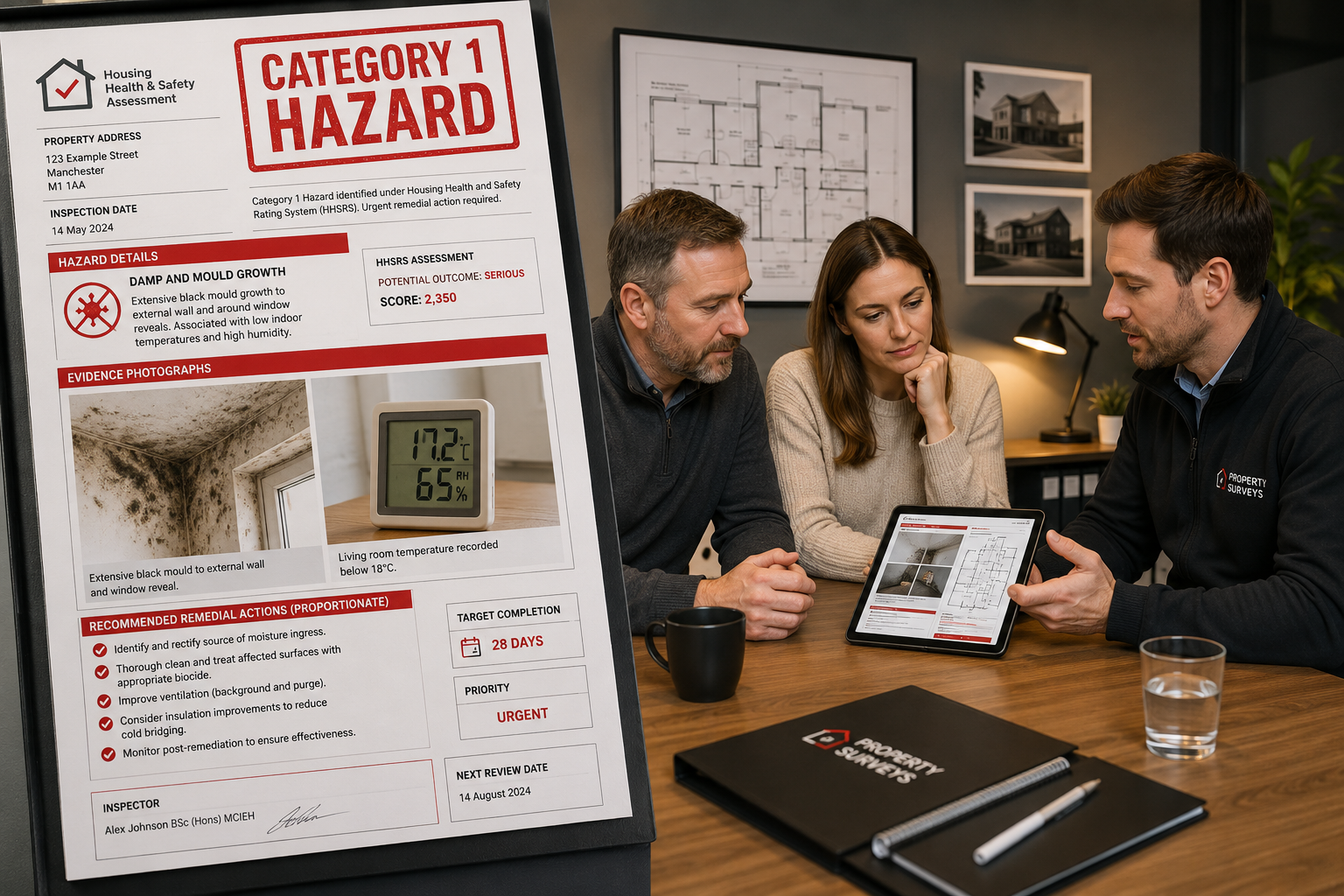
Every Category 1 finding should be supported by:
- 📸 Dated, geotagged photographs showing the extent and location of the defect
- 📊 Moisture meter readings recorded at multiple points with the instrument model noted
- 🌡️ Temperature and humidity readings at the time of inspection
- 📝 Written description of the defect, its probable cause, and its relationship to the hazard
- 🔧 Remediation recommendations that are proportionate to the hazard score
A RICS Home Survey or a specific defect report provides the appropriate professional framework for recording these findings in a structured, legally defensible format.
Communicating Findings Without Over‑Alarmism
The Language of Proportionality
The way surveyors communicate hazard findings shapes how landlords and tenants respond. Over-alarming language — "dangerous black mould infestation" for a small patch of surface condensation — triggers disproportionate responses, erodes trust, and can expose surveyors to professional challenge. Under-stating a genuine Category 1 hazard, conversely, is a regulatory and ethical failure [9].
Recommended language framework:
| Hazard Score | Recommended Framing |
|---|---|
| Category 1 (≥1,000) | "This defect presents a serious risk to health under HHSRS and requires prompt remediation. Landlord action is legally required under the Decent Homes Standard." |
| Category 2 (500–999) | "This defect presents a moderate risk and should be addressed as part of planned maintenance. It does not currently meet the threshold for mandatory intervention." |
| Below 500 | "This defect is noted as a minor issue. Monitoring and routine maintenance are recommended." |
This tiered approach ensures that tenants understand the seriousness of genuine hazards without being alarmed by minor defects, and that landlords receive clear, actionable guidance rather than vague warnings [9].
Engaging Landlords and Tenants Constructively
Under Awaab's Law, landlords must respond to damp and mould complaints within defined timeframes [1]. Surveyors can support this process by:
- Providing clear timelines for remediation in the report body
- Distinguishing between landlord responsibilities (structural defects, heating system failures) and occupant behaviour (ventilation habits, drying laundry indoors)
- Recommending interim measures — such as dehumidifiers or increased heating — while structural repairs are arranged
- Avoiding blame attribution in the report itself; focus on the defect, not the party responsible
For landlords managing multiple properties across London and the South East, working with chartered surveyors in London or chartered surveyors in Surrey who are familiar with local housing stock and regulatory enforcement patterns can significantly improve compliance outcomes.
Practical Checklist: Category 1 Hazard Inspection for Damp, Mould and Excess Cold
Use the following checklist to ensure inspections are thorough, proportionate, and compliant with 2026 requirements [5]:
Pre-Inspection
- Review tenancy history and any existing complaints
- Confirm occupant vulnerability profile (age, health conditions)
- Check EPC rating and heating system records
On-Site Inspection
- Visual survey of all rooms, including roof space and basement if accessible
- Moisture readings at all suspect locations (record instrument and readings)
- Thermal imaging scan of external walls and cold corners
- Temperature and relative humidity readings in each room
- Assess heating system: boiler age, radiator coverage, thermostat functionality
- Assess ventilation: extractor fans, trickle vents, window condition
- Inspect loft insulation depth and continuity
- Check for structural defects: gutters, pointing, render, flashings
HHSRS Scoring
- Assign hazard category based on documented evidence, not visual impression
- Record likelihood ratio and harm spread for each hazard
- Cross-reference with HHSRS Operating Guidance
- Distinguish Category 1 from Category 2 findings explicitly
Report
- Use tiered language framework (see above)
- Include photographic evidence for every Category 1 finding
- Provide proportionate remediation recommendations with indicative timelines
- Note any limitations on the inspection (access restrictions, seasonal factors)
For buyers considering properties with suspected damp or cold issues, a Level 3 Building Survey provides the most comprehensive assessment, while a Level 2 vs Level 3 comparison can help clients choose the right level of inspection for their property type.
The Competency Imperative: Staying Current in a Changing Regulatory Environment
The regulatory environment for damp, mould and excess cold in private housing has shifted faster in 2026 than at any point in the preceding decade. Surveyors who rely on pre-Awaab's Law protocols risk producing reports that are non-compliant, professionally indefensible, or — worse — that miss genuine Category 1 hazards [5].
Ongoing competency requirements include:
- 🎓 CPD on HHSRS scoring — particularly the 2024 HHSRS Review recommendations
- 📋 Familiarity with Awaab's Law timelines and their implications for report language
- 🔬 Thermal imaging certification — not all surveyors are trained to interpret thermographic data accurately
- 📐 Understanding of building physics — heat loss, vapour pressure, and interstitial condensation
- ⚖️ Knowledge of enforcement patterns — local authority approaches to Category 1 hazards vary significantly
RICS provides consumer guidance on damp and mould assessment that underpins professional standards in this area [4]. Surveyors should also stay abreast of enforcement activity in their local authority areas, as councils vary significantly in their willingness to use HHSRS powers against private landlords.
For those seeking a comprehensive overview of professional surveying services, the complete guide to building surveyors in London covers the full range of services and how to select the right specialist for specific property issues.
Conclusion: Proportionality Is a Professional Standard, Not a Compromise
The question of damp, mould and excess cold in private housing: how building surveyors can evidence Category 1 hazards without over‑alarmism is ultimately a question of professional integrity. In 2026, with Awaab's Law in force across the PRS and the Decent Homes Standard now a private landlord obligation, the stakes for accurate hazard assessment have never been higher [1][2].
Surveyors who invest in the right tools, apply structured HHSRS scoring, and communicate findings in calibrated, evidence-based language will protect tenants, support compliant landlords, and strengthen their own professional standing. Those who default to alarm — or, equally, to minimisation — risk both regulatory challenge and reputational damage.
Actionable next steps for surveyors:
- Audit your current inspection protocols against the 2026 HHSRS requirements and Awaab's Law timelines
- Invest in thermal imaging training if not already certified — it is rapidly becoming a baseline expectation
- Adopt a tiered language framework in all reports to ensure proportionate communication
- Document every scoring decision with reference to the HHSRS Operating Guidance
- Engage with local authority enforcement teams to understand local priorities and thresholds
For clients who need a professional assessment of damp, cold, or mould issues in a private property, contact a chartered surveyor with specific experience in HHSRS assessments and residential defect reporting.
References
[1] Awaabs Law Private Landlords Damp Mould – https://www.landlord-ready.com/blog/awaabs-law-private-landlords-damp-mould?utm_source=openai
[2] Decent Homes Standard Prs 2026 Landlord Guide – https://letcompliance.com/blog/decent-homes-standard-prs-2026-landlord-guide?utm_source=openai
[3] Written Evidence Submitted By The Chartered Institute Of Environmental Health To The House Of Commons Housing Communities And Local Government Committee Inquiry Into Housing Conditions In England – https://www.cieh.org/media/pg0lw3gi/written-evidence-submitted-by-the-chartered-institute-of-environmental-health-to-the-house-of-commons-housing-communities-and-local-government-committee-inquiry-into-housing-conditions-in-england.pdf?utm_source=openai
[4] Damp And Mould – https://www.rics.org/consumer-guides/damp-and-mould?utm_source=openai
[5] Building Surveys For Damp And Mould Post Awaabs Law Expansion Protocols For Identifying Prescribed Hazards In 2026 – https://nottinghillsurveyors.com/blog/building-surveys-for-damp-and-mould-post-awaabs-law-expansion-protocols-for-identifying-prescribed-hazards-in-2026?utm_source=openai
[6] Assessing Hazards – https://www.folkestone-hythe.gov.uk/private-renting/assessing-hazards?utm_source=openai
[7] Damp Mould Condensation A Surveyors Guide For London Homes – https://www.murrins.co.uk/damp-mould-condensation-a-surveyors-guide-for-london-homes/?utm_source=openai
[8] How Do Surveyors Check Damp – https://www.comparemymove.com/guides/surveying/how-do-surveyors-check-damp?utm_source=openai
[9] Awaabs Law Compliance In Rental Surveys Detecting And Reporting Damp Mould And Housing Hazards – https://wimbledonsurveyors.com/awaabs-law-compliance-in-rental-surveys-detecting-and-reporting-damp-mould-and-housing-hazards/?utm_source=openai
[10] Damp And Mould Survey – https://www.ansteyhorne.co.uk/news/damp-and-mould-survey?utm_source=openai
