
The UK's data centre landscape is experiencing unprecedented growth in 2026, driven by explosive demand for artificial intelligence infrastructure and cloud computing capacity. As tech giants and emerging AI companies race to secure physical infrastructure, many developments involve construction on or near shared property boundaries—triggering complex Party Wall Agreements in Data Centre Developments: 2026 Compliance Amid AI-Driven UK Demand scenarios that require meticulous legal and surveying expertise. For surveyors, developers, and neighbouring property owners, understanding these high-stakes compliance requirements has never been more critical.
This comprehensive guide explores the intersection of party wall legislation and data centre construction, addressing the unique challenges that arise when cutting-edge technology infrastructure meets traditional property law. Whether you're a chartered surveyor navigating complex commercial projects or a property owner affected by adjacent data centre development, this article provides essential insights into the compliance landscape shaping UK infrastructure in 2026.
Key Takeaways
- Data centre developments frequently trigger Party Wall Act 1996 obligations due to excavation depths, foundation work, and boundary wall construction
- 2026 compliance requirements demand enhanced documentation, accelerated timelines, and specialized surveying expertise for high-value infrastructure projects
- AI-driven demand has created a surge in data centre construction, increasing party wall disputes and requiring proactive mediation strategies
- Professional surveyors must understand both traditional party wall procedures and the unique technical requirements of data centre developments
- Early notification and engagement with adjoining owners can prevent costly delays in time-sensitive technology infrastructure projects

Understanding Party Wall Agreements in Data Centre Developments: 2026 Compliance Amid AI-Driven UK Demand
The Party Wall Act 1996 and Commercial Developments
The Party Wall etc. Act 1996 remains the cornerstone legislation governing construction work on or near shared boundaries in England and Wales. While originally designed with residential properties in mind, the Act applies equally to commercial and industrial developments—including the massive data centre facilities now reshaping the UK's technological infrastructure.
For data centre projects, party wall considerations typically arise in three key scenarios:
- Excavation work within three to six metres of neighbouring structures (often required for deep foundations and underground cable routing)
- Construction on boundary lines where new data centre buildings abut existing properties
- Work to existing party walls when repurposing industrial sites or expanding existing facilities
Understanding when a party wall agreement is legally required becomes especially critical in data centre developments, where construction timelines directly impact revenue generation and contractual obligations with major technology clients.
Why Data Centres Present Unique Party Wall Challenges
Data centre developments differ significantly from typical commercial construction projects in ways that complicate party wall compliance:
🏗️ Foundation Requirements: Data centres require exceptionally robust foundations to support heavy server equipment, backup power systems, and cooling infrastructure. Excavation depths often exceed 3-6 metres, automatically triggering party wall notifications under Section 6 of the Act.
⚡ Vibration Sensitivity: Both during construction and operation, data centres must minimize vibration that could affect sensitive electronic equipment. This creates additional surveying obligations to document baseline conditions and monitor impact on adjoining properties.
🔒 Security Considerations: The high-security nature of data centres can complicate traditional party wall procedures, as building owners may restrict surveyor access to certain areas or require enhanced confidentiality agreements.
⏰ Time-Critical Timelines: Technology companies often face contractual deadlines with clients requiring operational data centres by specific dates. Party wall delays can trigger substantial financial penalties, increasing pressure on all parties to expedite the process.
💰 High-Value Stakes: With data centre construction costs frequently exceeding £100 million, the financial implications of party wall disputes or compliance failures are proportionally severe.
The 2026 Compliance Landscape for Data Centre Party Wall Agreements
Recent Regulatory Developments
While the Party Wall Act 1996 itself hasn't been amended, 2026 has seen significant developments in how the legislation is interpreted and enforced in commercial contexts. The surge in party wall surveying activity across all sectors has prompted greater scrutiny of compliance procedures and professional standards.
The Royal Institution of Chartered Surveyors (RICS) has emphasized the importance of robust documentation and transparent communication in complex commercial projects. For data centre developments, this means:
- Enhanced photographic and video documentation of existing conditions
- Detailed structural surveys of adjoining properties before work commences
- Regular monitoring schedules throughout construction phases
- Comprehensive party wall awards that address technology-specific considerations
Compliance Challenges in High-Demand Markets
The AI boom has created intense competition for suitable data centre sites, particularly in areas with existing fiber infrastructure and reliable power supply. This demand pressure creates several compliance challenges:
Accelerated Development Timelines: Developers may attempt to compress party wall notification periods or begin work before proper agreements are in place. This approach invariably backfires, resulting in injunctions, work stoppages, and expensive legal disputes.
Multiple Adjoining Owners: Data centre sites often have numerous neighbouring properties—industrial units, residential areas, and other commercial facilities. Coordinating party wall agreements with multiple adjoining owners requires sophisticated project management and clear communication strategies.
Cross-Border Considerations: Large data centre campuses may span multiple local authority jurisdictions, each with different planning and building control interpretations that affect party wall compliance.
For property owners wondering whether they need a party wall agreement, the answer in data centre contexts is almost always affirmative given the scale and nature of construction work involved.
The Role of Building Surveyor Expertise
Effective party wall compliance in data centre developments requires surveyors with specialized knowledge spanning multiple disciplines:
- Structural engineering principles for assessing foundation impacts
- Technology infrastructure requirements to understand operational needs
- Commercial property law and high-value dispute resolution
- Environmental monitoring for vibration, noise, and other construction impacts
Understanding what a party wall surveyor does helps all parties appreciate the technical expertise required for these complex projects. In data centre contexts, surveyors often work alongside specialist structural engineers and technology consultants to develop comprehensive party wall awards.
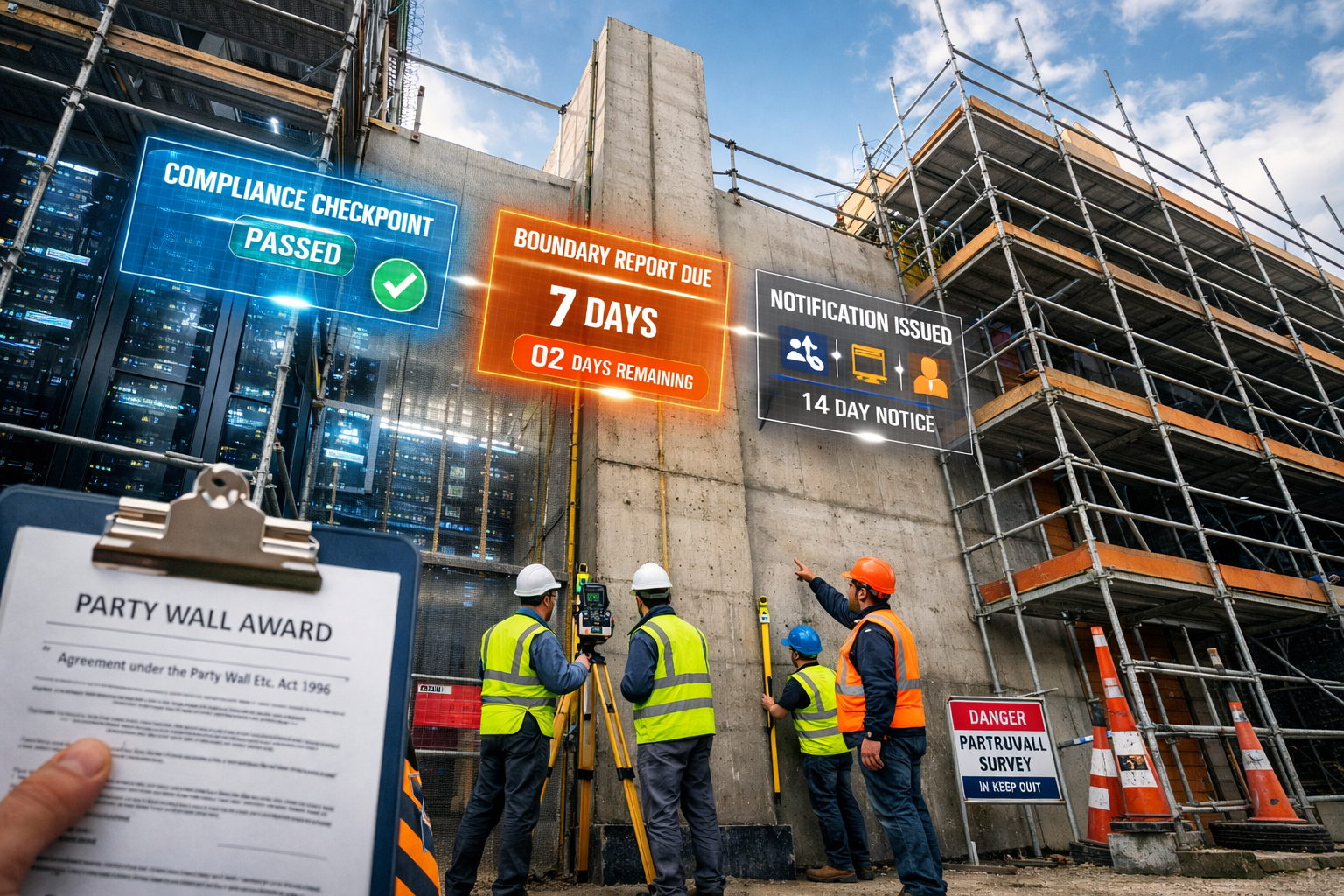
Navigating the Party Wall Process for Data Centre Developments
Step 1: Early Identification and Planning
Successful party wall compliance begins during the initial site selection and planning phases—long before construction commences. Developers should:
Conduct Boundary Surveys: Precise identification of property boundaries using professional land surveyors prevents disputes about where party wall obligations begin and end.
Review Title Deeds: Historical easements, rights of way, or restrictive covenants may affect party wall procedures or create additional notification requirements.
Assess Neighbouring Properties: Understanding the character, use, and condition of adjoining properties helps anticipate potential concerns and tailor communication strategies accordingly.
Budget Appropriately: Party wall costs for major data centre developments can range from £50,000 to £200,000+ depending on the number of adjoining owners and complexity of work. Understanding how much a party wall agreement costs enables accurate project budgeting.
Step 2: Serving Proper Notices
The Party Wall Act 1996 establishes strict notice requirements that cannot be waived or abbreviated, regardless of project urgency:
Notice Periods:
- Line of Junction Notices (Section 1): One month minimum for new walls on boundaries
- Party Structure Notices (Section 2): Two months minimum for work to existing party walls
- Adjacent Excavation Notices (Section 6): One month minimum for excavation work
For data centre projects, notices must include:
- Detailed technical drawings showing excavation depths and foundation designs
- Construction methodology statements addressing vibration control and temporary works
- Proposed schedules of condition to document pre-construction property status
- Contact information for appointed building owners' surveyors
Understanding the complete party wall process helps developers avoid procedural errors that could delay projects by months.
Step 3: Appointing Surveyors and Preparing Awards
When adjoining owners dissent to proposed works (or fail to respond within 14 days), the dispute resolution process begins:
Surveyor Appointment Options:
- Agreed Surveyor: Single surveyor acts for both parties (rarely appropriate for high-value data centre projects)
- Two Surveyors: Each party appoints their own surveyor, who jointly prepare the award
- Third Surveyor: Selected by the two appointed surveyors to resolve any disagreements
For data centre developments, the two-surveyor approach is strongly recommended given the complexity and financial stakes involved. Each surveyor advocates for their appointing owner while working collaboratively to produce a fair and comprehensive party wall award.
Party Wall Awards Must Address:
- Right to execute specified works with detailed technical descriptions
- Time and manner of work execution, including permitted hours and noise limitations
- Condition schedules documenting pre-construction property status
- Monitoring protocols during construction phases
- Dispute resolution procedures if damage or unexpected issues arise
- Cost allocation and payment mechanisms
Learning about party wall awards helps all parties understand their rights and obligations throughout the construction process.
Step 4: Construction Monitoring and Compliance
Once party wall awards are in place, ongoing compliance requires:
Regular Site Inspections: Appointed surveyors should conduct periodic inspections to verify work proceeds according to agreed methods and specifications.
Condition Monitoring: Photographic and structural monitoring of adjoining properties throughout construction phases provides evidence if damage claims arise.
Responsive Communication: Promptly addressing adjoining owner concerns prevents minor issues from escalating into formal disputes.
Documentation Management: Comprehensive records of all notices, responses, surveyor appointments, awards, and monitoring reports create an audit trail demonstrating compliance.
Dispute Resolution and Mediation in High-Stakes Infrastructure Projects
Common Sources of Party Wall Disputes in Data Centre Developments
Despite best efforts at compliance, party wall disputes frequently arise in data centre projects due to:
🏚️ Pre-Existing Damage Claims: Adjoining owners may attribute existing property defects to new construction work, requiring careful pre-construction documentation to refute.
📊 Valuation Disagreements: When construction genuinely damages adjoining properties, disputes often center on appropriate compensation amounts and repair methodologies.
⏱️ Timeline Conflicts: Adjoining owners may object to proposed working hours, especially when data centre construction requires extended or weekend work to meet deadlines.
🔊 Nuisance Complaints: Construction noise, vibration, dust, and traffic can generate complaints even when work complies with party wall awards and planning conditions.
💼 Commercial Leverage: Some adjoining owners view party wall procedures as opportunities to extract financial concessions or negotiate unrelated property matters.
For guidance on resolving party wall disputes, professional mediation and surveyor expertise prove essential.
Mediation Strategies for Technology Infrastructure Projects
Effective dispute resolution in data centre contexts requires strategies tailored to the unique pressures of technology infrastructure:
Early Engagement: Proactive communication with adjoining owners before formal notices are served can identify concerns and build goodwill that prevents later disputes.
Transparent Documentation: Sharing detailed construction plans, vibration monitoring data, and progress updates demonstrates good faith and addresses concerns before they escalate.
Commercial Pragmatism: In some cases, offering reasonable financial accommodations (temporary relocation assistance, property improvements, or direct compensation) proves more cost-effective than protracted disputes.
Expert Technical Evidence: When disputes reach formal proceedings, independent structural engineers and acoustic consultants provide objective evidence that courts and third surveyors find persuasive.
Alternative Dispute Resolution: Mediation and arbitration offer faster, more confidential resolution than court proceedings—critical advantages when technology companies face contractual deadlines.

The Role of Third Surveyors in Complex Disputes
When appointed surveyors cannot agree on specific award provisions, the Third Surveyor plays a crucial role in resolving impasses. In data centre contexts, Third Surveyors should possess:
- Extensive experience with large-scale commercial construction
- Understanding of technology infrastructure requirements
- Knowledge of structural engineering principles
- Familiarity with high-value dispute resolution
- RICS accreditation and professional indemnity insurance
Third Surveyor decisions are binding on all parties and can only be challenged through court proceedings on narrow grounds (procedural irregularities or jurisdictional errors, not mere disagreement with conclusions).
Cost Considerations for Party Wall Compliance in Data Centre Projects
Budgeting for Party Wall Expenses
Data centre developers should anticipate the following cost categories:
| Cost Category | Typical Range | Notes |
|---|---|---|
| Building Owner's Surveyor Fees | £15,000 – £50,000+ | Depends on project complexity and number of adjoining properties |
| Adjoining Owner's Surveyor Fees | £10,000 – £40,000+ per property | Building owner typically pays under the Act |
| Third Surveyor Fees | £5,000 – £20,000 | Only if disputes arise between appointed surveyors |
| Condition Surveys | £2,000 – £8,000 per property | Detailed documentation of pre-construction status |
| Monitoring and Inspections | £5,000 – £15,000 | Ongoing compliance verification during construction |
| Damage Remediation | Variable | Can range from thousands to millions depending on severity |
For comprehensive guidance on costs, review party wall agreement pricing breakdowns specific to commercial projects.
Hidden Costs of Non-Compliance
Attempting to avoid or shortcut party wall procedures creates far greater expenses:
⚖️ Injunctions: Courts readily grant injunctions halting work when proper party wall procedures haven't been followed, causing construction delays that can cost £50,000+ per day on major data centre projects.
📜 Retrospective Awards: When work proceeds without proper awards, adjoining owners can demand retrospective compliance, often with enhanced compensation for the breach.
🏛️ Legal Fees: Disputes escalating to court proceedings generate legal costs that dwarf proper party wall surveyor fees—often exceeding £100,000 for complex commercial cases.
💔 Relationship Damage: Poor party wall compliance creates lasting animosity with neighbouring property owners, complicating future expansion plans and operational relationships.
📉 Reputational Impact: Technology companies increasingly scrutinize contractors' compliance records when awarding data centre construction contracts.
Best Practices for Surveyors Handling Data Centre Party Wall Agreements
Technical Competencies Required
Surveyors working on Party Wall Agreements in Data Centre Developments: 2026 Compliance Amid AI-Driven UK Demand scenarios should develop specialized expertise:
Structural Assessment Skills: Understanding foundation design, soil mechanics, and structural loading calculations enables accurate impact assessments.
Technology Literacy: Familiarity with data centre design principles, cooling systems, power requirements, and security protocols facilitates productive discussions with developers and their technical teams.
Commercial Awareness: Appreciating the business drivers behind data centre development helps surveyors balance legal compliance with commercial pragmatism.
Communication Excellence: Explaining complex technical and legal concepts to diverse stakeholders—from individual homeowners to multinational corporations—requires exceptional communication skills.
Project Management: Coordinating multiple adjoining owner relationships, construction monitoring schedules, and documentation requirements demands robust project management capabilities.
Documentation Standards for High-Value Projects
Professional documentation standards become especially critical in data centre contexts where potential claims involve substantial sums:
Photographic Records: High-resolution photographs and video documentation of all adjoining properties before work commences, supplemented by regular monitoring throughout construction.
Structural Surveys: Detailed structural surveys identifying pre-existing defects, movement patterns, and vulnerability to construction impacts.
Monitoring Data: Vibration monitoring, settlement monitoring, and crack monitoring data collected throughout construction phases.
Correspondence Logs: Comprehensive records of all communications with adjoining owners, their surveyors, developers, and contractors.
Award Documentation: Meticulously prepared party wall awards addressing all foreseeable scenarios and clearly allocating responsibilities.
Continuing Professional Development
The intersection of party wall law and technology infrastructure represents an evolving specialty. Surveyors should pursue ongoing education through:
- RICS courses on party wall practice and commercial property
- Technical seminars on data centre design and construction
- Legal updates on case law affecting party wall interpretation
- Networking with specialist surveyors handling similar projects
Understanding the comprehensive UK homeowners guide to the Party Wall Act provides foundational knowledge applicable to commercial contexts.
The Future of Party Wall Compliance in UK Data Centre Development
Emerging Trends for 2026 and Beyond
Several trends are reshaping Party Wall Agreements in Data Centre Developments: 2026 Compliance Amid AI-Driven UK Demand:
🤖 AI-Powered Monitoring: Advanced sensors and artificial intelligence systems now enable real-time monitoring of construction impacts, providing early warning of potential damage and creating objective evidence for party wall proceedings.
🌍 Sustainability Requirements: Environmental regulations increasingly affect data centre design, with implications for party wall compliance when implementing ground-source cooling systems or extensive excavation for thermal storage.
📱 Digital Documentation: Building Information Modeling (BIM) and digital twin technologies enable more sophisticated party wall documentation and impact assessment.
⚡ Edge Computing Proliferation: The shift toward distributed edge computing facilities increases the number of smaller data centre developments in urban areas, multiplying party wall scenarios.
🏗️ Modular Construction: Prefabricated data centre modules may reduce some party wall impacts while creating new challenges around temporary works and installation methodologies.
Regulatory Evolution
While the Party Wall Act 1996 remains unchanged, its interpretation continues to evolve through case law and professional guidance. Surveyors should monitor:
- Court decisions establishing precedents for commercial party wall disputes
- RICS guidance updates addressing technology infrastructure projects
- Local authority interpretations of party wall obligations in planning contexts
- Insurance industry developments affecting professional indemnity coverage for high-value projects
The continued surge in party wall activity across residential and commercial sectors suggests potential future legislative attention to modernize procedures for 21st-century construction realities.
Conclusion: Mastering Party Wall Compliance in the AI Infrastructure Era
Party Wall Agreements in Data Centre Developments: 2026 Compliance Amid AI-Driven UK Demand represents a critical intersection of traditional property law and cutting-edge technology infrastructure. As artificial intelligence continues driving unprecedented demand for data processing capacity, the UK's construction sector faces complex compliance challenges that require specialized expertise and proactive management.
For developers and technology companies, success requires:
- Early integration of party wall considerations into site selection and project planning
- Adequate budgeting for professional surveyor fees and compliance procedures
- Transparent communication with adjoining owners before formal notices
- Engagement of surveyors with relevant commercial and technical expertise
For adjoining property owners, protection demands:
- Prompt response to party wall notices within statutory timeframes
- Appointment of experienced surveyors to represent their interests
- Documentation of property conditions before construction commences
- Understanding of rights to fair compensation if damage occurs
For professional surveyors, excellence in this specialized field requires:
- Technical competencies spanning structural engineering and technology infrastructure
- Meticulous documentation standards appropriate to high-value projects
- Mediation skills to resolve disputes efficiently and commercially
- Ongoing professional development as the sector evolves
The party wall framework established by the 1996 Act remains fit for purpose even in the context of 21st-century technology infrastructure—provided all parties approach compliance with professionalism, transparency, and mutual respect. As data centre development continues reshaping the UK's industrial landscape, mastery of party wall procedures will distinguish successful projects from costly failures.
Next Steps
If you're involved in data centre development or affected by adjacent construction:
- Engage qualified surveyors early in the planning process—don't wait until notices are served
- Review our comprehensive guides on party wall processes and legal requirements
- Document everything from initial site conditions through construction completion
- Communicate proactively with all stakeholders to prevent disputes
- Seek specialist advice for complex scenarios involving high-value infrastructure
For professional surveyor support with data centre party wall agreements or other commercial construction projects, contact our experienced team for confidential consultation.
References
[1] Party Wall Surveying Surge In 2026 Loft Conversions Navigating High Demand Compliance During Housing Uptick – https://nottinghillsurveyors.com/blog/party-wall-surveying-surge-in-2026-loft-conversions-navigating-high-demand-compliance-during-housing-uptick
