
The UK construction sector stands at a pivotal moment in 2026. After years of uncertainty, Building Survey Protocols for UK Construction Recovery: RICS Checklists from Q4 2025 Monitor into 2026 have emerged as essential tools guiding the industry's resurgence. Recent RICS Construction Monitor data from Q4 2025 signals a shift from stagnation to modest recovery, with flat activity finally turning positive. This recovery demands updated, rigorous protocols for surveyors assessing structural risks in reviving projects—projects that may have been paused, partially completed, or compromised during economic downturns.
For chartered surveyors, property developers, and construction professionals, understanding these enhanced protocols isn't optional—it's critical. The Royal Institution of Chartered Surveyors (RICS) has reinforced professional standards, integrated new technologies like AI, and established sustainability frameworks that fundamentally reshape how building surveys are conducted in 2026. This comprehensive guide explores the protocols, checklists, and best practices that define professional surveying during the UK's construction recovery phase.
Key Takeaways
✅ Enhanced Level 3 Survey Standards: RICS has strengthened Level 3 building surveys to uncover hidden issues including interstitial condensation and complex building fabric problems, essential for assessing recovery-phase projects.[1]
✅ AI Integration Requirements: Surveyors must now document AI system reliability in writing, adapt terms of engagement, and provide client opt-out mechanisms under new RICS professional standards.[2]
✅ Sustainability Protocols Mandatory: Whole Life Carbon Assessment frameworks and PAS 2080:2023 adoption require surveyors to measure and report lifecycle carbon emissions on all building projects.[2]
✅ Recovery-Specific Risk Assessment: Stalled or partially completed construction projects require specialized protocols addressing deterioration, incomplete weatherproofing, and structural integrity concerns unique to the recovery period.
✅ Regulatory Landscape Evolution: New legislation including the Warm Homes Plan, Awaab's Law, and Renters' Rights Act 2026 directly impact survey protocols and reporting requirements.[2][3]
Understanding the Q4 2025 Construction Monitor Context
The Recovery Indicators
The RICS Construction Monitor from Q4 2025 represents a watershed moment for the UK construction industry. After prolonged periods of flat or declining activity, key indicators show modest but meaningful recovery across multiple sectors. Workload projections have turned positive, with surveyors reporting increased confidence in both residential and commercial projects.
This recovery, however, isn't uniform. Regional variations persist, with London and the South East showing stronger momentum than other areas. The recovery also brings unique challenges: many projects were mothballed during downturn periods, creating a backlog of partially completed structures requiring comprehensive assessment before work can resume.
Why Recovery Demands Updated Protocols
🏗️ Stalled Project Risks: Buildings left partially complete face accelerated deterioration from weather exposure, incomplete waterproofing, and material degradation. Standard survey protocols designed for occupied or fully weatherproofed structures don't adequately address these conditions.
🔍 Hidden Defect Proliferation: Economic pressures during downturn periods may have led to cost-cutting measures, substandard materials, or rushed workmanship. Recovery-phase surveys must be more forensic in identifying these compromised elements.
📊 Insurance and Liability Concerns: Projects resuming after extended delays face complex insurance questions. Surveyors must document pre-existing conditions versus new deterioration with exceptional precision to protect all parties.
The enhanced Level 3 building survey protocols now required by RICS specifically address these recovery-phase challenges, providing surveyors with structured approaches to these complex scenarios.
Building Survey Protocols for UK Construction Recovery: Enhanced RICS Standards

Level 3 Survey Enhancements for 2026
RICS has significantly strengthened its Level 3 Building Survey standards to meet the demands of the construction recovery period. These surveys now represent the most detailed examination available, going far beyond surface-level observations to uncover hidden issues that could compromise project viability.[1]
Key enhancements include:
| Enhancement Area | 2026 Protocol Requirements |
|---|---|
| Building Fabric Analysis | Detailed assessment of wall construction, cavity conditions, insulation performance, and moisture ingress pathways |
| Interstitial Condensation | Mandatory thermal imaging and moisture mapping to identify condensation within wall cavities and roof spaces |
| Structural Integrity | Enhanced load-bearing assessment, foundation inspection, and structural movement monitoring |
| Services Assessment | Comprehensive evaluation of electrical, plumbing, heating, and ventilation systems for compliance and condition |
| Environmental Factors | Carbon footprint baseline, energy efficiency ratings, and retrofit potential analysis |
These enhanced standards ensure that surveyors conducting assessments on recovery-phase projects have the tools and frameworks to identify issues that might otherwise remain hidden until they become critical failures.
Professional Standards Reinforcement
RICS has reinforced its commitment to professional standards with particular emphasis on technical competence and ethical conduct throughout 2026.[1] This reinforcement directly responds to lessons learned during the construction downturn, where some practitioners may have been tempted to compromise thoroughness under economic pressure.
The reinforced standards include:
Technical Competence Requirements 📋
- Mandatory continuing professional development (CPD) in recovery-phase assessment techniques
- Specialization recognition for surveyors with expertise in stalled project evaluation
- Enhanced peer review processes for complex recovery assessments
Ethical Conduct Emphasis ⚖️
- Strict independence requirements preventing conflicts of interest
- Enhanced disclosure obligations regarding limitations and assumptions
- Whistleblower protections for surveyors identifying serious defects or non-compliance
These reinforced standards increase confidence in the quality and reliability of surveying services delivered during the critical recovery period, protecting both clients and the broader construction industry.[1]
For professionals seeking to understand what surveyors examine during these comprehensive assessments, our guide on what surveyors look for in a house survey provides detailed insights into inspection priorities.
RICS Checklists from Q4 2025 Monitor: Practical Implementation
Recovery-Phase Structural Assessment Checklist
Building on the Q4 2025 Monitor findings, RICS has developed specialized checklists for assessing structures in the recovery phase. These checklists address the unique risks associated with projects that have experienced delays, partial completion, or extended exposure to elements.
Foundation and Substructure Assessment 🏗️
- ✅ Verify foundation exposure duration and weather conditions during exposure period
- ✅ Inspect for water ingress, standing water, or drainage system failures
- ✅ Assess ground movement or settlement occurring during project pause
- ✅ Document any temporary protection measures and their effectiveness
- ✅ Evaluate foundation material integrity after extended exposure
- ✅ Check for vegetation growth affecting foundation stability
Superstructure and Building Envelope 🧱
- ✅ Assess weatherproofing completeness and effectiveness
- ✅ Identify areas of incomplete external cladding or roofing
- ✅ Inspect for water penetration damage to internal structures
- ✅ Evaluate structural frame integrity, particularly steel elements for corrosion
- ✅ Document any temporary coverings and assess damage prevented or caused
- ✅ Check for thermal bridging in partially insulated structures
Materials Degradation Assessment 🔬
- ✅ Test stored materials for moisture damage or degradation
- ✅ Verify material specifications against current building regulations
- ✅ Assess whether partially installed materials meet manufacturer warranties after exposure
- ✅ Document any material substitutions made during project pause
- ✅ Evaluate adhesive and sealant viability after extended shelf life
These comprehensive checklists ensure that no critical assessment area is overlooked when evaluating recovery-phase projects. Surveyors conducting commercial building surveys will find these protocols particularly relevant for stalled commercial developments.
Documentation and Reporting Protocols
The 2026 RICS protocols place unprecedented emphasis on documentation quality and completeness. Recovery-phase projects often involve multiple stakeholders, complex insurance claims, and potential disputes—making meticulous documentation essential.
Photographic Evidence Standards 📸
Modern survey protocols require comprehensive photographic documentation with specific technical standards:
- High-resolution images (minimum 12 megapixels) with embedded GPS and timestamp data
- 360-degree photography for key spaces and structural elements
- Thermal imaging for all external walls, roofs, and suspected moisture areas
- Before-and-after documentation for projects with known deterioration periods
- Annotated images clearly identifying defects and their locations
Written Report Requirements 📝
Recovery-phase survey reports must include:
- Executive Summary: Clear statement of overall project viability and major concerns
- Detailed Findings: Room-by-room or area-by-area assessment with condition ratings
- Risk Analysis: Prioritized list of structural, safety, and compliance risks
- Cost Implications: Estimated remediation costs for identified defects
- Timeline Assessment: Realistic project completion timelines considering remediation needs
- Regulatory Compliance: Current building regulation compliance status and upgrade requirements
The importance of thorough reporting cannot be overstated. Our comprehensive guide to Level 3 building surveys demonstrates how detailed documentation protects all parties and facilitates informed decision-making.
Technology Integration: AI and Digital Tools in 2026 Survey Protocols

RICS AI Professional Standards
One of the most significant developments in Building Survey Protocols for UK Construction Recovery: RICS Checklists from Q4 2025 Monitor into 2026 is the formal integration of artificial intelligence into surveying practice. The RICS Professional Standard for Responsible Use of AI in Surveying Practice establishes clear requirements for firms and members adopting AI systems.[2]
Mandatory AI Documentation Requirements 🤖
Surveyors using AI tools must now:
- Record AI Reliability Decisions: Document in writing the decision-making process for determining AI system reliability, including testing methodologies and validation results
- State Explicit Assumptions: Clearly articulate assumptions about AI system capabilities and limitations
- Document Concerns: Record any concerns about AI system performance, bias, or accuracy
- Maintain Audit Trails: Keep comprehensive records of AI-assisted decisions for professional liability purposes
Terms of Engagement Adaptations 📋
RICS-regulated firms must adapt their client engagement terms when adopting AI systems, specifying:
- AI Usage Disclosure: When and how AI will be used in the survey process
- Insurance Coverage: Extent of Professional Indemnity Insurance coverage for AI-assisted work
- Quality Assurance: Internal processes for validating AI-generated findings
- Client Opt-Out Rights: Mechanisms for clients to request non-AI survey methods
These requirements ensure transparency while allowing surveyors to leverage AI's efficiency benefits for tasks like thermal image analysis, defect pattern recognition, and comparative data analysis.
Digital Survey Technologies
Beyond AI, several digital technologies have become standard in 2026 survey protocols:
Thermal Imaging and Moisture Detection 🌡️
Advanced thermal cameras now detect temperature differentials as small as 0.1°C, revealing:
- Hidden moisture ingress pathways
- Insulation gaps and thermal bridging
- Interstitial condensation within wall cavities
- Underfloor heating failures
- Electrical hotspots indicating fire risks
Laser Scanning and 3D Modeling 📐
High-precision laser scanners create detailed 3D models enabling:
- Accurate measurement of structural movement
- Detection of subtle deformations invisible to visual inspection
- Creation of as-built documentation for recovery-phase projects
- Virtual site revisits without physical access
Drone Surveys for Roof and Elevation Assessment 🚁
Our specialized drone survey services provide safe, comprehensive assessment of:
- Roof condition and weatherproofing integrity
- High-level masonry and cladding
- Chimney stacks and parapet walls
- Areas inaccessible by traditional means
These technologies don't replace professional judgment—they enhance it, providing surveyors with data quality and comprehensiveness impossible through traditional methods alone.
Sustainability and Carbon Assessment Protocols
Whole Life Carbon Assessment Framework
The RICS Professional Standard Whole Life Carbon Assessment for the Built Environment (2nd Edition) represents a fundamental shift in how surveyors approach building assessment in 2026.[2] This framework provides measurement guidance for life-cycle carbon emissions on both new and existing buildings, aligning with International Cost Management Standards for global applicability.
Key Components of Whole Life Carbon Assessment 🌍
| Assessment Stage | Protocol Requirements |
|---|---|
| Embodied Carbon | Calculate carbon emissions from material extraction, manufacturing, transportation, and construction |
| Operational Carbon | Project energy consumption and associated emissions over building lifespan |
| End-of-Life Carbon | Account for demolition, waste management, and material recycling or disposal |
| Carbon Sequestration | Credit for carbon storage in timber and other bio-based materials |
| Retrofit Potential | Assess opportunities for carbon reduction through building improvements |
Recovery-phase projects present unique sustainability opportunities. Buildings already partially constructed have significant embodied carbon investment—completing them sustainably often represents better environmental outcomes than demolition and new construction.
PAS 2080:2023 Carbon Management
RICS has adopted PAS 2080:2023 Carbon Management in Buildings and Infrastructure to provide governance processes, roles, and requirements for managing carbon throughout the building lifecycle.[2] This standard establishes:
Carbon Management Hierarchy 📊
- Eliminate: Remove unnecessary construction activities and materials
- Reduce: Minimize carbon intensity of necessary elements
- Substitute: Replace high-carbon materials with lower-carbon alternatives
- Compensate: Offset unavoidable emissions through verified schemes
Surveyors assessing recovery-phase projects must now evaluate carbon implications of various completion strategies, providing clients with data to make informed sustainability decisions.
For properties requiring energy efficiency improvements, understanding subsidence risks and structural stability becomes crucial when planning retrofit interventions.
Regulatory Compliance: New Legislation Impacting Survey Protocols
Warm Homes Plan Implementation
The long-awaited Warm Homes Plan represents one of the most significant regulatory developments shaping surveying practice in 2026.[3] RICS is actively analyzing and responding to this legislation, which establishes ambitious targets for improving residential energy efficiency across the UK housing stock.
Survey Protocol Implications 🏠
Surveyors must now assess and report on:
- Current Energy Performance Certificate (EPC) ratings and improvement pathways
- Insulation adequacy in walls, roofs, and floors
- Heating system efficiency and suitability for heat pump conversion
- Window and door thermal performance
- Ventilation adequacy to prevent condensation in improved thermal envelopes
- Cost-benefit analysis of various improvement measures
Recovery-phase residential projects offer ideal opportunities to integrate Warm Homes Plan compliance measures before completion, often at lower cost than retrofit.
Awaab's Law and Housing Quality Standards
Awaab's Law has emerged as a key topic requiring surveyor awareness in 2026.[2] Named after a tragic case highlighting the dangers of housing disrepair, this legislation establishes strict timelines for landlords to address health hazards including damp and mould.
Surveyor Responsibilities Under Awaab's Law ⚖️
- Mandatory identification and reporting of damp, mould, and condensation issues
- Assessment of ventilation adequacy and moisture management
- Documentation of potential health hazards requiring immediate attention
- Recommendations for remediation with realistic timelines
- Follow-up inspection protocols to verify effective remediation
These requirements significantly elevate the importance of moisture detection and building fabric assessment in all residential surveys.
Renters' Rights Act 2026
The Renters' Rights Act 2026 introduces new standards for rental property conditions, with direct implications for survey protocols.[2] Surveyors assessing properties intended for the rental market must now evaluate compliance with enhanced minimum standards covering:
- Electrical safety certification currency
- Gas safety compliance
- Fire safety measures including smoke and carbon monoxide detectors
- Energy efficiency minimum standards
- Structural soundness and weatherproofing
- Hazard assessment under Housing Health and Safety Rating System (HHSRS)
For landlords and property investors, commissioning comprehensive surveys that address Renters' Rights Act compliance has become essential for avoiding costly enforcement action and ensuring rental income continuity.
Regional Considerations and Local Expertise
Scotland's Retrofit Programme
The RICS Scotland Manifesto 2026 prioritizes accelerating Scotland's retrofit programme alongside housing delivery across all tenures.[3] Scottish building regulations and climate conditions create unique survey protocol requirements:
Scottish-Specific Assessment Factors 🏴
- Enhanced moisture risk assessment due to higher rainfall and lower temperatures
- Traditional construction techniques requiring specialized knowledge
- Listed building considerations affecting retrofit options
- Scottish building standards compliance verification
- District heating system integration potential
Surveyors operating in Scotland must maintain current knowledge of evolving Scottish Government guidance on retrofit priorities and funding schemes.
Regional Recovery Patterns
The construction recovery isn't uniform across the UK. Regional variations in market conditions, planning policies, and economic factors create different survey protocol priorities:
London and South East 🏙️
- Focus on high-density residential and mixed-use developments
- Fire safety compliance post-Grenfell
- Planning condition discharge requirements
- Heritage and conservation area considerations
Northern England and Midlands 🏭
- Industrial building conversions and adaptive reuse
- Former commercial properties requiring residential conversion assessment
- Brownfield site contamination concerns
- Traditional construction techniques in older housing stock
Wales 🏴
- Welsh language statutory requirements for documentation
- Specific Welsh building regulations
- Rural property access and services challenges
- Traditional Welsh construction methods
Working with chartered surveyors who understand local conditions ensures survey protocols appropriately address regional factors affecting project viability and risk assessment.
Practical Implementation: Case Studies and Best Practices
Stalled Residential Development Assessment
Scenario: A 24-unit residential development paused for 18 months during economic uncertainty, now seeking to resume construction.
Protocol Application 📋
- Initial Site Assessment: Visual inspection revealed incomplete weatherproofing on six partially constructed units, with evidence of water ingress
- Thermal Imaging Survey: Identified moisture accumulation in wall cavities and insulation compression in exposed areas
- Structural Integrity Review: Structural engineer assessment confirmed no load-bearing compromise but identified corroded steel lintels requiring replacement
- Materials Assessment: Testing revealed 30% of stored materials exceeded acceptable moisture content, requiring replacement
- Regulatory Compliance Check: Building regulations had been updated during pause period, requiring additional fire safety measures
- Carbon Assessment: Whole life carbon analysis demonstrated completion with enhanced insulation represented better environmental outcome than demolition
Outcome: Comprehensive survey report provided developer with prioritized remediation schedule and revised cost projections, enabling informed decision on project viability and securing refinancing.
Commercial Property Conversion
Scenario: Former office building partially converted to residential use, work stopped due to market conditions.
Protocol Application 🏢
- Building Envelope Assessment: Detailed inspection of curtain walling systems revealed sealant degradation requiring complete replacement
- Services Evaluation: Partially installed residential services required updating to meet current Part L energy efficiency standards
- Sound Insulation Testing: Acoustic testing revealed non-compliance with residential sound insulation requirements, requiring additional measures
- Fire Safety Compliance: Assessment against updated fire safety guidance for residential conversions identified required upgrades
- Accessibility Review: Evaluation against current accessibility standards identified areas requiring modification
- Sustainability Analysis: Carbon assessment and EPC projection informed specification decisions for completion phase
Outcome: Survey identified £180,000 in additional works required for compliant completion, but also demonstrated project remained economically viable with adjusted sales pricing.
These case studies demonstrate how comprehensive application of Building Survey Protocols for UK Construction Recovery: RICS Checklists from Q4 2025 Monitor into 2026 protects stakeholder interests while facilitating informed decision-making.
Professional Development and Surveyor Competencies
Required Competencies for Recovery-Phase Surveys
The complexity of recovery-phase assessments demands surveyors possess enhanced competencies beyond traditional survey skills:
Technical Competencies 🎓
- Advanced moisture detection and analysis
- Thermal imaging interpretation
- Carbon assessment methodologies
- Building pathology and defect diagnosis
- Construction technology and materials science
- Structural behavior understanding
- Building services systems knowledge
Regulatory Knowledge 📚
- Current building regulations across all UK jurisdictions
- Energy efficiency standards and assessment methods
- Fire safety regulations and guidance
- Accessibility requirements
- Environmental legislation and sustainability frameworks
- Health and safety regulations
Professional Skills 💼
- Risk assessment and communication
- Report writing and technical documentation
- Client liaison and expectation management
- Multi-disciplinary coordination
- Expert witness capabilities
- Continuing professional development commitment
RICS mandates specific CPD requirements for surveyors undertaking recovery-phase assessments, ensuring practitioners maintain current knowledge of evolving standards and best practices.
Verification of Surveyor Credentials
Given the critical nature of recovery-phase assessments, verifying surveyor qualifications has never been more important. Our guide on verifying surveyor qualifications provides clients with tools to ensure they're working with appropriately qualified professionals.
Key Verification Steps ✅
- Confirm RICS membership status and designation (MRICS or FRICS)
- Verify Professional Indemnity Insurance coverage adequacy
- Check specialization areas and relevant experience
- Review sample reports demonstrating competency
- Confirm CPD compliance and recent training
- Verify no disciplinary actions or sanctions
Cost Considerations and Value Proposition
Investment in Comprehensive Surveys
Recovery-phase projects often involve substantial financial commitments. Some stakeholders may question whether enhanced survey protocols justify their cost. The evidence overwhelmingly supports comprehensive assessment as cost-effective risk management.
Cost-Benefit Analysis 💰
| Survey Investment | Typical Cost Range | Potential Issues Identified | Avoided Costs |
|---|---|---|---|
| Basic Visual Inspection | £500-£1,500 | Surface-level defects only | Limited |
| Standard Level 3 Survey | £1,500-£3,000 | Most visible and accessible issues | £10,000-£50,000 |
| Enhanced Recovery Protocol Survey | £3,000-£7,500 | Hidden defects, compliance gaps, carbon implications | £50,000-£500,000+ |
For a project with £2 million in remaining construction costs, a £5,000 comprehensive survey representing 0.25% of budget can identify issues that might otherwise cause 10-20% cost overruns—a potential saving of £200,000-£400,000.
Long-Term Value Protection
Beyond immediate cost avoidance, comprehensive surveys protect long-term asset value:
Asset Value Protection 🏗️
- Compliance Assurance: Avoiding future enforcement action and remediation orders
- Insurance Validity: Ensuring coverage isn't voided by undisclosed defects
- Resale Value: Documentation supporting future sale or refinancing
- Operational Efficiency: Identifying energy efficiency improvements reducing running costs
- Reputation Protection: Avoiding defects that could damage developer or owner reputation
Understanding whether comprehensive surveys are worth the investment requires considering both immediate risk mitigation and long-term value protection.
Future Developments and Emerging Trends
Single Construction Regulator Proposals
RICS has responded to UK government proposals for a single construction regulator, cautioning that any new regulatory body must avoid duplication, have clearly defined scope, and work effectively alongside existing professional bodies.[3]
Potential Implications for Survey Protocols 🔮
- Standardized national survey reporting formats
- Enhanced enforcement of professional standards
- Mandatory registration for all practicing surveyors
- Unified complaints and disciplinary procedures
- Integrated building safety and quality oversight
Surveyors should monitor these developments closely, as implementation could significantly affect practice requirements and professional obligations.
Technological Evolution
Survey technology continues evolving rapidly, with several emerging technologies likely to influence protocols:
Emerging Technologies 🚀
- Machine Learning Defect Recognition: AI systems trained on millions of defect images automatically identifying issues in survey photography
- Augmented Reality Site Assessment: AR overlays displaying hidden services, structural elements, and historical survey data during site inspections
- Internet of Things (IoT) Monitoring: Permanent sensor installations providing continuous structural health monitoring
- Blockchain Documentation: Immutable building records ensuring survey data integrity and preventing document tampering
- Predictive Analytics: AI systems projecting future maintenance needs and lifecycle costs based on current condition data
As these technologies mature and gain RICS approval, they'll be integrated into standard protocols, further enhancing survey comprehensiveness and accuracy.
Climate Adaptation Requirements
Climate change is driving new assessment requirements focused on building resilience:
Climate-Related Assessment Factors 🌍
- Flood risk assessment and mitigation measures
- Overheating risk in residential properties
- Extreme weather resilience of building envelope
- Water efficiency and drought resilience
- Adaptation potential for future climate conditions
These factors are increasingly relevant for recovery-phase projects, where climate adaptation measures can be integrated during completion at lower cost than future retrofit.
Conclusion
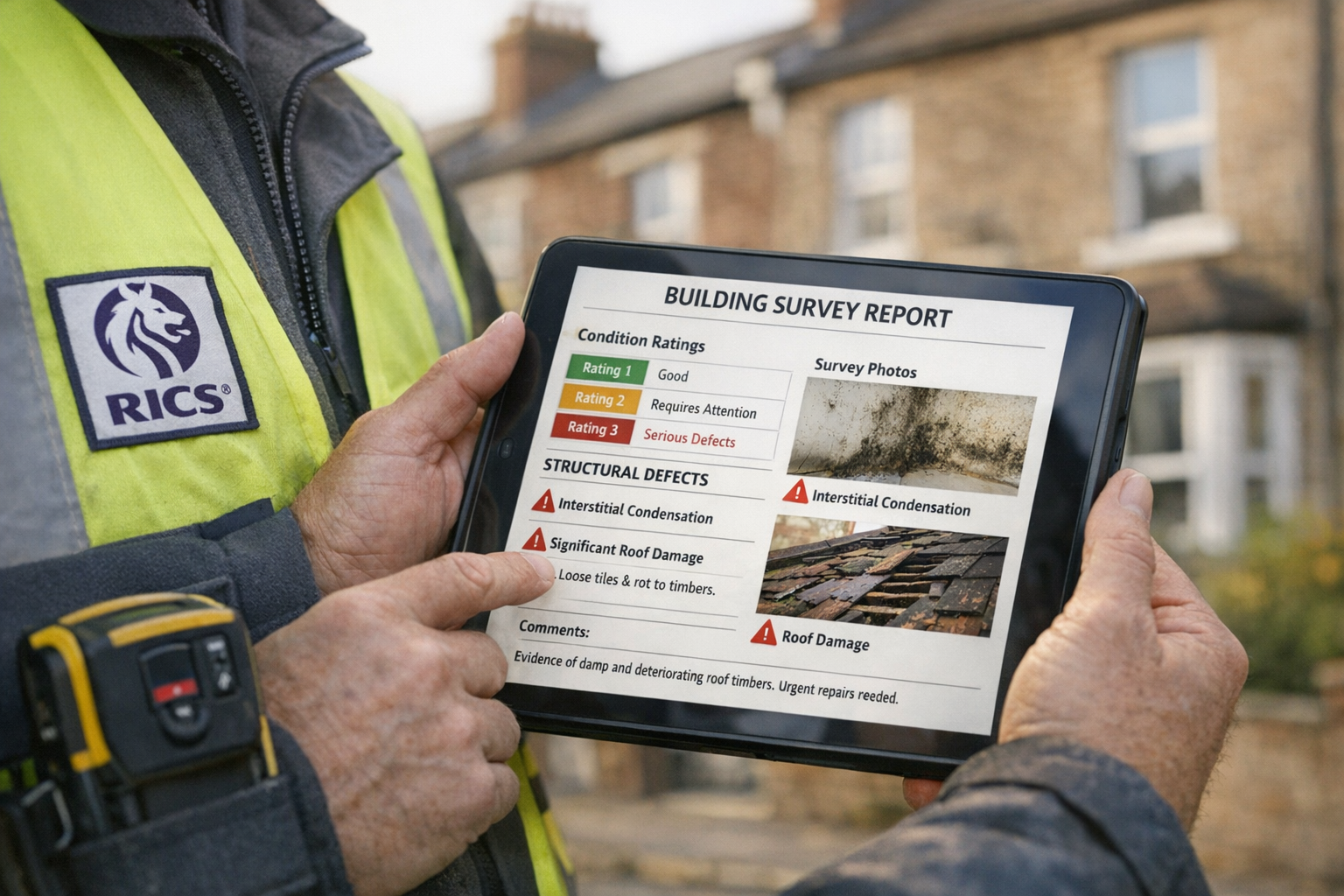
Building Survey Protocols for UK Construction Recovery: RICS Checklists from Q4 2025 Monitor into 2026 represent a comprehensive framework ensuring the UK construction sector's recovery proceeds on solid foundations. The modest recovery signals from Q4 2025 Construction Monitor data bring both opportunity and responsibility—opportunity to complete valuable projects and address housing and infrastructure needs, and responsibility to ensure those projects meet the highest standards of quality, safety, and sustainability.
The enhanced RICS protocols discussed throughout this guide—from strengthened Level 3 survey standards to AI integration requirements, from whole life carbon assessment to new regulatory compliance obligations—reflect lessons learned during challenging economic periods and position the surveying profession to deliver exceptional value during the recovery phase.
Key Success Factors
For successful implementation of these protocols:
✅ Embrace Technology: Leverage AI, thermal imaging, laser scanning, and drone surveys to enhance assessment comprehensiveness
✅ Prioritize Documentation: Maintain meticulous records protecting all stakeholders and facilitating informed decision-making
✅ Stay Current: Maintain CPD compliance and stay informed about evolving regulations and best practices
✅ Communicate Clearly: Translate technical findings into actionable recommendations clients can understand and implement
✅ Think Holistically: Consider not just immediate structural concerns but long-term sustainability, carbon implications, and regulatory compliance
Actionable Next Steps
For Property Developers and Construction Professionals 🏗️
- Commission comprehensive recovery-phase surveys for all stalled or paused projects before resuming work
- Budget appropriately for enhanced survey protocols—they're investments, not costs
- Engage RICS-qualified surveyors with specific recovery-phase experience
- Integrate sustainability assessments into project planning from the outset
- Maintain ongoing dialogue with surveyors throughout project completion
For Property Buyers and Investors 🏠
- Insist on Level 3 building surveys for any property with construction history concerns
- Verify surveyor credentials and relevant experience before engagement
- Request specific assessment of carbon performance and retrofit potential
- Ensure survey scope addresses all relevant 2026 regulatory requirements
- Use survey findings to inform negotiation and risk management strategies
For Surveyors 📋
- Complete required CPD on recovery-phase assessment protocols and new technologies
- Invest in advanced survey equipment including thermal imaging and moisture detection tools
- Develop expertise in carbon assessment methodologies and sustainability frameworks
- Enhance report writing to clearly communicate complex technical findings
- Build networks with structural engineers, building services consultants, and other specialists for multi-disciplinary assessments
The UK construction recovery presents both challenges and opportunities. With robust protocols, professional expertise, and commitment to excellence, the surveying profession will play a vital role in ensuring this recovery delivers quality, sustainable, and safe buildings that serve communities for generations to come.
For professional survey services applying these enhanced protocols, contact qualified chartered surveyors with proven expertise in recovery-phase assessments and comprehensive understanding of 2026 RICS standards.
References
[1] Things About Building Surveying You Need To Know In 2026 – https://mcessex.co.uk/2026/01/23/things-about-building-surveying-you-need-to-know-in-2026/
[2] pbctoday.co.uk – https://www.pbctoday.co.uk/news/planning-construction-news/five-hot-topics-for-surveyors-spring-2026/158511/
[3] Uk Influence And Advocacy Update January 2026 – https://www.rics.org/news-insights/uk-influence-and-advocacy-update-january-2026
[4] Building Surveying Standards – https://www.rics.org/profession-standards/rics-standards-and-guidance/sector-standards/building-surveying-standards
