
The rental property landscape in 2026 stands at a critical juncture. As Awaab's Law prepares to extend its reach from social housing to the private rental sector this October, chartered surveyors and property professionals face unprecedented demand for expert witness services. With approximately 4.6 million privately rented homes set to come under strict repair timeframes, the need for court-admissible evidence and professional testimonies in rental regulation disputes has never been greater. Expert Witness Testimonies in 2026 Rental Regulation Disputes: Preparing for Awaab's Law and Tenant Demand Surges represents more than just a regulatory shift—it signals a fundamental transformation in how property professionals must document, assess, and testify about damp, mould, and housing conditions.
Key Takeaways
- 📋 Awaab's Law extends to private landlords in October 2026, requiring 14-day investigation periods and 7-day repair commencement for serious health hazards affecting 4.6 million rental properties
- ⚖️ Expert witness demand will surge as enforcement actions increase, requiring surveyors to meet strict RICS standards and Civil Procedure Rules (CPR) Part 35 compliance
- 🔍 Evidence quality is paramount—court-admissible reports must include thermal imaging, moisture readings, photographic documentation, and clear causation analysis
- 💼 Professional indemnity and qualifications matter—expert witnesses need appropriate insurance, relevant accreditations, and demonstrable expertise in damp and mould pathology
- 🎯 Preparation is essential—surveyors must understand their duties to the court, maintain objectivity, and deliver clear, unbiased opinions regardless of who instructs them
Understanding Awaab's Law and Its 2026 Private Sector Extension
The Legislative Background
Awaab's Law emerged from tragedy—the preventable death of two-year-old Awaab Ishak from prolonged exposure to mould in social housing. The legislation initially targeted social housing providers, establishing strict timeframes for investigating and remedying damp and mould issues. Now, as 2026 approaches, the law's extension to private landlords marks a watershed moment for the rental sector.
Private landlords will face stringent obligations starting October 2026, including:
- 14-day investigation period after tenants report significant health hazards
- 7-day repair commencement once serious issues are identified
- Comprehensive documentation of all inspections and remedial actions
- Enforcement consequences including improvement notices, fines, and potential banning orders[1]
Timeline Considerations and Implementation Uncertainty
While October 2026 remains the targeted implementation date for private sector extension, property professionals should note ongoing discussions about potential delays. Some industry sources suggest the full rollout could extend to 2035 or 2037, though government intention clearly favours earlier implementation.[2] This uncertainty makes preparation even more critical—surveyors who develop expertise now will be positioned as market leaders regardless of the final timeline.
What This Means for Property Professionals
The expansion of Awaab's Law creates immediate implications for chartered surveyors and property experts:
🏠 Increased inspection demand: Landlords will require professional assessments to comply with investigation deadlines
📊 Documentation standards elevation: Reports must meet potential court scrutiny from the outset
⚖️ Expert witness opportunities: Disputes over compliance, causation, and remediation will require qualified testimony
💡 Specialisation value: Professionals with damp and mould expertise will command premium fees
For those conducting building surveys, understanding the specific requirements of Awaab's Law compliance assessments becomes essential to service delivery in 2026.
The Rising Demand for Expert Witness Testimonies in 2026 Rental Regulation Disputes
Why Expert Witnesses Are Becoming Essential
The convergence of stricter regulations, heightened tenant awareness, and enforcement powers creates perfect conditions for dispute escalation. Expert witness testimonies serve multiple critical functions in this environment:
Establishing causation: Determining whether mould results from structural defects, tenant behaviour, or inadequate ventilation requires specialist knowledge that courts cannot assess independently.
Quantifying compliance: Expert witnesses evaluate whether landlords met their 14-day and 7-day obligations under Awaab's Law, providing objective timelines and assessment quality reviews.
Assessing remediation adequacy: Disputes often centre on whether proposed or completed repairs genuinely address underlying problems—expert testimony clarifies technical sufficiency.
Valuing damages: When health impacts or property damage occur, expert witnesses calculate appropriate compensation based on industry standards and comparable cases.
The Types of Disputes Requiring Expert Testimony
Expert witnesses in rental regulation disputes typically encounter these scenarios:
| Dispute Type | Expert Role | Key Evidence Required |
|---|---|---|
| Compliance failures | Assess whether landlord met investigation/repair deadlines | Timeline documentation, correspondence records, inspection reports |
| Causation disputes | Determine root cause of damp/mould | Moisture readings, thermal imaging, building pathology analysis |
| Remediation adequacy | Evaluate if repairs address underlying issues | Pre/post-repair assessments, building science principles |
| Health impact claims | Connect property conditions to tenant health | Medical records correlation, exposure assessment, hazard quantification |
| Negligence allegations | Determine if landlord breached duty of care | Industry standards comparison, reasonable landlord test |
The Surveyor's Expanding Role
Chartered surveyors traditionally focused on property condition assessments now find themselves at the intersection of building science, legal compliance, and courtroom testimony. This evolution requires:
✅ Enhanced technical skills: Understanding building pathology, moisture dynamics, and remediation techniques at expert level
✅ Legal knowledge: Familiarity with Awaab's Law, Housing Health and Safety Rating System (HHSRS), and landlord obligations
✅ Communication abilities: Translating complex technical concepts into clear language for judges, juries, and solicitors
✅ Professional standards adherence: Meeting RICS Practice Standards and CPR Part 35 requirements
Those already experienced in dilapidations surveys possess transferable skills for rental dispute work, though specific damp and mould expertise remains essential.
Market Dynamics Driving Demand
Several factors compound the surge in expert witness requirements:
📈 Enforcement intensity: Local authorities receive enhanced powers to issue improvement notices and fines, increasing formal dispute frequency[1]
📈 Tenant empowerment: Greater awareness of rights under Awaab's Law encourages tenants to pursue legal remedies
📈 Insurance claims: Landlord insurance disputes over coverage for mould remediation require expert assessment
📈 Criminal prosecutions: Serious breaches may result in criminal proceedings where expert testimony proves essential
Preparing Court-Admissible Reports: RICS Standards and Evidence Requirements

The Foundation: CPR Part 35 Compliance
Expert witnesses in England and Wales operate under Civil Procedure Rules (CPR) Part 35, which establishes fundamental principles:
🎯 Duty to the court: The expert's overriding duty is to the court, not the party instructing them
🎯 Independence: Experts must provide objective, unbiased opinions regardless of who pays their fees
🎯 Competence: Experts must only opine on matters within their genuine expertise
🎯 Clarity: Reports must be comprehensible to non-specialists while maintaining technical accuracy
Failure to meet CPR Part 35 standards can result in report rejection, cost penalties, or professional consequences. For surveyors accustomed to client-focused reporting, this shift to court-focused objectivity requires conscious adjustment.
Essential Components of Court-Admissible Reports
A comprehensive expert witness report for rental regulation disputes should include:
1. Qualifications and Experience Section
- Professional memberships (RICS, CABE, etc.)
- Relevant qualifications and certifications
- Specific experience with damp, mould, and building pathology
- Previous expert witness experience
- Continuing professional development in relevant areas
2. Instructions and Scope
- Clear statement of questions posed
- Documents reviewed
- Site inspections conducted
- Limitations or constraints on the investigation
3. Factual Findings
- Property description and construction details
- Inspection observations with photographic evidence
- Moisture readings and thermal imaging results
- Ventilation assessment
- Timeline of reported issues and landlord responses
4. Technical Analysis
- Identification of damp/mould types and severity
- Causation analysis (structural defects, condensation, penetrating damp, rising damp)
- Assessment of health hazard significance
- Evaluation of landlord's investigation quality and timeliness
- Analysis of remediation adequacy
5. Expert Opinion
- Whether landlord complied with Awaab's Law timeframes
- Appropriateness of remedial actions
- Whether reasonable landlord would have acted differently
- Recommendations for adequate remediation
- Cost estimates for proper repairs
6. Statement of Truth
- Declaration that expert understands their duty to the court
- Confirmation that opinions represent genuine professional belief
- Acknowledgment that expert knows consequences of false statements
Evidence Standards and Documentation Requirements
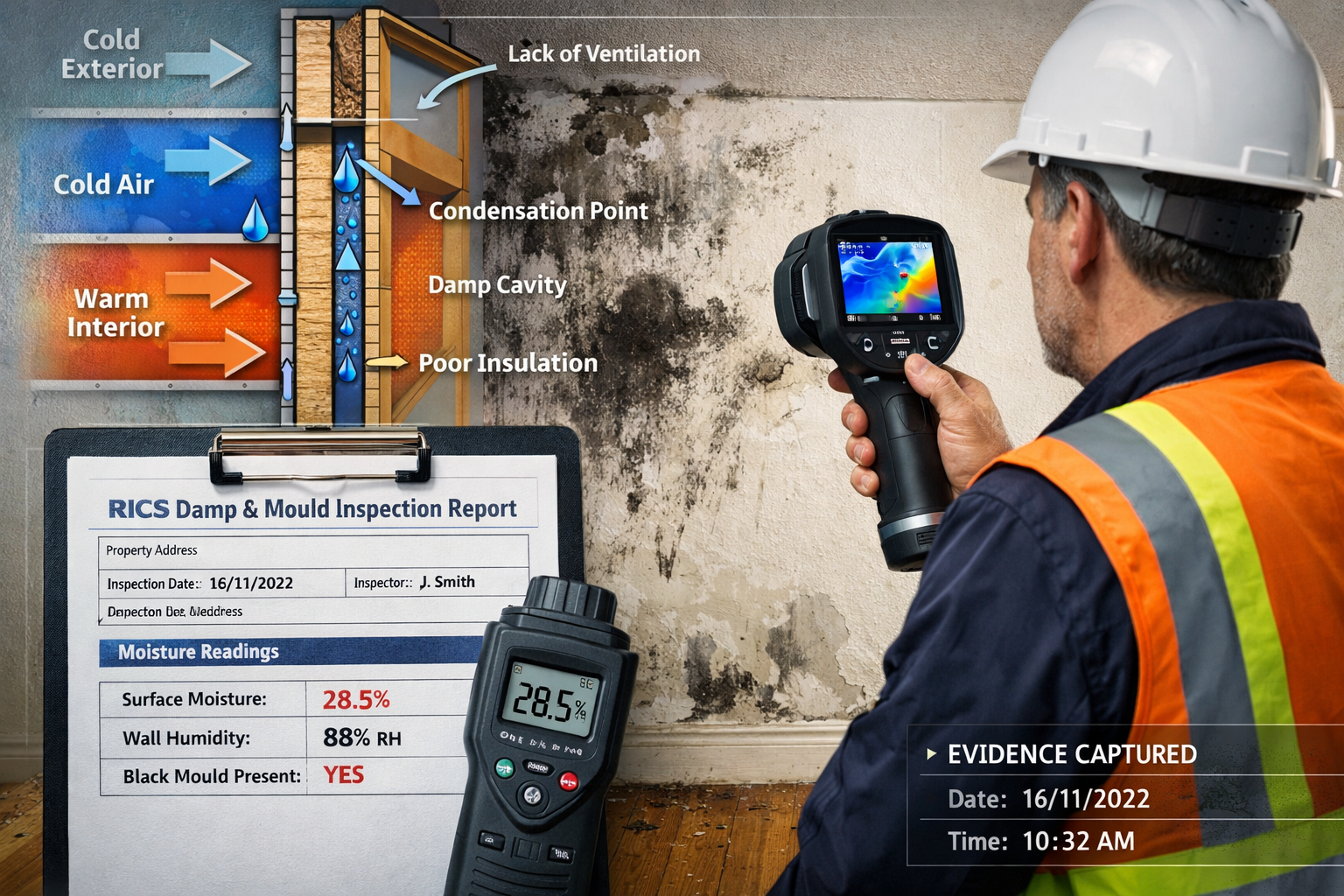
Court-admissible evidence in damp and mould cases demands rigorous documentation:
📸 Photographic evidence: Time-stamped, high-resolution images showing extent and location of mould growth, with scale references
🌡️ Moisture readings: Calibrated moisture meter readings taken at multiple points, recorded systematically with location mapping
🔍 Thermal imaging: Infrared thermography identifying cold spots, thermal bridges, and moisture patterns invisible to naked eye
📋 Ventilation assessment: Measurements of air changes per hour, identification of inadequate ventilation provisions
🧪 Sampling (when appropriate): Air quality testing or surface sampling to identify mould species and spore concentrations
📅 Timeline documentation: Comprehensive chronology of tenant reports, landlord responses, inspections, and remedial actions
For professionals conducting structural engineer reports, similar evidential rigour applies to rental dispute assessments.
RICS Practice Standards for Expert Witnesses
The Royal Institution of Chartered Surveyors provides specific guidance for members acting as expert witnesses:
RICS Practice Statement: Surveyors Acting as Expert Witnesses establishes requirements including:
- Appropriate professional indemnity insurance
- Conflicts of interest identification and management
- Fee arrangements that don't compromise independence
- Report format and content standards
- Ongoing competence maintenance
Best practices for RICS members include:
✔️ Specialisation focus: Only accept instructions within genuine areas of expertise
✔️ Independence maintenance: Avoid situations where prior involvement with property compromises objectivity
✔️ Clear communication: Explain technical matters accessibly without oversimplifying
✔️ Proportionality: Ensure investigation depth matches dispute value and complexity
✔️ Professional development: Maintain current knowledge of building pathology, regulations, and case law
Common Pitfalls to Avoid
Expert witnesses new to rental regulation disputes should guard against:
❌ Advocacy: Arguing for the instructing party rather than providing objective analysis
❌ Scope creep: Opining on matters outside genuine expertise (e.g., medical causation of health conditions)
❌ Insufficient investigation: Forming opinions without adequate site inspection or document review
❌ Technical jargon overload: Using terminology that obscures rather than clarifies
❌ Certainty overstatement: Failing to acknowledge limitations or alternative explanations
❌ Documentation gaps: Inadequate photographic or measurement evidence to support conclusions
Those experienced in rent review processes understand the importance of objective valuation—similar principles apply to expert witness objectivity in dispute resolution.
Practical Preparation Steps for Surveyors in 2026
Building Technical Expertise
Surveyors preparing for expert witness roles should prioritise:
Damp and mould pathology training: Understanding condensation dynamics, penetrating damp, rising damp, and mould species
Building physics knowledge: Thermal performance, ventilation requirements, and moisture movement through building fabrics
Remediation techniques: Current best practices for treating various damp and mould conditions
Health hazard assessment: Familiarity with HHSRS methodology and health impact evaluation
Regulatory framework: Comprehensive understanding of Awaab's Law, Housing Act provisions, and landlord obligations
Developing Expert Witness Skills
Technical competence alone doesn't create effective expert witnesses. Additional skills include:
🎤 Oral testimony preparation: Practice explaining complex concepts clearly under cross-examination pressure
📝 Report writing excellence: Develop clear, structured writing that balances technical accuracy with accessibility
⚖️ Legal process understanding: Familiarisation with court procedures, disclosure requirements, and expert conferences
🤝 Professional networking: Building relationships with solicitors, barristers, and other experts in the field
Professional Qualifications and Accreditations
Consider pursuing:
- RICS Registered Expert Witness status: Demonstrates commitment to expert witness standards
- Specialist qualifications: Damp and timber surveying diplomas or certificates
- CPD programmes: Regular training on building pathology and legal developments
- Bond Solon training: Respected expert witness skills courses
Insurance and Risk Management
Adequate professional indemnity insurance is non-negotiable for expert witness work. Ensure:
✓ Cover extends specifically to expert witness activities
✓ Limits are appropriate for potential claim values
✓ Retroactive cover protects against historical instruction claims
✓ Insurer is notified of expert witness work
Building Your Expert Witness Practice
Practical steps to establish expert witness credentials:
- Develop case studies: Document complex damp/mould cases with anonymised details demonstrating expertise
- Create marketing materials: Professional CV emphasising relevant qualifications and experience
- Network strategically: Attend legal conferences and property litigation events
- Publish expertise: Write articles or present on damp, mould, and Awaab's Law compliance
- Maintain records: Keep detailed CPD logs demonstrating ongoing competence
- Seek mentorship: Learn from established expert witnesses in the field
For surveyors across London and surrounding areas—from chartered surveyors in Chelsea to chartered surveyors in Essex—developing expert witness capabilities represents a significant practice development opportunity.
Case Study Scenarios: Expert Witness Testimonies in Action
Scenario 1: Compliance Timeline Dispute
Background: Tenant reports black mould in bedroom on 15th January 2027. Landlord arranges inspection on 3rd February (19 days later). Inspector identifies serious condensation mould requiring ventilation improvements. Works commence 18th February (15 days after identification).
Expert witness role: Assess whether landlord complied with Awaab's Law 14-day investigation and 7-day repair commencement requirements.
Key evidence: Email correspondence, inspection report dates, contractor quotations, weather conditions affecting scheduling.
Expert opinion: Landlord breached 14-day investigation requirement (took 19 days). However, 15-day gap between identification and work commencement exceeds 7-day requirement, constituting second breach. Expert recommends consideration of reasonable delays (contractor availability, materials ordering) but concludes timeframes exceeded permissible flexibility.
Scenario 2: Causation Analysis
Background: Landlord claims tenant caused mould through inadequate heating and excessive moisture generation. Tenant claims structural defects and inadequate ventilation are responsible.
Expert witness role: Determine primary causation of mould growth through objective building pathology assessment.
Key evidence: Thermal imaging revealing cold bridging at wall-ceiling junctions, inadequate trickle ventilation in windows, moisture readings suggesting condensation rather than penetrating damp, heating system capacity assessment.
Expert opinion: While tenant lifestyle factors may contribute, primary causation stems from inadequate ventilation provision and thermal bridging—both landlord responsibilities. Reasonable heating use by tenant would not prevent mould in these conditions. Landlord bears responsibility for remediation.
Scenario 3: Remediation Adequacy
Background: Following enforcement notice, landlord paints over mould with anti-mould paint without addressing underlying ventilation deficiencies. Tenant claims inadequate remediation.
Expert witness role: Evaluate whether remedial works adequately address the health hazard.
Key evidence: Pre- and post-work inspections, moisture readings showing continued elevated levels, absence of ventilation improvements, manufacturer specifications for anti-mould products.
Expert opinion: Cosmetic treatment without addressing causation (inadequate ventilation) constitutes inadequate remediation. Mould will recur within months. Proper remediation requires mechanical ventilation installation (positive input or mechanical extract) plus treatment of affected surfaces. Current works fail to satisfy Awaab's Law requirements.
Regional Considerations and Local Authority Enforcement
Enforcement Variation Across Jurisdictions
Local authority enforcement of Awaab's Law will vary based on resources, priorities, and housing stock characteristics. Expert witnesses should understand:
Urban vs. rural differences: High-density urban areas like central London may see more intensive enforcement than rural regions
Resource allocation: Well-funded authorities in areas like Hammersmith or Clapham may pursue cases more aggressively
Housing stock age: Older properties in historic areas face different challenges than modern builds
Demographic factors: Areas with vulnerable populations (elderly, children, immunocompromised) may prioritise damp/mould enforcement
Building Local Expertise
Surveyors should develop understanding of:
- Local authority enforcement approaches and priorities
- Regional building construction methods and common defects
- Climate and weather patterns affecting damp risk
- Local property market dynamics influencing landlord behaviour
Those operating across multiple regions—from chartered surveyors in North London to chartered surveyors in Sussex—benefit from understanding jurisdictional variations.
The Future Landscape: Beyond 2026
Evolving Standards and Expectations
As Awaab's Law matures, expect:
📊 Tightening timeframes: Potential reduction of investigation and repair periods based on implementation experience
📊 Expanded scope: Extension to other health hazards beyond damp and mould
📊 Technology integration: Increased use of continuous monitoring, IoT sensors, and predictive analytics
📊 Professional standards elevation: Higher baseline expectations for surveyor competence in building pathology
Emerging Technologies for Expert Witnesses
Forward-thinking experts should explore:
- Advanced thermal imaging: Higher resolution cameras revealing subtle defect patterns
- Moisture mapping software: 3D visualisation of moisture distribution throughout properties
- Mould species identification: Portable testing enabling rapid species determination
- Digital evidence management: Secure platforms for organising and presenting complex evidence
- Virtual inspections: Remote assessment capabilities supplementing physical inspections
Career Development Opportunities
The expansion of rental regulation creates sustained demand for:
✨ Specialist consultancies: Firms focusing exclusively on damp, mould, and rental compliance
✨ Training providers: Educating other surveyors in expert witness skills and building pathology
✨ Policy advisors: Contributing expertise to regulatory development and industry guidance
✨ Mediation services: Alternative dispute resolution reducing court burden
Conclusion
Expert Witness Testimonies in 2026 Rental Regulation Disputes: Preparing for Awaab's Law and Tenant Demand Surges represents both challenge and opportunity for chartered surveyors and property professionals. As October 2026 approaches and Awaab's Law extends to 4.6 million privately rented homes, the demand for qualified expert witnesses will intensify dramatically.
Success in this evolving landscape requires:
🎯 Technical excellence: Deep understanding of damp and mould pathology, building physics, and remediation best practices
🎯 Professional standards: Rigorous adherence to RICS guidance and CPR Part 35 requirements ensuring court-admissible evidence
🎯 Objectivity maintenance: Unwavering commitment to duty to the court over commercial interests
🎯 Clear communication: Ability to translate complex technical concepts into accessible language for legal professionals and courts
🎯 Continuous development: Ongoing investment in skills, knowledge, and professional credentials
The surveyors who invest now in developing expert witness capabilities will position themselves as market leaders in a rapidly expanding field. Whether conducting routine building surveys or providing specialist expert testimony, the principles remain consistent: thorough investigation, objective analysis, and clear reporting.
Actionable Next Steps
For surveyors preparing to enter or expand expert witness practice:
- Assess current capabilities: Honestly evaluate technical knowledge gaps in damp and mould pathology
- Pursue targeted training: Enrol in specialist courses addressing identified weaknesses
- Review insurance coverage: Ensure professional indemnity extends to expert witness activities
- Develop report templates: Create CPR Part 35 compliant formats for efficiency and consistency
- Build legal networks: Connect with solicitors and barristers handling housing disputes
- Document expertise: Create case studies and credentials demonstrating relevant experience
- Stay informed: Monitor Awaab's Law implementation and enforcement developments
- Consider accreditation: Pursue RICS Registered Expert Witness status or equivalent credentials
The rental regulation landscape of 2026 demands nothing less than excellence. Those who rise to meet these standards will find themselves not merely witnessing change, but shaping the future of housing quality and tenant protection across the UK.
For professional surveying services and expert guidance on rental property assessments, chartered surveyors in London and surrounding regions stand ready to support landlords, tenants, and legal professionals navigating this complex regulatory environment.
References
[1] Awaabs Law What Private Landlords Need To Know Before 2026 – https://objectivehealth.co.uk/news/awaabs-law-what-private-landlords-need-to-know-before-2026
[2] How Awaabs Law Will Be Stress Tested In 2026 – https://theintermediary.co.uk/2026/02/how-awaabs-law-will-be-stress-tested-in-2026/
