
The oldest baby boomers turn 80 in 2026, marking a historic inflection point that is fundamentally reshaping the property survey industry. This demographic tsunami, combined with accelerating urban migration patterns, is creating unprecedented demand for specialized property surveys that address the unique needs of aging populations and high-density urban development. Demographic Shifts Driving Survey Demand: Tailoring Property Surveys for Aging Populations and Urban Migration in 2026 represents more than just a market trend—it signals a complete transformation in how property professionals assess, evaluate, and certify buildings for an evolving population.
As the population aged 75+ is projected to grow by more than 4 million people by 2030[1], property surveyors face mounting pressure to adapt their methodologies, expand their expertise, and develop new assessment frameworks. Simultaneously, affordability pressures and lifestyle preferences are driving massive urban migration, creating complex survey challenges in dense metropolitan environments where every square foot matters.
Key Takeaways
✅ Historic demographic inflection: The oldest baby boomers turning 80 in 2026 drives senior housing demand to record levels, with occupancy rates expected to climb above 90 percent—potentially the highest in 20 years[1][2]
✅ Massive homeownership transition: Between 2026 and 2036, between 13.1 million and 14.6 million older adults will exit homeownership—at least a 42 percent increase over the previous decade[3]
✅ Critical supply shortage: Senior housing inventory grew by just 1% in 2026, the lowest level since 2006, while demand accelerates exponentially[6]
✅ Survey specialization imperative: Property surveyors must develop expertise in accessibility assessments, age-friendly design verification, and urban infill development challenges
✅ Middle-market opportunity: Middle-income seniors will comprise 44 percent of all older adult households by 2033, creating demand for cost-effective survey solutions tailored to value-oriented properties[1]
Understanding the 2026 Demographic Landscape
The Silver Tsunami Reaches Critical Mass
The demographic transformation reshaping property markets in 2026 represents decades of predictable but largely unaddressed population aging. The baby boomer generation, born between 1946 and 1964, has reached retirement age en masse, creating what industry experts call a "silver tsunami" of housing demand and transition.
Key demographic drivers include:
- 📊 Population aged 75+ growing by 4+ million by 2030[1]
- 🏠 65-74 age group reaching approximately 16.4 million homeowners by 2026[3]
- 📈 2.8 million homeowner growth in the 65-74 segment between 2016-2026[3]
- 🔄 13.1-14.6 million older adults exiting homeownership by 2036[3]
This demographic shift creates structural demand independent of economic cycles. Unlike traditional real estate markets that fluctuate with interest rates and employment trends, aging-driven housing transitions follow predictable biological and lifestyle timelines.
Urban Migration Patterns Intensify
Parallel to population aging, urban migration continues accelerating in 2026, driven by multiple converging factors:
Affordability pressures force families and retirees alike to seek housing markets with favorable property tax structures, reasonable insurance costs, and predictable maintenance expenses[2]. States offering tax advantages for seniors and moderate living costs attract substantial migration flows.
Lifestyle preferences increasingly favor walkable urban environments with access to healthcare, cultural amenities, and social connections. Today's seniors enter communities before care needs escalate, motivated by social engagement and reduced maintenance burdens rather than medical emergencies[2].
Economic consolidation concentrates employment and services in metropolitan areas, creating multi-generational migration patterns where younger workers and retiring parents both gravitate toward urban centers—albeit for different reasons.
How Demographic Shifts Driving Survey Demand: Tailoring Property Surveys for Aging Populations and Urban Migration in 2026 Transforms Survey Practice
Specialized Assessment Requirements for Senior Housing
The explosion in senior housing demand creates immediate needs for surveyors who understand age-specific property requirements. Traditional property survey approaches must evolve to address accessibility, safety, and age-friendly design elements that weren't priorities in conventional residential assessments.
Critical survey considerations for senior housing include:
| Assessment Category | Key Survey Elements | Why It Matters |
|---|---|---|
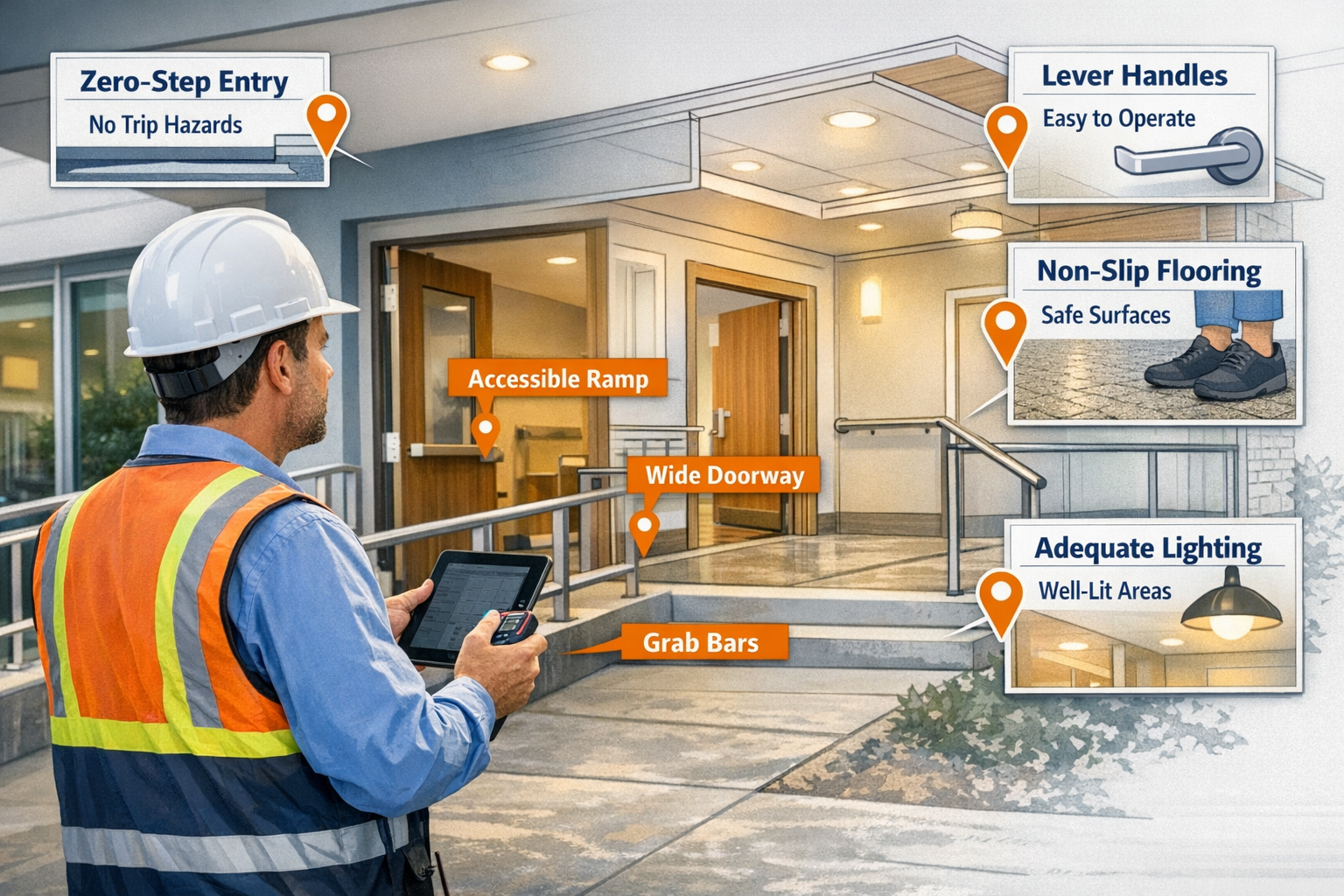
| Accessibility | Zero-step entries, doorway widths (36"+), corridor widths, elevator capacity | Ensures wheelchair and walker accessibility; compliance with ADA and local codes |
| Safety Features | Grab bar reinforcement, non-slip flooring, adequate lighting (50+ foot-candles), emergency call systems | Prevents falls—the leading cause of injury among seniors |
| Structural Adaptability | Load-bearing wall identification, ceiling heights for lifts, bathroom reinforcement capacity | Enables future modifications as care needs increase |
| HVAC & Air Quality | Air exchange rates, humidity control, allergen filtration, temperature zoning | Critical for respiratory health in aging populations |
| Egress & Emergency | Multiple exit routes, visual fire alarms, refuge areas, emergency lighting | Life safety requirements intensify with mobility limitations |
Professional surveyors conducting Level 3 building surveys for senior housing properties must expand their inspection protocols to include these age-specific elements. A comprehensive building survey for a senior living facility requires substantially more time and specialized knowledge than comparable residential properties.
Product Diversification Demands Survey Flexibility
Developers responding to Demographic Shifts Driving Survey Demand: Tailoring Property Surveys for Aging Populations and Urban Migration in 2026 are creating diverse property types that blur traditional classification boundaries:
Active adult 55+ communities combine residential amenities with recreational facilities, requiring surveyors to assess both housing units and shared amenity spaces including fitness centers, pools, and community buildings.
"Independent Living Lite" (IL Lite) hybrid models offer minimal services with optional care packages, creating survey challenges around service infrastructure that may or may not be utilized. Surveyors must verify that utility systems, kitchen facilities, and common areas can accommodate both independent residents and those requiring meal services or housekeeping support.
Single-story cottages and villas with attached garages appeal to downsizing seniors seeking privacy and vehicle access[1]. These properties require traditional single-family survey approaches while also assessing age-friendly modifications and community infrastructure.
Middle-market properties targeting the 44 percent of older adult households in middle-income brackets by 2033[1] emphasize cost efficiency. Surveyors must balance thorough assessment with cost-effective service delivery, often recommending Level 2 surveys where appropriate rather than defaulting to comprehensive inspections.
Urban Infill Development Survey Challenges
Urban migration creates intense demand for infill development—building on vacant or underutilized urban parcels surrounded by existing structures. These projects present unique survey challenges that require specialized expertise.
Party wall considerations dominate urban infill projects. When constructing new buildings adjacent to existing structures, party wall surveys become essential. Understanding what party wall surveyors do helps developers navigate complex legal requirements while protecting neighboring property owners.
Subsidence and foundation challenges intensify in urban environments where excavation for new construction can affect adjacent buildings. Subsidence surveys identify existing settlement issues and establish baseline conditions before construction begins, protecting all parties from future disputes.
Drainage infrastructure in dense urban areas often operates at capacity. Drainage surveys must assess not only the development site but also downstream capacity and connections to aging municipal systems.
Vertical construction demands require surveyors to assess structural capacity for additional floors on existing buildings—a common urban densification strategy. This involves detailed structural analysis, load calculations, and foundation capacity assessments.
The Supply-Demand Imbalance Creating Survey Opportunities
Record Occupancy Meets Constrained Supply
The senior housing market in 2026 faces a paradoxical situation: soaring demand colliding with the lowest supply growth in two decades. NIC expects senior housing occupancy rates to climb above 90 percent in 2026, potentially reaching the highest occupancy rate in the 20 years that NIC MAP has tracked this data[1].
Yet inventory growth tells a starkly different story. Year-over-year inventory growth fell to its lowest level since 2006[1], with inventory growing by just 1% in 2026[6]. New units breaking ground have fallen below units arriving online—a condition last occurring in 2021 and 2009[1].
This supply constraint creates immediate opportunities for property surveyors:
🔍 Acquisition due diligence intensifies: As existing senior housing properties become increasingly valuable due to scarcity, investors demand thorough assessments. Commercial building surveys for senior housing portfolios require specialized knowledge of operational systems, regulatory compliance, and age-specific building performance.
🔍 Conversion and adaptive reuse accelerates: Developers convert hotels, office buildings, and other property types to senior housing. These conversions require comprehensive surveys assessing structural suitability, systems capacity, and modification feasibility.
🔍 Portfolio rebalancing drives valuation needs: Cap rate compression and debt maturity management drive increased transaction activity[5], creating demand for accurate property valuations that account for demographic-driven demand fundamentals.
The Development Gap Widens
To maintain 90% occupancy levels given projected demand growth, the senior living industry would need to develop new communities at twice its maximum historical pace annually for the next 20 years[5]. This represents an impossible target given current development constraints including:
- 💰 Construction cost inflation reducing project feasibility
- 🏗️ Labor shortages limiting development capacity
- 📋 Regulatory complexity extending approval timelines
- 💵 Financing challenges as lenders remain cautious
Some markets experience net unit contraction as properties convert to other uses or close at rates exceeding new openings[5]. This creates survey demand for:
Decommissioning assessments when senior housing facilities close or convert, requiring documentation of property condition, environmental compliance, and adaptive reuse potential.
Market feasibility studies incorporating demographic projections, competitive analysis, and site suitability assessments to identify viable development opportunities.
Regulatory compliance verification ensuring proposed developments meet evolving codes and standards for senior housing—requirements that vary significantly by jurisdiction.
Behavioral Shifts Changing Survey Requirements
Earlier Entry, Longer Stays
Unlike previous generations who entered senior communities only when care needs became acute, today's seniors increasingly choose these environments before health crises emerge[2]. This behavioral shift fundamentally changes what surveyors must evaluate.
Lifestyle amenities matter more: When residents enter communities while still active and healthy, recreational facilities, social spaces, and aesthetic appeal become critical assessment factors. Surveyors must evaluate:
- Quality and condition of fitness centers, pools, and activity spaces
- Common area design promoting social interaction
- Outdoor spaces including walking paths, gardens, and gathering areas
- Technology infrastructure supporting modern connectivity expectations
Longer occupancy periods increase: Residents entering at 70 rather than 80 may occupy units for 15-20 years instead of 5-10 years. This extended timeline intensifies focus on:
- Building durability and long-term maintenance requirements
- Systems designed for extended service life
- Flexibility for future care level transitions within the same property
- Financial sustainability of the operating entity
Multi-level care progression: Properties offering continuum of care from independent living through skilled nursing require complex survey approaches assessing multiple building types, regulatory environments, and operational systems within a single campus.
Affordability-Driven Decision Making
Housing affordability—influenced by property taxes, insurance costs, and maintenance burdens—drives senior migration and housing choices more significantly than climate or amenities[2]. This economic reality shapes survey priorities.
Total cost of ownership analysis becomes essential. Surveyors must identify:
- Deferred maintenance requiring near-term capital investment
- Energy efficiency affecting ongoing utility costs
- Systems approaching end-of-life requiring replacement
- Property tax assessment accuracy and appeal opportunities
Value engineering opportunities: For middle-market properties targeting cost-conscious seniors, surveys should identify areas where strategic improvements deliver maximum value without premium costs.
Operational efficiency assessment: For senior housing operators, commercial property surveys should evaluate operational efficiency including staffing requirements, maintenance accessibility, and systems automation potential.
Regional Variations in Demographic Shifts Driving Survey Demand
Geographic Hotspots and Survey Specialization
Demographic shifts don't impact all markets equally. Certain regions experience concentrated senior migration and urban densification, creating localized survey demand spikes.
Sun Belt migration continues: Traditional retirement destinations in Florida, Arizona, and the Carolinas see sustained senior in-migration. Surveyors in these markets must develop expertise in:
- Climate-specific building performance (hurricane resistance, extreme heat)
- Insurance requirements in high-risk coastal zones
- Seasonal occupancy patterns affecting property condition
- Water conservation and drought-resistant landscaping systems
Urban core revitalization: Major metropolitan areas attract both young professionals and active seniors seeking walkable, amenity-rich environments. Cities like London, Central London, and other urban centers require specialized survey expertise in:
- High-density construction techniques
- Shared infrastructure and party wall complexities
- Historic building adaptation and preservation requirements
- Mixed-use development assessment
Secondary market opportunities: Affordable mid-sized cities attract cost-conscious seniors and families priced out of primary markets. Areas like Buckinghamshire, Hampshire, and Oxfordshire see increased development activity requiring local survey expertise.
Suburban transformation: Inner-ring suburbs undergo densification as municipalities allow multifamily development in formerly single-family zones. Neighborhoods in Fulham, Putney, and Battersea exemplify this transition.
Climate and Environmental Considerations
Climate change awareness influences both senior migration patterns and property survey requirements in 2026.
Resilience assessment becomes standard practice, evaluating:
- Flood risk and drainage capacity given changing precipitation patterns
- Wildfire exposure in interface zones
- Extreme temperature performance of building envelopes and HVAC systems
- Backup power and emergency systems for vulnerable populations
Sustainability features appeal to environmentally conscious seniors and reduce operating costs:
- Solar panel systems and renewable energy integration
- Water conservation technologies
- Energy-efficient building envelopes and systems
- Sustainable materials and indoor air quality
Environmental hazards require specialized assessment in older properties being converted or repurposed:
- Asbestos, lead paint, and other legacy materials
- Soil contamination on former industrial sites
- Radon and other naturally occurring hazards
- Mold and moisture issues affecting respiratory health
Technology Transformation in Property Surveys

Digital Tools Enhancing Survey Accuracy
The convergence of demographic demand and technological capability creates opportunities for surveyors who embrace modern assessment tools.
3D laser scanning captures precise spatial data, creating detailed as-built documentation essential for:
- Accessibility compliance verification (doorway widths, turning radii, slopes)
- Renovation planning and design coordination
- Historical condition documentation before construction
- Virtual property tours for remote investors and operators
Thermal imaging identifies building envelope deficiencies, moisture intrusion, and insulation gaps—critical for energy efficiency and indoor air quality in senior housing.
Drone surveys provide safe, efficient assessment of:
- Roof conditions without physical access risks
- Large campus layouts and site conditions
- Solar panel installations and mounting systems
- Drainage patterns and grading issues
Building Information Modeling (BIM) integration allows surveyors to deliver data in formats that support lifecycle facility management, particularly valuable for senior housing operators managing large portfolios.
Mobile reporting platforms enable real-time data capture, photo documentation, and client communication, improving efficiency and reducing report delivery timelines.
Data Analytics and Predictive Assessment
Advanced analytics transform surveys from static snapshots to predictive tools informing long-term planning.
Lifecycle cost modeling uses survey data to project:
- Capital replacement schedules and budgeting requirements
- Energy consumption and utility cost forecasts
- Maintenance staffing and operational expense projections
- Property value trajectories accounting for demographic trends
Comparative market analysis incorporates demographic data, occupancy trends, and competitive supply to contextualize individual property assessments within broader market dynamics.
Risk scoring algorithms evaluate properties across multiple dimensions:
- Physical condition and deferred maintenance
- Regulatory compliance and code conformance
- Market positioning and competitive vulnerability
- Operational efficiency and financial performance
Regulatory and Compliance Complexity
Evolving Standards for Senior Housing
Regulatory frameworks governing senior housing continue evolving in 2026, driven by safety incidents, advocacy efforts, and demographic pressure. Surveyors must stay current with:
Accessibility standards including ADA compliance, Fair Housing Act requirements, and local accessibility codes that often exceed federal minimums.
Life safety codes specific to residential care environments, including fire suppression systems, emergency egress, smoke compartmentation, and alarm systems.
Healthcare integration requirements as senior housing increasingly incorporates medical services, triggering healthcare facility regulations in addition to residential codes.
Environmental regulations governing everything from water quality to indoor air standards, particularly stringent for vulnerable populations.
Licensing and certification requirements varying by state and care level, with surveyors often asked to verify compliance as part of acquisition due diligence or operational audits.
Party Wall and Boundary Disputes
Urban densification intensifies property boundary issues and party wall complications. Understanding party wall dispute resolution becomes essential for surveyors working in dense urban markets.
Common scenarios include:
- Loft conversions requiring party wall agreements when modifications affect shared structures
- Excavation work near neighboring properties triggering party wall excavation notice requirements
- Shared infrastructure including chimneys and foundation elements
- Damage assessment when construction affects neighboring properties
Surveyors must understand when party wall agreements are needed and what happens if neighbors refuse to participate in the process.
Investment and Valuation Considerations
Cap Rate Compression and Market Dynamics
Investors expect continued cap rate compression as operators grow rents and revenues, with portfolio rebalancing and debt maturity management driving increased transaction activity in 2025-2026[5]. This investment activity creates sustained demand for survey services.
Acquisition due diligence for senior housing portfolios requires:
- Comprehensive property condition assessments across multiple facilities
- Operational systems evaluation including kitchens, laundries, and mechanical systems
- Regulatory compliance verification across multiple jurisdictions
- Deferred maintenance quantification and capital planning
Refinancing and recapitalization activity driven by debt maturities requires current property condition documentation and valuation support.
Development feasibility analysis combines site surveys, market analysis, and regulatory assessment to evaluate new project viability.
Specialized Valuation Methodologies
Senior housing properties require valuation approaches that account for operational performance, not just physical characteristics.
Income approach primacy: Unlike residential properties valued primarily through comparable sales, senior housing typically requires income capitalization methods accounting for:
- Occupancy rates and absorption trends
- Revenue per occupied unit and rate growth trajectories
- Operating expense ratios and efficiency metrics
- Capital reserve requirements and replacement costs
Specialized comparable selection: Meaningful comparables must match care level, market positioning, age, and operational model—not just physical size and location.
Demographic overlay: Valuations should incorporate local demographic projections, competitive supply pipelines, and migration trends affecting long-term demand fundamentals.
Training and Professional Development for Surveyors
Building Specialized Expertise
Demographic Shifts Driving Survey Demand: Tailoring Property Surveys for Aging Populations and Urban Migration in 2026 requires surveyors to expand their knowledge base significantly beyond traditional residential or commercial assessment skills.
Essential knowledge areas include:
🎓 Gerontology fundamentals: Understanding aging processes, common disabilities, and how physical environments support or hinder aging adults
🎓 Accessibility standards: Detailed knowledge of ADA, Fair Housing Act, and local accessibility codes including measurement protocols and compliance verification
🎓 Healthcare facility regulations: Familiarity with regulations governing assisted living, memory care, and skilled nursing environments
🎓 Senior housing operations: Understanding operational models, staffing patterns, service delivery, and how physical plant supports or constrains operations
🎓 Urban development dynamics: Expertise in infill development, party wall issues, historic preservation, and high-density construction
🎓 Demographic analysis: Ability to interpret population projections, migration data, and market fundamentals
Professional Certifications and Credentials
Surveyors serving these specialized markets benefit from relevant certifications:
- RICS (Royal Institution of Chartered Surveyors) membership demonstrating professional competence and ethical standards
- Specialist certifications in areas like accessibility, historic preservation, or environmental assessment
- Continuing education focused on senior housing trends, regulatory updates, and emerging technologies
Understanding what property surveyors do and what surveyors check during inspections provides foundational knowledge, but specialized markets require additional expertise.
Case Studies: Survey Challenges in Practice
Case Study 1: Active Adult Community Conversion
A developer acquired a struggling golf course property in a suburban market experiencing senior population growth. The conversion plan called for transforming the clubhouse into a community center and building 200 cottage-style homes for active adults 55+.
Survey challenges included:
- Environmental assessment: Former golf course required soil testing for pesticide and fertilizer contamination
- Infrastructure capacity: Existing water, sewer, and electrical systems designed for limited clubhouse use required major upgrades for residential density
- Accessibility compliance: New construction required full ADA compliance while preserving desirable architectural character
- Amenity evaluation: Clubhouse building assessment for conversion to fitness center, dining facility, and social spaces
- Drainage modification: Golf course irrigation and drainage systems required complete redesign for residential use
The comprehensive survey identified $2.3 million in additional infrastructure costs not included in initial budgets, allowing the developer to renegotiate the acquisition price and secure appropriate financing.
Case Study 2: Urban Infill Senior Housing
A senior housing operator planned an 80-unit assisted living facility on a narrow urban parcel surrounded by existing residential and commercial buildings in North London.
Survey challenges included:
- Party wall complexity: The site shared boundaries with four separate properties requiring individual party wall agreements and condition assessments
- Subsidence risk: Adjacent buildings showed signs of historic settlement requiring detailed foundation investigation
- Access constraints: Limited site access required creative solutions for construction staging and material delivery
- Utility coordination: Aging municipal infrastructure required upgrades and coordination with multiple utility providers
- Historic preservation: One adjacent building had protected status requiring vibration monitoring and protective measures
The survey process took four months and involved coordination with local party wall surveyors and multiple specialists. Early identification of constraints allowed the development team to modify designs and secure necessary approvals before significant capital commitment.
Case Study 3: Portfolio Acquisition Due Diligence
An institutional investor evaluated a 12-property senior housing portfolio across multiple markets for potential acquisition.
Survey scope included:
- Property condition assessments for all 12 facilities totaling 1,400 units
- Immediate repair identification requiring attention within 12 months
- Capital reserve planning projecting replacement costs over 10-year hold period
- Regulatory compliance verification across four different state regulatory environments
- Operational efficiency evaluation identifying opportunities for systems upgrades and energy improvements
The comprehensive survey revealed $8.7 million in deferred maintenance and near-term capital requirements—information that reduced the acquisition price by $12 million and informed the buyer's capital improvement strategy.
Future Outlook: Sustained Demand Through 2036
Long-Term Demographic Certainty
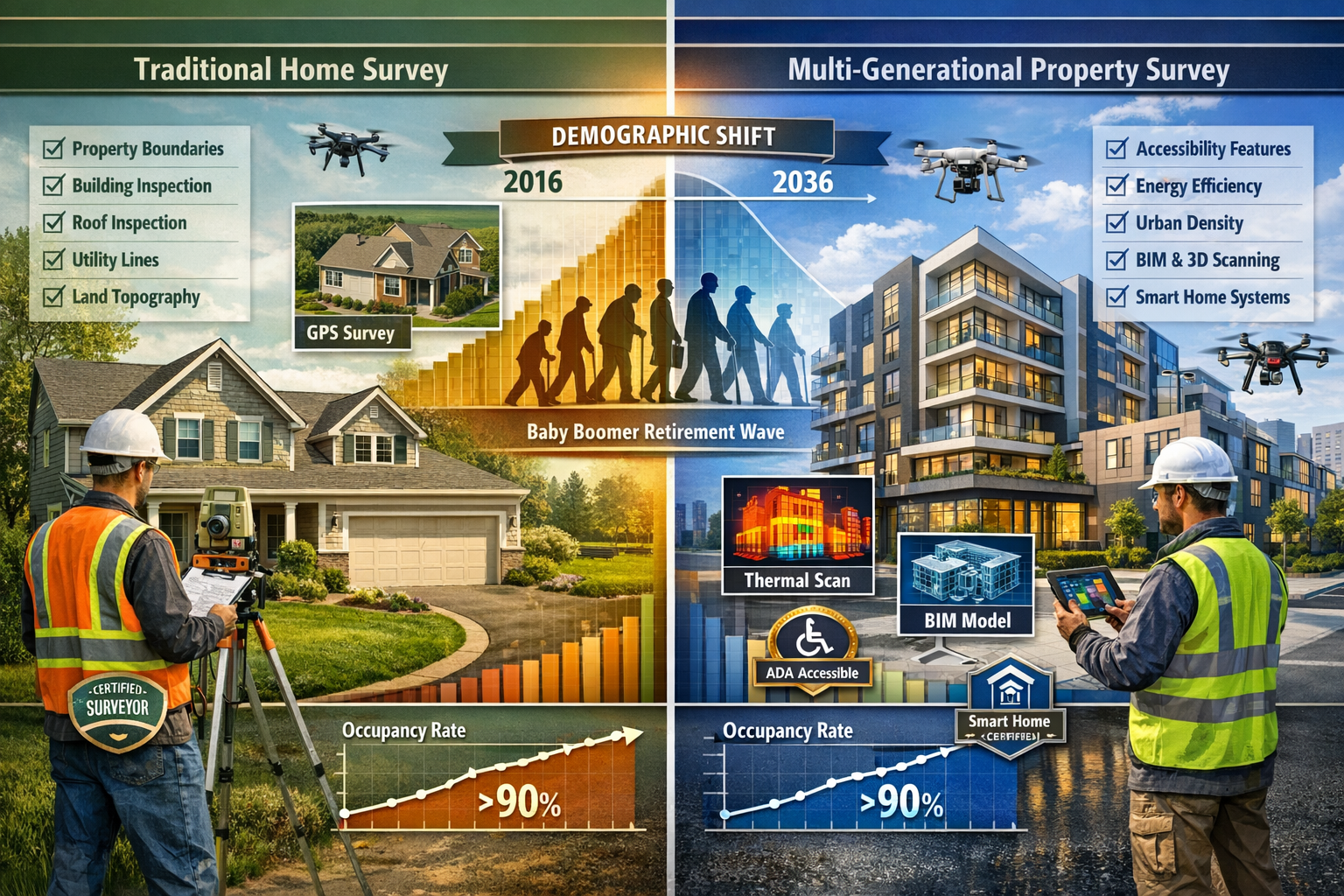
Unlike many market trends subject to economic volatility or policy changes, demographic shifts follow predictable patterns. The people who will turn 75 in 2030 are already 71 in 2026—their aging is certain.
Projected trends through 2036:
📈 Continued 75+ population growth: Adding millions annually to the senior housing target demographic
📈 Peak homeownership exits: Between 13.1 and 14.6 million older adults exiting homeownership between 2026-2036[3]—a 42% increase over the previous decade
📈 Middle-market expansion: Middle-income seniors reaching 44% of older adult households by 2033[1], creating sustained demand for value-oriented housing and survey services
📈 Urban densification persistence: Affordability pressures and lifestyle preferences maintaining urban migration regardless of short-term economic conditions
📈 Supply constraints continuing: Development pipeline insufficient to meet demand, maintaining tight markets and high property values
Technology Integration Accelerating
Survey technology will continue advancing, with artificial intelligence, machine learning, and automation enhancing capabilities:
- AI-powered defect detection identifying issues in photos and scans faster and more consistently than human inspection alone
- Predictive maintenance algorithms forecasting component failures and optimal replacement timing
- Automated report generation reducing administrative burden and accelerating delivery
- Virtual and augmented reality enabling remote inspections and enhanced client communication
- Blockchain documentation creating immutable property condition records supporting transactions and dispute resolution
Regulatory Evolution
Expect continued regulatory development addressing senior housing quality, safety, and accessibility:
- Enhanced accessibility standards potentially exceeding current ADA requirements
- Climate resilience requirements mandating backup power, extreme weather protection, and emergency preparedness
- Transparency mandates requiring detailed condition disclosure and standardized reporting
- Professional licensing expansion potentially creating specialized credentials for senior housing surveyors
Practical Recommendations for Survey Professionals
Positioning for Demographic-Driven Demand
Surveyors seeking to capitalize on Demographic Shifts Driving Survey Demand: Tailoring Property Surveys for Aging Populations and Urban Migration in 2026 should consider:
✅ Develop specialized expertise: Invest in training, certifications, and experience specifically related to senior housing and urban development
✅ Build strategic relationships: Cultivate connections with senior housing operators, developers, investors, and lenders active in these markets
✅ Invest in technology: Acquire modern survey tools including 3D scanners, thermal cameras, and drones that enhance service quality and efficiency
✅ Create specialized service packages: Develop standardized assessment protocols for different senior housing property types, enabling efficient, consistent service delivery
✅ Market demographic insights: Position services around understanding of demographic trends and their property implications, not just technical inspection capabilities
✅ Expand geographic coverage: Consider serving multiple markets experiencing different stages of demographic transition, diversifying revenue sources
✅ Develop educational content: Create resources helping clients understand demographic trends, survey importance, and property implications—establishing thought leadership
Service Differentiation Strategies
In increasingly competitive markets, differentiation becomes essential:
🎯 Specialization depth: Become the recognized expert in specific property types (active adult, assisted living, memory care) or geographic markets
🎯 Speed and responsiveness: Develop systems enabling faster turnaround than competitors without sacrificing quality
🎯 Technology integration: Offer digital deliverables, 3D documentation, and data formats supporting client systems and workflows
🎯 Comprehensive reporting: Provide context, market insights, and actionable recommendations beyond basic defect identification
🎯 Client education: Help clients understand findings, implications, and decision options—adding advisory value to technical assessment
Conclusion: Embracing the Demographic Transformation
Demographic Shifts Driving Survey Demand: Tailoring Property Surveys for Aging Populations and Urban Migration in 2026 represents a generational opportunity for property survey professionals. The convergence of predictable demographic trends, constrained supply, and evolving property requirements creates sustained demand for specialized survey expertise.
The oldest baby boomers turning 80 in 2026 marks just the beginning of a multi-decade transformation. With the 75+ population growing by more than 4 million by 2030[1], between 13.1 and 14.6 million older adults exiting homeownership by 2036[3], and senior housing occupancy climbing above 90 percent[1][2], the structural demand fundamentals remain extraordinarily strong.
Success in this evolving market requires more than technical competence in building assessment. Surveyors must understand demographic trends, aging processes, accessibility standards, urban development dynamics, and the operational realities of senior housing. They must embrace technology, develop specialized expertise, and position themselves as strategic advisors—not just inspectors.
Actionable Next Steps
For survey professionals seeking to capitalize on these demographic shifts:
-
Assess your current capabilities: Identify gaps in knowledge, technology, or experience related to senior housing and urban development
-
Invest in targeted education: Pursue training in accessibility standards, senior housing operations, and urban development challenges
-
Acquire appropriate technology: Evaluate tools like 3D scanners, thermal cameras, and mobile reporting platforms that enhance service delivery
-
Build market relationships: Connect with senior housing operators, developers, investors, and lenders in your geographic markets
-
Develop specialized services: Create service packages specifically designed for senior housing assessments, urban infill projects, and portfolio due diligence
-
Market your expertise: Communicate your specialized knowledge and understanding of demographic trends through content, speaking, and direct outreach
-
Monitor market developments: Stay current on demographic data, regulatory changes, and industry trends affecting survey demand
The demographic transformation reshaping property markets in 2026 and beyond is predictable, profound, and persistent. Survey professionals who recognize this opportunity, develop relevant expertise, and position themselves strategically will find sustained demand for their services throughout the coming decades.
The silver tsunami has arrived. The question isn't whether demographic shifts will drive survey demand—it's whether you're prepared to meet it.
References
[1] Senior Housing – https://www.pwc.com/us/en/industries/financial-services/asset-wealth-management/real-estate/emerging-trends-in-real-estate-pwc-uli/property-type-outlook/senior-housing.html
[2] What Will Drive Senior Living Occupancy Growth In 2026 – https://slfinvestments.com/2026/01/30/what-will-drive-senior-living-occupancy-growth-in-2026/
[3] Display – https://www.fanniemae.com/media/20281/display
[4] Emerging Trends In Real Estate United States And Canada 2026 – https://knowledge.uli.org/en/reports/emerging-trends/2026/emerging-trends-in-real-estate-united-states-and-canada-2026
[5] Top Senior Living Trends For 2026 – https://seniorhousingnews.com/2026/01/05/top-senior-living-trends-for-2026/
[6] Where Will Seniors Move – https://nationalmortgageprofessional.com/news/where-will-seniors-move
[7] Looking Ahead What 2026 Means For Senior Living – https://www.epicbrokers.com/insights/looking-ahead-what-2026-means-for-senior-living/
[8] Baby Boomers Senior Housing Crunch – https://www.housingwire.com/articles/baby-boomers-senior-housing-crunch/
