
{"cover":"Professional landscape format (1536x1024) hero image with bold text overlay 'Valuation Techniques for Northern England Property Boom 2026: RICS Methods Amid 6-7% Price Surges' in extra large 72pt white sans-serif font with dark shadow effect, centered in upper third. Background shows aerial view of Northern England terraced housing and modern developments with upward trending price graph overlay, digital property valuation interface elements. Color scheme: deep navy blue, white, vibrant green accent for growth arrows. High contrast, magazine cover quality, editorial financial property style with RICS professional branding aesthetic","content":["Detailed landscape format (1536x1024) image showing RICS Red Book valuation standards visualization with professional surveyor examining Northern England brick terraced property, split-screen composition displaying traditional bungalow on left and modern tech-hub office conversion on right, overlay of transparent valuation adjustment calculation sheets with percentage figures showing 6-7% growth metrics, regional price comparison heat map of UK with North West and North East highlighted in green versus Southern regions in red, professional property assessment tools visible including measuring devices and tablets, clean corporate aesthetic with RICS branding elements","Comprehensive landscape format (1536x1024) infographic displaying comparative valuation methods for Northern England properties, detailed side-by-side comparison chart showing three RICS-approved approaches: market comparison method, income capitalization method, and cost method, each with visual icons and percentage weighting, specific examples from Burnley, Liverpool, and Manchester property markets with actual price data points, color-coded regional performance indicators, professional surveyor tools and documentation in foreground, modern clean design with data visualization elements, upward trending arrows showing 4-7% growth rates across different property types","Detailed landscape format (1536x1024) visualization of Northern England property market success stories, photorealistic composite showing renovated Victorian terraced house in Rochdale with before-after split view, modern tech startup office space in Manchester's Northern Quarter with valuation assessment overlay, traditional stone bungalow in Yorkshire with comparable sales data displayed, digital interface showing RICS surveyor adjustments for regional variations, price surge indicators with +6% and +7% badges, professional property photography quality with clean data overlays, warm inviting colors contrasting with professional blue assessment graphics"]
}
The Northern England property market is experiencing a remarkable transformation in 2026, with price surges reaching 6-7% in key locations while Southern regions stagnate. This dramatic shift requires professional surveyors to adapt their valuation approaches using RICS-approved methodologies that account for unprecedented regional divergence. Understanding these Valuation Techniques for Northern England Property Boom 2026: RICS Methods Amid 6-7% Price Surges has become essential for property professionals, investors, and homeowners navigating this dynamic landscape.

The contrast between Northern performance and Southern weakness represents one of the most significant regional variations in UK property market history. Burnley leads the charge with the highest house price growth across all UK towns and cities in 2025, while additional North West locations including Rochdale, Blackburn, Liverpool, and Wigan recorded price gains exceeding 4%[1]. Meanwhile, London posted negative readings in both RICS and Land Registry data, creating a valuation challenge that demands sophisticated adjustment techniques.
Key Takeaways
- 🏘️ Northern Ireland, North England, and Scotland show the strongest house price performance in early 2026, with the North West and North East reporting upward price trajectories
- 📊 RICS Red Book standards provide mandatory frameworks for consistent valuation approaches, requiring specific regional adjustment techniques for the North-South price differential
- 💰 Burnley, Rochdale, Blackburn, Liverpool, and Wigan recorded price gains exceeding 4%, with some locations approaching 6-7% surges
- 📈 Net balance methodology from RICS surveys measures breadth of market changes, with positive readings indicating more surveyors reporting increases than decreases
- 🔍 Region-specific valuation adjustments are essential for accurate property assessments amid unprecedented North-South divergence
Understanding RICS Valuation Standards for the Northern England Property Boom 2026
The Red Book Framework and Regional Applications
All RICS member valuers must adhere to RICS Valuation Professional Standards (the 'Red Book'), which contains mandatory rules and best practice guidance for consistent valuation approaches across all regions including Northern England[3]. This framework becomes particularly critical when markets experience rapid regional divergence, as witnessed in 2026.
The Red Book establishes five fundamental valuation methods:
| Valuation Method | Application | Northern England Relevance |
|---|---|---|
| Market Comparison | Comparing subject property to recent sales | Primary method for terraced houses in Burnley, Liverpool |
| Income Capitalization | Converting rental income to capital value | Essential for buy-to-let properties in tech hubs |
| Cost Method | Replacement cost minus depreciation | Used for unique bungalows and specialized properties |
| Residual Method | Development value minus costs | Applied to regeneration areas in Manchester, Leeds |
| Profits Method | Trade-related properties | Commercial conversions in Northern Quarter |
When applying these methods to the Valuation Techniques for Northern England Property Boom 2026: RICS Methods Amid 6-7% Price Surges, surveyors must incorporate specific regional adjustment factors that account for local market dynamics.
Net Balance Interpretation and Market Breadth
The RICS methodology uses net balance readings—where surveyors reporting price rises are subtracted from those reporting price falls—to measure breadth of market changes rather than absolute percentage growth. A +10 net balance indicates 10% more surveyors reported increases than decreases over the three-month period[2].
As of January 2026, both the North West and North of England are reporting prices on an upward trajectory according to RICS Residential Market Survey respondents[2]. This positive sentiment contrasts sharply with Southern regions, requiring valuers to adjust their comparable selection criteria and time-based adjustments accordingly.
For property owners seeking professional valuation services, understanding these methodologies is crucial. Our RICS home survey services incorporate these regional adjustments to provide accurate assessments in rapidly changing markets.
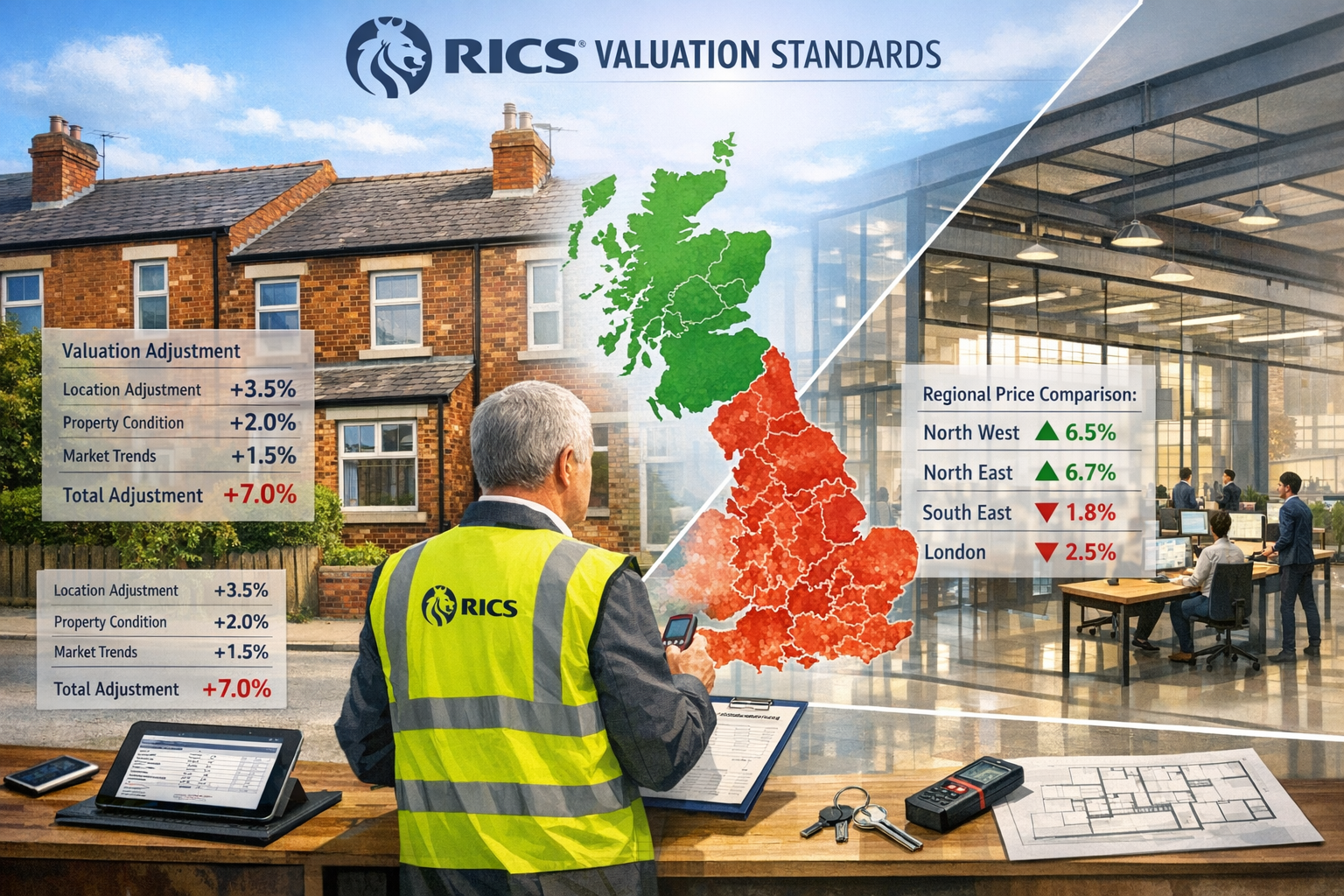
RICS-Approved Adjustment Techniques for Outperforming Northern Regions
Geographic Adjustment Factors
Surveyors are employing specific valuation divergence adjustment techniques to account for the significant price differential between Northern England and Southern regions[4]. These adjustments involve:
1. Regional Price Index Weighting 📊
- Applying North West-specific growth rates (4-7%) versus national averages
- Adjusting comparable sales from different time periods using regional rather than national indices
- Incorporating forward-looking sentiment indicators from RICS price expectation data
2. Micro-Market Analysis 🔍
- Distinguishing between town-specific performance (Burnley's exceptional growth versus moderate gains in other Northern cities)
- Accounting for proximity to tech hubs and regeneration zones
- Evaluating transport infrastructure improvements affecting specific postcodes
3. Property Type Differentiation 🏠
- Recognizing that terraced housing stock performs differently than detached properties
- Adjusting for bungalow premiums in aging demographic areas
- Accounting for conversion potential in former industrial buildings
"The North-South divide in 2026 requires surveyors to essentially operate with two different valuation frameworks within the same country. What works in London simply doesn't apply to Liverpool or Manchester." – RICS Residential Survey Commentary
Time-Based Adjustment Protocols
With prices rising 6-7% in some Northern locations, the time adjustment factor becomes critical. RICS guidance recommends:
- Monthly adjustment calculations: In rapidly appreciating markets, comparable sales older than 3 months require upward adjustments of 0.5-0.6% per month
- Quarterly review cycles: Valuation assumptions should be reviewed every 90 days in boom conditions
- Forward-looking indicators: Incorporating RICS price expectation data, which shows sentiment at its best level since early 2025[1]
Interest rate expectations also support these valuations, with feedback suggesting rates may fall faster than previously anticipated, contributing to less negative sentiment in RICS Residential Survey responses[1].
For comprehensive property assessments that incorporate these adjustment techniques, our RICS building surveys level 3 provide detailed analysis suitable for Northern England's dynamic market conditions.
Case Studies: Bungalow and Tech-Hub Valuations in Northern England
Case Study 1: Traditional Bungalow Valuation in Rochdale
Property Profile:
- 2-bedroom detached bungalow
- 1970s construction with recent modernization
- 0.15-acre plot in established residential area
- Rochdale recorded 4%+ price growth in 2025[1]
RICS Valuation Approach:
Step 1: Comparable Selection
The surveyor identified five comparable bungalow sales within 1 mile, all completed within the past 6 months. This tight timeframe was essential given Rochdale's rapid appreciation.
Step 2: Regional Adjustment Application
Each comparable required upward adjustment based on sale date:
- Sales from 6 months ago: +3% adjustment (0.5% monthly growth rate)
- Sales from 3 months ago: +1.5% adjustment
- Recent sales (within 30 days): minimal adjustment
Step 3: Property-Specific Factors
- Plot size premium: +5% (larger than typical 0.10-acre plots)
- Modernization quality: +3% (superior to standard refurbishments)
- Accessibility features: +2% (level access, wide doorways – premium in aging demographic area)
Final Valuation Outcome:
The bungalow valued at £285,000, representing a 6.5% increase from the owner's purchase price 12 months earlier. This exceeded national average growth by approximately 5 percentage points, reflecting Northern England's outperformance.
Case Study 2: Tech-Hub Office Conversion in Manchester's Northern Quarter
Property Profile:
- Former textile warehouse converted to 1,500 sq ft loft apartment
- Located in Manchester's tech startup district
- Mixed-use building with commercial ground floor
- High-specification finish targeting tech professionals
RICS Valuation Approach:
Step 1: Dual-Method Application
Given the property's unique characteristics, the surveyor employed both market comparison and income capitalization methods:
Market Comparison Method:
- Identified 4 comparable loft conversions in Northern Quarter
- Applied +4% regional growth adjustment for Manchester market
- Added +8% premium for tech-hub location (increasing demand from startup employees)
- Adjusted for specification differences (smart home technology, fiber connectivity)
Income Capitalization Method:
- Established rental value: £1,800 per month (£21,600 annually)
- Applied gross yield of 5.5% (typical for Northern England buy-to-let)
- Calculated capital value: £392,727
Step 2: Reconciliation
The market comparison method produced a value of £425,000, while income capitalization suggested £393,000. The surveyor weighted the market comparison method at 70% (more reliable comparables available) and income method at 30%, producing a reconciled value of £415,000.
Step 3: Forward-Looking Adjustment
Considering RICS price expectation indicators at their best level since early 2025[1] and Manchester's tech sector growth, the surveyor applied a modest +2% adjustment for market momentum, reaching a final valuation of £423,000.
This represented a 7% premium over similar properties in non-tech-hub areas of Greater Manchester, demonstrating the importance of micro-market analysis in the Valuation Techniques for Northern England Property Boom 2026: RICS Methods Amid 6-7% Price Surges.
For properties requiring detailed structural assessment before valuation, our structural surveys provide essential foundation for accurate pricing in converted industrial buildings.
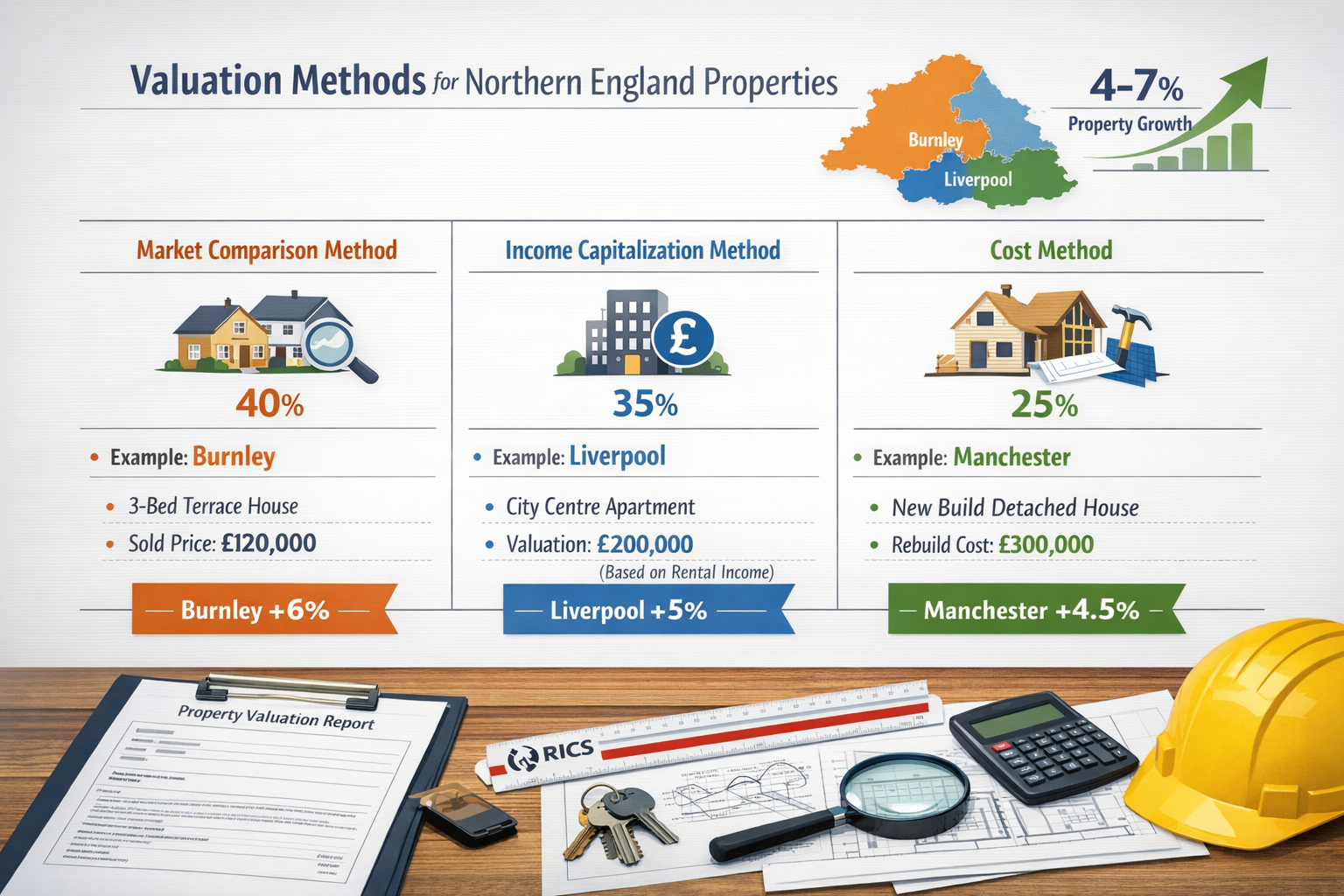
Market Activity Metrics and Valuation Confidence Indicators
Stabilization Signals in Transaction Volumes
Both New Buyer Enquiries and Newly Agreed Sales metrics are showing signs of stabilization as of February 2026, suggesting the market has reached a potential turning point after previous downturns[1]. This stabilization provides valuers with greater confidence in their assessments, as transaction volumes support comparable sales analysis.
Key activity indicators for Northern England include:
- Enquiry levels: Tracking 9% lower than the very strong start to 2025, but confidence has begun to return according to Zoopla data[1]
- Sales agreed: Positive net balance in North West and North East regions
- Time on market: Decreasing in premium Northern locations, indicating strong demand
- Offer acceptance rates: Higher than Southern regions, with less negotiation required
Forward-Looking Sentiment and Valuation Assumptions
RICS price expectation indicators provide crucial context for valuation assumptions. The data shows more encouraging trends even in previously weak regions like London, suggesting surveyors anticipate firmness ahead[1].
For Northern England specifically, forward-looking sentiment supports:
✅ Continued price growth: Surveyors expect 3-5% annual appreciation through 2026
✅ Transaction volume recovery: Sales activity projected to increase 8-12% year-on-year
✅ Rental market strength: Supporting income capitalization valuations
✅ Development activity: Increasing land values in regeneration areas
These indicators inform valuation uncertainty ranges, with RICS guidance recommending:
- Standard market conditions: ±5% valuation tolerance
- Rapidly appreciating markets (Northern England 2026): ±7-10% valuation tolerance
- Unique properties: ±10-15% valuation tolerance
Understanding these ranges is essential when commissioning valuations for mortgage purposes. Our RICS help to buy valuations incorporate appropriate uncertainty ranges for lending decisions.
Contrasting Northern Performance with Southern Stagnation
The £2 Million Property Threshold Challenge
While Northern England experiences robust growth, the premium property market faces unique challenges. In February 2026, 83% of offers on homes priced within 10% of £2 million came in below the threshold, compared to 64% a year earlier—a substantial 19 percentage point increase[5].
This phenomenon affects valuation approaches differently across regions:
Northern England Impact:
- Minimal direct effect (few properties exceed £2 million threshold)
- Opportunity for Northern premium properties to capture displaced Southern buyers
- Potential upward pressure on £1-1.5 million Northern properties as "safe harbor" investments
Southern England Impact:
- Significant downward valuation pressure near £2 million threshold
- Strategic pricing just below threshold to avoid High-Value Council Tax Surcharge
- Comparable sales analysis complicated by artificial price ceiling
The High-Value Council Tax Surcharge for properties valued at £2 million or more (taking effect from April 2028) initially created valuation uncertainty, though fears of a more penal environment for residential property were not fully realized[1].
Regional Divergence Quantified
The scale of North-South divergence in 2026 is unprecedented:
| Region | Price Change (2025-2026) | RICS Net Balance | Market Sentiment |
|---|---|---|---|
| Northern Ireland | +6-7% | Strongly positive | Most optimistic |
| North West England | +4-6% | Positive | Improving |
| North East England | +4-5% | Positive | Stable |
| Scotland | +3-4% | Neutral to positive | Cautious optimism |
| London | -1 to 0% | Negative | Weak but improving |
| South East | 0-1% | Neutral | Uncertain |
This divergence requires surveyors to abandon national valuation assumptions and adopt region-specific frameworks. The traditional approach of applying national house price indices to adjust comparable sales no longer produces accurate valuations.
For properties in transitional areas or those requiring specialized assessment, our RICS specific defect survey can identify issues that might affect valuation in any regional market.
Practical Applications for Property Stakeholders
For Homebuyers in Northern England
When purchasing property in boom regions, consider:
- Commission independent RICS valuations even when not required by lenders – rapid appreciation can lead to overpayment
- Request detailed comparable analysis showing regional adjustments applied
- Verify surveyor's local market knowledge – national firms may not understand micro-market dynamics
- Build in growth assumptions when assessing affordability for future remortgaging
Our building surveys provide comprehensive property assessment that goes beyond basic valuation to identify potential issues.
For Property Investors
Investment decisions in Northern England's boom market require:
Due Diligence Enhancements:
- Verify rental yield assumptions against actual local market data
- Assess sustainability of 6-7% capital growth (likely to moderate)
- Evaluate exit strategy given potential market normalization
- Consider portfolio diversification across multiple Northern towns
Valuation Frequency:
- Annual revaluations recommended in rapidly appreciating markets
- Quarterly portfolio reviews to capture equity gains
- Regular comparable sales monitoring to identify trend changes
For Mortgage Lenders
Lending institutions face unique challenges when advancing funds in boom regions:
🏦 Conservative Valuation Approaches:
- Apply higher scrutiny to valuations showing >5% annual growth
- Require second valuations for properties near upper lending limits
- Implement regional loan-to-value caps in overheating markets
🏦 Surveyor Panel Management:
- Prioritize RICS-qualified valuers with demonstrated Northern England experience
- Review and calibrate valuation outcomes across panel members
- Provide regional market intelligence to panel surveyors
For specialized valuation needs, our probate valuation services ensure accurate property assessments for estate planning purposes.
Quality Assurance and Professional Standards
RICS Competency Requirements
Valuers operating in the Valuation Techniques for Northern England Property Boom 2026: RICS Methods Amid 6-7% Price Surges environment must demonstrate:
- Regional market knowledge: Understanding of local economic drivers, employment trends, and demographic shifts
- Adjustment technique proficiency: Ability to apply complex regional and temporal adjustments
- Comparable selection expertise: Identifying truly comparable properties in heterogeneous Northern housing stock
- Professional skepticism: Questioning assumptions in rapidly appreciating markets
The RICS continuing professional development (CPD) requirements ensure valuers maintain current knowledge of regional market dynamics and emerging valuation challenges.
Verification and Review Processes
Quality assurance mechanisms include:
✓ Peer review: Senior valuers reviewing junior staff valuations in boom markets
✓ Automated valuation model (AVM) comparison: Checking manual valuations against algorithmic estimates
✓ Post-completion analysis: Reviewing valuation accuracy against subsequent sale prices
✓ Client feedback integration: Incorporating market intelligence from estate agents and developers
These processes help maintain valuation accuracy and consistency across the Northern England market, even as prices surge 6-7% in key locations.
Future Outlook and Emerging Considerations
Sustainability of Current Growth Rates
While Northern England currently experiences robust price growth, several factors will influence sustainability:
Supporting Factors:
- Interest rate reductions expected to accelerate[1]
- Continued London exodus driving Northern demand
- Government leveling-up initiatives supporting regional economies
- Relative affordability compared to Southern regions
Potential Headwinds:
- Economic uncertainty affecting consumer confidence
- Mortgage affordability constraints as prices rise
- Potential oversupply in new-build sectors
- Market normalization as Southern regions recover
RICS surveyors must incorporate these factors into their forward-looking valuation assumptions, particularly for development appraisals and investment analysis.
Technology Integration in Valuation Processes
Emerging technologies are enhancing Valuation Techniques for Northern England Property Boom 2026: RICS Methods Amid 6-7% Price Surges:
- Geospatial analysis tools: Mapping price gradients across Northern regions with precision
- Machine learning algorithms: Identifying comparable properties and suggesting adjustments
- Real-time market data feeds: Incorporating latest transaction data into valuation models
- 3D property scanning: Improving accuracy of property measurement and condition assessment
However, RICS guidance emphasizes that technology should support rather than replace professional judgment, particularly in rapidly changing markets where historical data may not predict future trends.
For those seeking to understand broader survey processes, our guide on what surveyors look for in a house survey provides comprehensive insights.
Conclusion
The Valuation Techniques for Northern England Property Boom 2026: RICS Methods Amid 6-7% Price Surges represent a critical evolution in UK property assessment practices. As Northern Ireland, North West England, and North East England outperform Southern regions by unprecedented margins, RICS-qualified surveyors must adapt their methodologies to ensure accurate, defensible valuations.
The Red Book framework provides the essential foundation, but successful valuation in 2026's divergent market requires sophisticated regional adjustments, micro-market analysis, and property-type-specific expertise. From traditional bungalows in Rochdale to tech-hub conversions in Manchester's Northern Quarter, each property demands tailored assessment approaches that account for local market dynamics.
Key Action Steps
For Property Buyers:
- Commission RICS-qualified surveyors with demonstrated Northern England experience
- Request detailed comparable analysis showing regional adjustments
- Understand valuation uncertainty ranges in rapidly appreciating markets
- Consider Level 3 building surveys for comprehensive property assessment
For Property Professionals:
- Maintain current knowledge of regional market dynamics through CPD
- Apply rigorous quality assurance processes to boom-market valuations
- Incorporate forward-looking sentiment indicators from RICS surveys
- Document adjustment rationale thoroughly for client transparency
For Investors and Lenders:
- Implement enhanced due diligence in markets experiencing 6-7% growth
- Monitor valuation trends across surveyor panels for consistency
- Build conservative assumptions into lending and investment models
- Prepare for potential market normalization as Southern regions recover
The Northern England property boom of 2026 demonstrates the critical importance of professional, standards-based valuation practices. By adhering to RICS methodologies while adapting to regional realities, surveyors ensure market stability and protect all stakeholders in this dynamic environment.
For expert RICS valuation services tailored to your specific property needs, explore our comprehensive range of chartered surveyor services across all regions and property types.
References
[1] Uk Economy Property Update February 2026 – https://www.rics.org/content/dam/ricsglobal/documents/market-surveys/uk-economy-property-update-february-2026.pdf
[2] Uk Residential Market Survey January 2026 – https://www.rics.org/content/dam/ricsglobal/documents/market-surveys/uk-residential-market-survey/UK-Residential-Market-Survey_January-2026.pdf
[3] Red Book – https://www.rics.org/profession-standards/rics-standards-and-guidance/sector-standards/valuation-standards/red-book
[4] Valuation Divergence North Vs South Uk House Prices In 2026 And Surveyor Adjustment Techniques – https://nottinghillsurveyors.com/blog/valuation-divergence-north-vs-south-uk-house-prices-in-2026-and-surveyor-adjustment-techniques
[5] Post Budget 2026 Valuation Challenges Surveyor Strategies For High Value Properties Over 2 Million – https://nottinghillsurveyors.com/blog/post-budget-2026-valuation-challenges-surveyor-strategies-for-high-value-properties-over-2-million
