
Over 40% of party wall disputes that reach formal adjudication in England and Wales involve excavation work — and the majority stem from notices that were never served, or served incorrectly. For any developer, homeowner, or surveyor managing urban construction projects in 2026, understanding the precise requirements of Party Wall Act Notices for Excavations Near Boundaries: Serving Valid Notices to Avoid Injunctions in 2026 is not optional. It is the difference between a project that runs on schedule and one that grinds to a halt under a court injunction.
This guide covers the legal triggers, mandatory notice content, common invalidity pitfalls, and the step-by-step process for getting it right — every time.
Key Takeaways
- ✅ Section 6 of the Party Wall etc. Act 1996 governs excavations within 3 metres or 6 metres of a neighbouring structure, depending on depth.
- ✅ A valid notice must be served at least one month before excavation begins and must include plans, sections, and specific structural details.
- ✅ Omitting plans and sections is the single most common reason a notice is declared invalid.
- ✅ Failure to serve a valid notice exposes the building owner to injunctions, full liability for damage, and significant project delays.
- ✅ If a neighbour disputes or ignores the notice within 14 days, a party wall surveyor must be appointed before work proceeds.
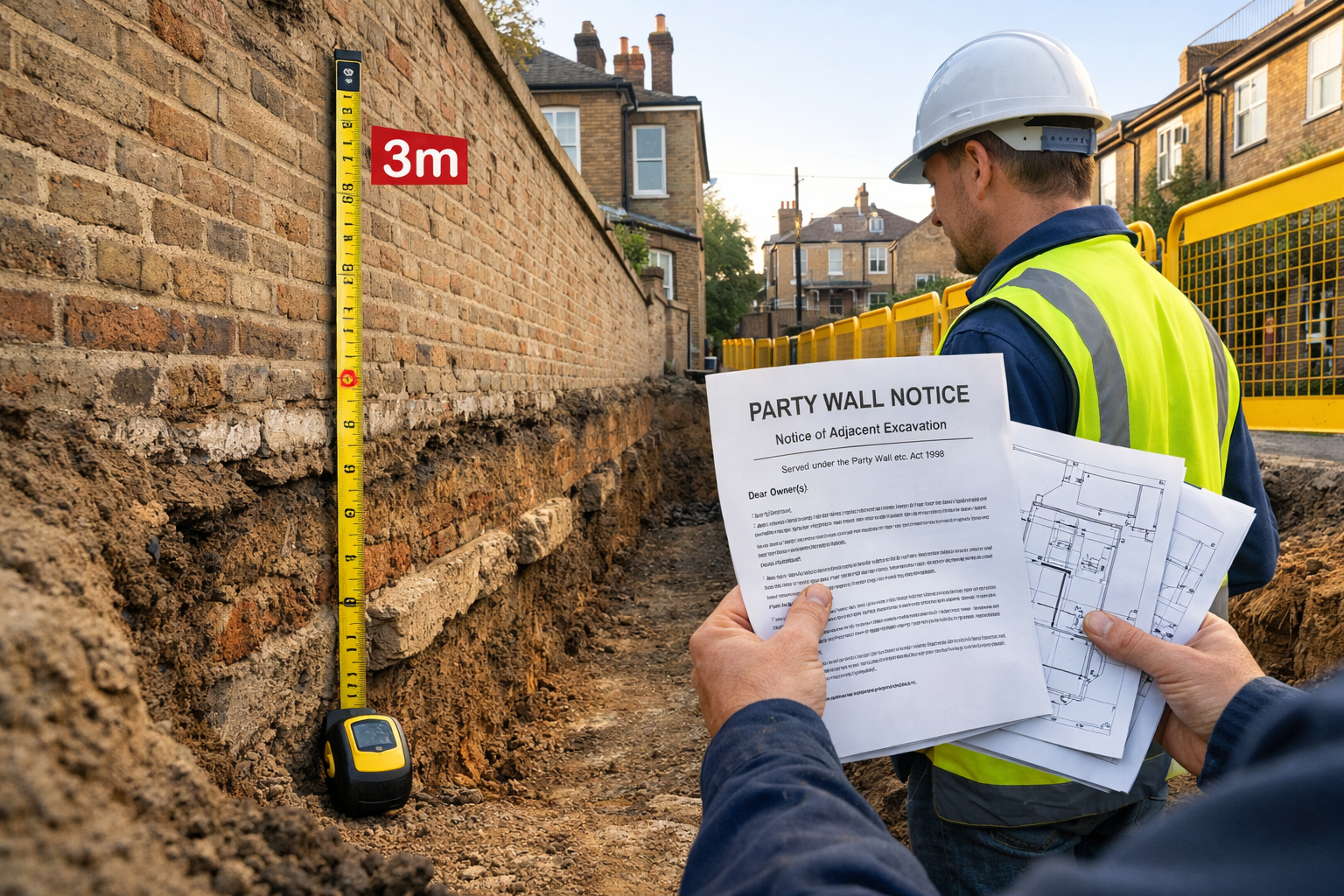
Understanding the Legal Triggers: The 3-Metre and 6-Metre Rules
What Section 6 of the Party Wall etc. Act 1996 Actually Covers
Section 6 of the Party Wall etc. Act 1996 is the specific provision that governs excavation and new foundation construction near a neighbour's building or structure [3]. It is distinct from Sections 1 and 2, which deal with new walls on boundaries and work to existing party walls respectively [5]. Many building owners mistakenly assume that only work on a shared wall requires notice — but excavation near a boundary triggers its own separate legal duty.
The Act applies when a building owner proposes to:
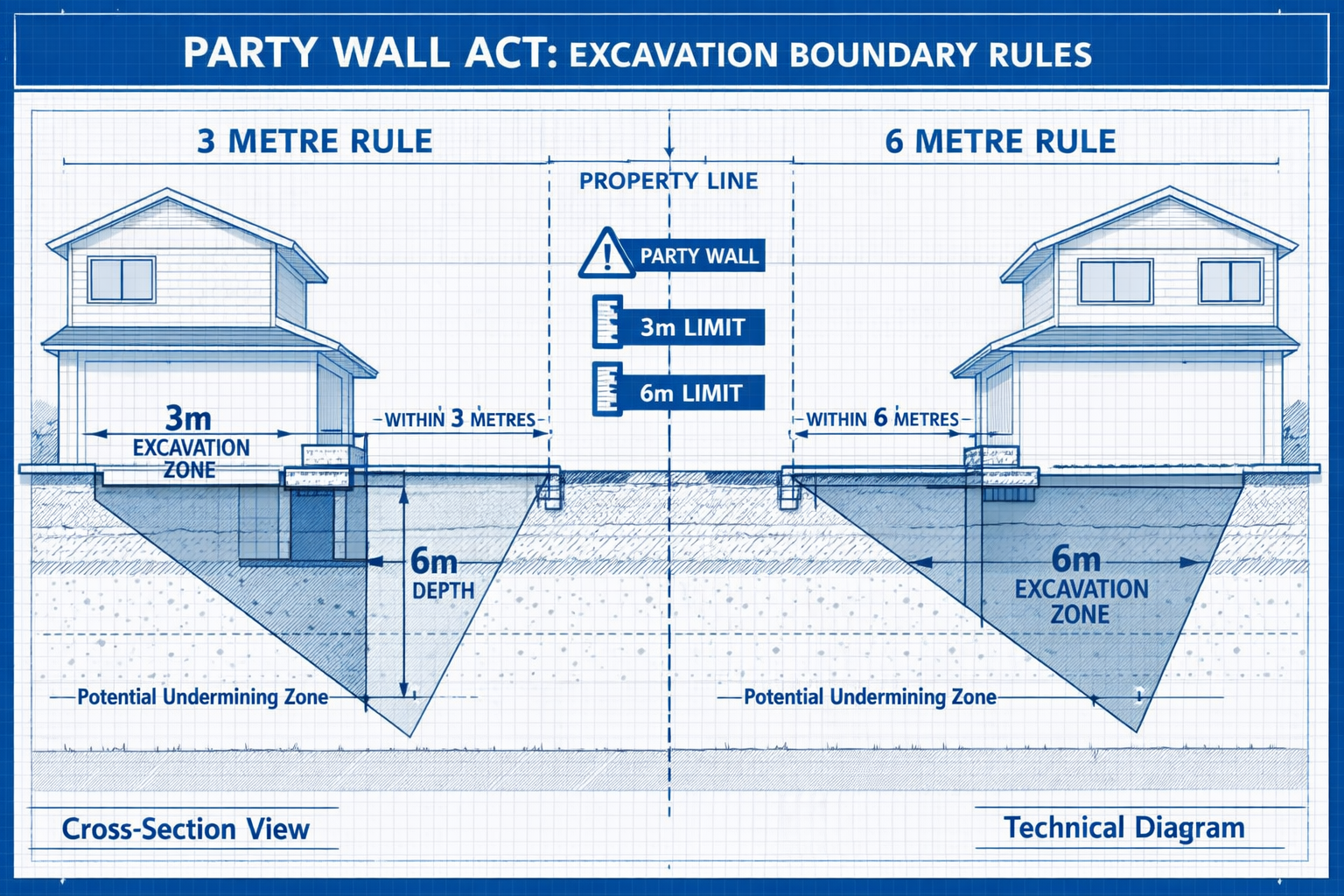
- Excavate within 3 metres of a neighbouring building or structure, where the proposed excavation will be deeper than the bottom of the neighbour's foundations [1][3].
- Excavate within 6 metres of a neighbouring building or structure, where the proposed work will intersect a line drawn downwards at a 45-degree angle from the bottom of the neighbour's foundations [1][2].
💡 Pull Quote: "Distance alone is not the trigger — depth relative to your neighbour's existing foundations is the critical legal test."
The Depth Check: Why Distance Alone Is Not Enough
This is the point most often misunderstood on high-volume urban projects. A building owner may be excavating just 2 metres from a boundary, but if the proposed foundation depth is shallower than the neighbour's existing foundations, Section 6 does not apply [3][4].
Conversely, even if the excavation appears modest, if it undercuts the neighbour's foundation level — even by a small margin — the notice obligation is triggered immediately.
Practical depth assessment checklist:
| Scenario | Distance from Neighbour | Depth vs. Neighbour's Foundations | Notice Required? |
|---|---|---|---|
| New basement extension | 2.5m | Deeper | ✅ Yes — Section 6 (3m rule) |
| Shallow drainage trench | 1.8m | Shallower | ❌ No |
| Deep pile foundations | 5.5m | Intersects 45° line | ✅ Yes — Section 6 (6m rule) |
| Surface-level landscaping | 1m | No excavation depth | ❌ No |
For a comprehensive overview of when these obligations arise, see this complete guide to party wall agreements which covers all triggering scenarios.
Serving a Valid Section 6 Notice: Precise Requirements and Common Pitfalls
Mandatory Content of a Section 6 Notice
The Party Wall etc. Act 1996 is explicit about what a valid notice must contain. Serving a notice that is missing any of the following elements renders it legally defective — and a defective notice offers no protection against injunctions [2][6].
A valid Section 6 Notice must include:
- Full name and address of the building owner serving the notice
- Full address of the property where the work is to be carried out
- Detailed description of the proposed works, including the type of excavation
- Proposed depth of the new foundations or excavation
- Intended location of the new wall or structure relative to the boundary
- Proposed start date of the works
- Plans and sections showing the depth, location, and relationship of the excavation to the neighbouring structure [2][3]
⚠️ Critical Warning: Plans and sections are a legal requirement, not a courtesy. Omitting them is the most frequently cited reason for notice invalidity in adjudication proceedings [6].
The One-Month Minimum Notice Period
The notice must be served a minimum of one calendar month before excavation begins [1][3]. This is non-negotiable. Serving notice on the day work is due to start — or even a week before — provides no legal protection whatsoever.
Timeline for a typical excavation project:
Week 1:    Commission structural engineer drawings
Week 2-3:  Prepare Section 6 Notice with plans and sections
Week 4:    Serve notice on all adjoining owners
Week 5-8:  One-month notice period (neighbour has 14 days to respond)
Week 6:    If no response after 14 days → dispute deemed to have arisen
Week 6-8:  Appoint party wall surveyor(s) if required
Week 9+:   Excavation may lawfully commence (subject to Award)
For detailed guidance on drafting the notice document itself, the party wall letter template and legal requirements guide provides practical templates aligned with current practice.
How to Serve the Notice: Method Matters
Under the Act, notice can be served by:
- Personal delivery to the adjoining owner
- Recorded delivery post to the last known address
- Delivery to the property if the owner's address is unknown
For urban projects with multiple adjoining owners — common in London terraces or apartment blocks — notice must be served individually on every affected owner, including leaseholders where relevant [5]. Serving notice on just one owner in a block of flats is a common and costly error.
Schedule of Condition: Essential Protection Before Work Starts
Before any excavation begins, a schedule of condition report should be commissioned for all adjacent properties [1]. This document records the pre-existing state of neighbouring structures — cracks, settlement, finishes — with photographs and written descriptions.
Without this report, any damage claim that arises during or after excavation becomes a dispute of word against word. With it, the building owner has clear evidence to defend against inflated or spurious claims. For properties where structural concerns are already present, a subsidence survey prior to notice service can also identify pre-existing movement that might otherwise be attributed to the excavation works.
What Happens When Notices Are Invalid or Ignored: Injunctions and Remedies in 2026

The Injunction Risk Is Real and Immediate
If excavation begins without a valid Section 6 Notice having been served, the adjoining owner has the right to apply to the courts for an injunction to halt the works [3]. In 2026, with courts increasingly familiar with party wall disputes and legal costs rising, this is not a theoretical risk — it is a routine enforcement mechanism.
The consequences of proceeding without notice include:
- 🔴 Injunction to stop all excavation — potentially mid-project
- 🔴 Full personal liability for any damage caused to the neighbour's property
- 🔴 Legal costs of the injunction proceedings, typically borne by the building owner at fault
- 🔴 Project delays of weeks or months while the legal position is regularised
- 🔴 Reputational damage for professional developers and contractors
💡 Pull Quote: "An injunction obtained mid-excavation can cost more in delay and remediation than the entire party wall process would have cost if followed correctly from the start."
For a deeper understanding of what happens when the process breaks down, see this guide on what to do when no party wall notice has been served — including urgent remedies available to both parties.
What Happens If the Neighbour Disputes or Does Not Respond?
If the adjoining owner:
- Consents in writing within 14 days → work may proceed as notified
- Does not respond within 14 days → a dispute is deemed to have arisen [1]
- Dissents → a dispute has arisen
In either dispute scenario, the matter must be resolved by appointing a party wall surveyor or surveyors — not by proceeding unilaterally [1]. The surveyor(s) will then produce a Party Wall Award setting out the conditions under which work may proceed. For guidance on this process, the party wall award guidance resource explains the Award's legal effect and what it must contain.
Urgent Remedies: Retrospective Notices and Agreed Awards
Where excavation has already begun without notice — whether through oversight or misunderstanding — there are limited but important remedies:
- Cease works immediately and seek legal advice
- Serve a retrospective notice (though this does not extinguish liability for work already done without authority)
- Agree an Award with the adjoining owner's surveyor to regularise the position going forward
- Commission a schedule of condition of the current state of the neighbour's property as a baseline for any future claims
Retrospective regularisation is possible but expensive and uncertain. Prevention through proper notice service is always the correct approach.
The Role of Party Wall Surveyors in High-Volume Urban Projects
For developers managing multiple simultaneous excavation projects — basement conversions, new-build terraces, commercial developments — a dedicated party wall surveyor is not a luxury. It is operational infrastructure.
A qualified party wall surveyor will:
- Assess whether Section 6 notice obligations are triggered for each plot
- Prepare and serve valid notices with compliant plans and sections
- Manage the 14-day response window and dispute resolution process
- Produce Party Wall Awards that protect the developer's programme
- Commission and review schedules of condition
For a full breakdown of the surveyor's role and responsibilities, see what a party wall surveyor does in London. For those dealing with damage that has already occurred, the damage to property in party wall disputes resource covers the claims process in detail.
Quick Reference: Section 6 Notice Validity Checklist
Use this checklist before serving any excavation notice in 2026:
- Confirmed excavation depth exceeds neighbour's foundation depth
- Measured horizontal distance to nearest neighbouring structure
- Applied correct rule (3m or 6m) based on depth and 45° line test
- Identified all adjoining owners (including leaseholders)
- Notice includes full name, address, and property description
- Notice includes detailed description of excavation works
- Notice states proposed foundation depth
- Notice states proposed start date (minimum 1 month away)
- Plans and sections attached showing depth and location
- Notice served by recorded delivery or personal service
- Schedule of condition commissioned for adjacent properties
- Diary reminder set for 14-day response deadline
Conclusion: Actionable Next Steps for 2026
Party Wall Act Notices for Excavations Near Boundaries: Serving Valid Notices to Avoid Injunctions in 2026 is not a bureaucratic formality — it is a legal framework with real enforcement teeth. The consequences of getting it wrong range from costly delays to full liability for structural damage and injunctions that can shut down a project entirely.
The path to compliance is straightforward when followed correctly:
- Assess depth and distance before any design is finalised — engage a structural engineer early.
- Identify all adjoining owners and serve individual notices on each one.
- Ensure every notice includes plans and sections — this is non-negotiable.
- Allow the full one-month notice period and track the 14-day response window.
- Appoint a party wall surveyor at the first sign of dispute or non-response.
- Commission a schedule of condition before a single spade enters the ground.
For professional support with excavation notices, party wall awards, and dispute resolution, explore the full range of party wall services available from qualified chartered surveyors experienced in London's complex urban environment.
References
[1] Party Wall Act And Boundary Excavation Rules – https://charrettelaw.co.uk/party-wall-act-and-boundary-excavation-rules/
[2] How To Serve A Party Wall Notice – https://onlinearchitecturalservices.com/how-to-serve-a-party-wall-notice/
[3] Excavation And The Party Wall Act Navigating The 3 And 6 Metre Rules For Foundations – https://www.partywallslimited.com/blog/excavation-and-the-party-wall-act-navigating-the-3–and-6-metre-rules-for-foundations
[4] Section 6 – https://www.partywall.expert/section-6/
[5] The Party Wall Act In Plain English – https://westvilleassociates.com/blog/the-party-wall-act-in-plain-english
[6] Party Wall Excavation Questions – https://collier-stevens.co.uk/faqs/party-wall-excavation-questions/
