
Structural collapse kills. In the UK, the Housing Health and Safety Rating System (HHSRS) has long classified structural instability as a Category 1 hazard — yet until 2026, no hard legal deadline forced landlords to act on it. That gap is now closing. Awaab's Law Phase 2, which comes into force in 2026, extends the same mandatory repair and mitigation deadlines that shook the social housing sector after Phase 1 to cover structural collapse, explosion risks, and a range of additional serious hazards [1][2][4].
For surveyors, landlords, and property professionals, this is not a minor regulatory update. It fundamentally changes how building survey protocols for structural collapse risks: Awaab's Law 2026 extensions and high-risk property assessments must be designed, documented, and delivered. Level 3 building surveys — once focused primarily on damp, mould, and cosmetic defects — must now incorporate advanced structural defect detection with the rigour that legal compliance demands.
Key Takeaways 📋
- Awaab's Law Phase 2 (2026) extends mandatory repair deadlines to structural collapse, explosion, and other serious HHSRS hazards in social housing [4].
- Social landlords face strict timelines: emergency hazards require 24-hour action; urgent repairs must begin within 48 hours [6].
- RICS Level 3 surveys are now the minimum standard for high-risk property assessments under the new framework.
- Surveyors must be trained to identify when routine repairs signal wider HHSRS structural hazards [4].
- The private rented sector (PRS) faces parallel pressure, with regulatory convergence expected through 2026 and beyond [7].
What Awaab's Law Phase 2 Actually Means for Structural Hazards
The Legislative Background
Awaab's Law takes its name from Awaab Ishak, a two-year-old boy who died in 2020 from prolonged exposure to dangerous mould in a Rochdale social housing property. The tragedy triggered Section 42 of the Social Housing (Regulation) Act 2023, which empowers the Secretary of State to set mandatory timeframes for investigating and repairing hazards in social rented homes [3][5].
Phase 1, which came into force in December 2024, focused on damp and mould. Phase 2 extends the same legal framework to all remaining Category 1 HHSRS hazards — including structural collapse, falling elements, explosions, and electrical hazards — with implementation deadlines taking effect in 2026 [1][2][4].
💬 "Phase 2 means structural instability is no longer a 'we'll get to it' issue. It carries the same legal weight as a mould emergency."
The Mandatory Repair Timeline Framework
Under Awaab's Law, the response framework operates in tiers [6][9]:
| Hazard Type | Investigation Deadline | Repair Start Deadline |
|---|---|---|
| Emergency hazard (risk to life) | Within 24 hours | Within 24 hours |
| Urgent hazard | Within 48 hours | Within 48 hours |
| Non-emergency HHSRS hazard | Within 14 days | Within a reasonable period |
Structural collapse sits firmly in the emergency or urgent category in most cases. A cracked load-bearing wall, failing lintel, or compromised foundation is not a defect that can wait for a quarterly maintenance cycle.
Who Is Affected in 2026?
The primary duty falls on registered social landlords (RSLs) and local authority housing providers [5]. However, the private rented sector is not immune. The Renters' Rights Bill, progressing through Parliament alongside Awaab's Law, is expected to apply equivalent hazard response obligations to private landlords by 2026 [7]. This creates a unified compliance landscape where building survey protocols for structural collapse risks must meet the same standard across tenures.
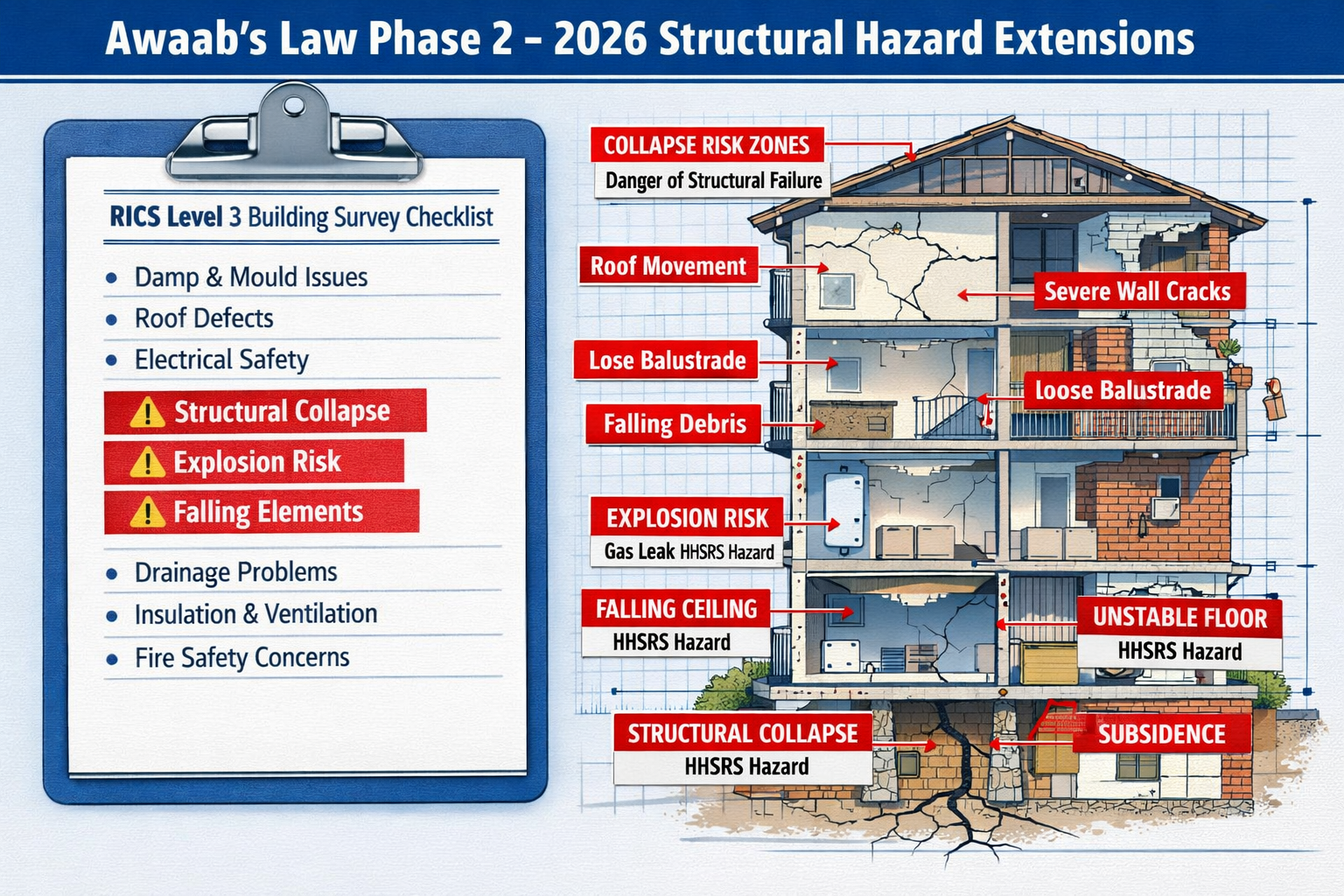
Building Survey Protocols for Structural Collapse Risks: Awaab's Law 2026 Extensions and High-Risk Property Assessments — The RICS Framework
Why Level 3 Surveys Are Now the Baseline
A Level 1 or Level 2 survey was never designed to identify latent structural failure. The RICS Level 3 building survey — formerly the Full Structural Survey — is the only survey type that provides the depth of investigation required to identify, classify, and report on structural collapse risks under the new legal framework.
For anyone purchasing or managing a high-risk property in 2026, a full structural survey is no longer optional — it is the foundation of legal compliance.
The RICS Structural Collapse Risk Checklist
A compliant Level 3 survey for high-risk properties should now include the following elements:
🔍 External Structural Inspection
- Crack mapping: width, depth, pattern, and direction of all visible cracks
- Assessment of load-bearing wall integrity (brick, block, concrete, or steel frame)
- Inspection of lintels, arches, and openings for deflection or failure
- Roof structure assessment: rafters, purlins, ridge board, and truss integrity
- Chimney stack stability and flaunching condition
- Foundation movement indicators: stepped cracking, window/door frame distortion
🔍 Internal Structural Inspection
- Floor structure: joist condition, bearing points, notching, and drilling compliance
- Ceiling structure: plasterboard fixing, joist integrity, and sagging indicators
- Internal load-bearing wall identification and condition
- Staircase structural integrity
- Signs of previous underpinning or structural intervention
🔍 Advanced Defect Detection Tools
- Thermal imaging cameras (identify moisture ingress and thermal bridging)
- Damp meters and hygrometers
- Crack monitors (for ongoing movement assessment)
- Borescope cameras (for concealed voids and cavities)
- Ground-penetrating radar (for foundation assessment in high-risk cases)
⚠️ Critical point: Surveyors must now be trained to recognise when a repair request — a sticking door, a cracked ceiling, a bouncy floor — is actually a symptom of a wider HHSRS structural hazard requiring immediate escalation [4].
Explosion and Gas Hazards: The Overlooked Phase 2 Extension
Structural collapse is not the only new hazard covered by Phase 2. Explosion risks — primarily from gas leaks, faulty boilers, and inadequate ventilation — are also included [1][4]. This means building survey protocols must integrate:
- Gas installation condition assessment
- Ventilation adequacy checks (particularly in converted or subdivided properties)
- Boiler flue integrity and CO risk assessment
- Electrical installation condition reports (EICRs) as a parallel compliance document
For a comprehensive understanding of how commercial building surveys handle multi-hazard assessments, the principles translate directly to high-risk residential stock.
High-Risk Property Categories: Where Structural Collapse Risk Is Greatest
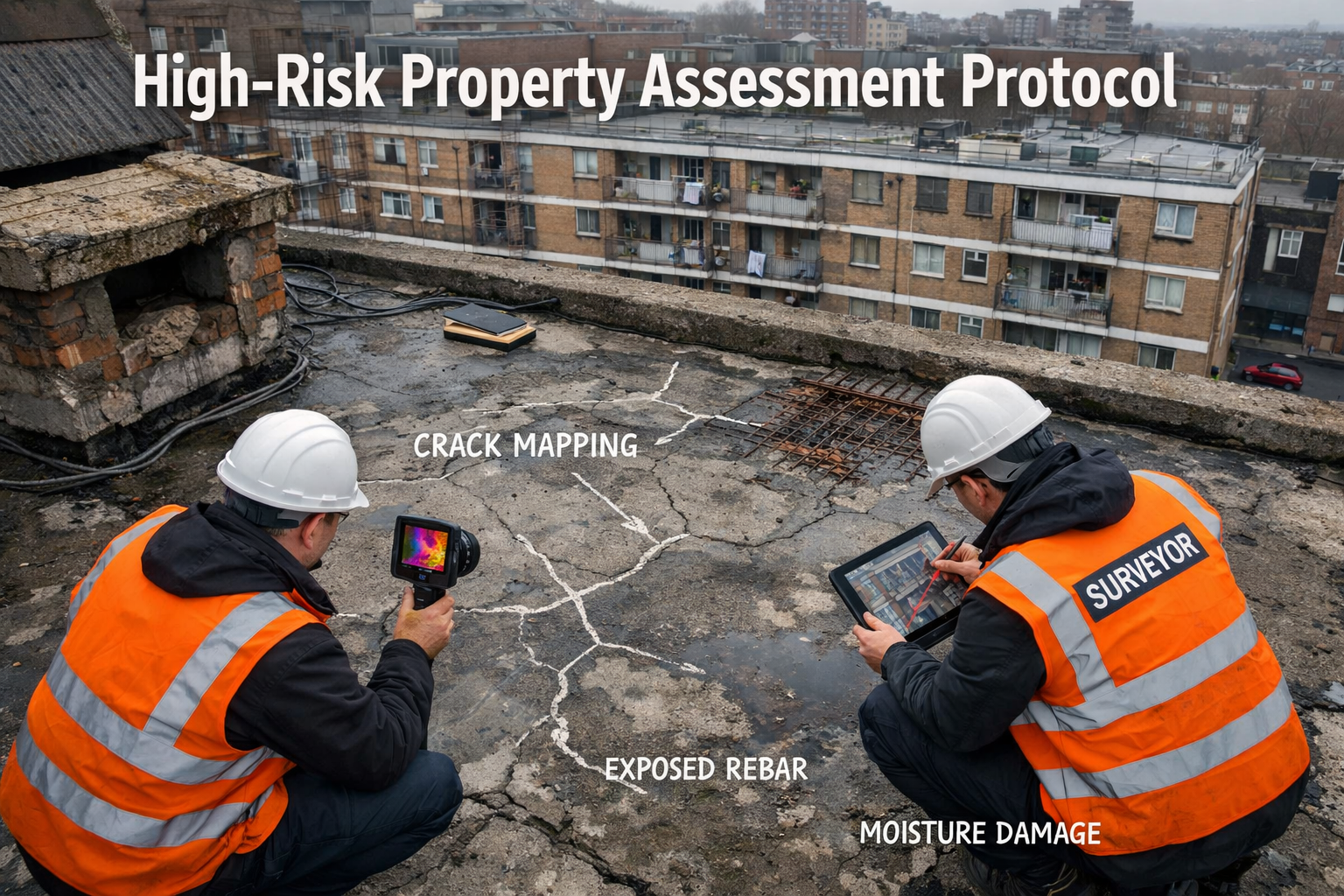
Identifying High-Risk Property Types
Not all properties carry equal structural collapse risk. The following property categories demand the most rigorous assessment protocols in 2026:
🏢 High-Rise and Medium-Rise Residential Blocks
Properties over 11 metres fall under the Building Safety Act 2022 as well as Awaab's Law. Structural surveys must address:
- Large Panel System (LPS) construction (common in 1960s–1970s social housing)
- Concrete carbonation and rebar corrosion
- Flat roof membrane integrity and drainage
- Cladding system structural fixings
🏚️ Pre-1919 Terraced and Semi-Detached Housing
Older housing stock presents different but equally serious risks:
- Shallow or absent foundations
- Lime mortar degradation
- Timber decay in floor and roof structures
- Subsidence risks from clay soils, tree roots, or historical mining
🔧 Converted Properties
Conversions — particularly HMOs and flat conversions — frequently involve structural alterations that were poorly designed or executed without Building Regulations approval:
- Removed load-bearing walls without adequate steel installation
- Overloaded floor structures
- Inadequate fire compartmentation (which also affects structural integrity in a fire event)
🏗️ Non-Standard Construction
Properties built with non-standard methods — prefabricated concrete, steel frame, timber frame, or system-built designs — require specialist assessment. See the non-standard construction guidance for property-specific protocols.
The Role of Stock Condition Surveys
For social landlords managing large housing portfolios, individual Level 3 surveys for every property are impractical. Stock condition surveys provide the portfolio-level data needed to triage properties by risk category and prioritise structural inspections [4].
A stock condition survey should now include a structural hazard risk rating for every property, mapped against HHSRS Category 1 and Category 2 hazard thresholds. This creates the audit trail that regulators — including the Regulator of Social Housing — will expect to see in 2026 compliance reviews [5].
Damp as a Structural Warning Sign
One of the most important shifts in 2026 survey practice is recognising damp as a precursor to structural failure, not just a standalone hazard. Persistent moisture ingress causes:
- Timber rot in floor joists and roof structures
- Freeze-thaw damage to masonry
- Concrete spalling and rebar corrosion
- Foundation softening in clay-rich soils
A damp survey that identifies significant moisture penetration should automatically trigger a structural assessment under the new protocols. The two hazards are legally separate under HHSRS but physically interconnected.
Building Survey Protocols for Structural Collapse Risks: Awaab's Law 2026 Extensions — Compliance, Documentation, and Liability
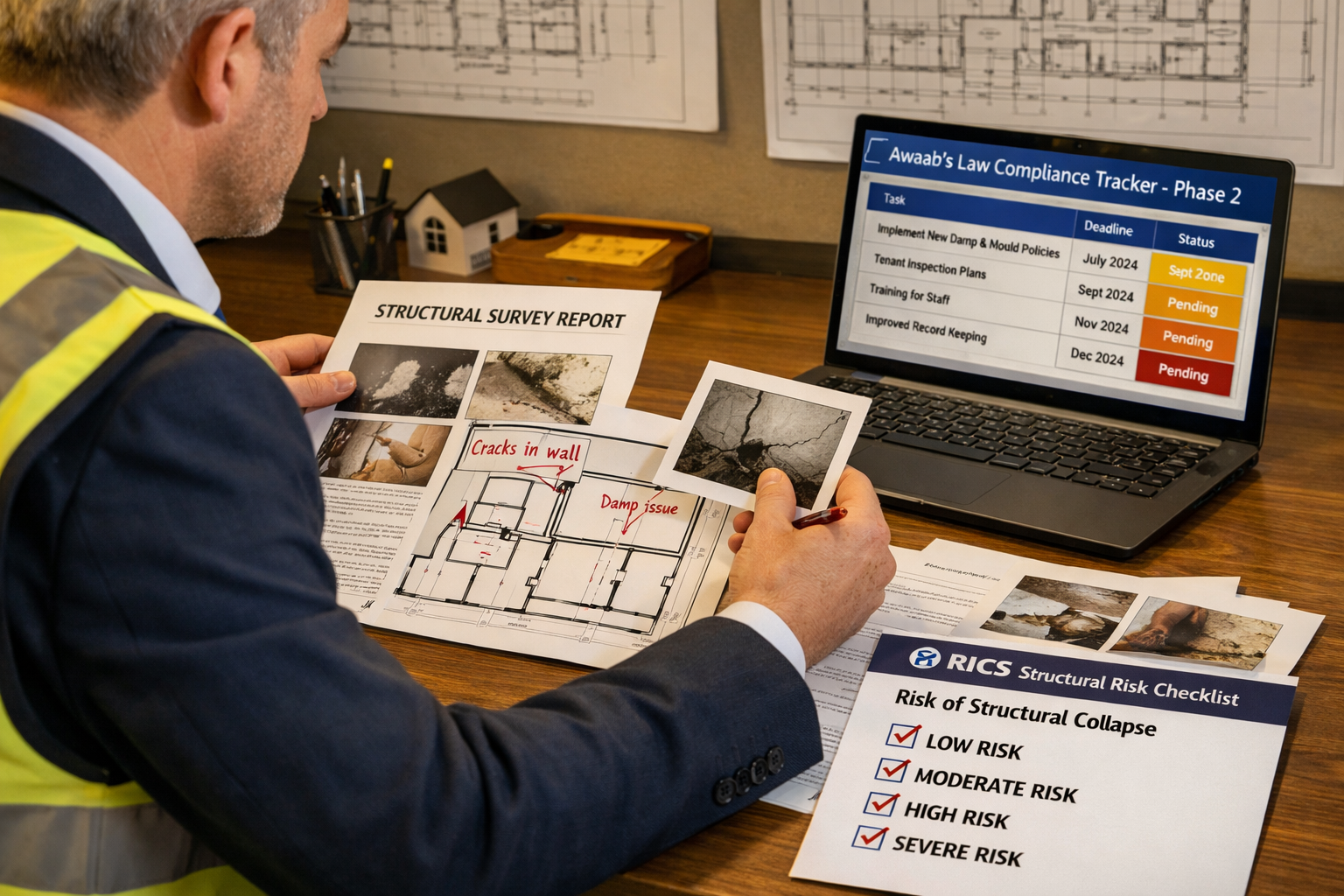
Documentation Standards for Legal Compliance
Under Awaab's Law, the quality of documentation is as important as the quality of the inspection itself. A verbal assessment or a brief email is not sufficient. Compliant survey documentation must include:
- Dated photographic evidence of all identified defects
- HHSRS hazard classification for each structural defect (Category 1 or Category 2)
- Risk scoring using the HHSRS likelihood and harm outcome matrices
- Recommended repair timeline aligned with Awaab's Law deadlines
- Escalation pathway — who must be notified and within what timeframe
- Follow-up inspection schedule for monitoring ongoing structural movement
For pre-purchase assessments, a full structural survey sample report illustrates the level of detail that now represents best practice.
Consequences of Non-Compliance
The consequences for landlords who fail to meet Awaab's Law obligations are significant [5]:
- Regulatory enforcement action from the Regulator of Social Housing
- Rent repayment orders (tenants can reclaim up to 12 months' rent)
- Civil liability for personal injury or death caused by structural failure
- Criminal prosecution in the most serious cases
- Reputational damage and potential loss of registration for RSLs
💬 "Awaab's Law creates a direct line between a missed survey protocol and a criminal charge. That changes the risk calculus for every landlord in England."
Training Requirements for Surveying Staff
Social landlords cannot rely solely on external surveyors. Internal maintenance and housing management staff must be trained to:
- Recognise early warning signs of structural instability
- Understand the difference between a cosmetic crack and a structural crack
- Know when to escalate a repair request to a qualified structural engineer or RICS surveyor
- Document observations in a format that satisfies HHSRS compliance requirements [4]
This training gap is one of the most significant operational challenges facing social landlords in 2026. Many organisations focused their Phase 1 compliance efforts entirely on damp and mould awareness — Phase 2 requires a much broader knowledge base [4].
Pre-Purchase Risk Mitigation for Buyers
For buyers in the private market, building survey protocols for structural collapse risks: Awaab's Law 2026 extensions and high-risk property assessments are equally relevant. Even where Awaab's Law does not directly apply to private purchases, the HHSRS framework informs what a competent surveyor must identify and report.
Buyers should:
✅ Always commission a Level 3 survey for properties built before 1945, properties with visible cracking, or properties that have been significantly altered
✅ Request that the surveyor explicitly addresses HHSRS Category 1 structural hazards in the report
✅ Obtain a specialist structural engineer's report where the Level 3 survey identifies significant concerns
✅ Check whether the property has a history of subsidence, underpinning, or structural claims through the conveyancing process
✅ Ensure any specific defect report covers the full scope of identified structural risks before exchange
For buyers in London and the South East — where older housing stock and high-density conversions are common — working with chartered surveyors in London who understand both the local property landscape and the 2026 regulatory framework is essential.
Conclusion: Acting Now on Awaab's Law 2026 Structural Compliance
The 2026 extension of Awaab's Law to structural collapse and explosion hazards is not a distant policy aspiration — it is an active legal obligation with real enforcement teeth. For social landlords, the window to build compliant survey protocols, train staff, and audit housing stock is narrowing fast. For private buyers and landlords, the regulatory direction of travel is clear: structural hazard assessment is becoming a non-negotiable element of responsible property ownership.
Actionable Next Steps
For social landlords:
- Commission a portfolio-wide stock condition survey with HHSRS structural hazard ratings before Q3 2026
- Establish a clear escalation protocol linking maintenance requests to structural survey triggers
- Train housing management staff on structural defect recognition and HHSRS classification
- Review and update your repair response timelines to align with Awaab's Law Phase 2 deadlines
For private landlords and buyers:
- Commission a Level 3 building survey for any high-risk property acquisition or tenancy renewal
- Ensure survey reports explicitly address HHSRS Category 1 structural hazards
- Act immediately on any Category 1 findings — do not wait for tenant complaints
- Seek specialist structural engineering input where surveys identify significant concerns
For surveyors:
- Update Level 3 survey templates to include HHSRS structural hazard classification
- Invest in advanced defect detection equipment (thermal imaging, crack monitors, borescopes)
- Develop clear referral pathways to structural engineers for high-risk findings
- Stay current with Regulator of Social Housing enforcement guidance as it evolves through 2026
The cost of a comprehensive structural survey is a fraction of the cost of a collapsed ceiling, a failed prosecution defence, or a rent repayment order. In 2026, that calculation has never been clearer.
References
[1] Awaabs Law – https://www.ecosafegroup.co.uk/post/awaabs-law
[2] Awaabs Law Comes Into Force What Does It Mean For Construction – https://www.trowers.com/insights/2025/november/awaabs-law-comes-into-force-what-does-it-mean-for-construction
[3] Awaabs Law Explained – https://firntec.com/blog/awaabs-law-explained
[4] Awaabs Law Phase 2 Is Coming What Social Landlords Need To Know About Additional Hazard Compliance In 2026 – https://www.mobysoft.com/resources/blogs/awaabs-law-phase-2-is-coming-what-social-landlords-need-to-know-about-additional-hazard-compliance-in-2026/
[5] Awaabs Law Compliance Consequences And Oversight For Social Housing Providers – https://www.penningtonslaw.com/insights/awaabs-law-compliance-consequences-and-oversight-for-social-housing-providers/
[6] Awaabs Law Deadlines Explained – https://awaabs-law.com/awaabs-law-deadlines-explained
[7] Awaabs Law Private Landlords 2026 – https://www.idealresponse.co.uk/blog/awaabs-law-private-landlords-2026/
[8] Awaabs Law Technical Compliance Hvac Ventilation – https://www.arm-environments.com/resources/awaabs-law-technical-compliance-hvac-ventilation
[9] Awaabs Law Guidance For Social Landlords Timeframes For Repairs In The Social Rented Sector – https://www.gov.uk/government/publications/awaabs-law-guidance-for-social-landlords/awaabs-law-guidance-for-social-landlords-timeframes-for-repairs-in-the-social-rented-sector
