
{"cover":"Professional landscape format (1536×1024) hero image with bold text overlay: 'Party Wall & Renters' Rights Act: Section 8 Notice Validity in Renovation Disputes' in extra large 70pt bold white sans-serif font with dark semi-transparent overlay box, centered upper-third composition. Background shows a split-scene: left side a brick party wall with construction scaffolding and a surveyor in hard hat reviewing documents, right side a formal legal notice document with a PRS database interface on a laptop screen. Color palette: deep navy blue, white text, amber accent lines. Magazine cover aesthetic, editorial quality, high contrast, 2026 UK property law theme.","content":["Detailed landscape format (1536×1024) editorial illustration showing a UK terraced house renovation scene with scaffolding against a shared brick party wall, a landlord and tenant in dispute on opposite sides of the wall, a Section 8 legal notice document prominently displayed in the foreground, and a digital PRS database registration screen visible on a tablet. Warm amber and navy color scheme, documentary photography style, sharp focus on the legal notice with blurred construction background, realistic UK urban streetscape setting.","Landscape format (1536×1024) infographic-style image showing a vertical flowchart diagram on a clean white background with navy and amber accents: steps from 'PRS Database Registration' through 'Section 8 Notice Served' to 'Party Wall Award Issued' and 'Tribunal Validity Check', with icons for each stage including a database cylinder, legal gavel, brick wall symbol, and checkmark. Professional flat-design illustration style, UK government document aesthetic, clear typography labels at each node, 2026 compliance theme.","Landscape format (1536×1024) close-up editorial photograph of a party wall surveyor's desk with a Party Wall Act 1996 document, a Section 8 notice form, a laptop showing a PRS database landlord registration portal, a measuring tape, and a set square. Shallow depth of field focusing on the overlapping legal documents. Overhead bird's-eye angle, warm office lighting, dark wood desk surface, subtle UK flag pin visible, professional surveying tools arranged compositionally, conveying legal compliance and property dispute resolution."]
"A Section 8 notice served by an unregistered landlord may be legally void — and if that landlord is also mid-way through a party wall renovation, the consequences cascade in two directions at once."
As of 2026, the Renters' Rights Act has fundamentally reshaped the private rented sector (PRS) in England. One of its most operationally complex provisions is the mandatory PRS database — a landlord registration system that directly affects the validity of Section 8 possession notices. When renovation works triggering the Party Wall etc. Act 1996 are underway during a tenancy, the intersection of these two legal regimes creates a minefield of procedural risk. Understanding the Party Wall Implications of Renters' Rights Act PRS Database: Validity Checks for Section 8 Notices in Renovation Disputes is now essential knowledge for landlords, surveyors, and tenants alike.
Key Takeaways 🔑
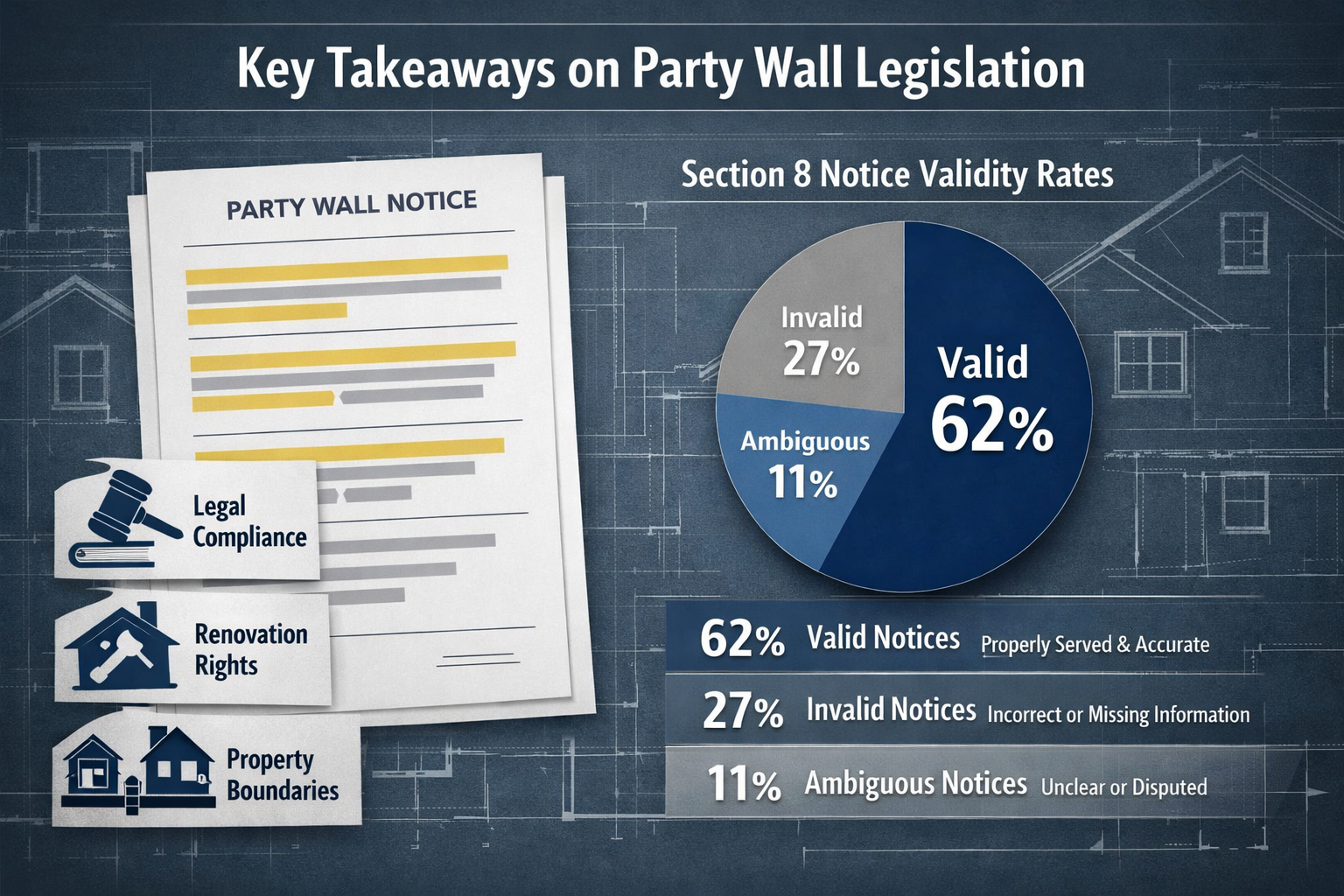
- PRS database registration is now a prerequisite for serving a valid Section 8 notice under the Renters' Rights Act 2026.
- Party wall works during a tenancy can trigger possession proceedings — but only if the Section 8 notice meets strict new validity criteria.
- Surveyors play a critical role in verifying compliance at the point of issuing a Party Wall Award, particularly where renovation disputes overlap with tenancy law.
- Section 21 "no-fault" evictions are abolished — landlords relying on renovation as grounds for possession must now use Section 8 with specific, expanded grounds.
- Procedural errors at any stage — from PRS registration to notice service — can invalidate possession claims and expose landlords to tribunal challenges.
The Renters' Rights Act 2026: What Changed and Why It Matters for Party Walls
The Renters' Rights Act received Royal Assent in 2025, with major provisions taking effect in 2026 [1]. The headline change — abolition of Section 21 "no-fault" evictions — has been widely reported. But the downstream effects on renovation-related possession proceedings, particularly where party wall works are involved, have received far less attention.
Abolition of Section 21 and the New Possession Landscape
Under the old regime, a landlord planning significant renovation could serve a Section 21 notice and recover possession without specifying grounds. That option is now gone [2]. All possession proceedings must now proceed via Section 8, using specific statutory grounds set out in Schedule 2 of the Housing Act 1988, as amended by the Renters' Rights Act.
For landlords undertaking works that affect a party wall — such as loft conversions, rear extensions, or underpinning — this creates a direct legal challenge. If the works require vacant possession (which many structural party wall projects do), the landlord must satisfy a Section 8 ground, serve a valid notice, and demonstrate compliance with the new PRS database requirements [4].
What the PRS Database Requires in 2026
The PRS database is a phased rollout, with landlord registration forming a core obligation [5]. Key requirements include:
| Requirement | Detail |
|---|---|
| Landlord registration | All private landlords must register on the PRS database |
| Property listing | Each tenanted property must be individually recorded |
| Compliance status | Gas safety, EPC rating, and deposit protection must be logged |
| Notice validity link | Section 8 notices served without valid registration may be challenged |
💡 Pull Quote: "The PRS database is not merely an administrative exercise — it is a gateway condition for lawful possession proceedings under the new Act."
Rent increases are also restricted to once per year under the Act [6], which matters in renovation contexts where landlords may attempt to use rent hikes as an indirect mechanism to encourage departure before serving formal notices.
Understanding the Overlap: Party Wall Implications of Renters' Rights Act PRS Database: Validity Checks for Section 8 Notices in Renovation Disputes
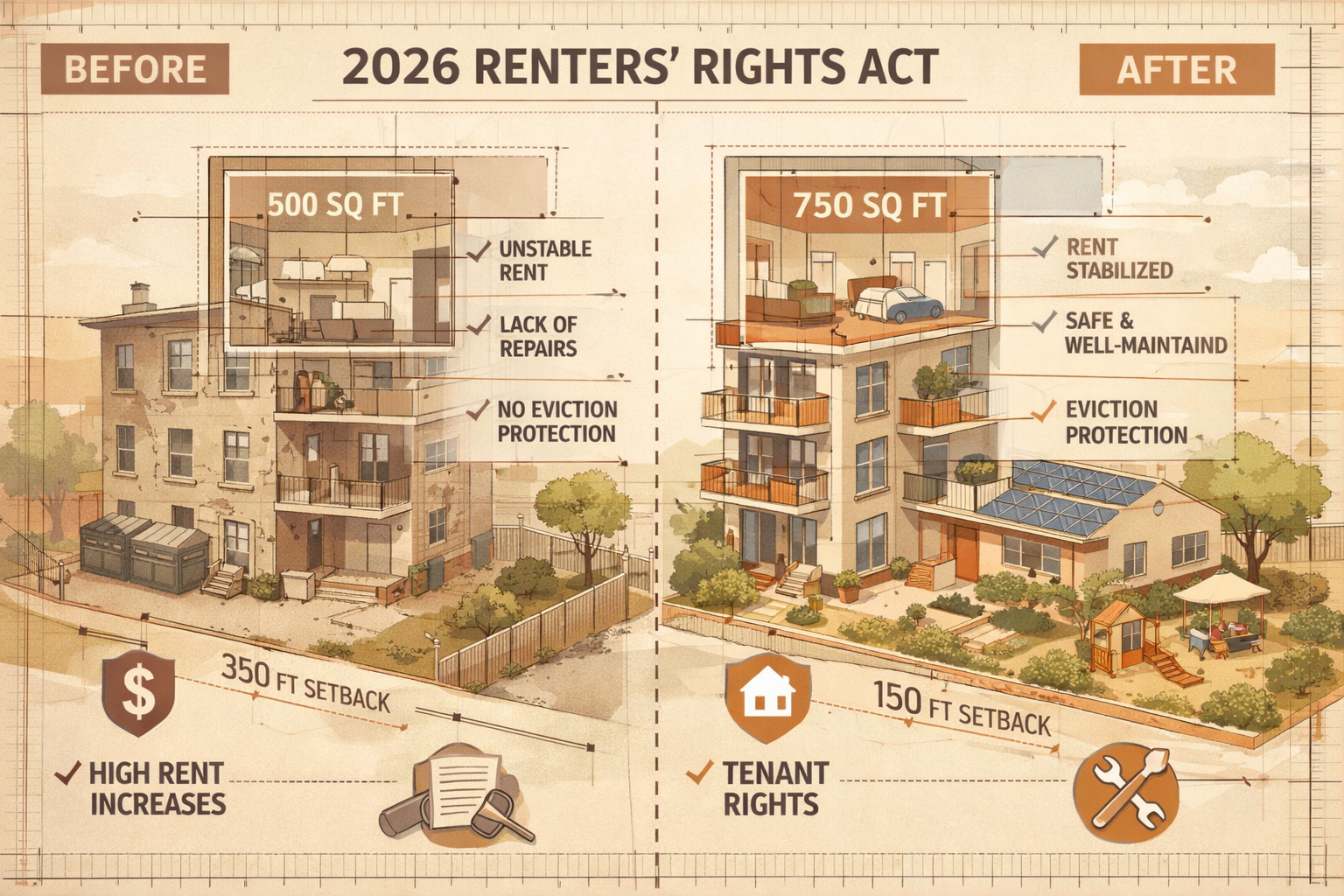
The Party Wall etc. Act 1996 and the Renters' Rights Act 2025 operate on parallel legal tracks — but they converge sharply when a landlord-owner undertakes structural works to a shared wall while a tenant remains in occupation.
How Party Wall Works Trigger Possession Needs
Several categories of party wall work commonly require vacant possession or at minimum create significant disruption:
- Loft conversions involving the party wall or shared chimney stacks 🏗️
- Rear extensions requiring excavation near the party wall boundary
- Underpinning and foundation works under Section 6 of the Party Wall Act
- Structural beam insertions through a party wall under Section 2
For works of this nature, a landlord may seek to recover possession before or during the project. This is where the Section 8 notice machinery — and its new validity requirements — becomes critical.
For a comprehensive overview of what triggers a formal notice obligation, see this complete guide to party wall act notices and how to respond.
The Relevant Section 8 Grounds for Renovation
Under the expanded Section 8 grounds introduced by the Renters' Rights Act, the most relevant grounds for renovation-related possession are:
Ground 6 (Redevelopment): The landlord intends to demolish, reconstruct, or carry out substantial works that cannot reasonably be done with the tenant in occupation. This ground has been retained and refined [1][4].
Ground 6A (New — Compliance with planning or regulatory requirements): A new ground allowing possession where the landlord must comply with a statutory obligation — potentially including obligations arising from a Party Wall Award or enforcement notice.
Ground 8 (Rent arrears): Less directly relevant to renovation, but sometimes arises where tenants withhold rent due to disruption from party wall works.
Validity Checks: What Surveyors Must Verify
When a party wall surveyor is appointed and proceeds to issue a Party Wall Award, they are increasingly expected to verify — or at minimum flag — the tenancy status of the building owner's property. This is because:
- A Party Wall Award issued while a Section 8 notice is pending may be challenged if the notice is later found invalid
- Works proceeding under an Award while a tenant remains unlawfully in occupation may expose the building owner to civil liability
- Adjoining owners' surveyors may raise the tenancy compliance issue as part of dispute resolution
For details on what a party wall surveyor does in these complex scenarios, the roles, responsibilities, and legal requirements of a party wall surveyor provides essential context.
Section 8 Notice Validity: A Step-by-Step Compliance Protocol
The Party Wall Implications of Renters' Rights Act PRS Database: Validity Checks for Section 8 Notices in Renovation Disputes framework requires landlords and their advisors to follow a structured compliance pathway. Missing any step risks invalidation.
Step 1: Confirm PRS Database Registration ✅
Before any Section 8 notice is drafted, the landlord must confirm:
- Active registration on the PRS database
- The specific property is listed and compliant
- No outstanding enforcement notices from the local authority
An unregistered landlord cannot lawfully serve a Section 8 notice. Tribunals are expected to strike out claims where this condition is not met [5].
Step 2: Identify the Correct Section 8 Ground
For renovation and party wall contexts, Ground 6 is the primary vehicle. The landlord must demonstrate genuine intention to carry out works, supported by:
- Planning permission (if required)
- A Party Wall Notice already served on the adjoining owner
- Structural engineer's report or architect's drawings
- Evidence that works cannot proceed with the tenant in occupation
See our guide on understanding party structure notices for what documentation is typically required at the notice stage.
Step 3: Serve the Section 8 Notice Correctly
The notice must:
- Use the prescribed form (updated for 2026 compliance)
- State the ground(s) clearly
- Give the correct notice period (Ground 6 requires 2 months' notice under the new Act)
- Include the landlord's PRS database registration number
⚠️ Critical Warning: Serving notice on the wrong form, or omitting the PRS registration reference, is likely to render the notice invalid. Courts and tribunals have shown little appetite for waiving procedural defects since the Act came into force [2].
Step 4: Coordinate with the Party Wall Process
This is the step most landlords overlook. The Party Wall Notice and the Section 8 Notice must be coordinated in sequence:
Party Wall Notice Served → Adjoining Owner Responds →
Award Drafted → Section 8 Notice Served →
Possession Obtained → Works Commence
Attempting to commence party wall works before possession is secured — or serving Section 8 after works begin — creates significant legal exposure. For situations where no party wall notice has been served, the risks escalate considerably, as explained in this resource on what happens when no party wall notice is served.
Step 5: Obtain the Party Wall Award
Once possession proceedings are underway or concluded, the Party Wall Award should be finalised before works begin. The Award is a legally binding document that governs how works are carried out, protects the adjoining owner, and sets out the schedule of condition.
For a full breakdown of what a Party Wall Award contains, see this complete guide to party wall awards for UK property owners.
Common Invalidity Challenges and How to Avoid Them
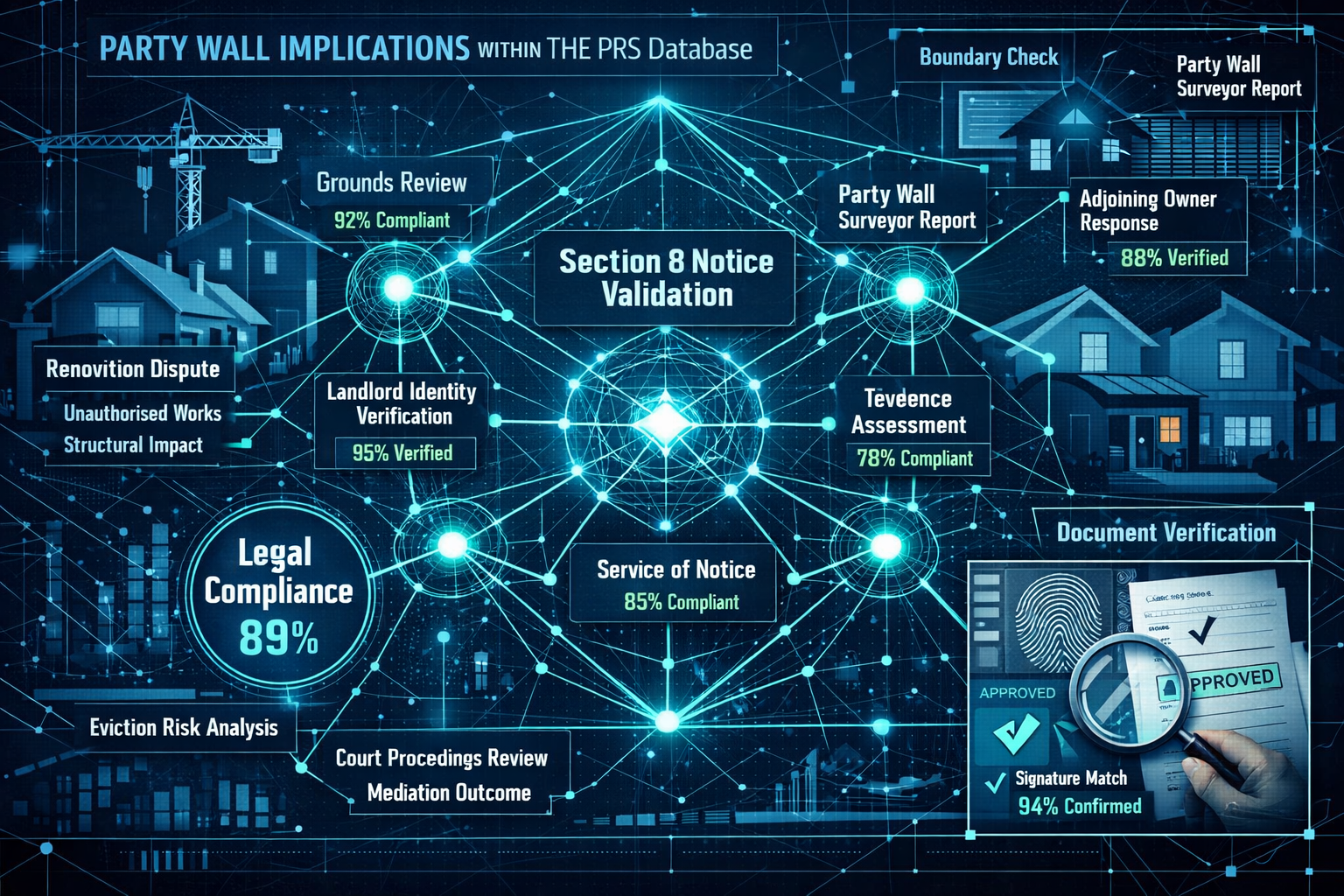
Tenants and their advisors are increasingly sophisticated in challenging Section 8 notices served in renovation contexts. The most common grounds for challenge in 2026 include:
Challenge 1: Landlord Not Registered on PRS Database
Risk level: 🔴 High
This is the most straightforward challenge. If the landlord cannot produce a valid PRS registration number at the point of service, the notice is likely void. Landlords should obtain and retain their registration certificate before initiating any possession proceedings [4].
Challenge 2: Insufficient Evidence of Genuine Renovation Intent
Risk level: 🟠 Medium-High
Ground 6 requires the landlord to demonstrate genuine intent to carry out substantial works. A vague reference to "planned renovation" will not suffice. Tenants' representatives will scrutinise:
- Whether planning permission has been applied for or granted
- Whether a party wall surveyor has been appointed
- Whether contracts with builders have been signed
- The timeline between notice service and alleged works commencement
Challenge 3: Works Possible Without Vacant Possession
Risk level: 🟠 Medium-High
Ground 6 is only available where the works cannot reasonably be done with the tenant in occupation. If the renovation affects only part of the property, or if temporary decanting arrangements are feasible, the ground may fail.
Structural party wall works — particularly underpinning, loft conversions, or major excavations — are generally stronger candidates for this ground because of the genuine safety and access requirements involved. For excavation-related party wall works, this party wall excavation notice guide sets out the specific obligations.
Challenge 4: Incorrect Notice Period
Risk level: 🟡 Medium
The Renters' Rights Act introduced new minimum notice periods for various Section 8 grounds. Serving a notice with an incorrect period — even by a few days — can invalidate it. Always verify the current prescribed period for the specific ground being relied upon [1][2].
Challenge 5: Failure to Protect the Deposit
Risk level: 🟡 Medium
If the tenant's deposit has not been protected in a government-approved scheme, or if the prescribed information has not been provided, the landlord cannot serve a valid Section 8 notice on certain grounds. This is a pre-existing requirement reinforced by the new Act.
The Surveyor's Role in Renovation Dispute Resolution
Party wall surveyors are not tenancy lawyers — but in 2026, they cannot afford to be entirely ignorant of tenancy law either. When appointed under the Party Wall Act, surveyors should:
- Ask the building owner whether the property is tenanted and whether possession proceedings are underway
- Flag in the Award any conditions relating to the timing of works relative to possession
- Avoid issuing Awards that effectively facilitate works in breach of tenancy obligations
- Document their inquiries to protect themselves from later challenge
Where damage to a tenant's property arises from party wall works, the liability framework becomes particularly complex. The party wall damage to property guide sets out how compensation claims are typically handled.
For landlords uncertain whether they need a formal agreement before proceeding, this resource on whether you need a party wall agreement provides a practical starting point.
Practical Checklist for Landlords Planning Renovation Works in 2026
Use this checklist before serving any Section 8 notice in a renovation context:
- Registered on the PRS database with property listed ✅
- Correct Section 8 ground identified (likely Ground 6) ✅
- Planning permission obtained or applied for ✅
- Party Wall Notice served on all adjoining owners ✅
- Structural engineer's report or architect's drawings prepared ✅
- Builder contracts or quotes obtained ✅
- Tenant's deposit protected and prescribed information served ✅
- Correct notice period calculated and applied ✅
- PRS registration number included on the notice ✅
- Legal advice obtained from a specialist property solicitor ✅
Conclusion: Navigating a Complex Legal Intersection
The Party Wall Implications of Renters' Rights Act PRS Database: Validity Checks for Section 8 Notices in Renovation Disputes represent one of the most technically demanding areas of UK property law in 2026. The abolition of Section 21 has removed the easy route to possession, and the new PRS database requirements add a further layer of procedural obligation that landlords must satisfy before any notice is valid [1][4].
For landlords planning renovation works that affect a party wall, the message is clear: sequence matters, documentation matters, and registration matters. A Section 8 notice served without PRS database compliance is likely void. A Party Wall Award issued without regard to the tenancy position may expose the building owner to liability. And works commenced before possession is secured create risks on both legal fronts simultaneously.
Actionable Next Steps 🎯
- Register on the PRS database immediately if not already done — this is a gateway condition for all possession proceedings
- Appoint a specialist party wall surveyor early in the renovation planning process to coordinate the legal sequence
- Seek combined legal advice from a solicitor experienced in both tenancy law and the Party Wall Act
- Document everything — from planning applications to builder quotes — to support Ground 6 claims
- Do not serve any notice until PRS registration is confirmed and the correct ground has been verified
The complexity of this area means professional guidance is not optional — it is essential. Engaging a qualified surveyor and specialist solicitor from the outset will protect landlords, tenants, and adjoining owners alike.
References
[1] Major Parts Renters Rights Act Set Take Effect – https://www.pinsentmasons.com/out-law/news/major-parts-renters-rights-act-set-take-effect
[2] The Renters Rights Act 2025 Key Implications For Living Sector Lenders 3 31 2026 – https://www.klgates.com/The-Renters-Rights-Act-2025-Key-Implications-for-Living-Sector-Lenders-3-31-2026
[3] Existing Tenancies Renters Rights Act – https://www.nrla.org.uk/resources/renters-rights/existing-tenancies-renters-rights-act
[4] Implementing The Renters Rights Act 2025 Our Roadmap For Reforming The Private Rented Sector – https://www.gov.uk/government/publications/renters-rights-act-2025-implementation-roadmap/implementing-the-renters-rights-act-2025-our-roadmap-for-reforming-the-private-rented-sector
[5] Alerts Realestate Impacts Of The Renters Rights Act – https://www.goodwinlaw.com/en/insights/publications/2026/01/alerts-realestate-impacts-of-the-renters-rights-act
[6] The Renters Rights Act Information Sheet 2026 – https://assets.publishing.service.gov.uk/media/69bc04b8f7b1c24d8e23ce60/The_Renters__Rights_Act_Information_Sheet_2026.pdf
