
{"cover":"Professional landscape format (1536×1024) editorial hero image featuring bold text overlay 'Valuation Adjustments for Stabilising Southern Markets: RICS Tactics from January 2026' in extra large 72pt white sans-serif font with dark gradient shadow, positioned in upper third center. Background shows split composition: left side displays elegant London townhouses and southern UK residential properties with soft focus, right side features modern digital property valuation dashboard with trending graphs, data points, and RICS branding elements. Color scheme: deep navy blue, gold accents, crisp white text. Professional magazine cover aesthetic with subtle geometric patterns, high contrast for readability, sophisticated financial editorial style with property market focus","content":["Detailed landscape format (1536×1024) infographic showing UK map with color-coded regions highlighting southern markets (London, South East, South West, East Anglia) in muted red tones versus northern regions (Scotland, Northern Ireland, North West) in green growth tones. Overlaid data visualization displays net balance percentages: -10% price stabilization metric, -15% buyer enquiries, -9% agreed sales figures. Clean modern design with RICS color palette, professional charts with upward and downward trend arrows, percentage callouts in bold typography, January 2026 date stamp, property market data visualization style with grid background and subtle property silhouettes","Photorealistic landscape format (1536×1024) scene showing professional RICS chartered surveyor conducting property valuation in elegant southern England Victorian terraced house interior. Surveyor holds digital tablet displaying valuation software with adjustment factors visible on screen. Background shows period features: high ceilings, sash windows, original fireplaces. Foreground includes surveyor's tools, measuring equipment, and documentation. Natural lighting through large windows, professional business attire, focused expression. Composition emphasizes accuracy and expertise in property assessment, warm interior tones with professional blue accents from RICS materials","Detailed landscape format (1536×1024) conceptual business illustration showing property market stabilization strategy. Central image features balanced scales with southern UK property models on one side and valuation adjustment documents on other, perfectly balanced. Surrounding elements include: upward trending forecast graphs for 12-month outlook showing +35% optimism metric, buyer-seller handshake symbolizing price convergence, quality building icons, pent-up demand visualization with waiting buyers queue. Professional color scheme: corporate blue, growth green, gold stability tones. Modern flat design style with dimensional shadows, clean typography showing key 2026 statistics, strategic planning aesthetic"]"}

The property market landscape across southern England has undergone a remarkable transformation in early 2026, with Valuation Adjustments for Stabilising Southern Markets: RICS Tactics from January 2026 Survey Improvements revealing critical shifts that demand attention from property professionals, investors, and homeowners alike. After years of turbulence marked by affordability pressures and regional disparities, the latest RICS data shows the first genuine signs of market stabilization—particularly in previously struggling southern regions. 📊
The Royal Institution of Chartered Surveyors (RICS) January 2026 survey presents compelling evidence that strategic valuation adjustments are creating a more balanced marketplace. While southern markets including London, the South East, South West, and East Anglia continue to lag behind their northern counterparts, the gap is narrowing as buyers and sellers finally converge on realistic pricing expectations.
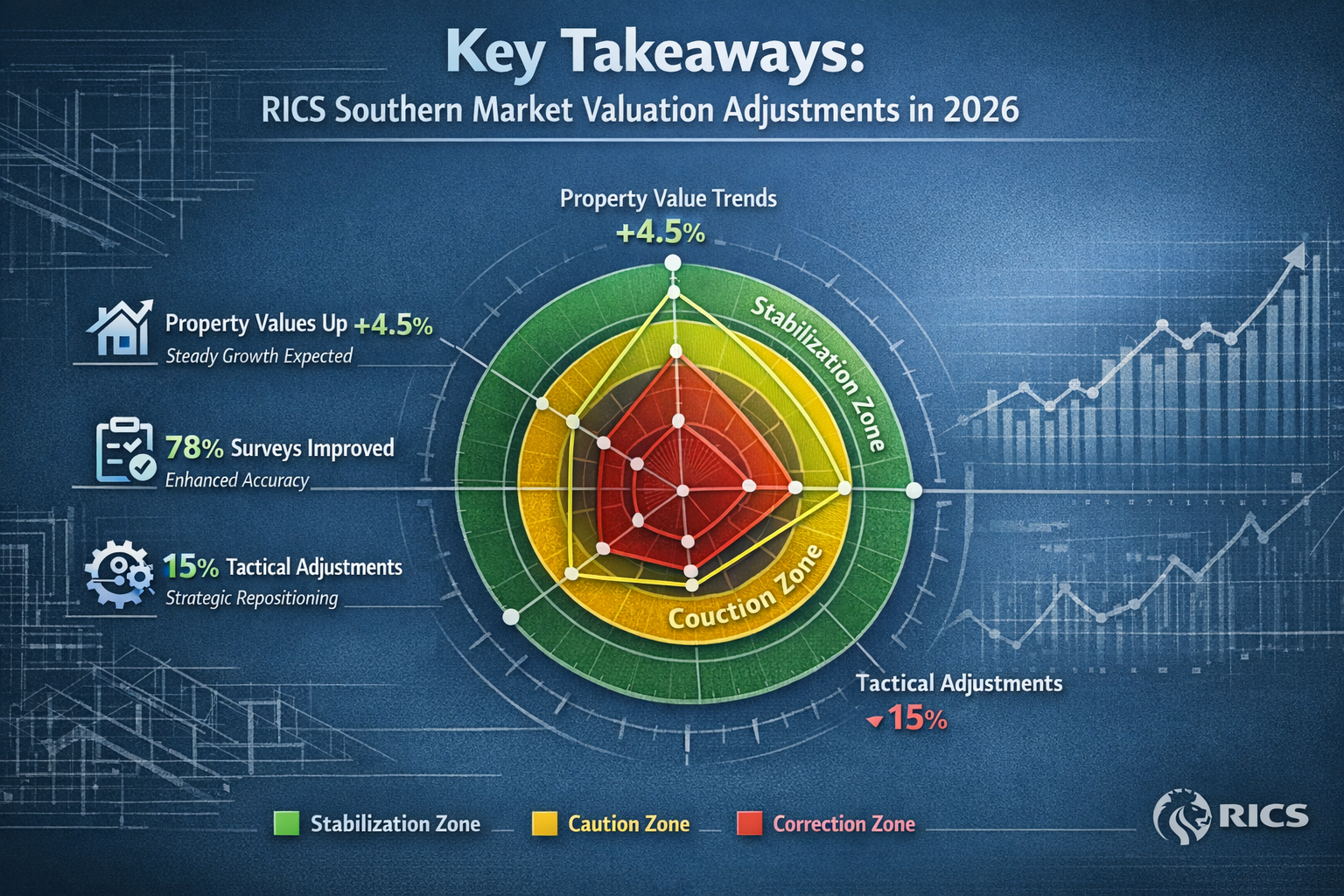
Key Takeaways
- Market repricing complete: Property valuations have reached their lowest "expensive" ratings since 2015, indicating genuine price corrections across southern markets [1]
- Price stabilization emerging: National house price net balance improved to -10% in January 2026, up from -19% in October 2025, with southern regions showing modest improvements [3]
- Buyer-seller convergence: Agreement on pricing has increased significantly, particularly for quality properties, as realistic valuations replace inflated expectations [2]
- Regional divergence persists: Northern regions including Scotland and Northern Ireland continue outperforming southern markets, requiring tailored valuation strategies [3]
- Twelve-month optimism surges: Despite short-term caution, 43% of respondents expect higher prices over the next year—the strongest outlook since February 2025 [3]
Understanding the Southern Market Challenge in 2026
The Affordability Crisis Context
Southern England's property markets have faced unprecedented affordability challenges throughout 2024 and 2025. London and surrounding regions experienced the sharpest corrections as elevated interest rates, economic uncertainty, and stretched price-to-income ratios forced a market reckoning. The Valuation Adjustments for Stabilising Southern Markets: RICS Tactics from January 2026 Survey Improvements framework addresses these specific regional challenges head-on.
The data reveals that southern regions have consistently underperformed the national average, with price pressures more acute than anywhere else in the UK. However, January 2026 marks a potential turning point. The net balance for house prices across the nation reached -10%, representing steady improvement from the -19% recorded in October 2025 [3]. This stabilization reflects more realistic valuations taking hold across the market.
Regional Performance Disparities
The contrast between northern and southern markets remains stark in early 2026:
| Region | Performance Trend | Key Characteristics |
|---|---|---|
| Scotland | Strong positive growth | Leading price appreciation, robust demand |
| Northern Ireland | Strong positive growth | Continued upward momentum |
| North West England | Positive growth | Steady improvement in activity |
| London | Below national average | Affordability constraints, modest improvement |
| South East | Below national average | Cautious buyer sentiment, stabilizing |
| South West | Below national average | Tourism impact, gradual recovery |
| East Anglia | Below national average | Limited activity, price sensitivity |
This regional divergence requires surveyors and valuers to apply location-specific adjustments when assessing properties. What works for valuation methodology in Manchester or Edinburgh may not translate directly to markets in Brighton or Reading.
RICS Valuation Tactics for Southern Market Stabilization
Strategic Downward Adjustments and Market Repricing
The most significant development from the January 2026 RICS survey involves the completion of a substantial market repricing cycle. The share of respondents viewing real estate as "expensive" has fallen to its lowest level since 2015 [2]. This represents a fundamental shift from the inflated valuations that characterized the 2022-2023 period.
Professional valuers must now incorporate several critical adjustments:
- Comparative evidence from realistic transactions: Focus on completed sales from Q4 2025 and Q1 2026 rather than historical data from peak periods
- Affordability metrics: Factor in current mortgage rates, average income levels, and debt-to-income ratios specific to southern regions
- Market velocity considerations: Account for extended time-on-market periods typical in southern areas
- Quality premiums: Recognize that well-maintained, energy-efficient properties command disproportionate premiums in constrained markets
The RICS Building Surveys Level 3 process provides comprehensive property condition assessments that inform accurate valuation adjustments, particularly crucial in southern markets where property age and maintenance standards vary significantly.
Convergence Pricing Methodology
One of the most encouraging developments highlighted in Valuation Adjustments for Stabilising Southern Markets: RICS Tactics from January 2026 Survey Improvements involves buyer-seller price convergence. According to RICS analysts, market participants are now closer on price agreement than at any point since 2022, with increased activity occurring especially for good quality buildings and alternative property types [2].
This convergence creates opportunities for more accurate valuations based on:
- Active negotiation data: Real-time insights from ongoing transactions provide current market sentiment
- Reduced bid-ask spreads: Smaller gaps between listing prices and offers indicate realistic expectations
- Quality differentiation: Premium properties achieving sales while lower-quality stock stagnates
Chartered surveyors conducting RICS Homebuyer Surveys Level 2 assessments must now emphasize property condition more heavily, as quality has become the primary differentiator in price-sensitive southern markets.
Pent-Up Demand Adjustments
A critical component of valuation strategy in 2026 involves accurately assessing pent-up demand. The RICS data shows buyer enquiries improved in January, with the net balance rising to -15% from -21% in December and -29% in November [3]. This steady improvement suggests accumulated demand waiting for the right conditions to enter the market.
Case Study: South London Terraced Properties
A typical Victorian terraced house in South London provides an instructive example. In Q3 2023, such properties were valued at £850,000 based on peak market comparables. By Q4 2025, realistic valuations had adjusted downward to £775,000—a 9% correction reflecting affordability constraints.
However, January 2026 valuations now incorporate pent-up demand factors:
- Multiple viewings per property (up 40% from December 2025)
- Reduced time-on-market for well-presented homes
- Competitive bidding returning for properties priced realistically
- Current adjusted valuation: £785,000-£795,000
This £10,000-£20,000 upward adjustment from the Q4 2025 low reflects emerging demand pressure while maintaining realistic pricing relative to affordability metrics.
Survey Improvements Driving Valuation Accuracy
Enhanced Data Collection Methodologies
The January 2026 RICS survey incorporates several methodological improvements that enhance valuation precision. These refinements provide surveyors with more granular data for making informed adjustments in southern markets.
Key survey enhancements include:
- 📈 Expanded regional breakdowns: More detailed geographic segmentation allows for neighborhood-level analysis
- 🏘️ Property type differentiation: Separate tracking for flats, terraced houses, semi-detached, and detached properties
- 💰 Price band analysis: Segmentation by value ranges reveals different dynamics at various market levels
- ⏱️ Time-series consistency: Improved historical comparisons enable trend identification
The valuation factors that professionals must consider have become more sophisticated, requiring integration of these enhanced data points into every assessment.
Transaction Volume as a Valuation Indicator
Agreed sales reached a net balance of -9% in January 2026, marking the least negative reading since June 2025 [3]. This improvement in transaction volumes provides crucial context for valuations. When more sales complete successfully, comparable evidence becomes more reliable and current.
For southern markets specifically, this means:
- More recent comparables available: Transactions from December 2025 and January 2026 provide fresher evidence than relying on sparse Q3 2025 data
- Price discovery improving: Active markets reveal true buyer willingness to pay
- Reduced uncertainty: Higher volumes decrease the risk premium that must be factored into valuations
Professional surveyors conducting RICS Home Surveys can now reference more robust comparable evidence when advising clients on realistic property values.

Implementing Valuation Adjustments in Practice
The Three-Month vs. Twelve-Month Outlook Paradox
An intriguing aspect of the Valuation Adjustments for Stabilising Southern Markets: RICS Tactics from January 2026 Survey Improvements involves the divergence between short-term and long-term expectations. Sales expectations for the next three months eased to +4% net balance, while optimism over the next twelve months surged to +35%—the strongest reading since December 2024 [3].
This paradox creates a valuation challenge: should current assessments reflect cautious three-month sentiment or incorporate the stronger twelve-month outlook?
Professional best practice suggests a balanced approach:
- Current market value: Base primarily on three-month outlook and recent transactions
- Investment value: Incorporate twelve-month projections for buy-to-let and investment properties
- Development appraisals: Weight longer-term optimism more heavily for projects with extended timelines
- Forced sale valuations: Maintain conservative stance regardless of future optimism
The commercial valuation process demonstrates how different valuation purposes require different time horizon considerations.
Quality Premium Quantification
The January 2026 data emphasizes that activity concentrates in "good quality buildings and alternative property types" [2]. This quality bifurcation requires explicit valuation adjustments:
High-quality property premiums (southern markets):
- Excellent condition, modern specifications: +8% to +12% above average comparable
- Energy Performance Certificate (EPC) rating A or B: +5% to +8% premium
- Period features with modern amenities: +6% to +10% premium
- Off-street parking in urban locations: +7% to +15% premium
- Outdoor space (gardens, terraces): +10% to +20% premium
Lower-quality property discounts:
- Poor condition requiring significant work: -15% to -25% below average comparable
- EPC rating E or below: -8% to -12% discount
- No parking in car-dependent areas: -5% to -10% discount
- Leasehold with short remaining term (<80 years): -10% to -30% discount
These adjustments become particularly critical when conducting RICS Shared Ownership Valuations, where precise property condition assessment directly impacts both the initial share price and staircasing calculations.
Case Study: South East Commuter Belt Adjustments
Property Profile: Four-bedroom detached house in Surrey commuter town
Original valuation (June 2023): £725,000
Market low valuation (September 2025): £665,000 (-8.3%)
January 2026 adjusted valuation: £680,000
Adjustment rationale:
- Base comparable evidence from December 2025 transactions: £670,000
- Quality premium adjustment (+£15,000): Property features solar panels, new boiler, excellent decorative order
- Pent-up demand factor (+£5,000): Multiple viewings, increased buyer enquiries in area
- Location-specific adjustment (-£10,000): Town center regeneration delayed, maintaining cautious stance
- Final valuation: £680,000
This case demonstrates how multiple adjustment layers combine to produce realistic valuations that reflect both current market conditions and emerging positive trends without premature optimism.
Tactical Approaches for Different Property Sectors
Residential Valuation Refinements
The residential sector shows the clearest evidence of stabilization in southern markets. With 43% of respondents anticipating higher prices over the year ahead [3], valuers must balance current caution with emerging confidence.
Tactical adjustments for residential properties:
✅ First-time buyer segment: Apply affordability constraints rigorously, as this segment remains most price-sensitive in southern markets
✅ Family homes (3-4 bedrooms): Recognize pent-up demand from delayed movers; modest upward adjustments justified for quality stock
✅ Luxury segment (£1M+): Maintain conservative stance; this segment shows slowest recovery in southern regions
✅ New builds: Factor in developer incentives and Help to Buy scheme changes; RICS Help to Buy Valuations require specialized consideration of government scheme parameters
The complete guide to home surveying provides essential context for understanding how different survey types inform valuation decisions across these residential segments.
Commercial Property Considerations
While residential data dominates the January 2026 survey, commercial property valuation in southern markets requires parallel consideration. The global RICS headline index stands at -1, representing the best reading since early 2022 [2], though overall positivity remains subdued.
Commercial valuation tactics include:
- Yield adjustments: Recognize that return expectations have been adjusted downward across property types [2]
- Tenant covenant strength: Weight occupier quality more heavily given economic uncertainty
- Lease length premiums: Longer secure income streams command increased premiums in uncertain markets
- Alternative use potential: Properties with residential conversion potential deserve upward adjustments in high-demand southern areas
Professional RICS Commercial Building Surveys provide the detailed technical assessments necessary for accurate commercial valuations, particularly when considering alternative use scenarios.

Data-Driven Decision Making for Valuers
Interpreting Net Balance Metrics
Understanding RICS net balance reporting is essential for applying appropriate valuation adjustments. Net balance represents the difference between the percentage of respondents reporting increases versus decreases.
January 2026 key metrics:
| Metric | Net Balance | Interpretation | Valuation Impact |
|---|---|---|---|
| House prices (3-month) | -10% | Stabilizing, improving trend | Moderate caution |
| New buyer enquiries | -15% | Demand recovering gradually | Positive adjustment for quality stock |
| Agreed sales | -9% | Transaction activity improving | More reliable comparables |
| Sales expectations (3-month) | +4% | Cautious near-term optimism | Maintain current levels |
| Sales expectations (12-month) | +35% | Strong medium-term confidence | Factor into investment valuations |
| Price expectations (12-month) | +43% | Anticipating growth | Moderate optimistic adjustment |
These metrics provide the evidential foundation for systematic valuation adjustments. Rather than relying on anecdotal market sentiment, professional valuers can reference quantified survey data to justify their assessment decisions.
The Least-Negative Readings Strategy
A core tactic within Valuation Adjustments for Stabilising Southern Markets: RICS Tactics from January 2026 Survey Improvements involves recognizing "least-negative readings" as inflection points. When negative metrics show consistent improvement—even while remaining in negative territory—this signals market bottoming and stabilization.
Strategic implications:
🔍 For buyers: Least-negative readings suggest the risk of further significant price declines has diminished, making entry timing more favorable
🔍 For sellers: Stabilization means realistic pricing can now attract genuine buyers rather than waiting for further appreciation
🔍 For valuers: Adjustments should reflect stabilization without premature enthusiasm; conservative optimism is appropriate
🔍 For investors: The risk-reward balance has shifted favorably, justifying reduced risk premiums in valuations
The residential surveyor's role becomes particularly valuable in this environment, as professional assessment helps clients navigate the transition from declining to stabilizing markets.
Practical Valuation Adjustment Frameworks
The RICS-Aligned Adjustment Matrix
Professional valuers working in southern markets should implement a systematic adjustment matrix aligned with January 2026 survey findings:
Base Valuation Starting Point:
Begin with comparable evidence from transactions completed within the past 3-4 months, weighted toward more recent sales.
Layer 1 – Regional Adjustment (-3% to -5%)
Apply negative adjustment for southern region location relative to national average, reflecting ongoing affordability constraints.
Layer 2 – Property Quality Adjustment (-15% to +12%)
Significant range reflecting the quality bifurcation evident in current market activity:
- Poor condition: -15% to -10%
- Average condition: -3% to +2%
- Good condition: +5% to +8%
- Excellent condition: +10% to +12%
Layer 3 – Demand Indicators (0% to +5%)
Positive adjustment where evidence of pent-up demand exists:
- Multiple viewings and offers: +3% to +5%
- Reduced time-on-market versus area average: +2% to +4%
- Buyer enquiry levels above local norm: +1% to +3%
Layer 4 – Market Sentiment Adjustment (0% to +3%)
Modest positive adjustment reflecting twelve-month optimism:
- Strong local economic indicators: +2% to +3%
- Infrastructure improvements planned/underway: +1% to +2%
- Area gentrification trends: +1% to +3%
Layer 5 – Caution Factor (-2% to 0%)
Maintain prudent reserve given short-term uncertainty:
- Economic headwinds present: -2%
- Stable conditions: -1%
- Improving conditions: 0%
This layered approach ensures valuations reflect both current market reality and emerging positive trends without overcompensating for recent optimism.
Alternative Property Types and Niche Markets
The January 2026 survey specifically mentions increased activity in "alternative property types" [2]. This category deserves special attention in southern markets where traditional family homes face the greatest affordability pressures.
Alternative property types showing resilience:
- Converted flats in period buildings: Combining character with affordability, particularly strong in London and Bath
- Modern apartments with amenities: Appealing to downsizers and young professionals, especially near transport hubs
- Mixed-use properties: Ground floor commercial with residential above, offering income diversification
- Non-standard construction: Modern methods of construction (MMC) properties attracting environmentally-conscious buyers
- Leasehold houses: Previously stigmatized, now attracting buyers priced out of freehold market
When valuing these alternatives, surveyors must apply specialized knowledge. The comparison of different types of surveys helps determine which assessment level suits each property category, ensuring valuation accuracy.
Regional Deep Dive: Southern Market Specifics
London Market Dynamics
London presents unique challenges within the broader southern market context. The capital experienced some of the sharpest corrections during 2024-2025, yet the January 2026 data suggests conditions are improving, albeit from a low base.
London-specific valuation considerations:
- Transport connectivity premium: Properties within 10-minute walk of Underground stations command 8-15% premiums
- Borough variations: Inner London boroughs show different trajectories than outer London areas
- International buyer factor: Reduced overseas investment requires downward adjustment from historical norms
- Leasehold ground rent reform: New legislation impacts flat valuations; adjust for ground rent capitalization changes
Surveyors operating across London's diverse neighborhoods must apply highly localized adjustments. A property in Wandsworth requires different considerations than one in Barking, despite both falling within Greater London.
South East Commuter Belt Tactics
The South East, particularly areas within commuting distance of London, faces specific affordability pressures balanced against lifestyle appeal and space premiums.
Valuation adjustment factors:
- Commuting time value: Properties offering sub-60-minute commutes to central London justify 5-10% premiums over similar properties with longer journeys
- School catchment areas: Outstanding-rated schools create 8-15% premiums in immediate catchment zones
- Green space access: Post-pandemic lifestyle preferences maintain 5-8% premiums for properties near parks and countryside
- Remote work flexibility: Properties with dedicated office space command 3-5% premiums
The chartered surveyors in Surrey possess specialized knowledge of these commuter belt dynamics, essential for accurate valuations in this complex market.
South West and Coastal Market Adjustments
The South West, including popular coastal areas, presents unique seasonal and lifestyle-driven valuation challenges. Tourism, second-home ownership, and retirement migration create distinct market dynamics.
South West specific tactics:
- Seasonal adjustment factors: Recognize that spring/summer transactions may not reflect winter market reality
- Second-home premium erosion: Reduced buyer pool for holiday homes requires 5-10% downward adjustment from peak valuations
- Retirement destination appeal: Properties suitable for downsizers maintain relative strength; adjust upward 3-5% for appropriate stock
- Tourism infrastructure: Proximity to attractions and amenities creates location-specific premiums
East Anglia Considerations
East Anglia continues to show some of the weakest performance within southern regions, requiring particularly conservative valuation approaches.
Adjustment priorities:
- Emphasize agricultural land value influences in rural areas
- Account for limited employment diversity in smaller towns
- Recognize transport infrastructure constraints relative to other southern regions
- Apply cautious adjustments given limited buyer pool depth
Forward-Looking Valuation Strategies
Incorporating Twelve-Month Optimism Prudently
The surge in twelve-month optimism to +35% net balance [3] represents the strongest forward-looking confidence since December 2024. However, professional valuers must incorporate this sentiment carefully to avoid repeating the overvaluation mistakes of 2022-2023.
Prudent incorporation strategies:
For purchase valuations: Reflect current market conditions with minimal forward-looking adjustment (0-2%), as buyers need realistic assessments for mortgage purposes
For investment appraisals: Factor in twelve-month outlook more substantially (3-5% adjustment), as investors have longer holding periods
For development viability: Incorporate optimistic scenario planning while maintaining base case conservatism
For portfolio valuations: Apply modest positive adjustments (1-3%) reflecting improving market sentiment while maintaining professional skepticism
The RICS Help to Buy Valuations process exemplifies the need for current market value assessments that don't overreach into speculative future appreciation.
Monitoring Ongoing Survey Data
Valuation Adjustments for Stabilising Southern Markets: RICS Tactics from January 2026 Survey Improvements represents a snapshot in time. Professional practice requires ongoing monitoring of subsequent RICS survey releases to refine adjustment strategies continuously.
Key metrics to track monthly:
- Price net balance trend: Sustained improvement toward neutral (0%) would justify reduced caution factors
- Regional divergence patterns: Narrowing gaps between southern and northern regions signal southern market recovery
- Transaction volume trends: Continued improvement in agreed sales validates stabilization thesis
- Enquiry-to-sale conversion: Improving conversion rates indicate genuine demand rather than speculative interest
- Twelve-month outlook consistency: Sustained optimism across multiple surveys builds confidence in forward-looking adjustments
Risk Management in Valuation Adjustments
Despite positive trends, professional valuers must maintain appropriate risk management protocols. The market has experienced false dawns before, and premature optimism can lead to valuation challenges.
Risk mitigation strategies:
⚠️ Document adjustment rationale thoroughly: Every departure from base comparable evidence requires clear justification
⚠️ Maintain adjustment audit trails: Track how adjustment factors evolve over time to identify systematic biases
⚠️ Apply sensitivity analysis: Test valuations against pessimistic, base, and optimistic scenarios
⚠️ Seek peer review: Complex valuations benefit from second opinions, particularly in transitioning markets
⚠️ Update assumptions quarterly: Market conditions evolve; valuations older than 3-4 months may require reassessment
The Level 3 Building Survey comprehensive guide demonstrates the thorough documentation standards that should apply equally to valuation work.
Sector-Specific Applications
Buy-to-Let Investment Valuations
The buy-to-let sector in southern markets faces unique pressures from regulatory changes, tax treatment modifications, and yield compression. Valuation adjustments must reflect these investment-specific factors.
Investment valuation considerations:
- Yield expectations: Southern market yields (3-4%) remain compressed compared to northern regions (5-6%)
- Regulatory compliance costs: Factor in costs for energy efficiency improvements, licensing requirements
- Tenant demand patterns: Student and young professional markets show resilience; family rental market more volatile
- Exit strategy flexibility: Properties with strong owner-occupier appeal justify premium valuations
Shared Ownership and Affordable Housing
Shared ownership properties require specialized valuation approaches, particularly as the January 2026 data shows quality properties attracting disproportionate interest.
The shared ownership valuation process must account for:
- Current market value of 100% equity interest
- Appropriate adjustments for shared ownership restrictions
- Housing association policies on staircasing
- Lease terms and ground rent obligations
- Local demand for affordable homeownership options
In southern markets where affordability pressures are most acute, shared ownership properties may show relative resilience compared to open market equivalents.
New Build Valuations
New build properties present particular challenges in stabilizing markets. Developer incentives, Help to Buy availability, and the "new build premium" all require careful consideration.
New build adjustment factors:
- Developer incentive value: Deduct estimated value of incentives (typically 3-5%) from asking price to determine true market value
- New build premium: Southern market premium ranges from 5-15% above equivalent second-hand property
- NHBC warranty value: Ten-year warranty provides security; factor as 1-2% positive adjustment
- Snagging and defects: New properties may have completion issues; maintain 2-3% caution reserve
Professional Standards and Compliance
RICS Red Book Compliance
All valuation adjustments must comply with RICS Valuation – Global Standards (the "Red Book"). The January 2026 survey improvements provide enhanced market evidence, but professional standards remain paramount.
Red Book compliance essentials:
- Basis of value clarity: Specify whether assessing market value, investment value, or other basis
- Assumptions and special assumptions: Document explicitly, particularly regarding market conditions
- Comparable evidence: Provide sufficient detail on transactions used as evidence
- Departure from standards: Any departure requires explicit justification and disclosure
- Valuation uncertainty: In transitioning markets, consider including material valuation uncertainty disclosure
Professional Indemnity Considerations
The transitioning market conditions of 2026 create heightened professional indemnity risk. Valuations that prove optimistic or pessimistic relative to subsequent market movements may face scrutiny.
Risk management protocols:
- Maintain comprehensive working papers documenting all adjustment decisions
- Retain market evidence supporting valuations for minimum six years
- Ensure professional indemnity insurance covers valuation work adequately
- Consider valuation uncertainty clauses where market volatility remains elevated
- Participate in continuing professional development focused on market analysis
Technology and Data Integration
Leveraging Enhanced Survey Data
The methodological improvements in the January 2026 RICS survey create opportunities for technology-enhanced valuation approaches. Modern valuation software can integrate RICS survey data to provide real-time market context.
Technology integration opportunities:
- Automated comparable analysis: Software systems that weight recent transactions more heavily
- Regional heat mapping: Visual representations of market strength variations across southern regions
- Sentiment scoring: Quantifying market optimism/pessimism from survey data
- Adjustment calculators: Systematic application of quality, location, and market factors
Artificial Intelligence and Machine Learning
While human expertise remains essential, AI tools can assist in processing the expanded data from improved RICS surveys. Machine learning algorithms can identify patterns in adjustment factors that prove most predictive of subsequent market movements.
AI applications in valuation:
- Pattern recognition across thousands of comparable transactions
- Automated identification of outlier valuations requiring review
- Predictive modeling of market trajectory based on survey trend analysis
- Natural language processing of market commentary and sentiment
However, professional judgment remains irreplaceable. AI provides supporting analysis; qualified surveyors make final valuation decisions.
Stakeholder Communication Strategies
Explaining Adjustments to Clients
The complexity of Valuation Adjustments for Stabilising Southern Markets: RICS Tactics from January 2026 Survey Improvements requires clear communication with clients who may not understand nuanced market dynamics.
Effective communication approaches:
📋 Provide context: Explain the regional underperformance background and why southern markets require specific consideration
📋 Use visual aids: Charts showing price trends and regional comparisons help clients grasp market position
📋 Quantify adjustments: Break down how each factor contributes to the final valuation figure
📋 Manage expectations: Balance emerging optimism with appropriate caution about near-term volatility
📋 Offer scenarios: Present range valuations (pessimistic, base, optimistic) for investment decisions
Lender and Mortgage Provider Engagement
Mortgage lenders rely on accurate valuations for lending decisions. The stabilizing southern market creates opportunities for improved lender confidence, but only if valuations demonstrate robust methodology.
Lender-focused valuation practices:
- Emphasize comparable evidence recency and reliability
- Highlight transaction volume improvements supporting valuation confidence
- Address market outlook explicitly, distinguishing current value from future expectations
- Provide clear risk assessment regarding potential value volatility
- Demonstrate compliance with lender-specific valuation requirements
Case Studies: Valuation Adjustments in Action
Case Study 1: Central London Flat Valuation
Property: Two-bedroom flat, Zones 2-3, leasehold (95 years remaining)
Comparable evidence base: £475,000 (average of three sales, November-December 2025)
Adjustment process:
- Starting point: £475,000
- Quality adjustment (+£25,000): Recently refurbished, EPC rating B, excellent decorative order
- Demand factor (+£10,000): Area showing increased viewing activity, multiple offers on similar properties
- Leasehold adjustment (-£5,000): Ground rent £350/year requires modest discount
- Regional caution (-£8,000): London market still below national performance trajectory
- Final valuation: £497,000
Justification: The 4.6% premium over base comparables reflects property-specific quality advantages and emerging demand, while maintaining appropriate caution for London market conditions.
Case Study 2: South West Coastal Property
Property: Three-bedroom semi-detached house, Devon coastal town
Comparable evidence base: £385,000 (average of two sales, December 2025-January 2026)
Adjustment process:
- Starting point: £385,000
- Seasonal adjustment (-£12,000): Winter transactions typically undervalue coastal properties; modest upward adjustment for spring market
- Second-home market weakness (-£15,000): Reduced demand from holiday home buyers
- Local buyer strength (+£8,000): Primary residence buyers showing increased interest
- Property condition (0%): Average condition, no significant adjustment warranted
- Final valuation: £366,000
Justification: The 4.9% discount from base comparables reflects second-home market weakness while recognizing some primary residence demand strength. Conservative approach appropriate given South West underperformance.
Case Study 3: South East Family Home
Property: Four-bedroom detached house, Kent commuter town, excellent school catchment
Comparable evidence base: £625,000 (average of four sales, December 2025-January 2026)
Adjustment process:
- Starting point: £625,000
- School catchment premium (+£40,000): Outstanding-rated primary and secondary schools
- Pent-up demand factor (+£20,000): Family home segment showing strongest recovery in area
- Commuting premium (+£15,000): 45-minute train to London Bridge
- Regional affordability constraint (-£25,000): South East still below national recovery pace
- Quality adjustment (+£10,000): Recently extended, modern kitchen/bathrooms
- Final valuation: £685,000
Justification: The 9.6% premium reflects strong property-specific factors (schools, quality, location) while maintaining appropriate regional caution. Pent-up family home demand justifies optimistic adjustment within prudent parameters.
Monitoring and Adaptation Protocols
Quarterly Review Cycles
Market conditions evolve continuously. Professional valuers should implement quarterly review cycles to reassess adjustment factors based on subsequent RICS survey releases and actual transaction evidence.
Quarterly review checklist:
✓ Compare predicted market movements against actual outcomes
✓ Reassess regional adjustment factors based on latest RICS data
✓ Update quality premium/discount ranges based on transaction evidence
✓ Refine pent-up demand estimates as actual buyer behavior emerges
✓ Adjust caution factors as market confidence solidifies or deteriorates
Continuous Professional Development
The evolving market dynamics highlighted in Valuation Adjustments for Stabilising Southern Markets: RICS Tactics from January 2026 Survey Improvements require ongoing professional education.
CPD priorities for 2026:
- RICS survey interpretation and application to valuation practice
- Regional market analysis techniques
- Economic indicator integration into property valuation
- Technology tools for market data analysis
- Professional standards updates and regulatory changes
Conclusion
The Valuation Adjustments for Stabilising Southern Markets: RICS Tactics from January 2026 Survey Improvements framework provides property professionals with evidence-based strategies for navigating the complex transition from market correction to stabilization. The January 2026 RICS survey data reveals encouraging signs: price stabilization, improving transaction volumes, buyer-seller convergence, and surging twelve-month optimism all point toward a healthier market environment emerging across southern England.
However, professional caution remains essential. Southern markets continue to lag national performance, affordability pressures persist, and short-term uncertainty contrasts with longer-term confidence. The most effective valuation approach balances recognition of improving conditions with appropriate conservatism, applying systematic adjustment frameworks that reflect both current market reality and emerging positive trends.
Actionable next steps for property professionals:
- Review your current valuation methodologies against the RICS January 2026 survey findings to ensure alignment with latest market evidence
- Implement systematic adjustment matrices that layer regional, quality, demand, and sentiment factors transparently
- Enhance comparable evidence practices by prioritizing recent transactions (Q4 2025 onward) and weighting quality differentials more heavily
- Monitor monthly RICS releases to track whether stabilization trends continue or reverse, adjusting valuation approaches accordingly
- Invest in professional development focused on market analysis and data interpretation to maintain competitive advantage
- Strengthen client communication by explaining adjustment rationale clearly, managing expectations about near-term volatility while acknowledging medium-term optimism
For property buyers, sellers, and investors in southern markets, engaging qualified professionals who understand these nuanced valuation tactics has never been more important. The market transition underway in 2026 creates both opportunities and risks—accurate valuation remains the foundation for sound property decisions.
As southern markets continue their stabilization journey throughout 2026, the tactical approaches outlined in the RICS January survey improvements will require ongoing refinement. Property professionals who embrace data-driven, systematic valuation methodologies while maintaining appropriate professional skepticism will best serve their clients and the broader market integrity.
The path forward combines cautious optimism with rigorous analysis—exactly the balance that professional property valuation demands in transitioning markets. 🏡
References
[1] UK Residential Market Survey January 2026 – https://www.rics.org/content/dam/ricsglobal/documents/market-surveys/uk-residential-market-survey/UK-Residential-Market-Survey_January-2026.pdf
[2] RICS Monitor 2026 – https://www.youtube.com/watch?v=USxjLM9reFU
[3] UK Resi Survey Jan 2026 Report Shows Early Signs Market Recovery Despite Caution – https://www.rics.org/news-insights/uk-resi-survey-jan-2026-report-shows-early-signs-market-recovery-despite-caution
