
The London property market has entered turbulent waters. In February 2026, the capital experienced the steepest price declines nationally, with a staggering -40% net balance of surveyors reporting price falls—a figure that demands immediate attention from valuation professionals. Understanding Valuation Adjustments for London's February 2026 Price Slump: RICS Techniques for -40% Net Balances has become essential for chartered surveyors navigating this challenging landscape. This dramatic shift, significantly outpacing other regions and representing the most pronounced regional divergence in recent memory, requires sophisticated appraisal strategies and robust risk mitigation approaches.
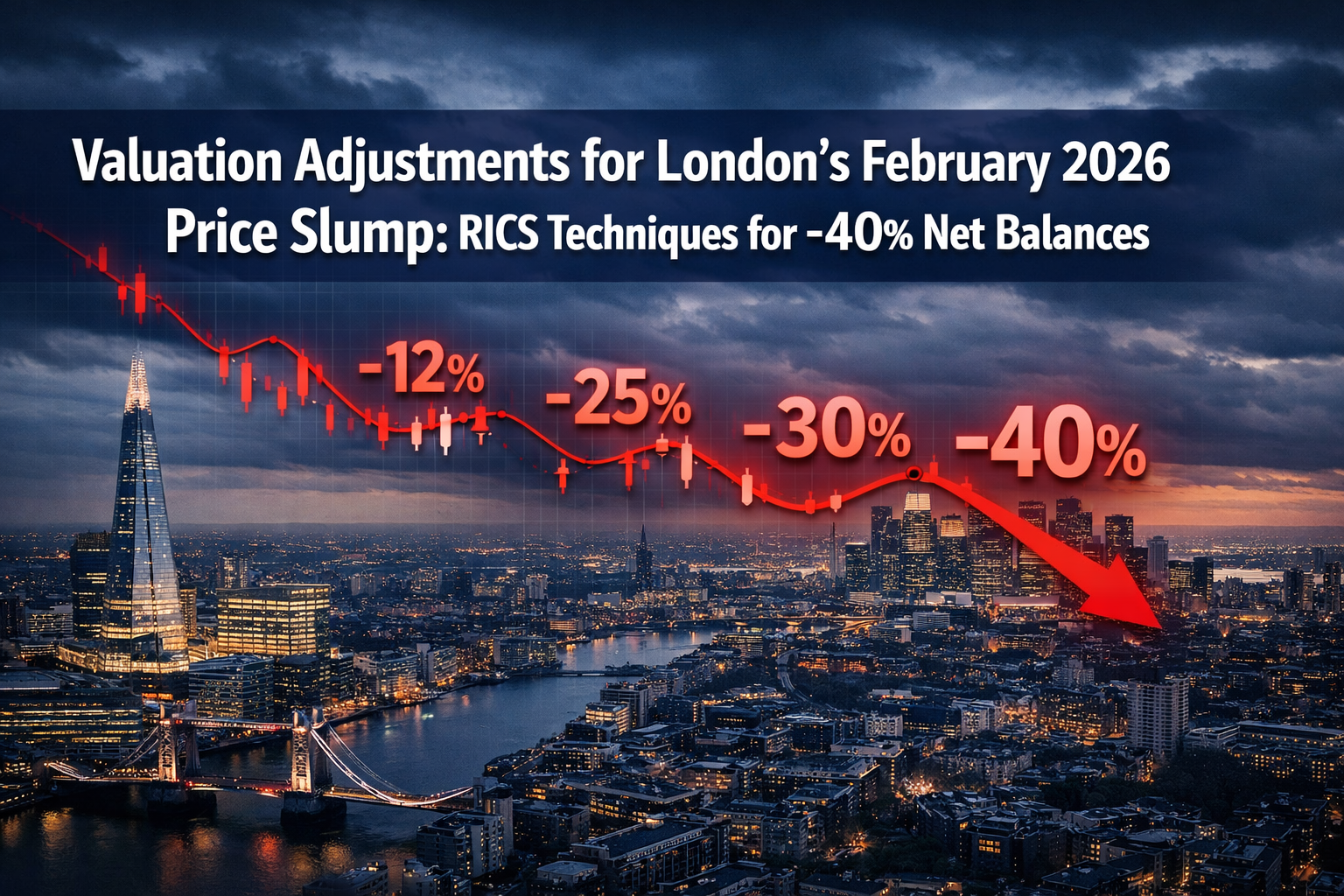
For property professionals operating across East London, Central London, and West London, the February 2026 RICS data presents both challenges and opportunities. This comprehensive guide explores the technical methodologies, comparable adjustments, and professional standards required to deliver accurate valuations during this period of market stress.
Key Takeaways
- 📉 London's -40% net balance represents the steepest regional price decline nationally, requiring immediate valuation methodology adjustments
- 🔍 RICS Red Book standards provide the essential framework for defensible valuations during market uncertainty and rapid price corrections
- 📊 Comparable evidence adjustments must account for time, location, and condition factors with heightened scrutiny during volatile periods
- ⚠️ Risk mitigation strategies including uncertainty disclosures and professional indemnity considerations are critical for surveyor protection
- 💡 Long-term sentiment indicators show dramatic cooling from +56% to +7% in just one month, signaling sustained pressure ahead
Understanding London's February 2026 Market Dynamics
The Scale of the Decline
The February 2026 RICS UK Residential Market Survey revealed unprecedented regional divergence, with London bearing the brunt of market pessimism. The -40% net balance figure means that 40% more surveyors reported price decreases than increases—a metric that substantially exceeds other regions such as the South East (-24%) and East Anglia (-26%)[1]. This represents not merely a correction but a fundamental shift in market sentiment that requires valuation professionals to recalibrate their approaches.
The magnitude becomes even more striking when compared to the national picture. While buyer demand weakened substantially across the UK market, with new buyer enquiries declining to a -26% net balance in February from -15% in January[1], London's price pressure exceeded these national trends by a significant margin. This regional concentration of weakness suggests location-specific factors beyond general market conditions.
Macroeconomic Headwinds Driving the Slump
Several converging factors contributed to this dramatic downturn:
Interest Rate Environment 🏦
The recent rise in oil and energy prices increased the likelihood that mortgage rates would remain elevated for longer periods, directly impacting buyer affordability and sentiment[1]. For surveyors conducting matrimonial valuations or freehold valuations, understanding these financing constraints becomes essential to market value determinations.
Geopolitical Uncertainty 🌍
Middle East developments specifically tempered the early 2026 strengthening that had begun in the housing market[3]. This external shock created renewed caution among buyers, particularly in high-value London markets where international investment plays a significant role.
Sentiment Collapse 📉
Perhaps most concerning for valuation professionals, long-term sentiment for London cooled dramatically. The 12-month price expectations dropped sharply to +7% from +56% in January 2026—a 49-percentage-point swing in just one month[1]. This represents a fundamental reassessment of London's price trajectory that must inform current valuation opinions.
Transaction Activity and Market Liquidity
Agreed sales remained subdued, posting a -12% net balance in February, with near-term sales expectations at -2%—the softest reading since November 2025[1][2]. This reduction in transaction velocity creates particular challenges for valuation professionals seeking comparable evidence, as the pool of recent arm's-length transactions narrows precisely when market conditions are most volatile.
Interestingly, new listings remained broadly stable, with new instructions posting a +2% net balance[1][2]. This suggests that while sellers continue to bring properties to market, buyer hesitancy rather than supply constraints drives the current imbalance. For surveyors, this dynamic means comparable evidence exists but may require more substantial adjustments to reflect rapidly changing market conditions.
RICS Valuation Framework for Market Downturns
Red Book Standards and Professional Requirements
The RICS Valuation – Global Standards (commonly known as the Red Book) provides the authoritative framework for conducting valuations during periods of market stress. When addressing Valuation Adjustments for London's February 2026 Price Slump: RICS Techniques for -40% Net Balances, adherence to these standards becomes non-negotiable for professional protection and client service.
Core Principles During Market Volatility
Market Value Definition 💼
RICS defines market value as "the estimated amount for which an asset or liability should exchange on the valuation date between a willing buyer and a willing seller in an arm's length transaction, after proper marketing and where the parties had each acted knowledgeably, prudently and without compulsion." During the February 2026 slump, the "knowledgeably" and "prudently" elements require particular attention, as market participants may be acting with heightened caution or incomplete information.
Valuation Date Sensitivity 📅
In rapidly moving markets, the valuation date assumes critical importance. A valuation conducted on February 1, 2026, may differ materially from one conducted on February 28, 2026, given the pace of sentiment deterioration. Surveyors must clearly state the valuation date and avoid backdating opinions when market conditions have materially changed.
Assumptions and Special Assumptions ⚖️
Red Book standards require explicit statement of assumptions underlying the valuation. During the February 2026 downturn, surveyors should consider whether special assumptions (departures from reality) are appropriate, and if so, clearly disclose their impact on the reported value.
Comparable Evidence Selection and Adjustment
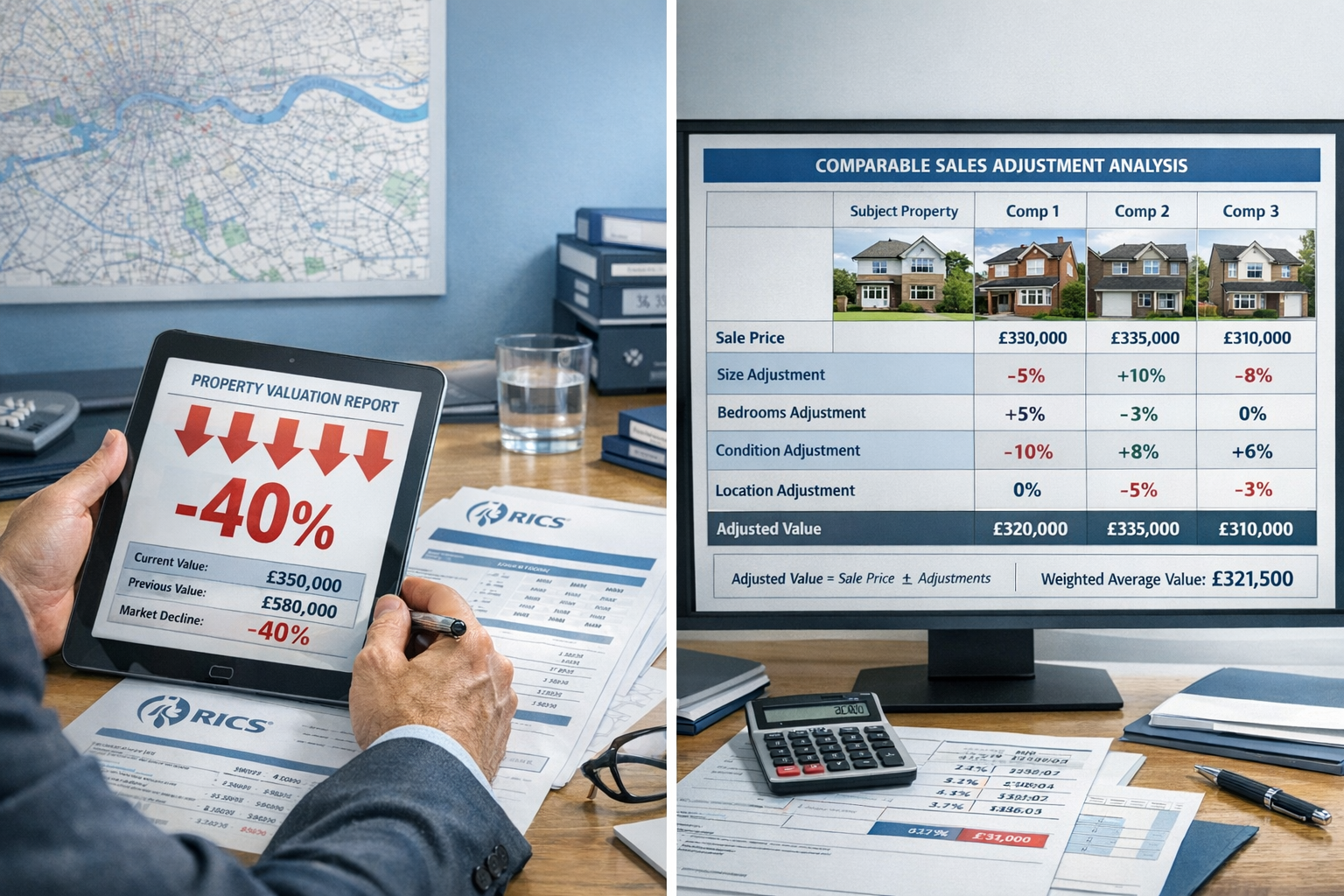
The cornerstone of residential valuation remains the comparable method, but applying this approach during Valuation Adjustments for London's February 2026 Price Slump: RICS Techniques for -40% Net Balances requires enhanced rigor.
Time Adjustments
With a -40% net balance indicating rapid price movements, time adjustments to comparable evidence become paramount. Consider this framework:
| Time Period | Suggested Adjustment Range | Rationale |
|---|---|---|
| Same month (Feb 2026) | 0% to -5% | Even within-month variation exists given rapid sentiment shift |
| Previous month (Jan 2026) | -5% to -10% | Pre-dates the dramatic sentiment collapse |
| 2-3 months prior (Dec 2025-Jan 2026) | -10% to -15% | Reflects earlier market optimism (+56% expectations) |
| 4-6 months prior | -15% to -25% | Requires substantial downward adjustment |
| 6+ months prior | Generally unreliable | Market conditions too dissimilar for meaningful comparison |
These ranges should be calibrated to specific London sub-markets, as the -40% net balance represents an average that may mask variation between prime central London, inner boroughs, and outer London locations.
Location Adjustments
London's property market comprises numerous micro-markets with distinct characteristics. When selecting comparables for Valuation Adjustments for London's February 2026 Price Slump: RICS Techniques for -40% Net Balances, consider:
- Transport connectivity: Properties near Crossrail stations may show different resilience
- School catchment areas: Family-oriented locations may experience different demand dynamics
- Commercial proximity: Areas dependent on office workers may face additional pressure
- Development pipeline: Locations with significant new supply may face compounded downward pressure
Physical Condition and Specification
Standard adjustments for size, condition, and specification remain applicable but should be applied with recognition that buyer preferences may shift during downturns. Features that commanded premiums during strong markets (such as luxury finishes) may see reduced marginal value when buyers become more price-sensitive.
Uncertainty and Material Valuation Uncertainty Clauses
The RICS guidance on material valuation uncertainty, refined following the COVID-19 pandemic experience, provides important tools for addressing the February 2026 market conditions.
When to Include Uncertainty Clauses ⚠️
Surveyors should consider including material valuation uncertainty language when:
- Transaction evidence is sparse or dated
- Market sentiment is changing rapidly (as evidenced by the 49-point swing in expectations)
- External factors (geopolitical events, interest rate uncertainty) create unpredictable conditions
- The valuation purpose involves significant financial decisions (mortgage lending, lease extension valuations)
Drafting Effective Uncertainty Disclosures 📝
Rather than generic boilerplate, effective uncertainty clauses should:
- Specify the source of uncertainty (e.g., "rapid deterioration in market sentiment as evidenced by RICS February 2026 survey data")
- Quantify the potential impact where possible (e.g., "values may vary by ±5-10% depending on transaction timing")
- Recommend review periods (e.g., "this valuation should be reviewed within 90 days given current market volatility")
- Avoid undermining the valuation opinion itself while appropriately flagging risks
Implementing RICS Techniques for -40% Net Balance Conditions
Comparable Adjustment Methodology
When applying Valuation Adjustments for London's February 2026 Price Slump: RICS Techniques for -40% Net Balances, a systematic approach ensures defensibility and consistency.
Step 1: Establish the Comparable Database
Begin by identifying potential comparables within the following hierarchy:
- Tier 1: Completed sales from February 2026 in the immediate locality (within 0.25 miles)
- Tier 2: Agreed sales from February 2026 or completed sales from January 2026 in the immediate locality
- Tier 3: Completed sales from February 2026 in the wider area (0.25-0.5 miles)
- Tier 4: Asking prices adjusted for typical negotiation margins (typically 5-10% below asking in current conditions)
Given the -12% net balance in agreed sales[1][2], Tier 2 evidence may be limited, requiring greater reliance on Tier 1 and Tier 3 sources.
Step 2: Apply Systematic Adjustments
For each comparable, apply adjustments in the following sequence:
Property Characteristics 🏘️
- Size (£ per square foot/meter baseline)
- Bedroom/bathroom count
- Outdoor space (gardens, balconies, terraces)
- Parking provision
- Period/architectural features
- Condition and specification
Location Factors 📍
- Proximity to transport links
- School catchment areas
- Neighborhood amenities
- Street appeal and traffic levels
- Flood risk and environmental factors
Temporal Adjustments ⏰
- Time-based adjustments reflecting the -40% net balance trend
- Seasonal factors (February typically shows lower activity)
- Interest rate environment at transaction date versus valuation date
Market Conditions 📊
- Buyer motivation (distressed sales require adjustment)
- Marketing period (quick sales may indicate pricing below market)
- Special purchaser premiums (adjoining owners, specific use requirements)
Step 3: Weight the Evidence
Not all comparables deserve equal weight. Consider:
- Recency: February 2026 transactions receive highest weight
- Proximity: Closer comparables receive higher weight
- Similarity: Properties requiring fewer adjustments are more reliable
- Transaction type: Arm's length sales preferred over family transfers or auction sales
Valuation Approaches Beyond Comparables
While the comparable method dominates residential valuation, alternative approaches provide important cross-checks during periods of market stress like the February 2026 slump.
Investment Method for Rental Properties
With the rental market showing significant stress—landlord instructions firmly negative at -27% in February—but +20% of surveyors expecting rents to rise over the coming three months[1], the investment method offers insights for buy-to-let properties.
Calculation Framework:
Market Value = Net Annual Rent ÷ Yield
Where yield reflects:
- Comparable investment transactions
- Risk-free rate plus property risk premium
- Landlord taxation and regulatory environment
- Void periods and management costs
The rental market dynamics suggest yields may need to expand (reducing capital values) even as rents rise, reflecting increased landlord risk and reduced supply.
Residual Method for Development Potential
For properties with development potential, the residual method provides value insights:
Gross Development Value (completed scheme value)
Less: Development costs (construction, fees, finance)
Less: Developer's profit (typically 15-20% of GDV)
Less: Purchaser's costs (stamp duty, legal fees)
= Residual land value
During market downturns, this approach requires conservative assumptions about GDV (reflecting the -40% net balance) and potentially increased profit margins to reflect heightened development risk.
Risk Mitigation Strategies for Surveyors

Professional Indemnity Considerations
The February 2026 market conditions create elevated professional indemnity (PI) risk for surveyors. Claims often emerge when property values decline after purchase, with buyers or lenders questioning whether the valuation was appropriate at the time it was conducted.
Documentation Standards
Comprehensive File Notes 📋
Maintain detailed records demonstrating:
- Market research conducted (including reference to RICS survey data showing -40% net balance)
- Comparable evidence considered and reasons for inclusion/exclusion
- Adjustment rationale with supporting calculations
- Consideration of alternative valuation approaches
- Assumptions and limitations clearly stated
Market Commentary 📰
Include substantive market commentary in valuation reports referencing:
- RICS survey data for February 2026
- Transaction volume trends
- Interest rate environment and outlook
- Regional performance variations
- Relevant economic indicators
This demonstrates the valuation was conducted with full awareness of prevailing market conditions, providing important defense against hindsight bias in any future challenge.
Terms of Engagement
Clear terms of engagement protect both surveyor and client:
Scope Definition 🎯
- Specify the valuation purpose (mortgage lending, matrimonial, taxation, etc.)
- Define the extent of investigations (desktop vs. inspection)
- Clarify reliance parties (who may rely on the valuation)
- State the valuation date and report date
Limitation of Liability ⚖️
- Consider proportionate liability caps where appropriate
- Ensure PI insurance covers the valuation type and amount
- Exclude consequential losses where contractually permissible
Review Provisions 🔄
- Include language requiring revaluation if circumstances materially change
- Specify the "shelf life" of the valuation (typically 90 days, potentially shorter in volatile markets)
- Reserve the right to revise the valuation if new information emerges
Client Communication and Expectation Management
Effective communication during the Valuation Adjustments for London's February 2026 Price Slump: RICS Techniques for -40% Net Balances period protects professional relationships and reduces dispute risk.
Pre-Instruction Discussion
Before accepting instructions, discuss:
- Current market conditions and the -40% net balance data
- Potential for values to differ from client expectations or previous valuations
- Limitations of available comparable evidence
- Appropriate use of the valuation (fitness for purpose)
Report Presentation
Structure valuation reports to enhance understanding:
Executive Summary 📊
Lead with key findings, including the valuation figure and material qualifications.
Market Context Section 🌐
Dedicate a section to market conditions, referencing RICS data and explaining how London's -40% net balance compares to other regions and historical norms.
Methodology Transparency 🔍
Explain the valuation approach in accessible language, helping clients understand how the figure was derived and why certain comparables were selected or adjusted.
Sensitivity Analysis 📈
Where appropriate, provide sensitivity analysis showing how the valuation would change under different assumptions (e.g., if market conditions improve or deteriorate further).
Regulatory Compliance and Quality Assurance
RICS Registration and Competence
Ensure compliance with RICS requirements for registered valuers:
- Maintain appropriate qualifications (MRICS or FRICS status)
- Complete continuing professional development (CPD) requirements
- Maintain professional indemnity insurance at appropriate levels
- Comply with RICS Rules of Conduct
For clients seeking assurance of surveyor qualifications, resources explaining how to verify credentials provide valuable guidance.
Internal Review Processes
Firms should implement enhanced review processes during volatile market conditions:
Peer Review 👥
Have complex or high-value valuations reviewed by a second qualified surveyor before issuance.
Consistency Checks ✅
Compare valuations across similar properties to ensure consistent application of adjustments and methodologies.
Market Data Updates 📅
Regularly update comparable databases and market intelligence to reflect the rapidly evolving February 2026 conditions.
Sector-Specific Considerations
Prime Central London
The prime central London market often exhibits distinct characteristics during downturns. International buyer participation, which typically supports this segment, may be particularly affected by geopolitical uncertainty and currency fluctuations.
Valuation Considerations:
- Currency-adjusted comparables for international transactions
- Analysis of transaction nationality mix
- Premium property features may see reduced marginal value
- Longer marketing periods typically required
Residential Development Sites
Development land values are particularly sensitive to market downturns, as they reflect discounted future residential values. The -40% net balance suggests development land values may face even steeper declines than completed residential properties.
Adjustment Factors:
- Increased developer's profit margins (20-25% vs. typical 15-20%)
- Extended development timescales increasing finance costs
- Planning risk premiums
- Reduced buyer appetite for off-plan purchases
Leasehold Properties and Enfranchisement
Lease extension valuations require particular care during market downturns, as they involve projecting future values and determining appropriate deferment rates.
Key Considerations:
- Freehold vacant possession value assessment in declining market
- Deferment rate selection (may increase during volatile periods)
- Relativity adjustments reflecting current market conditions
- Marriage value calculations with appropriate risk adjustments
Practical Application: Case Study Approach
Example Valuation Scenario
Property: Three-bedroom Victorian terrace house in Clapham, South West London
Valuation Date: February 28, 2026
Purpose: Mortgage lending
Previous Valuation: £850,000 (September 2025)
Comparable Evidence:
| Address | Sale Date | Price | Size | Adjustments Required |
|---|---|---|---|---|
| Comparable A | Feb 2026 | £775,000 | 1,250 sq ft | +£25,000 (condition) |
| Comparable B | Jan 2026 | £825,000 | 1,300 sq ft | -£50,000 (size), -£40,000 (time) |
| Comparable C | Dec 2025 | £865,000 | 1,280 sq ft | -£20,000 (location), -£85,000 (time) |
Subject Property: 1,275 sq ft, good condition
Analysis:
- Comparable A (February 2026): £775,000 + £25,000 = £800,000
- Comparable B (January 2026): £825,000 – £50,000 – £40,000 = £735,000
- Comparable C (December 2025): £865,000 – £20,000 – £85,000 = £760,000
Weighted Conclusion: £775,000 (giving highest weight to February 2026 transaction)
Variance from Previous Valuation: -8.8% (£850,000 to £775,000)
This demonstrates how systematic application of Valuation Adjustments for London's February 2026 Price Slump: RICS Techniques for -40% Net Balances produces a defensible valuation opinion that reflects current market realities while remaining anchored to comparable evidence.
Technology and Data Resources
Market Data Platforms
Surveyors should leverage multiple data sources to inform valuations during the February 2026 downturn:
Land Registry Data 🏛️
Provides completed transaction evidence with exact prices and dates, though with a typical 2-3 month lag.
Rightmove and Zoopla 🏠
Offer asking price data and "sold subject to contract" information, providing more current market indicators than completed sales.
RICS Residential Market Survey 📊
The source of the -40% net balance data, providing invaluable sentiment and trend indicators updated monthly.
Local Agent Intelligence 🤝
Direct engagement with active estate agents provides qualitative insights into buyer behavior, negotiation dynamics, and emerging trends.
Valuation Software and Tools
Modern valuation software can enhance consistency and efficiency:
- Automated comparable adjustment calculations
- Market trend visualization
- Report generation with standardized formatting
- Audit trails for regulatory compliance
- Integration with market data sources
However, technology should support rather than replace professional judgment, particularly during volatile periods like February 2026 when algorithmic approaches may lag market reality.
Looking Forward: Post-Slump Valuation Strategies
Monitoring Recovery Indicators
Surveyors should track several indicators to identify when market conditions stabilize:
RICS Net Balance Trends 📈
Improvement from the -40% February figure toward neutral territory would signal stabilization.
Transaction Volumes 📊
Increased agreed sales (currently -12% net balance) would indicate renewed buyer confidence.
Sentiment Indicators 💭
Recovery in 12-month expectations (currently +7%, down from +56%) would suggest improving outlook.
Interest Rate Trajectory 💰
Clarity on mortgage rate direction would reduce a key source of buyer hesitation.
Positioning for Market Recovery
When conditions improve, surveyors who maintained rigorous standards during the downturn will be well-positioned:
- Reputation protection through defensible valuations during difficult conditions
- Client relationships strengthened by transparent communication
- Comparable databases enriched with downturn evidence for future reference
- Methodological refinement through experience with adjustment techniques
For surveyors operating across London—from Hammersmith to Chelsea, from Battersea to Clapham—the February 2026 experience provides valuable lessons applicable to future market cycles.
Conclusion
Valuation Adjustments for London's February 2026 Price Slump: RICS Techniques for -40% Net Balances represents both a challenge and an opportunity for property professionals. The unprecedented -40% net balance demands rigorous application of RICS standards, systematic comparable adjustments, and enhanced risk management practices.
Key principles for navigating this environment include:
✅ Anchor to RICS Red Book standards for defensible methodology
✅ Apply time-sensitive adjustments reflecting rapid market changes
✅ Document thoroughly to demonstrate professional diligence
✅ Communicate transparently with clients about market conditions
✅ Include appropriate uncertainty disclosures where evidence is limited
✅ Maintain professional indemnity protection through proper terms of engagement
✅ Cross-check valuations using multiple approaches where applicable
Actionable Next Steps
For surveyors conducting valuations in the current environment:
- Review and update comparable databases with February 2026 transaction evidence
- Calibrate adjustment factors to reflect the -40% net balance and regional variations
- Enhance report templates to include market context sections referencing RICS data
- Strengthen terms of engagement with appropriate limitation and review provisions
- Engage in peer discussion to share insights and ensure consistency across the profession
- Monitor RICS updates for March 2026 and beyond to track market evolution
- Consider additional training on valuation uncertainty and downturn techniques
For property owners, buyers, and lenders relying on valuations during this period, selecting appropriately qualified professionals becomes paramount. Engaging chartered surveyors with RICS registration and relevant experience ensures valuations reflect both current market realities and professional best practices.
The February 2026 price slump will eventually pass, but the methodological rigor and professional standards applied during this challenging period will serve the profession well for years to come. By combining technical expertise with transparent communication and robust risk management, surveyors can navigate market volatility while maintaining the trust and confidence essential to the valuation profession.
References
[1] Uk Residential Survey February 2026 – https://www.rics.org/news-insights/uk-residential-survey-february-2026
[2] Uk Residential Market Survey February 2026 – https://www.rics.org/content/dam/ricsglobal/documents/market-surveys/uk-residential-market-survey/UK-Residential-Market-Survey_February-2026.pdf
[3] Uk Rics Residential Market Survey Feb 2026 – https://www.capitaleconomics.com/publications/uk-housing-market-update/uk-rics-residential-market-survey-feb-2026
[4] Valuation Adjustments For Widening Regional Disparities Rics January 2026 Survey Insights For Surveyors – https://nottinghillsurveyors.com/blog/valuation-adjustments-for-widening-regional-disparities-rics-january-2026-survey-insights-for-surveyors
