
The construction and property sector faces an unprecedented challenge in 2026: consumers now expect building survey completions in just 6.78 weeks, yet the industry average stands at 123 days—a staggering 18-week gap. This disconnect between expectation and reality creates intense pressure on surveyors to accelerate timelines while maintaining the rigorous standards that protect property buyers and ensure regulatory compliance. Building Survey Speed vs. Accuracy: Managing the 6-Week Completion Expectation in 2026 represents one of the most pressing operational challenges facing chartered surveyors today.
The tension between speed and accuracy isn't merely an inconvenience—it fundamentally impacts property transactions, client satisfaction, and professional liability. As project delays and cancellations become increasingly prevalent across the construction sector[5], surveyors must find innovative ways to compress timelines without compromising the thorough inspections that form the foundation of quality building surveys.
Key Takeaways
- ⏱️ The expectation gap is real: Consumers expect 6.78-week survey completions while the industry averages 123 days, creating significant pressure on surveying firms
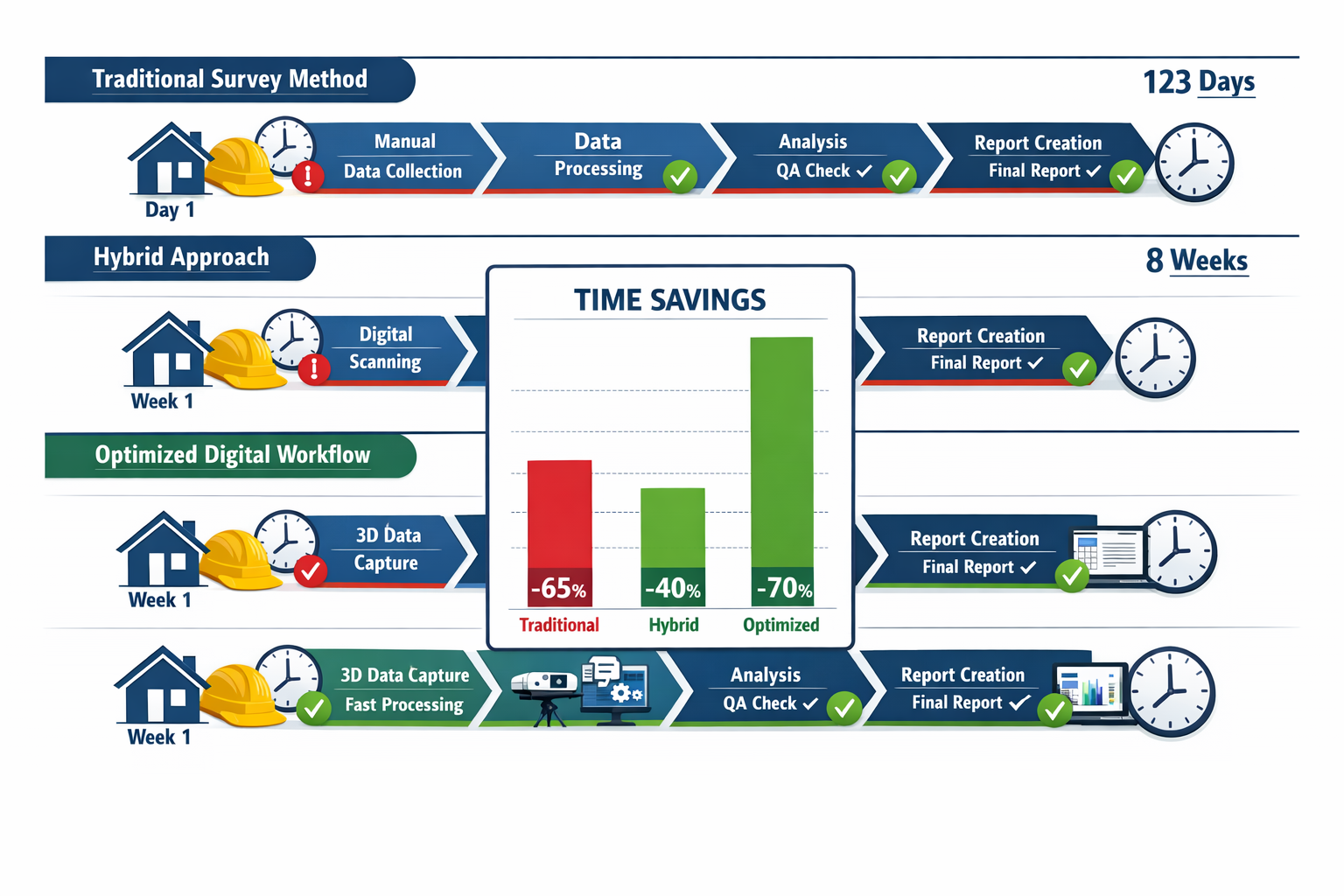
- 🔧 Technology enables dual objectives: Digital workflows, BIM, and 3D scanning can reduce timelines by up to 20% while simultaneously improving accuracy[2]
- ⚖️ Quality cannot be sacrificed: Despite time pressures, maintaining RICS standards and thorough inspections remains non-negotiable for professional liability and client protection
- 📊 Workflow optimization matters more than equipment: 2026 surveying trends emphasize how data is captured, processed, and managed rather than just hardware investments[7]
- ✅ Strategic planning is essential: Balancing speed with accuracy requires upfront planning, clear communication, and realistic client expectation management
Understanding the 6-Week Completion Expectation Challenge
The Reality of Current Survey Timelines
The construction industry faces a significant timing crisis. While consumers increasingly demand faster turnarounds on property surveys, the reality of comprehensive building inspections tells a different story. Traditional Level 3 building surveys, which provide the most detailed property assessments, typically require substantial time for thorough inspection, analysis, and reporting.
Current timeline breakdown for comprehensive surveys:
| Survey Stage | Traditional Duration | Client Expectation |
|---|---|---|
| Initial scheduling | 5-7 days | 2-3 days |
| Site inspection | 1-2 days | 1 day |
| Data analysis | 7-10 days | 3-4 days |
| Report preparation | 10-14 days | 5-7 days |
| Quality review | 3-5 days | 1-2 days |
| Total | 26-38 days (4-5.5 weeks) | 12-17 days (1.7-2.4 weeks) |
This timeline gap creates tension between what's professionally responsible and what clients demand. The pressure intensifies when considering that many surveys reveal issues requiring additional specialist investigations—drainage surveys, structural surveys, or damp surveys—which extend timelines further.
Why Speed Matters in Property Transactions
In competitive property markets, transaction speed directly impacts success rates. Buyers face intense competition, and delayed surveys can mean losing preferred properties to faster-moving competitors. Sellers equally desire quick completions to secure sales and move forward with their plans.
"The surveying profession must adapt to market realities while maintaining professional standards. Speed without accuracy is worthless, but accuracy without reasonable speed is increasingly unmarketable." — Industry perspective on 2026 surveying challenges
The construction sector's broader challenges compound these pressures. Recent data indicates that project delays and cancellations have become increasingly prevalent[5], creating ripple effects throughout property transactions. When construction timelines slip, survey expectations paradoxically tighten as stakeholders attempt to recover lost time elsewhere in the process.
The Cost of Getting It Wrong
Rushing surveys to meet unrealistic deadlines carries substantial risks:
- Professional liability exposure 🚨 – Missing critical defects due to rushed inspections can result in negligence claims
- Reputation damage 📉 – Incomplete or inaccurate reports harm professional credibility
- Financial consequences 💰 – Errors and omissions insurance claims increase premiums and may result in coverage limitations
- Client dissatisfaction 😞 – Even fast reports that miss issues create long-term client relationship problems
- Regulatory concerns ⚖️ – Failing to meet RICS standards can trigger disciplinary proceedings
The stakes are particularly high for commercial building surveys, where property values and potential defect costs multiply exponentially compared to residential properties.
Technology Solutions for Accelerating Survey Workflows
Digital Tools Transforming Survey Speed
The surveying profession is experiencing a technological revolution that directly addresses the speed-versus-accuracy dilemma. Advanced scanning, surveying, and positioning technologies capable of achieving millimeter-level accuracy onsite rank among contractors' top technology priorities for 2026[1], indicating industry-wide recognition that precision and efficiency can coexist.
Key technologies accelerating survey workflows:
-
3D Laser Scanning 📸
- Captures comprehensive spatial data in hours rather than days
- Provides millimeter-accurate measurements
- Creates permanent digital records for future reference
- Reduces return visits for additional measurements
-
Thermal Imaging Technology 🌡️
- Instantly identifies insulation deficiencies, moisture intrusion, and air leaks
- Non-invasive inspection of hidden building elements
- Generates visual evidence for reports quickly
- Detects issues invisible to traditional inspection methods
-
Drone Surveys 🚁
- Safely inspects roofs, chimneys, and high structures without scaffolding
- Captures high-resolution imagery in minutes
- Reduces inspection time for large or complex properties
- Provides comprehensive external envelope documentation
-
Mobile Reporting Applications 📱
- Enables real-time data capture during site visits
- Reduces transcription errors and double-handling
- Generates preliminary findings immediately
- Streamlines photo annotation and organization
Building Information Modeling (BIM) Integration
Building information modeling represents a paradigm shift in how survey data is captured, analyzed, and communicated. Digital workflows incorporating BIM, 3D printing, and digital twins enable timeline reductions of up to 20% while simultaneously improving accuracy and minimizing rework[2].
For surveyors, BIM integration offers several advantages:
- Contextual understanding – Existing building models provide baseline information before site visits
- Efficient data organization – Survey findings integrate directly into 3D models
- Enhanced visualization – Clients better understand issues when presented in 3D context
- Collaborative workflows – Multiple specialists can work simultaneously on different aspects
The shift toward workflow optimization rather than equipment acquisition marks a significant trend in 2026 surveying practices[7]. Firms increasingly recognize that having the latest technology means little without efficient processes for deploying it effectively.
Artificial Intelligence and Automated Analysis
AI-powered analysis tools are beginning to transform how surveyors process inspection data:
- Pattern recognition algorithms identify common defect types in photographs automatically
- Predictive analytics flag areas requiring closer attention based on property characteristics
- Natural language processing assists in generating initial report drafts from field notes
- Quality assurance checks automatically verify report completeness and consistency
These technologies don't replace professional judgment—they augment it by handling routine analysis tasks, freeing surveyors to focus on complex interpretation and recommendations.
Maintaining Accuracy Standards Under Time Pressure
RICS Standards and Professional Obligations
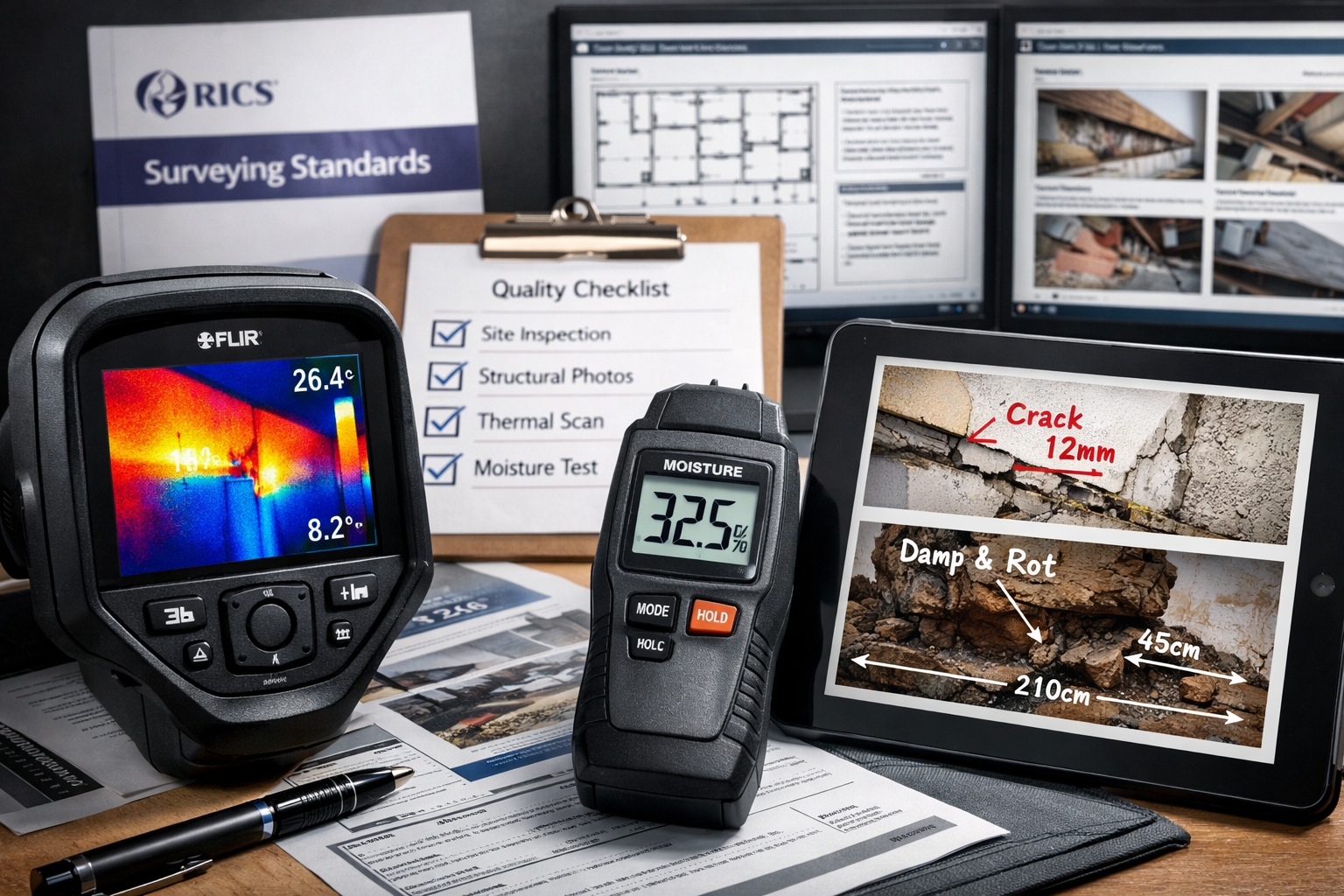
Regardless of client timeline pressures, chartered surveyors must maintain compliance with Royal Institution of Chartered Surveyors (RICS) standards. These professional requirements exist to protect both clients and surveyors themselves. Understanding what does a surveyor check during inspections reveals the comprehensive nature of these obligations.
Non-negotiable elements of thorough building surveys:
✅ Structural integrity assessment – Foundation, walls, roof structure, and load-bearing elements
✅ Building envelope evaluation – External walls, windows, doors, and weather-tightness
✅ Services inspection – Electrical, plumbing, heating, and ventilation systems (visible elements)
✅ Moisture and damp investigation – Rising damp, penetrating damp, and condensation issues
✅ Defect identification – Current problems and potential future issues
✅ Maintenance recommendations – Immediate, short-term, and long-term repair priorities
When comparing Level 2 and Level 3 survey options, the depth of investigation increases significantly, requiring proportionally more time for thorough completion.
Quality Control Checkpoints
Implementing systematic quality control processes helps maintain accuracy even under accelerated timelines:
Pre-inspection stage:
- Review property documentation and available records
- Identify potential red flags requiring extended investigation time
- Prepare specialized equipment based on property characteristics
- Set realistic client expectations about timeline and scope
During inspection:
- Follow systematic inspection protocols without shortcuts
- Use digital checklists to ensure comprehensive coverage
- Capture extensive photographic documentation
- Note areas requiring follow-up or specialist investigation
Post-inspection analysis:
- Cross-reference findings against property type norms
- Verify measurements and observations for consistency
- Consult specialists for areas outside core competency
- Conduct peer review for complex or high-value properties
Report preparation:
- Use standardized templates for consistency and efficiency
- Include clear, unambiguous language avoiding technical jargon
- Provide photographic evidence for all significant findings
- Implement multi-stage review before client delivery
When to Refuse Unrealistic Deadlines
Professional integrity sometimes requires declining projects with impossible timelines. Surveyors should consider refusing instructions when:
🚫 The requested timeline doesn't allow for thorough inspection of the property type
🚫 Client pressure explicitly or implicitly suggests cutting corners
🚫 Seasonal conditions (weather, vegetation) prevent adequate assessment
🚫 Access limitations require multiple visits but timeline allows only one
🚫 Specialist investigations are clearly needed but not accommodated in schedule
Transparent communication about why certain timelines are unrealistic protects both the surveyor's professional standing and the client's interests. Many clients, when presented with clear reasoning, accept extended timelines rather than risk inadequate surveys.
Strategies for Balancing Speed and Accuracy in 2026
Workflow Optimization Techniques
Building Survey Speed vs. Accuracy: Managing the 6-Week Completion Expectation in 2026 requires systematic workflow improvements rather than simply working faster. Survey firms can implement several proven strategies:
1. Standardization and Templates 📋
- Develop property-type-specific inspection protocols
- Create standardized report templates with pre-populated common sections
- Maintain libraries of standard defect descriptions and recommendations
- Use consistent photographic documentation approaches
2. Parallel Processing ⚡
- Conduct preliminary desktop research while scheduling site visits
- Begin report drafting immediately after inspection using mobile notes
- Process photographs and thermal images during travel time
- Engage specialists for concurrent investigations rather than sequential
3. Team Specialization 👥
- Assign surveyors to property types matching their expertise
- Develop specialist teams for common issues (damp, structural, roofing)
- Use junior staff for routine data processing under senior supervision
- Implement mentoring programs to build team capabilities
4. Client Communication Protocols 💬
- Provide clear timeline expectations during initial consultation
- Offer tiered service levels with corresponding completion times
- Send progress updates to manage client expectations
- Deliver preliminary findings verbally before full report completion
Strategic Scheduling and Resource Allocation
Effective practice management significantly impacts survey completion times:
Capacity planning considerations:
- Maintain realistic surveyor workload limits to prevent quality degradation
- Build buffer time for unexpected complications or weather delays
- Schedule complex properties when senior staff availability is highest
- Avoid over-booking during peak transaction seasons
Technology investment priorities:
- Focus on tools that eliminate bottlenecks in current workflows
- Invest in training alongside equipment purchases
- Implement cloud-based systems for remote team collaboration
- Regularly review technology ROI and utilization rates
Outsourcing and specialist partnerships:
- Develop relationships with reliable specialist surveyors for quick referrals
- Use professional photography services for large commercial properties
- Consider report writing assistance for routine sections
- Partner with laboratories for expedited testing services
Client Education and Expectation Management
Many timeline pressures arise from client misunderstanding about survey complexity. Proactive education helps align expectations with reality:
During initial consultation:
- Explain the difference between survey types and their respective timelines
- Discuss property-specific factors that may extend completion times
- Clarify what surveyors can and cannot assess within scope
- Provide written timeline estimates with milestone dates
Throughout the process:
- Communicate immediately if complications arise requiring timeline extensions
- Explain why certain issues require specialist follow-up investigations
- Provide context about industry standards and professional obligations
- Offer interim updates for properties requiring extended investigation
In marketing materials:
- Publish realistic timeline ranges for different survey types
- Showcase technology and processes that enable efficient service
- Highlight quality assurance measures that protect client interests
- Share client testimonials emphasizing thoroughness over speed alone
For those seeking comprehensive property assessments, understanding the complete guide to building surveyors in London helps set appropriate expectations about service levels and timelines.
Industry Trends Shaping Survey Timelines in 2026
Market Pressures and Economic Factors
The construction and property sectors face significant headwinds in 2026. Builder sentiment has lost ground at the start of the year[6], and demand uncertainty is changing homebuilding strategies[3]. These broader market conditions create contradictory pressures on surveyors:
- Increased competition drives firms to offer faster turnarounds as differentiators
- Economic uncertainty makes buyers more risk-averse, demanding more thorough surveys
- Transaction volumes fluctuate, creating feast-or-famine workload challenges
- Fee pressure limits resources available for technology investment and staffing
Regulatory and Professional Standards Evolution
Professional standards continue evolving to address contemporary challenges. RICS regularly updates guidance to reflect technological capabilities and market realities. Surveyors must balance:
- Traditional thoroughness valued in professional standards
- Modern efficiency enabled by technological advances
- Client service expectations shaped by other industries' digital transformation
- Liability considerations in an increasingly litigious environment
The emphasis on workflow optimization rather than equipment acquisition[7] reflects professional recognition that process improvements deliver more sustainable timeline reductions than technology alone.
The Role of Specialization
As properties become more complex and building technologies advance, surveyor specialization increasingly impacts completion timelines:
Specialist survey types requiring extended timelines:
- Asbestos surveys requiring laboratory analysis
- Subsidence surveys needing monitoring periods
- Commercial property surveys involving multiple buildings or complex systems
- Non-standard construction requiring specialized knowledge
Generalist surveyors face pressure to complete all survey types within similar timelines, while specialists can justify extended periods for complex assessments within their expertise.
Practical Implementation: A Roadmap for Survey Firms
Short-Term Actions (0-3 Months)
For firms seeking to address Building Survey Speed vs. Accuracy: Managing the 6-Week Completion Expectation in 2026, immediate steps include:
- Audit current workflows – Map existing processes from instruction to report delivery, identifying bottlenecks
- Implement mobile reporting – Equip surveyors with tablets and field reporting software
- Standardize templates – Create consistent report structures for common property types
- Review scheduling practices – Optimize appointment booking and surveyor allocation
- Enhance client communication – Develop clear timeline guidance for different survey types
Medium-Term Initiatives (3-12 Months)
Building on quick wins, firms should pursue:
- Technology integration – Invest in 3D scanning, thermal imaging, or drone capabilities based on property mix
- Team training – Develop staff competencies in new technologies and efficient workflows
- Quality assurance systems – Implement formal review processes ensuring accuracy under faster timelines
- Specialist partnerships – Establish relationships with reliable specialists for quick referrals
- Performance metrics – Track completion times, revision rates, and client satisfaction scores
Long-Term Strategic Development (1-3 Years)
Sustainable competitive advantage requires:
- BIM integration – Develop capabilities for working with building information models
- AI-assisted analysis – Implement machine learning tools for pattern recognition and quality checking
- Service tier development – Create clearly differentiated offerings with corresponding timelines and pricing
- Market positioning – Establish reputation for specific property types or survey specializations
- Continuous improvement culture – Regularly review and refine processes based on performance data
Conclusion
Building Survey Speed vs. Accuracy: Managing the 6-Week Completion Expectation in 2026 represents a defining challenge for the surveying profession. The gap between consumer expectations (6.78 weeks) and industry reality (123 days) cannot be bridged by simply working faster or cutting corners. Instead, surveyors must embrace a multifaceted approach combining technological innovation, workflow optimization, and strategic client communication.
The evidence is clear: digital workflows incorporating advanced technologies can reduce timelines by up to 20% while simultaneously improving accuracy[2]. However, technology alone isn't sufficient—successful firms must emphasize how data is captured, processed, and managed[7] rather than merely acquiring equipment.
Key Success Factors
✅ Invest strategically in technology that eliminates bottlenecks, not just impressive capabilities
✅ Maintain unwavering commitment to RICS standards and professional obligations
✅ Implement systematic quality controls that function effectively under time pressure
✅ Educate clients proactively about realistic timelines and the value of thoroughness
✅ Specialize strategically to build expertise that justifies appropriate completion times
✅ Measure and optimize continuously using performance data to guide improvements
Next Steps for Surveying Professionals
For surveyors seeking to thrive amid these pressures:
- Assess your current position – Honestly evaluate existing workflows, technology, and completion times
- Identify your biggest bottleneck – Focus improvement efforts where they'll deliver maximum impact
- Start with quick wins – Implement mobile reporting and standardized templates immediately
- Plan strategic investments – Develop a technology and training roadmap aligned with your property mix
- Communicate your value – Help clients understand why quality surveys require appropriate time
The firms that successfully navigate Building Survey Speed vs. Accuracy: Managing the 6-Week Completion Expectation in 2026 won't be those that simply work faster—they'll be those that work smarter, leveraging technology and optimized processes while maintaining the professional standards that protect both clients and surveyors themselves.
For property buyers and sellers, partnering with surveyors who understand this balance ensures both timely transactions and the thorough inspections that prevent costly surprises. The future belongs to surveying practices that refuse to sacrifice accuracy for speed, instead finding innovative ways to deliver both.
References
[1] Future Construction Technology Trends Contractor Survey – https://www.trimble.com/blog/trimble/en-US/article/future-construction-technology-trends-contractor-survey
[2] Engineering And Construction Industry Outlook – https://www.deloitte.com/us/en/insights/industry/engineering-and-construction/engineering-and-construction-industry-outlook.html
[3] Survey Reveals Demand Uncertainty Is Changing 2026 Homebuilding Strategy – https://www.housingwire.com/articles/survey-reveals-demand-uncertainty-is-changing-2026-homebuilding-strategy/
[5] January 2026 – https://www.aia.org/resource-center/consensus-construction-forecast/january-2026
[6] Builder Sentiment Loses Ground At Start Of 2026 – https://www.nahb.org/news-and-economics/press-releases/2026/01/builder-sentiment-loses-ground-at-start-of-2026
[7] 2026 Surveying Trends How Survey Firms Are Adapting Without Overcommitting – https://munsonedsurvey.com/blogs/news/2026-surveying-trends-how-survey-firms-are-adapting-without-overcommitting
