
Two homeowners on the same street, both planning rear extensions of identical size, both receiving party wall notices at the same time — yet one pays £1,100 in surveying fees while the other pays £3,400. That gap is not an anomaly. It is the direct result of factors most property owners never think to ask about before work begins.
Understanding party wall surveying fees in 2026: what drives cost, why quotes vary, and how clients can compare value is no longer optional knowledge for anyone planning structural work near a shared boundary. With fees trending upward due to inflation and increased demand [6], and with the law leaving fee-setting entirely unregulated [6], the difference between an informed client and an uninformed one can run to thousands of pounds.
This guide breaks down every meaningful cost driver, explains why legitimate quotes can differ by 20–50%, and gives readers a clear framework for evaluating value — not just price.
Key Takeaways 📌
- Project complexity is the single biggest cost driver — basement works and deep excavations cost significantly more than straightforward loft conversions or extensions.
- The building owner pays all reasonable fees under the Party Wall etc. Act 1996, including the adjoining owner's surveyor costs.
- Hourly rates in 2026 range from £90–£450, and most standard jobs require 6–8 surveyor hours — making the fee structure chosen critically important.
- A joint (agreed) surveyor arrangement can cut total costs significantly compared to each party appointing their own surveyor.
- Getting 2–3 competitive quotes is essential — fee variation between surveyors of 20–50% is common and legitimate.
What Drives Party Wall Surveying Fees in 2026
The Party Wall etc. Act 1996 does not set fixed fees. It requires only that surveyors charge "reasonable" amounts based on time spent and work required [6]. That single word — reasonable — is the source of enormous variation in the market. To understand what any quote represents, it helps to examine the core drivers individually.
🏗️ 1. Project Type and Complexity
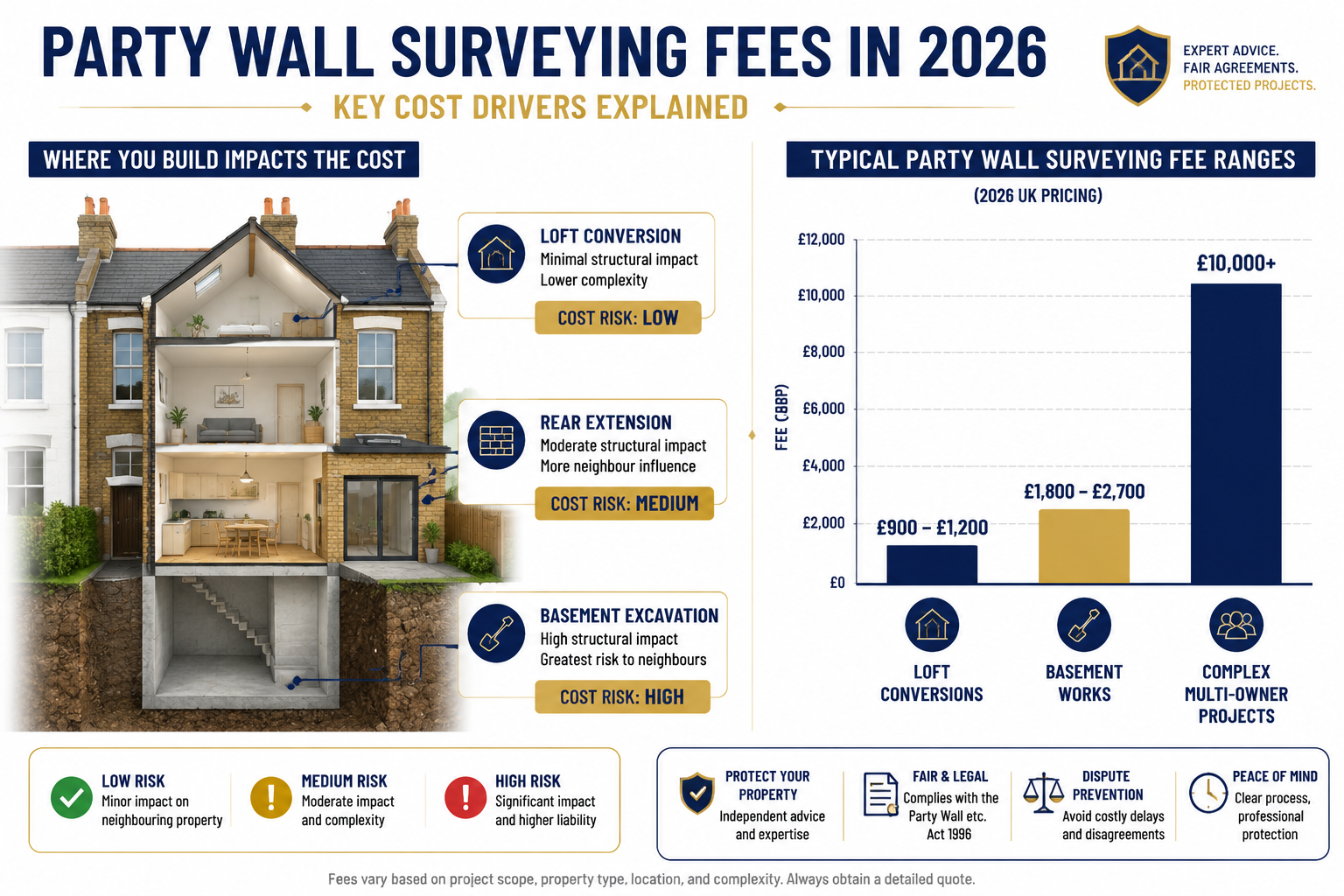
This is the dominant factor. A straightforward loft conversion involving minor work to a shared wall sits at the lower end of the cost spectrum: typically £900–£1,200 for a single surveyor appointment [1][2]. A rear extension with underpinning sits in the middle range. Basement excavations and deep structural works — which carry the highest risk of damage to neighbouring properties — can push single-surveyor fees to £1,800–£2,700, and complex multi-owner basement projects have been known to exceed £10,000–£15,000 in total surveying costs [5].
The logic is straightforward: higher-risk projects require more site visits, more detailed Schedule of Condition reports, more complex Party Wall Awards, and more professional time. Every additional hour of surveyor time adds to the final invoice.
💡 Pull Quote: "The fee is not a reflection of the surveyor's price list — it is a reflection of how much work your project genuinely creates."
📍 2. Geographic Location
London and the South East consistently command premium rates. Geographic location can account for a 20–40% cost difference compared to equivalent work in the Midlands or Northern England [5]. This reflects higher local costs of living, greater property density (meaning more complex structural environments), and stronger demand for qualified surveyors in urban centres.
For homeowners in areas like West London, North London, or Richmond, party wall surveying fees will typically sit at the higher end of published ranges. Those in Hampshire or Oxfordshire may find more competitive rates — though the same complexity factors still apply.
👥 3. Number of Adjoining Owners and Surveyors
Each additional adjoining owner who dissents to a party wall notice and appoints their own surveyor adds approximately £1,000–£3,000 to the project budget [5]. A mid-terrace property, for example, may have two adjoining owners — one on each side — both of whom could appoint separate surveyors. When both neighbours appoint separately, total costs for the project can rise to £1,800–£5,400 [1][2].
This is why the agreed surveyor route — where both the building owner and adjoining owner appoint the same single surveyor — can generate meaningful savings. One surveyor handles the entire process, reducing duplication of time and administration [9].
⏱️ 4. Hourly Rates vs. Fixed Fees
In 2026, surveyors operate under several fee models [6]:
| Fee Model | Typical Range | Best Suited For |
|---|---|---|
| Fixed fee | £900–£1,500 | Straightforward, predictable projects |
| Hourly rate | £90–£450/hour | Complex or bespoke work |
| Award-based fee | £500–£950 (Award only) | Full Party Wall service packages |
| Variable/scaled fee | Depends on complexity | Multi-owner or high-risk projects |
Most standard party wall jobs require 6–8 hours of surveyor time [3][5]. At £150/hour, that produces a fee of £900–£1,200. At £250/hour (a common London rate), the same hours produce £1,500–£2,000. The fee model and the hourly rate together determine the final figure — which is why two surveyors with identical qualifications can quote very differently.
📋 5. Individual Service Components
Some surveyors quote a single all-in figure. Others itemise components separately. Understanding what each element costs helps clients decode any quote they receive:
- Party Wall Notice preparation: £65–£150 [4][5]
- Schedule of Condition report: £300–£450 [4][5]
- Party Wall Award preparation: £500–£950 [4][5]
- Site visits: Charged at hourly rate or included in fixed fee
- Administration and correspondence: Often bundled, sometimes itemised
When comparing quotes, always check whether these components are included or charged additionally. A low headline figure that excludes the Schedule of Condition report is not necessarily cheaper than a higher all-in quote that includes everything.
Why Party Wall Surveying Quotes Vary So Much in 2026
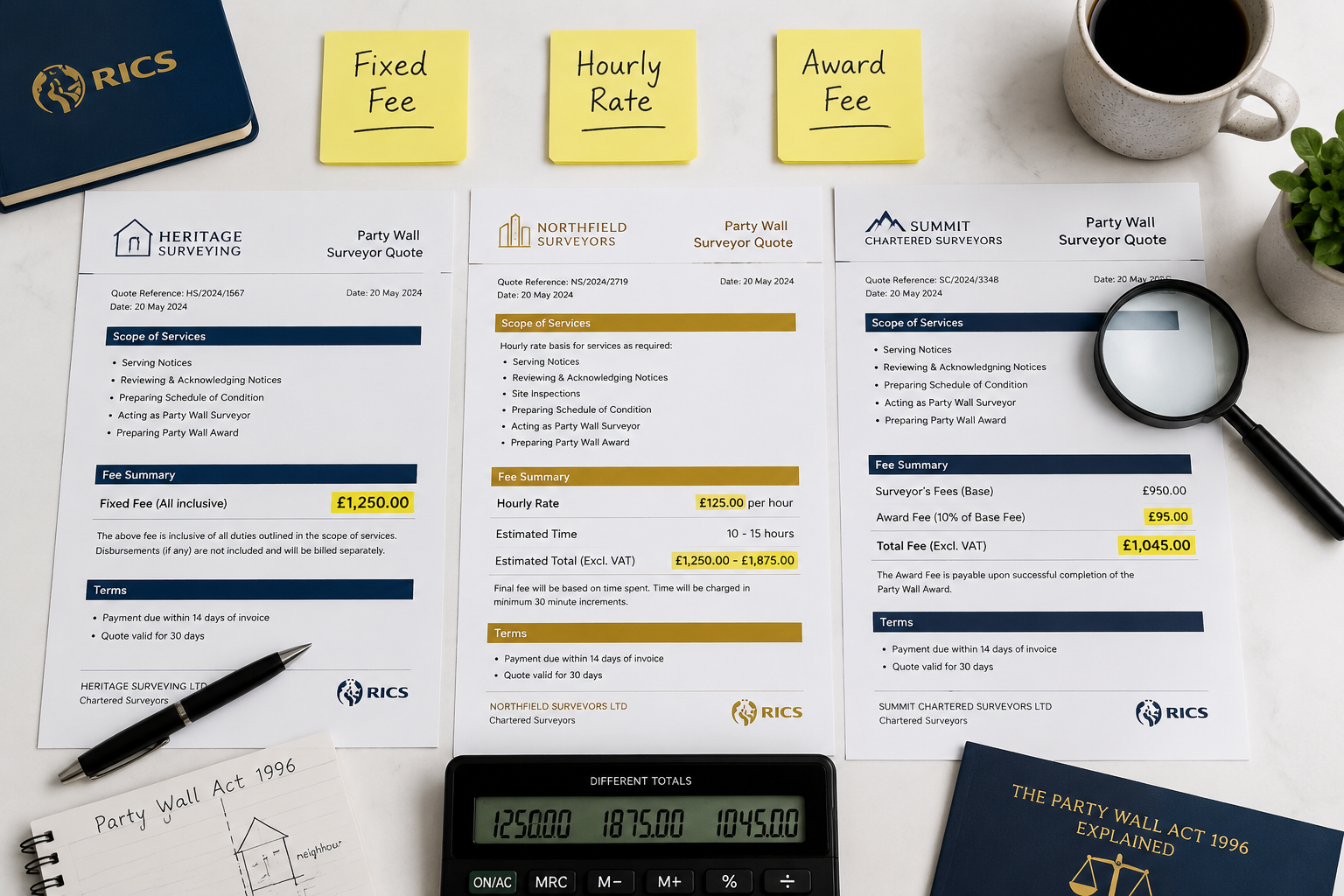
The fee variation that confuses most clients is not a sign of market dysfunction. It reflects legitimate differences in how surveyors assess, price, and structure their services. Understanding these differences is the key to comparing quotes meaningfully.
The "Reasonable Fee" Problem
Because the Party Wall etc. Act 1996 does not define a fee scale, every surveyor makes their own judgement about what is reasonable for a given project [6]. A surveyor who has handled 200 basement projects may price a new basement instruction efficiently and confidently. A surveyor less experienced with basement work may build in more contingency time — or underquote and then find themselves unable to complete the work properly within the fee.
Neither situation is automatically better for the client. An underquote that leads to corner-cutting or disputes is far more expensive in the long run than a higher fee from a specialist who completes the work cleanly.
Notice Issues and Dispute Risk
If a party wall notice has been served incorrectly — wrong format, wrong timing, or missing required information — the process becomes significantly more complex [7]. Surveyors who identify notice defects early may charge more upfront to correct them. Those who do not identify problems may quote cheaply and then face disputes that generate additional fees later.
For a thorough understanding of how disputes arise and what they cost, the complete guide to resolving party wall disputes covers the full landscape of conflict scenarios and their financial implications.
Surveyor Experience and RICS Membership
A Fellow of the Royal Institution of Chartered Surveyors (FRICS) with 20 years of party wall experience will typically charge more per hour than a recently qualified Associate (AssocRICS). That premium often represents genuine value — particularly on complex projects where professional judgement matters most [8].
Always verify that any surveyor holds appropriate qualifications. The guide to RICS party wall surveyors explains what credentials to look for and why they matter.
Who Pays — and Why It Matters for Quote Comparison
Under the Party Wall etc. Act 1996, the building owner (the party initiating construction) bears all reasonable costs [3]. This includes:
- Their own surveyor's fees
- The adjoining owner's surveyor's fees (if separately appointed)
- Party Wall Award preparation
- Schedule of Condition reports
- All reasonable administration costs
This means the building owner has a direct financial interest in keeping total surveying costs reasonable — including the adjoining owner's surveyor fees. For a detailed breakdown of cost responsibilities, the guide to who pays for a party wall surveyor is an essential reference.
How Clients Can Compare Value in 2026

Comparing party wall surveying fees in 2026 requires a structured approach. Price alone is an unreliable guide. The following framework helps clients evaluate genuine value across multiple quotes.
✅ Step 1: Get 2–3 Competitive Quotes
Fee variation between surveyors of 20–50% is common and legitimate [4]. Obtaining at least two to three quotes is strongly recommended before appointing anyone. Published rates do not always reflect the fee actually applied to a specific project — always request a project-specific quote in writing.
✅ Step 2: Confirm What Is Included
Ask every surveyor to confirm whether their quote includes:
- Party Wall Notice preparation (if not already served)
- Schedule of Condition report
- Site visits (how many, and at what cost)
- Party Wall Award drafting
- Correspondence with the adjoining owner's surveyor
- Any VAT (many quotes are quoted ex-VAT)
✅ Step 3: Verify Qualifications and Experience
Check that the surveyor is RICS-registered and has specific experience with your project type. A surveyor who specialises in party wall work for loft conversions will approach that project differently from one whose background is primarily in commercial work.
✅ Step 4: Assess the Fee Structure for Your Project
For predictable, low-complexity projects, a fixed fee provides cost certainty. For complex or unusual projects, an hourly rate may be more appropriate — but ask for a realistic estimate of total hours. A surveyor who cannot give a reasonable hours estimate for a standard project is a red flag.
✅ Step 5: Consider the Agreed Surveyor Option
If the adjoining owner has not yet appointed a surveyor, discuss whether both parties would accept a single agreed surveyor. This can reduce total costs substantially — particularly relevant for urban extensions where multiple adjoining owners are involved [9].
✅ Step 6: Understand the Party Wall Award
The Party Wall Award is the legal document that governs how work proceeds. A well-drafted Award protects both parties and reduces the risk of post-construction disputes. A cheaply produced Award that omits key provisions can result in disputes costing far more than the original surveying fee saved.
2026 Fee Benchmarks at a Glance 📊
| Project Type | Single Surveyor | Two Surveyors (Total) |
|---|---|---|
| Loft conversion | £900–£1,200 | £1,800–£2,400 |
| Rear extension | £1,000–£1,500 | £2,000–£3,000 |
| Basement/excavation | £1,800–£2,700 | £3,600–£5,400 |
| Complex multi-owner project | £3,000–£5,000+ | £6,000–£15,000+ |
Sources: [1][2][5]. Figures represent 2026 market ranges and exclude VAT.
When Cheaper Is Not Better
A low quote can reflect genuine efficiency — or it can reflect corners being cut. The following scenarios represent situations where a higher fee from a more experienced surveyor typically delivers better value:
- Basement and excavation works near neighbouring foundations, where structural risk is high [5]
- Properties with complex ownership structures (leasehold, shared ownership, or multiple freeholders)
- Projects where the party wall notice has already been disputed or where the adjoining owner has expressed strong objections
- Historic or listed buildings where Schedule of Condition reports require specialist knowledge
In these cases, the complete guide to party wall surveys provides valuable context on what a thorough surveying process should involve — and what to look for when assessing whether a quote reflects genuine professional rigour.
Conclusion: Making an Informed Decision on Party Wall Fees
Party wall surveying fees in 2026 are not arbitrary. Every meaningful cost driver — project complexity, geographic location, number of surveyors appointed, fee model chosen, and the professional experience of the surveyor — has a logical basis. The variation between quotes is real, but it is not random.
Actionable next steps for property owners:
- Understand your project's risk profile before requesting quotes — basement works and excavations near boundaries carry significantly higher costs than surface-level extensions.
- Request itemised, written quotes from at least two to three surveyors, confirming exactly what is and is not included.
- Verify RICS credentials and ask specifically about experience with your project type.
- Consider the agreed surveyor route if both parties are open to it — it can generate meaningful savings without compromising the quality of the Party Wall Award.
- Budget for the adjoining owner's surveyor costs from the outset — the building owner is legally responsible for all reasonable fees under the Act.
- Do not treat the lowest quote as the best value — on complex or high-risk projects, professional expertise is worth paying for.
For a full understanding of the process from notice to Award, the step-by-step guide to the party wall process is an excellent starting point before any work begins.
References
[1] Party Wall Surveyor Cost – https://hoa.org.uk/advice/guides-for-homeowners/i-am-improving/party-wall-surveyor-cost/
[2] Costs – https://westvilleassociates.com/party-wall-surveyor/costs
[3] Who Pays For A Party Wall Surveyor A Guide To Cost Responsibilities – https://nottinghillsurveyors.com/blog/who-pays-for-a-party-wall-surveyor-a-guide-to-cost-responsibilities
[4] Party Wall Surveyor Costs – https://www.designingbuildings.co.uk/wiki/Party%20Wall%20Surveyor%20Costs
[5] Party Wall Surveyor Cost Analysis How Much Does A Party Wall Agreement Cost – https://www.surveymerchant.com/blog/party-wall-surveyor-cost-analysis-how-much-does-a-party-wall-agreement-cost
[6] Will Party Wall Surveyor Fees Go Up In 2026 – https://www.simplesurvey.co.uk/article/will-party-wall-surveyor-fees-go-up-in-2026/
[7] The Reality Of Party Wall Surveying In 2026 Insights From Industry Pros On Fees Disputes And Daily Challenges – https://partywallsurveyorlondon.uk/blogs/the-reality-of-party-wall-surveying-in-2026-insights-from-industry-pros-on-fees-disputes-and-daily-challenges/
[8] Party Wall Awards And Fee Structures In 2026 Navigating Increased Demand And Cost Pressures – https://wimbledonsurveyors.com/party-wall-awards-and-fee-structures-in-2026-navigating-increased-demand-and-cost-pressures/
[9] Agreed Surveyors Under Party Wall Act 2026 Cost And Time Savings For Urban Extensions – https://kingstonsurveyors.com/agreed-surveyors-under-party-wall-act-2026-cost-and-time-savings-for-urban-extensions/
[10] Party Wall Award Costs Explained What You Should Budget For – https://thepartywallguru.com/party-wall-award-costs-explained-what-you-should-budget-for/
