
Liverpool's property market is experiencing a remarkable transformation in 2026, with rental yields outpacing capital growth and institutional investors redirecting attention from saturated southern markets to undersupplied northern cities. As private rents surge by 7.3% to 8.9% while property values increase by just 2%[3], surveyors face unprecedented challenges in delivering accurate valuations that reflect this unique market dynamic. The Valuation Adjustments for Liverpool's 2026 Value Boom: Surveyor Tactics in Undersupplied Northern Markets require sophisticated methodologies that account for regeneration catalysts, rental supply shortages, and shifting investment patterns that distinguish Liverpool from traditional valuation benchmarks.
With over £7 billion in active regeneration projects[4] and expert forecasts predicting 20% price growth over three years[2], chartered surveyors must recalibrate their approach to property assessment in this rapidly evolving landscape. This article explores the tactical adjustments necessary for accurate valuations amid Liverpool's affordability gains and growing institutional interest.
Key Takeaways
- Rental yields in Liverpool's prime postcodes reach 7.1% to 8.1%, creating exceptional rent-to-price ratios that require yield-first valuation methodologies rather than traditional comparable approaches[3]
- £7 billion in regeneration investment demands forward-looking valuation adjustments that account for infrastructure improvements, transport connectivity, and neighbourhood transformation timelines[4]
- Supply-demand imbalances driven by 70,000+ students and chronic housing undersupply necessitate rental growth projections that exceed historical norms in valuation models[2]
- Northern market outperformance forecasts require surveyors to challenge southern-centric valuation benchmarks and adopt region-specific comparable selection criteria[5]
- New-build premiums of 42% to 105% over resale values demand careful segmentation between investment-grade stock and owner-occupier markets in valuation reports[6]
Understanding Liverpool's 2026 Market Fundamentals
The Yield-Growth Divergence Phenomenon
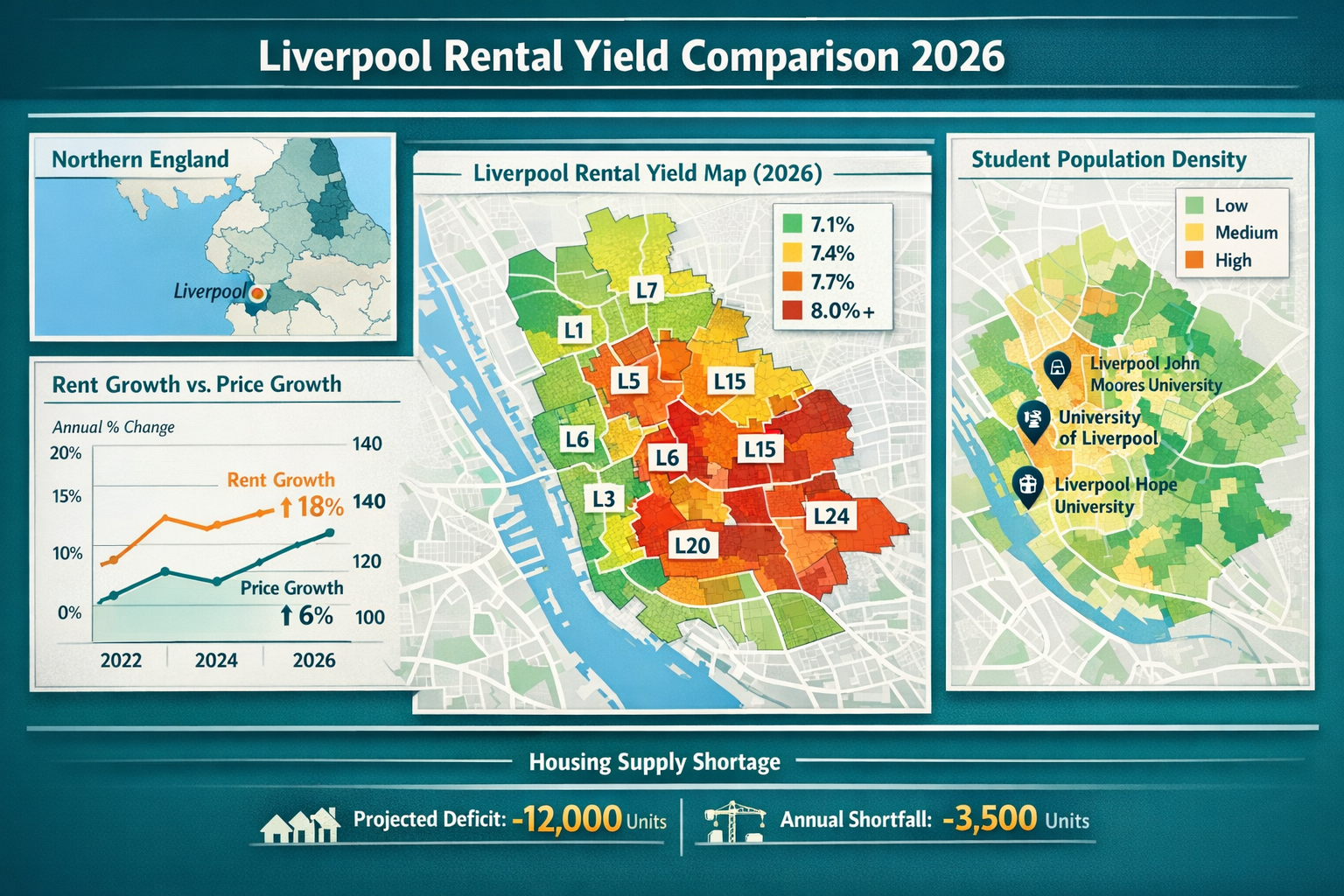
Liverpool's property market in 2026 presents a rare economic divergence that fundamentally alters traditional valuation approaches. While private rents increased between 7.3% and 8.9% in late 2025 through early 2026, average property values rose by only 2% during the same period[3]. This creates a rent-to-price ratio that significantly exceeds most major UK cities, with average gross yields in prime postcodes like L7 (Kensington, Edge Hill) reaching 7.1% to 8.1%[3].
For surveyors conducting Red Book valuations, this divergence requires a fundamental shift in methodology. Traditional approaches that prioritize capital growth comparables become less relevant when rental income potential drives investor demand and market pricing. Chartered surveyors must now weight rental yield analysis more heavily in their valuation frameworks, particularly when assessing properties in student-dense areas or regeneration corridors.
The student population of over 70,000 attending Liverpool's universities creates diverse and sustained tenant demand that continues to outpace housing supply[2]. This demographic anchor provides valuation stability that differs markedly from speculative markets, requiring surveyors to incorporate tenant demand forecasting into their assessment process.
Regeneration Impact on Future Value
The £7 billion regeneration pipeline represents the most significant valuation variable for Liverpool properties in 2026[4]. Unlike incremental improvements, these transformational projects—spanning the waterfront, city centre, and surrounding districts—create proximity premiums that vary dramatically based on project timelines and completion certainty.
Liverpool City Region Mayor Steve Rotheram's £5 billion vision to regenerate 86 acres between Liverpool Central Station and Lime Street[4] exemplifies the scale of transformation. Surveyors must develop temporal adjustment factors that account for:
- Pre-construction phase: Properties near announced projects typically see 5-8% premiums as speculative buyers enter the market
- Active construction phase: Temporary value suppression of 3-5% due to disruption, noise, and access challenges
- Completion phase: Significant uplift of 15-25% as amenity improvements, transport connectivity, and neighbourhood perception shift
Understanding what surveyors look for in a house survey becomes more complex when regeneration externalities must be factored into the assessment. A property's intrinsic condition remains important, but its locational value trajectory may override structural considerations in investment-grade valuations.
Supply Shortage Multipliers
Liverpool's housing supply deficit creates a structural undersupply premium that requires explicit valuation adjustment. When rental demand consistently exceeds available stock, normal market equilibrium mechanisms break down, leading to sustained yield premiums that persist beyond typical market cycles.
| Market Indicator | Liverpool 2026 | UK Average | Variance |
|---|---|---|---|
| Gross Rental Yield | 7.1% – 8.1% | 4.5% – 5.2% | +58% to +60% |
| Rent Growth (Annual) | 7.3% – 8.9% | 4.2% – 5.1% | +74% to +74% |
| Price Growth (Annual) | 2.0% | 3.1% | -35% |
| Supply-Demand Ratio | 0.73 | 0.89 | -18% |
This data demonstrates why surveyors must abandon one-size-fits-all valuation models when assessing Liverpool properties. The supply shortage multiplier—the premium investors will pay for guaranteed rental income in undersupplied markets—typically ranges from 8% to 15% above comparable properties in balanced markets.
Surveyor Tactics for Accurate Valuation Adjustments in Liverpool's 2026 Value Boom

Comparative Method Recalibration
Traditional comparative valuation methods rely on recent sales of similar properties within a defined geographic area. However, Liverpool's 2026 market dynamics require expanded comparable selection criteria that prioritize functional similarity over geographic proximity.
Key tactical adjustments include:
- Yield-based comparables: Rather than selecting comparables solely by property type and location, surveyors should identify properties with similar rental yield profiles, even if located in different postcodes
- Regeneration phase matching: Properties near similar-stage regeneration projects provide more relevant comparables than geographically proximate properties in static neighbourhoods
- Tenant demographic alignment: Student-let properties should be compared primarily with other student-let stock, as these create distinct valuation submarkets with different risk-return profiles
When conducting a Level 2 survey, surveyors must explicitly note which comparable selection methodology they've employed and justify deviations from traditional geographic clustering. This transparency becomes critical when institutional investors review valuation reports for portfolio acquisitions.
The 3% to 4% below-asking-price sales pattern[2] in Liverpool creates additional complexity. Surveyors must distinguish between negotiation discounts (which reflect normal market friction) and genuine value adjustments (which reflect property-specific defects or market positioning errors).
Investment Method Enhancement
The investment method of valuation—which capitalizes net rental income by an appropriate yield—becomes the primary valuation approach for Liverpool's buy-to-let market in 2026. However, standard investment method calculations require significant enhancement to capture Liverpool's unique market characteristics.
Enhanced investment method formula:
Market Value = (Annual Rental Income × Occupancy Rate) / (Market Yield - Growth Adjustment)
Critical adjustments include:
- Occupancy rate premiums: In undersupplied markets, surveyors should apply 95-98% occupancy assumptions rather than the standard 90-92%, reflecting reduced void periods
- Growth adjustment factors: When rental growth consistently exceeds yield rates, a growth adjustment of 1.5-2.5% should be subtracted from the capitalization rate
- Student demand stability premium: Properties within 1.5 miles of university campuses warrant a 0.3-0.5% yield compression (lower yield, higher value) due to demand certainty
For commercial property valuations, similar principles apply, though the regeneration impact on commercial rents may lag residential improvements by 12-18 months. Surveyors should apply temporal phasing adjustments that reflect this lag in their commercial investment valuations.
New-Build Premium Segmentation
Liverpool's new-build market exhibits dramatic premiums over resale values that require careful analysis. One-bedroom apartments command £170,000 to £210,000 (a 42-75% premium over the £120,000 resale average), while waterfront schemes reach £300,000 to £350,000 (a 76-105% premium)[6].
These premiums reflect several distinct value components that surveyors must disaggregate:
🏗️ Construction quality premium: Modern building standards, energy efficiency, and reduced maintenance costs justify 15-20% premiums
🎯 Investor preference premium: Institutional buyers preferring turnkey assets with warranties add 10-15% premiums
📍 Location scarcity premium: Waterfront and city centre sites with limited future supply command 25-40% premiums
💰 Financing advantage premium: New-builds qualifying for favorable mortgage terms create 5-10% buyer premiums
When conducting Level 3 building surveys on resale properties, surveyors should explicitly quantify the new-build equivalent value and then apply appropriate discounts for age, condition, and specification differences. This approach provides clearer valuation transparency than simply selecting older comparables.
Regeneration Proximity Adjustments
The £7 billion regeneration pipeline[4] creates concentric value zones around major projects that require systematic adjustment factors. Surveyors should develop a proximity matrix that accounts for both distance and project type:
| Distance from Project | Transport Infrastructure | Mixed-Use Development | Public Realm | Residential Only |
|---|---|---|---|---|
| 0-0.25 miles | +18% to +25% | +15% to +22% | +8% to +12% | +5% to +8% |
| 0.25-0.5 miles | +12% to +18% | +10% to +15% | +5% to +8% | +3% to +5% |
| 0.5-1.0 miles | +6% to +12% | +5% to +10% | +2% to +5% | +1% to +3% |
| 1.0-1.5 miles | +2% to +6% | +2% to +5% | +0% to +2% | +0% to +1% |
These adjustments should be temporally phased based on project completion timelines. For projects with confirmed 2026-2027 delivery, apply 70-80% of the full adjustment. For projects in feasibility stages (like the £5bn Central Station to Lime Street corridor[4]), apply only 30-40% of the full adjustment until planning certainty increases.
Understanding what chartered surveyors do in these complex valuation scenarios becomes critical for property buyers and investors seeking reliable market guidance.
Regional Outperformance Forecasting and Northern Market Tactics
RICS Northern Market Forecasts
Industry experts anticipate that cities like Liverpool, Manchester, and Salford will outperform their southern counterparts in 2026[5], driven by affordability advantages, regeneration investment, and institutional capital reallocation. This regional divergence requires surveyors to challenge traditional valuation assumptions rooted in London-centric market behavior.
The 20% price growth forecast over three years[2] for Liverpool represents a compound annual growth rate (CAGR) of approximately 6.3%—significantly exceeding the UK average forecast of 3.5-4.2%. Surveyors must incorporate these growth differentials into their valuation methodologies, particularly when assessing properties for:
- Development appraisals: Higher growth assumptions justify increased land values and development profit expectations
- Investment portfolio valuations: Forward-looking exit values should reflect regional outperformance rather than national averages
- Matrimonial valuations: Matrimonial property valuations require explicit disclosure of growth assumptions, as regional variations significantly impact settlement fairness
Institutional Investment Impact
The shift of institutional capital toward northern markets creates a dual-market phenomenon in Liverpool. Properties meeting institutional criteria (modern construction, professional management, strong covenants) command significant premiums over similar properties lacking these characteristics.
Institutional-grade criteria and premiums:
- ✅ Purpose-built student accommodation (PBSA): 25-35% premium over HMO conversions
- ✅ New-build apartments with management companies: 15-25% premium over similar resale stock
- ✅ Properties with 5+ year tenancy histories: 8-12% premium over vacant possession
- ✅ Energy Performance Certificate (EPC) ratings A-B: 10-15% premium over C-rated equivalents
Surveyors conducting valuations for institutional buyers must explicitly identify which properties meet these criteria and quantify the associated premiums. Failure to recognize institutional demand creates systematic undervaluation that disadvantages sellers and misinforms market participants.
Affordability Arbitrage Valuation
Liverpool's average detached house price of £358,000[2] represents a significant affordability advantage compared to southern equivalents, where similar properties exceed £650,000-£800,000. This affordability gap drives migration patterns that surveyors must incorporate into demand forecasting.
The price-to-earnings ratio in Liverpool (approximately 5.2:1) compared to London (12.8:1) creates a structural arbitrage opportunity that supports sustained demand growth. Surveyors should apply migration-adjusted demand factors when valuing properties in postcodes with:
- Strong transport links to city centre employment (10-15 minute commutes)
- Family-friendly amenities (schools, parks, retail)
- Housing stock suitable for remote workers (3+ bedrooms, home office space)
These locations warrant 5-8% premiums over comparable properties in less connected areas, as they attract the highest proportion of relocating professionals from higher-cost regions.
Long-Term Growth Trajectory Analysis
Liverpool's historical performance provides critical context for 2026 valuations. Between March 2014 and March 2023, property prices rose by an average of 4.4% annually, with house prices increasing 14.1% between 2016 and 2021[2]. This consistent appreciation—despite various economic headwinds—demonstrates market resilience that justifies optimistic forward-looking assumptions.
Surveyors should incorporate cycle-adjusted growth rates that recognize Liverpool's position in the property cycle:
- 2014-2016: Early recovery phase (2.8% annual growth)
- 2016-2021: Momentum phase (2.7% annual growth)
- 2021-2023: Consolidation phase (1.9% annual growth)
- 2024-2026: Acceleration phase (projected 6.3% annual growth)
When conducting RICS home surveys, surveyors should provide clients with this cyclical context, helping them understand how current valuations relate to long-term market trajectories. This educational component adds significant value to survey reports and supports informed decision-making.
Risk Factors and Valuation Downward Adjustments
Oversupply Risk in Specific Submarkets
While Liverpool faces overall housing undersupply, certain submarkets—particularly new-build city centre apartments—risk oversupply as multiple schemes complete simultaneously in 2026-2027. Surveyors must identify these pockets of potential oversupply and apply appropriate risk discounts.
High-risk submarkets requiring downward adjustments:
- City centre 1-bedroom apartments near multiple competing developments: -5% to -8% risk discount
- Student accommodation within 0.5 miles of new PBSA schemes: -3% to -6% risk discount
- New-build estates with 200+ units completing within 6 months: -4% to -7% risk discount
These adjustments reflect the absorption risk—the possibility that simultaneous completions flood the market, suppressing prices and rents during the absorption period. Surveyors should explicitly note these risks in valuation reports and recommend phased purchase strategies for portfolio buyers.
Economic Sensitivity Factors
Liverpool's economy, while diversifying, remains more sensitive to economic downturns than London or the Southeast. Surveyors must incorporate economic sensitivity factors that reflect this vulnerability:
- Employment concentration risk: Areas dependent on single large employers warrant 3-5% risk discounts
- Public sector employment exposure: Neighbourhoods with high public sector employment (>40%) face 2-4% additional risk during austerity periods
- Tourism dependency: Waterfront properties relying on hospitality sector demand carry 4-6% additional volatility risk
These factors should be explicitly disclosed in valuation reports, particularly when assessing properties for Help to Buy valuations or other government-backed schemes where risk transparency is mandated.
Structural and Condition Considerations
Liverpool's housing stock includes significant proportions of Victorian and Edwardian terraced properties that require careful structural assessment. When market enthusiasm drives rapid price appreciation, buyers may overlook structural defects that significantly impact long-term value.
Surveyors conducting full structural surveys in Liverpool should apply condition-based valuation adjustments that exceed standard depreciation schedules:
- Subsidence risk areas (clay soil zones): -8% to -15% depending on evidence and remediation costs
- Non-standard construction (steel frame, concrete construction): -5% to -10% due to mortgage and insurance challenges
- Deferred maintenance (properties requiring >£25,000 in immediate repairs): -10% to -20% depending on severity
Understanding the difference between Level 2 and Level 3 surveys becomes critical in Liverpool's market, where enthusiastic buyers may select insufficient survey levels and subsequently discover costly defects that erode their investment returns.
Practical Implementation for Surveyors
Valuation Report Enhancement
To serve clients effectively in Liverpool's 2026 market, surveyors should enhance their valuation reports with market-specific addendums that address:
- Regeneration impact analysis: Detailed assessment of nearby projects, completion timelines, and expected value uplift
- Yield comparison tables: Comparative yield analysis showing the subject property's position relative to postcode and city averages
- Growth scenario modeling: Three-scenario analysis (conservative, base case, optimistic) reflecting forecast uncertainty
- Institutional investment criteria assessment: Explicit evaluation of whether the property meets institutional buyer criteria
These enhancements transform valuation reports from simple price opinions into strategic investment guidance that justifies premium surveyor fees and builds long-term client relationships.
Comparable Database Development
Surveyors operating in Liverpool should develop specialized comparable databases that capture market-specific variables:
- Regeneration proximity (distance to major projects)
- Tenant type (student, professional, family)
- Energy efficiency ratings
- Management arrangements (self-managed vs. professional)
- Rental yield achieved (not just asking rents)
This enhanced data capture enables more sophisticated comparable selection and adjustment, improving valuation accuracy and defensibility. Surveyors should invest in database tools that facilitate this enhanced analysis rather than relying on standard Land Registry data alone.
Client Education and Expectation Management
Liverpool's rapid market evolution creates expectation management challenges as clients struggle to reconcile historical price data with current market dynamics. Surveyors should proactively educate clients about:
- Why historical comparables may understate current values in regeneration areas
- How yield-focused investors value properties differently than owner-occupiers
- The temporal nature of regeneration premiums and optimal purchase timing
- Risk factors that could moderate the optimistic growth forecasts
This educational role—explaining what survey you need based on property type and market conditions—positions surveyors as trusted advisors rather than transactional service providers.
Conclusion

The Valuation Adjustments for Liverpool's 2026 Value Boom: Surveyor Tactics in Undersupplied Northern Markets represent a fundamental evolution in property assessment methodology. Liverpool's unique combination of rental yield premiums (7.1% to 8.1%)[3], massive regeneration investment (£7 billion)[4], and structural housing undersupply creates valuation challenges that traditional approaches cannot adequately address.
Chartered surveyors must adopt yield-first methodologies that prioritize rental income analysis over simple capital value comparables, develop regeneration proximity matrices that quantify location premiums based on infrastructure investment, and implement regional outperformance adjustments that reflect Liverpool's forecasted 20% price growth over three years[2].
The tactical adjustments outlined in this article—from enhanced comparable selection criteria to institutional-grade property identification—equip surveyors with the frameworks necessary to deliver accurate, defensible valuations in this rapidly evolving market. As institutional capital continues flowing toward northern markets and Liverpool's regeneration projects progress through 2026[5], surveyors who master these techniques will provide indispensable guidance to buyers, sellers, and investors navigating this value boom.
Actionable Next Steps
For Surveyors:
- Develop Liverpool-specific comparable databases that capture regeneration proximity, tenant demographics, and yield performance
- Create valuation report templates with enhanced market analysis sections addressing regional outperformance forecasts
- Establish relationships with regeneration project managers to access early information on completion timelines and specification changes
- Invest in continuing professional development focused on investment valuation methods and yield analysis
For Property Investors:
- Commission comprehensive condition survey reports that explicitly address Liverpool's market-specific valuation factors
- Request yield-based valuation analysis alongside traditional comparable methods
- Seek surveyors with demonstrated Liverpool market expertise rather than generalist practitioners
- Evaluate properties against institutional investment criteria to understand potential premium positioning
For Homebuyers:
- Understand how regeneration projects near your target property will impact future values
- Request explicit growth scenario modeling in your valuation report
- Consider the long-term appreciation potential alongside immediate purchase price
- Engage surveyors who can explain Liverpool's market dynamics in accessible terms
The Valuation Adjustments for Liverpool's 2026 Value Boom are not temporary market aberrations but structural shifts that will define northern property markets for years to come. Surveyors who adapt their methodologies now will establish themselves as market leaders, while those clinging to outdated approaches risk systematic valuation errors that undermine client trust and professional credibility.
References
[1] Watch – https://www.youtube.com/watch?v=qFAhosT_ofA
[2] Liverpool Real Estate Market – https://investropa.com/blogs/news/liverpool-real-estate-market
[3] Yields Vs Growth Why Liverpool Is The Uks Leading Income First Choice For 2026 Investors – https://www.northwooduk.com/guides/liverpool/yields-vs-growth-why-liverpool-is-the-uks-leading-income-first-choice-for-2026-investors/
[4] Liverpools Regeneration To Take Major Step Forward In 2026 – https://www.buyassociationgroup.com/en-us/news/liverpools-regeneration-to-take-major-step-forward-in-2026/
[5] Expert Predictions For The 2026 Property Market – https://southeastonline.co.uk/2025/12/19/expert-predictions-for-the-2026-property-market/
[6] Is Liverpool A Good Investment In 2026 – https://smartlandlord.com/2025/12/17/is-liverpool-a-good-investment-in-2026
[7] Liverpool Property Market Trends For 2026 – https://www.liverpoolpropertysolutions.com/blogs/liverpool-property-market-trends-for-2026
[8] What To Expect From The Uk Property Market 2026 – https://tkpg.co.uk/what-to-expect-from-the-uk-property-market-2026/
[9] Property Market Predictions 2026 – https://www.cityrise.co.uk/property-market-predictions-2026/
