
The UK property market in 2026 presents a unique challenge for chartered surveyors: maintaining valuation accuracy in an environment of modest price appreciation. With forecasts pointing to steady 2-5% annual growth across most regions, the margin for error has never been smaller. Unlike the dramatic swings of previous years, this measured uplift requires surveyors to refine their methodologies, sharpen their comparable analysis, and develop nuanced strategies for assessing how property defects impact value in a gradually appreciating market.
Understanding Valuation Accuracy Under Modest Price Growth: Surveyor Tactics for 2-5% Annual Uplift Forecasts in 2026 is essential for property professionals navigating this balanced market. The stakes are high: overvalue a property by just 3%, and buyers face immediate negative equity; undervalue by the same margin, and sellers lose thousands in potential proceeds. This article explores the tactical approaches surveyors must adopt to deliver precise valuations when market movements are subtle but significant.
Key Takeaways
- 📊 Modest 2-5% growth demands precision: Small market movements require surveyors to refine comparable analysis and reduce valuation margins to maintain accuracy
- 🔍 Defect assessment becomes critical: In steady markets, property condition variations create proportionally larger value differentials than in volatile periods
- 📈 Enhanced documentation standards: The 2026 ALTA survey updates emphasize transparency and supporting evidence, raising the bar for professional surveying practice
- 🎯 Regional variation matters more: With national averages masking local trends, hyperlocal market knowledge becomes the differentiator in accurate valuations
- 💼 RICS-qualified expertise essential: Professional credentials and continuous market monitoring separate accurate valuations from costly estimation errors
Understanding the 2026 Market Context for Valuation Accuracy
The commercial and residential property markets entered 2026 with greater pricing clarity and improved capital market functionality, creating a more stable foundation for accurate valuations[2]. This stability, however, brings its own challenges. When markets swing dramatically, valuation ranges naturally widen; when growth moderates to 2-5% annually, clients expect—and deserve—tighter precision.
Several factors are shaping the valuation landscape in 2026:
Market Stabilization Factors:
- Supply discipline and moderating construction pipelines reducing oversupply concerns
- Increased lender participation restoring confidence across property types
- Narrowing bid-ask spreads supporting consistent price discovery
- Transaction activity strengthening through late 2025 into 2026[2]
For surveyors conducting property valuations, this environment requires a shift from crisis management to precision engineering. The question is no longer "Will values hold?" but rather "By exactly how much will they appreciate?"
The Precision Challenge in Modest Growth Markets
When annual price growth sits at 2-5%, a surveyor's margin of error must shrink proportionally. Consider this scenario:
| Property Value | 3% Growth | 5% Surveyor Error | Impact |
|---|---|---|---|
| £500,000 | £15,000 gain | ±£25,000 variance | Error exceeds annual growth |
| £750,000 | £22,500 gain | ±£37,500 variance | 167% of actual appreciation |
| £1,000,000 | £30,000 gain | ±£50,000 variance | Potential negative equity |
This table illustrates why valuation accuracy under modest price growth demands enhanced surveyor tactics. Traditional tolerance levels become unacceptable when they exceed the actual market movement.
"In 2026's measured market, the difference between a good valuation and an excellent one isn't just professional pride—it's the difference between a client making a sound investment or facing immediate financial pressure." – Industry Valuation Standards
Core Surveyor Tactics for 2-5% Annual Uplift Forecasts in 2026

Achieving Valuation Accuracy Under Modest Price Growth: Surveyor Tactics for 2-5% Annual Uplift Forecasts in 2026 requires a multi-layered approach combining traditional methodology with enhanced precision techniques. The following tactics represent best practices for 2026's market conditions.
1. Enhanced Comparable Analysis Methodology
The foundation of accurate valuation remains robust comparable analysis, but 2026 standards demand greater rigor:
Tightening Comparable Selection Criteria:
- Reduce geographic radius for comparables (within 0.5 miles for urban properties)
- Narrow time window to transactions within 3-6 months maximum
- Match property characteristics more precisely (age, condition, features)
- Weight recent sales more heavily in trending markets
- Adjust for seasonal variations in transaction timing
Adjustment Precision:
When making adjustments between comparable properties and the subject property, surveyors must quantify differences with greater accuracy. In a 2-5% growth environment, a £10,000 adjustment error on a £500,000 property represents 2%—potentially the entire year's appreciation.
Professional chartered surveyors in London and surrounding areas increasingly employ statistical modeling to validate adjustment factors, moving beyond subjective estimation.
2. Defect Impact Assessment in Modest Growth Markets
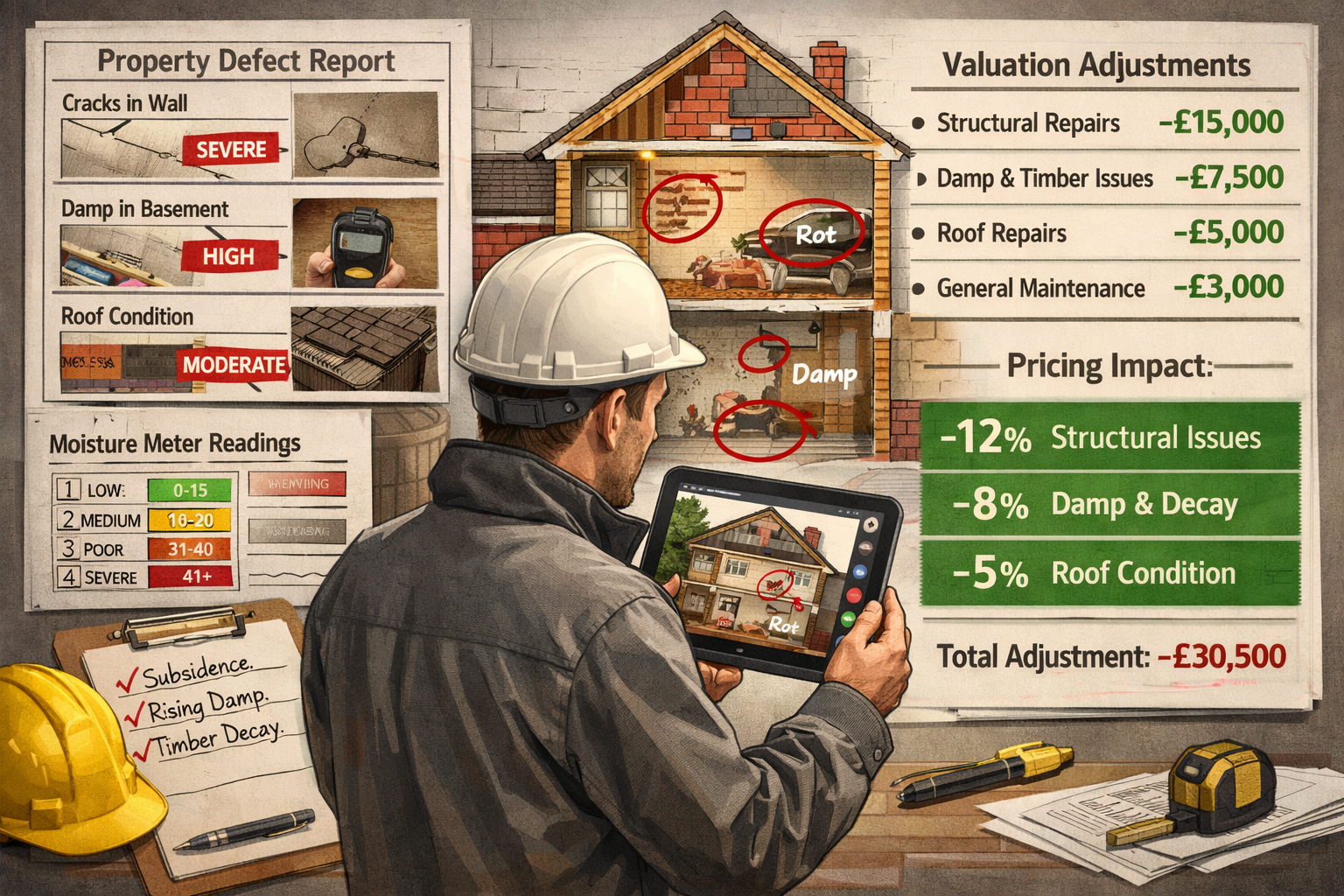
Property condition assessment takes on heightened importance when market growth is modest. A significant defect that might have been absorbed by 10% annual appreciation now represents a substantial portion of value in a 2-5% growth scenario.
Defect Categorization and Value Impact:
Minor Defects (0.5-2% value impact):
- Cosmetic issues requiring routine maintenance
- Dated fixtures and fittings
- Minor decorative updates needed
- Garden or external maintenance items
Moderate Defects (2-5% value impact):
- Aging heating systems requiring replacement within 3-5 years
- Roof repairs needed but not urgent
- Window replacements required
- Damp issues in non-critical areas
Major Defects (5-15% value impact):
- Structural movement requiring remediation
- Significant damp or water ingress
- Electrical rewiring needed immediately
- Major roof replacement required
- Subsidence or foundation issues
Understanding how to properly assess these defects is crucial, and our guide on understanding survey home reports provides comprehensive insights for property owners and professionals alike.
3. Market Positioning and Micro-Location Analysis
In 2026, national and regional averages mask significant local variations. A chartered surveyor in Buckinghamshire might see 4% growth while nearby areas experience only 2%, making hyperlocal knowledge essential.
Critical Market Positioning Factors:
- 🏘️ Neighborhood trajectory: Regeneration areas versus established locations
- 🚇 Transport infrastructure: Proximity to stations and planned improvements
- 🏫 School catchment areas: Premium for sought-after schools
- 🌳 Environmental factors: Green space, air quality, noise levels
- 🏗️ Development pipeline: Planned construction affecting supply/demand
Surveyors must maintain current knowledge of local planning applications, infrastructure projects, and demographic trends. Properties in areas with positive momentum may justify valuations at the higher end of the 2-5% growth spectrum, while those in declining micro-markets may warrant more conservative assessments.
4. Documentation and Evidence Standards
The 2026 ALTA survey standards have raised expectations for documentation transparency and supporting evidence[7]. While these standards specifically apply to ALTA/NSPS Land Title Surveys in the United States, they reflect a broader industry trend toward enhanced documentation that UK surveyors should embrace.
Key Documentation Enhancements:
- Comprehensive notes when discrepancies arise between recorded information and observations
- Clear statements regarding easements, encumbrances, and boundary issues
- Research into non-public documents affecting property rights
- Transparent disclosure of measurement precision and any limitations
- Detailed photographic evidence of property condition and defects
For those considering a full structural survey, understanding these enhanced documentation standards helps set appropriate expectations for the thoroughness of modern surveying practice.
Advanced Valuation Techniques for Steady Appreciation Markets
Beyond core tactics, sophisticated surveyors employ advanced techniques specifically designed for modest growth environments. These approaches help refine Valuation Accuracy Under Modest Price Growth: Surveyor Tactics for 2-5% Annual Uplift Forecasts in 2026 to the highest professional standards.
Statistical Modeling and Trend Analysis
Modern valuation increasingly incorporates quantitative analysis alongside traditional judgment:
Regression Analysis Applications:
- Identifying which property characteristics most significantly affect value in current market
- Quantifying the specific value contribution of features (extra bedroom, parking, garden size)
- Validating subjective adjustment factors with statistical evidence
- Detecting market trends before they become obvious in transaction data
Time-Series Analysis:
Tracking price movements over rolling periods helps surveyors identify whether the market is accelerating, decelerating, or maintaining steady growth. In a 2-5% environment, detecting a shift from 3% to 4% growth early provides competitive advantage.
Scenario-Based Valuation Approaches
Given economic uncertainties affecting 2026 markets—including demand uncertainty reshaping homebuilding strategy[8]—prudent surveyors consider multiple scenarios:
Three-Scenario Framework:
- Conservative Scenario (2% growth): Assumes economic headwinds, rising interest rates, or local market softening
- Base Case Scenario (3-4% growth): Most likely outcome based on current trends and fundamentals
- Optimistic Scenario (5% growth): Assumes positive economic developments, infrastructure improvements, or supply constraints
This approach provides clients with a valuation range rather than a single point estimate, acknowledging the inherent uncertainty in forecasting while maintaining professional precision.
Integration of Technology and Data Analytics
Forward-thinking surveyors leverage technology to enhance accuracy:
Digital Tools for Enhanced Precision:
- 📱 Property data platforms providing real-time comparable sales information
- 🗺️ GIS mapping systems for spatial analysis and location assessment
- 📊 Automated Valuation Models (AVMs) as cross-checks (not replacements) for professional judgment
- 📸 Drone photography for comprehensive property condition assessment
- 💻 Digital reporting platforms ensuring consistent documentation standards
The key is using technology to augment—not replace—professional expertise. An AVM might suggest a value, but only a qualified surveyor can assess how specific defects, location nuances, and market positioning affect that figure.
Specialized Property Type Considerations
Different property types require tailored approaches in 2026's modest growth environment:
Residential Properties:
For standard residential valuations, including freehold valuations and shared ownership valuations, focus on comparable sales within tight parameters and detailed condition assessment.
New Build Properties:
New builds present unique challenges, as our guide on whether you need a survey on a new build explains. In modest growth markets, the "new build premium" must be carefully justified against comparable resale properties.
Commercial Properties:
Commercial property surveyors must consider income potential, lease terms, and market yield expectations. In 2-5% growth environments, income stability becomes more valuable than speculative appreciation.
Period and Listed Properties:
Older properties require specialized expertise in assessing maintenance requirements and renovation costs. A Level 3 building survey becomes essential for accurate valuation of properties with potential hidden defects.
Regional Variations and Local Market Intelligence
While national forecasts suggest 2-5% growth for 2026, regional and local variations create significant opportunities and risks for valuation accuracy. Properties in high-performing micro-markets may appreciate 6-7%, while others stagnate at 1-2%.
Geographic Hotspots and Cold Zones
Factors Creating Regional Variation:
- Economic development and employment growth in specific regions
- Housing supply constraints in desirable areas
- Infrastructure investment (Crossrail, HS2, local transport improvements)
- Demographic shifts (remote work enabling relocation)
- Local planning policies affecting development
Surveyors operating across multiple regions must maintain current intelligence on each market. A chartered surveyor in Berkshire faces different market dynamics than one in North London or Oxfordshire.
The Importance of Hyperlocal Knowledge
Even within a single borough, significant variations exist. Consider London submarkets:
Example: London Submarket Variations (2026 Forecast)
- Barnes: 4-5% growth (strong schools, riverside location, limited supply)
- Clapham: 3-4% growth (transport links, young professionals, competitive supply)
- Ealing: 2-3% growth (Crossrail benefits already priced in, higher supply)
- Kingston: 3-4% growth (family appeal, good schools, riverside premium)
Surveyors serving these markets—such as chartered surveyors in Barnes, Clapham, Ealing, or Kingston—must understand these nuances to deliver accurate valuations.
Building Local Market Intelligence Networks
Successful surveyors cultivate information sources beyond public data:
Intelligence Network Components:
- 🏢 Estate agent relationships providing market sentiment and buyer demand insights
- 👷 Local builder and contractor connections revealing renovation cost trends
- 🏛️ Planning department contacts for upcoming development information
- 📰 Local media monitoring for regeneration projects and infrastructure plans
- 🤝 Professional networking with other surveyors for market intelligence sharing
This network provides the qualitative context that complements quantitative data, enabling more nuanced valuation judgments.
Professional Standards and Continuous Development
Maintaining Valuation Accuracy Under Modest Price Growth: Surveyor Tactics for 2-5% Annual Uplift Forecasts in 2026 requires commitment to professional standards and ongoing skill development.
RICS Qualifications and Standards
RICS-qualified surveyors represent the gold standard for property valuation[1]. The Royal Institution of Chartered Surveyors maintains rigorous standards ensuring members:
- Complete comprehensive professional education and assessment
- Adhere to ethical guidelines and professional conduct rules
- Maintain continuing professional development (CPD) requirements
- Follow the RICS Valuation – Global Standards (Red Book)
- Carry professional indemnity insurance
When selecting a surveyor, verifying RICS credentials is essential, as explained in our guide on verifying surveyor qualifications.
Continuous Market Monitoring
In 2026's dynamic environment, yesterday's market knowledge quickly becomes outdated. Professional surveyors implement systematic market monitoring:
Daily/Weekly Activities:
- Review new comparable sales in coverage areas
- Monitor property listing platforms for pricing trends
- Track economic indicators affecting property markets
- Follow property news and market commentary
Monthly/Quarterly Activities:
- Analyze transaction volume and pricing trends
- Review mortgage lending data and approval rates
- Assess regional market reports from major agencies
- Update comparable databases and adjustment factors
Annual Activities:
- Comprehensive market review and forecast development
- Professional development courses on valuation methodology
- Technology and tool evaluation and implementation
- Client feedback review and service improvement planning
Specialization and Niche Expertise
While broad market knowledge is essential, developing specialized expertise enhances valuation accuracy in specific property types or situations:
Valuable Specializations:
- Period and listed properties requiring heritage expertise
- New build developments and off-plan valuations
- Commercial and mixed-use properties
- Agricultural and rural properties
- Leasehold and complex tenure arrangements
- Properties with specific defects (subsidence, Japanese knotweed, etc.)
Specialization allows surveyors to develop deeper knowledge of factors affecting value within their niche, improving accuracy beyond what generalist approaches achieve.
Risk Management and Professional Liability
Even with excellent methodology, valuation involves professional judgment and inherent uncertainty. Effective risk management protects both surveyors and clients.
Clear Scope and Limitations
Professional valuations should clearly state:
Essential Disclosures:
- Purpose of valuation (mortgage, purchase, tax, etc.)
- Inspection extent and limitations
- Assumptions and special assumptions made
- Market conditions and data sources used
- Valuation date and report validity period
- Professional indemnity insurance details
Transparency about scope and limitations manages client expectations and reduces liability risk.
Professional Indemnity Insurance
Adequate professional indemnity insurance is both a regulatory requirement and essential protection. In modest growth markets where valuation margins are tight, even small errors can result in significant client losses and potential claims.
Quality Assurance Processes
Leading surveying practices implement quality assurance procedures:
QA Best Practices:
- Peer review of valuations before issuance
- Systematic comparable verification processes
- Standardized adjustment methodologies and documentation
- Regular accuracy audits comparing valuations to subsequent sales
- Client feedback mechanisms and complaint resolution procedures
These processes help identify and correct errors before they impact clients.
Client Communication and Expectation Management
Technical accuracy means little if clients don't understand the valuation or have unrealistic expectations. Effective communication is a core surveyor competency.
Explaining Valuation Ranges
In 2026's modest growth environment, presenting valuations as ranges rather than single figures often provides more honest guidance:
Example Valuation Communication:
"Based on current market conditions and comparable sales analysis, we assess the property value at £525,000, with a reasonable range of £515,000-£535,000 depending on buyer motivation and specific transaction circumstances. This reflects anticipated 3-4% annual growth in this micro-market."
This approach acknowledges valuation uncertainty while providing clear guidance for decision-making.
Managing Buyer and Seller Expectations
Different stakeholders have different needs:
For Buyers:
- Explain how defects affect value and future costs
- Discuss market positioning and negotiation leverage
- Clarify difference between valuation and asking price
- Address concerns about overpaying in rising markets
For Sellers:
- Provide realistic pricing guidance based on comparables
- Explain how property presentation affects achievable price
- Discuss timing considerations in seasonal markets
- Manage expectations about achieving asking prices
Understanding house survey anxiety helps surveyors provide reassurance alongside technical information.
Report Clarity and Accessibility
Valuation reports should be comprehensive yet accessible:
Report Best Practices:
- Executive summary with key findings upfront
- Clear valuation figure and supporting rationale
- Plain English explanations of technical terms
- Photographs and diagrams illustrating key points
- Logical structure following inspection flow
- Contact information for follow-up questions
The difference between a Level 2 and Level 3 survey should be clearly explained when discussing survey options with clients.
Future-Proofing Valuation Practices
As 2026 progresses, surveyors must anticipate evolving market conditions and professional requirements.
Adapting to Market Shifts
While current forecasts suggest 2-5% growth, markets can shift quickly. Surveyors must remain agile:
Scenario Planning:
- Monitor leading indicators for market direction changes
- Maintain comparable databases allowing quick reanalysis
- Develop relationships enabling rapid market intelligence gathering
- Build flexible valuation models accommodating different growth scenarios
Technology Integration
Technology will continue reshaping surveying practice:
Emerging Technologies:
- AI-powered comparable analysis and adjustment recommendations
- Virtual reality property inspections and remote surveying
- Blockchain-based property records and transaction verification
- Advanced data analytics for market trend prediction
- Mobile apps streamlining inspection and reporting processes
Successful surveyors will integrate these tools while maintaining the professional judgment that technology cannot replace.
Regulatory Evolution
The 2026 ALTA survey standards updates[7] exemplify ongoing regulatory evolution. UK surveyors should anticipate:
Potential Regulatory Developments:
- Enhanced disclosure requirements for valuation assumptions
- Stricter documentation standards for comparable analysis
- Increased scrutiny of valuation accuracy in mortgage lending
- Greater emphasis on climate risk and sustainability factors
- Evolving professional development requirements
Staying ahead of regulatory changes positions surveyors as trusted advisors rather than reactive compliance officers.
Conclusion
Valuation Accuracy Under Modest Price Growth: Surveyor Tactics for 2-5% Annual Uplift Forecasts in 2026 represents both a challenge and an opportunity for property professionals. In an environment where annual appreciation is measured rather than dramatic, the margin for valuation error shrinks proportionally. A 5% valuation error—perhaps acceptable when markets rise 15% annually—becomes unacceptable when it exceeds the entire year's actual appreciation.
The tactics outlined in this article provide a framework for enhanced precision:
✅ Tighter comparable analysis with narrower geographic and temporal parameters
✅ Enhanced defect assessment recognizing that condition variations create proportionally larger value differentials in steady markets
✅ Hyperlocal market intelligence capturing micro-market variations masked by regional averages
✅ Improved documentation standards providing transparency and supporting evidence for valuation conclusions
✅ Technology integration augmenting professional judgment with data analytics and digital tools
✅ Continuous professional development maintaining current market knowledge and methodological expertise
For property buyers, sellers, and investors navigating 2026's market, engaging RICS-qualified surveyors who employ these enhanced tactics is essential. The modest appreciation forecast for 2026 demands nothing less than professional excellence in valuation practice.
Next Steps for Property Stakeholders
For Property Buyers:
- Engage qualified surveyors early in the purchase process
- Request detailed comparable analysis supporting valuations
- Understand how identified defects affect value and future costs
- Consider commissioning appropriate survey levels based on property age and condition
For Property Sellers:
- Obtain professional valuations before setting asking prices
- Address significant defects that disproportionately affect value
- Understand your property's micro-market positioning
- Time market entry strategically based on seasonal patterns
For Property Professionals:
- Invest in continuous professional development and market monitoring
- Implement enhanced documentation and quality assurance processes
- Build local market intelligence networks
- Integrate appropriate technology while maintaining professional judgment
The surveyors who master these tactics will deliver the accuracy clients deserve and the market demands, positioning themselves as trusted advisors in 2026's measured appreciation environment.
References
[1] Valuation Strategies For First Time Buyers In 2026 Leveraging Affordability Gains And Regional Price Variations – https://nottinghillsurveyors.com/blog/valuation-strategies-for-first-time-buyers-in-2026-leveraging-affordability-gains-and-regional-price-variations
[2] 2026 Valuation Advisory North American Market Survey – https://www.nmrk.com/insights/market-report/2026-valuation-advisory-north-american-market-survey
[6] Blog Land Survey Costs 2026 – https://www.thelandgeek.com/blog-land-survey-costs-2026/
[7] 2026 Alta Survey Standards Updates – https://www.hklaw.com/en/insights/publications/2026/03/2026-alta-survey-standards-updates
[8] Survey Reveals Demand Uncertainty Is Changing 2026 Homebuilding Strategy – https://www.housingwire.com/articles/survey-reveals-demand-uncertainty-is-changing-2026-homebuilding-strategy/
