
The surveying industry faces a critical crossroads in 2026. As property markets recover and demand for surveying services increases, many professionals find themselves trapped in a race to the bottom—competing primarily on price rather than value. This approach threatens both profitability and long-term business sustainability. Surveyor Fee Pressures and Competitive Differentiation in 2026's Recovery: Moving Beyond Price Competition to Value-Based Positioning represents more than just a strategic shift; it's a necessary evolution for surveyors who want to thrive rather than merely survive in today's competitive landscape.
The challenge is clear: how can surveying professionals break free from commoditized pricing models and establish themselves as premium service providers? The answer lies in understanding that clients don't just buy surveys—they buy expertise, peace of mind, and solutions to complex property challenges.
Key Takeaways
✅ Fee pressures are intensifying as more surveyors compete for the same work, but differentiation through specialization and technology can command premium pricing
✅ The 2026 ALTA/NSPS standards create immediate opportunities for compliant surveyors to differentiate themselves from competitors still using outdated practices
✅ Technology investment in the USD 8.7 billion equipment market surge enables surveyors to deliver superior value and justify higher fees[4]
✅ Specialization beats volume as industry experts confirm that "surveyors who adapt will find more profitable work with less competition"[8]
✅ Value-based positioning requires a fundamental shift from selling surveys as commodities to marketing comprehensive property intelligence solutions
Understanding the Current Fee Pressure Landscape in 2026
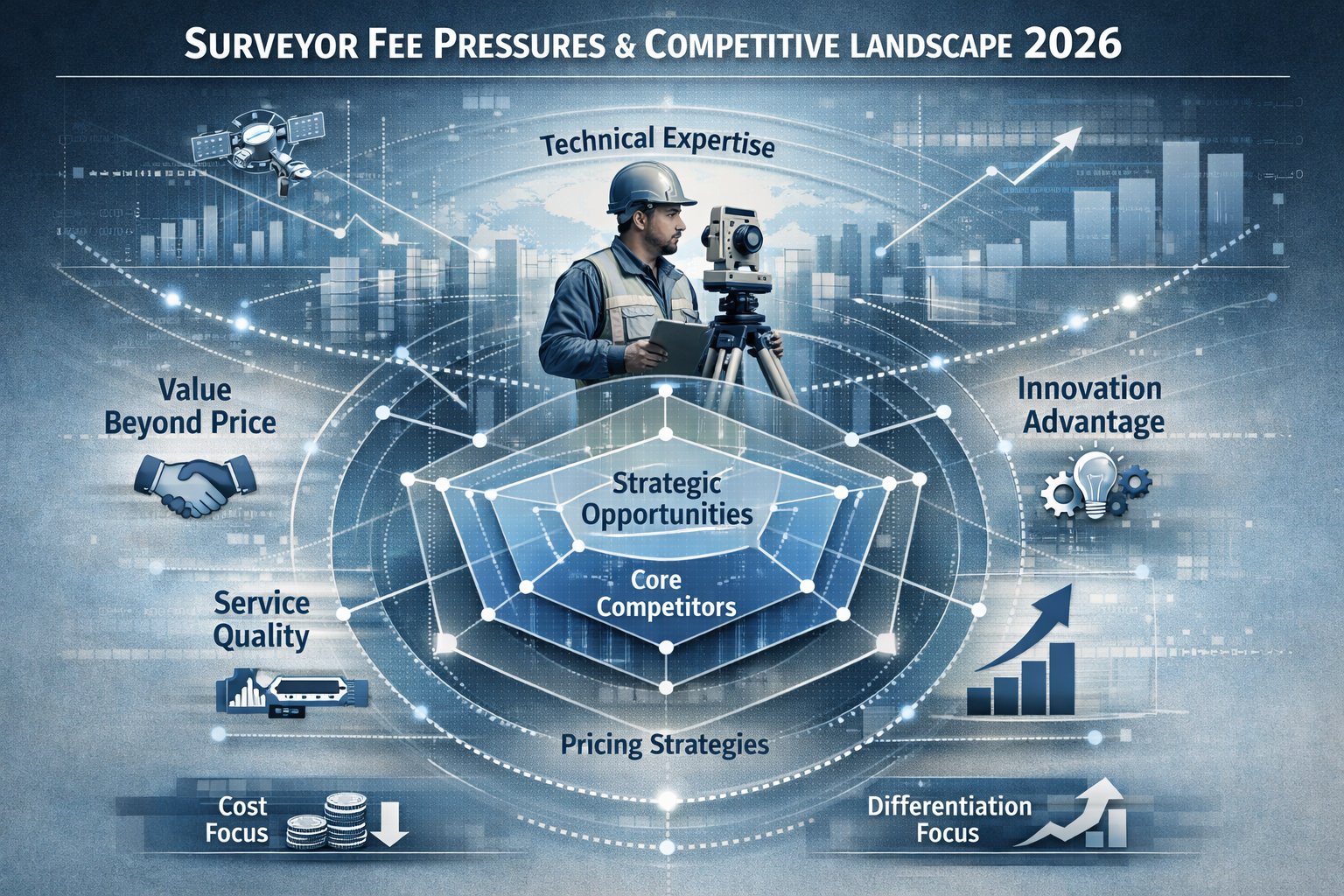
The surveying profession in 2026 faces unprecedented pricing challenges. Traditional boundary surveys that once commanded premium fees now face intense competition, with many surveyors undercutting each other to secure work. This downward spiral affects not just individual practitioners but the entire profession's perceived value.
The Root Causes of Fee Compression
Several factors contribute to the current fee pressure environment facing surveyors:
Market saturation in certain geographic areas has created an oversupply of general surveying services. When clients can choose from dozens of surveyors offering seemingly identical services, price becomes the primary differentiator. This commoditization erodes profit margins and devalues professional expertise.
Digital comparison platforms make it easier than ever for property owners to compare surveyor fees instantly. While transparency benefits consumers, it intensifies price competition among surveyors who haven't established clear value propositions. Clients shopping purely on price often overlook critical quality differences.
Economic recovery dynamics create paradoxical pressures. While increased property transactions should benefit surveyors, the influx of new market entrants and part-time practitioners floods the market with low-cost alternatives. According to industry data, land survey costs in 2026 vary significantly based on property complexity and surveyor expertise[1].
Client education gaps mean many property buyers don't understand the difference between a basic boundary identification and a comprehensive Level 3 building survey. This knowledge deficit makes it difficult to justify premium pricing for superior service.
The Real Cost of Competing on Price Alone
Surveyors who engage primarily in price competition face several hidden costs:
| Consequence | Impact on Business | Long-term Effect |
|---|---|---|
| Reduced profit margins | Less investment in equipment and training | Falling behind competitors technologically |
| Higher volume requirements | Increased workload and stress | Quality compromises and burnout |
| Commodity perception | Clients view service as interchangeable | No client loyalty or repeat business |
| Inability to invest | Cannot afford advanced technology | Loss of competitive advantage |
| Talent retention issues | Cannot pay competitive salaries | Difficulty attracting skilled staff |
The surveying professionals who recognize these dangers are already pivoting toward value-based positioning strategies that emphasize expertise, specialization, and comprehensive service delivery rather than lowest price.
Surveyor Fee Pressures and Competitive Differentiation in 2026's Recovery: Strategic Responses
The path forward requires surveyors to fundamentally rethink their market positioning. Instead of asking "How can I match competitors' prices?" successful surveyors ask "What unique value can I provide that justifies premium fees?"
Embracing the 2026 ALTA/NSPS Standards as a Differentiator
The implementation of new industry standards on February 23, 2026, represents a significant competitive differentiation opportunity. The 11th edition of ALTA/NSPS standards updated Table A Optional Items, creating new compliance requirements[5][6]. All surveys begun on or after this date must reference and comply with the 2026 standards rather than the 2021 version[5].
Early adopters gain immediate advantages:
📊 Compliance expertise becomes a marketable specialty, allowing surveyors to position themselves as industry leaders rather than followers
🎯 Commercial real estate focus enables surveyors familiar with the new standards to capture high-value projects where compliance is non-negotiable
💼 Professional credibility increases when surveyors demonstrate proactive adoption of current standards rather than reactive compliance
Surveyors who master these updated standards can educate clients about the enhanced protections and accuracy they provide, justifying higher fees through demonstrable value. Understanding what surveyors do in the context of modern standards helps communicate this value effectively.
Technology Investment as Value Creation
The land survey equipment market is experiencing a remarkable USD 8.7 billion surge in 2026[4], indicating widespread industry investment in advanced capabilities. This technology boom creates clear differentiation opportunities for forward-thinking surveyors.
High-value technology investments include:
🚁 Drone and LiDAR systems that capture comprehensive property data in hours rather than days, reducing client project timelines while increasing accuracy
📱 Mobile scanning technology that enables real-time data collection and client visualization, demonstrating value during the survey process itself
💻 Building Information Modeling (BIM) integration that transforms survey data into actionable intelligence for architects, engineers, and developers
🔍 Advanced GPS and total station equipment that delivers precision measurements for complex boundary disputes and legal proceedings
These investments aren't just about efficiency—they're about delivering outcomes clients can't obtain elsewhere. When a surveyor can provide a detailed 3D model of a property's existing conditions within 48 hours, the value proposition transcends price comparison with traditional methods.
The key is communicating these technological advantages in terms clients understand. Rather than discussing equipment specifications, successful surveyors explain how technology solves specific client problems: faster closings, reduced legal risk, better renovation planning, or more accurate property valuations.
Moving Beyond Volume: Specialization Strategies for Premium Positioning
Industry experts have made the shift explicit: "surveyors who adapt will find more profitable work with less competition," while "surveyors who keep competing on staking volume will discover" diminishing returns[8]. This insight points directly toward specialization as a differentiation strategy.
Identifying Profitable Niche Markets
Rather than being generalists competing for every survey request, successful surveyors in 2026 are carving out specialized expertise in specific property types or service categories:
Heritage and historic properties require specialized knowledge of traditional construction methods, conservation considerations, and regulatory requirements. Surveyors with this expertise can command premium fees from clients who recognize the unique challenges these properties present.
Commercial and industrial facilities demand understanding of complex systems, structural loading, and operational considerations beyond residential expertise. Commercial property surveyors who specialize in these sectors access higher-value projects with less price sensitivity.
Boundary dispute resolution combines surveying expertise with legal knowledge and expert witness capabilities. Surveyors who develop this specialization provide value far beyond simple measurement, justifying significantly higher fees.
New construction verification serves developers who need assurance that buildings meet specifications and regulatory requirements. Understanding whether you need a survey on a new build helps position this specialized service effectively.
Environmental and topographic surveys for development projects require specialized equipment and analytical capabilities that command premium pricing from commercial clients.
Building Specialized Expertise
Developing genuine specialization requires strategic investment:
🎓 Advanced certifications in specific survey types or property categories demonstrate commitment beyond basic qualifications
📚 Continuing education focused on niche market needs rather than general practice updates
🤝 Professional relationships with attorneys, architects, and other specialists who serve the same niche markets
📊 Case study development that showcases specialized expertise through documented successful projects
💡 Thought leadership through articles, presentations, and educational content that establishes authority in the specialty area
Specialization doesn't mean turning away all general work—it means having a clear answer when potential clients ask "Why should I choose you?" The answer should never be "Because we're cheaper."
Value-Based Pricing Models: Articulating Worth Beyond Hourly Rates
Surveyor Fee Pressures and Competitive Differentiation in 2026's Recovery: Moving Beyond Price Competition to Value-Based Positioning requires fundamental changes in how surveyors price and present their services.
Shifting from Cost-Plus to Value-Based Pricing
Traditional surveying pricing often follows a simple formula: estimate hours required, multiply by hourly rate, add equipment costs and markup. This cost-plus approach inherently commoditizes surveying services by focusing on inputs rather than outcomes.
Value-based pricing flips this model by asking: "What is this survey worth to the client?" The answer varies dramatically based on context:
A boundary survey for a £300,000 residential property might prevent a £50,000 boundary dispute or enable a £75,000 extension project. The survey's value isn't the 8 hours of fieldwork—it's the financial risk mitigation and opportunity enablement it provides.
A commercial property survey for a £5 million acquisition might reveal structural issues that save the buyer £500,000 in unexpected repairs or enable renegotiation of the purchase price. The survey's value is measured in hundreds of thousands of pounds, not hundreds.
Understanding full structural survey costs helps surveyors benchmark their pricing while focusing on value delivery rather than just cost recovery.
Communicating Value Effectively
Premium pricing requires premium communication:
📋 Comprehensive proposals that outline specific deliverables, timelines, and value propositions rather than just line-item costs
🎯 Risk mitigation framing that helps clients understand what problems the survey prevents, not just what data it collects
📊 Comparative analysis showing the cost of NOT having a thorough survey versus the investment in comprehensive assessment
🏆 Credentials and experience presented as value indicators rather than mere qualifications
💬 Client testimonials that speak to outcomes achieved and problems avoided through quality surveying
When discussing fees, successful surveyors focus conversations on value delivery: "This comprehensive assessment will provide you with complete certainty about the property's condition, enabling confident decision-making on your significant investment." This framing differs dramatically from "The survey will cost £X."
Building Client Relationships That Transcend Price Sensitivity

Long-term business sustainability comes from clients who choose surveyors based on trust and proven value rather than lowest price. Relationship-based positioning creates competitive moats that price-focused competitors cannot breach.
The Client Education Advantage
Many property buyers don't understand the differences between survey types or the value of comprehensive assessment. Surveyors who invest in client education create significant differentiation:
Educational content marketing through blogs, videos, and guides establishes expertise while helping clients make informed decisions. Explaining the difference between Level 2 and Level 3 surveys helps clients understand why comprehensive assessment justifies higher investment.
Consultation-based selling where initial conversations focus on understanding client needs and educating about options rather than immediately quoting prices builds trust and positions the surveyor as advisor rather than vendor.
Transparent process explanation that demystifies what happens during a survey and why certain steps matter helps clients appreciate the expertise involved.
Creating Memorable Client Experiences
The survey process itself becomes a differentiation opportunity when approached strategically:
🤝 Responsive communication throughout the process, with regular updates and accessibility, contrasts sharply with surveyors who disappear after booking confirmation
📸 Visual documentation including photos, videos, and detailed diagrams that make reports more accessible and valuable to non-technical clients
⏰ Reliable delivery with clear timelines and consistent meeting of commitments builds trust that encourages referrals
🎓 Post-survey consultation to explain findings and answer questions transforms a transactional service into a consultative relationship
😊 Anxiety management recognizing that property surveys create stress for buyers and proactively addressing concerns creates positive emotional associations with the service
Understanding house survey anxiety helps surveyors design client experiences that reduce stress and increase satisfaction.
Surveyor Fee Pressures and Competitive Differentiation in 2026's Recovery: Service Expansion Strategies
Beyond improving core surveying services, competitive differentiation increasingly comes from expanding service offerings to address adjacent client needs.
Complementary Services That Add Value
Surveyors positioned as comprehensive property intelligence providers rather than mere measurement specialists can capture additional revenue while increasing client stickiness:
Party wall services represent natural extensions for surveyors with appropriate expertise. Understanding what party wall surveyors do enables surveyors to offer these services to clients planning extensions or renovations.
Valuation services for probate, tax purposes, or lending requirements leverage existing property assessment skills while serving different client needs. Services like probate valuation and capital gains tax valuation provide recurring revenue opportunities.
Project monitoring for construction or renovation projects extends the client relationship beyond the initial survey into ongoing advisory roles.
Expert witness services for legal proceedings capitalize on specialized knowledge and provide high-value, premium-priced services to clients facing disputes.
Condition schedules for commercial tenancies create documentation that protects both landlords and tenants while generating additional revenue from existing survey work.
Packaging Services for Maximum Value Perception
Individual services priced separately often face price resistance, but bundled packages create perceived value while increasing average transaction size:
The "Complete Property Intelligence Package" might combine boundary survey, building assessment, environmental considerations, and planning consultation at a price point higher than any individual service but lower than purchasing separately.
The "Investment Property Due Diligence Bundle" could include structural survey, rental valuation, and condition schedule specifically designed for buy-to-let investors.
The "Development Readiness Assessment" might package topographic survey, planning consultation, and feasibility analysis for clients considering property development.
These packages position the surveyor as comprehensive solution provider rather than commodity service vendor, making price comparison with basic survey providers irrelevant.
Marketing and Positioning for Premium Service Delivery
Value-based positioning requires marketing that communicates expertise, specialization, and client outcomes rather than just availability and price.
Digital Presence That Demonstrates Expertise
Modern clients research surveyors online before making contact. A strong digital presence becomes essential for premium positioning:
Comprehensive website content that educates visitors about survey types, processes, and value propositions establishes authority. Resources explaining what property surveyors do help clients understand the profession's value.
Case studies and project portfolios showcase specific expertise and successful outcomes, making abstract claims concrete and credible.
Video content featuring surveyors explaining complex concepts in accessible language builds trust and demonstrates communication skills.
Professional photography of team members, equipment, and work in progress creates visual credibility that stock photos cannot match.
Client testimonials specifically addressing value delivered rather than just satisfaction provide social proof of premium positioning.
Strategic Networking and Referral Development
High-value surveying work often comes through professional referrals rather than direct consumer marketing:
🏛️ Legal professional relationships with property attorneys who need reliable surveyors for client referrals and expert witness work
🏗️ Architect and engineer partnerships that create recurring work on commercial and development projects
🏡 Estate agent relationships built on reliability and quality that generate consistent residential referrals
💼 Commercial property advisor connections that access high-value corporate and investment property work
🎯 Niche market associations relevant to specializations, such as heritage property organizations or commercial development groups
These relationships develop over time through consistent quality delivery and professional interaction, creating referral streams that bypass price-focused competition entirely.
Operational Efficiency: Delivering Premium Service Profitably
Premium pricing must be supported by efficient operations that maintain profitability while delivering superior value. Competitive differentiation fails if higher fees simply compensate for operational inefficiency.
Technology-Enabled Efficiency Gains
Strategic technology investment delivers both client-facing value and internal efficiency:
Field data collection software that integrates with office systems eliminates duplicate data entry and reduces errors while accelerating report production.
Cloud-based collaboration platforms enable team members to access project information anywhere, improving responsiveness and coordination.
Automated report generation for standard elements allows surveyors to focus expertise on analysis and recommendations rather than formatting.
Client portals for document delivery and communication reduce administrative overhead while improving client experience.
Project management systems that track timelines, deliverables, and client communications ensure nothing falls through cracks while providing accountability.
Quality Control Systems
Premium positioning requires consistent quality delivery:
✅ Standardized procedures for each survey type ensure comprehensive coverage and consistent quality regardless of which team member performs the work
✅ Peer review processes catch errors before reports reach clients, protecting professional reputation
✅ Continuous improvement protocols that capture lessons learned and integrate them into standard procedures
✅ Client feedback systems that systematically gather and act on client input to refine service delivery
✅ Professional development requirements ensuring team members maintain and expand expertise
These systems enable surveyors to deliver premium quality consistently, justifying premium pricing through reliable excellence.
Measuring Success Beyond Revenue: Key Performance Indicators for Value-Based Positioning

Transitioning from volume-based to value-based business models requires different success metrics:
Financial Metrics That Matter
Average project value becomes more important than total project count. Increasing average fees from £500 to £1,200 means the same revenue with less than half the projects, reducing overhead and stress.
Profit margin per project rather than gross revenue indicates whether premium pricing translates to actual profitability or just covers higher costs.
Client lifetime value measures the total revenue generated from each client relationship, including repeat business and referrals, indicating relationship strength.
Revenue per surveyor or per employee hour indicates operational efficiency and pricing effectiveness.
Non-Financial Success Indicators
🎯 Referral rate shows whether clients value services enough to recommend them to others
⭐ Client satisfaction scores indicate whether premium pricing delivers commensurate value
🏆 Industry recognition through awards, speaking opportunities, or media coverage validates expertise claims
📈 Specialization penetration measuring what percentage of revenue comes from specialized services versus commodity work
💼 Strategic partnership development tracking relationships with key referral sources and collaborative partners
These metrics help surveyors assess whether their competitive differentiation strategies are working or require adjustment.
Overcoming Implementation Challenges
Transitioning from price-based to value-based positioning presents real challenges that require strategic navigation:
Managing the Transition Period
Surveyors cannot instantly abandon existing pricing models without risking revenue disruption:
Gradual implementation where new pricing applies to new clients or specialized services while existing relationships continue under current terms manages risk during transition.
Service tier development offering both standard and premium options allows clients to self-select while the premium tier establishes higher value positioning.
Pilot specialization focusing on one niche market or service type to develop and prove value-based positioning before broader implementation.
Addressing Client Price Resistance
Not every potential client will accept premium pricing, and that's acceptable:
Qualification processes that identify clients likely to value comprehensive service before investing significant proposal effort improve conversion rates.
Education-first approach that helps price-sensitive clients understand value differences rather than immediately defending fees converts some while respectfully declining others.
Referral to alternatives for clients genuinely needing basic commodity service maintains professional relationships while protecting premium positioning.
The goal isn't serving every potential client—it's serving the right clients profitably and sustainably.
Future-Proofing Your Surveying Practice in 2026 and Beyond
Surveyor Fee Pressures and Competitive Differentiation in 2026's Recovery: Moving Beyond Price Competition to Value-Based Positioning isn't a temporary strategy but a fundamental business model evolution.
Anticipating Market Evolution
Several trends will shape surveying's competitive landscape:
🤖 Automation and AI will increasingly handle routine measurement and data processing, making human expertise more valuable for interpretation, judgment, and client consultation
🌍 Climate and environmental considerations will create new specialization opportunities in sustainability assessment, flood risk evaluation, and environmental impact analysis
📱 Client expectations for digital delivery, real-time communication, and visual presentation will continue rising, requiring ongoing technology adoption
🏗️ Construction technology integration with BIM and digital twins will demand surveyors who can participate in digital construction ecosystems
⚖️ Regulatory complexity will increase the value of compliance expertise and specialized knowledge
Surveyors who position themselves as expert interpreters and advisors rather than measurement technicians will thrive as automation handles routine tasks.
Building Sustainable Competitive Advantages
Long-term success requires advantages competitors cannot easily replicate:
Reputation and relationships developed over years through consistent quality and professionalism create barriers to competition.
Specialized expertise in niche markets takes time to develop and cannot be instantly copied by price-focused competitors.
Technology integration where systems and processes create genuine efficiency and quality advantages rather than just expensive equipment.
Team development creating organizational capabilities beyond any individual surveyor's expertise.
Brand positioning that clearly communicates unique value in ways that resonate with ideal clients.
These sustainable advantages enable surveyors to maintain premium positioning even as markets evolve and new competitors emerge.
Conclusion: Embracing Value-Based Positioning for Long-Term Success
The surveying profession stands at a crossroads in 2026. The path of least resistance—competing primarily on price—leads to diminishing margins, increased stress, and commoditization of professional expertise. The alternative path—Surveyor Fee Pressures and Competitive Differentiation in 2026's Recovery: Moving Beyond Price Competition to Value-Based Positioning—requires strategic thinking, investment, and courage but leads to sustainable profitability and professional satisfaction.
The evidence is clear: surveyors who specialize, invest in technology, develop client relationships, and communicate value effectively will "find more profitable work with less competition"[8]. The USD 8.7 billion equipment market surge demonstrates industry-wide recognition that differentiation requires investment[4]. The 2026 ALTA/NSPS standards implementation creates immediate opportunities for compliant surveyors to distinguish themselves[5][6].
Actionable Next Steps
Surveyors ready to move beyond price competition should take these concrete actions:
1️⃣ Audit current positioning: Honestly assess whether your marketing, pricing, and client communications emphasize price or value
2️⃣ Identify specialization opportunities: Research which niche markets align with your expertise, interests, and local market needs
3️⃣ Invest strategically in technology: Prioritize equipment and software that deliver client-visible value, not just internal efficiency
4️⃣ Develop educational content: Create resources that demonstrate expertise while helping potential clients understand value differences
5️⃣ Build strategic relationships: Cultivate referral sources in legal, architectural, and real estate professional communities
6️⃣ Implement value-based pricing: Start with new clients or specialized services, clearly articulating value propositions that justify premium fees
7️⃣ Measure what matters: Track metrics that indicate successful transition to value-based positioning, not just revenue volume
8️⃣ Commit to continuous improvement: Invest in professional development, quality systems, and client experience enhancement
The transition from commodity pricing to value-based positioning won't happen overnight, but every step in this direction strengthens competitive position and improves business sustainability. The surveyors who thrive in 2026 and beyond will be those who recognize that their true value lies not in the measurements they take but in the expertise, insights, and peace of mind they provide to clients making significant property decisions.
The choice is clear: compete on price and join the race to the bottom, or differentiate on value and build a sustainable, profitable practice that reflects the true worth of professional surveying expertise. The recovery of 2026 offers the perfect opportunity to make this strategic shift. The question is not whether to embrace value-based positioning, but how quickly you can implement it before competitors claim the high ground.
References
[1] Blog Land Survey Costs 2026 – https://www.thelandgeek.com/blog-land-survey-costs-2026/
[2] How Much Does Land Survey Cost – https://www.angi.com/articles/how-much-does-land-survey-cost.htm
[3] Boundary Survey Cost Price – https://haller-blanchard.com/boundary-survey-cost-price/
[4] Land Survey Equipment Market Boom 2026 Investment Guide For Surveyors Facing Usd 8 7 Billion Surge – https://nottinghillsurveyors.com/blog/land-survey-equipment-market-boom-2026-investment-guide-for-surveyors-facing-usd-8-7-billion-surge
[5] Nsps Land Title – https://www.parkerpoe.com/news/2026/02/key-takeaways-from-the-2026-alta/nsps-land-title
[6] What 2026 Alta Nsps Updates Mean For Cre Professionals – https://www.partneresi.com/resources/articles/what-2026-alta-nsps-updates-mean-for-cre-professionals/
[7] Pls Act – https://www.bpelsg.ca.gov/laws/pls_act.pdf
[8] Speakers – https://www.idahospls.org/Speakers
