
Northern England is experiencing an unprecedented transformation. With £1.7 billion in government investment announced in March 2026 and regeneration portfolios totaling over £100 billion across the region, Manchester and Liverpool are emerging as the UK's most dynamic urban renewal zones outside London [1]. This massive institutional commitment presents both extraordinary opportunities and complex challenges for building surveyors tasked with assessing structural viability, investment potential, and regulatory compliance across these high-activity development corridors.
The scale of these megaprojects demands specialized assessment protocols that go far beyond traditional survey methodologies. From Liverpool's £5 billion city centre vision to Manchester's Victoria Riverside £4 billion district overhaul, surveying institutional growth in Northern England: building assessment protocols for Manchester and Liverpool renewal megaprojects requires a sophisticated understanding of large-scale urban development dynamics, multi-phase construction coordination, and evolving regulatory frameworks [3][5].

Key Takeaways
- 🏗️ Northern England is receiving £1.7 billion in targeted government investment for city-centre regeneration projects across Manchester, Liverpool, Leeds, Newcastle, and Sheffield, creating unprecedented demand for specialized building assessment services
- 📊 Liverpool's £7 billion regeneration portfolio and Manchester's £4 billion Victoria Riverside development represent the largest coordinated renewal schemes in the region, requiring comprehensive structural evaluation protocols
- 🔍 Building surveyors must adapt traditional methodologies to address the unique challenges of megaproject environments, including phased construction coordination, heritage integration, and multi-stakeholder compliance requirements
- 💼 Institutional investment patterns are reshaping assessment priorities, with increased focus on long-term structural resilience, sustainability metrics, and mixed-use development viability
- ⚡ Specialized protocols for high-density urban renewal zones are essential for managing risk, ensuring regulatory compliance, and supporting informed investment decisions in these transformative development corridors
Understanding the Northern England Renewal Landscape in 2026
The Scale of Institutional Investment
The Northern Powerhouse initiative has evolved from political aspiration to concrete reality in 2026. The government's £1.7 billion commitment announced in March specifically targets five major city-centre projects: Leeds South Bank, Liverpool Central, Manchester Victoria North, Newcastle and Gateshead Quays, and Sheffield City Centre [1]. This represents a fundamental shift in regional development strategy, with coordinated institutional resources mobilized across multiple urban centres simultaneously.
Liverpool City Region alone is advancing a £7 billion regeneration portfolio spanning housing, transport, commercial development, and public realm improvements [3]. This includes the ambitious £5 billion city centre vision covering 86 acres between Liverpool Central Station and Lime Street, with feasibility and design work progressing throughout 2026 [3].
Manchester's transformation is equally dramatic. The Victoria Riverside £4 billion district is designed to deliver 15,000 new homes with integrated community infrastructure, representing one of the city's largest coordinated renewal schemes [5]. When combined with projects like the Manchester Viadux Two tower (246 meters tall, approximately 1,000 homes) and the Vista River Gardens 55-storey towers, the scale of structural assessment requirements becomes evident [7][8].
Key Development Zones Requiring Specialized Assessment
Several strategic zones demand particular attention from building surveyors in 2026:
Liverpool Waterfront Transformation:
- King Edward Triangle (£1 billion): Approximately 3,000 homes in high-rise clusters with hotels and potential events arena; planning application for first 28-storey building submitted 2025 [3]
- Central Docks Liverpool Waters (26 acres): 2,000+ new homes with infrastructure works commenced late 2025; £55 million government funding confirmed [3]
- Littlewoods Edge Lane (£70 million): Film and television facility with two 20,000 sq ft studio stages and Grade II-listed building refurbishment [3]
Manchester Development Corridor:
- Etihad Stadium expansion (£300 million): Targeting late 2026 completion with 60,000+ capacity, 400-bed hotel, covered city square fan zone, museum, and collaborative workspace [7][8]
- Victoria Riverside district: 15,000 homes with phased delivery requiring continuous assessment protocols [5]
- Festival Gardens redevelopment: 440 new homes comprising 110 affordable units and 80 extra-care units [3]
Infrastructure Integration and Assessment Implications
The Northern Powerhouse Rail £45 billion infrastructure commitment announced in January 2026 establishes foundational connectivity requirements that directly impact building assessment protocols [7]. With TransPennine Route journey times reduced from 50 to 42 minutes, development corridors are experiencing increased investment pressure and accelerated construction timelines.
This infrastructure integration creates complex assessment scenarios where building surveyors must evaluate not only individual structure viability but also connectivity to regional transport networks, utility capacity, and long-term infrastructure resilience. For comprehensive guidance on large-scale property assessments, professionals can reference our building surveys services.
Surveying Institutional Growth in Northern England: Specialized Assessment Protocols for Megaproject Environments
Pre-Assessment Planning and Stakeholder Coordination
Effective assessment of megaproject developments requires fundamentally different planning approaches compared to traditional building surveys. The multi-stakeholder environment characteristic of institutional renewal projects demands coordinated assessment protocols that account for:
Institutional Stakeholder Mapping:
- Government funding bodies and regulatory authorities
- Private developers and investment consortiums
- Local planning authorities and heritage organizations
- Community stakeholders and tenant associations
- Infrastructure providers and utility companies
Building surveyors must establish clear communication channels with all stakeholders before commencing on-site assessments. This includes understanding phased delivery schedules, identifying critical path dependencies, and coordinating access arrangements across active construction zones.
For projects involving heritage structures like the Littlewoods Edge Lane facility, surveyors need specialized expertise in Grade II-listed building assessment combined with modern commercial development requirements [3]. Our Level 3 building survey essential guide provides detailed methodology for comprehensive structural assessments.
Structural Assessment Methodologies for High-Density Development
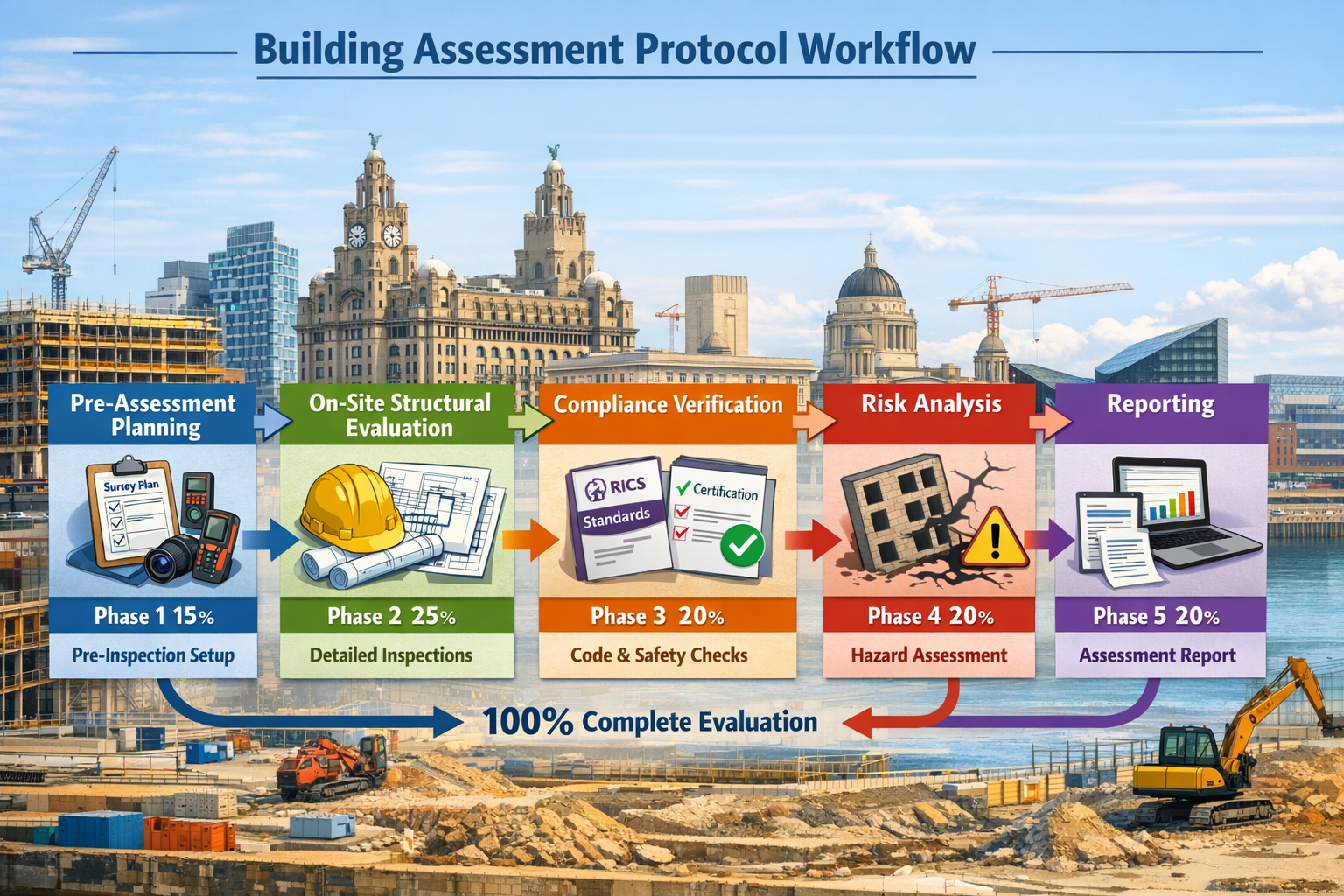
The high-density nature of Northern England megaprojects—with towers reaching 55 storeys in Manchester and 28 storeys in Liverpool—requires advanced structural assessment techniques that go beyond standard survey protocols:
Foundation and Ground Condition Analysis:
- Comprehensive geotechnical investigation for high-rise load distribution
- Assessment of historic subsidence patterns in post-industrial zones
- Evaluation of adjacent structure impact during deep excavation phases
- Water table analysis and flood risk assessment in waterfront locations
For properties showing potential ground movement concerns, specialized subsidence surveys provide essential baseline data for long-term structural monitoring.
Structural Integrity Evaluation:
- Advanced non-destructive testing (NDT) for existing structures undergoing renovation
- Load-bearing capacity assessment for mixed-use developments
- Seismic resilience evaluation aligned with updated UK building standards
- Progressive collapse resistance analysis for high-density residential towers
Material Condition Assessment:
- Concrete carbonation testing for aging commercial structures
- Steel corrosion evaluation in waterfront environments
- Masonry condition surveys for heritage building integration
- Modern cladding system compliance verification post-Grenfell
Compliance and Regulatory Framework Navigation
The regulatory environment for megaprojects in Northern England involves multiple overlapping frameworks that building surveyors must navigate simultaneously:
Building Regulations Compliance:
- Part B (Fire Safety) enhanced requirements for high-rise residential
- Part L (Conservation of Fuel and Power) sustainability standards
- Part M (Access to and Use of Buildings) inclusive design requirements
- Part E (Resistance to the Passage of Sound) acoustic performance standards
Planning Policy Alignment:
- Local Development Framework compliance verification
- Section 106 agreement infrastructure contribution assessment
- Community Infrastructure Levy (CIL) liability evaluation
- Heritage impact assessment for conservation area developments
RICS Standards Application:
- RICS Professional Standards and Guidance compliance
- Building Survey (Level 3) methodology for complex structures
- Commercial building survey protocols for mixed-use developments
- Valuation standards for institutional investment assessment
Surveyors working on projects like the Manchester Viadux Two tower (construction starting Q2 2026, completion target Q4 2030) must implement phased compliance verification protocols that track regulatory adherence across multi-year construction timelines [7]. Our commercial building surveys service provides specialized expertise for large-scale commercial and mixed-use developments.
Risk Assessment and Investment Viability Analysis
Institutional investors backing Northern England megaprojects require comprehensive risk assessments that inform capital allocation decisions. Building surveyors play a critical role in quantifying structural risk, compliance risk, and long-term viability concerns:
Structural Risk Quantification:
- Probability assessment of critical defect occurrence
- Cost estimation for remedial works and contingency planning
- Timeline impact analysis for identified structural issues
- Insurance implications and risk transfer strategies
Market Viability Assessment:
- Comparative analysis of similar developments in regional context
- Demand assessment for high-density residential product types
- Mixed-use integration viability for commercial/residential combinations
- Long-term asset value projection based on structural condition
Sustainability and ESG Considerations:
- Energy performance assessment and improvement potential
- Carbon footprint evaluation for institutional ESG reporting
- Climate resilience analysis for waterfront developments
- Circular economy principles in material selection and lifecycle planning
For investors requiring detailed cost projections, our guide on full structural survey cost in the UK provides comprehensive pricing frameworks applicable to large-scale assessments.
Building Assessment Protocols for Manchester and Liverpool Renewal Megaprojects: Implementation Best Practices
Manchester-Specific Assessment Considerations
Manchester's development landscape in 2026 presents unique assessment challenges driven by the city's rapid vertical growth and mixed-use integration strategies:
Victoria Riverside District Protocol:
The £4 billion Victoria Riverside development delivering 15,000 homes requires phased assessment protocols that address:
- Sequential construction impact on adjacent completed phases
- Shared infrastructure capacity and utility coordination
- Community facility integration and accessibility compliance
- Long-term maintenance planning for large-scale residential portfolios [5]
Building surveyors must implement rolling assessment schedules that provide continuous monitoring across the multi-year delivery timeline. This includes establishing baseline structural conditions, monitoring construction vibration impact, and verifying completion standards against original specifications.
High-Rise Tower Assessment Framework:
Projects like the Manchester Viadux Two (246 meters) and Vista River Gardens (55 storeys) demand specialized high-rise assessment protocols [7][8]:
| Assessment Component | Methodology | Frequency |
|---|---|---|
| Foundation Settlement | Precision leveling surveys | Quarterly during construction |
| Structural Movement | Tilt monitoring and laser scanning | Monthly through topping out |
| Facade System Performance | Wind load testing and water penetration | Pre-installation and post-completion |
| Fire Safety Systems | Integrated system testing and certification | Multiple stages per building regulations |
| MEP Integration | Building services coordination and capacity verification | Continuous through fit-out |
Etihad Stadium Expansion Assessment:
The £300 million Etihad Stadium expansion targeting late 2026 completion represents a complex mixed-use institutional project combining sports infrastructure, hospitality facilities, and public realm development [7][8]. Assessment protocols must address:
- Structural integration with existing stadium infrastructure
- Crowd loading and dynamic structural response analysis
- Acoustic performance for adjacent residential development
- Heritage impact assessment for surrounding urban fabric
For large institutional projects requiring ongoing monitoring, project management services ensure coordinated oversight across all assessment phases.
Liverpool-Specific Assessment Considerations
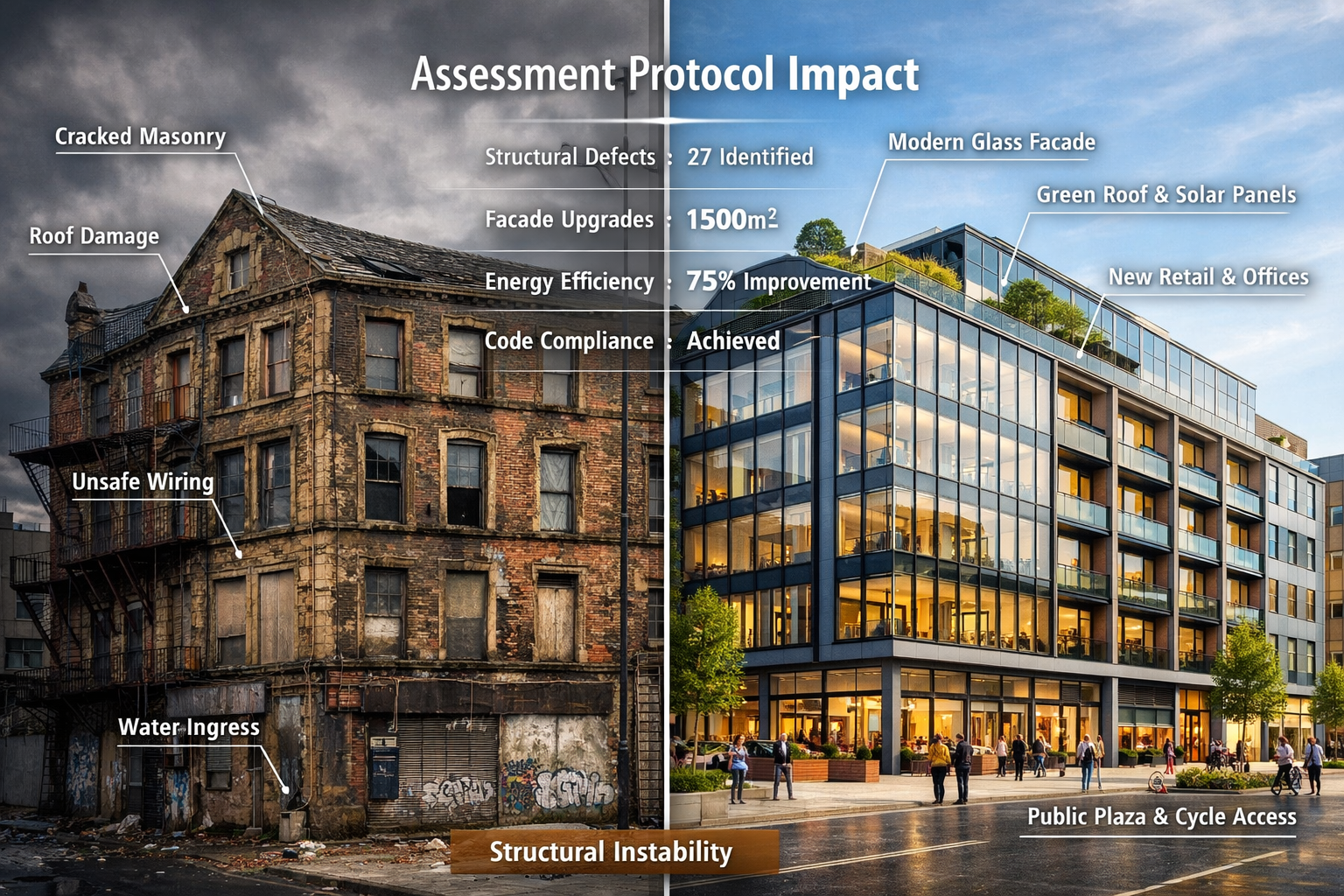
Liverpool's regeneration strategy emphasizes waterfront transformation and heritage integration, creating distinct assessment requirements:
King Edward Triangle High-Rise Protocol:
The £1 billion King Edward Triangle development with approximately 3,000 homes in high-rise clusters requires specialized waterfront assessment protocols [3]:
- Coastal exposure analysis: Wind loading, salt spray corrosion, and weathering assessment
- Flood resilience evaluation: Climate change adaptation and tidal surge protection
- Heritage context integration: Visual impact assessment and conservation area compliance
- Ground condition challenges: Post-industrial land remediation verification
The planning application for the first 28-storey building submitted in 2025 establishes precedent for subsequent phases, making initial assessment accuracy critical for the entire development trajectory [3].
Central Docks Liverpool Waters Assessment:
The 26-acre Central Docks site with 2,000+ new homes and £55 million government funding presents complex infrastructure integration challenges [3]:
- Coordination with five-acre Central Park scheduled completion 2028
- Phased residential delivery assessment across multiple years
- Utility capacity verification for large-scale residential density
- Transport infrastructure integration and accessibility compliance
Heritage Building Conversion Protocol:
The Littlewoods Edge Lane film and television facility (£70 million) exemplifies the heritage conversion challenges prevalent in Liverpool's regeneration strategy [3]:
Heritage Assessment Requirements:
- Grade II-listed building fabric condition survey
- Historic England consultation and consent coordination
- Structural intervention impact on heritage significance
- Modern building services integration without heritage harm
- Fire safety upgrades compliant with historic building guidance
Surveyors working on heritage conversions must balance preservation principles with modern functional requirements, often requiring innovative structural solutions that respect historic fabric while enabling contemporary use. Our stock condition survey services provide comprehensive assessment frameworks for existing building portfolios.
Festival Gardens Residential Development:
The 440-home Festival Gardens redevelopment with 110 affordable units and 80 extra-care units requires specialized assessment for diverse housing typologies [3]:
- Accessibility compliance verification for extra-care housing
- Affordable housing quality standards assessment
- Community facility integration and shared space evaluation
- Long-term maintenance planning for mixed-tenure developments
Technology Integration in Megaproject Assessment
Modern building assessment for Northern England megaprojects increasingly relies on advanced technology platforms that enhance accuracy, efficiency, and stakeholder communication:
Building Information Modeling (BIM) Integration:
- Level 2 BIM compliance for government-funded projects
- Digital twin creation for long-term asset management
- Clash detection and coordination across multiple disciplines
- As-built verification against design intent
Drone and Aerial Survey Technology:
- High-resolution facade condition assessment for tall buildings
- Construction progress monitoring across large development sites
- Thermal imaging for building envelope performance evaluation
- 3D photogrammetry for accurate dimensional verification
Advanced NDT and Monitoring Systems:
- Ground-penetrating radar for concealed structure investigation
- Ultrasonic testing for concrete and steel integrity assessment
- Fiber optic strain monitoring for real-time structural performance
- Automated crack monitoring systems for long-term observation
Digital Reporting and Stakeholder Communication:
- Interactive digital survey reports with embedded multimedia
- Cloud-based document management for multi-stakeholder access
- Real-time dashboard reporting for institutional investors
- Mobile-optimized platforms for on-site data capture
For comprehensive understanding of survey types and their applications, our comparison guide on Level 2 vs Level 3 survey key differences helps professionals select appropriate assessment methodologies.
Professional Qualifications and Expertise Requirements
Essential Credentials for Megaproject Assessment
Surveying institutional growth in Northern England's renewal megaprojects requires advanced professional qualifications beyond standard chartered surveyor credentials:
Core Professional Qualifications:
- MRICS (Member of the Royal Institution of Chartered Surveyors) status
- Specialist accreditation in building surveying or structural engineering
- Registered Building Inspector credentials for regulatory compliance work
- CDM (Construction Design and Management) Regulations competency
Specialized Expertise Areas:
- High-rise residential and mixed-use development assessment
- Heritage building evaluation and conservation principles
- Fire safety engineering and regulatory compliance
- Sustainability assessment and ESG reporting frameworks
Continuing Professional Development (CPD):
- Regular training on updated Building Regulations and fire safety standards
- Advanced NDT and survey technology certification
- BIM Level 2 competency and digital workflow integration
- Megaproject management and multi-stakeholder coordination
Building Effective Assessment Teams
Large-scale megaprojects require multidisciplinary assessment teams that combine diverse expertise:
Core Team Structure:
- Lead Chartered Surveyor: Overall assessment coordination and reporting
- Structural Engineer: Advanced structural analysis and design verification
- MEP Consultant: Building services capacity and integration assessment
- Fire Safety Specialist: Regulatory compliance and system verification
- Heritage Consultant: Conservation area and listed building expertise (where applicable)
Supporting Specialists:
- Geotechnical engineer for foundation and ground condition analysis
- Acoustic consultant for sound insulation and environmental noise
- Sustainability assessor for energy performance and ESG metrics
- Project manager for phased delivery coordination
For professionals seeking to understand the full scope of chartered surveyor responsibilities, our article on what does a chartered surveyor do provides comprehensive career insights.
Cost Considerations and Investment in Assessment Protocols
Assessment Cost Frameworks for Megaprojects
The financial investment required for comprehensive building assessment in Northern England megaprojects varies significantly based on project scale, complexity, and assessment depth:
Typical Cost Ranges (2026):
- Standard residential block (50-100 units): £15,000 – £35,000
- High-rise tower (200+ units): £50,000 – £150,000+
- Mixed-use development (commercial + residential): £75,000 – £250,000+
- Heritage conversion project: £40,000 – £120,000+
- Large-scale district assessment (multiple buildings): £200,000 – £500,000+
Cost Variables:
- Building height and structural complexity
- Heritage designation and conservation requirements
- Access challenges and construction phase coordination
- Technology deployment (BIM, drone surveys, advanced NDT)
- Regulatory compliance depth and certification requirements
Value Proposition:
While comprehensive assessment represents significant upfront investment, the risk mitigation value for institutional investors far exceeds the cost. Early identification of structural defects, compliance issues, or design conflicts can prevent:
- Construction delays costing millions in financing charges
- Remedial work expenses during or post-construction
- Regulatory enforcement actions and project suspensions
- Reputational damage and investor confidence erosion
- Long-term asset value impairment
Return on Investment for Robust Assessment
Institutional investors backing Northern England megaprojects recognize that thorough building assessment delivers measurable ROI through:
Risk Reduction:
- 15-25% reduction in construction contingency requirements
- Lower insurance premiums through demonstrated risk management
- Reduced warranty claim exposure post-completion
- Enhanced asset value through verified quality standards
Timeline Optimization:
- Fewer construction delays from unexpected structural issues
- Streamlined regulatory approval through proactive compliance
- Faster sales/letting velocity through quality assurance
- Reduced post-completion defect rectification periods
Market Positioning:
- Premium pricing justification through independent quality verification
- Enhanced investor confidence and capital raising capability
- Competitive advantage in crowded development markets
- Long-term asset performance and tenant satisfaction
Regulatory Compliance and Quality Assurance
Navigating the Post-Grenfell Regulatory Environment
The building assessment landscape in 2026 remains profoundly shaped by post-Grenfell regulatory reforms that have fundamentally altered compliance requirements for high-rise residential development:
Building Safety Act 2022 Implications:
- Enhanced competency requirements for building control professionals
- Mandatory Gateway approval process for high-risk buildings
- Golden Thread information management throughout building lifecycle
- Resident engagement and building safety manager requirements
High-Rise Residential Specific Requirements:
- Comprehensive fire safety strategy documentation
- External wall system testing and certification
- Evacuation strategy verification and resident communication
- Secondary means of escape assessment
Building surveyors assessing projects like the King Edward Triangle 28-storey tower or Manchester Viadux Two must ensure full compliance with enhanced fire safety standards throughout the assessment process [3][7].
Quality Assurance Frameworks
Institutional investors increasingly demand third-party quality assurance that validates building assessment accuracy and completeness:
Independent Verification Protocols:
- Peer review of assessment reports by senior chartered surveyors
- Sampling inspection programs during construction phases
- Post-completion verification against assessment recommendations
- Long-term monitoring programs for structural performance
Documentation Standards:
- Comprehensive photographic and video documentation
- Detailed defect schedules with location mapping
- Risk-rated findings with remediation priority classification
- Clear, actionable recommendations with cost implications
Professional Indemnity Insurance:
- Adequate PI coverage for megaproject assessment liability
- Project-specific insurance for high-value developments
- Clear scope of service definition and limitation of liability
- Professional standards compliance documentation
Future Trends and Evolving Assessment Protocols
Emerging Technologies Reshaping Building Assessment
The building assessment profession is experiencing rapid technological transformation that will fundamentally reshape protocols for Northern England megaprojects:
Artificial Intelligence and Machine Learning:
- Automated defect detection from drone and camera imagery
- Predictive maintenance algorithms for long-term asset management
- Risk scoring models based on historical project data
- Natural language processing for automated report generation
Digital Twin Technology:
- Real-time building performance monitoring post-completion
- Scenario modeling for maintenance planning and lifecycle costing
- Integration with building management systems for operational optimization
- Continuous condition assessment through sensor networks
Advanced Materials Assessment:
- Non-invasive material composition analysis
- Nano-technology applications in structural monitoring
- Smart materials integration and performance verification
- Carbon capture and storage technology assessment
Climate Resilience and Sustainability Integration
Northern England's waterfront megaprojects face increasing climate change pressures that are reshaping assessment priorities:
Climate Adaptation Assessment:
- Sea level rise impact analysis for Liverpool waterfront developments
- Extreme weather resilience evaluation (flooding, wind, temperature)
- Urban heat island mitigation assessment
- Biodiversity net gain verification
Embodied Carbon Assessment:
- Whole-life carbon analysis for material selection
- Circular economy principles in construction methodology
- Retrofit-first approach evaluation for existing structures
- Carbon offset strategy verification
Energy Performance Optimization:
- Net-zero carbon operational target assessment
- Renewable energy integration capacity evaluation
- Smart building technology deployment verification
- Future-proofing for evolving energy standards
Conclusion: Strategic Imperatives for Building Assessment Excellence
The unprecedented scale of institutional growth in Northern England—exemplified by £1.7 billion in government investment and over £100 billion in regional regeneration portfolios—demands a fundamental evolution in building assessment protocols. Manchester and Liverpool's renewal megaprojects represent not just construction opportunities but complex institutional ecosystems requiring sophisticated evaluation frameworks that balance structural integrity, regulatory compliance, investment viability, and long-term sustainability.
Surveying institutional growth in Northern England: building assessment protocols for Manchester and Liverpool renewal megaprojects must embrace several strategic imperatives:
Key Strategic Actions for Building Surveyors
✅ Develop Megaproject-Specific Expertise: Invest in specialized training covering high-rise assessment, heritage integration, and multi-stakeholder coordination unique to large-scale urban renewal environments.
✅ Embrace Technology Integration: Deploy advanced assessment technologies including BIM, drone surveys, and digital twin platforms that enhance accuracy and stakeholder communication.
✅ Build Multidisciplinary Teams: Establish collaborative relationships with structural engineers, fire safety specialists, heritage consultants, and sustainability assessors to deliver comprehensive evaluation services.
✅ Implement Phased Assessment Protocols: Design rolling assessment frameworks that provide continuous monitoring across multi-year construction timelines characteristic of megaprojects.
✅ Prioritize Regulatory Compliance: Maintain current knowledge of evolving building safety regulations, particularly post-Grenfell reforms affecting high-rise residential development.
✅ Quantify Investment Risk: Develop robust risk assessment methodologies that translate structural findings into financial implications for institutional investors.
✅ Champion Sustainability Integration: Incorporate climate resilience, embodied carbon assessment, and ESG metrics into standard evaluation protocols.
Next Steps for Stakeholders
For Building Surveyors:
- Pursue RICS specialist accreditation in building surveying or structural engineering
- Develop regional expertise in Manchester and Liverpool development contexts
- Invest in advanced survey technology and digital workflow systems
- Establish strategic partnerships with complementary professional disciplines
For Institutional Investors:
- Commission comprehensive building assessments early in project development
- Require multidisciplinary assessment teams for complex megaprojects
- Implement third-party quality assurance verification protocols
- Integrate assessment findings into risk management and capital allocation decisions
For Developers:
- Engage chartered surveyors during design development to identify issues proactively
- Establish clear communication protocols between assessment teams and construction management
- Budget adequately for comprehensive assessment across all project phases
- Use assessment findings to demonstrate quality assurance to investors and end-users
For Local Authorities:
- Develop clear guidance on assessment requirements for megaproject planning applications
- Establish streamlined coordination protocols for multi-stakeholder projects
- Provide training resources on evolving building safety regulations
- Foster collaboration between public sector objectives and private sector delivery
The transformation of Northern England through Manchester and Liverpool's renewal megaprojects represents a generational opportunity to establish best-practice building assessment protocols that can serve as models for urban regeneration nationally and internationally. By embracing specialized expertise, advanced technology, and collaborative multidisciplinary approaches, building surveyors can ensure these landmark developments deliver structural integrity, regulatory compliance, and long-term value that justifies the extraordinary institutional investment reshaping the region's urban landscape.
For professional building assessment services tailored to large-scale development projects, explore our comprehensive building surveys and commercial building surveys offerings, or contact our team of chartered surveyors for project-specific consultation.
References
[1] Chancellor Backs North With 17bn For City Centre Projects – https://www.gov.uk/government/news/chancellor-backs-north-with-17bn-for-city-centre-projects
[3] Liverpools Regeneration To Take Major Step Forward In 2026 – https://www.buyassociationgroup.com/en-us/news/liverpools-regeneration-to-take-major-step-forward-in-2026/
[5] Watch – https://www.youtube.com/watch?v=O5AssgliUx8
[7] Watch – https://www.youtube.com/watch?v=JGB5MpwQQ2k
[8] New Developments Greater Manchester 2026 – https://secretmanchester.com/new-developments-greater-manchester-2026/
