
The UK rental market is experiencing an unprecedented transformation in 2026. Institutional landlords are rapidly expanding their buy-to-let portfolios, acquiring entire blocks of terraced properties and converting larger buildings into multiple rental units. Yet amid this investment surge, one critical compliance requirement often catches professional investors off guard: party wall surveys. Understanding Party Wall Surveys for Institutional Buy-to-Let Expansions: Compliance in 2026's Landlord Investment Surge has become essential for avoiding costly delays, legal disputes, and regulatory penalties that can derail even the most promising property ventures.
As rental shortages drive institutional investors to acquire and develop multi-unit properties at scale, the complexity of managing party wall obligations multiplies exponentially. A single terraced block conversion might involve dozens of adjoining owners, each requiring proper notice and potentially separate surveys. The stakes have never been higher for getting compliance right from the start.
Key Takeaways
✅ Institutional landlords must serve formal party wall notices at least 2 months before any structural work affecting shared walls, regardless of portfolio size or corporate structure
✅ Party wall survey costs typically start at £1,000 per agreement but can multiply significantly for multi-unit developments requiring multiple awards
✅ Professional party wall surveyors protect institutional investors from disputes, delays, and potential legal action that could stall entire development projects
✅ The 2026 landlord investment surge has intensified scrutiny on party wall compliance, making proper procedures non-negotiable for institutional portfolios
✅ Failure to comply with the Party Wall Act 1996 can result in injunctions, forcing work stoppage and creating substantial financial losses for buy-to-let expansions
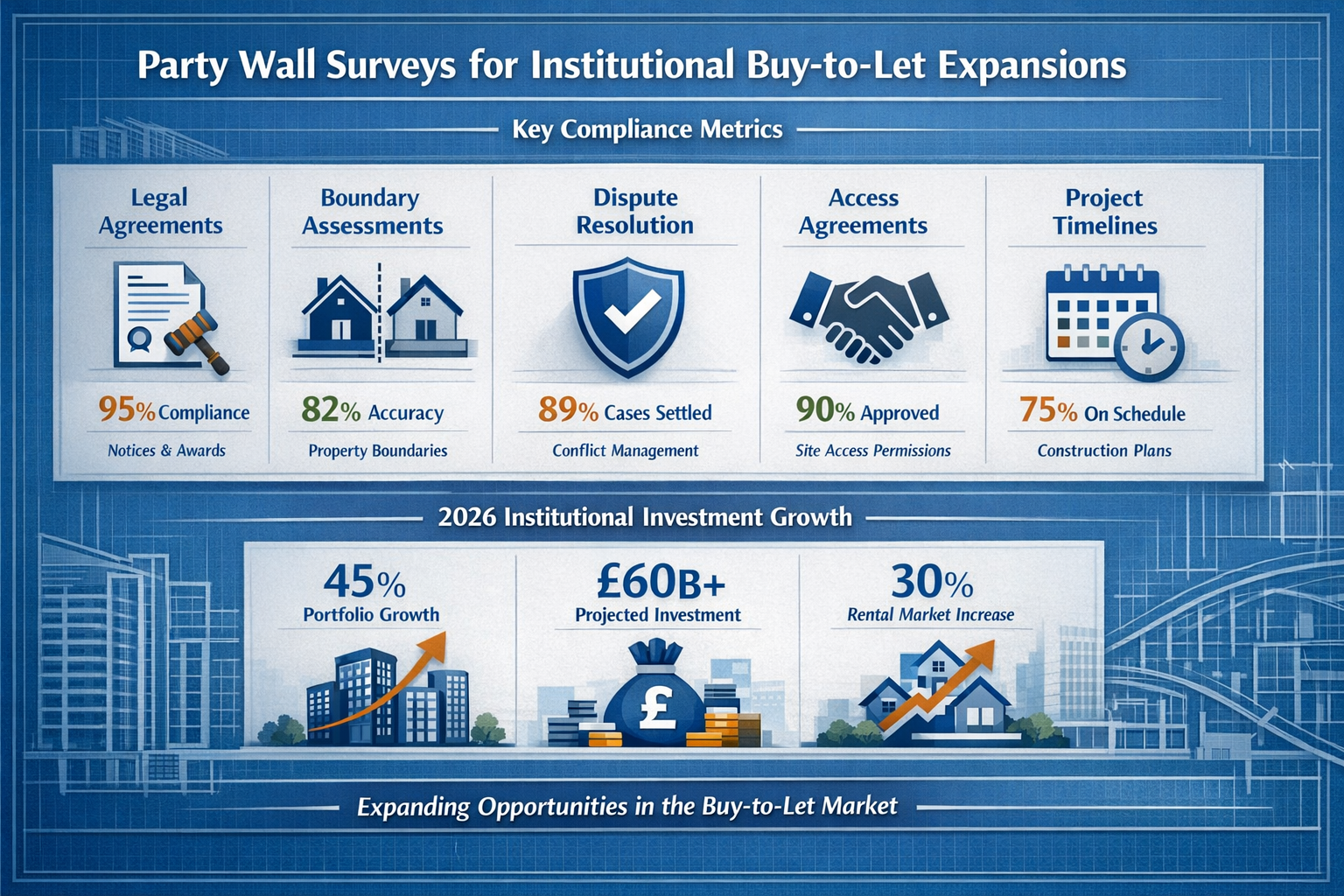
Understanding Party Wall Surveys for Institutional Buy-to-Let Expansions in 2026
What Makes Institutional Buy-to-Let Different?
Institutional buy-to-let investors operate at a fundamentally different scale than individual landlords. Where a private landlord might purchase a single property every few years, institutional investors acquire entire portfolios—sometimes dozens of properties simultaneously. This scale creates unique party wall challenges.
Key differences include:
- 🏢 Multiple simultaneous projects across various properties
- 📊 Higher volume of adjoining owners to manage
- ⚖️ Greater legal exposure due to portfolio size
- 💼 Corporate reputation risks from compliance failures
- 🔄 Ongoing development programs requiring continuous party wall management
The Party Wall etc. Act 1996 applies equally to all building owners, regardless of whether they're individual homeowners or multi-billion-pound investment funds. However, institutional landlords face amplified consequences when things go wrong.
The 2026 Landlord Investment Surge Context
Several factors have converged to create 2026's institutional buy-to-let boom:
Market Drivers:
- Persistent rental shortages in major UK cities
- Government policy changes favoring professional landlords
- Exit of smaller landlords creating acquisition opportunities
- Strong rental yield projections through 2030
- Build-to-rent sector maturation
This surge means more conversions, extensions, and structural modifications—all triggering party wall requirements. Institutional investors renovating multiple terraced houses or converting commercial buildings into flats must navigate party wall compliance across every unit.
Why Party Wall Surveys Matter for Portfolio Expansion
Party wall surveys serve multiple critical functions for institutional landlords:
- Legal Protection: Formal documentation protects against future claims
- Condition Recording: Establishes baseline property conditions before work
- Dispute Prevention: Professional surveyors mediate between parties
- Project Timeline Certainty: Proper procedures prevent work stoppages
- Due Diligence Evidence: Demonstrates compliance to investors and lenders
When expanding a buy-to-let portfolio through renovations or conversions, understanding when you need a party wall agreement becomes fundamental to project planning and risk management.
Compliance Requirements for Party Wall Surveys in Institutional Portfolios

Mandatory Notice Periods and Procedures
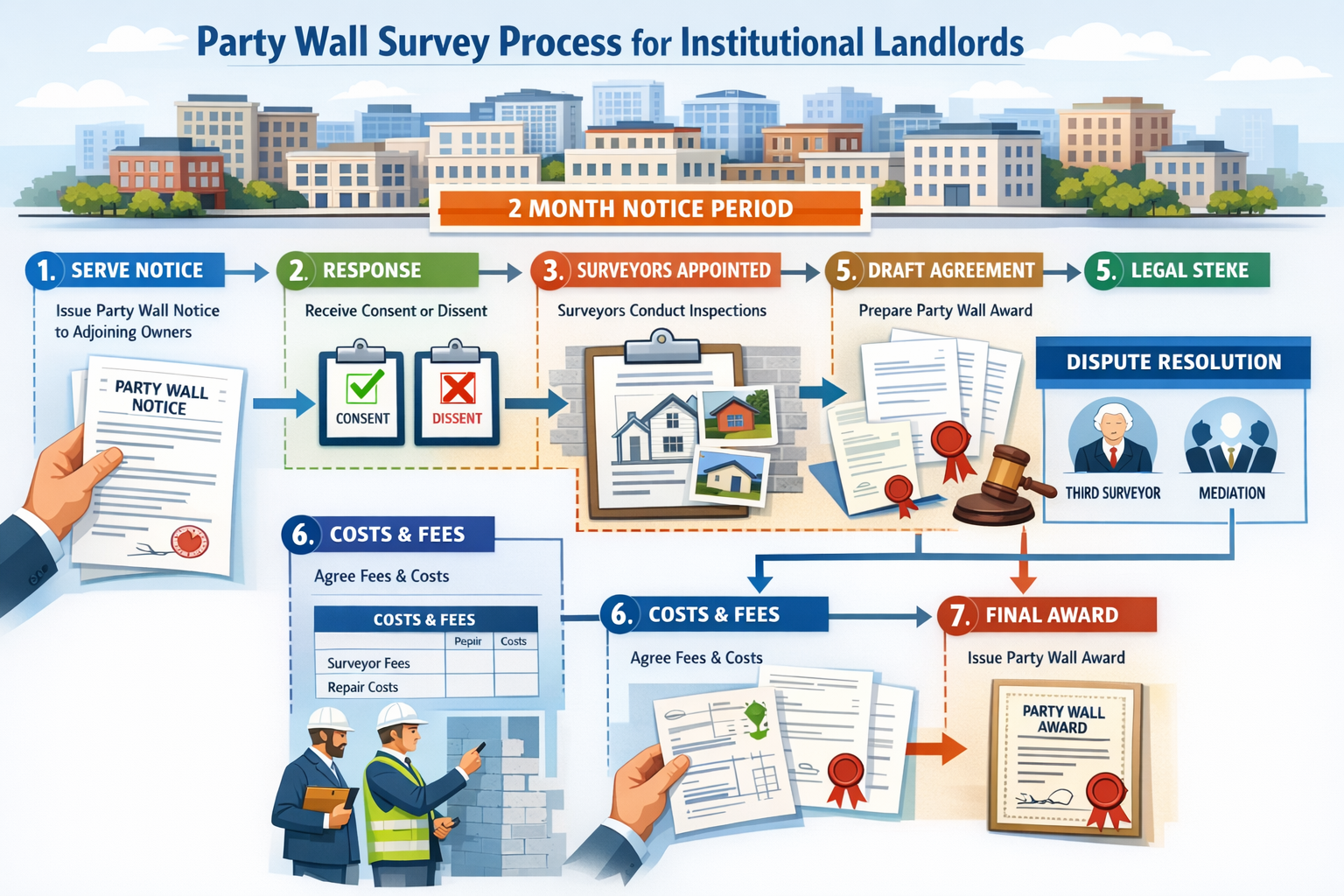
The Party Wall Act 1996 establishes strict notice requirements that institutional landlords must follow:
| Work Type | Notice Period | Notice Requirements |
|---|---|---|
| New wall on boundary | 1 month | Line of Junction Notice |
| Work to existing party wall | 2 months | Party Structure Notice |
| Excavation within 3-6 meters | 2 months | Adjacent Excavation Notice |
Critical compliance steps:
- Identify all affected neighbors across your portfolio properties
- Prepare and serve formal notices using prescribed formats
- Allow full statutory notice periods before commencing work
- Appoint qualified party wall surveyors if neighbors dissent
- Obtain Party Wall Awards documenting agreed procedures
- Maintain comprehensive records for audit and legal purposes
For institutional investors managing multiple simultaneous projects, creating standardized notice procedures and tracking systems becomes essential. Missing a single notice can delay an entire development program.
The Role of Professional Party Wall Surveyors
When neighbors dissent to your notice (or fail to respond within 14 days), the Act requires appointment of surveyors. Institutional landlords have three options:
Surveyor Appointment Models:
- Agreed Surveyor: Single surveyor acts for both parties (most cost-effective)
- Two Surveyors: Each party appoints their own surveyor who jointly prepare the award
- Third Surveyor: Selected by the two surveyors to resolve disagreements
Professional party wall surveyors provide institutional landlords with:
✅ Expert interpretation of the Act's requirements
✅ Impartial condition surveys protecting all parties
✅ Professionally drafted Party Wall Awards
✅ Dispute resolution expertise
✅ Court-admissible documentation
For buy-to-let expansions involving multiple properties, establishing relationships with experienced surveyors who understand institutional requirements creates significant efficiency gains.
Cost Considerations for Institutional Compliance
Party wall survey costs represent a necessary investment in legal compliance. For institutional landlords, understanding the cost structure helps with accurate project budgeting.
Typical Cost Ranges (2026):
- Agreed Surveyor (single property): £1,000 – £2,000
- Two Surveyors (single property): £1,500 – £3,500
- Complex multi-unit projects: £5,000 – £15,000+
- Portfolio-wide programs: Negotiated rates with volume discounts
The building owner (institutional landlord) typically pays all surveyor fees, including the neighbor's surveyor costs. This is a legal requirement under the Act. Understanding who pays for party wall surveyors helps institutional investors budget accurately.
Cost-saving strategies for institutional portfolios:
💰 Negotiate framework agreements with surveyors for multiple properties
💰 Use agreed surveyors where possible to minimize costs
💰 Implement early neighbor engagement to reduce dissent rates
💰 Standardize procedures across portfolio to improve efficiency
💰 Factor party wall costs into acquisition analysis from the start
Common Compliance Pitfalls for Institutional Landlords
Despite professional resources, institutional investors frequently encounter these party wall compliance issues:
⚠️ Critical Mistakes to Avoid:
- Assuming corporate status exempts you from residential party wall requirements
- Using standard corporate notice templates instead of Act-compliant formats
- Delegating to contractors without proper oversight of notice procedures
- Starting work before notice periods expire due to project pressure
- Failing to identify all affected neighbors in complex multi-unit buildings
- Inadequate record-keeping across portfolio properties
- Ignoring party wall requirements for "minor" works that actually trigger the Act
The consequences of non-compliance can be severe. Neighbors can obtain injunctions forcing immediate work stoppage, creating cascade delays across development programs. Legal costs defending against injunctions often dwarf the original survey costs.
For institutional landlords managing party wall disputes, early professional intervention typically produces better outcomes than reactive legal battles.
Strategic Implementation: Party Wall Surveys for Institutional Buy-to-Let Expansions
Building a Scalable Compliance Framework
Institutional landlords need systematic approaches to party wall compliance that scale across portfolios. Ad-hoc procedures create gaps and inconsistencies that generate risk.
Framework Components:
1. Pre-Acquisition Due Diligence
- Identify potential party wall issues during property assessment
- Review existing party wall awards from previous owners
- Factor party wall costs and timelines into acquisition models
- Assess neighbor relationships and potential dispute risks
2. Standardized Procedures
- Create template notice documents compliant with the Act
- Develop tracking systems for notice periods and responses
- Establish approved surveyor panels for consistent service
- Implement quality control checkpoints before work commences
3. Stakeholder Management
- Train property managers on party wall requirements
- Brief contractors on compliance obligations
- Establish communication protocols with neighbors
- Create escalation procedures for potential disputes
4. Documentation Systems
- Centralized repository for all party wall notices and awards
- Digital tracking of notice periods and deadlines
- Photographic condition records linked to specific properties
- Audit trails demonstrating compliance to regulators and lenders
Technology Solutions for Portfolio-Scale Compliance
Forward-thinking institutional landlords are leveraging technology to manage party wall compliance:
Digital Tools:
📱 Property management software with party wall tracking modules
📱 Automated notice generation from standardized templates
📱 Calendar systems with deadline alerts and reminders
📱 Document management platforms for centralized record-keeping
📱 Neighbor communication portals for transparent updates
These systems become particularly valuable when managing renovation programs across dozens of properties simultaneously, ensuring nothing falls through the cracks.
Integrating Party Wall Surveys with Project Planning
Successful institutional landlords integrate party wall compliance into standard project workflows rather than treating it as an afterthought.
Recommended Timeline:
| Project Stage | Party Wall Actions | Timeline |
|---|---|---|
| Acquisition | Initial party wall assessment | Pre-completion |
| Design | Identify triggering works | 4-6 months before work |
| Pre-construction | Serve notices, appoint surveyors | 2-3 months before work |
| Award preparation | Surveys, negotiations, documentation | 1-2 months before work |
| Construction | Ongoing compliance monitoring | During works |
| Completion | Final inspections, documentation | At project end |
Building these steps into standard operating procedures ensures compliance becomes automatic rather than requiring special attention for each project.
Neighbor Relations and Dispute Minimization
While party wall legislation provides legal frameworks, institutional landlords benefit from proactive neighbor engagement that goes beyond minimum requirements.
Best Practices:
🤝 Early informal communication before formal notices
🤝 Clear explanations of planned works in accessible language
🤝 Regular updates throughout the project
🤝 Responsive handling of concerns and questions
🤝 Professional conduct from contractors and surveyors
🤝 Swift resolution of any issues that arise
Institutional landlords with strong neighbor relations experience lower dissent rates, faster survey processes, and fewer disputes—all contributing to smoother project delivery and better investment returns.
For comprehensive guidance on party wall procedures, institutional investors should review complete party wall survey guides that cover all aspects of compliance.
Risk Management and Insurance Considerations
Party wall compliance intersects with broader risk management for institutional portfolios.
Key Risk Areas:
⚠️ Legal liability for damage to neighboring properties
⚠️ Project delays from compliance failures or disputes
⚠️ Reputational damage affecting future acquisitions
⚠️ Lender concerns about compliance standards
⚠️ Regulatory scrutiny of institutional landlord practices
Risk Mitigation Strategies:
- Maintain comprehensive professional indemnity insurance
- Ensure contractors carry adequate liability coverage
- Document all compliance efforts meticulously
- Engage qualified professionals rather than cutting corners
- Build contingency time into project schedules
- Establish reserve funds for unexpected party wall costs
Emerging Trends in 2026's Institutional Buy-to-Let Market
The party wall compliance landscape continues evolving alongside the institutional buy-to-let sector:
Current Trends:
📈 Increased regulatory scrutiny of institutional landlords
📈 Growing neighbor awareness of party wall rights
📈 Higher professional standards expected from corporate owners
📈 Technology adoption for compliance management
📈 Sustainability considerations in party wall works
📈 ESG integration with compliance frameworks
Institutional investors who stay ahead of these trends position themselves for sustainable portfolio growth while maintaining strong compliance records.
Conclusion
Party Wall Surveys for Institutional Buy-to-Let Expansions: Compliance in 2026's Landlord Investment Surge represents both a legal obligation and a strategic opportunity. As institutional investors continue expanding their portfolios amid ongoing rental shortages, proper party wall compliance separates successful, sustainable operations from those plagued by disputes, delays, and legal challenges.
The key to success lies in treating party wall surveys not as bureaucratic obstacles but as essential risk management tools. Institutional landlords who implement robust compliance frameworks, engage qualified professionals, maintain strong neighbor relations, and integrate party wall procedures into standard operations will navigate 2026's investment surge with confidence.
Actionable Next Steps for Institutional Landlords
Immediate Actions:
- Audit your current portfolio for any ongoing or planned works requiring party wall compliance
- Review existing procedures against the requirements outlined in this guide
- Establish relationships with qualified party wall surveyors experienced in institutional work
- Implement tracking systems for notices, deadlines, and documentation
- Train your team on party wall requirements and compliance procedures
Strategic Development:
- Create standardized templates for notices and communications
- Build party wall costs and timelines into all acquisition and development models
- Develop neighbor engagement protocols that exceed minimum legal requirements
- Integrate compliance monitoring into regular portfolio management reviews
- Stay informed about regulatory developments and industry best practices
The institutional buy-to-let sector's continued growth depends on professional standards that protect both investment returns and community relations. Proper party wall compliance demonstrates the responsible stewardship that distinguishes leading institutional landlords in 2026's competitive market.
By prioritizing compliance, engaging qualified professionals, and implementing scalable systems, institutional investors can expand their portfolios confidently while maintaining the legal protections and neighbor goodwill essential for long-term success. The investment in proper party wall surveys pays dividends through smoother projects, fewer disputes, and sustainable portfolio growth.
