
Nearly one in three party wall disputes in England and Wales involves work that has already been carried out without proper notice — leaving neighbours facing cracked walls, subsidence risks, and no formal record of pre-existing conditions. When the dust has literally settled, party wall retrospective agreements: resolving disputes after works complete—surveyor protocols and client recovery strategies become the critical legal and practical mechanism for protecting both affected neighbours and building owners who failed to follow the correct process.
This guide explains exactly what retrospective agreements are, when they apply, how surveyors structure them, and what clients on both sides of the wall can do to recover their position in 2026.
Key Takeaways 📋
- Completed works cannot be retrospectively notified under the Party Wall etc. Act 1996, but a formal retrospective agreement can still provide legal and practical protection [1]
- Both parties must consent to appoint an agreed surveyor or their own surveyors to draw up a retrospective Party Wall Award [1]
- Courts reverse the burden of proof when the Act has been ignored — the building owner must prove they did not cause damage, not the other way around [2]
- A Schedule of Condition is the single most important document in any retrospective dispute; its absence significantly weakens the building owner's defence [1]
- Remaining works can still be properly notified even after some work is complete, offering a partial legal reset [2]
What Is a Party Wall Retrospective Agreement and When Is It Necessary?
A retrospective party wall agreement is a formal arrangement reached between neighbouring property owners after building work has been partially or fully completed. Its purpose is to address damage complaints, establish what work was carried out, and provide both parties with a degree of legal clarity and protection — even though the proper statutory process was not followed beforehand [1].
This situation arises more often than most people expect. Common triggers include:
- 🏗️ A building owner who genuinely did not know the Party Wall etc. Act 1996 applied to their project
- 🔨 Contractors who began work before notices were served
- 📋 Neighbours who consented verbally but never formalised the agreement in writing
- 🏠 Loft conversions, basement excavations, or rear extensions where the party wall element was overlooked
"Work already completed cannot be 'retrospectively notified' under the Party Wall Act — but that does not mean the affected neighbour is without recourse." [2]
It is important to understand the distinction: statutory notice cannot be served for work already done, but the spirit of the Act can still be applied through a consensual retrospective agreement. Both parties may agree to treat the completed works as if they had been properly notified, putting protections in place going forward [2]. This is not a perfect solution, but it is often far better than immediate litigation.
The Party Wall etc. Act 1996 applies only to England and Wales. Homeowners in Scotland or Northern Ireland operate under entirely different property law frameworks and should seek jurisdiction-specific legal advice [1].
For a broader understanding of when formal agreements are required from the outset, see this complete guide to when a party wall agreement is legally required in the UK.

Surveyor Protocols for Party Wall Retrospective Agreements: Resolving Disputes After Works Complete
Appointing the Right Surveyor
The first and most critical step in structuring a retrospective agreement is the correct appointment of surveyors. Under the Act's framework — applied by analogy to retrospective scenarios — there are two options:
| Appointment Model | Description | Best Used When |
|---|---|---|
| Agreed Surveyor | One independent surveyor appointed by both parties | Parties are cooperative; dispute is relatively minor |
| Two Surveyors | Each owner appoints their own surveyor | Significant damage claimed; parties are adversarial |
| Third Surveyor | Selected in advance as a tiebreaker | Escalation fallback when two surveyors disagree |
A critical protocol point: the agreed surveyor must be genuinely independent. They cannot be the same surveyor the building owner has already engaged for their own project — if they are, the affected neighbour is highly unlikely to view them as neutral, and the agreement's validity may be challenged [1].
For guidance on finding properly qualified professionals, the complete UK guide to finding qualified party wall surveyors is an essential starting point.
Producing the Retrospective Party Wall Award
Once surveyors are appointed, their primary task is to produce a Party Wall Award — a legally binding document that sets out:
- A detailed description of the works carried out
- A Schedule of Condition with dated photographs of the neighbouring property
- Any damage identified and its likely cause
- Remediation requirements and timelines
- Costs and who is responsible for paying them [1]
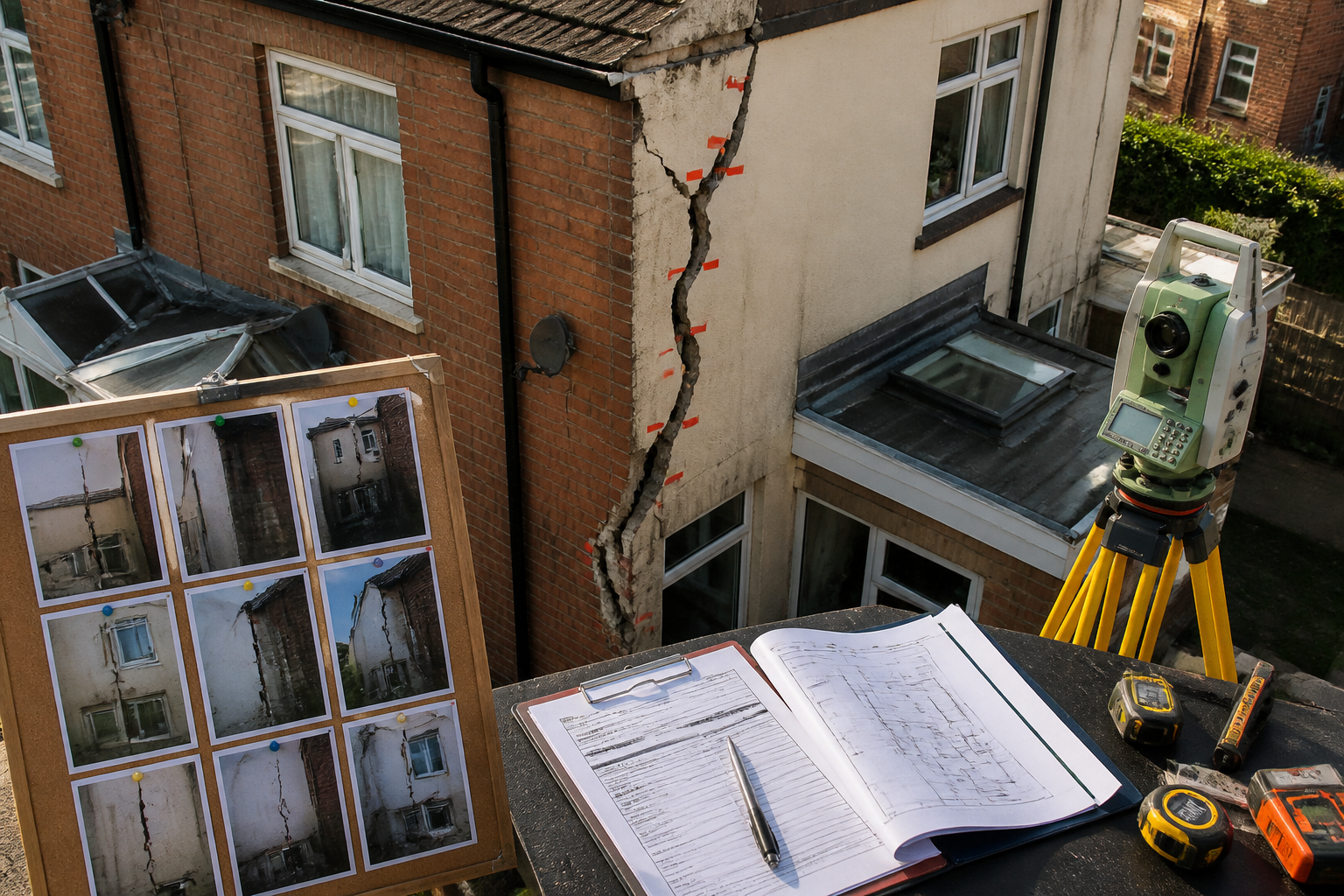
In a retrospective context, the Schedule of Condition is reconstructed from whatever evidence is available: pre-work photographs, contractor records, estate agent listings, Google Street View history, and witness statements. The absence of a proper pre-work condition survey is the single biggest weakness in retrospective cases — and the primary reason why damage to property in party wall situations is so difficult to resolve without professional help.
The Burden of Proof Reversal ⚖️
This is where the legal landscape becomes particularly significant for building owners who ignored the Act.
In the landmark case Roadrunner Properties Ltd v John Dean (2004), the court established a critical precedent: when a building owner has failed to comply with the Party Wall etc. Act, the burden of proof reverses. Instead of the affected neighbour having to prove that the works caused damage, the building owner must prove that their works did not cause the damage [2].
Courts in England and Wales take a consistently dim view of non-compliance, and judges regularly favour the affected neighbour when proper procedures have been ignored [2]. This makes retrospective agreements not just practically useful but strategically essential for building owners — settling through a formal award is almost always preferable to defending a court claim under reversed burden rules.
Client Recovery Strategies Within Party Wall Retrospective Agreements: Resolving Disputes After Works Complete
For Affected Neighbours: Protecting Your Position
If a neighbour has carried out works without serving proper notice and damage has occurred, the following recovery strategy applies in 2026:
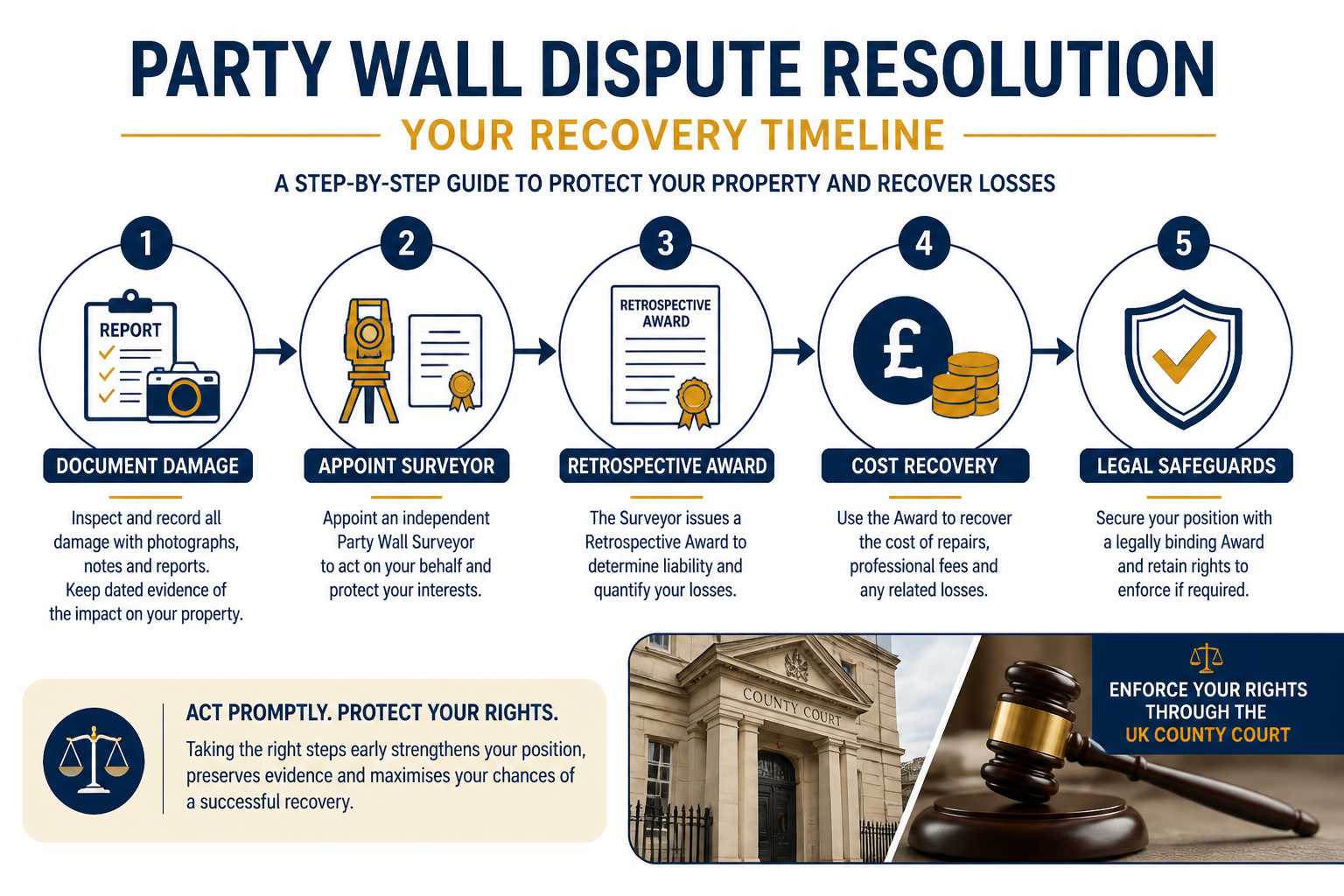
Step 1 — Document Everything Immediately
Take dated photographs of all cracks, settlement, or structural changes. Note the date works began and when damage first appeared. Even retrospective photographic evidence is valuable [1].
Step 2 — Do Not Agree Informally
Verbal assurances from a building owner or their contractor carry no legal weight. Insist on a formal surveyor appointment before agreeing to anything.
Step 3 — Appoint Your Own Surveyor
You are entitled to appoint your own party wall surveyor, whose reasonable fees the building owner is generally required to pay. For an overview of what this involves, see this complete guide to party wall surveyors' roles, costs, and legal requirements.
Step 4 — Pursue a Formal Award
Push for a retrospective Party Wall Award that documents the works, records existing damage, and sets out remediation obligations. This creates an enforceable legal instrument.
Step 5 — Consider Court Action If Necessary
If the building owner refuses to engage, legal remedies include injunctions (if any work remains), damages claims, and mandatory remediation orders. The reversed burden of proof significantly strengthens the affected neighbour's position [2].
For Building Owners: Minimising Liability Exposure
Building owners who have proceeded without notice face a more difficult position, but proactive steps can significantly reduce liability:
✅ Engage immediately and transparently — Attempting to conceal or minimise the situation invariably worsens legal outcomes
✅ Commission an independent condition survey now — Even retrospective surveys provide useful baseline data and demonstrate good faith
✅ Offer to fund the neighbour's surveyor — This is a legal obligation anyway, and doing so voluntarily signals cooperation
✅ Serve notice for any remaining works — If any notifiable work remains incomplete, proper notice can still be served [2]. This provides a partial legal reset and demonstrates compliance going forward
✅ Engage with the Party Wall Award process — A formal award, even retrospective, limits future claims by establishing an agreed record of conditions
For building owners concerned about costs, the party wall agreement cost breakdown provides useful context on what surveyor fees and award production typically involve.
What Happens When a Neighbour Refuses to Engage?
Sometimes the affected neighbour refuses to participate in a retrospective agreement — perhaps because they want to preserve their right to sue, or because trust has completely broken down. In this scenario:
- The building owner cannot force a retrospective agreement
- The affected neighbour retains their right to pursue civil claims for nuisance, negligence, or trespass
- The building owner should still commission their own independent condition survey to establish what damage existed before the works
If you are navigating a situation where a neighbour is refusing to cooperate, the guide on what happens when a neighbour legally refuses a party wall agreement covers the legal options in detail.
The Role of the Schedule of Condition in Retrospective Cases
The Schedule of Condition deserves special attention because it is the document that determines who wins and who loses in the vast majority of retrospective party wall disputes.
"Pre-work condition documentation is critical — homeowners should take dated pictures and have agreed written notes of any cracks, with copies for both parties." [1]
When no pre-work schedule exists, surveyors in retrospective cases must reconstruct baseline conditions using:
- Historical photographs from estate agent listings, Google Street View, or personal archives
- Building control records and structural engineer reports
- Witness statements from neighbours, contractors, or previous occupants
- Expert analysis of crack patterns to determine whether damage is fresh or longstanding
A retrospective schedule is inherently weaker than a contemporaneous one, but it is far better than nothing. The schedule of condition report service offered by qualified surveyors is specifically designed to capture property conditions in a legally defensible format — something that becomes invaluable in exactly these situations.
Costs, Timelines, and Practical Considerations in 2026
Typical Cost Breakdown
| Item | Estimated Cost (2026) |
|---|---|
| Agreed surveyor (retrospective award) | £800 – £1,500 |
| Each party's own surveyor | £700 – £1,200 per surveyor |
| Third surveyor (if required) | £500 – £900 per dispute |
| Retrospective condition survey | £400 – £800 |
| Legal advice (if court action considered) | £200 – £400/hour |
The building owner is generally liable for the reasonable surveyor fees of both parties. Costs escalate significantly when disputes become adversarial or when court proceedings are initiated.
Timeline Expectations
Retrospective agreements typically take 4 to 12 weeks to finalise, depending on:
- The complexity of the works carried out
- The degree of cooperation between parties
- Whether damage is disputed or agreed
- The availability of historical condition evidence
When to Seek Legal Advice
Solicitor involvement becomes necessary when:
- The building owner refuses to engage with the surveyor process
- Damage is substantial (typically above £5,000)
- There is a dispute about whether the Act applied to the works at all
- The affected neighbour is considering an injunction to halt remaining works
For complex party wall disputes, the comprehensive guide to party wall dispute resolution provides a detailed overview of all available resolution pathways.
Conclusion: Actionable Next Steps
Party wall retrospective agreements are not a perfect substitute for following the correct statutory process — but they are a vital tool for resolving real-world disputes after works have been completed. The key lessons for 2026 are clear:
For affected neighbours:
- Document damage immediately with dated photographs
- Appoint your own independent party wall surveyor without delay
- Insist on a formal retrospective Party Wall Award — do not accept verbal assurances
- Understand that the law is on your side: the burden of proof falls on the building owner who ignored the Act
For building owners:
- Engage proactively and transparently — delay makes everything worse
- Fund the neighbour's surveyor fees voluntarily to demonstrate good faith
- Serve proper notice for any remaining notifiable works immediately
- Commission an independent retrospective condition survey to limit future liability exposure
For both parties:
- Prioritise a formal surveyor-led process over informal negotiation
- Understand that courts take non-compliance seriously and will not look favourably on those who ignored the Act
- Consider mediation as a cost-effective alternative to litigation when both parties are willing to engage
The Party Wall etc. Act 1996 exists to protect everyone involved in construction near shared boundaries. When that process is bypassed, retrospective agreements — structured correctly by qualified, independent surveyors — remain the most effective mechanism for restoring fairness, limiting liability, and resolving disputes without the cost and uncertainty of court proceedings.
References
[1] Party Wall Agreement – https://hoa.org.uk/advice/guides-for-homeowners/i-am-improving/party-wall-agreement/
[2] My Neighbour Has Ignored The Party Wall Act – https://thesilverbrief.blog/2026/03/23/my-neighbour-has-ignored-the-party-wall-act/
[3] Party Wall Act Notices For Excavations Near Boundaries Serving Valid Notices To Avoid Injunctions In 2026 – https://nottinghillsurveyors.com/blog/party-wall-act-notices-for-excavations-near-boundaries-serving-valid-notices-to-avoid-injunctions-in-2026
