
Nearly 70% of party wall disputes that escalate into formal appeals could have been avoided with the right surveyor model chosen at the outset — yet most homeowners make this decision without fully understanding the financial and legal implications. The Agreed Surveyor vs. Two Surveyor Model: Cost-Benefit Analysis and When Each Approach Protects Your Interests in 2026 is not a minor procedural question. It directly shapes how much you pay, how quickly works proceed, and whether your legal rights are genuinely protected.
Under the Party Wall etc. Act 1996, when a building owner serves notice and the adjoining owner dissents, both parties must appoint surveyors. The law offers two routes: one jointly agreed surveyor, or two separately appointed surveyors. Each path carries distinct advantages, risks, and costs that every property owner in 2026 needs to understand before committing.
Key Takeaways 📌
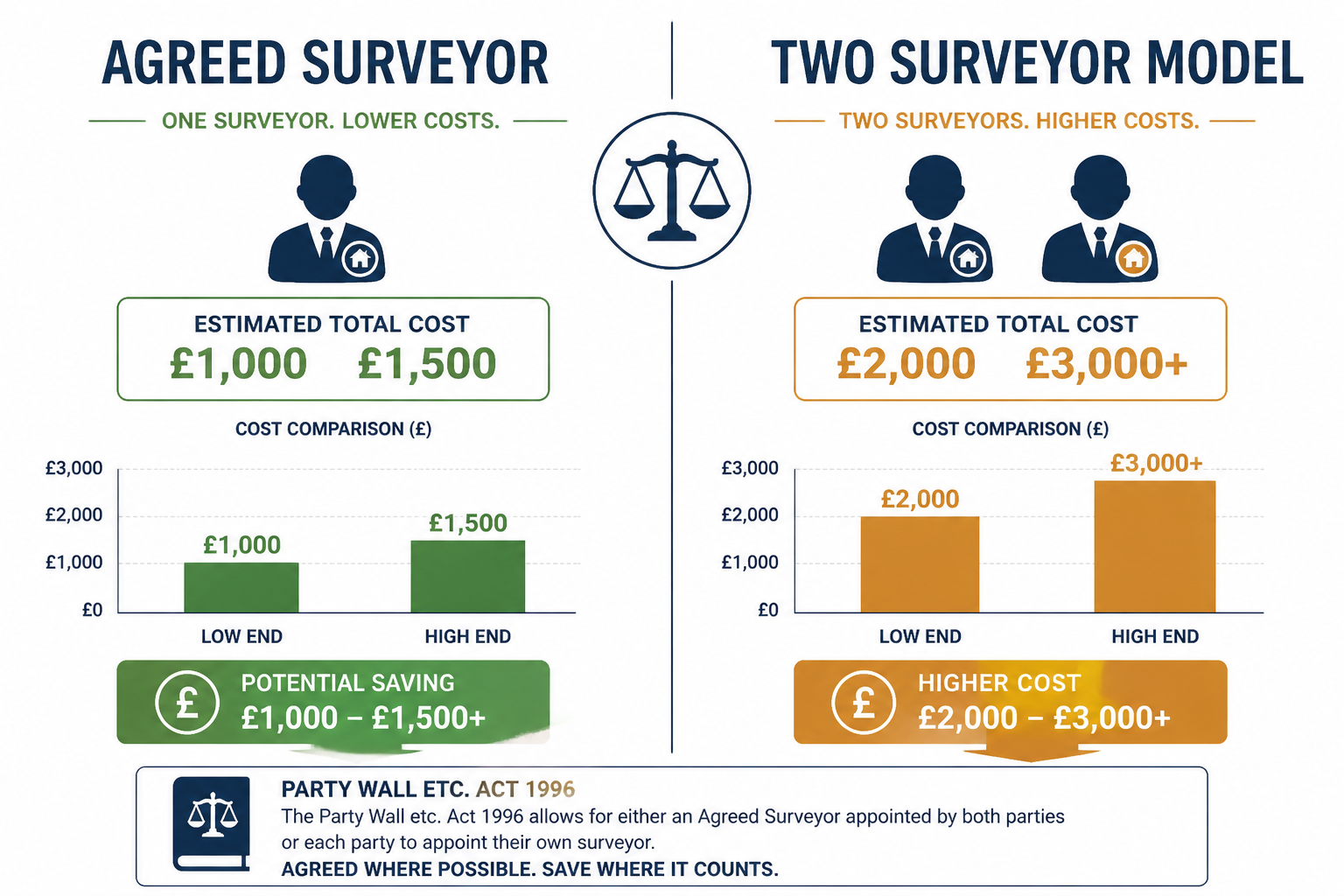
- Cost gap is significant: Two surveyors can cost two to three times more than a single agreed surveyor, with the building owner liable for all fees.
- Speed matters: An agreed surveyor typically resolves matters faster, with fewer communication layers and less back-and-forth.
- Adjoining owners hold the power: Only the adjoining owner can insist on a separate surveyor — the building owner cannot force an agreed appointment.
- Complex projects need separate surveyors: High-value or contentious works benefit from the independent oversight that two surveyors provide.
- Perception of bias is a real risk: Even when an agreed surveyor acts impartially, the appearance of bias can undermine trust and lead to appeals.
Understanding the Two Models: What the Party Wall Act Actually Allows
Before diving into costs and strategy, it helps to understand exactly what each model involves under UK law.
The Agreed Surveyor Model
An agreed surveyor is a single, jointly appointed professional who acts on behalf of both the building owner and the adjoining owner simultaneously. This surveyor prepares the party wall award, schedules the schedule of condition, and resolves any disagreements — all as a neutral party. [1]
Crucially, the agreed surveyor is not the building owner's surveyor wearing two hats. They must act with strict impartiality and neutrality, regardless of who is paying their fees. [2] For more on what this role entails day-to-day, see this complete guide to party wall surveyors' roles, costs, and legal requirements.
The Two Surveyor Model
Under the two surveyor model, each party appoints their own independent surveyor. The building owner's surveyor and the adjoining owner's surveyor then negotiate and agree the party wall award between them. If they cannot agree, a third surveyor — selected in advance by both appointed surveyors — makes the binding determination. [1]
This third surveyor mechanism is a critical safeguard that does not exist under the agreed surveyor model. It provides an additional layer of protection if the process breaks down.
Agreed Surveyor vs. Two Surveyor Model: Cost-Benefit Analysis and When Each Approach Protects Your Interests in 2026
💷 The Real Cost Comparison
Cost is often the deciding factor — and the numbers tell a clear story.
| Cost Element | Agreed Surveyor | Two Surveyor Model |
|---|---|---|
| Surveyor fees (typical range) | £1,000 – £1,500 | £2,000 – £3,500+ |
| Who pays? | Building owner | Building owner (both fees) |
| Third surveyor risk | None | Additional cost if invoked |
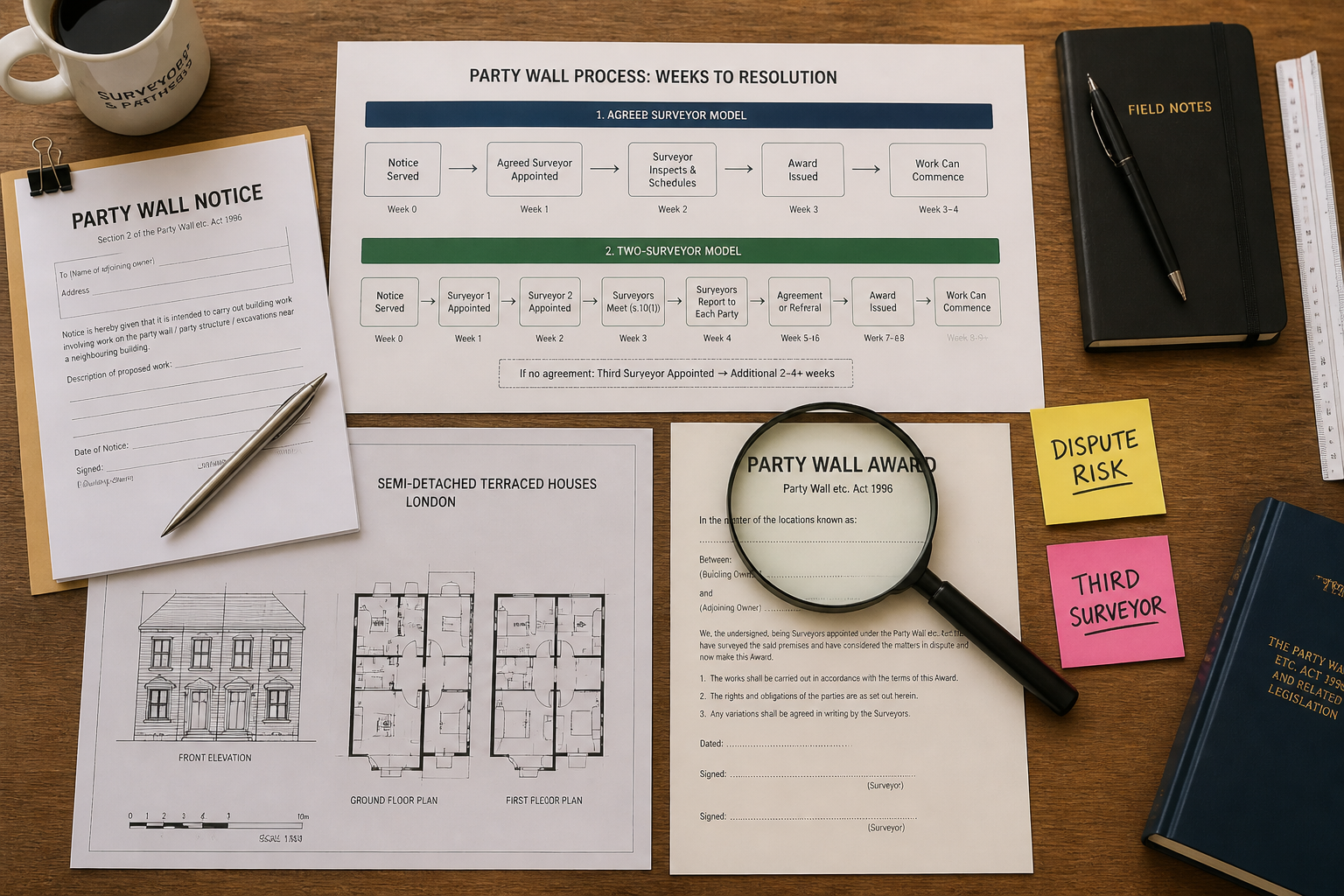
| Timeline (average) | 4–6 weeks | 6–12 weeks |
| Risk of appeals/revisions | Moderate | Lower (with proper representation) |
Appointing two surveyors can double or triple the overall costs compared to a single agreed surveyor. [3] The building owner remains liable for all surveyor costs under both models — including the adjoining owner's surveyor fees if separate appointments are made. [2]
For a detailed breakdown of what party wall surveyors charge and why, the 2024 party wall surveyor pricing guide provides useful benchmarks that remain largely applicable in 2026.
💡 Pull Quote: "The building owner pays all surveyor fees under both models. Choosing two surveyors isn't just about paying more — it's about deciding whether that extra cost buys meaningful protection."
⏱️ Timeline and Project Efficiency
Speed is a genuine advantage of the agreed surveyor model. A single surveyor eliminates the back-and-forth communication between two separate professionals, enabling faster decision-making and fewer delays. [1] When a loft conversion or basement excavation is already planned around a contractor's schedule, weeks of delay have real financial consequences.
The two surveyor model introduces more communication layers. Each surveyor must review, respond, and negotiate — a process that, on complex projects, can extend the award-making period significantly. [4]
⚖️ Dispute Resolution Effectiveness
Here is where the two models diverge most sharply in terms of risk profile.
Agreed surveyor strengths:
- Faster award production
- Lower cost to the building owner
- Demonstrates goodwill and cooperation between neighbours [3]
- Simpler process with fewer moving parts
Agreed surveyor weaknesses:
- No third surveyor safety net if the process breaks down [1]
- Higher risk of one party feeling their concerns were not heard [4]
- Perception of bias toward the building owner (who pays the fees) can undermine trust [2]
- Communication failures can escalate disagreements rather than resolve them [4]
Two surveyor model strengths:
- Each party has dedicated professional representation
- Third surveyor mechanism provides a binding backstop [1]
- Diverse expertise and perspectives on complex or unusual projects [1]
- Lower risk of award dissatisfaction and subsequent appeals [4]
Two surveyor model weaknesses:
- Significantly higher cost for the building owner
- Slower process with more potential for delay
- Requires both surveyors to communicate effectively — which is not guaranteed
Who Actually Controls This Decision?
This is a point many building owners misunderstand: the adjoining owner has the right to insist on separate surveyors. [2] The building owner cannot force an agreed appointment. If the adjoining owner dissents from a party wall notice and declines to agree to a single surveyor, the two surveyor model applies automatically.
This means the building owner's strategy should focus on making the agreed surveyor option attractive to the neighbour — not assuming it will be accepted.
Understanding who pays for a party wall surveyor and how to present this clearly to an adjoining owner can make a meaningful difference in gaining their agreement.
When Each Approach Genuinely Protects Your Interests
When the Agreed Surveyor Model Works Best ✅
The agreed surveyor approach is most effective when:
-
The relationship between neighbours is positive. Mutual trust is the foundation of a successful agreed appointment. When neighbours are on good terms, a single surveyor can work efficiently and produce an award both parties accept. [3]
-
The works are straightforward. Standard loft conversions, rear extensions, and chimney breast removals on well-documented Victorian terraces rarely require the complexity that two surveyors bring.
-
Speed is a priority. If the building owner has a contractor booked and a tight schedule, the agreed model's faster timeline is a genuine financial benefit.
-
Cost management is critical. For smaller projects where the total construction budget is modest, doubling surveyor fees can represent a disproportionate overhead.
-
Both parties are informed and engaged. An agreed surveyor works best when both the building owner and adjoining owner understand the process and are willing to participate constructively.
For context on what the party wall process involves from start to finish, this step-by-step guide to the party wall process is a useful reference.
When the Two Surveyor Model Protects You Better ✅
Separate surveyors are the stronger choice when:
-
The relationship with the neighbour is strained. If there is existing tension or a history of disputes, an agreed surveyor faces an almost impossible task. [4] Separate representation removes the perception of bias entirely.
-
The project is high-value or technically complex. Basement excavations, underpinning, or works close to a party wall's foundations benefit from two independent professional assessments. [1]
-
The adjoining owner is vulnerable or unfamiliar with the process. An elderly neighbour or a first-time homeowner may not fully understand what an agreed surveyor arrangement means for their rights. Separate representation ensures they are properly protected.
-
There is a specific concern about structural impact. Two surveyors bring diverse expertise and specialized insights that a single surveyor may not match on highly technical matters. [1]
-
The adjoining owner simply refuses to agree. In this case, the decision is made for both parties — and the building owner should focus on appointing a competent, experienced surveyor of their own.
⚠️ Important: Under the Party Wall Act, all surveyors — whether agreed or separately appointed — are legally required to act with strict impartiality. [2] However, the perception of bias can be just as damaging as actual bias, particularly when one party already feels anxious about the works.
For guidance on resolving situations where disputes have already arisen, this complete guide to resolving party wall disputes covers practical options.
The Agreed Surveyor vs. Two Surveyor Model: Strategic Considerations for 2026
The Bias Perception Problem
One of the most common reasons agreed surveyor arrangements fail is not actual misconduct — it is the perception of partiality. Because the building owner typically pays the agreed surveyor's fees, adjoining owners frequently worry that the surveyor's loyalties lie with the paying party. [2]
This concern is understandable even when unfounded. A skilled agreed surveyor will document their impartiality carefully, communicate equally with both parties, and produce an award that demonstrably protects both sets of interests. But if an adjoining owner enters the process already suspicious, the agreed model may create more conflict than it resolves. [4]
The Third Surveyor Safety Net
One structural disadvantage of the agreed model deserves emphasis: the absence of a third surveyor mechanism. [1]
Under the two surveyor model, if the two appointed surveyors cannot agree on a point, the pre-selected third surveyor makes a binding determination. This is a formal, legally recognised escalation route.
Under the agreed model, if the single surveyor's award is disputed, the only recourse is an appeal to the county court — a significantly more expensive and time-consuming process. This asymmetry in dispute resolution infrastructure is a genuine risk for both parties on complex projects.
Practical Tips for Building Owners in 2026 🏗️
- Propose the agreed model early and explain the cost savings clearly. Many adjoining owners agree once they understand the building owner bears all costs either way.
- Suggest a surveyor with a strong reputation for impartiality. A well-regarded name can overcome bias concerns.
- Be transparent about the works. Adjoining owners who feel informed are far more likely to trust a shared process.
- If the neighbour declines, accept it gracefully. Pushing back against a neighbour's right to separate representation creates ill-will that can complicate the entire project.
For situations where a party wall notice was not served correctly, understanding what happens when no party wall notice is served is essential reading before works begin.
A Note on Who Pays — and Why It Matters
The building owner's financial liability under both models is a point worth reiterating clearly. Whether one surveyor or two are appointed, the building owner pays. [2] This includes:
- Their own surveyor's fees (in the two surveyor model)
- The adjoining owner's surveyor's fees
- Any third surveyor fees if invoked
The agreed model saves money primarily by eliminating one set of fees — not by shifting liability. This is why the agreed model's cost advantage is real but should not be the sole deciding factor.
For a broader view of how party wall surveyor costs fit into overall property transaction costs, the party wall surveyor roles, responsibilities, and legal requirements guide provides helpful context.
Conclusion: Making the Right Choice for Your Project
The Agreed Surveyor vs. Two Surveyor Model: Cost-Benefit Analysis and When Each Approach Protects Your Interests in 2026 ultimately comes down to three variables: relationship quality, project complexity, and risk tolerance.
For straightforward works between cooperative neighbours, the agreed surveyor model offers genuine savings of £1,000 or more, faster timelines, and a simpler process that preserves goodwill. For complex, high-value, or contentious projects, the two surveyor model's independent representation, diverse expertise, and third surveyor safety net justify the higher cost.
✅ Actionable Next Steps
- Assess your relationship with your neighbour honestly before proposing an agreed surveyor.
- Get a cost estimate for both models from a qualified party wall surveyor before serving notice.
- Consult a chartered surveyor early — ideally before serving the party wall notice — to understand which model suits your specific project.
- If the adjoining owner insists on separate surveyors, appoint an experienced, specialist party wall surveyor to protect your interests effectively.
- Document everything — whichever model is chosen, clear written communication protects both parties throughout the process.
The right model is not always the cheapest one. It is the one that matches the real-world dynamics of your project and keeps both parties protected from start to finish.
References
[1] Exploring The Pros And Cons Of Agreed Surveyors Versus Separate Surveyors In Party Wall Disputes – https://www.partywalllondonlimited.com/post/exploring-the-pros-and-cons-of-agreed-surveyors-versus-separate-surveyors-in-party-wall-disputes
[2] Agreed Surveyor Vs Two Surveyor – https://stokemont.com/advice/agreed-surveyor-vs-two-surveyor/
[3] The Powerful Advantages Of Employing An Agreed Surveyor In Domestic Projects – https://www.tayross.com/blogs/the-powerful-advantages-of-employing-an-agreed-surveyor-in-domestic-projects
[4] The Failure Of The Agreed Surveyor Appointment – https://akt-surveyors.com/the-failure-of-the-agreed-surveyor-appointment/
