
By 2026, over 40% of new EV charger installations in England are expected to occur in terraced or semi-detached properties — precisely the housing stock where shared driveways, boundary walls, and party structures make every cable run a potential legal flashpoint. For homeowners and surveyors alike, Party Wall Surveys for EV Charging Infrastructure: RICS Protocols for Shared Access and Cost Apportionment in 2026 Terrace Developments have become one of the most pressing new frontiers in property law.
The UK government's 2030 EV adoption target is accelerating demand for home charging points at a pace that the Party Wall etc. Act 1996 was never designed to handle. When a cable must pass through a shared wall, or when a structural reinforcement is needed beneath a shared driveway, the legal and financial questions multiply fast. This article breaks down exactly what surveyors, homeowners, and developers need to know in 2026. [1]
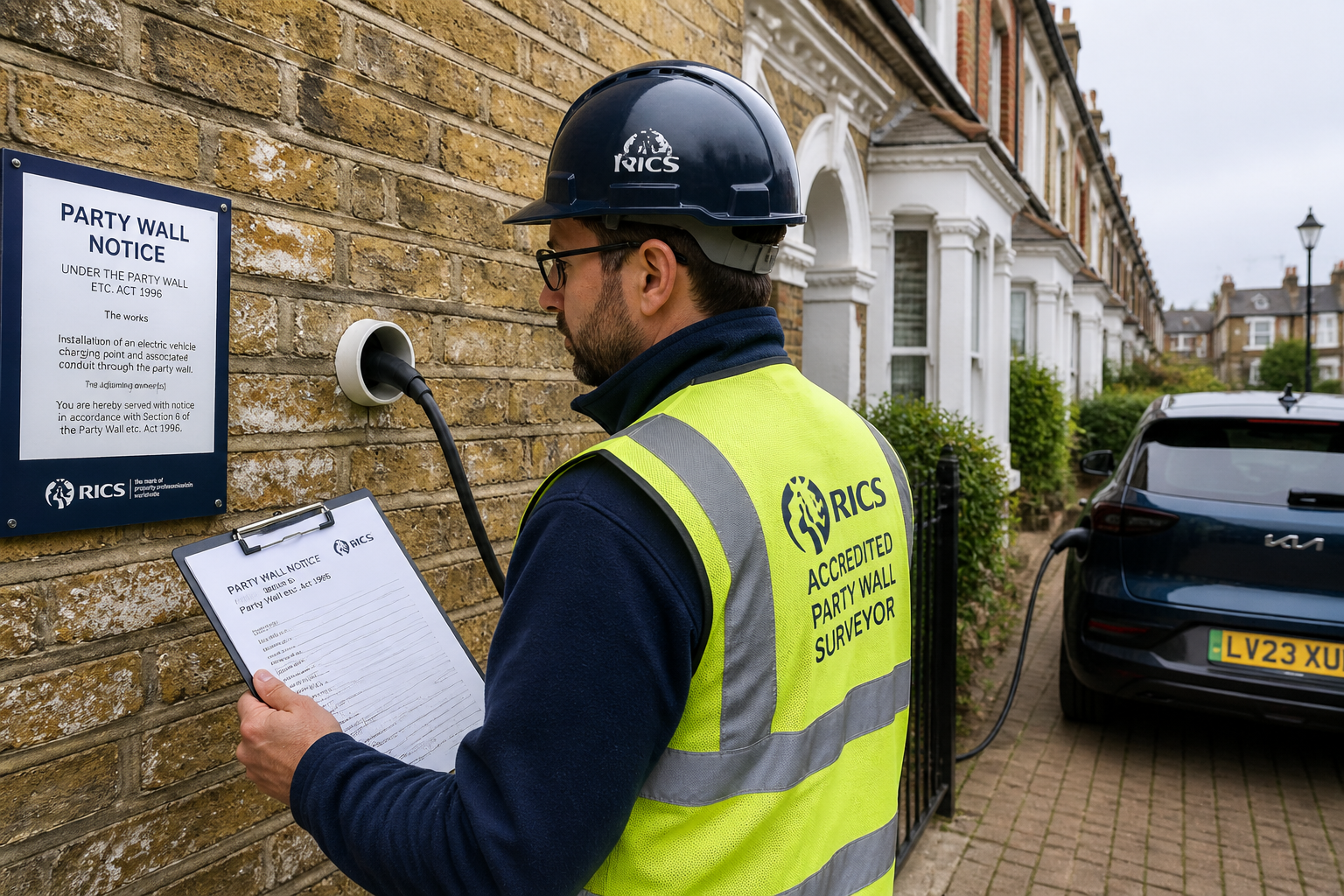
Key Takeaways 📋
- EV charger installations that affect party walls or shared structures require formal notice under the Party Wall etc. Act 1996 before any work begins.
- RICS protocols in 2026 provide updated guidance on how to draft Party Wall Awards that fairly allocate costs between adjoining owners for shared EV infrastructure.
- Cable routing through party walls is a notifiable act — ignoring this can expose building owners to injunctions and compensation claims.
- Cost apportionment disputes are the most common flashpoint; a well-drafted award can prevent them entirely.
- Shared driveway EV infrastructure requires a schedule of condition before works begin to protect all parties from spurious damage claims.
Why EV Charging and Party Walls Are Colliding in 2026
The collision between electric vehicle adoption and party wall legislation was, in hindsight, inevitable. Britain's terraced housing stock — much of it Victorian or Edwardian — was built long before anyone imagined a 7kW home charger bolted to a front wall. Yet in 2026, that is exactly the scenario playing out on millions of streets.
The core problem is structural and legal:
- Terraced houses share walls, foundations, and often driveways.
- Installing an EV charger frequently requires drilling through or attaching to a party wall.
- Running conduit beneath a shared driveway may disturb shared foundations or drainage.
- Load-bearing implications arise when cable trays or trunking are fixed to party structures. [5]
💡 Pull Quote: "A cable run that takes a contractor two hours to install can take a party wall surveyor two months to resolve if the correct notices were never served."
The EV charging sector is maturing rapidly, with standardised practices and dedicated circuits now the norm for residential installations [3]. But standardisation in the electrical trade does not automatically translate to compliance with property law. That gap is where disputes — and the need for expert party wall surveying — emerge.
To understand the foundational legal framework, it helps to start with a comprehensive guide to the Party Wall Act for UK homeowners, which sets out when and how the Act applies to works affecting shared structures.
Understanding the Legal Trigger Points for EV Charging Works
Not every EV charger installation triggers the Party Wall etc. Act 1996. The key question is whether the proposed works affect a party structure — defined as a wall, floor, or other structure shared between two properties.
When a Party Wall Notice IS Required
| Scenario | Notice Required? | Notice Type |
|---|---|---|
| Drilling through a shared wall to route cable | ✅ Yes | Party Structure Notice |
| Fixing cable tray to a party wall surface | ✅ Yes | Party Structure Notice |
| Excavating beneath a shared driveway for conduit | ✅ Yes | Line of Junction / Section 6 Notice |
| Reinforcing a party wall to support charging equipment | ✅ Yes | Party Structure Notice |
| Installing a charger on an external non-shared wall | ❌ No | Not required |
| Surface-mounted charger on owner's sole wall | ❌ No | Not required |
For a detailed breakdown of when formal notice obligations arise, the complete guide to party structure notices is an essential reference.
The Three-Metre Rule and EV Excavations
Section 6 of the Act applies when excavations are planned within three metres of an adjoining owner's building and to a depth lower than the neighbour's foundations. Trenching for underground EV cable conduit in a shared driveway can easily fall within this zone. Understanding the 3-metre rule is therefore critical for any surveyor advising on EV infrastructure projects in terrace settings.
RICS Protocols for Shared Access and Cost Apportionment in 2026 Terrace Developments
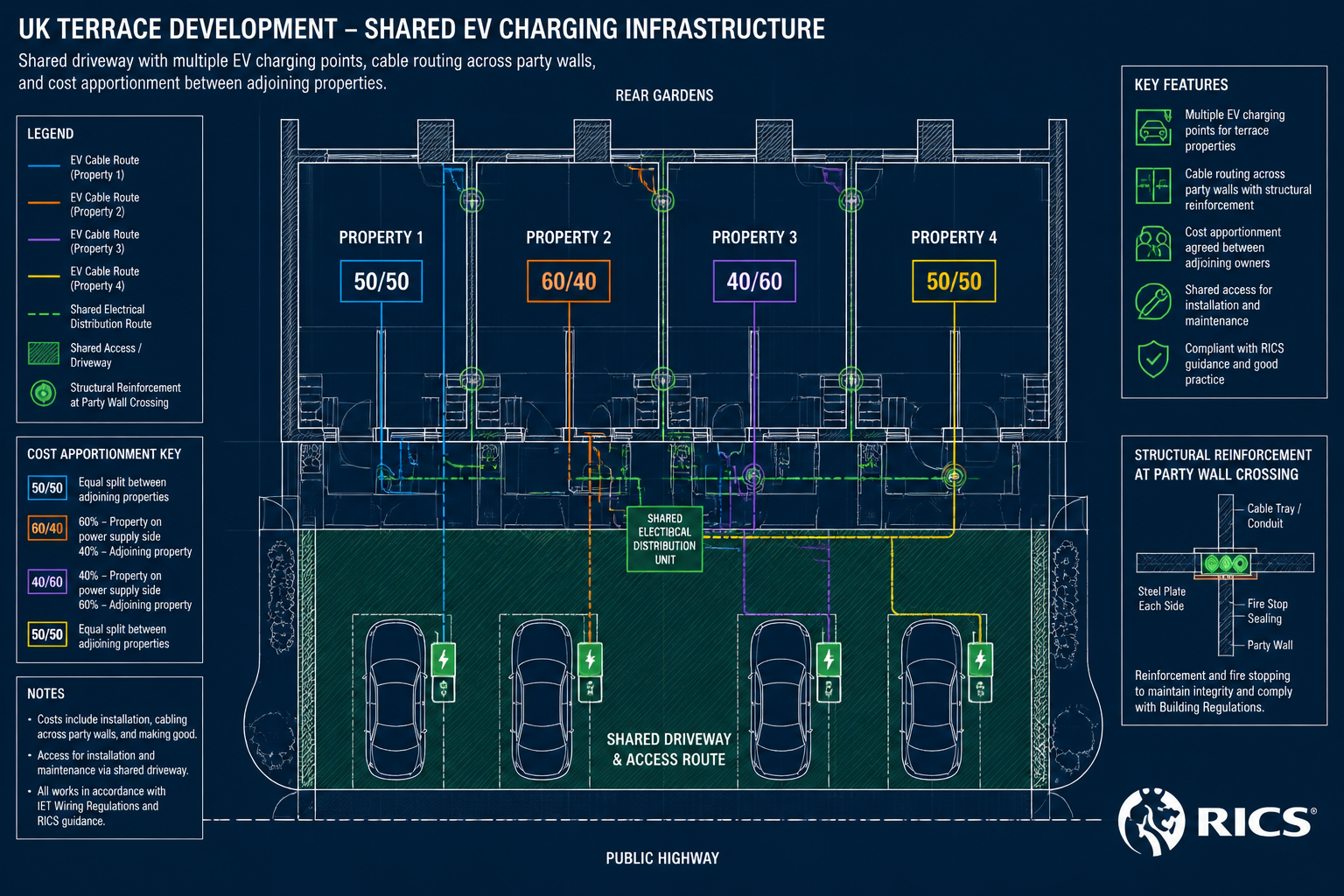
This is where Party Wall Surveys for EV Charging Infrastructure: RICS Protocols for Shared Access and Cost Apportionment in 2026 Terrace Developments become most technically demanding. The Royal Institution of Chartered Surveyors has, through its ongoing professional guidance and training programmes, sharpened expectations for how surveyors handle the intersection of green technology and party wall law. [6]
RICS Guidance on Cost Allocation
The foundational principle under the Party Wall etc. Act 1996 is that the building owner who initiates the works bears the cost — unless the works also benefit the adjoining owner, in which case costs may be shared proportionately.
For EV charging infrastructure, this creates several distinct scenarios:
Scenario A: Single-Owner Benefit
One homeowner wants to route a cable through the party wall to reach their side of the driveway. The adjoining owner derives no benefit. Cost: 100% borne by the building owner.
Scenario B: Shared Infrastructure
Both owners agree to install a shared EV charging hub on the party driveway, served by a single cable run through the party wall. Cost: Apportioned by agreement, typically 50/50 or weighted by usage capacity.
Scenario C: Structural Reinforcement Required
The party wall needs reinforcement before the cable tray can be safely fixed. The reinforcement benefits both properties. Cost: Shared proportionately, as determined by the surveyor(s).
🔑 Key Principle: RICS guidance emphasises that cost apportionment must be documented explicitly in the Party Wall Award — vague references to "shared costs" are insufficient and routinely lead to post-completion disputes.
Drafting the Party Wall Award for EV Installations
A well-drafted Party Wall Award for EV charging works in 2026 should include:
- Precise description of works — cable specification, conduit diameter, fixing method, depth of any excavation.
- Schedule of Condition — photographic and written record of the party wall and driveway before works begin.
- Cost apportionment table — itemised breakdown of each cost element and the percentage borne by each party.
- Access provisions — times and methods for the contractor to access shared areas.
- Reinstatement obligations — who is responsible for making good any damage to shared surfaces.
- Future access rights — provisions for maintenance or upgrading of the charging infrastructure.
For guidance on the structure and legal weight of these documents, the Party Wall Award guidance resource provides a practical framework.
The Role of the Schedule of Condition
Before any EV charging works begin on or near a party structure, a Schedule of Condition is essential. This document records the existing state of the wall, driveway, and any adjacent structures. If damage occurs during cable installation — cracked render, disturbed pointing, subsidence in the driveway surface — the schedule provides an objective baseline for assessing liability.
In 2026, with EV installations happening at pace and contractors sometimes prioritising speed over care, this protection is more important than ever. [1]
Navigating Shared Driveway Disputes: Practical Award Drafting Strategies
Shared driveways are the most contested territory in EV charging party wall disputes. Unlike a wall that clearly belongs to one owner or is shared equally, driveway ownership is often ambiguous — sometimes held jointly, sometimes as a right of way over one owner's land.
Establishing Ownership Before Serving Notice
Before any notice is served, the surveyor must establish:
- Who owns the driveway surface? (Check title deeds and Land Registry entries)
- Are there existing easements or rights of way?
- Is the driveway subject to a shared maintenance agreement?
Ambiguity here does not excuse inaction. If works are planned and ownership is unclear, notices should be served on all potentially affected parties as a precaution. Understanding when a party wall agreement is needed can help homeowners and surveyors determine the correct threshold for action.
Common Dispute Scenarios and Resolution Approaches
🔴 Dispute: "Your cable damages my driveway surface"
Resolution: A pre-works Schedule of Condition, combined with a clear reinstatement clause in the Award, removes ambiguity. The Award should specify the exact reinstatement standard (e.g., "matching block paving to be relaid within 14 days of cable installation").
🟡 Dispute: "I don't want a cable running through my wall"
Resolution: The adjoining owner cannot unreasonably withhold consent to notifiable works. However, they are entitled to appoint their own surveyor. A qualified party wall surveyor can negotiate conditions — such as requiring armoured conduit or specific fixing methods — that protect the adjoining owner's interests without blocking the works entirely.
🟢 Dispute: "Who pays for the electrical upgrade to the shared supply?"
Resolution: Where a shared electrical supply requires upgrading to support EV charging loads, RICS guidance points to proportionate cost-sharing based on each owner's anticipated draw on the upgraded capacity. This must be explicitly documented in the Award.
💡 Pull Quote: "In 2026, the most effective party wall awards for EV infrastructure are those that anticipate future upgrades — not just the installation being planned today."
Load Balancing and Structural Implications
Commercial-grade EV infrastructure planning requires dedicated circuits, load balancing, and compliance with electrical codes [5]. In a terrace development, this can mean significant electrical upgrades to a shared supply point. When those upgrades involve works to a party wall or shared structure, the party wall process must run in parallel with the electrical planning process — not after it.
Surveyors advising on these projects in 2026 should coordinate closely with the electrical engineer to ensure that the structural implications of load-balancing equipment (which can be heavy and vibration-generating) are fully assessed before the Award is finalised.
Step-by-Step: The Party Wall Process for EV Charging in 2026
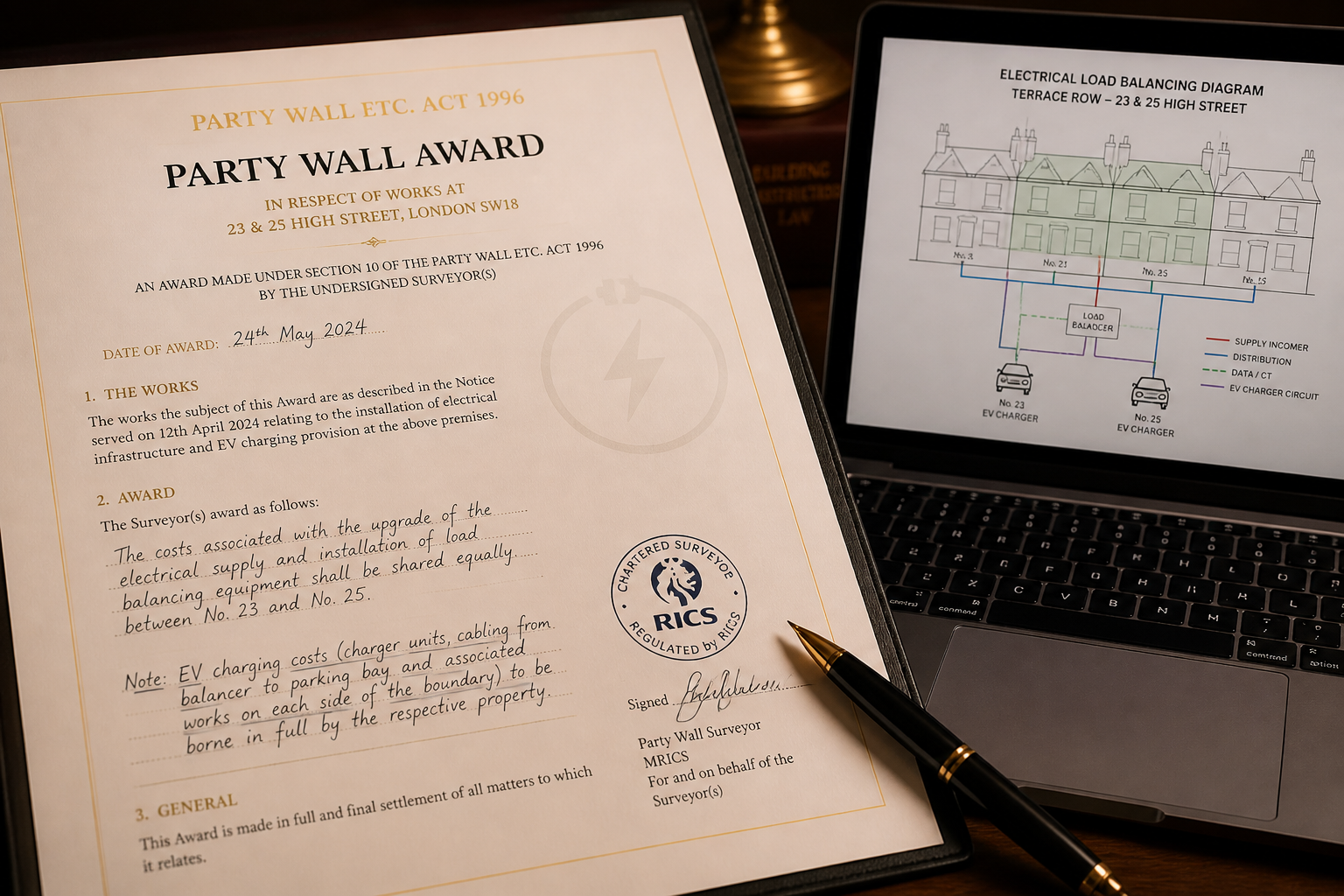
Understanding Party Wall Surveys for EV Charging Infrastructure: RICS Protocols for Shared Access and Cost Apportionment in 2026 Terrace Developments is most useful when translated into a clear process. Here is how it works in practice:
Step 1: Pre-Application Assessment
- Obtain electrical engineer's cable routing plan.
- Identify all party structures affected.
- Check title deeds for driveway ownership and easements.
Step 2: Serve the Correct Notice(s)
- Party Structure Notice for works to a shared wall (minimum 2 months before works begin).
- Section 6 Notice for excavations near adjoining foundations (minimum 1 month before works begin).
- Notices must be in writing and served on all adjoining owners. For a step-by-step guide to the party wall process, this resource covers the full timeline.
Step 3: Await Consent or Dissent
- Adjoining owner has 14 days to respond.
- Consent: Works can proceed (though a Schedule of Condition is still advisable).
- Dissent or no response: A dispute is deemed to have arisen; surveyors must be appointed.
Step 4: Surveyor Appointment and Award Drafting
- Each party appoints a surveyor (or agrees on a single Agreed Surveyor).
- Surveyors inspect, assess, and draft the Party Wall Award.
- Award includes all cost apportionment provisions for the EV installation.
Step 5: Works and Post-Completion
- Works proceed in accordance with the Award.
- Post-completion inspection confirms reinstatement obligations have been met.
- Award remains enforceable if disputes arise later.
Avoiding the Most Costly Mistakes in 2026 EV Party Wall Cases
The EV charging trajectory in 2026 remains dynamic, with regulatory and infrastructure uncertainties still playing out [4]. Against that backdrop, the following mistakes are proving most expensive for homeowners and developers:
❌ Failing to serve notice at all — assuming a small cable run doesn't count. It does, if it passes through a party wall.
❌ Serving notice too late — starting works before the statutory notice period expires exposes the building owner to injunctions.
❌ Vague Award language — "costs to be shared" without a specific breakdown invites post-completion litigation.
❌ No Schedule of Condition — without a baseline record, any pre-existing crack or surface defect becomes a disputed liability.
❌ Ignoring future upgrade provisions — EV technology is evolving rapidly [2]. An Award that only covers today's 7kW charger may need revisiting when an owner upgrades to a 22kW unit.
For situations where works have already begun without the correct agreements in place, the guidance on proceeding without a party wall agreement outlines the risks and remedies available.
Conclusion: Actionable Next Steps for Surveyors and Homeowners
The intersection of EV charging infrastructure and party wall law is one of the defining surveying challenges of 2026. The good news is that the legal framework — the Party Wall etc. Act 1996, supported by evolving RICS protocols — is entirely capable of handling these situations when applied correctly and proactively.
Here are the key actionable steps:
- ✅ Homeowners planning EV charger installations should consult a RICS-accredited party wall surveyor before appointing an electrician, not after.
- ✅ Surveyors should update their Award templates to include EV-specific provisions: load specifications, future upgrade rights, and detailed cost apportionment tables.
- ✅ Developers of terrace schemes should build party wall notice timelines into their EV infrastructure project plans from day one.
- ✅ All parties should insist on a Schedule of Condition before any works affecting a shared driveway or party wall begin.
- ✅ Adjoining owners should not simply ignore notices — engaging a surveyor early protects their interests and often results in better outcomes than passive resistance.
The 2030 EV target is not moving. The party wall framework is not going away. The surveyors and homeowners who understand how these two worlds interact will navigate 2026 and beyond with far fewer disputes — and far lower costs.
References
[1] Party Wall Implications Of Rics Sustainability Report 2025 Survey Protocols For Net Zero Boundary Works In 2026 – https://nottinghillsurveyors.com/blog/party-wall-implications-of-rics-sustainability-report-2025-survey-protocols-for-net-zero-boundary-works-in-2026
[2] What We Learned At Evcs 2026 From Buildout To Execution – https://www.myeva.org/blog/what-we-learned-at-evcs-2026-from-buildout-to-execution
[3] What It Takes For Cpos To Scale Ev Charging In 2026 – https://driivz.com/blog/what-it-takes-for-cpos-to-scale-ev-charging-in-2026/
[4] Ev Charging Trajectory Uncertain In 2026 – https://ieci.org/ev-charging-trajectory-uncertain-in-2026/
[5] Planning Ev Charger Installations For 2026 What Commercial Properties Should Prepare Now – https://amtekconstruction.com/planning-ev-charger-installations-for-2026-what-commercial-properties-should-prepare-now/
[6] Scheduled – https://www.rics.org/training-events/online-training/scheduled
