
{"cover":"Professional landscape format (1536×1024) hero image featuring bold text overlay 'Expert Witness Challenges in 2026 Interest Rate Volatility Disputes: RICS Data-Driven Preparation' in extra large 72pt white sans-serif font with dark shadow and semi-transparent navy overlay box, positioned in upper third center. Background shows sophisticated courtroom setting with modern digital screens displaying fluctuating interest rate graphs, financial charts with volatility indicators, and RICS professional standards documentation. Foreground includes professional expert witness in business attire reviewing data on tablet, with gavel and legal documents visible. Color scheme: deep navy blue, gold accents, white text, professional burgundy highlights. High contrast, editorial magazine cover quality, authoritative legal-financial aesthetic with depth of field effect.","content":["Detailed landscape format (1536×1024) image showing close-up of expert witness preparation workspace with multiple data sources spread across modern desk. Central focus on large monitor displaying RICS valuation standards documentation alongside dual screens showing historical interest rate volatility charts from 2020-2026 with marked peaks and troughs. Foreground includes printed property valuation reports with highlighted sections, calculator, professional notepad with handwritten case preparation notes, RICS accreditation certificate on wall. Background shows bookshelf with legal reference materials and property law texts. Warm professional lighting, shallow depth of field, business editorial style with rich colors – mahogany desk, cream documents, blue-green chart lines, gold RICS branding elements visible.","Detailed landscape format (1536×1024) infographic-style image illustrating data-driven methodologies for interest rate dispute cases. Split-screen composition: left side shows three-dimensional bar chart comparing property valuations under different interest rate scenarios (2%, 4%, 6% rates) with color-coded columns in navy, gold, and burgundy. Right side displays flowchart diagram of RICS expert witness preparation process with connected nodes showing stages: Initial Assessment, Data Collection, Market Analysis, Report Preparation, Court Presentation. Center includes magnifying glass hovering over specific data point with callout boxes showing key metrics. Clean professional design with white background, subtle grid lines, professional typography, icons representing documents, graphs, and legal scales. Modern business intelligence aesthetic.","Detailed landscape format (1536×1024) image depicting modern courtroom testimony scenario with expert witness presenting evidence. Wide-angle view showing professional surveyor standing beside large presentation screen displaying interactive property valuation model with interest rate sensitivity analysis. Screen shows split comparison of property values with sliding interest rate scale, heat maps indicating market volatility zones, and RICS methodology framework diagram. Foreground includes judge's bench with gavel, legal team reviewing documents on tablets, courtroom gallery in soft focus. Professional lighting emphasizing presentation screen and expert witness. Color palette: judicial wood tones, navy blue professional attire, white presentation backgrounds, gold accent lighting. Authoritative, contemporary legal setting with technology integration, editorial photography style with balanced composition."]
The courtroom falls silent as the expert witness takes the stand. In 2026, property disputes involving interest rate volatility have become increasingly complex, demanding unprecedented levels of data sophistication and professional rigor. As interest rates continue their unpredictable trajectory following years of economic uncertainty, Expert Witness Challenges in 2026 Interest Rate Volatility Disputes: RICS Data-Driven Preparation has emerged as a critical competency for surveyors and valuation professionals navigating litigation.
The landscape of expert witness testimony has transformed dramatically. With RICS launching its 5th edition of professional standards for surveyors acting as expert witnesses in August 2025—the first major update since 2014—professionals face heightened expectations for independence, data integrity, and technological competence. This comprehensive guide explores how RICS-accredited experts can leverage data-driven methodologies to navigate the turbulent waters of interest rate volatility disputes while maintaining the highest professional standards.
Key Takeaways
- RICS standards update: The 5th edition emphasizes expert witnesses' primary duty to the tribunal, not the client, with enhanced guidance on professional independence and conflict disclosure
- Data-driven preparation: Successful expert testimony in 2026 requires sophisticated analysis of historical interest rate patterns, market volatility indicators, and property valuation sensitivity models
- Technology integration: Modern expert witnesses must demonstrate competence with AI tools, digital evidence presentation, and real-time data validation while maintaining professional judgment
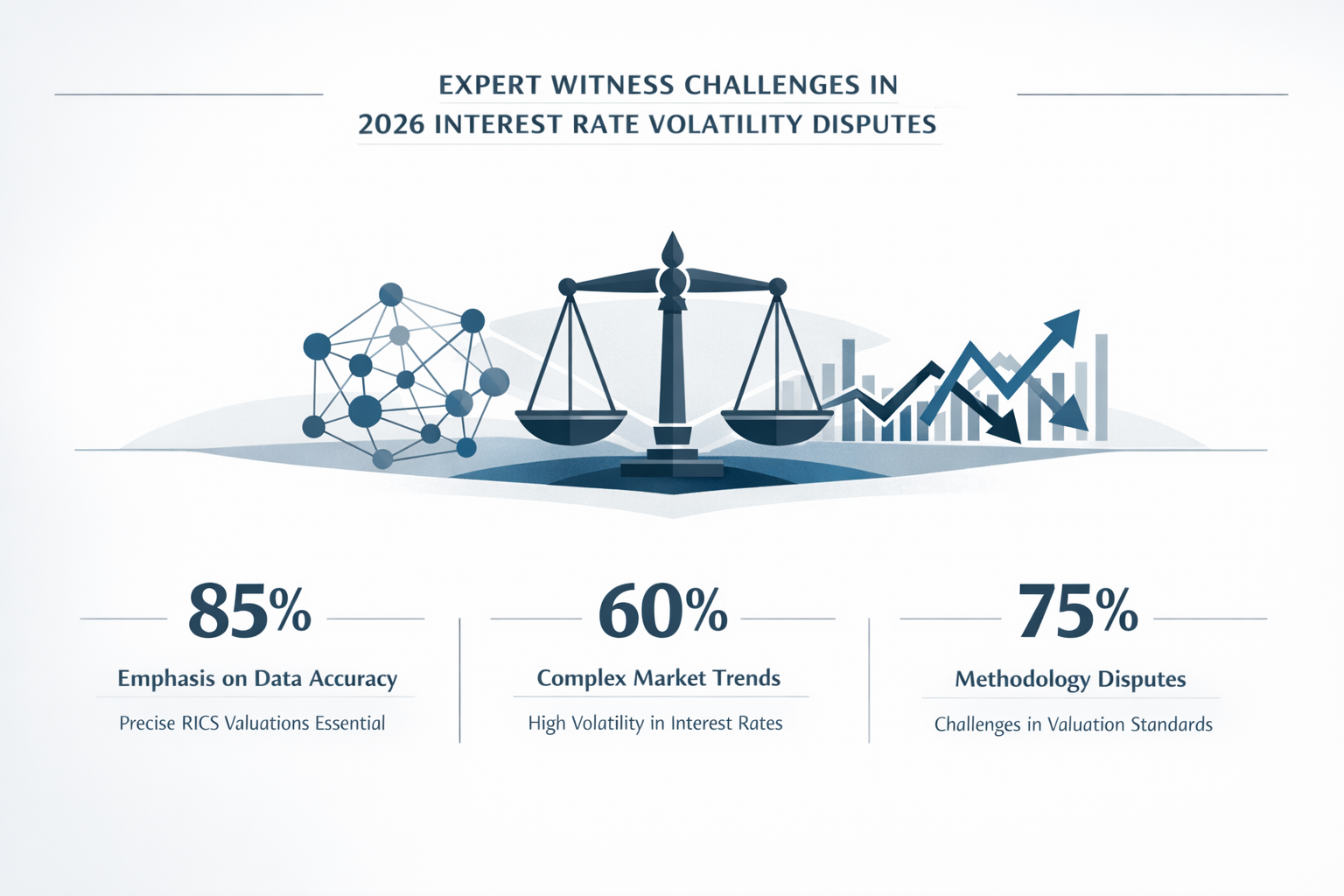
- Rigorous accreditation: RICS Expert Witness Accreditation maintains approximately 75% pass rates, reflecting the elevated standards required for 2026 practice
- Global application: Updated standards apply worldwide while recognizing local legal differences, ensuring consistent professional principles across jurisdictions
Understanding Expert Witness Challenges in 2026 Interest Rate Volatility Disputes: RICS Data-Driven Preparation
The Evolving Role of Expert Witnesses in Property Disputes
The role of expert witnesses in property-related litigation has undergone significant transformation in 2026. Unlike traditional advocacy roles, expert witnesses serve as impartial advisors to the court, providing objective analysis based on specialized knowledge. This distinction becomes particularly crucial in interest rate volatility disputes, where emotional stakes run high and financial implications can reach millions of pounds.
RICS professionals acting as expert witnesses must navigate several competing pressures:
- Client expectations versus tribunal obligations
- Complex financial data requiring clear, accessible explanation
- Rapidly changing market conditions affecting property valuations
- Technological evidence requiring both technical and interpretive skills
- Cross-examination pressures testing methodology and conclusions
The updated RICS standards explicitly address these tensions by reinforcing that an expert's primary duty is to the tribunal, not to the instructing party. This fundamental principle underpins all aspects of Expert Witness Challenges in 2026 Interest Rate Volatility Disputes: RICS Data-Driven Preparation.
Interest Rate Volatility: The 2026 Context
Interest rate movements in 2026 continue to create significant challenges for property valuations. Following years of unprecedented monetary policy interventions, market participants face:
📊 Key volatility indicators:
- Quarterly rate adjustments exceeding 50 basis points
- Divergent central bank policies across major economies
- Inflation uncertainty affecting long-term rate projections
- Commercial property yield compression and expansion cycles
- Residential mortgage market disruptions
These factors directly impact property disputes in several ways:
| Dispute Type | Interest Rate Impact | Expert Witness Challenge |
|---|---|---|
| Lease renewals | Capitalization rate disputes | Justifying yield assumptions in volatile markets |
| Matrimonial valuations | Property value fluctuations | Selecting appropriate valuation dates |
| Compulsory purchase | Discount rate selection | Defending methodology against alternative approaches |
| Partnership dissolutions | Asset valuation timing | Accounting for market movements during proceedings |
| Development disputes | Financing cost assumptions | Projecting future rate scenarios |
For professionals handling commercial valuation or matrimonial valuation work, understanding these dynamics has become essential to credible expert testimony.
RICS Professional Standards: The 5th Edition Framework
The August 2025 launch of the 5th edition consultation for "Surveyors acting as expert witnesses" represents the most significant update to professional standards in over a decade. Key enhancements directly address Expert Witness Challenges in 2026 Interest Rate Volatility Disputes: RICS Data-Driven Preparation:
🎯 Enhanced Independence Requirements:
- Clear guidance on conditional and deferred fee arrangements
- Explicit prohibition on outcome-contingent compensation
- Strengthened conflict of interest identification protocols
- Independence declaration requirements in all reports
💡 Modern Practice Integration:
- Guidance on appropriate AI tool usage in analysis
- Digital evidence handling and authentication standards
- Remote testimony protocols and technology requirements
- Data security and confidentiality in digital environments
🌍 Global Application Framework:
- Worldwide applicability with local legal system recognition
- Jurisdiction-specific adaptation guidance
- International best practice benchmarking
- Cross-border dispute considerations
These updates reflect RICS's recognition that expert witnesses must maintain professional credibility while adapting to technological advancement and increasingly sophisticated legal challenges.
Data-Driven Methodologies for Interest Rate Dispute Preparation
Building a Robust Analytical Framework
Successful expert witness preparation in 2026 interest rate volatility disputes requires systematic data collection and analysis. The foundation begins with establishing a comprehensive analytical framework that withstands cross-examination scrutiny.
Essential data sources include:
- Historical interest rate data (minimum 10-year lookback)
- Property transaction evidence with rate-adjusted comparables
- Market sentiment indicators from lender surveys
- Economic forecasts from credible institutions
- Sector-specific yield data relevant to the property type
When preparing for disputes involving properties requiring detailed analysis, such as those assessed through RICS HomebuYer surveys or building surveys, experts must demonstrate how interest rate movements affect valuation assumptions.
Quantitative Analysis Techniques
Modern expert witnesses must employ sophisticated quantitative methods to demonstrate the relationship between interest rate volatility and property values. Key analytical approaches include:
Sensitivity Analysis:
- Model property values across multiple rate scenarios
- Demonstrate valuation range under different assumptions
- Identify critical rate thresholds affecting conclusions
- Present results in accessible visual formats
Comparative Market Analysis:
- Identify comparable transactions during similar rate environments
- Adjust for timing differences using appropriate indices
- Account for market psychology during volatile periods
- Document adjustment methodology transparently
Discounted Cash Flow Modeling:
- Project income streams under various rate scenarios
- Apply appropriate discount rates with clear justification
- Conduct scenario testing for optimistic/pessimistic cases
- Demonstrate model sensitivity to key assumptions
Professional Insight: "The most persuasive expert testimony doesn't just present conclusions—it demonstrates the analytical journey from raw data to reasoned opinion, making complex financial relationships accessible to non-specialist tribunal members."
Leveraging RICS Valuation Standards
RICS valuation standards provide the professional framework for credible expert testimony. The recent updates to bank lending valuation guidance, effective January 1, 2026, reflect Basel 3.1 framework changes that directly impact how experts approach interest rate considerations in property valuations.
Key RICS principles for expert witnesses:
✅ Transparency: Document all assumptions, limitations, and uncertainties
✅ Objectivity: Separate factual observations from professional opinions
✅ Competence: Only accept instructions within areas of genuine expertise
✅ Diligence: Conduct thorough research and verification of data sources
✅ Independence: Maintain professional distance from litigation outcomes
Professionals working with RICS registered valuers benefit from established methodologies that courts recognize and respect, strengthening the credibility of expert testimony.
Practical Preparation Strategies for Expert Witness Challenges in 2026 Interest Rate Volatility Disputes: RICS Data-Driven Preparation

Report Writing Excellence
The expert witness report serves as the foundation for testimony credibility. In 2026, courts expect reports that balance technical rigor with accessibility, particularly when addressing complex interest rate volatility issues.
Essential report components:
1. Executive Summary 📋
- Clear statement of instructions received
- Concise summary of conclusions (2-3 paragraphs maximum)
- Key assumptions highlighted upfront
- Scope limitations explicitly stated
2. Methodology Section 🔬
- Detailed explanation of analytical approach
- Data sources with verification methods
- Alternative methodologies considered and rejected
- Compliance with RICS standards referenced
3. Analysis and Findings 📊
- Systematic presentation of evidence
- Clear linkage between data and conclusions
- Visual aids supporting complex concepts
- Sensitivity analysis demonstrating robustness
4. Professional Declaration ⚖️
- Confirmation of duty to tribunal
- Independence statement
- Qualifications and experience summary
- Conflict of interest disclosure
When dealing with specialized property types requiring detailed assessment, such as those involving party wall disputes or lease extension valuations, experts must adapt their reporting style while maintaining these core elements.
Preparing for Cross-Examination
Cross-examination represents the ultimate test of expert witness credibility. Attorneys challenging expert testimony in interest rate volatility disputes typically employ several strategies:
Common challenge tactics:
- Assumption attacks: Questioning the reasonableness of rate projections
- Methodology disputes: Proposing alternative analytical approaches
- Data source credibility: Challenging the reliability of market evidence
- Timing issues: Highlighting market changes since valuation date
- Qualification challenges: Testing the boundaries of expertise
Effective preparation strategies:
🛡️ Anticipate weaknesses: Identify vulnerable aspects of your analysis before opposing counsel does
🛡️ Know your data intimately: Be prepared to cite specific sources, dates, and figures without reference to notes
🛡️ Practice clear explanations: Develop analogies and simple language for complex financial concepts
🛡️ Maintain composure: Respond to aggressive questioning with professional calm and measured responses
🛡️ Acknowledge limitations: Demonstrate intellectual honesty by admitting uncertainty where appropriate
Technology Integration and Digital Evidence
The 2026 expert witness landscape demands technological competence alongside traditional analytical skills. RICS's updated standards explicitly address modern practice integration, including AI tools and digital evidence handling.
Technology considerations for expert witnesses:
AI and Machine Learning Tools:
- Use for data pattern recognition and preliminary analysis
- Maintain human oversight and professional judgment
- Document AI tool usage transparently in reports
- Be prepared to explain AI-generated insights in non-technical language
Digital Evidence Presentation:
- Interactive valuation models for courtroom demonstration
- Real-time sensitivity analysis during testimony
- Secure data sharing platforms for confidential information
- Video testimony capabilities for remote proceedings
Data Verification and Authentication:
- Blockchain-verified transaction records
- Digital audit trails for data sources
- Secure timestamping of market evidence
- Electronic signature authentication for expert reports
Professionals conducting specialized assessments such as monitoring surveys or subsidence surveys increasingly rely on digital tools for data collection and analysis, making technological competence essential for expert credibility.
Case Study Preparation Framework
Developing a systematic approach to case preparation ensures comprehensive coverage of Expert Witness Challenges in 2026 Interest Rate Volatility Disputes: RICS Data-Driven Preparation:
Phase 1: Initial Assessment (Weeks 1-2)
- Review instructions and identify key issues
- Conduct conflict checks and independence assessment
- Gather preliminary market data and rate history
- Establish timeline and deliverable milestones
Phase 2: Data Collection (Weeks 3-4)
- Compile comprehensive transaction evidence
- Obtain historical interest rate data across relevant periods
- Interview market participants if appropriate
- Document all data sources with verification
Phase 3: Analysis (Weeks 5-6)
- Conduct primary valuation analysis
- Perform sensitivity testing across rate scenarios
- Develop alternative scenarios and stress tests
- Prepare preliminary findings and identify gaps
Phase 4: Report Drafting (Weeks 7-8)
- Write comprehensive expert report
- Create supporting visual aids and exhibits
- Conduct internal peer review
- Finalize report with all required declarations
Phase 5: Testimony Preparation (Weeks 9-10)
- Review opposing expert reports if available
- Identify areas of agreement and disagreement
- Prepare responses to anticipated challenges
- Conduct mock cross-examination practice
This structured approach ensures thorough preparation while maintaining the flexibility to adapt to case-specific requirements, whether dealing with Right to Buy valuations or complex commercial property disputes.
Maintaining Professional Standards and Accreditation
RICS Expert Witness Accreditation
The RICS Expert Witness Accreditation Service maintains rigorous standards, with pass rates hovering around 75% in 2026. This selective accreditation process ensures that only qualified professionals represent RICS standards in litigation contexts.
Accreditation requirements include:
- Demonstrated expertise in relevant property sectors
- Litigation experience with documented case involvement
- Report writing proficiency meeting RICS standards
- Oral testimony skills tested through practical assessment
- Continuing professional development in expert witness practice
Maintaining accreditation requires ongoing engagement with professional development, staying current with evolving standards, and demonstrating consistent high-quality work across multiple cases.
Ethical Considerations in Volatile Markets
Interest rate volatility creates unique ethical challenges for expert witnesses. The temptation to favor instructing clients' positions can be subtle but significant when market conditions create genuine uncertainty about appropriate valuation approaches.
Key ethical principles:
💼 Independence over advocacy: Resist pressure to adjust conclusions to support desired outcomes
💼 Transparency about uncertainty: Clearly communicate limitations and alternative viewpoints
💼 Objective data interpretation: Let evidence drive conclusions rather than reverse-engineering analysis
💼 Professional skepticism: Question assumptions even when they favor your instructing party
💼 Collegial respect: Treat opposing experts professionally even during vigorous disagreement
These principles align with the updated RICS standards' emphasis on tribunal duty over client loyalty, reinforcing the expert witness role as an aid to justice rather than an advocate for a party.
Continuous Professional Development
The rapidly evolving landscape of Expert Witness Challenges in 2026 Interest Rate Volatility Disputes: RICS Data-Driven Preparation demands ongoing professional development. Successful expert witnesses invest in:
Technical skills enhancement:
- Advanced financial modeling techniques
- Statistical analysis and econometric methods
- Data visualization and presentation skills
- Emerging technology applications in valuation
Legal knowledge updates:
- Changes in evidence rules and procedures
- Jurisdiction-specific expert witness requirements
- Case law developments affecting expert testimony
- Professional liability and insurance considerations
Soft skills development:
- Public speaking and courtroom presence
- Clear communication of complex concepts
- Stress management during cross-examination
- Professional networking with legal practitioners
Organizations offering valuation services increasingly recognize that expert witness capability requires distinct skills beyond standard valuation competence, justifying dedicated training investment.
Emerging Trends and Future Considerations
Artificial Intelligence and Expert Testimony
The integration of AI tools in expert witness practice presents both opportunities and challenges. While AI can enhance data analysis efficiency and pattern recognition, courts remain cautious about AI-generated opinions without human professional judgment.
Best practices for AI integration:
🤖 Use AI for data processing and preliminary analysis, not final conclusions
🤖 Maintain detailed documentation of AI tool methodology and limitations
🤖 Be prepared to explain AI-generated insights in accessible language
🤖 Apply professional skepticism to AI outputs, verifying key findings independently
🤖 Disclose AI usage transparently in expert reports and testimony
Climate Change and Long-Term Rate Projections
The intersection of climate risk and interest rate volatility creates additional complexity for expert witnesses in 2026. Properties with climate exposure may face different financing costs and valuation approaches, requiring experts to integrate environmental risk factors into interest rate sensitivity analysis.
Regulatory Evolution
The Basel 3.1 framework changes affecting bank lending valuations represent just one example of ongoing regulatory evolution. Expert witnesses must stay current with regulatory developments across multiple domains:
- Financial services regulation affecting lending practices
- Property market regulation influencing transaction structures
- Professional standards updates from RICS and other bodies
- Legal precedent developments shaping expert witness requirements
Professionals handling specialized work such as ATED valuations or non-domicile tax valuations must integrate these regulatory considerations into their expert witness practice.
Conclusion
Expert Witness Challenges in 2026 Interest Rate Volatility Disputes: RICS Data-Driven Preparation represents a critical competency for surveying professionals navigating today's complex litigation landscape. The convergence of unprecedented interest rate volatility, enhanced RICS professional standards, and technological advancement demands a sophisticated, data-driven approach to expert witness practice.
Success in this demanding role requires:
✅ Unwavering commitment to professional independence and tribunal duty
✅ Rigorous analytical methodologies supported by comprehensive data
✅ Clear communication skills translating complex financial concepts for non-specialists
✅ Technological competence balanced with professional judgment
✅ Continuous professional development maintaining currency with evolving standards
The updated RICS standards provide a robust framework for professional practice, emphasizing the fundamental principle that expert witnesses serve the court, not the instructing party. This clarity of purpose, combined with sophisticated data analysis and transparent methodology, positions RICS-accredited experts to provide invaluable assistance in resolving property disputes affected by interest rate volatility.
Actionable Next Steps
For professionals seeking to enhance their expert witness capabilities in interest rate volatility disputes:
- Review the 5th edition RICS standards thoroughly and assess current practice against updated requirements
- Invest in advanced data analysis training focusing on financial modeling and sensitivity analysis
- Develop technology competencies including AI tools, digital evidence handling, and remote testimony platforms
- Build a comprehensive data library of historical interest rate information and property market evidence
- Seek mentorship from experienced expert witnesses who have successfully navigated complex interest rate disputes
- Consider RICS Expert Witness Accreditation to demonstrate professional competence and commitment to standards
- Engage in mock testimony practice to refine communication skills and cross-examination resilience
Whether handling rent review disputes, dilapidations surveys, or complex commercial valuations, the principles of data-driven preparation and professional independence remain constant. By embracing these standards and continuously developing expertise, RICS professionals can provide the high-quality expert testimony that courts require and clients deserve in 2026's challenging interest rate environment.
