
Do I Need a Survey on a New Build? Everything You Need to Know in 2026
Buying a brand-new home feels like purchasing a car straight from the factory—pristine, untouched, and covered by warranty. But here’s the uncomfortable truth that catches thousands of homebuyers off guard each year: new builds can harbor serious defects that won’t be discovered until you’ve already moved in. The question “do I need a survey on a new build” is one that property buyers ask with increasing frequency, and the answer might surprise you. While many assume that new construction comes with automatic quality assurance, the reality is far more complex—and potentially costly.
In 2026, with updated land survey standards and evolving construction practices, understanding whether you need a survey on your new build property has become more important than ever. This comprehensive guide will walk you through everything you need to know about surveys for new construction, helping you make an informed decision that could save you thousands of pounds in future repairs.
Key Takeaways
- New build warranties don’t replace professional surveys – NHBC and similar warranties have significant limitations and exclusions that leave many defects uncovered
- Lenders rarely require surveys for new builds – but this doesn’t mean they’re unnecessary; it simply shifts the risk entirely to you as the buyer
- Snagging surveys differ from structural surveys – understanding the types of surveys available helps you choose the right protection level
- Hidden defects are common in new builds – from poor drainage to structural issues, problems often emerge after the warranty period expires
- Professional surveys provide negotiating power – discovering issues before completion gives you leverage to request repairs or price reductions
Understanding New Build Properties and Survey Requirements
What Qualifies as a New Build?
A new build property is typically defined as a home that has never been previously occupied and is being sold by a developer or builder. In the UK property market, this classification usually applies to homes completed within the past two years, though the exact definition can vary depending on your lender and the warranty provider.
New builds come in several forms:
- Newly constructed homes on greenfield or brownfield sites
- Converted properties that have been substantially rebuilt
- Off-plan purchases where you buy before construction completes
- Show homes that developers sell after using them for marketing
Each type presents unique considerations when determining whether you need a survey on a new build.
The Common Misconception About New Build Quality
Many buyers operate under the assumption that new builds are automatically superior to older properties. After all, they’re built to modern standards, incorporate the latest building regulations, and come with warranties. However, this assumption can be dangerously misleading.
The reality is that new builds face their own set of challenges:
🏗️ Rushed construction timelines – Developers often work under tight deadlines to meet sales targets, which can compromise quality
⚠️ Inexperienced subcontractors – The construction boom has led to workforce shortages, sometimes resulting in less experienced tradespeople
📋 Cosmetic focus – Show homes are designed to look perfect, but this doesn’t guarantee quality in the structural elements you can’t see
💰 Profit margins – Developers may cut corners on materials or workmanship to maximize returns
According to recent industry reports, snagging issues affect the vast majority of new builds, with the average property having between 100-200 defects at completion.
Do I Need a Survey on a New Build? The Essential Factors
Warranty Coverage: What’s Actually Protected?
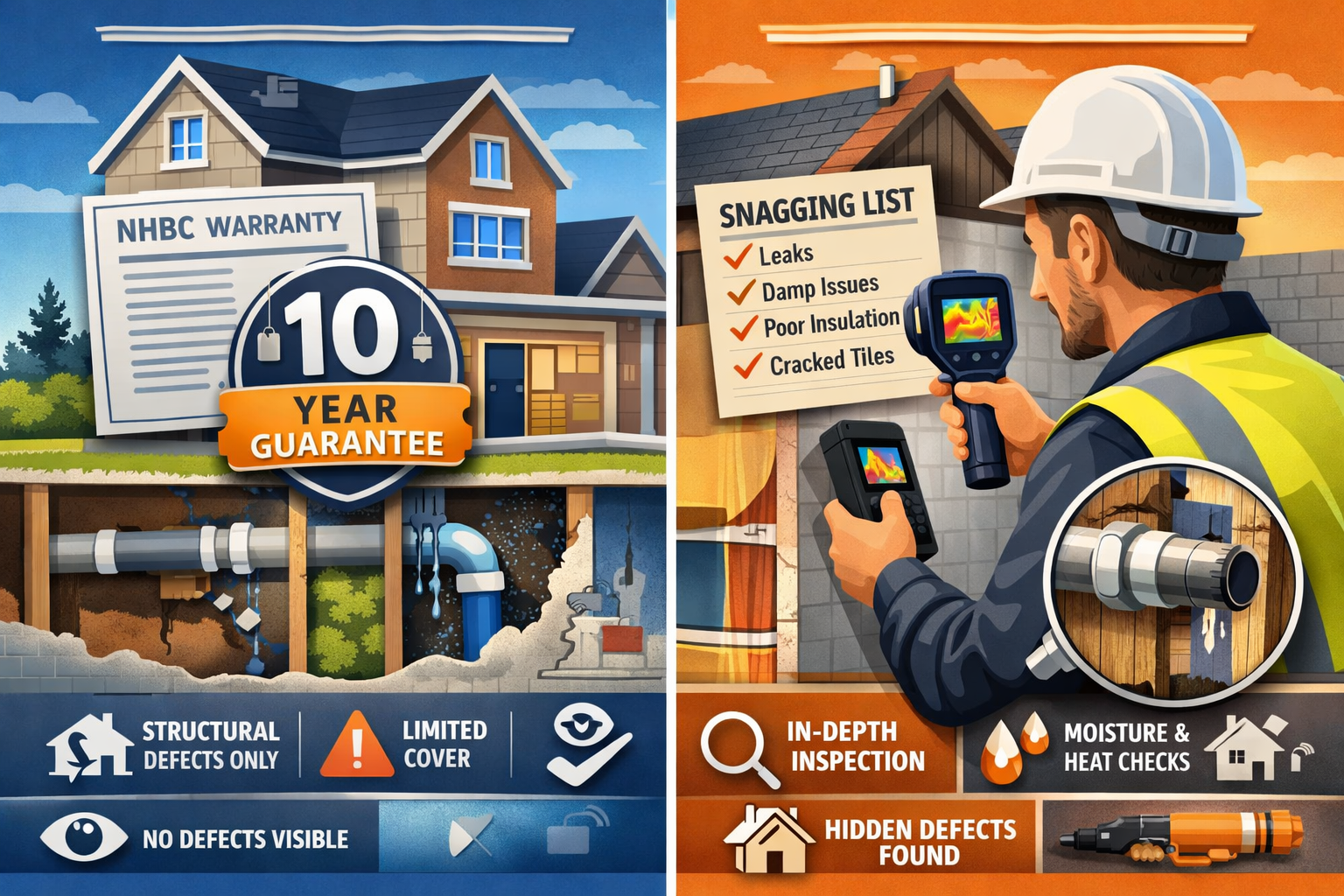
Most new builds in the UK come with a 10-year NHBC (National House Building Council) warranty or equivalent protection from providers like Premier Guarantee or LABC Warranty. While these warranties sound comprehensive, understanding their limitations is crucial when deciding if you need a survey on a new build.
NHBC Warranty Structure:
| Period | Coverage | Limitations |
|---|---|---|
| Years 1-2 | Builder’s defects liability | Builder must still be trading; cosmetic issues often excluded |
| Years 3-10 | Structural defects only | High threshold for claims; many issues don’t qualify as “structural” |
| Throughout | Legal protection | Only if builder becomes insolvent |
Common exclusions that warranties don’t cover include:
- Minor cracking in walls or ceilings
- Poor workmanship that doesn’t affect structural integrity
- Drainage issues outside the building footprint
- Landscaping and external works
- Appliances and fixtures
- Issues caused by “normal wear and tear”
This is where professional building surveys become invaluable. A qualified surveyor can identify problems that fall outside warranty coverage but could still cost you significant money to repair.
Lender Requirements and Title Company Policies
One reason many buyers skip surveys on new builds is that mortgage lenders rarely require them. Unlike purchases of older properties where lenders typically mandate at least a basic valuation, new builds often receive automatic approval based on the developer’s reputation and warranty coverage.
However, this doesn’t mean surveys are unnecessary—it simply means the lender has shifted the risk to you.
What lenders actually check:
- ✅ Property valuation (to ensure it’s worth the loan amount)
- ✅ Valid warranty certificate (NHBC or equivalent)
- ✅ Building regulations compliance certificate
- ✅ Energy Performance Certificate (EPC)
What lenders don’t check:
- ❌ Quality of workmanship
- ❌ Hidden defects behind finished surfaces
- ❌ Compliance with planning permissions
- ❌ Drainage and foundation adequacy
- ❌ Future maintenance issues
The 2026 updates to ALTA/NSPS land title survey standards have introduced new requirements for commercial properties, but residential new builds remain largely unaffected by mandatory survey requirements [1][2]. This means the decision to commission a survey rests entirely with you as the buyer.
Builder Obligations vs. Owner Responsibilities
Understanding where the builder’s obligations end and your responsibilities begin is essential when considering whether you need a survey on a new build.
Builder’s Legal Obligations:
- Comply with building regulations and planning permissions
- Provide structural warranty (typically NHBC or equivalent)
- Complete the property to a reasonable standard
- Address defects during the initial warranty period (usually 2 years)
Your Responsibilities:
- Identify and report defects promptly
- Maintain the property appropriately
- Prove that defects are builder-related, not wear and tear
- Bear the cost of any issues outside warranty coverage
The challenge is that proving a defect is the builder’s fault can be extremely difficult without professional documentation. This is where a pre-completion survey becomes your insurance policy. Having a qualified surveyor document issues before you take ownership creates an indisputable record that can be used to hold builders accountable.
Types of Surveys Available for New Build Properties
Snagging Surveys: The New Build Specialist
A snagging survey is specifically designed for new build properties and focuses on identifying cosmetic and minor defects before you complete the purchase. Think of it as a detailed quality control inspection.
What a snagging survey covers:
- Paintwork quality and finish
- Alignment of doors and windows
- Flooring installation
- Kitchen and bathroom fitting
- Plasterwork and tiling
- External finishes and guttering
- Minor plumbing and electrical issues
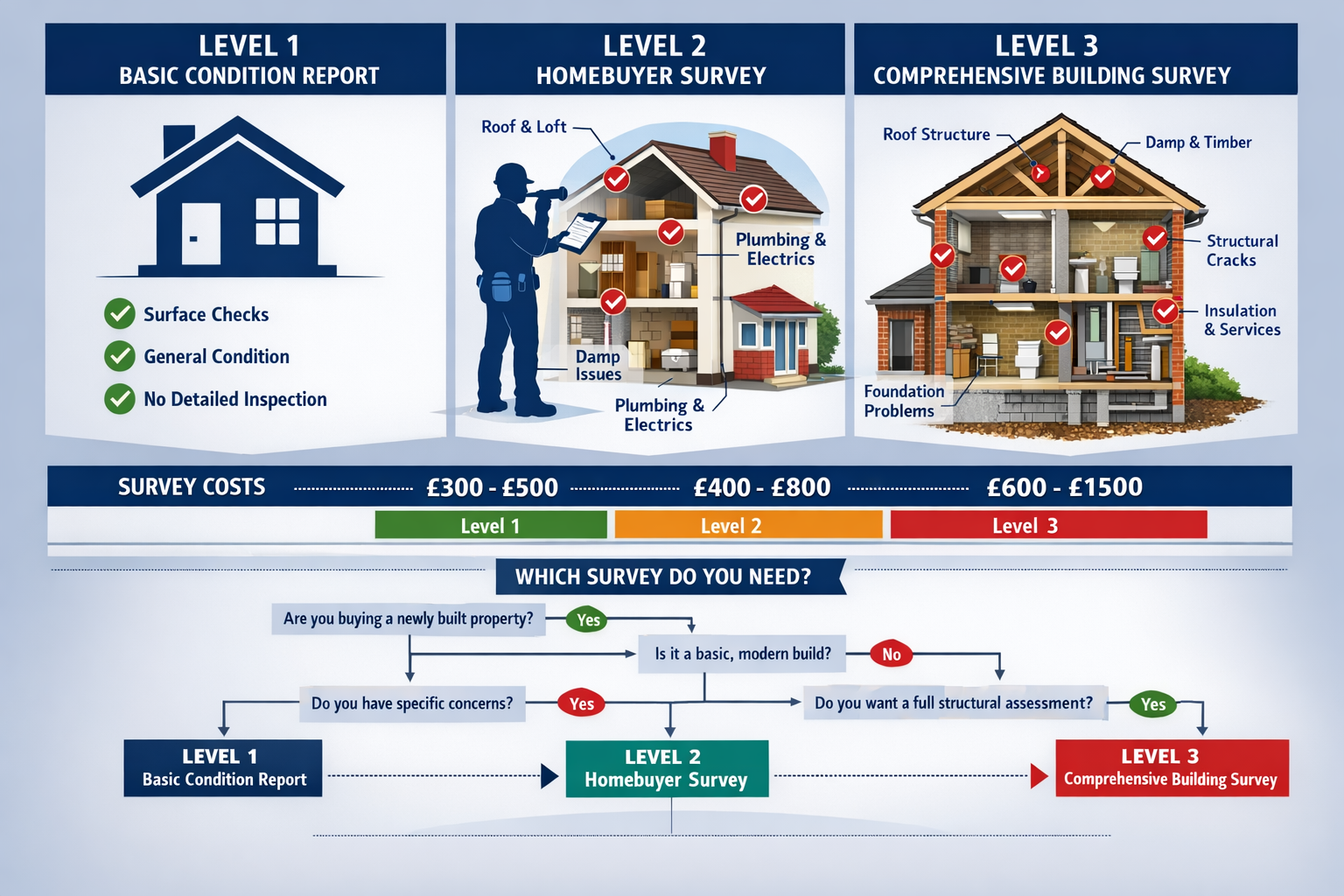
Typical cost: £300-£600 depending on property size
Snagging surveys are valuable for creating a comprehensive list of defects that the builder should rectify before handover. However, they have significant limitations—they don’t examine structural elements, hidden systems, or long-term durability issues.
Homebuyer Reports for New Construction
A homebuyer survey (also known as a Level 2 survey) offers more comprehensive coverage than a snagging inspection. While traditionally used for older properties, these surveys can be adapted for new builds to provide greater peace of mind.
What a Level 2 survey includes:
- 🏠 Overall condition assessment
- 🔍 Identification of urgent defects
- ⚠️ Potential problems requiring further investigation
- 📊 Market valuation
- 💷 Insurance rebuild costs
Typical cost: £400-£800
For most new build buyers, a Level 2 survey strikes the right balance between thoroughness and cost. It’s particularly valuable if you’re purchasing a property that’s been completed for several months or if you’re buying a show home that’s been used for viewings.
Full Structural Surveys (Level 3): Maximum Protection
For buyers who want the most comprehensive protection, a Level 3 building survey provides the deepest level of inspection available. While this might seem excessive for a brand-new property, there are situations where it’s absolutely justified.
When to consider a Level 3 survey for a new build:
- Properties built using non-standard construction methods
- Conversions of existing buildings
- New builds on problematic land (former industrial sites, flood plains)
- High-value properties where the investment warrants maximum protection
- Properties where you’ve noticed concerning signs during viewings
What Level 3 surveys examine:
- Detailed structural analysis
- Roof space and foundations (where accessible)
- Drainage systems
- Damp and moisture issues
- Building services (heating, plumbing, electrical)
- Compliance with building regulations
- Future maintenance requirements
Typical cost: £800-£1,500+
A comprehensive Level 3 building survey provides the most thorough assessment and is particularly valuable for complex new build projects.
The Hidden Risks of Skipping a Survey on New Builds
Common Defects Found in New Construction
Despite modern building standards, new builds frequently harbor defects that only become apparent after you’ve moved in. Understanding these common issues helps answer the question “do I need a survey on a new build” with greater clarity.
Top 10 Most Common New Build Defects:
- Poor drainage and water management – Inadequate site drainage leading to flooding or damp
- Structural movement – Settlement cracks exceeding normal tolerances
- Roof defects – Poor flashing, inadequate ventilation, or substandard materials
- Plumbing issues – Leaks, poor connections, or inadequate water pressure
- Electrical problems – Incorrect wiring, insufficient outlets, or non-compliant installations
- Window and door problems – Poor sealing, misalignment, or inadequate security
- Heating system failures – Undersized boilers or poorly designed heating zones
- Insulation deficiencies – Gaps in insulation causing heat loss and condensation
- External works – Poor paving, inadequate boundaries, or drainage issues
- Finishing defects – Cosmetic issues that indicate rushed workmanship
Real-world example: A 2025 study found that 68% of new build buyers discovered at least one significant defect within the first year of ownership, with 23% facing repair costs exceeding £5,000.
Financial Implications of Undiscovered Issues
The financial impact of skipping a survey can be substantial. While a comprehensive survey might cost £500-£1,500, the cost of repairing undiscovered defects can run into tens of thousands of pounds.
Cost comparison breakdown:
| Issue Type | Survey Cost to Identify | Average Repair Cost Without Survey |
|---|---|---|
| Drainage problems | £600 | £3,000-£8,000 |
| Structural defects | £1,000 | £10,000-£50,000+ |
| Roof issues | £800 | £5,000-£15,000 |
| Damp and insulation | £600 | £2,000-£10,000 |
| Electrical faults | £500 | £1,500-£5,000 |
Beyond direct repair costs, undiscovered defects can:
- Reduce property value when you come to sell
- Complicate future mortgage applications if issues are discovered during subsequent valuations
- Create health and safety hazards for you and your family
- Void insurance coverage if problems stem from pre-existing defects
- Generate stress and disruption during what should be an exciting time
Legal Protection and Negotiating Power
One of the most valuable aspects of commissioning a survey on a new build is the negotiating leverage it provides. When a professional surveyor identifies defects before completion, you have several options:
Negotiation strategies based on survey findings:
✅ Request repairs – Require the builder to fix all identified issues before you complete
✅ Negotiate price reduction – Seek a discount to cover the cost of repairs you’ll undertake yourself
✅ Delay completion – Refuse to complete until critical issues are resolved
✅ Walk away – If defects are severe enough, you may be able to withdraw from the purchase
Without a professional survey, you lack the documented evidence needed to support these negotiations. Builders are far more likely to take concerns seriously when they’re backed by a qualified surveyor’s report rather than a layperson’s observations.
For guidance on choosing the right professional, see our guide on building surveyors in London.
When You Might Skip a Survey on a New Build
Scenarios Where Surveys Are Less Critical
While this article advocates strongly for surveys on new builds, there are limited circumstances where the risk-reward calculation might justify skipping one:
Low-risk scenarios:
- 🏘️ Established developer with excellent reputation – Major national developers with proven track records and robust quality control
- 📋 Comprehensive warranty coverage – Properties with enhanced warranty packages beyond standard NHBC
- 💰 Very low purchase price – Where the survey cost represents a significant percentage of the property value
- 🔄 Buy-to-sell investment – If you plan to sell immediately without occupying (though this still carries risks)
Important caveat: Even in these scenarios, a basic snagging survey is still recommended. The cost is minimal compared to the potential benefits.
Alternative Protection Measures
If you decide against a full survey, consider these alternative protection measures:
1. Professional Snagging Inspection
At minimum, commission a snagging survey to document cosmetic and minor defects. This typically costs £300-£500 and provides a comprehensive list for the builder to address.
2. Detailed Personal Inspection
Conduct multiple thorough inspections yourself at different times of day and in various weather conditions. Bring a detailed checklist and take extensive photographs.
3. Warranty Review
Carefully review your warranty documentation to understand exactly what’s covered and for how long. Note the claims process and any exclusions.
4. Retention Agreements
Negotiate with your solicitor to retain a portion of the purchase price (typically 2.5-5%) in escrow until all snagging items are resolved.
5. Insurance Products
Consider specialist new build insurance products that provide additional coverage beyond standard warranties.
However, none of these alternatives provide the comprehensive protection of a professional building survey conducted by a qualified chartered surveyor.
The Survey Process for New Build Properties
Choosing the Right Surveyor
Not all surveyors have equal experience with new build properties. When selecting a professional to conduct your survey, look for these qualifications and characteristics:
Essential credentials:
- ✅ RICS (Royal Institution of Chartered Surveyors) membership
- ✅ Specific experience with new build properties
- ✅ Professional indemnity insurance
- ✅ Local knowledge of your area
- ✅ Clear, detailed reporting style
Questions to ask potential surveyors:
- How many new build surveys have you conducted in the past year?
- What specific issues do you commonly find in new construction?
- How long will the inspection take?
- When will I receive the report?
- Can you explain your findings in person or by phone?
- What happens if significant defects are discovered?
For more information on verifying surveyor credentials, read our article on how to verify surveyor qualifications.
Timing Your Survey
Optimal timing for new build surveys:
Before exchange of contracts: This is the ideal time, as it gives you maximum flexibility to negotiate or withdraw without penalty.
After exchange but before completion: You can still negotiate repairs or retention, though your options are more limited.
Pre-completion inspection: Many developers offer a final inspection before handover—bring your surveyor to this appointment.
Avoid: Waiting until after completion, when you’ve already taken ownership and lost most negotiating power.
What to Expect During the Inspection
A professional new build survey typically takes 2-4 hours depending on property size. Here’s what happens:
The inspection process:
- External examination – Roof, walls, windows, doors, drainage, boundaries
- Internal assessment – Each room systematically checked for defects
- Services testing – Heating, plumbing, and electrical systems evaluated
- Documentation – Photographs and detailed notes of all findings
- Measurements – Checking room dimensions match floor plans
- Specialist equipment – Moisture meters, thermal imaging (for comprehensive surveys)
After the inspection:
- Report delivered within 5-10 working days
- Detailed findings with photographs
- Priority ratings for identified issues
- Recommendations for remedial action
- Cost estimates for major repairs
Making Your Decision: Do I Need a Survey on a New Build?
Decision Framework
Use this framework to determine whether you need a survey on your new build purchase:
Answer these questions:
1. Property Value
- Is the property worth more than £300,000? → Strong yes for survey
- Is this your largest financial investment? → Strong yes for survey
2. Developer Reputation
- Is this a small or unknown developer? → Strong yes for survey
- Have you found negative reviews about their build quality? → Strong yes for survey
3. Construction Type
- Is it a non-standard construction method? → Strong yes for survey
- Is it a conversion rather than new build? → Strong yes for survey
4. Site Characteristics
- Is it on former industrial land? → Strong yes for survey
- Are there drainage or flooding concerns? → Strong yes for survey
5. Your Risk Tolerance
- Would unexpected £5,000+ repair costs cause financial hardship? → Strong yes for survey
- Do you plan to live in the property long-term? → Strong yes for survey
If you answered “yes” to three or more questions, a professional survey is strongly recommended.
Cost-Benefit Analysis
Let’s examine the mathematics of survey decisions:
Survey Investment:
- Snagging survey: £300-£600
- Level 2 survey: £400-£800
- Level 3 survey: £800-£1,500
Potential savings from survey:
- Average defects identified: £3,000-£8,000 in builder repairs
- Negotiated price reduction: Typically 1-3% of purchase price
- Avoided future repair costs: £5,000-£50,000+
- Peace of mind: Priceless
Return on investment example:
- Survey cost: £800
- Defects identified and repaired by builder: £6,500
- Additional price negotiation: £4,000
- Total benefit: £10,500
- ROI: 1,213%
Even if a survey identifies no significant issues, the peace of mind alone justifies the expense for most buyers. You’re essentially paying a small premium to eliminate a potentially catastrophic financial risk.
Expert Recommendations
Property professionals consistently recommend surveys for new builds when:
🏗️ The property is a complex build or conversion
💰 The purchase price exceeds £250,000
📍 The site has known issues (contamination, flooding, subsidence history)
🏢 The developer is small or has limited track record
⏰ Construction was rushed to meet deadlines
🔧 You’ve noticed concerning signs during viewings
📋 The warranty has limitations or exclusions
When a basic snagging survey might suffice:
✅ Established national developer with excellent reputation
✅ Standard construction on greenfield site
✅ Property under £200,000
✅ You have construction knowledge yourself
✅ Enhanced warranty coverage in place
For more guidance on whether you need a survey when buying property, consult our comprehensive guide on whether you need a survey when buying a house.
Regional Considerations and 2026 Updates
Updated Survey Standards in 2026
The property survey industry has seen significant updates in 2026, particularly for commercial and land title surveys. While these changes primarily affect commercial real estate transactions, they reflect an industry-wide movement toward greater transparency and standardization [1][2][3].
Key 2026 updates to ALTA/NSPS standards include:
- Enhanced requirements for surveyor qualifications and certification
- More detailed documentation of boundary determinations
- Improved standards for digital survey deliverables
- Greater emphasis on environmental considerations
- Updated requirements for surveyor liability and insurance [4][5]
While residential new build surveys aren’t directly governed by ALTA/NSPS standards in the UK, these changes signal an industry trend toward more rigorous professional standards that benefit all property buyers [6][7].
Local Regulations and Requirements
Survey requirements and building standards can vary significantly by region:
England and Wales:
- Building regulations enforced by local authorities
- NHBC or equivalent warranty typically required by lenders
- No mandatory survey requirement for new builds
- Party wall considerations for semi-detached and terraced properties
Scotland:
- Home Report required for all property sales (including new builds)
- Includes basic survey, valuation, and energy report
- More comprehensive than England’s approach
- Additional surveys still recommended for new builds
Northern Ireland:
- Similar to England and Wales
- Energy Performance Certificate required
- No mandatory survey for new builds
For location-specific advice, our network includes chartered surveyors across London and surrounding areas who understand regional variations in construction standards and requirements.
Taking Action: Your Next Steps
Immediate Actions Before Purchase
If you’re currently in the process of buying a new build, take these steps immediately:
1. Review Your Timeline
- Identify when exchange and completion are scheduled
- Determine how much time you have for a survey
- Contact surveyors to check availability
2. Research Surveyors
- Get quotes from at least three RICS-qualified surveyors
- Check reviews and credentials
- Verify they have new build experience
- Confirm turnaround times for reports
3. Communicate with Your Solicitor
- Inform them you’re commissioning a survey
- Discuss options for delaying exchange if needed
- Ask about retention clauses in the contract
- Review warranty documentation together
4. Inspect the Property Yourself
- Visit multiple times in different weather conditions
- Take detailed photographs
- Note any concerns to discuss with the surveyor
- Review the snagging list if the developer has provided one
5. Understand Your Contract
- Identify any clauses about defects or quality standards
- Check what happens if you discover issues before completion
- Understand your right to withdraw and any penalties
- Review the warranty terms carefully
Long-Term Protection Strategies
Even after completing your purchase, continue protecting your investment:
During the first two years (builder’s defect period):
- 📝 Document all defects immediately in writing
- 📸 Take photographs of any issues
- ⏰ Report problems promptly to the builder
- 📋 Keep copies of all correspondence
- 🔍 Conduct periodic inspections yourself
Years 3-10 (structural warranty period):
- 🏠 Maintain the property according to warranty requirements
- 📄 Keep all maintenance records
- 🔧 Address minor issues before they become major problems
- 💰 Budget for eventual repairs outside warranty coverage
- 📞 Contact warranty provider immediately if structural issues arise
Beyond 10 years:
- 🔄 Consider periodic professional inspections
- 🛠️ Plan for major maintenance items (roof, boiler, etc.)
- 💷 Build a maintenance reserve fund
- 📈 Track property value and condition for future sale
Conclusion
The question “do I need a survey on a new build” doesn’t have a one-size-fits-all answer, but for the vast majority of buyers, the answer is a resounding yes. While new builds come with warranties and should theoretically be defect-free, the reality is that construction defects are common, warranties have significant limitations, and the financial risks of skipping a survey far outweigh the modest cost of commissioning one.
A professional survey provides three critical benefits: identifying defects before you complete, creating negotiating leverage with the developer, and establishing documented evidence of the property’s condition at purchase. These advantages can save you thousands of pounds in repair costs and provide invaluable peace of mind.
Your action plan:
- Assess your specific situation using the decision framework provided in this guide
- Choose an appropriate survey level based on your property type and risk tolerance
- Select a qualified RICS surveyor with new build experience
- Schedule the survey before exchange of contracts if possible
- Use the findings to negotiate repairs, price reductions, or contract terms
- Maintain documentation for warranty claims and future reference
Remember, buying a property is likely the largest financial commitment you’ll ever make. Investing £500-£1,500 in a professional survey is a small price to pay for protecting an asset worth hundreds of thousands of pounds. Don’t let the excitement of buying a brand-new home cloud your judgment about this essential due diligence step.
For expert guidance tailored to your specific situation, consider consulting with professional building surveyors who can provide personalized recommendations based on your property and circumstances. Whether you need a basic homebuyer survey or a comprehensive Level 3 inspection, professional expertise is your best insurance against costly surprises.
The right survey at the right time can transform your new build purchase from a leap of faith into a confident, informed investment in your future.
References
[1] New 2026 Minimum Standard Detail Requirements For Land Title Surveys – https://www.harrisbeachmurtha.com/insights/new-2026-minimum-standard-detail-requirements-for-land-title-surveys/
[2] Understanding The 2026 Alta Nsps Land Survey Standards Whats New And Why It Matters – https://millmanland.com/company-news/understanding-the-2026-alta-nsps-land-survey-standards-whats-new-and-why-it-matters/
[3] 20251125 Key Updates To The 2026 Altansps Land Title Survey Standards – https://www.alta.org/news-and-publications/news/20251125-Key-Updates-to-the-2026-ALTANSPS-Land-Title-Survey-Standards
[4] Blog Land Survey Costs 2026 – https://www.thelandgeek.com/blog-land-survey-costs-2026/
[5] 20260126 Alta Insights Understanding The 2026 Altansps Land Title Survey Standards – https://www.alta.org/news-and-publications/news/20260126-ALTA-Insights-Understanding-the-2026-ALTANSPS-Land-Title-Survey-Standards
[6] 2026 Alta Nsps Land Title Survey Standards – https://www.partneresi.com/resources/references/standards-regulations/2026-alta-nsps-land-title-survey-standards/
[7] Alta Standards Updated – https://cretelligent.com/alta-standards-updated/
