
Council Property Surveyor: Your Complete Guide to Roles, Qualifications, and Career Opportunities
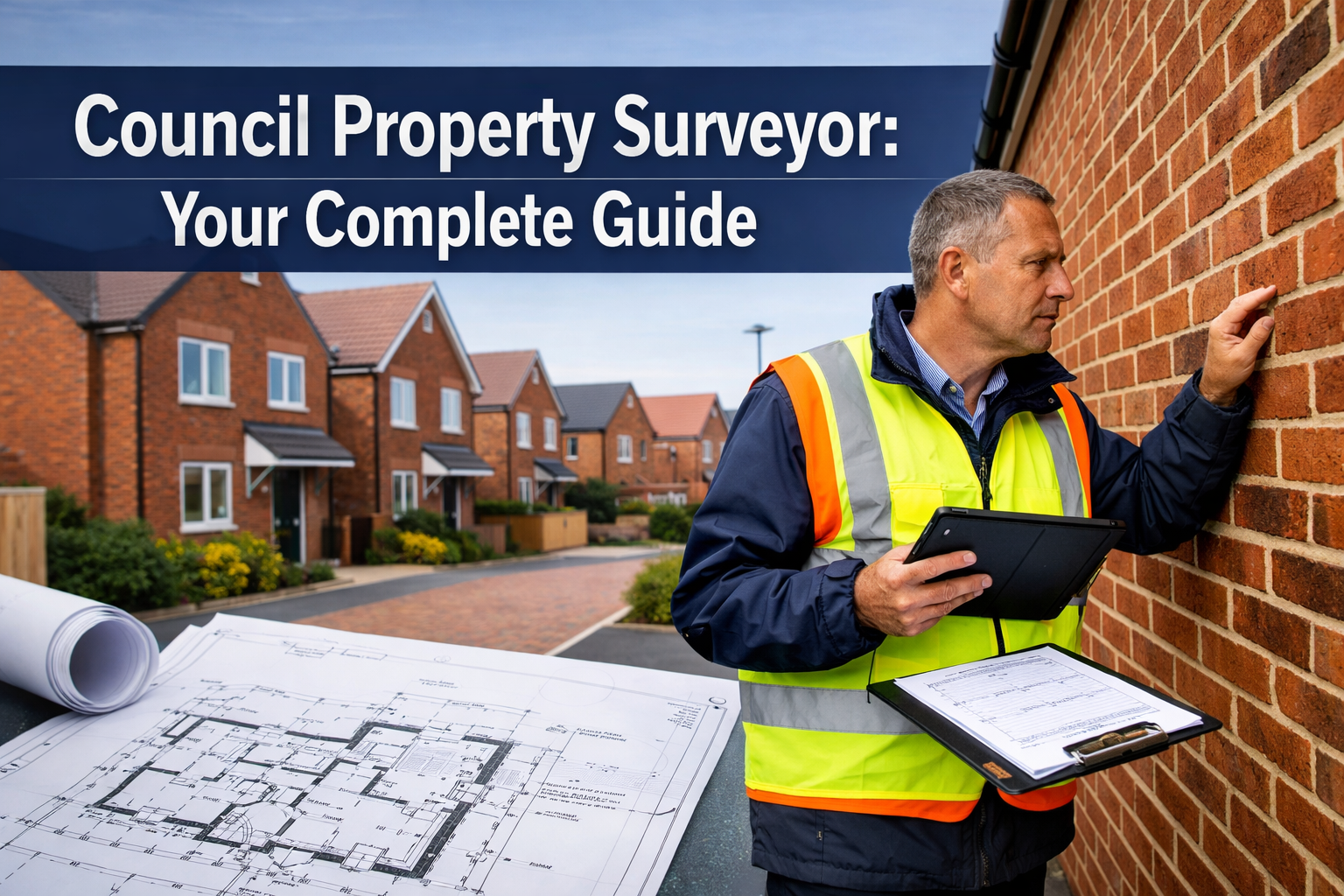
When a council tenant reports damp in their home or a local authority needs to assess thousands of properties for maintenance planning, who ensures these buildings remain safe, compliant, and fit for purpose? The answer lies with the council property surveyor—a specialized professional who plays a vital role in managing and maintaining public housing stock across the UK. These experts combine technical surveying skills with an understanding of public sector requirements, making them essential to local government operations and community wellbeing.
Key Takeaways
- Council property surveyors are chartered professionals who specialize in assessing, maintaining, and managing local authority housing and public buildings
- These surveyors require RICS accreditation, technical expertise in building pathology, and knowledge of housing legislation and compliance standards
- Career opportunities span from graduate trainee positions to senior management roles with competitive salaries ranging from £28,000 to £65,000+ annually
- The role encompasses diverse responsibilities including condition surveys, planned maintenance programs, disrepair claims, and capital works projects
- Council property surveyors work closely with tenants, contractors, and other council departments to ensure safe, decent housing standards across public sector properties
What Is a Council Property Surveyor?
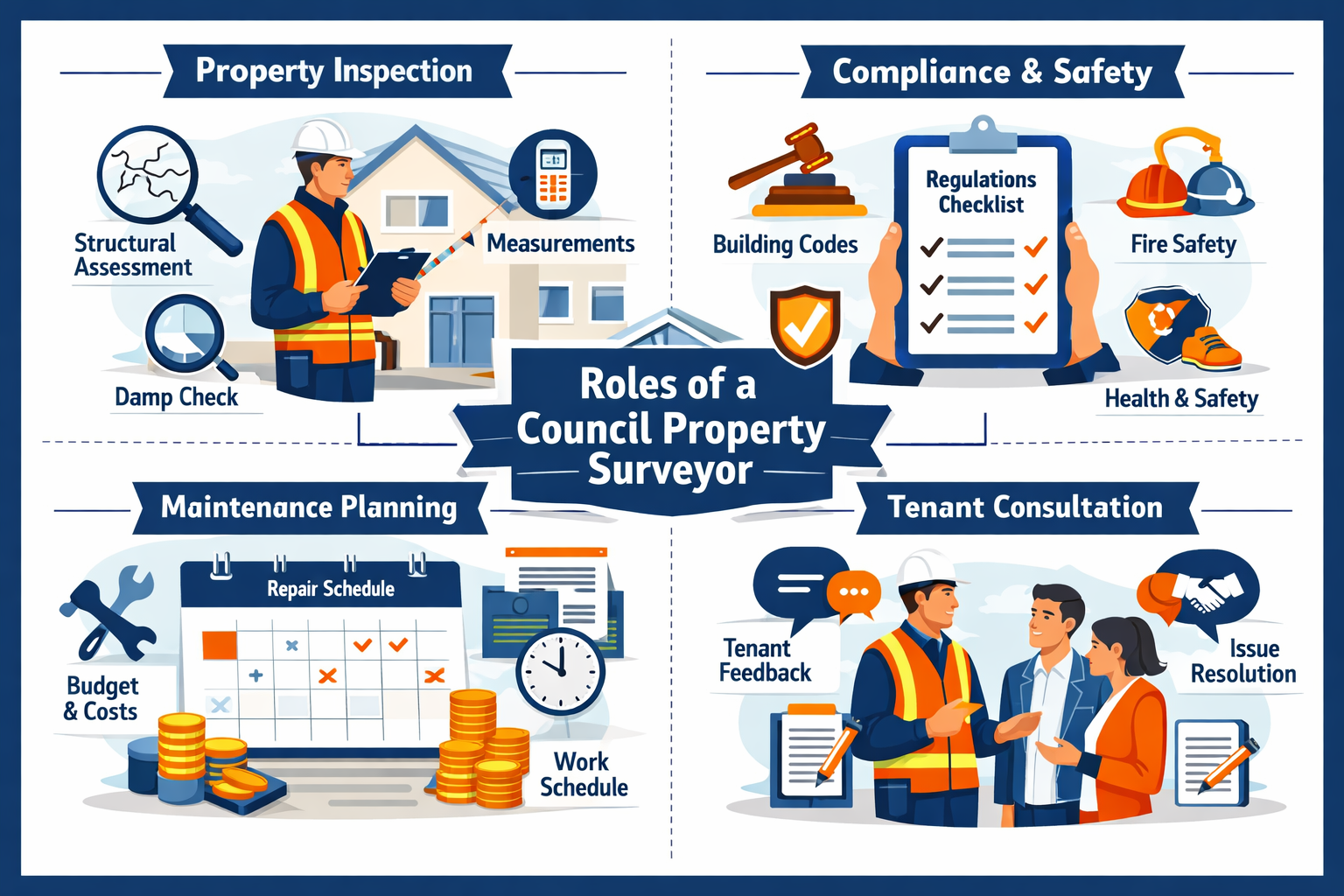
A council property surveyor is a qualified building professional employed by local authorities to manage and assess their property portfolio. Unlike private sector surveyors who primarily work with individual homeowners or commercial clients, council property surveyors focus exclusively on public sector assets—primarily social housing, but also schools, libraries, community centers, and other municipal buildings.
These professionals serve as the technical experts responsible for ensuring council-owned properties meet legal standards, remain structurally sound, and provide safe living conditions for tenants. Their work directly impacts thousands of residents who depend on social housing, making this role both technically demanding and socially significant.
Core Responsibilities
Council property surveyors handle a diverse range of tasks that require both technical expertise and practical problem-solving skills:
Property Inspections and Assessments 🏘️
- Conducting condition surveys on existing housing stock
- Identifying structural defects, damp issues, and maintenance requirements
- Assessing properties for compliance with Decent Homes Standards
- Evaluating buildings for health and safety risks
Maintenance Planning and Management
- Developing planned maintenance programs for large property portfolios
- Prioritizing repair works based on urgency and available budgets
- Preparing specifications for contractors and monitoring work quality
- Managing cyclical maintenance schedules (painting, roofing, heating systems)
Disrepair and Legal Matters
- Investigating tenant disrepair claims and complaints
- Preparing technical reports for legal proceedings
- Liaising with legal teams on housing condition cases
- Ensuring compliance with landlord repair obligations
Capital Projects and Regeneration
- Overseeing major refurbishment and modernization programs
- Managing new build social housing developments
- Coordinating energy efficiency improvement schemes
- Supporting estate regeneration initiatives
The role requires balancing technical competence with budget constraints, tenant needs, and regulatory requirements—a challenge unique to the public sector environment.
Qualifications and Skills Required for Council Property Surveyors
Becoming a council property surveyor requires a combination of formal education, professional accreditation, and practical experience. Local authorities typically seek candidates with robust technical credentials and a commitment to public service.
Educational Requirements
Undergraduate Degrees 📚
Most council property surveyors hold degrees in:
- Building Surveying
- Quantity Surveying
- Construction Management
- Civil Engineering
- Architecture or Architectural Technology
These programs must be accredited by the Royal Institution of Chartered Surveyors (RICS) to provide a pathway to chartered status. Alternatively, candidates with non-accredited degrees can pursue RICS-approved postgraduate qualifications or conversion courses.
Professional Accreditation
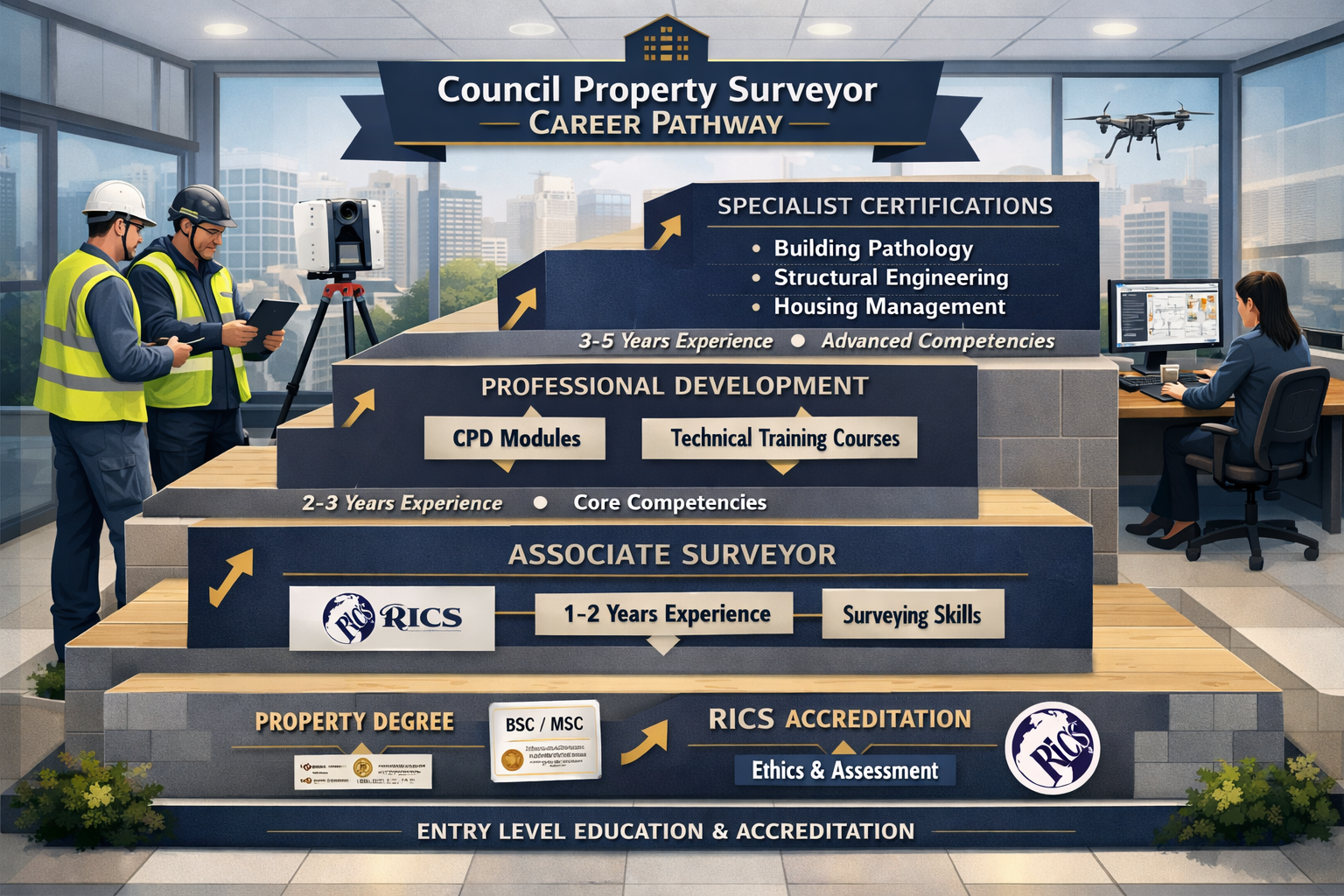
RICS chartered status represents the gold standard for council property surveyors. The pathway typically involves:
| Stage | Requirement | Duration |
|---|---|---|
| Academic Qualification | RICS-accredited degree or equivalent | 3-4 years |
| Assessment of Professional Competence (APC) | Structured training with employer | 24 months minimum |
| Final Assessment | Professional interview and case study | Single day |
Many councils also recognize alternative qualifications from:
- Chartered Institute of Building (CIOB)
- Royal Town Planning Institute (RTPI)
- Chartered Association of Building Engineers (CABE)
For those interested in understanding broader surveying roles and qualifications, our guide on building surveyors in London provides comprehensive insights into the profession.
Essential Technical Skills
Building Pathology and Diagnostics
Council property surveyors must expertly identify:
- Structural movement and subsidence
- Damp penetration and condensation issues
- Timber decay and insect infestation
- Defective building elements and materials
Regulatory Knowledge
Understanding legislation is crucial, including:
- Building Regulations and Approved Documents
- Housing Health and Safety Rating System (HHSRS)
- Decent Homes Standard requirements
- Party Wall Act 1996 (for adjoining properties)
- Fire Safety Regulations (particularly post-Grenfell)
Those working with party wall matters may benefit from understanding party wall surveyor responsibilities in greater detail.
Soft Skills and Personal Attributes
Beyond technical expertise, successful council property surveyors demonstrate:
✅ Strong communication skills for explaining technical issues to non-specialist audiences
✅ Empathy and patience when dealing with vulnerable tenants
✅ Budget management abilities to maximize value from limited resources
✅ Organizational skills for managing multiple properties and projects simultaneously
✅ Problem-solving mindset to find practical solutions within constraints
✅ Commitment to public service and improving community living standards
Career Pathways and Progression for Council Property Surveyors
The public sector offers structured career progression for council property surveyors, with clear advancement opportunities and competitive benefits packages.
Entry-Level Positions
Graduate Surveyor / Trainee Surveyor
- Salary range: £28,000 – £35,000
- Typically undertaking APC training toward chartered status
- Working under supervision on inspections and reports
- Building knowledge of council procedures and housing stock
Assistant Building Surveyor
- Salary range: £32,000 – £40,000
- Conducting routine inspections and condition surveys
- Managing smaller repair projects
- Responding to tenant disrepair complaints
Mid-Level Roles
Building Surveyor / Property Surveyor
- Salary range: £40,000 – £52,000
- Managing complex disrepair cases and legal claims
- Overseeing planned maintenance programs
- Supervising junior staff and contractors
- Leading capital improvement projects
Senior Building Surveyor
- Salary range: £48,000 – £60,000
- Strategic planning for property portfolios
- Managing high-value refurbishment schemes
- Providing expert witness testimony in legal proceedings
- Developing policies and procedures
Senior Management
Principal Surveyor / Lead Surveyor
- Salary range: £55,000 – £70,000
- Heading specialized teams (responsive repairs, planned maintenance, etc.)
- Budget responsibility for multi-million pound programs
- Liaison with senior council management and elected members
Head of Property Services / Asset Management
- Salary range: £65,000 – £85,000+
- Strategic oversight of entire property portfolio
- Policy development and implementation
- Cross-departmental leadership
- Performance management and service improvement
Alternative Career Paths
Council property surveyors can also transition into:
- Consultancy – advising multiple local authorities as external experts
- Housing Associations – similar work in the registered provider sector
- Private Practice – leveraging public sector experience in commercial building surveys
- Specialist Roles – focusing on areas like energy efficiency, fire safety, or historic buildings
The Day-to-Day Work of a Council Property Surveyor
Understanding what a typical day involves helps illustrate the varied and demanding nature of council property surveying work.
Morning: Office-Based Activities
8:30 AM – Email and Case Review 📧
The day often begins with reviewing overnight emails, including:
- Urgent disrepair reports from tenants
- Updates from contractors on ongoing works
- Legal team requests for technical information
- Queries from housing officers about property conditions
9:00 AM – Team Meeting
Weekly or daily briefings with colleagues to discuss:
- Priority cases requiring immediate attention
- Resource allocation across the team
- Progress updates on capital projects
- Policy changes or new legislative requirements
9:30 AM – Report Writing
Completing technical reports from previous inspections:
- Detailed condition survey reports
- Disrepair investigation findings
- Specifications for remedial works
- Budget estimates and cost projections
Midday: Site Inspections
11:00 AM – Property Inspections 🏠
The core of the role involves visiting properties:
- Meeting tenants to discuss reported issues
- Conducting thorough internal and external inspections
- Taking photographs and measurements
- Using moisture meters, thermal imaging, and other diagnostic tools
- Identifying immediate safety hazards
Example Inspection Scenario:
A tenant has reported persistent damp in a bedroom. The surveyor:
- Interviews the tenant about the problem history
- Inspects the affected room with moisture detection equipment
- Examines the external wall, roof, and guttering
- Checks ventilation and heating systems
- Determines the cause (e.g., penetrating damp from failed pointing)
- Recommends appropriate remedial action
- Arranges urgent temporary measures if needed
Afternoon: Project Management and Coordination
2:00 PM – Contractor Meetings
Liaising with building contractors about:
- Ongoing repair programs and quality standards
- Variations to specifications
- Site progress and completion timelines
- Health and safety compliance
3:30 PM – Budget Planning
Working with finance teams to:
- Review expenditure against allocated budgets
- Prioritize works based on available funding
- Prepare business cases for additional resources
- Forecast future maintenance costs
4:30 PM – Tenant Consultations
Engaging with residents about:
- Planned improvement works to their homes
- Temporary decanting arrangements during major works
- Resolving concerns about proposed changes
- Gathering feedback on completed projects
For those interested in the broader surveying process, our article on what surveyors look for in a house survey provides valuable insights.
Challenges Unique to Council Property Surveying
Working as a council property surveyor presents distinct challenges compared to private sector surveying roles.
Budget Constraints and Resource Limitations
Local authorities face persistent funding pressures that directly impact property maintenance:
Competing Priorities 💰
- Limited budgets must cover thousands of properties
- Emergency repairs take precedence over preventative maintenance
- Difficult decisions about which works to defer
- Balancing tenant expectations with financial realities
Aging Housing Stock
Many councils manage properties built in the 1950s-1980s with:
- Outdated construction methods and materials
- System-built homes requiring specialized knowledge
- Historic defects requiring expensive remediation
- Energy inefficiency demanding costly upgrades
Legal and Compliance Pressures
Council surveyors operate under intense scrutiny:
Regulatory Requirements
- Strict adherence to Decent Homes Standards
- Housing Health and Safety Rating System assessments
- Fire safety compliance (especially post-Grenfell Tower)
- Energy Performance Certificate requirements
- Asbestos management in older properties
For specialized compliance work, councils often commission asbestos surveys from accredited contractors.
Litigation Risk
- Increasing tenant disrepair claims
- Legal proceedings requiring expert witness testimony
- Potential personal liability for negligent advice
- Media and political scrutiny of failures
Social and Ethical Dimensions
Vulnerable Tenants 🤝
Council property surveyors frequently work with:
- Elderly residents with mobility or health issues
- Families living in poverty
- People with disabilities requiring adaptations
- Tenants experiencing mental health challenges
This requires exceptional interpersonal skills, empathy, and patience—qualities not always emphasized in technical training but essential for effective public service.
Political Environment
Unlike private sector roles, council surveyors navigate:
- Elected member involvement in decision-making
- Public accountability and transparency requirements
- Media interest in housing conditions
- Community activism and tenant associations
Technology and Innovation in Council Property Surveying
Modern council property surveyors increasingly leverage technology to improve efficiency and service delivery.
Digital Survey Tools
Mobile Technology 📱
- Tablet-based inspection apps for real-time data capture
- Cloud-based systems for instant report generation
- Digital photography and annotation tools
- GPS tagging for accurate property location
Diagnostic Equipment
- Thermal imaging cameras for heat loss and moisture detection
- Electronic moisture meters for damp diagnosis
- Laser distance measurers for accurate dimensions
- Borescopes for inspecting concealed spaces
Asset Management Systems
Integrated Databases
Modern councils use sophisticated software platforms that:
- Maintain comprehensive property records
- Track repair histories and expenditure
- Schedule planned maintenance programs
- Generate performance analytics and KPIs
- Integrate with finance and housing management systems
Predictive Maintenance
Advanced systems employ:
- Data analytics to predict component failures
- Stock condition modeling for long-term planning
- Risk-based prioritization of interventions
- Lifecycle costing for replacement decisions
Building Information Modeling (BIM)
Progressive councils are adopting BIM for:
- New build social housing projects
- Major refurbishment schemes
- Facilities management integration
- Digital twin creation for complex properties
How Council Property Surveyors Differ from Private Sector Surveyors
While sharing core technical competencies, council property surveyors operate in a fundamentally different context than their private sector counterparts.
Key Distinctions
| Aspect | Council Property Surveyor | Private Sector Surveyor |
|---|---|---|
| Client | Single employer (local authority) | Multiple private clients |
| Portfolio | Large volume of similar properties | Diverse individual properties |
| Focus | Long-term asset management | Transaction-based assessments |
| Budget | Public funds with accountability | Client’s private resources |
| Timescales | Ongoing relationship with properties | One-off inspections |
| Legal Context | Landlord repair obligations | Purchase advice and due diligence |
| Stakeholders | Tenants, councillors, public | Individual buyers/sellers |
Complementary Skills
Despite differences, council surveyors benefit from understanding private sector practices. For instance, knowledge of Level 2 and Level 3 surveys helps when commissioning external valuations or understanding market comparables.
Similarly, understanding party wall procedures proves valuable when council properties adjoin private dwellings.
Finding and Recruiting Council Property Surveyors
Local authorities face ongoing challenges in attracting and retaining qualified council property surveyors.
Recruitment Channels
Direct Council Recruitment
- Local authority websites and job portals
- Public sector recruitment agencies
- RICS careers platform
- Professional networking (LinkedIn, industry events)
Graduate Schemes
Many larger councils offer structured graduate programs:
- Rotations through different surveying teams
- Funded APC training and professional development
- Mentorship from experienced surveyors
- Clear progression pathways
Attraction and Retention Strategies
Benefits of Council Employment ✨
- Job Security: Permanent contracts with stable public sector employers
- Pension: Generous Local Government Pension Scheme (LGPS)
- Work-Life Balance: Standard hours with limited out-of-hours work
- Professional Development: Funded training and CPD opportunities
- Meaningful Work: Direct positive impact on community wellbeing
- Diversity: Varied work across different property types and projects
Challenges
- Salaries often lower than private sector equivalents
- Bureaucratic processes and slower decision-making
- Budget constraints limiting project scope
- Political pressures and public scrutiny
The Future of Council Property Surveying
The role of the council property surveyor continues to evolve in response to emerging challenges and opportunities.
Climate Change and Energy Efficiency
Net Zero Targets 🌱
Local authorities are committed to decarbonizing housing stock by 2050, requiring:
- Retrofit expertise in insulation and heating systems
- Understanding of renewable energy technologies
- Whole-house assessment approaches
- Grant funding navigation (e.g., Social Housing Decarbonisation Fund)
Fuel Poverty Reduction
Improving energy efficiency directly helps vulnerable tenants:
- Lower heating costs for low-income households
- Improved thermal comfort and health outcomes
- Reduced carbon emissions
- Enhanced property values
Building Safety and Regulation
Post-Grenfell reforms have intensified focus on:
- Fire safety in high-rise buildings
- External wall system assessments
- Regular building safety inspections
- Resident engagement on safety matters
New Legislation
The Building Safety Act 2022 introduces:
- Accountable Persons for residential buildings
- Safety Case Reports for higher-risk buildings
- Mandatory Occurrence Reporting systems
- Enhanced resident rights and protections
Digital Transformation
Smart Buildings
Council housing increasingly incorporates:
- IoT sensors for monitoring building performance
- Smart heating controls for efficiency
- Automated fault detection systems
- Real-time data for predictive maintenance
Virtual Inspections
Technology enables:
- Video call inspections for routine matters
- Tenant-submitted photographs and videos
- Drone surveys for roof and high-level inspections
- Reduced travel time and carbon emissions
Social Value and Community Engagement
Modern council property surveyors increasingly engage in:
- Co-design of improvement schemes with residents
- Community consultation on regeneration projects
- Supporting local employment through procurement
- Enhancing biodiversity and green spaces
- Creating inclusive, accessible housing
Working with Council Property Surveyors: A Tenant’s Perspective
For social housing tenants, understanding how to effectively engage with council property surveyors can improve outcomes.
When You’ll Encounter a Council Surveyor
Routine Inspections 🔍
- Periodic stock condition surveys
- Gas safety and electrical testing visits
- Pre-planned maintenance assessments
- Energy efficiency evaluations
Repair Requests
- Complex or disputed repair issues
- Structural concerns requiring expert assessment
- Damp and condensation investigations
- Major component failures (roof, heating, etc.)
Improvement Programs
- Kitchen and bathroom replacement schemes
- Window and door upgrades
- Heating system modernization
- External works (roofing, rendering, etc.)
How to Prepare for a Surveyor Visit
Before the Appointment
- Document the issue with photographs if possible
- Note when problems occur (e.g., damp after heavy rain)
- Gather any previous repair records
- List all concerns you want to raise
- Ensure access to all affected areas
During the Inspection
- Provide clear information about the problem history
- Point out all relevant issues, even if they seem minor
- Ask questions about findings and next steps
- Request estimated timescales for repairs
- Get contact details for follow-up
After the Visit
- Expect a written report or outcome letter
- Follow up if you don’t hear back within promised timeframes
- Keep records of all communications
- Escalate through formal complaints if necessary
For those purchasing properties, understanding survey processes is equally important—our guide on whether you need a survey when buying a house provides comprehensive advice.
Professional Development and Continuing Education
Council property surveyors must maintain and enhance their expertise throughout their careers.
Continuing Professional Development (CPD)
RICS Requirements 📖
Chartered surveyors must complete:
- Minimum 20 hours CPD annually
- Including at least 10 hours of formal learning
- Record keeping in RICS online system
- Compliance audits to verify standards
Relevant CPD Topics
- Building pathology and diagnostics
- Fire safety and building regulations
- Energy efficiency and retrofit
- Legal updates (housing law, health and safety)
- Project management and contract administration
- Equality, diversity, and inclusion
- Digital tools and technology
Specialist Qualifications
Additional Certifications
Council surveyors may pursue:
- Domestic Energy Assessor (DEA) qualification
- HHSRS assessment training
- Fire risk assessment competency
- Asbestos awareness or management
- CDM (Construction Design and Management) coordinator training
Academic Advancement
- Master’s degrees in Building Conservation, Project Management, or Housing
- Research degrees for those interested in policy development
- Teaching qualifications for training roles
Professional Networks
Industry Organizations
- RICS regional groups and special interest networks
- Chartered Institute of Housing (CIH)
- Association of Building Engineers (ABE)
- Local authority professional networks
Knowledge Sharing
- Regional benchmarking groups
- Best practice forums
- Conference attendance
- Academic and industry research collaboration
Conclusion: The Vital Role of Council Property Surveyors
The council property surveyor occupies a unique and essential position within local government, combining technical expertise with public service commitment to ensure safe, decent housing for thousands of residents. These professionals navigate complex challenges—from aging building stock and limited budgets to evolving regulations and climate change imperatives—while maintaining focus on improving lives and communities.
For those considering this career path, council property surveying offers meaningful work with genuine social impact, structured professional development, and diverse technical challenges. The role demands not only surveying competence but also empathy, resilience, and dedication to public service values.
Next Steps
For Aspiring Council Property Surveyors:
- Pursue RICS-accredited education in building surveying or related disciplines
- Seek graduate positions or trainee roles with local authorities
- Develop both technical skills and understanding of public sector context
- Build experience across different property types and surveying disciplines
- Engage with professional networks and continuing education opportunities
For Local Authorities:
- Invest in competitive recruitment and retention strategies
- Provide comprehensive training and professional development
- Embrace technology to enhance surveyor efficiency and effectiveness
- Foster collaborative, supportive team environments
- Recognize and value the critical contribution of property surveyors
For Tenants and Residents:
- Understand the role and constraints of council property surveyors
- Report issues promptly with clear, detailed information
- Engage constructively during inspections and consultations
- Utilize formal channels if concerns aren’t adequately addressed
- Participate in improvement schemes and community engagement
The future of council property surveying will be shaped by climate imperatives, technological innovation, and evolving resident expectations. Those entering or working in this field have the opportunity to drive positive change, improve housing quality, and contribute to sustainable, thriving communities across the UK.
Whether you’re a professional seeking to understand this specialization, a council looking to strengthen your surveying team, or a resident wanting to engage more effectively with property services, recognizing the complexity and importance of the council property surveyor role is the first step toward better outcomes for all.
For professional surveying services and expert guidance, Notting Hill Surveyors offers comprehensive support across residential and commercial property needs. Visit our About Us page to learn more about our expertise and commitment to excellence in property surveying.
