
Urban landscapes across the UK are transforming at an unprecedented pace. Empty office towers that once housed bustling corporate teams now stand silent, casualties of the remote work revolution. Yet these vacant structures represent more than abandoned real estate—they're opportunities waiting to be unlocked. Building Surveys for Office-to-Residential Conversions: Structural Viability and Value Assessment in 2026's Recovery has become the critical process that determines whether these commercial giants can be reborn as thriving residential communities. 🏢➡️🏠
As 2026 unfolds, property developers, investors, and local authorities are racing to capitalize on relaxed planning regulations and growing housing demand. However, the path from corporate workspace to comfortable home is fraught with structural challenges, regulatory hurdles, and financial uncertainties. Professional building surveys have emerged as the essential first step in this transformation journey, providing the detailed technical intelligence needed to make informed conversion decisions.
Key Takeaways
- Regulatory changes in 2024 removed floor space caps and shortened vacancy requirements, making office-to-residential conversions more accessible and commercially viable across the UK
- Comprehensive structural assessments are essential to identify load-bearing capacity, fire safety requirements, and hidden defects that could derail conversion projects or inflate costs
- Value assessment protocols must account for conversion costs, post-completion residential values, and market demand factors specific to 2026's recovery environment
- Specialized survey methodologies differ significantly from standard residential or commercial building surveys, requiring expertise in both commercial structures and residential building standards
- Prior approval considerations remain critical despite relaxed planning rules, with local authorities assessing transport, contamination, noise, and natural light factors
Understanding the 2026 Conversion Landscape
The office-to-residential conversion market has experienced dramatic shifts following legislative changes introduced in March 2024. The UK government removed the 1,500 square metre floor space cap and three-month vacancy requirement for Class MA conversions, allowing commercial buildings of any size to be converted without full planning permission.[4][5] This regulatory transformation has opened the floodgates for conversion projects previously deemed unviable.
Market Drivers Fueling Conversion Demand
Several converging factors have created the perfect storm for office-to-residential conversions in 2026:
Remote Work Legacy 💼
The permanent shift toward hybrid and remote working arrangements has left substantial commercial office space vacant. Buildings that once commanded premium rents now struggle to attract tenants, making conversion to residential use an economically attractive alternative.[1]
Housing Shortage Pressures 🏘️
The UK continues to face acute housing shortages, particularly in urban centers. Converting existing commercial structures offers a faster route to increasing housing supply compared to traditional new-build developments.
Economic Viability Improvements
The removal of vacancy and floor space restrictions has facilitated faster decision-making and reduced holding costs, significantly improving the commercial viability of conversion projects.[5] Developers can now move forward with larger-scale conversions without waiting for extended vacancy periods.
Government Support
Simplified planning rules demonstrate clear governmental commitment to encouraging commercial-to-residential transitions, reducing bureaucratic obstacles that previously deterred developers.[1]
Ongoing Regulatory Requirements
Despite the relaxed regulations, important requirements remain. Buildings must still have been used for a relevant commercial purpose for a continuous two-year period before conversion.[4] This prevents developers from gaming the system through short-term commercial use arrangements designed solely to qualify for permitted development rights.
Local planning authorities retain assessment powers over several critical factors including:
- Transport and highways impacts
- Contamination and flooding risks
- Noise impacts on future residents
- Adequate natural light provision
- Effects on conservation areas[4]
Building Surveys for Office-to-Residential Conversions: Essential Assessment Components
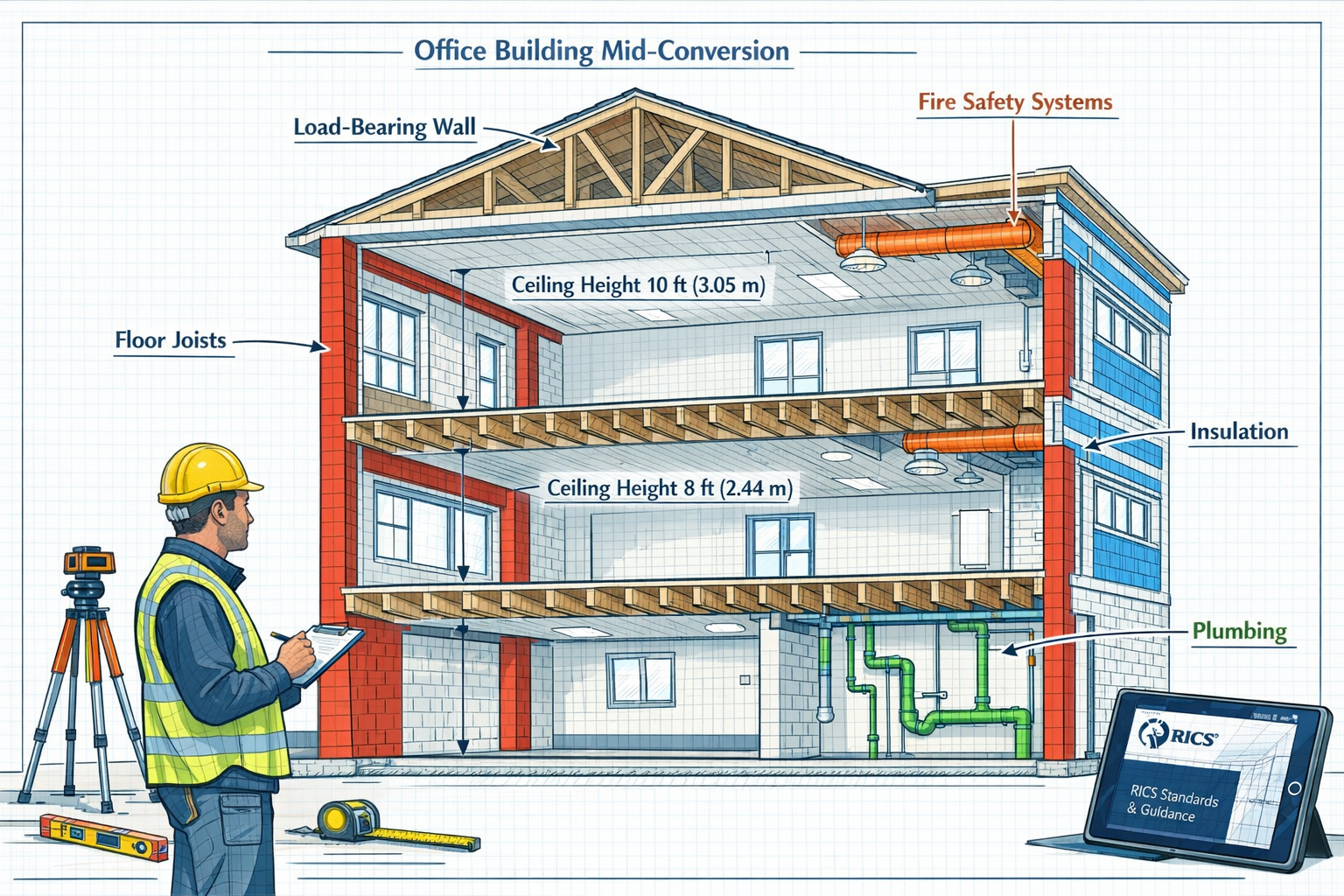
Conducting thorough building surveys for office-to-residential conversions requires a fundamentally different approach than standard property surveys. These specialized assessments must evaluate both the existing commercial structure's condition and its suitability for residential adaptation. Similar to comprehensive Level 3 building surveys, conversion surveys demand meticulous attention to detail, but with additional layers of complexity.
Structural Viability Assessment
The structural evaluation forms the foundation of any conversion feasibility study. Surveyors must determine whether the existing building can safely accommodate residential use without prohibitively expensive structural modifications.
Load-Bearing Capacity Analysis 🏗️
Commercial buildings typically feature different load distributions than residential structures. Office floors designed for uniformly distributed loads may require reinforcement to support residential layouts with concentrated loads from partition walls, kitchens, and bathrooms. Surveyors must assess:
- Floor slab thickness and reinforcement adequacy
- Column spacing and beam spans
- Foundation capacity for potential additional floors
- Structural frame integrity and material condition
Floor-to-Ceiling Heights
Adequate ceiling heights are essential for residential comfort and compliance with building regulations. Many older commercial buildings feature generous floor-to-ceiling dimensions (often 2.7-3.0 meters), which can accommodate services installation while maintaining acceptable residential ceiling heights. However, suspended ceiling voids may conceal structural issues requiring investigation.
Natural Light and Ventilation
Office buildings designed for artificial lighting and mechanical ventilation must be evaluated for residential natural light requirements. Deep floor plates common in commercial buildings can create "dark core" areas unsuitable for habitable rooms. Surveyors assess:
- Window-to-floor area ratios
- Depth of floor plates from external walls
- Potential for light wells or atria
- Orientation and solar access
Critical Systems and Services Evaluation
Transforming commercial building services to meet residential requirements represents one of the most significant conversion challenges and cost drivers.
Plumbing and Drainage Infrastructure 🚰
Commercial buildings typically feature minimal plumbing compared to residential needs. Each converted apartment requires:
- Hot and cold water supply to multiple outlets
- Waste water drainage for kitchens and bathrooms
- Adequate water pressure across multiple floors
- Individual metering capability
Surveyors must evaluate existing risers, drainage stacks, and water supply capacity. Retrofitting extensive plumbing infrastructure through existing structures can prove technically challenging and expensive.
Electrical Systems Upgrade Requirements ⚡
Residential electrical demands differ significantly from commercial specifications:
- Individual apartment metering and distribution boards
- Higher density of power outlets
- Dedicated circuits for kitchens and bathrooms
- Modern safety standards including RCD protection
- Telecommunications and data infrastructure
Heating, Ventilation, and Air Conditioning (HVAC)
Commercial HVAC systems designed for open-plan spaces rarely suit individual residential units. Conversion surveys must assess:
- Potential for individual apartment heating systems
- Ventilation requirements for kitchens and bathrooms
- Noise transmission from mechanical services
- Energy efficiency standards compliance
Fire Safety and Building Regulations Compliance
Fire safety represents perhaps the most critical and complex aspect of office-to-residential conversions. Residential buildings face stricter fire safety requirements than commercial offices, particularly following recent regulatory changes.[2]
Compartmentation and Fire Separation 🔥
Surveyors must evaluate:
- Existing fire compartmentation adequacy
- Fire resistance ratings of floors and walls
- Fire stopping around service penetrations
- Protected escape routes and stairwell provision
- Requirement for additional fire-rated construction
Means of Escape Analysis
Residential buildings require clearly defined escape routes meeting specific travel distances and width requirements. Commercial buildings with large open floors may need substantial reconfiguration to create compliant residential escape routes.
Fire Detection and Alarm Systems
Modern residential buildings require sophisticated fire detection systems with interconnected alarms in individual apartments and common areas. Conversion surveys assess the feasibility of installing these systems within existing structures.
Structural Defects and Latent Issues
Former commercial buildings may harbor hidden defects that only become apparent during detailed survey work. These latent issues can significantly impact conversion viability and costs.
Common Defects in Commercial Stock ⚠️
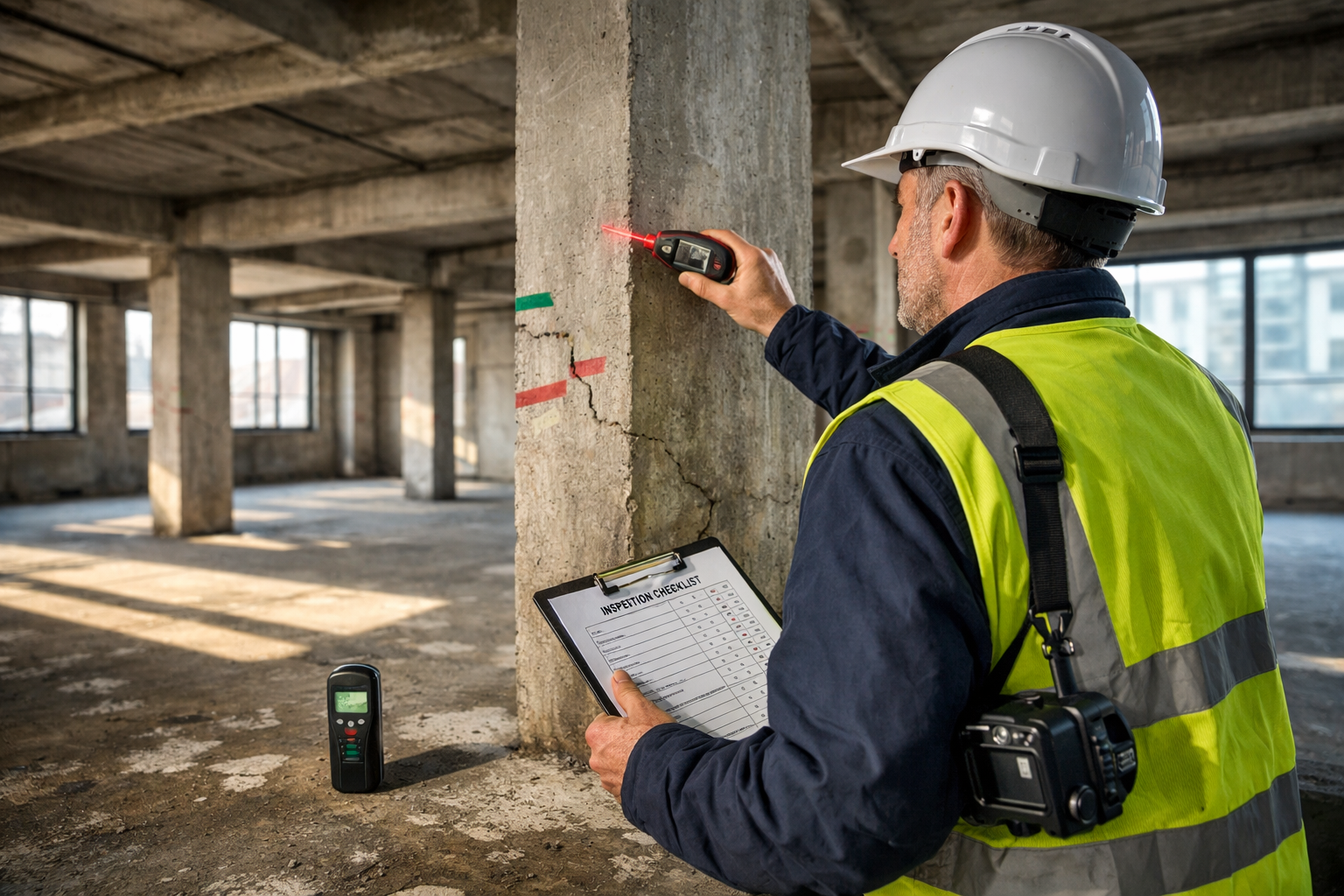
- Concrete carbonation and reinforcement corrosion in older concrete frame buildings
- Structural movement and settlement particularly in buildings constructed on made ground
- Water ingress and dampness from failed flat roofs or deteriorated cladding systems
- Asbestos-containing materials common in buildings constructed before 2000
- Structural alterations made during commercial occupation without proper approval
Professional subsidence surveys may be necessary where structural movement is suspected, particularly for buildings in areas with known ground stability issues.
Building Envelope Assessment
The external envelope requires thorough evaluation:
- Cladding system condition and safety (particularly relevant post-Grenfell)
- Window and door condition and thermal performance
- Roof waterproofing and insulation adequacy
- Thermal bridging and condensation risk areas
Insulation and Energy Performance
Converting commercial buildings to meet residential energy efficiency standards presents significant challenges. Surveyors must assess:
- Existing insulation levels in walls, roofs, and floors
- Thermal bridging through structural elements
- Window thermal performance and replacement requirements
- Feasibility of achieving required Energy Performance Certificate (EPC) ratings
- Cost implications of thermal upgrade works[1]
Many commercial buildings feature single-glazed curtain walling systems requiring complete replacement to meet residential thermal standards. This represents a major cost item that must be identified during survey work.
Value Assessment in 2026's Recovery: Financial Viability Analysis
Determining the financial viability of office-to-residential conversions requires sophisticated value assessment methodologies that account for both current commercial values and projected residential values post-conversion. This analysis forms the critical business case that determines whether conversion projects proceed.
Pre-Conversion Commercial Value Assessment
Understanding the existing commercial property value establishes the baseline investment. In 2026's market, many commercial properties trade at significant discounts due to:
- Reduced demand for traditional office space
- Obsolescence of older building specifications
- Location factors with some areas experiencing greater commercial decline
- Lease status including vacant possession or tenanted situations
RICS registered valuers employ comparative and income-based approaches to establish current commercial values, considering both existing use value and alternative use potential.
Conversion Cost Estimation
Accurate conversion cost estimation requires detailed quantity surveying based on comprehensive building survey findings. Major cost categories include:
| Cost Category | Typical Range (per m²) | Key Variables |
|---|---|---|
| Structural works | £150-£400 | Extent of modifications required |
| Building services | £200-£350 | Plumbing, electrical, HVAC complexity |
| Fire safety upgrades | £100-£250 | Compartmentation, detection systems |
| Thermal improvements | £150-£300 | Insulation, window replacement |
| Internal fit-out | £300-£600 | Specification level, unit sizes |
| External works | £50-£150 | Cladding, roof, accessibility |
| Professional fees | 10-15% of construction | Design, survey, project management |
| Contingency | 10-20% of construction | Risk profile dependent |
These figures vary significantly based on building condition, specification requirements, and regional cost variations. Detailed survey work reduces uncertainty and enables more accurate cost forecasting.
Post-Conversion Residential Value Projection
Estimating the completed residential value requires analysis of comparable residential properties in the same location. Key considerations include:
Unit Mix Optimization 🏘️
The building's structural grid, floor plate depth, and natural light characteristics determine optimal unit configurations. Surveyors work with architects to identify layouts that maximize both unit numbers and individual unit values.
Market Demand Analysis
Understanding local housing market dynamics is essential:
- Demand for different unit types (studios, 1-bed, 2-bed, etc.)
- Price points for comparable new and converted residential stock
- Rental yields for investment-oriented developments
- Buyer preferences regarding building character and amenities
Location Premium Factors
Residential values depend heavily on location attributes:
- Proximity to transport links
- Local amenities and services
- School catchment areas
- Neighborhood character and safety
- Future development plans
Development Appraisal and Viability Modeling
Professional development appraisals combine all value and cost inputs to determine project viability. The basic residual valuation formula is:
Gross Development Value (GDV) – Total Development Costs – Developer's Profit = Residual Land Value
For conversion projects, the residual value must exceed the existing commercial property value plus acquisition costs to justify proceeding. Sensitivity analysis tests viability under different scenarios:
- Construction cost variations (±10-20%)
- Sales value changes reflecting market uncertainty
- Program delays and extended holding costs
- Interest rate fluctuations affecting finance costs
Funding and Investment Considerations
Securing development finance for conversion projects requires robust value assessments demonstrating viability. Lenders typically require:
- Independent valuation reports from RICS-qualified valuers
- Detailed building survey reports identifying risks
- Planning status confirmation including prior approval
- Development appraisals with conservative assumptions
- Exit strategy clarity (sale or hold for rental income)
The improved economics resulting from relaxed planning regulations have made conversion projects more attractive to funders in 2026, improving access to development finance.[5]
Risk Assessment and Mitigation
Value assessments must identify and quantify key risks:
Technical Risks ⚠️
- Unforeseen structural issues discovered during works
- Asbestos or contamination requiring remediation
- Planning or building control complications
- Service infrastructure inadequacy
Market Risks 📊
- Residential value decline during development period
- Extended sales periods affecting cash flow
- Competition from other conversion projects
- Economic downturn impacting demand
Regulatory Risks
- Building regulation changes during development
- Fire safety requirement evolution
- Energy performance standard increases
- Cladding safety requirements
Comprehensive building surveys minimize technical risks by identifying issues before financial commitments are made. This front-loaded due diligence proves far more cost-effective than discovering problems mid-project.
Specialized Survey Methodologies for Conversion Projects
Conducting building surveys for office-to-residential conversions requires specialized methodologies that differ from standard RICS commercial building surveys or residential property surveys. Surveyors must employ a hybrid approach combining commercial building expertise with residential standards knowledge.
Multi-Disciplinary Survey Teams
Complex conversion projects benefit from multi-disciplinary survey teams including:
- Chartered building surveyors for overall condition assessment
- Structural engineers for load-bearing capacity analysis
- Building services engineers for MEP (mechanical, electrical, plumbing) evaluation
- Fire safety consultants for compliance pathway identification
- Quantity surveyors for cost estimation
- Planning consultants for regulatory navigation
This collaborative approach ensures all technical aspects receive appropriate expert attention, similar to comprehensive structural engineer reports that complement building surveys.
Phased Survey Approach
Large or complex conversion projects often employ phased survey methodologies:
Phase 1: Desktop Review and Initial Inspection
- Review existing building documentation
- Conduct preliminary site inspection
- Identify obvious constraints and opportunities
- Determine detailed survey scope requirements
Phase 2: Detailed Building Survey
- Comprehensive condition assessment
- Intrusive investigations where necessary
- Services infrastructure evaluation
- Defects identification and recording
Phase 3: Specialist Investigations
- Structural opening-up works
- Asbestos surveys
- Ground investigation (if required)
- Environmental assessments
- Acoustic testing
Phase 4: Reporting and Recommendations
- Consolidated findings presentation
- Conversion feasibility conclusions
- Cost implications quantification
- Risk identification and mitigation strategies
Technology-Enhanced Survey Techniques
Modern survey methodologies incorporate advanced technologies improving accuracy and efficiency:
3D Laser Scanning 📐
Point cloud technology creates precise digital models of existing buildings, enabling:
- Accurate dimensional surveys
- Clash detection for proposed services
- Virtual design validation
- As-built record creation
Thermal Imaging
Infrared thermography identifies:
- Heat loss and thermal bridging
- Hidden moisture and water ingress
- Insulation deficiencies
- Air leakage paths
Drone Surveys
Unmanned aerial vehicles enable safe, cost-effective inspection of:
- Roof conditions
- High-level facades
- Inaccessible elevations
- Site context documentation
Building Information Modeling (BIM)
Survey data integrated into BIM platforms facilitates collaborative design development and clash detection before construction begins.
Regulatory Compliance Verification
Survey work must verify compliance pathways for multiple regulatory frameworks:
- Building Regulations Approved Documents (particularly Part B – Fire Safety, Part L – Conservation of Fuel and Power)
- Planning policies including local authority design guides
- Housing standards including nationally described space standards
- Accessibility requirements under Building Regulations Part M
- Environmental performance standards
Understanding these requirements enables surveyors to identify compliance gaps requiring remedial work, directly impacting conversion cost estimates.
Best Practices for Commissioning Conversion Surveys
Property developers and investors commissioning building surveys for office-to-residential conversions should follow established best practices to maximize value from survey work.
Selecting Qualified Survey Professionals
Choose surveyors with demonstrated experience in conversion projects, not just standard residential or commercial work. Look for:
- RICS membership with relevant specialisms
- Conversion project portfolio demonstrating relevant experience
- Multi-disciplinary capabilities or established consultant networks
- Professional indemnity insurance appropriate to project value
- Local market knowledge understanding regional building characteristics
The types of surveyors vary significantly in their specializations, making it essential to engage professionals with specific conversion expertise.
Defining Clear Survey Scope and Objectives
Provide surveyors with comprehensive project information including:
- Intended conversion scheme (unit numbers, types, specification)
- Budget parameters and viability constraints
- Timeline expectations for survey completion
- Known issues or concerns requiring investigation
- Funding requirements if survey supports finance applications
Clear scope definition prevents misunderstandings and ensures survey outputs meet decision-making needs.
Providing Building Documentation
Supply all available building information to surveyors:
- Original construction drawings and specifications
- Previous survey or inspection reports
- Building control and planning records
- Maintenance records and repair history
- Asbestos registers and environmental reports
- Lease documents and tenant records
This documentation provides valuable context and may identify issues requiring focused investigation.
Facilitating Comprehensive Access
Ensure surveyors can access all building areas including:
- Roof spaces and plant rooms
- Basements and sub-floor voids
- Service risers and distribution areas
- External elevations (arrange scaffold or access equipment if needed)
- Adjacent buildings if party wall issues exist
Restricted access limits survey effectiveness and may necessitate costly assumptions or contingencies.
Planning for Intrusive Investigations
Budget and program for intrusive investigations where necessary:
- Opening up floor and wall constructions
- Concrete testing (cores, carbonation testing)
- Structural load testing
- Service condition verification
- Contamination sampling
While intrusive works add cost and time, they significantly reduce uncertainty and enable accurate cost forecasting.
Acting on Survey Findings
Survey reports provide actionable intelligence for decision-making:
Go/No-Go Decisions ✅❌
Use survey findings to make informed decisions about proceeding with acquisitions or conversions. Identified deal-breaker issues may justify walking away before significant capital commitment.
Negotiation Leverage
Survey-identified defects and cost implications provide evidence for purchase price negotiations, potentially improving project economics.
Design Development
Share survey findings with design teams early, enabling schemes that work with building constraints rather than against them.
Cost Planning
Use survey-based cost estimates for accurate development appraisals and funding applications.
Risk Management
Implement mitigation strategies for identified risks before they become expensive problems during construction.
Conclusion
Building Surveys for Office-to-Residential Conversions: Structural Viability and Value Assessment in 2026's Recovery represents a critical discipline at the intersection of urban renewal, housing provision, and sustainable development. As the UK continues adapting to post-pandemic work patterns and addressing acute housing shortages, the transformation of redundant commercial buildings into residential communities offers a pragmatic solution with significant benefits.
The regulatory landscape has evolved to support these conversions, with the removal of floor space caps and shortened vacancy requirements opening new possibilities for projects previously deemed unviable. However, regulatory simplification does not diminish the technical complexity of conversion projects or the critical importance of thorough building surveys.
Key Success Factors for 2026 and Beyond
Comprehensive Due Diligence 🔍
Successful conversion projects begin with thorough building surveys that identify structural constraints, service infrastructure limitations, and hidden defects before financial commitments are made. The cost of comprehensive survey work represents a small fraction of total development costs but provides disproportionate value through risk reduction and accurate cost forecasting.
Multi-Disciplinary Expertise
The complexity of conversion projects demands collaborative approaches bringing together building surveyors, structural engineers, services engineers, and fire safety specialists. No single professional possesses all the expertise required to fully evaluate conversion feasibility.
Realistic Value Assessments
Financial viability depends on accurate assessment of both conversion costs and post-completion residential values. Optimistic assumptions about either can transform apparently viable projects into financial disasters. Conservative, evidence-based valuations provide the foundation for sound investment decisions.
Early Stakeholder Engagement
Engaging with local planning authorities, building control, and fire safety officers early in the process helps identify potential obstacles and compliance pathways before detailed design work begins. Despite relaxed planning rules, prior approval requirements remain, and early dialogue smooths the approval process.
Actionable Next Steps
For property developers and investors considering office-to-residential conversions:
-
Commission preliminary feasibility surveys before making acquisition commitments, ensuring survey scope includes structural viability, services capacity, and fire safety compliance pathways
-
Engage multi-disciplinary teams with demonstrated conversion project experience, not just standard residential or commercial survey expertise
-
Develop realistic financial models incorporating survey-based cost estimates with appropriate contingencies for uncertainty
-
Maintain flexibility in design approaches, working with building constraints rather than fighting against them to minimize structural modification costs
-
Stay informed about regulatory evolution, particularly regarding fire safety and energy performance standards that continue developing
-
Consider phased approaches for larger buildings, enabling learning from initial phases to inform later development
The office-to-residential conversion opportunity will continue evolving throughout 2026 and beyond. Buildings that successfully navigate the transformation from commercial to residential use will contribute meaningfully to urban housing supply while breathing new life into aging commercial stock. However, this transformation depends fundamentally on the thorough, expert building survey work that separates viable opportunities from expensive mistakes.
For professional guidance on conversion project surveys, contact experienced chartered surveyors with specific expertise in commercial-to-residential transformations. The investment in expert survey work at the project's outset provides returns throughout the development process and beyond.
References
[1] The Future Of Commercial To Residential Conversions In Greater London – https://craftex.co.uk/blog/the-future-of-commercial-to-residential-conversions-in-greater-london
[2] Legal Requirements That Will Shape Residential Development In 2026 – https://lcf.co.uk/media-centre/blogs/legal-requirements-that-will-shape-residential-development-in-2026/
[3] Convert Commercial Property To Residential – https://realestateagentslondon.co.uk/convert-commercial-property-to-residential/
[4] Converting Commercial Spaces Legislative Changes Aiming To Fast Track Housing Provision – https://www.kennedyslaw.com/en/thought-leadership/article/2024/converting-commercial-spaces-legislative-changes-aiming-to-fast-track-housing-provision/
[5] Unlocking New Opportunities – https://www.cushmanwakefield.com/en/united-kingdom/insights/unlocking-new-opportunities
